
A budget e-bike that offers more than you might expect.
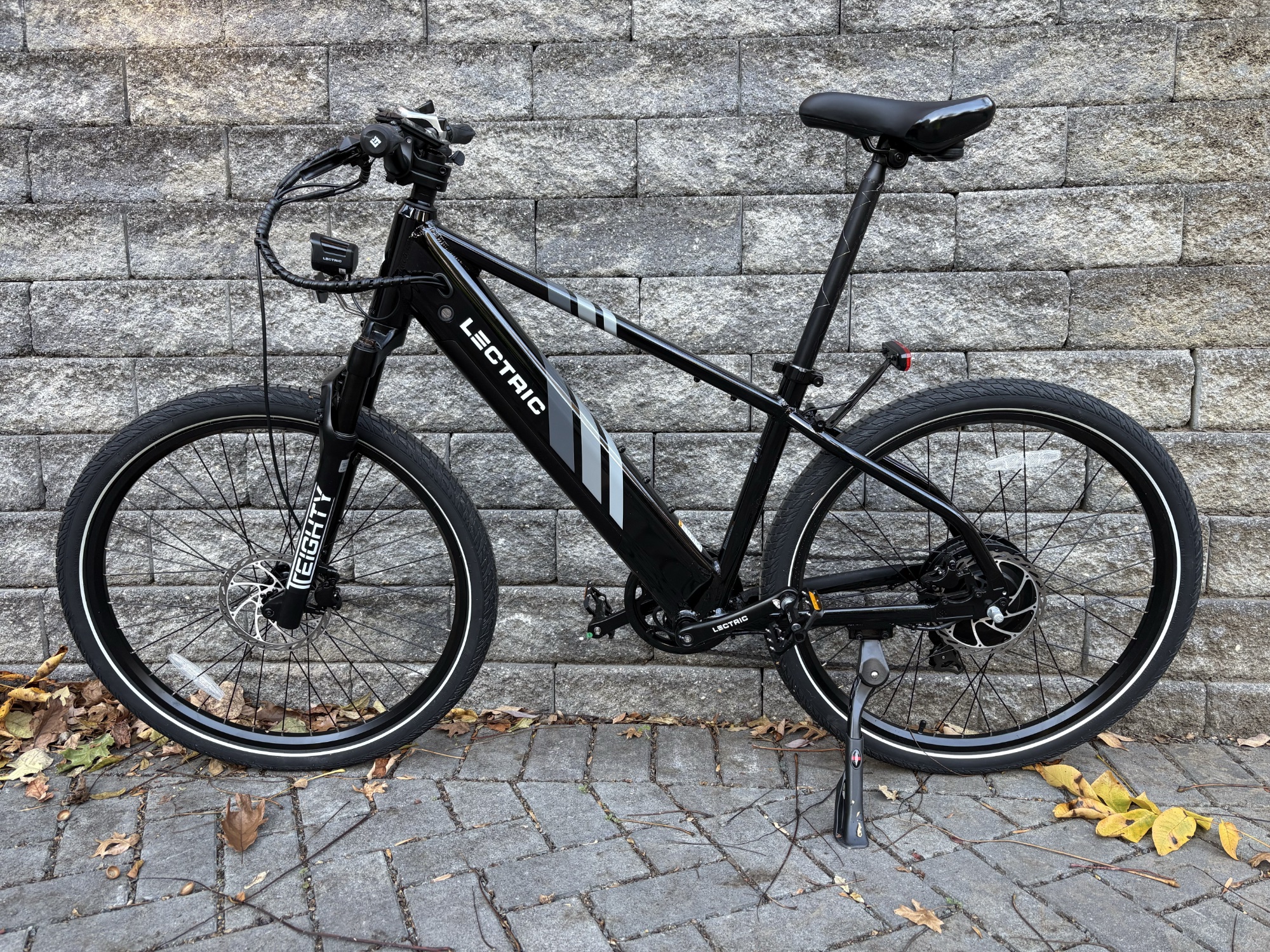
Almost every bit of bike testing I’ve done starts out the same way. After assembling the bike, I set the seatpost to its maximum recommended height, take it on a short test ride, and try to figure out new and creative phrasing to describe the same old problem: The frame isn’t quite big enough to accommodate my legs. While I’m on the tall side at a bit over 6 feet (~190 cm), I’m definitely not abnormally large. Yet very few e-bike manufacturers seem to be interested in giving people my height a comfortable ride.
So imagine my surprise when, within two blocks of my first ride on the XPress 750, I had to pull off to the side of the street and lower the seat. This was especially notable given that the XPress is a budget bike (currently on sale for just under $1,000.00) that is only offered in a single frame size. So kudos to Lectric for giving me a comfortable and enjoyable ride, and doing so with a lot of features I wouldn’t expect at this price point.
That said, hitting that price necessitated some significant compromises. We’ll discuss those in detail so you can get a sense of whether any of them will get in the way of your riding enjoyment.
A bit more than you paid for
Lectric is not a household name, but the company says its XPress foldable bike is the bestselling model in the US, making it a major vendor in that market. It’s gotten there largely through affordability, with none of its models costing over $2,000.00. Within that limit, however, the company tries to remain responsive to its users’ needs, as its intro video for the latest version of the XPress makes clear.
The XPress model isn’t foldable, and it comes in both step-through and step-over frames; we tested the latter. It’s a pretty standard hybrid-style bike, not quite built for everything you’d use a hard-tail mountain bike for but more than robust enough for commuting or errand-running and a bit sportier than a dedicated commuter bike. It comes with a suspension fork for cushioning the ride a bit; this also includes a setting that locks it in place, which is nice for riders who spend their time on smooth pavement and find that the fork sags when they stand up on the pedals.
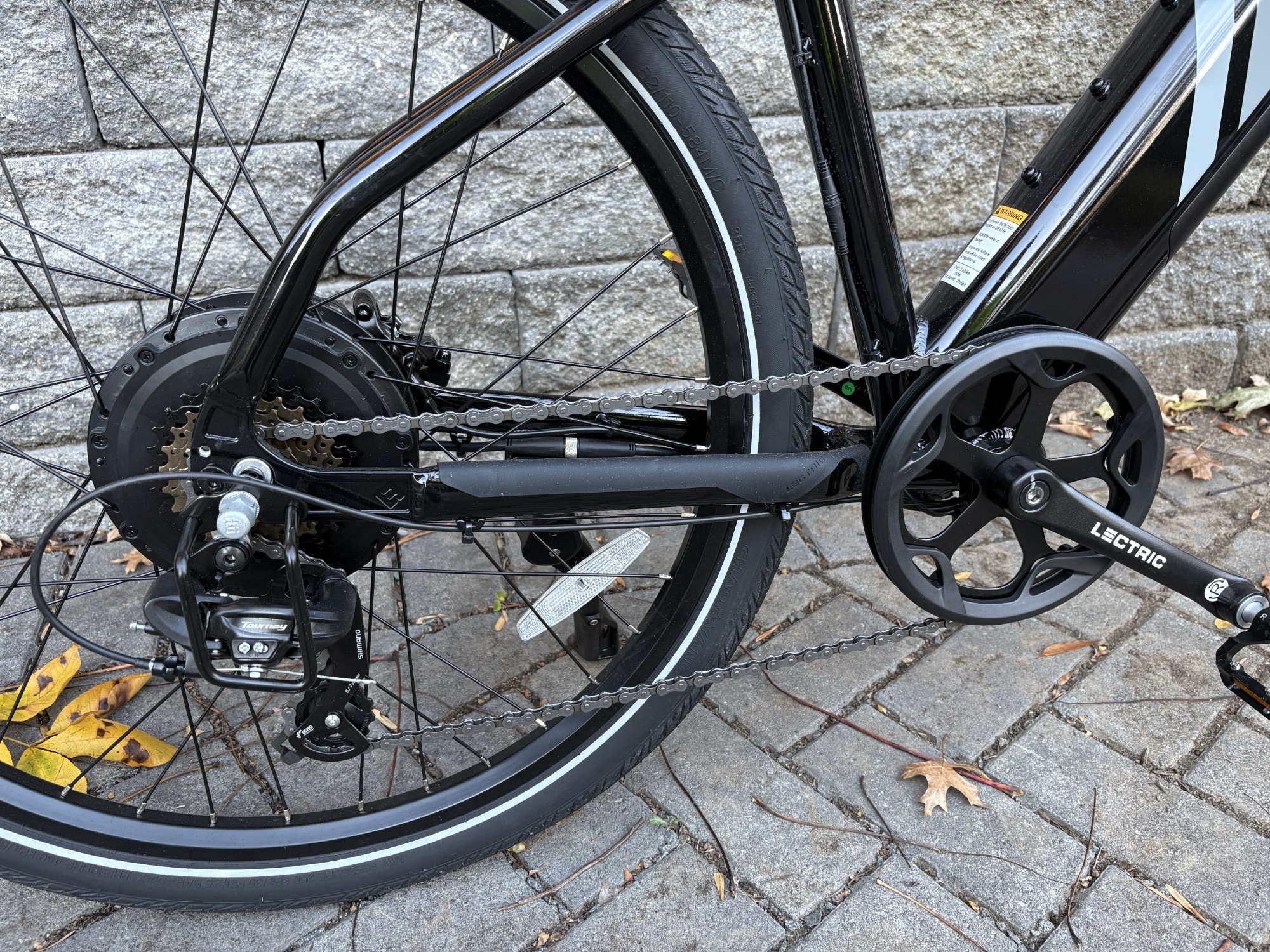
The gearing on the XPress wasn’t a great match for its motor. Credit: John TImmer
The pedals are actually one of the bike’s most unusual features. Rather than screwing into the cranks, the pedals click into an insert when a sleeve is pulled out. The result is indistinguishable when you’re turning the cranks, but it avoids the complexity of remembering that the left and right pedals thread into the cranks in opposite directions. That makes a lot of sense for a company that ships at volume to people who may have limited experience in assembling or maintaining bikes. The pedals themselves are covered in metal pins that suggest they’re meant to be used for mountain biking, which is somewhat odd, given that the rest of the bike really isn’t.
The electric portion of the bike is fairly standard, with a battery in the downtube and a rear hub motor. It’s driven by a torque sensor, which registers the force you’re applying to the cranks and is relatively rare on cheaper bikes. A simple three-button controller (power and up/down) handles navigation, and the stat-tracking screen is bright and colorful and lays out all the information you’re likely to want. There’s also a very bright front light and rear brake/tail light linked into the electrical system. The controller lets you choose between five levels of assist, and there’s a throttle that can get the bike moving even without any pedaling.
Despite the simplicity of the three-button control system, Lectric lets you use it to exercise pretty fine-grained control over the behavior of its assist. By tweaking three different control settings, it’s possible to switch the bike between Class 1 (20 mph/32 kmph) and Class 3 (28 mph/45 kmph) modes or even set the assist to cut out at lower speeds (nine and 15 mph/15 and 24 kmph). You can also fine-tune the amount of assist each of the five settings provides.
Compromises
At the moment, Lectric is offering a lower-end version of the XPress for just under $1,000. It’s informative to compare it to a $1,000 e-bike from just four years ago, the SWFT. Just about every aspect of the XPress is better. It has multiple gears, a suspension fork, much better control over the electronics, a bigger, removable battery, a better screen, disc brakes, the tail light, and probably more that I’m not noticing. The value proposition of low-priced e-bikes has changed dramatically for the better over just a few years.
That said, it’s impossible to hit this price range without making some compromises. If this is the price you’re targeting, you’ll want to do your best to minimize the compromises while making sure the ones you make won’t bother you in the long term.
The biggest compromise to me is in the drive train. It’s using a Shimano Tourney, which is controlled by a cheap-feeling plastic dial with awkwardly placed buttons (I can’t find it on Shimano’s site, but here’s an eBay listing). That’s hooked up to seven gears in the rear, but almost all of them are only needed for going uphill or pedaling with the assist off. I spent almost all my time in the top two gears and almost never touched the lower end of the range.
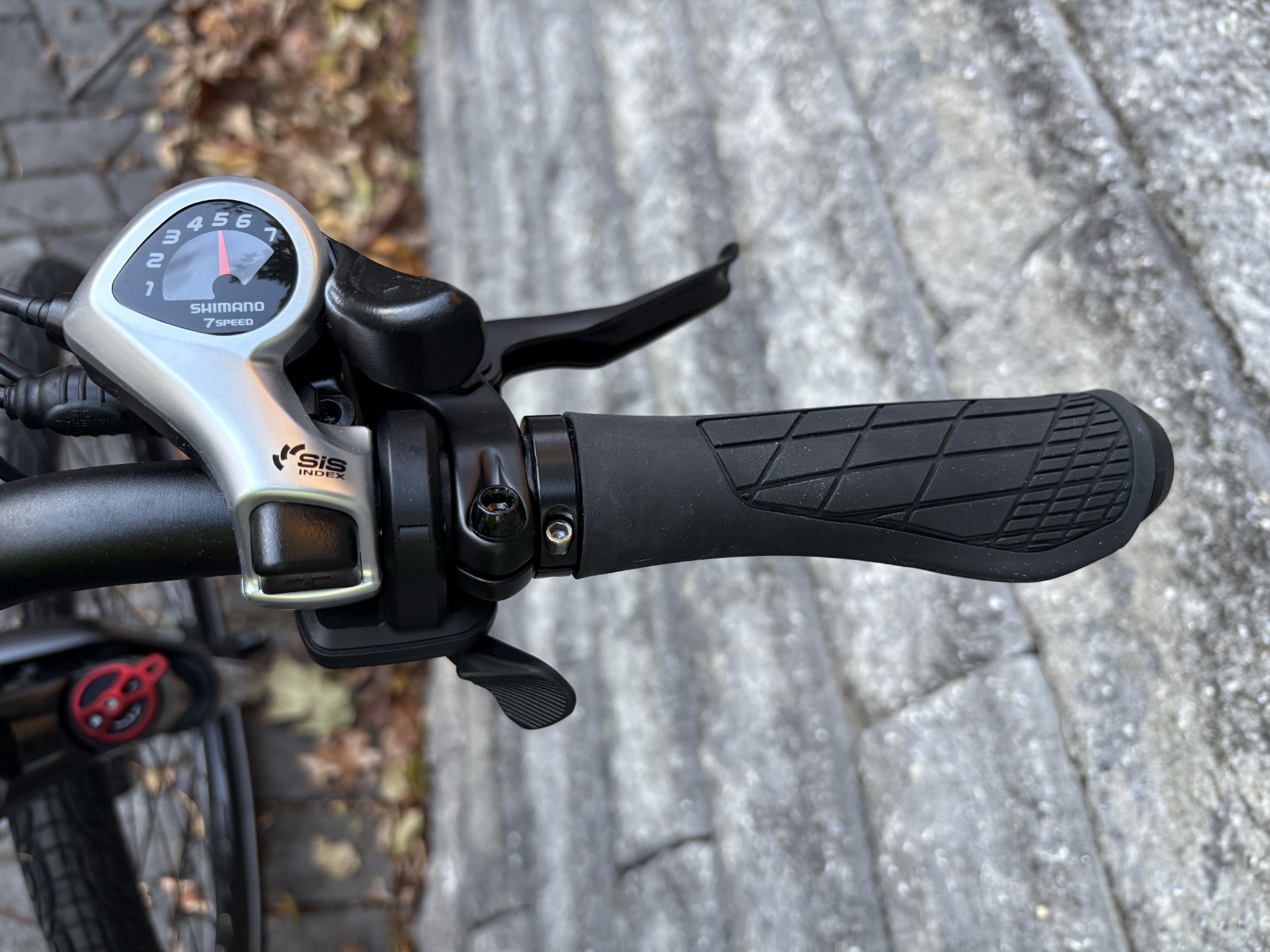
My least favorite feature is the bike’s shifter. Credit: John TImmer
Another big problem is with the system that tracks battery use. As we saw in another affordability-focused bike, the battery display was prone to exaggerating the speed at which the actual battery was being drained. Shutting the bike off and letting it sit for 10 minutes was often enough to seemingly restore over a quarter of the battery’s capacity (again, it was there all the time, but the battery management software somehow failed to see it). This made judging how well the bike met Lectric’s range claims impossible and frequently left me wondering whether I could complete errands under power if I started them without a full charge.
The final thing was the noise. The XPress had the misfortune of being tested between two other bikes with motors that were nearly silent. The XPress, by contrast, emitted a very audible whine that cut into part of what makes biking special to me: silently gliding through quiet neighborhoods. I eventually settled on making the assist cut out at 20 mph (the lower of its two primary settings), where, on flat ground, my legs could easily minimize the need for the motor. But I wouldn’t want to be putting in that much physical effort if I were just running errands in typical summertime temperatures.
If any of those issues are dealbreakers for you, you’ll likely want to pay more for your bike or do an exhaustive search for something with a different combination of compromises. But in this price range, you’ll never avoid facing compromises.
That’s an indirect way of saying that this is a very good bike for its price range, and if its limitations are ones you can adjust to, it would be a great option for errand running, commuting, or light trail riding. It can be set to Class 3 to help it fit in with typical suburban traffic, it provides a throttle to help you avoid over-exertion in hot weather, and you can put a rack on back if you need to add cargo capacity. If you don’t try to treat it as something it’s not, it should perform quite well.
That said, riding it has me interested to see how many of these compromises might disappear from low-end models over the next four years.

John is Ars Technica’s science editor. He has a Bachelor of Arts in Biochemistry from Columbia University, and a Ph.D. in Molecular and Cell Biology from the University of California, Berkeley. When physically separated from his keyboard, he tends to seek out a bicycle, or a scenic location for communing with his hiking boots.