NASA’s Curiosity Mars rover has detected the largest organic (carbon-containing) molecules ever found on the red planet. The discovery is one of the most significant findings in the search for evidence of past life on Mars. This is because, on Earth at least, relatively complex, long-chain carbon molecules are involved in biology. These molecules could actually be fragments of fatty acids, which are found in, for example, the membranes surrounding biological cells.
Scientists think that, if life ever emerged on Mars, it was probably microbial in nature. Because microbes are so small, it’s difficult to be definitive about any potential evidence for life found on Mars. Such evidence needs more powerful scientific instruments that are too large to be put on a rover.
The organic molecules found by Curiosity consist of carbon atoms linked in long chains, with other elements bonded to them, like hydrogen and oxygen. They come from a 3.7-billion-year-old rock dubbed Cumberland, encountered by the rover at a presumed dried-up lakebed in Mars’s Gale Crater. Scientists used the Sample Analysis at Mars (SAM) instrument on the NASA rover to make their discovery.
Scientists were actually looking for evidence of amino acids, which are the building blocks of proteins and therefore key components of life as we know it. But this unexpected finding is almost as exciting. The research is published in Proceedings of the National Academies of Science.
Among the molecules were decane, which has 10 carbon atoms and 22 hydrogen atoms, and dodecane, with 12 carbons and 26 hydrogen atoms. These are known as alkanes, which fall under the umbrella of the chemical compounds known as hydrocarbons.
It’s an exciting time in the search for life on Mars. In March this year, scientists presented evidence of features in a different rock sampled elsewhere on Mars by the Perseverance rover. These features, dubbed “leopard spots” and “poppy seeds,” could have been produced by the action of microbial life in the distant past, or not. The findings were presented at a US conference and have not yet been published in a peer-reviewed journal.
Like many legacy government IT systems, SSA systems contain code written in COBOL, a programming language created in part in the 1950s by computing pioneer Grace Hopper. The Defense Department essentially pressured private industry to use COBOL soon after its creation, spurring widespread adoption and making it one of the most widely used languages for mainframes, or computer systems that process and store large amounts of data quickly, by the 1970s. (At least one DOD-related website praising Hopper’s accomplishments is no longer active, likely following the Trump administration’s DEI purge of military acknowledgements.)
As recently as 2016, SSA’s infrastructure contained more than 60 million lines of code written in COBOL, with millions more written in other legacy coding languages, the agency’s Office of the Inspector General found. In fact, SSA’s core programmatic systems and architecture haven’t been “substantially” updated since the 1980s when the agency developed its own database system called MADAM, or the Master Data Access Method, which was written in COBOL and Assembler, according to SSA’s 2017 modernization plan.
SSA’s core “logic” is also written largely in COBOL. This is the code that issues social security numbers, manages payments, and even calculates the total amount beneficiaries should receive for different services, a former senior SSA technologist who worked in the office of the chief information officer says. Even minor changes could result in cascading failures across programs.
“If you weren’t worried about a whole bunch of people not getting benefits or getting the wrong benefits, or getting the wrong entitlements, or having to wait ages, then sure go ahead,” says Dan Hon, principal of Very Little Gravitas, a technology strategy consultancy that helps government modernize services, about completing such a migration in a short timeframe.
It’s unclear when exactly the code migration would start. A recent document circulated amongst SSA staff laying out the agency’s priorities through May does not mention it, instead naming other priorities like terminating “non-essential contracts” and adopting artificial intelligence to “augment” administrative and technical writing.
Google revealed the Pixel 9a last week, but its release plans were put on hold by a mysterious “component quality issue.” Whatever that was, it’s been worked out. Google now says its new budget smartphone will arrive as soon as April 10. The date varies by market, but the wait is almost over.
The first wave of 9a releases on April 10 will include the US, Canada, and the UK. On April 14, the Pixel 9a will arrive in Europe, launching in Germany, Spain, Italy, Ireland, France, Norway, Denmark, Sweden, Netherlands, Belgium, Austria, Portugal, Switzerland, Poland, Czechia, Romania, Hungary, Slovenia, Slovakia, Lithuania, Estonia, Latvia, and Finland. On April 16, the phone will come to Australia, India, Singapore, Taiwan, and Malaysia.
You may think that takes care of Google’s launch commitments, but no—Japan still has no official launch date. That’s a bit strange, as Japan is not a new addition to Google’s list of supported regions. It’s unclear if this has anything to do with the previous component issue. Google says only that the Japanese launch will happen “soon.” Its statements about the delayed release were also vague, with representatives noting that the cause was a “passive component.”
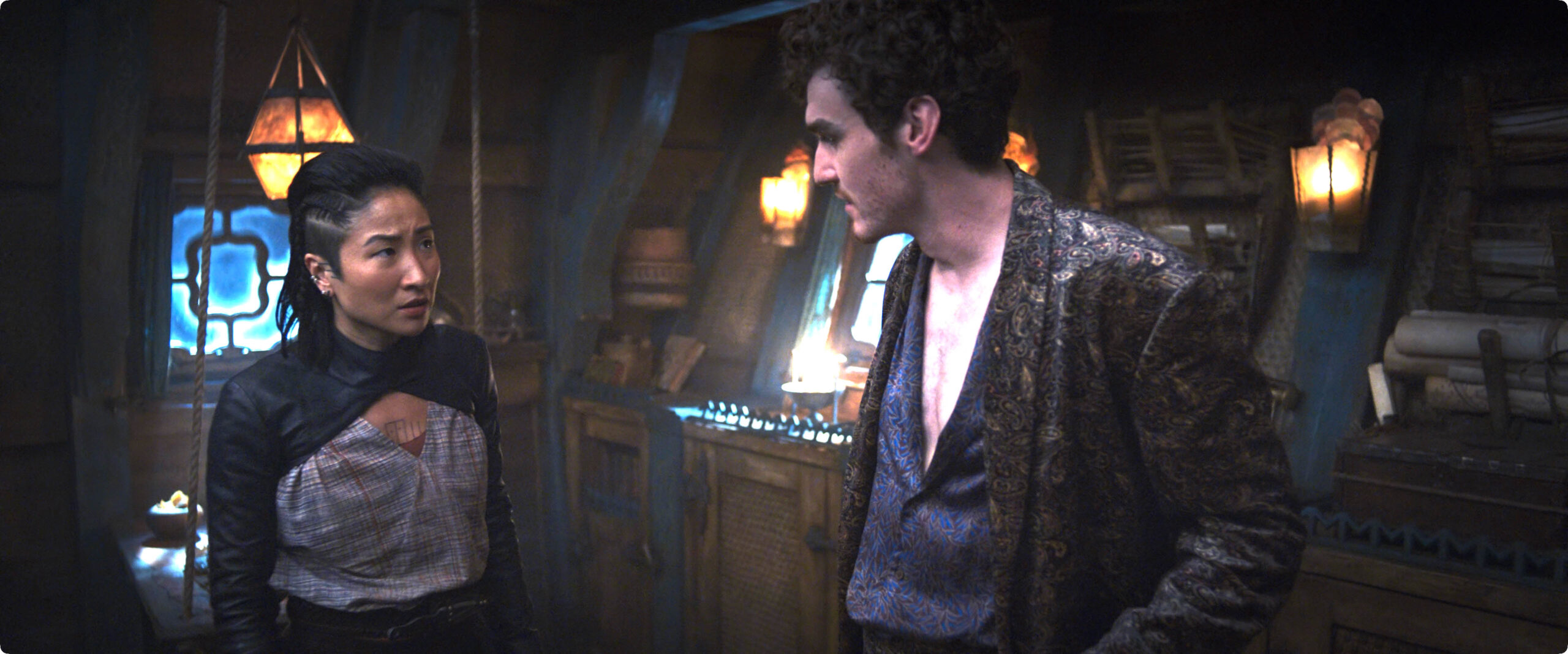
Andrew Cunningham and Lee Hutchinson have spent decades of their lives with Robert Jordan and Brandon Sanderson’s Wheel of Time books, and they previously brought that knowledge to bear as they recapped each first season episode and second season episode of Amazon’s WoT TV series. Now we’re back in the saddle for season 3—along with insights, jokes, and the occasional wild theory.
These recaps won’t cover every element of every episode, but they will contain major spoilers for the show and the book series. We’ll do our best to not spoil major future events from the books, but there’s always the danger that something might slip out. If you want to stay completely unspoiled and haven’t read the books, these recaps aren’t for you.
New episodes of The Wheel of Time season three will be posted for Amazon Prime subscribers every Thursday. This write-up covers episode five, “Tel’Aran’Rhiod,” which was released on March 27.
Andrew: Three seasons in I think we have discerned a pattern to the Wheel of Time’s portrayal of the Pattern: a mid-season peak in episode four, followed by a handful of more table-setting-y episodes that run up to a big finale. And so it is in Tel’aran’rhiod, which is a not-entirely-unwelcome slowdown after last week’s intense character-defining journey into Rhuidean.
The show introduces or expands a bunch of book plotlines as it hops between perspectives this week. Which are you the most interested in picking apart, Lee? Anything the show is tending to here that you wish we were skipping?
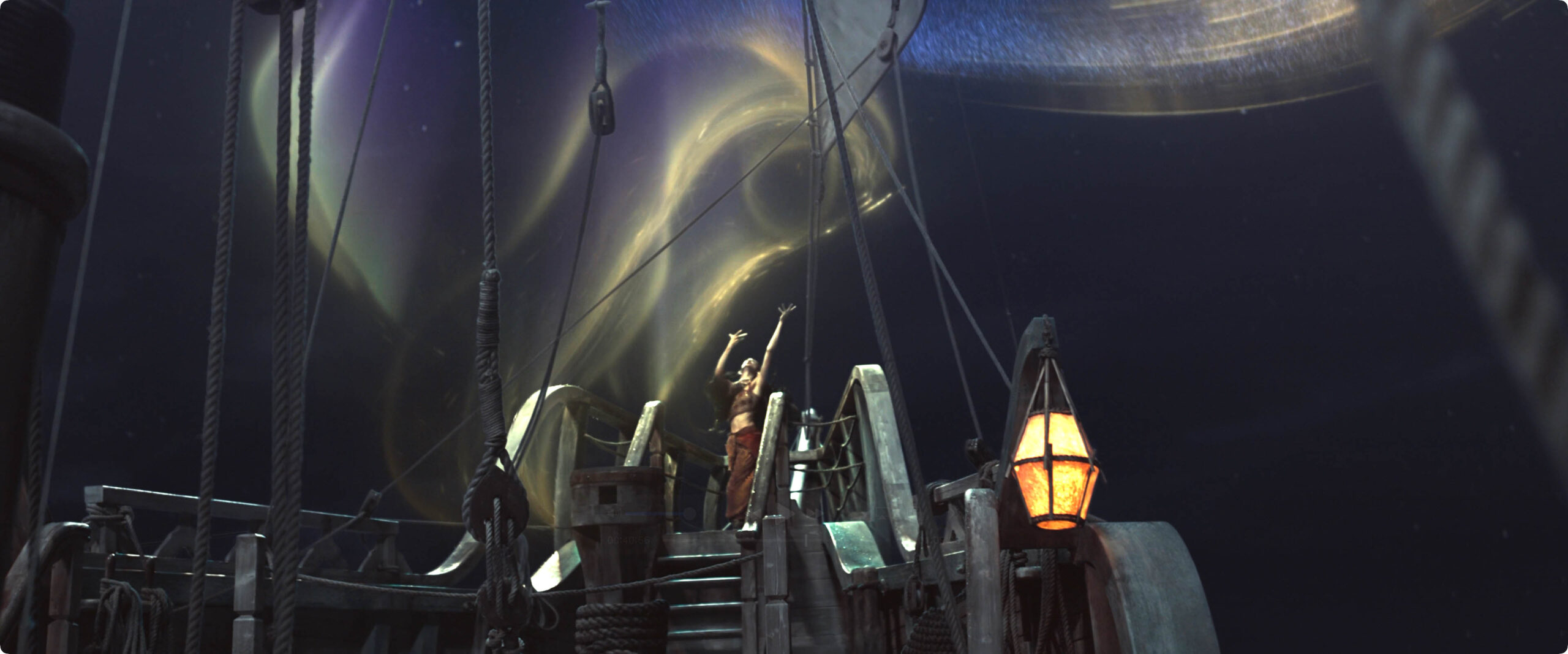
“Let it go, let it goooooo…” A Sea Folk Windfinder, doing her thing.
Credit: Prime/Amazon MGM Studios
“Let it go, let it goooooo…” A Sea Folk Windfinder, doing her thing. Credit: Prime/Amazon MGM Studios
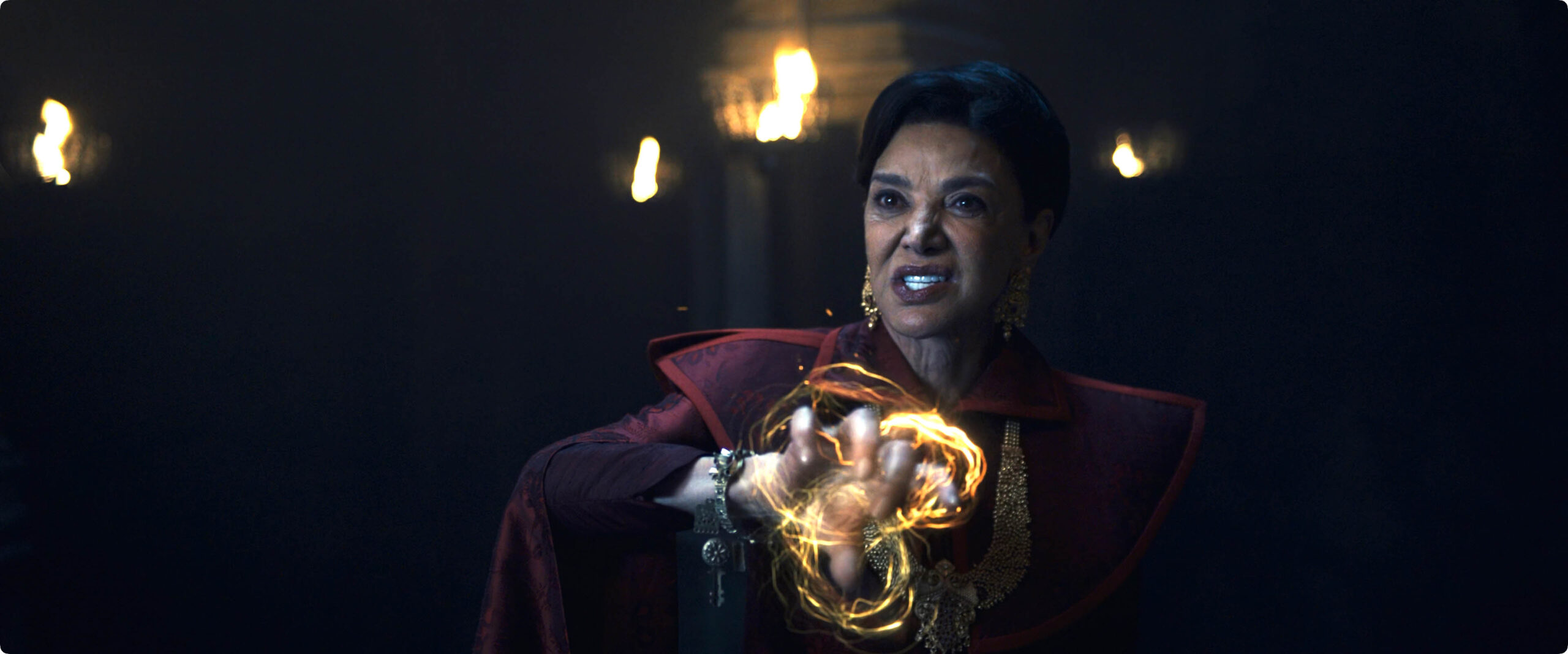
Lee: Yes, this was a good old-fashioned move-the-pieces-into-place episode, and you gotta have at least one or two of those. I think, if I were coming into this having not read the books, the most puzzling bits might have been what’s going on in the White Tower this episode, with the who-is-the-darkfriend hide-n-seek game the Aes Sedai are playing. And it turns out that in spite of the Sisters’ best attempts at a fake-out, Shohreh Aghdashloo’s Elaida is in fact not it. (And Elaida gets the crap stabbed out of her by another Gray Man for her troubles, too. Ouch. Fortunately, healing is nearby. Nobody has to die in this show unless the plot really demands it.)
I was a little taken aback at the casualness with which Elaida takes lives—her execution of Black Ajah sister Amico Nagoyin was pretty off-handed. I don’t recall her being quite that blasé about death in the books, but it has been a while. Regardless, while she’s not capital-E EEEEEVIL, she’s clearly not a good person.
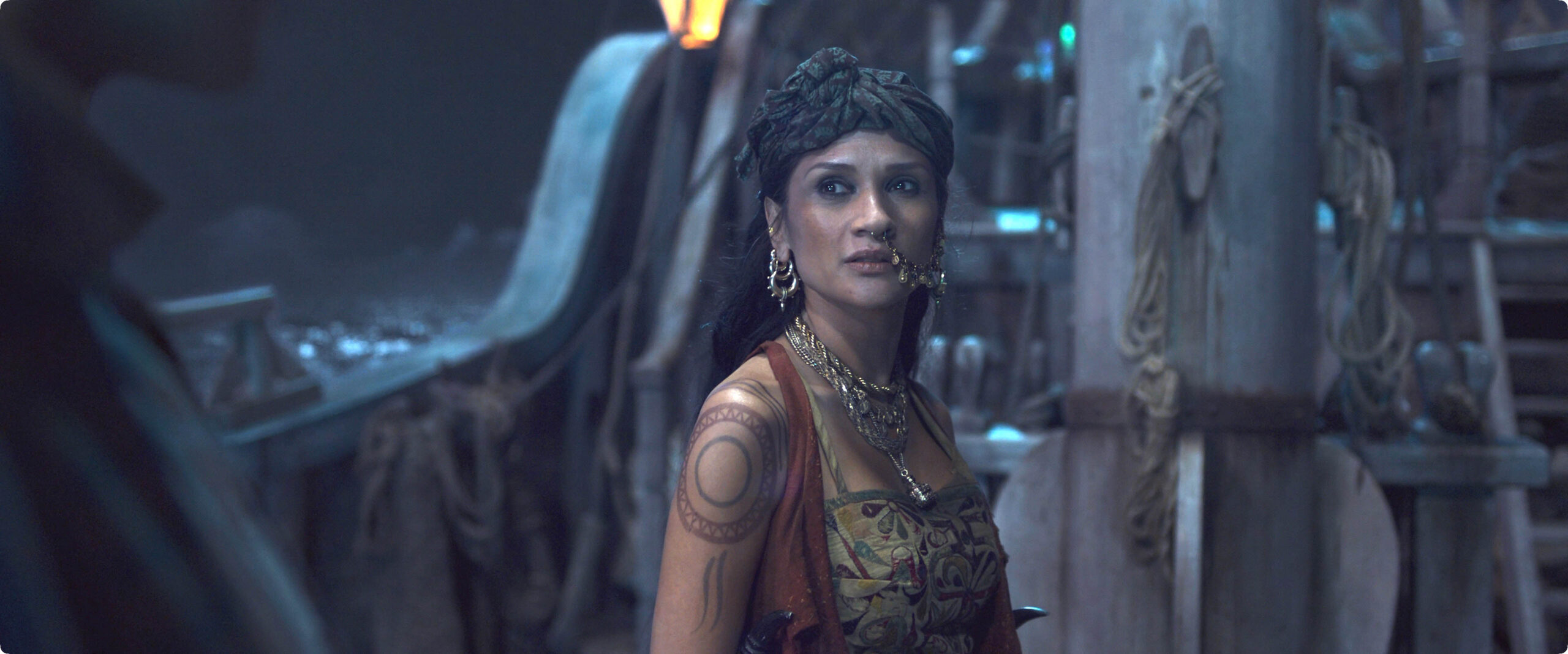
We do get our first glimpse of the Sea Folk, though it felt a bit ham-fisted—like they spent both more time than they needed to tee them up, and much less time than was needed to actually establish WTF this new group of people is. (Though I guess the name “Sea Folk” is pretty explanatory—it does what it says on the tin, as it were.)
My eyes see Elaida Sedai, but my ears and heart hear Chrisjen Avasarala saying “Sometimes I f—ing hate being right.”
My eyes see Elaida Sedai, but my ears and heart hear Chrisjen Avasarala saying “Sometimes I f—ing hate being right.”
Andrew: Our first glimpse of show-Elaida is an advisor to a new queen who casually murders her former political opponents, so I guess I shouldn’t be too surprised that she just straight-up executes someone she thinks is of no further use. The show is also happy to just quickly kill tertiary or… sextiary (??) characters to streamline the story. There are lots of those to go around in the books.
There’s a lot of Aiel and Sea Folk stuff where the show is just kind of asking you to take things at face value, even if book-readers are aware of more depth. One of the big running plotlines in the book is that the White Tower has weakened itself by being too doctrinaire about the way it absorbs the channelers of other cultures, totally taking them away from their families and societies and subjecting them to all kinds of weird inflexible discipline. This is why there are so many Aiel and Sea Folk channelers running around that the White Tower doesn’t know about, and the show has nodded toward it but hasn’t had a lot of room to communicate the significance of it.
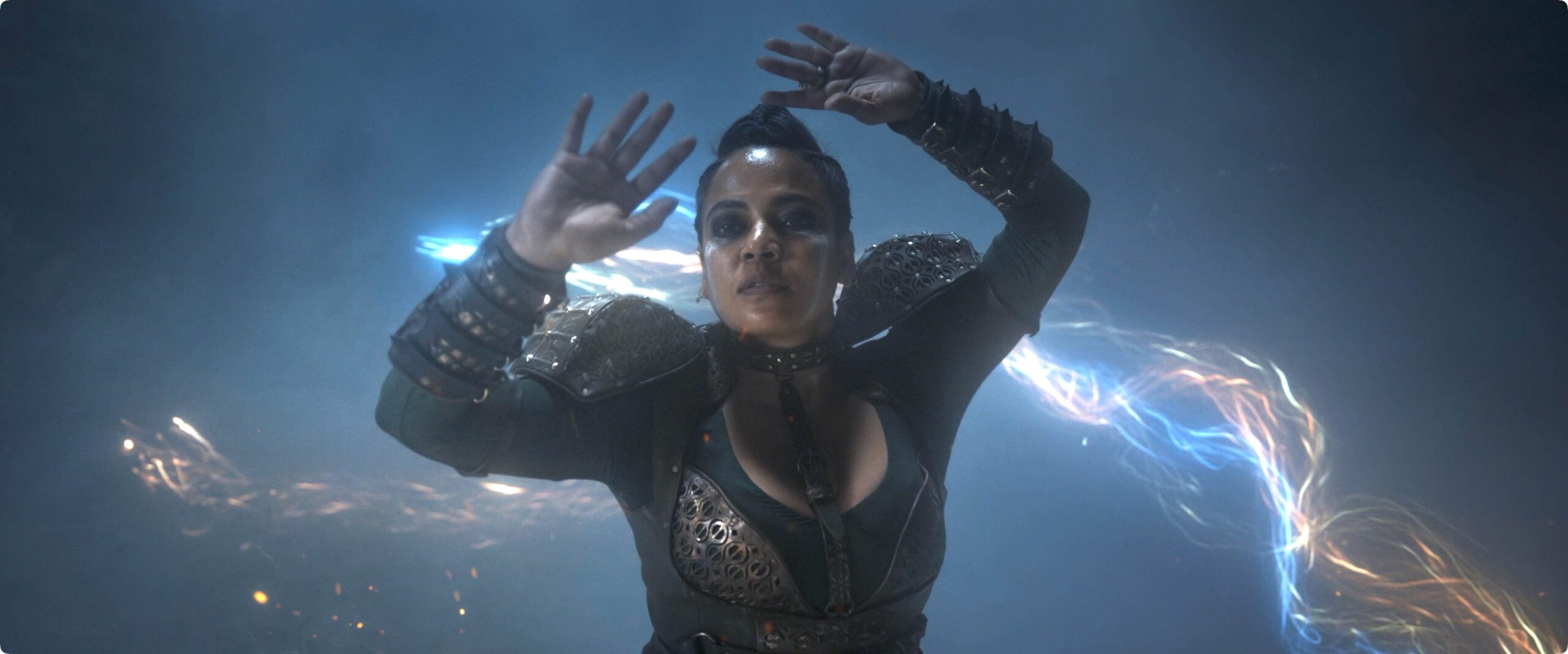
Lee: That’s a point that Alanna Sedai comments on in this episode, and the reason she’s in the Two Rivers: The Tower has been too selective, too closed-minded, and—somewhat ironically—too parochial in its approach to accepting and training channelers. Further, there’s some worry that by spending thousands of years finding and gentling (or executing) male channelers, humanity has begun to self-select channeling out of the gene pool.
This doesn’t seem to be the case, though, as we see by the sheer number of channelers popping up everywhere, and Alanna’s hypothesis proves correct: the old blood of Manetheren runs true and strong, spilling out in ta’veren and channelers and other pattern-twisting craziness all over the place.
Alanna has her own challenges to face, but first, I want to hear your take on the Aiel in this post-Rhuidean episode, and especially of Cold Rocks Hold—a place that I know a subset of fans have been imagining for decades. What did you think?
Alanna Sedai’s intuition is right on the money.
Credit: Prime/Amazon MGM Studios
Alanna Sedai’s intuition is right on the money. Credit: Prime/Amazon MGM Studios
Andrew: Rocks! It’s all rocks. Which makes sense for a desert, I suppose.
The show does a solid job of showing us what day-to-day Aiel society looks like through just a handful of characters, including Rhuarc’s other wife Lian and his granddaughter Alsera. It’s an economy of storytelling that is forced upon the show by budget and low episode count but usually you don’t feel it.
We’re also getting our very first look at the awe and discomfort that Rand is going to inspire, as the prophesied Aiel chief-of-chiefs. Clan leaders are already telling tales of him to their children. But not everyone is going to have an easy time accepting him, something we’ll probably start to pick apart in future episodes.
Alanna is definitely in the running for my favorite overhauled show character. She’s visible from very early on as a background character and loose ally of the Two Rivers crew in the books, but the show is giving her more of a personality and a purpose, and a wider view than Book-Alanna (who was usually sulking somewhere about her inability to take any of the Two Rivers boys as a Warder, if memory serves). In the show she and her Warder Maksim are fleshed-out characters who are dealing with their relationship and the Last Battle in their own way, and it’s fun to get something unexpected and new in amongst all of the “how are they going to portray Book Event X” stuff.
Lee: Book-Alanna by this point has made some… let’s call them questionable choices, and her reworking into someone a bit less deserving of being grabbed by the throat and choked is excellent. (Another character with a similar reworking is Faile, who so far I actually quite like and do not at all want to throttle!)
I think you’ve hit upon the main overarching change from the books, bigger than all other changes: The show has made an effort to make these characters into people with relatable problems, rather than a pack of ill-tempered, nuance-deaf ding-dongs who make bad choices and then have to dig themselves out.
Well, except maybe for Elayne. I do still kind of want to shake her a bit.
Hey, it’s Faile, and I don’t hate her!
Credit: Prime/Amazon MGM Studios
Hey, it’s Faile, and I don’t hate her! Credit: Prime/Amazon MGM Studios
Andrew: Yes! But with show-Elayne at least you get the sense that a bit of her showy know-it-all-ness is being played up on purpose. And she is right to be studying up on their destination and trying to respect the agreement they made with the Sea Folk when they came on board. She’s just right in a way that makes you wish she wasn’t, a personality type I think we’ve all run into at least once or twice in our own lives.
In terms of Big Book Things that are happening, let’s talk about Egwene briefly. Obviously she’s beginning to hone her skills in the World of Dreams—Tel’aran’rhiod, which gives the episode its name—and she’s already using it to facilitate faster communication between far-flung characters and to check in on her friends. Two other, minor things: We’re starting to see Rand and Egwene drift apart romantically, something the books had already dispensed with by this point. And this was the first time I noted an Aiel referring to her as “Egwene Sedai.” I assume this has already happened and this is just the first time I’ve noticed, but Egwene/Nynaeve/Elayne playing at being full Aes Sedai despite not being is a plot thread the books pull at a lot here in the middle of the series.
Lee: Right, I seem to remember the dissembling about Egwene’s Sedai-ishness resulting in some kind of extended spanking session, that being the punishment the Book Wise Ones (and the Book Aes Sedai) were most likely to hand out. I think the characters’ pretending to be full Sisters and all the wacky hijinks that ensue are being dispensed with, and I am pretty okay with that.
The Sea Folk wear tops!
Credit: Prime/Amazon MGM Studios
The Sea Folk wear tops! Credit: Prime/Amazon MGM Studios
Andrew: That’s the thing, I’m not sure the characters pretending to be full Sisters is being dispensed with. The show’s just dropping breadcrumbs so that they’re there later, if/when they want to make a Big Deal out of them. We’ll see whether they make the time or not.
Lee: Regardless, Eggy’s growth into a dream-walker is fortunately not being dispensed with, and as in the books, she does a lot of things she’s not supposed to do (or at least not until she’s got more than a single afternoon’s worth of dreamwalker training under her belt). She sort of heeds the Wise Ones’ directive to stay out of Tel’aran’rhiod and instead just skips around between her various friends’ dreams, before finally landing in Rand’s, where she finds him having sexytimes with, uh oh, an actual-for-real Forsaken. Perhaps this is why one shouldn’t just barge into someone’s dreams uninvited!
And on the subject of dreams—or at least visions—I think we’d be remiss if we didn’t check in on the continuing bro-adventures of Min and Mat (which my cousin described as “a lesbian and her gay best friend hanging out, and it’s unclear which is which”). The show once again takes the opportunity to remind us of Min’s visions—especially the one of Mat being hanged. Foreshadowing!
The buddy comedy we didn’t know we needed.
Credit: Prime/Amazon MGM Studios
The buddy comedy we didn’t know we needed. Credit: Prime/Amazon MGM Studios
Andrew: Honestly of all the plotlines going on right now I’m the most curious to see how Elayne/Nynaeve/Mat/Min get along in Tanchico, just because these characters have gotten so many minor little tweaks that I find interesting. Mat and Min are more friendly, and their plots are more intertwined in the show than they were in the books, and having a version of Nynaeve and a version of Mat that don’t openly dislike each other has a lot of fun story potential for me.
I am a little worried that we only have three episodes left, since we’ve got the party split up into four or five groups, and most of those groups already have little sub-groups inside of them who are doing their own thing. I do trust the show a lot at this point, but the splitting and re-splitting of plotlines is what eventually gets the books stuck in the mud, and we’ve already seen that dynamic play out on TV in, say, mid-to-late-series Game of Thrones. I just hope we can keep things snappy without making the show totally overwhelming, as it is already in danger of being sometimes.
There are constant reminders that Mat may be heading toward a dark fate.
Credit: Prime/Amazon MGM Studios
There are constant reminders that Mat may be heading toward a dark fate. Credit: Prime/Amazon MGM Studios
Lee: I seem to remember the time in Tanchico stretching across several books, though I may be getting that mixed up with whatever the hell the characters do in Far Madding much later (that’s not really a spoiler, I don’t think—it’s just the name of another city-state where readers are forced to spend an interminable amount of time). I’m reasonably sure our crew will find what they need to find in Tanchico by season’s end, at least—and, if it follows the books, things’ll get a little spicy.
Let’s see—for closing points, the one I had on my notepad that I wanted to hit was that for me, this episode reinforces that this show is at its best when it focuses on its characters and lets them work. Episode four with Rhuidean was a rare epic hit; most of the times the show has attempted to reach for grandeur or epic-ness, it has missed. The cinematography falls flat, or the sets look like styrofoam and carelessness, or the editing fails to present a coherent through-line for the action, or the writing whiffs it. But up close, locked in a ship or sitting on a mountainside or hanging out in a blacksmith’s dream, the actors know what they’re doing, and they have begun consistently delivering.
Andrew: There are a whole lot of “the crew spends a bunch of time in a city you’ve never seen before, accomplishing little-to-nothing” plotlines I think you’re conflating. Tanchico is a Book 4 thing, and it’s also mostly resolved in Book 4; the interminable one you are probably thinking of is Ebou Dar, where characters spend three or four increasingly tedious books. Far Madding is later and at least has the benefit of being brief-ish.
Perrin dreams of peaceful times—and of hanging out with Hopper!
Credit: Prime/Amazon MGM Studios
Perrin dreams of peaceful times—and of hanging out with Hopper! Credit: Prime/Amazon MGM Studios
Lee: Ahhh, yes, you are absolutely correct! My Randland mental map is a bit tattered these days. So many city-states. So many flags. So many import and export crops to keep track of.
Andrew: But yes I agree that there’s usually at least something that goes a bit goofy when the show attempts spectacle. The big battle that ended the first season is probably the most egregious example, but I also remember the Horn of Valere moment in the season 2 finale as looking “uh fine I guess.” But the talking parts are good! The smaller fights, including the cool Alanna-Whitecloak stuff we get in this episode, are all compelling. There’s some crowd-fight stuff coming in the next few episodes, if we stick to Book 4 as our source material, so we’ll see what the show does and doesn’t manage to pull off.
But in terms of this episode, I don’t have much more to say. We’re scooting pieces around the board in service of larger confrontations later on. It remains a very dense show, which is what I think will keep it from ever achieving a Game of Thrones level of cultural currency. But I’m still having fun. Anything else you want to highlight? Shoes you’re waiting to drop?
Egwene, entering the “finding out” phase of her ill-advised nighttime adventures.
Credit: Prime/Amazon MGM Studios
Egwene, entering the “finding out” phase of her ill-advised nighttime adventures. Credit: Prime/Amazon MGM Studios
Lee: Almost all of the books (at least in the front half of the series, before the Slog) tend to end in a giant spectacle of some sort, and I think I can see which spectacle—or spectacles, plural—we’re angling at for this one. The situation in the Two Rivers is clearly barreling toward violence, and Rand’s got them dragons on his sleeves. I’d say buckle up, folks, because my bet is we’re about to hit the gas.
Until next week, dear readers—beware the shadows, and guard yourselves. I hear Lanfear walks the dream world this night.
Microsoft released a new Windows Insider build of Windows 11 to its experimental Dev Channel today, with a fairly extensive batch of new features and tweaks. But the most important one for enthusiasts and PC administrators is buried halfway down the list: This build removes a command prompt script called bypassnro, which up until now has been a relatively easy and reliable way to circumvent the otherwise mandatory Microsoft Account sign-in requirement on new Windows 11 PCs and fresh installs of Windows 11 on existing PCs.
Microsoft’s Windows Insider Program lead Amanda Langowski and Principal Product Manager Brandon LeBlanc were clear that this change is considered a feature and not a bug.
“We’re removing the bypassnro.cmd script from the build to enhance security and user experience of Windows 11,” Langowski and LeBlanc write in the post. “This change ensures that all users exit setup with internet connectivity and a Microsoft Account.”
Of course, the removal of bypassnro makes life harder for people who want to exit Windows setup without Internet connectivity or a Microsoft Account. You might be setting up a computer in a place with no Internet connection, or you might simply prefer a local user account like the ones that all past Windows versions allowed you to use.
There are benefits to a Microsoft Account—easy access to any existing Microsoft 365 or OneDrive subscriptions, automated encryption for your local disk and backup of your drive’s encryption key for recovery purposes, and syncing of certain settings between PCs. But using a local account reduces the number of notifications and other upsells that Windows 11 will bother you with. Whatever your reasoning, you’ll need to find a different workaround for future Windows versions.
Importantly, it then applies a weighting step, dividing higher-frequency spectral coefficients by the overall brightness (the DC component), allowing less important data to be compressed more aggressively. That is then fed into the codec, and rather than inventing a completely new file type, the method uses the compression engine and features of the standardized JPEG XL image format to store the specially prepared spectral data.
Making spectral images easier to work with
According to the researchers, the massive file sizes of spectral images have reportedly been a real barrier to adoption in industries that would benefit from their accuracy. Smaller files mean faster transfer times, reduced storage costs, and the ability to work with these images more interactively without specialized hardware.
The results reported by the researchers seem impressive—with their technique, spectral image files shrink by 10 to 60 times compared to standard OpenEXR lossless compression, bringing them down to sizes comparable to regular high-quality photos. They also preserve key OpenEXR features like metadata and high dynamic range support.
While some information is sacrificed in the compression process—making this a “lossy” format—the researchers designed it to discard the least noticeable details first, focusing compression artifacts in the less important high-frequency spectral details to preserve important visual information.
Of course, there are some limitations. Translating these research results into widespread practical use hinges on the continued development and refinement of the software tools that handle JPEG XL encoding and decoding. Like many cutting-edge formats, the initial software implementations may need further development to fully unlock every feature. It’s a work in progress.
And while Spectral JPEG XL dramatically reduces file sizes, its lossy approach may pose drawbacks for some scientific applications. Some researchers working with spectral data might readily accept the trade-off for the practical benefits of smaller files and faster processing. Others handling particularly sensitive measurements might need to seek alternative methods of storage.
For now, the new technique remains primarily of interest to specialized fields like scientific visualization and high-end rendering. However, as industries from automotive design to medical imaging continue generating larger spectral datasets, compression techniques like this could help make those massive files more practical to work with.
The Federal Communications Commission’s news distortion investigation into CBS drew a public rebuke from a bipartisan group of five former FCC commissioners, including two former chairmen.
The group criticizing current Chairman Brendan Carr includes Republican Alfred Sikes, the FCC chair from 1989 to 1993, and Democrat Tom Wheeler, the FCC chair from 2013 to 2017. They were joined by Republican Rachelle Chong, Democrat Ervin Duggan, and Democrat Gloria Tristani, all former commissioners.
“These comments are submitted to emphasize the unprecedented nature of this news distortion proceeding, and to express our strong concern that the Federal Communications Commission may be seeking to censor the news media in a manner antithetical to the First Amendment,” the former chairs and commissioners told the FCC in a filing this week.
The Center for American Rights filed the news distortion complaint against flagship station WCBS over the editing of a CBS 60 Minutes interview with Kamala Harris. The complaint was dismissed in January by then-Chairwoman Jessica Rosenworcel. Carr, Trump’s pick to lead the FCC, revived the complaint shortly after taking over.
“Editorial judgment protected by First Amendment”
The Center for American Rights’ claim of news distortion is based on an allegation that CBS misled viewers by airing two different responses from Harris to the same question about Israeli Prime Minister Benjamin Netanyahu, one on 60 Minutes and the other on Face the Nation. But CBS provided the FCC with a transcript showing that the programs aired two different sentences from the same response.
“The transcript confirms that the editing choices at issue lie well within the editorial judgment protected by the First Amendment and that the Commission’s January 16 dismissal of the complaint was legally correct,” the former chairs and commissioners wrote. “Yet the Commission has reopened the complaint and taken the highly unusual step of inviting public comment, even though the proceeding is adjudicatory in nature. These developments have unjustifiably prolonged this investigation and raise questions about the actual purpose of the proceeding.”
The FCC has historically punished licensees only after dramatic violations, like “elaborate hoaxes, internal conspiracies, and reports conjured from whole cloth,” they wrote. There is “no credible argument” that the allegations against CBS “belong in the same category.”
Elon Musk and the Department of Government Efficiency (DOGE) don’t have to turn over information related to their government cost-cutting operations, at least for now, a federal appeals court ruled yesterday.
A federal judge previously ruled that 14 states suing the federal government can serve written discovery requests on Musk and DOGE. Musk, DOGE, and President Trump turned to the US Court of Appeals for the District of Columbia Circuit in an attempt to block that order.
A three-judge panel at the appeals court granted an emergency motion for a stay in an order issued yesterday, putting the lower-court ruling on hold pending further orders from the appeals court. “Petitioners have satisfied the stringent requirements for a stay,” the panel ruling said. “In particular, petitioners have shown a likelihood of success on their argument that the district court was required to decide their motion to dismiss before allowing discovery.”
Musk, DOGE, and Trump filed a petition to quash the district court’s discovery order at the same time that they filed their emergency motion for a stay. The appeals court did not rule on the petition to quash the discovery order. The three-judge panel included judges appointed by George H.W. Bush, Barack Obama, and Donald Trump.
The states suing the US alleged that “President Trump has delegated virtually unchecked authority to Mr. Musk without proper legal authorization from Congress and without meaningful supervision of his activities.” They sought “planning, implementation, and organizational documents,” but no emails, text messages, or other electronic communications.
US District Judge Tanya Chutkan denied a request for depositions but otherwise found the states’ discovery requests to be “reasonable and narrowly tailored to their request for injunctive relief.”
Three weeks ago, NASA revealed that a shipping container protecting a Cygnus spacecraft sustained “damage” while traveling to the launch site in Florida.
Built by Northrop Grumman, Cygnus is one of two Western spacecraft currently capable of delivering food, water, experiments, and other supplies to the International Space Station. This particular Cygnus mission, NG-22, had been scheduled for June. As part of its statement in early March, the space agency said it was evaluating the NG-22 Cygnus cargo supply mission along with Northrop.
On Wednesday, after a query from Ars Technica, the space agency acknowledged that the Cygnus spacecraft designated for NG-22 is too damaged to fly, at least in the nearterm.
Loading up Dragon
“Following initial evaluation, there also is damage to the cargo module,” the agency said in a statement. “The International Space Station Program will continue working with Northrop Grumman to assess whether the Cygnus cargo module is able to safely fly to the space station on a future flight.” That future flight, NG-23, will launch no earlier than this fall.
As a result, NASA is modifying the cargo on its next cargo flight to the space station, the 32nd SpaceX Cargo Dragon mission, due to launch in April. The agency says it will “add more consumable supplies and food to help ensure sufficient reserves of supplies aboard the station” to the Dragon vehicle.
As it mulls stopgap measures, one option available to NASA may be to try to slot in a cargo mission on Boeing’s Starliner spacecraft. After the propulsion issues experienced on Starliner’s first crew flight to the space station last June, NASA is still evaluating whether the vehicle can be certified for an operational crew mission, or whether it would be better to perform an uncrewed test flight.
The US Space Force on Wednesday announced that it has certified United Launch Alliance’s Vulcan rocket to conduct national security missions.
“Assured access to space is a core function of the Space Force and a critical element of national security,” said Brig. Gen. Panzenhagen, program executive officer for Assured Access to Space, in a news release. “Vulcan certification adds launch capacity, resiliency, and flexibility needed by our nation’s most critical space-based systems.”
The formal announcement closes a yearslong process that has seen multiple delays in the development of the Vulcan rocket, as well as two anomalies in recent years that were a further setback to certification.
The first of these, an explosion on a test stand in northern Alabama during the spring of 2023, delayed the first test flight of Vulcan by several months. Then, in October 2024, during the second test flight of the rocket, a nozzle on one of the Vulcan’s two side-mounted boosters failed.
A cumbersome process
This nozzle issue, more than five months ago, compounded the extensive paperwork needed to certify Vulcan for the US Department of Defense’s most sensitive missions. The military has several options for companies to certify their rockets depending on the number of flights completed, which could be two, three, or more. The fewer the flights, the more paperwork and review that must be done. For Vulcan, this process entailed:
52 certification criteria
more than 180 discrete tasks
2 certification flight demonstrations
60 payload interface requirement verifications
18 subsystem design and test reviews
114 hardware and software audits
That sounds like a lot of work, but at least the military’s rules and regulations are straightforward and simple to navigate, right? Anyway, the certification process is complete, elevating United Launch Alliance to fly national security missions alongside SpaceX with its fleet of Falcon 9 and Falcon Heavy rockets.
Google is planning a major change to the way it develops new versions of the Android operating system. Since the beginning, large swaths of the software have been developed in public-facing channels, but that will no longer be the case. This does not mean Android is shedding its open source roots, but the process won’t be as transparent.
Google has confirmed to Android Authority that all Android development work going forward will take place in Google’s internal branch. This is a shift from the way Google has worked on Android in the past, which featured frequent updates to the public AOSP branch. Anyone can access AOSP, but the internal branches are only available to Google and companies with a Google Mobile Services (GMS) license, like Samsung, Motorola, and others.
According to the company, it is making this change to simplify things, building on a recent change to trunk-based development. As Google works on both public and private branches of Android, the two fall out of sync with respect to features and API support. This forces Google to tediously merge the branches for every release. By focusing on the internal branch, Google claims it can streamline releases and make life easier for everyone.
When new versions of Android are done, Google says it will continue to publish the source code in AOSP as always. Supposedly, this will allow developers to focus on supporting their apps without keeping track of pending changes to the platform in AOSP. Licensed OEMs, meanwhile, can just focus on the lively internal branch as they work on devices that can take a year or more to launch.
Prior to running its follow-up article, The Atlantic asked Trump administration officials if they objected to publishing the full texts. White House Press Secretary Karoline Leavitt emailed a response:
As we have repeatedly stated, there was no classified information transmitted in the group chat. However, as the CIA Director and National Security Advisor have both expressed today, that does not mean we encourage the release of the conversation. This was intended to be a an [sic] internal and private deliberation amongst high-level senior staff and sensitive information was discussed. So for those reason [sic]—yes, we object to the release.”
Obviously, The Atlantic moved ahead with publishing the texts. “The Leavitt statement did not address which elements of the texts the White House considered sensitive, or how, more than a week after the initial air strikes, their publication could have bearing on national security,” the article said.
On Monday, the National Security Council said it was “reviewing how an inadvertent number was added to the chain.” Trump publicly supported Waltz after the incident, but Politico reported that “Trump was mad—and suspicious—that Waltz had Atlantic editor-in-chief Jeffrey Goldberg’s number saved in his phone in the first place.” One of Politico’s anonymous sources was quoted as saying, “The president was pissed that Waltz could be so stupid.”
Senate Armed Services Chairman Roger Wicker (R-Miss.) said the committee will investigate, according to The Hill. “We’re going to look into this and see what the facts are, but it’s definitely a concern. And you can be sure the committee, House and Senate, will be looking into this… And it appears that mistakes were made, no question,” he said.
The White House said its investigation is being undertaken by the National Security Council, the White House Counsel’s office, and a group led by Elon Musk. “Elon Musk has offered to put his technical experts on this to figure out how this number was inadvertently added to the chat, again to take responsibility and ensure this can never happen again,” Leavitt told reporters.