Amazon is bricking all Astro for Business robots on September 25. It first released the robot about eight months ago as a security device for small and medium-sized businesses (SMBs) for $2,350, but the device will soon be a pricey new addition to Amazon’s failed products list.
Amazon announced Astro in September 2021 as a home robot; that version of the device is still only available as a $1,600, invite-only preview.
In November, Amazon pivoted Astro to SMBs. But as first reported by GeekWire, Amazon on Wednesday sent emails to employees working on Astro for Business and customers telling them that the devices will stop working on September 25. At the time, Amazon’s email to customers said: “Your personal data will be deleted from the device. Any patrol or investigation videos recorded by Astro will still be available in your Ring app until your video storage time expires or your Ring Protect subscription ends.” According to The Verge, the email adds:
While we are proud of what we’ve built, we’ve made the decision to end support for Astro for Business to put our focus on making Astro the best robot for the home.
As of this week, Amazon will no longer charge users for subscriptions associated with Astro for Business, such as Astro Secure, which let the robot patrol businesses via customized routes, or Ring Protect Pro, which let Astro for Business owners store video history and sync the robot with Ring devices.
Amazon said it would refund customers $2,350 and give them a $300 Amazon credit. It also said it would refund unused, prepaid subscription fees.
Amazon has declined to share how many robots it sold, but it’s unfortunate to see such an expensive, complex piece of technology become obsolete after less than a year. Amazon hasn’t shared any ways to make further use of the devices, and spokesperson Courtney Ramirez told The Verge that Astro for Business can’t be used as a home robot instead. Amazon’s email to customers encourages owners to recycle Astro for Business through the Amazon Recycling Program, with Amazon covering associated costs.
Astro slow to take off
Amazon introduced Astro in late 2021, but as of 2024, it’s still not available to the general public. When Amazon released Astro for SMBs, it seemed like it might have found a new niche for the product. A May 2023 report from Business Insider claimed that Amazon opted to release Astro for Business over “an internal plan to release a lower-cost model” in 2022 for consumers.
Astro for Business could autonomously patrol spaces up to 5,000 square feet with an HD periscope and night vision, it could carry small devices, and, of course, was controllable by Amazon Alexa. Since its release, we’ve learned about Alexa’s dire financial straits and seen David Limp, who headed the Astro project as Amazon SVP of devices and services, exit Amazon, while his division has suffered notable layoffs (an Amazon rep told GeekWire that the shuttering of Astro for Business won’t result in layoffs as employees will start working on the home version of the robot instead).
Astro’s future
Per Amazon’s emails, the company is still keen to release the home version of Astro, which may surprise some since there has been no sign of an impending release since Amazon announced Astro years ago.
In May 2023, an Amazon representative told Insider that the firm had eyes on the potential of generative AI for Astro. It’s likely that Amazon is hoping to one day release Astro to consumers with the generative AI version of Alexa (which is expected this year with a subscription fee). In May 2023, Insider cited internal documents that it said discussed adding “intelligence and a conversational spoken interface” to Astro.
But considering that it has taken Amazon more than two and a half years (and counting) and reportedly the work of over 800 people to make Astro generally available, plus the sudden demise of the business version, there are reasons to be hesitant about paying the high price and any subscription fees for a consumer Astro—if it ever comes out. Early adopters could find themselves in similarly disappointing positions as the SMBs that bought into Astro for Business.
Astro’s development comes during a tumultuous time for Amazon’s devices business as it seeks to make Alexa a competitive and, critically, lucrative AI assistant. In June, Reuters reported that Amazon senior management had been telling employees that 2024 is a “must-win” for Alexa. Some analysts expect more reduced investment in Alexa if the paid tier doesn’t take off.
Amazon’s Astro home robot faces an uphill climb toward any potential release or consumer demand. Meanwhile, the version of it that actually made it to market is rolling toward a graveyard filled with other dead Amazon products—like Just Walk Out, Amazon Glow, Fire Phone, Dash buttons, and the Amazon Smart Oven.
If you were to envision the kind of accident that would cause a person’s bowels to explode out of their body, you might imagine some sort of gruesome stabbing or grisly car accident. You’d probably never imagine that something as commonplace and harmless as a sneeze would cause this kind of ghastly injury—but that’s exactly what happened to a Florida man earlier this month.
The man had recently had abdominal surgery and was suffering from wound dehiscence—where his surgical scar wasn’t healing properly. While eating breakfast, the man first sneezed, then began coughing. He noticed pain and a wet sensation on his lower abdomen—only to discover several loops of his bowel had burst through his unhealed wound.
The man was rushed to hospital for emergency surgery where his bowels were returned to his abdomen.
Sneezing is normally a protective mechanism that keeps potentially harmful things—such as dust, bacteria and viruses – out of our respiratory system. The process is controlled by the so-called “sneezing center” in the brain’s medulla (which governs autonomic functions, including breathing). It’s activated by the presence of irritants in the lining of the nose and airways, which send impulses to the center.
The response is a closing of your eyes, throat and mouth while your chest muscles contract—compressing your lungs and driving air out of your respiratory system. This forces whatever triggered the response “out” of your system at an impressive speed—up to 15.9m/s (35mph) in some cases.
But despite the benefits of a good sneeze, it can sometimes come with a greater risk of injury than many might realize.
There are also cases of sneezing tearing the delicate tissues of the lungs. This happens when the higher pressure air deep in the lungs escapes into the space between the chest and the lung, causing this air to compress the lung on one or both sides of the chest.
Sneezing raises blood pressure which can cause other serious injuries to the blood vessels. There are cases of aortic dissection from sneezing, where the force of the sneeze tears the layers of the aorta (the major artery that carries oxygenated blood around the body) and causes blood to burst between the layers. If not treated, it has a 50 percent mortality rate within 48 hours of happening.
While it’s pretty common to injure your back while sneezing, this isn’t the only musculoskeletal injury that can happen. There are case reports of people fracturing the bones around their eye from sneezing. This type of fracture, called a blow-out fracture, is typically caused by blunt force trauma—often from a golf, tennis or baseball to the eye.
The small bones of the ear can fracture following a sneeze, which can cause hearing loss. Dental implants have been known to dislodge themselves into other parts of the face from a forceful sneeze.
The increased pressure caused by sneezing can cause fluid to escape from the body, particularly urine from the bladder. This is typically seen in people with weak pelvic floor muscles—usually caused by pregnancy, childbirth, obesity, menopause, and physical trauma or nerve damage.
Don’t hold it in
Given all the potential injuries a sneeze can cause, you might think it’s better to hold them in.
But even that isn’t safe to do. In 2023, a Scottish man held in a sneeze by closing his mouth and holding his nose. This resulted in him tearing his windpipe. By closing off his airways, this allowed the pressure generated by the sneeze to build up inside the respiratory system—which can sometimes be up to 20 times the pressure normally seen in the respiratory system. But this energy has to go somewhere, so is typically absorbed by the tissues.
Thankfully, there is one injury that would be impossible for a sneeze to cause. Ever been told that if you sneeze with your eyes open, it’ll cause them to pop out? Thankfully, that’s just a tall tale. This is because your eyes are held in place by muscles and a nerve that anchors it in place. Not to mention that the airways in our respiratory system have no connection to your eyeballs or eye sockets.
Our body is well adapted to sneeze, so you probably don’t need to worry about suffering any injuries as many of these harms only happen in very rare circumstances. Though if you’re someone like Donna Griffiths (who has the longest recorded sneezing fit, lasting a nose-clearing 976 days) or Yi Yang (who has the loudest recorded sneeze at 176 decibels, the equivalent of a rocket taking flight), you may be at greater risk of harm.
Outside a 100-year-old house on the edge of the Peak District in northern England, a heat pump’s fan blades are swiftly spinning. They’re drawing outdoor air over coils of refrigerant, harvesting warmth from that air. All air-source heat pumps do this—and they can glean heat even on cold days. But this heat pump is special. It is one of the most efficient installations of its kind in the country.
“I’m number two on there,” fizzes owner Rob Ritchie, a retired chemistry teacher, referring to the system’s position on HeatPumpMonitor.org, a kind of online leaderboard for heat pumps around the UK and beyond. “I should say it isn’t important—but it is. It’s nice being there.”
At the time of writing, real-time data suggests that for every kilowatt-hour of electricity Ritchie’s heat pump consumes, it delivers 5.5 kilowatt-hours of heat—a coefficient of performance, or COP, of 5.5. Achieving a COP of 5 or above is “absolutely incredible,” says Emma-Louise Bennett, active transition support lead at Viessmann, the company that made Ritchie’s heat pump. In the UK, average heat pump COPs tend to be between 2 and 3.
For social-media-savvy plumbers and environmentally conscious home renovators who are increasingly sharing videos of their heating systems online, heat pumps are in vogue. In the race to decarbonize and curtail the devastating effects of climate change, switching home heating systems away from fossil-fuel-burning boilers and furnaces is essential. Heat pumps will be a key weapon in that fight, says the International Energy Agency. It estimates that, globally, heat pumps could reduce CO2 emissions by 500 million metric tons—equivalent to taking every car in Europe off the road.
A new generation of heating engineers has realized that they can push heat pumps to the limit. These installers are reaching astounding levels of efficiency by taking extra care to design low-temperature heating systems that warm rooms without using excess energy.
Heat pumps can offer multiple kilowatt-hours of heat per kilowatt-hour of electricity, thanks to physics. The refrigerant sealed inside the device evaporates readily when it is warmed even slightly, say by the outdoor air, and a compressor then pressurizes the warmed gas, which has the effect of heating it further. It only takes a little electricity to power this process, which can raise the refrigerant’s temperature by many degrees Celsius.
Since moving to his detached house near Sheffield about 10 years ago, Ritchie has installed loft insulation and solar panels, but the fabric of the building is not necessarily ideal for keeping the place toasty in an efficient way. The property has thin-cavity walls without much insulation in them, and Ritchie lives at 800 feet above sea level, meaning outdoor temperatures are generally relatively low. Thanks to his heat pump and solar panels, though, he estimates he’s now saving 2,700 pounds ($3,420) on his utility bills annually. It goes to show that heat pumps can work well in older properties in challenging locations, he says.
The system was designed by local installer Damon Blakemore, who also checks HeatPumpMonitor.org regularly to see how his work stands up against that of his competitors. Ritchie’s heat pump is not quite in pole position at present, but it is noteworthy, emphasizes Blakemore, because once a year’s worth of data has accumulated this September, it could be the first air-source device on the leaderboard to achieve a 365-day seasonal COP, or SCOP, of 5. This is an average that reveals how well a heat pump has performed over an entire year. Weather changes between summer and winter, which shift demand for heating, tend to affect overall system efficiency, among other factors.
Blakemore is one of the “SCOP-chasers,” as Bennett puts it, driven to maximize the efficiency of the systems he installs. There is a small but highly visible group of such people in the UK who follow each other on Facebook and X, drop in on each other’s podcasts, and jostle for high rankings on HeatPumpMonitor.org. Among the stakeholders in this race for efficiency is Heat Geek, an organization that has trained multiple high-performing installers—including Blakemore.
“It’s not really something we particularly anticipated,” says Glyn Hudson, cofounder of Open Energy Monitor (OEM), which runs HeatPumpMonitor.org, referring to the casual competition emerging in the heating industry. “But installers are proud of their work. They do enjoy showing off photos of their installations on social media. The pipework layout is very important to them.”
Enlarge/ ATM at a Patelco Credit Union branch in Dublin, California, on July 23, 2018.
Getty Images | Smith Collection/Gado
A California-based credit union with over 450,000 members said it suffered a ransomware attack that is disrupting account services and could take weeks to recover from.
“The next few days—and coming weeks—may present challenges for our members, as we continue to navigate around the limited functionality we are experiencing due to this incident,” Patelco Credit Union CEO Erin Mendez told members in a July 1 message that said the security problem was caused by a ransomware attack. Online banking and several other services are unavailable, while several other services and types of transactions have limited functionality.
Patelco Credit Union was hit by the attack on June 29 and has been posting updates on this page, which says the credit union “proactively shut down some of our day-to-day banking systems to contain and remediate the issue… As a result of our proactive measures, transactions, transfers, payments, and deposits are unavailable at this time. Debit and credit cards are working with limited functionality.”
Patelco Credit Union is a nonprofit cooperative in Northern California with $9 billion in assets and 37 local branches. “Our priority is the safe and secure restoration of our banking systems,” a July 2 update said. “We continue to work alongside leading third-party cybersecurity experts in support of this effort. We have also been cooperating with regulators and law enforcement.”
“Everything’s frozen”
Patelco member Enrique Juarez said he was having trouble accessing his Social Security payment, according to the Mercury News. “I’ve never had a problem before,” Juarez told the news organization. “Everything’s frozen, I can’t even check my balance until this is resolved—and they don’t know [when that will happen].”
Patelco says that check and cash deposits should be working, but direct deposits have limited functionality.
Security expert Ahmed Banafa “said Tuesday that it looks likely that hackers infiltrated the bank’s internal databases via a phishing email and encrypted its contents, locking out the bank from its own systems,” the Mercury News reported. Banafa was paraphrased as saying that it is “likely the hackers will demand an amount of money from the credit union to restore its systems back to normal, and will continue to hold the bank’s accounts hostage until either the bank finds a way around the hack or until the hackers are paid.”
Change Healthcare, a health payment processing company hit by ransomware this year, told lawmakers that it paid a ransom of $22 million in bitcoin. Change Healthcare owner UnitedHealth failed to use multifactor authentication on critical systems.
Patelco hasn’t revealed details about how it will recover from the ransomware attack but acknowledged to customers that their personal information could be at risk. “The investigation into the nature and scope of the incident is ongoing,” the credit union said. “If the investigation determines that individuals’ information is involved as a result of this incident, we will of course notify those individuals and provide resources to help protect their information in accordance with applicable laws.”
Patelco waives fees, warns of more outages
Patelco said it is waiving overdraft, late payment, and ATM fees “until we are back up and running.” Members who need to access funds from direct deposits can do so by writing a check, using an ATM card to get cash, or by making a purchase, Patelco said.
As of yesterday, members could expect to “experience short, intermittent outages at Patelco ATMs,” the organization said. “This is normal and to be expected during our recovery process. Access to shared ATMs will not be interrupted as part of this process and they remain available for cash withdrawals and deposits.”
A chart on the security update page says the services that remain unavailable include online banking, the mobile app, outgoing wire transfers, monthly statements, Zelle, balance inquiries, and online bill payments.
Patelco branches, call center services, and live chats have “limited functionality,” as do debit card transactions, credit card transactions, and direct deposits, according to the chart. Services that are listed as available include check and cash deposits, ATM withdrawals, ACH transfers, ACH for bill payments, and in-branch loan payments.
About two years after the country’s digital minister publicly declared a “war on floppy discs,” Japan reportedly stopped using floppy disks in governmental systems as of June 28.
Per a Reuters report on Wednesday, Japan’s government “eliminated the use of floppy disks in all its systems.” The report notes that by mid-June, Japan’s Digital Agency (a body set up during the COVID-19 pandemic and aimed at updating government technology) had “scrapped all 1,034 regulations governing their use, except for one environmental stricture related to vehicle recycling.” That suggests that there’s up to one government use that could still turn to floppy disks, though more details weren’t available.
Digital Minister Taro Kono, the politician behind the modernization of the Japanese government’s tech, has made his distaste for floppy disks and other old office tech, like fax machines, quite public. Kono, who’s reportedly considering a second presidential run, told Reuters in a statement today:
We have won the war on floppy disks on June 28!
Although Kono only announced plans to eradicate floppy disks from the government two years ago, it’s been 20 years since floppy disks were in their prime and 53 years since they debuted. It was only in January 2024 that the Japanese government stopped requiring physical media, like floppy disks and CD-ROMs, for 1,900 types of submissions to the government, such as business filings and submission forms for citizens.
The timeline may be surprising, considering that the last company to make floppy disks, Sony, stopped doing so in 2011. As a storage medium, of course, floppies can’t compete with today’s options since most floppies max out at 1.44MB (2.88MB floppies were also available). And you’ll be hard-pressed to find a modern system that can still read the disks. There are also basic concerns around the old storage format, such as Tokyo police reportedly losing a pair of floppy disks with information on dozens of public housing applicants in 2021.
But Japan isn’t the only government body with surprisingly recent ties to the technology. For example, San Francisco’s Muni Metro light rail uses a train control system that uses software that runs off floppy disks and plans to keep doing so until 2030. The US Air Force used using 8-inch floppies until 2019.
Outside of the public sector, floppy disks remain common in numerous industries, including embroidery, cargo airlines, and CNC machines. We reported on Chuck E. Cheese using floppy disks for its animatronics as recently as January 2023.
Modernization resistance
Now that the Japanese government considers its reliance on floppy disks over, eyes are on it to see what, if any, other modernization overhauls it will make.
Despite various technological achievements, the country has a reputation for holding on to dated technology. The Institute for Management Development’s (IMD) 2023 World Digital Competitiveness Ranking listed Japan as number 32 out of 64 economies. The IMD says its rankings measure the “capacity and readiness of 64 economies to adopt and explore digital technologies as a key driver for economic transformation in business, government, and wider society.”
It may be a while before the government is ready to let go of some older technologies. For example, government officials have reportedly resisted moving to the cloud for administrative systems. Kono urged government offices to quit requiring hanko personal stamps in 2020, but per The Japan Times, movement from the seal is occurring at a “glacial pace.”
Many workplaces in Japan also opt for fax machines over emails, and 2021 plans to remove fax machines from government offices have been tossed due to resistance.
Some believe Japan’s reliance on older technology stems from the comfort and efficiencies associated with analog tech as well as governmental bureaucracy.
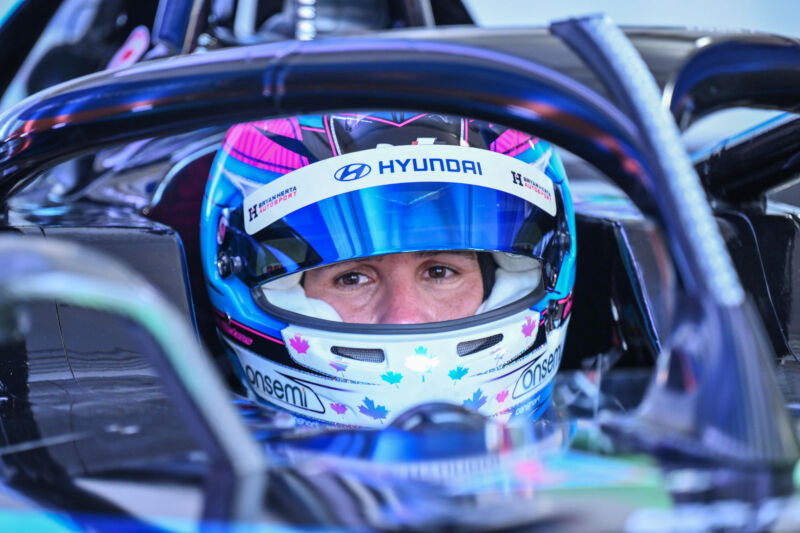
Enlarge/ Robert Wickens looks out from the cockpit of the Formula E GenBeta test car in Portland, Oregon.
Formula E
PORTLAND, Ore.—The timing of Robert Wickens’ life-altering crash at Pocono Raceway in 2018 could hardly have been more cruel. After landing a full-time seat in IndyCar, he was named rookie of the year at the Indy 500 in June, finally showing the world his talent in a single-seat race car. F1’s loss was IndyCar’s gain, and the prospect of championships seemed certain. But a bad wreck derailed all of that, leaving Wickens paralyzed from the waist down. This past weekend, he made his return to the cockpit of a single-seater, testing a Formula E car with hand controls at Portland International Raceway.
It wasn’t his first time in a racing car since 2018—for the last few years he’s been running in IMSA’s Michelin Pilot Challenge series, taking the 2023 TCR championship in a Hyundai Elantra N. But Formula E’s GenBeta car weighs almost 900 lbs less than Wickens’ Hyundai and boasts far more power and that immediate electric torque. More power than the Gen3 Formula E cars that lined up to race the following day, too—the 530 hp (395 kW) GenBeta machine is Formula E’s test bed and is able to deploy energy from its front electric motor (in addition to the rear motor) instead of just regenerating energy under braking.
I spoke with Wickens a few hours before his test and asked what he was expecting in terms of performance. “It’s an entirely different beast to an IndyCar,” he said. “So I know here in Portland that they actually had the exact same straight line speed as IndyCar [170 mph/275 km/h], obviously achieving in very different ways. The aerodynamic differences between the two and the whole philosophy of the series are entirely different. You’ll never really compare them, apples to apples, I don’t think, but, I’m really excited to give the Gen beta car a go,” Wickens said.
Enlarge/ The GenBeta car is Formula E’s rolling test bed.
Formula E
Unlike the steering wheel and accelerator and brake pedals most of us use, there’s no standard hand control setup, especially for a racing car. When Alex Zanardi competed in the 2019 Rolex 24, he used a wheel-mounted hand throttle to accelerate, but braked using a hand lever. That would be a challenge to fit into the tight confines of a single-seater cockpit, but that’s not the only reason Wickens and Formula E haven’t gone that route.
Hand controls
“When I was very early in my recovery, I had the luxury to talk to Alex several times. And he told me that if you need something easy, doing the brake lever off the steering wheel is the quickest solution to get into a car. But if you want to be as competitive as you can be, you have to have the brake on the steering wheel in some capacity,” Wickens said.
“It’s not like a sequential gearbox where you just downshift and then your two hands are on the steering wheel turning in—you’re trail-braking all the way to the apex. In Daytona, for example, you’re in the whole first section of the bus stop one handed—it’s like you can’t be 100 percent committed to the corner entry with one hand,” he explained.
I suggested that sounded like trying to race someone while holding a cellphone at the same time. “Pretty much yeah. But then unfortunately that cell phone is manipulating the balance of the car,” Wickens pointed out.
The advantage of a lever is the amount of force it allows the driver to send to the master cylinder. In his current setup in the TCR car, there’s a pneumatic actuator that helps apply sufficient brake pressure, “because I can only squeeze so much with my hands. And the difficulty with it is, there’s a small latency in achieving peak brake pressure. And that latency is not the same every time,” he said. While most of us would be rightfully terrified at having inconsistent brakes on track, Wickens adapted his driving style, something he says won’t transition to faster cars, though.
The US Supreme Court today agreed to hear a challenge to the Texas law that requires age verification on porn sites. A list of orders released this morning shows that the court granted a petition for certiorari filed by the Free Speech Coalition, an adult-industry lobby group.
In March, the US Court of Appeals for the 5th Circuit ruled that Texas could continue enforcing the law while litigation continues. In a 2-1 decision, 5th Circuit judges wrote that “the age-verification requirement is rationally related to the government’s legitimate interest in preventing minors’ access to pornography. Therefore, the age-verification requirement does not violate the First Amendment.”
The dissenting judge faulted the 5th Circuit majority for reviewing the law under the “rational-basis” standard instead of the more stringent strict scrutiny. The Supreme Court “has unswervingly applied strict scrutiny to content-based regulations that limit adults’ access to protected speech,” Judge Patrick Higginbotham wrote at the time.
Though the 5th Circuit majority upheld the age-verification rule, it also found that a requirement to display health warnings about pornography “unconstitutionally compel[s] speech” and cannot be enforced.
While the Supreme Court could eventually overturn the age-verification law, it is being enforced in the meantime. In April, the Supreme Court declined a request to temporarily block the Texas law.
Pornhub disabled site in Texas
After losing that April decision, the Free Speech Coalition said: “[We] remain hopeful that the Supreme Court will grant our petition for certiorari and reaffirm its lengthy line of cases applying strict scrutiny to content-based restrictions on speech like those in the Texas statute we’ve challenged.”
The Texas law, which took effect in September 2023, applies to websites in which more than one-third of the content “is sexual material harmful to minors.” Those websites must “use reasonable age verification methods” to limit their material to adults.
In February 2024, Texas Attorney General Ken Paxton alleged in a lawsuit that Pornhub owner Aylo (formerly MindGeek) violated the law. Pornhub disabled its website in Texas after the 5th Circuit ruling and has gone dark in other states in response to similar age laws.
The Free Speech Coalition’s petition for certiorari said that the Supreme Court “has repeatedly held that States may rationally restrict minors’ access to sexual materials, but such restrictions must withstand strict scrutiny if they burden adults’ access to constitutionally protected speech.” The group asked the court to determine whether the 5th Circuit “erred as a matter of law in applying rational-basis review to a law burdening adults’ access to protected speech, instead of strict scrutiny as this Court and other circuits have consistently done.”
“While purportedly seeking to limit minors’ access to online sexual content, the Act imposes significant burdens on adults’ access to constitutionally protected expression,” the petition said. “Of central relevance here, it requires every user, including adults, to submit personally identifying information to access sensitive, intimate content over a medium—the Internet—that poses unique security and privacy concerns.”
Enlarge/ Tires are a growing source of microplastic pollution. Michelin says it wants to change that.
Getty Images
Reduce, Reuse, Recycle—it’s more than just a fun alliteration tagline. It’s also a set of instructions for how to consume in a way that’s less destructive to our environment. We reduce our consumption and reuse what we already have, then recycle it once it no longer has any use. Unfortunately, many are going straight to recycling and calling it a day.
At its sustainability summit in Northern California at the Sonoma Raceway, Michelin laid out a new roadmap for its plans to become a more sustainable company. Most importantly, the company shared what it’s been doing for decades to reduce the harm done to the world by its tires.
The company reiterated its desire to have 100 percent renewable tires by 2050. Companies make a lot of pronouncements like this, and they only sometimes come to fruition. But looking at Michelin’s present efforts and past record, the company has a decent chance of succeeding.
The now
Michelin currently has a demonstration tire made of 42 percent renewable materials. The company has plenty of time to reach its goal in 2050, so it’s trying to make the change in the most profitable way possible.
“We are guided by a sustainable world view of organizing principles that is in every business decision we make. We balance it across three domains: the people, the planet, the profits,” Michelin North America President and CEO Alexis Garcin said during a presentation.
The “People, Planet, Profit” principles emphasize eco-consciousness but also remind everyone that Michelin is a company that needs to make money to keep tires rolling off the lines.
During the event, Michelin said that its research into more sustainable tires requires teams to show that the materials they use are readily available and that the tire can be produced at scale. This is a vast improvement over companies that unveil unrealistic, feel-good items that won’t ever see production.
The then
In 1992, Michelin introduced its first fuel-efficient tire. It had a lower rolling resistance, allowing drivers to potentially save money on gas and reduce their carbon footprint (although, to be fair, most probably didn’t think about that).
The company has been stress-testing the stuff that goes into tires, too. In 2019, it introduced new racing tires for IMSA’s WeatherTech Sportscar Championship that used 30 percent renewable and recycled materials, with no real drop-off in performance.
There’s also the reputation for longevity. According to a 2023 study by the German ADAC (Allgemeiner Deutscher Automobil-Club—think Germany’s AAA), Michelin’s average tire abrasion rate was 28 percent lower than the rate in average tires from other brands on the road in Germany.
The abrasion rate is how much of the tire is shed while driving. The higher the abrasion rate, the more particulates are left on the asphalt, which migrate to the soil and eventually end up in the water supply. Much has been said about these particles that have permeated our environment, little of it good.
Tires are a major source of microplastics, and as our vehicles get larger and heavier due to an insatiable appetite for large vehicles and our transition to EVs, tire companies have a spotlight on them to reduce their product abrasion rates. Here, Michelin seems to be ahead of the curve.
The later
Eighty percent of a tire’s environmental impact comes from the time that it’s sitting on a vehicle. Building a more sustainable tire can’t be done by just relying on different materials, especially if those materials wear down quicker than what’s already on the road. Michelin’s lifecycle assessment looks at the cradle-to-grave impact of a product as an ecosystem.
“For us, it’s people, profit, planet. We care about all of them at the same time with the same intensity, and that’s how we think we’re going to be sustainable,” Garcin said. If the company keeps sight of the goal, it might just pull it off.
Hellboy: The Crooked Man is based on a 2008 limited series by Mike Mignola and artist Richard Corben.
It has only been a few years since David Harbour starred in the 2019 reboot of the Hellboy film franchise—a critical and box office failure, although Harbour’s performance earned praise. But via Entertainment Weekly, we learned that there’s a new reboot coming our way: Hellboy: The Crooked Man. The project wrapped filming in May and now has a teaser—inexplicably released in 480p—giving us our first glimpse of star Jack Kesy’s (Claws, Deadpool 2) take on Mike Mignola’s iconic character.
It’s definitely a very different look and vibe from the previous big studio releases. Director Brian Taylor (Crank) is clearly leaning into the low-budget folk horror genre for this, but will fans embrace a bargain-basement Hellboy reboot—even one co-written by Mignola himself?
Mignola based his script on a 2008 Hellboy limited series he created, with artwork by Richard Corben. That story features a younger Hellboy wandering in the Appalachian Mountains in 1958 after “finishing up some stuff down South.” He meets regional native Tom Ferrell, coming home after decades away. When he was young, Tom was initiated as a witch and has returned to atone for that, even though he has never actually practiced magic—apart from a magical “witch-bone” he carries with him.
Tom and Hellboy team up to protect a young witch named Cora from having her soul reaped by the Crooked Man, aided by a blind pastor, the Reverend Watts. The Crooked Man was an 18th-century war profiteer named Jeremiah Witkins. Witkins was hanged for his crimes but returned from Hell and became the resident devil in those parts. Witkins wants Cora’s soul, and he also covets Tom’s witch-bone, but his evil machinations prove to be no match for Hellboy.
Enlarge/ Jack Kesy steps into the role of Hellboy, following in the footsteps of Ron Perlman and David Harbour.
Ketchup Entertainment
The new film seems to hew fairly closely to the source material—understandably so given Mignola’s direct involvement. Per the official premise: “In the 1950s, Hellboy and a rookie BPRD (Bureau of Paranormal Research and Defense) agent, stranded in rural Appalachia, discover a small community haunted by witches, led by a local devil with a troubling connection to Hellboy’s past: the Crooked Man.”
In addition to Kesy, the cast includes Jefferson White as Tom Ferrell; Adeline Rudolph as rookie BPRD agent Bobbie Jo Song; Joseph Marcell as Reverend Nathaniel Armstrong Watts; Leah McNamara as Effie Kolb; Hannah Margetson as Cora Fisher; and Martin Bassindale in a dual role: Trevor “Broom” Bruttenholm, founder and head of the BPRD and Hellboy’s adoptive father, and Jeremiah Witkins, aka the Crooked Man.
The teaser opens with some scenic shots of Appalachia as Hellboy makes ominous comments in a voiceover about “evil” lurking and how the forest “smells like death.” It doesn’t take long for that evil to make itself known, as a levitating woman is bitten by a snake, plagues of insects and other creatures wreak havoc, and Hellboy is assured that “all your friends are gonna die.” The poor quality of the teaser is unfortunate and frankly does not instill tons of confidence, but I like the folk horror vibe; some of those scenes look hella scary. Tonally, the teaser feels a bit like The Blair Witch Project meets The Conjuring or The Witch.
What it doesn’t feel like is the Hellboy we have come to know and love. Look, diehard fans are still mad that Guillermo del Toro never got to complete his planned trilogy after the massive success of Hellboy (2004) and Hellboy II: The Golden Army (2008). Originally titled Hellboy III: Dark Worlds, the project was canceled due to lack of financing, and the fans haven’t forgotten… or forgiven.
Lionsgate tried to reboot the franchise instead with Harbour in the titular role, but that film turned out to be one of the biggest flops of 2019. Director Neil Marshall actually disowned the film, calling it “godawful” and “the worst professional experience of my life.” He had pitched the project as a darker, R-rated horror version of Hellboy, but studio interference meant he had very little creative control in the end. Now it’s Taylor’s turn to bring us his own darker, horrific R-rated vision, working on a smaller scale—if nothing else, it hopefully reduced the aforementioned studio interference. There’s not yet a release date, but we’ll see how it turned out soon enough.
Enlarge/ Right now, the software doesn’t do arms, so don’t go taking on any aliens with it.
20th Century Fox
Exoskeletons today look like something straight out of sci-fi. But the reality is they are nowhere near as robust as their fictional counterparts. They’re quite wobbly, and it takes long hours of handcrafting software policies, which regulate how they work—a process that has to be repeated for each individual user.
To bring the technology a bit closer to Avatar’s Skel Suits or Warhammer 40k power armor, a team at North Carolina University’s Lab of Biomechatronics and Intelligent Robotics used AI to build the first one-size-fits-all exoskeleton that supports walking, running, and stair-climbing. Critically, its software adapts itself to new users with no need for any user-specific adjustments. “You just wear it and it works,” says Hao Su, an associate professor and co-author of the study.
Tailor-made robots
An exoskeleton is a robot you wear to aid your movements—it makes walking, running, and other activities less taxing, the same way an e-bike adds extra watts on top of those you generate yourself, making pedaling easier. “The problem is, exoskeletons have a hard time understanding human intentions, whether you want to run or walk or climb stairs. It’s solved with locomotion recognition: systems that recognize human locomotion intentions,” says Su.
Building those locomotion recognition systems currently relies on elaborate policies that define what actuators in an exoskeleton need to do in each possible scenario. “Let’s take walking. The current state of the art is we put the exoskeleton on you and you walk on a treadmill for an hour. Based on that, we try to adjust its operation to your individual set of movements,” Su explains.
Building handcrafted control policies and doing long human trials for each user makes exoskeletons super expensive, with prices reaching $200,000 or more. So, Su’s team used AI to automatically generate control policies and eliminate human training. “I think within two or three years, exoskeletons priced between $2,000 and $5,000 will be absolutely doable,” Su claims.
His team hopes these savings will come from developing the exoskeleton control policy using a digital model, rather than living, breathing humans.
Digitizing robo-aided humans
Su’s team started by building digital models of a human musculoskeletal system and an exoskeleton robot. Then they used multiple neural networks that operated each component. One was running the digitized model of a human skeleton, moved by simplified muscles. The second neural network was running the exoskeleton model. Finally, the third neural net was responsible for imitating motion—basically predicting how a human model would move wearing the exoskeleton and how the two would interact with each other. “We trained all three neural networks simultaneously to minimize muscle activity,” says Su.
One problem the team faced is that exoskeleton studies typically use a performance metric based on metabolic rate reduction. “Humans, though, are incredibly complex, and it is very hard to build a model with enough fidelity to accurately simulate metabolism,” Su explains. Luckily, according to the team, reducing muscle activations is rather tightly correlated with metabolic rate reduction, so it kept the digital model’s complexity within reasonable limits. The training of the entire human-exoskeleton system with all three neural networks took roughly eight hours on a single RTX 3090 GPU. And the results were record-breaking.
Bridging the sim-to-real gap
After developing the controllers for the digital exoskeleton model, which were developed by the neural networks in simulation, Su’s team simply copy-pasted the control policy to a real controller running a real exoskeleton. Then, they tested how an exoskeleton trained this way would work with 20 different participants. The averaged metabolic rate reduction in walking was over 24 percent, over 13 percent in running, and 15.4 percent in stair climbing—all record numbers, meaning their exoskeleton beat every other exoskeleton ever made in each category.
This was achieved without needing any tweaks to fit it to individual gaits. But the neural networks’ magic didn’t end there.
“The problem with traditional, handcrafted policies was that it was just telling it ‘if walking is detected do one thing; if walking faster is detected do another thing.’ These were [a mix of] finite state machines and switch controllers. We introduced end-to-end continuous control,” says Su. What this continuous control meant was that the exoskeleton could follow the human body as it made smooth transitions between different activities—from walking to running, from running to climbing stairs, etc. There was no abrupt mode switching.
“In terms of software, I think everyone will be using this neural network-based approach soon,” Su claims. To improve the exoskeletons in the future, his team wants to make them quieter, lighter, and more comfortable.
But the plan is also to make them work for people who need them the most. “The limitation now is that we tested these exoskeletons with able-bodied participants, not people with gait impairments. So, what we want to do is something they did in another exoskeleton study at Stanford University. We would take a one-minute video of you walking, and based on that, we would build a model to individualize our general model. This should work well for people with impairments like knee arthritis,” Su claims.
Enlarge/ Extreme sportsman Ross Edgley comes face to face with a great hammerhead shark in the waters of Bimini in the Bahamas.
National Geographic/Nathalie Miles
Ultra-athlete Ross Edgley is no stranger to pushing his body to extremes. He once ran a marathon while pulling a one-ton car; ran a triathlon while carrying a 100-pound tree; and climbed a 65-foot rope over and over again until he’d climbed the equivalent of Mt. Everest—all for charity. In 2016, he set the world record for the world’s longest staged sea swim around the coastline of Great Britain: 1780 miles over 157 days.
At one point during that swim, a basking shark appeared and swam alongside Edgley for a day and a half. That experience ignited his curiosity about sharks and eventually led to his new National Geographic documentary, Shark vs. Ross Edgley—part of four full weeks of 2024 SHARKFEST programming. Edgley matches his athletic prowess against four different species of shark. He tries to jump out of the water (polaris) like a great white shark; withstand the G forces produced by a hammerhead shark‘s fast, rapid turns; mimic the extreme fasting and feasting regimen of a migrating tiger shark; and match the swimming speed of a mako shark.
“I love this idea of having a goal and then reverse engineering and deconstructing it,” Edgley told Ars. “[Sharks are] the ultimate ocean athletes. We just had this idea: what if you’re crazy enough to try and follow in the footsteps of four amazing sharks? It’s an impossible task. You’re going to fail, you’re going to be humbled. But in the process, we could use it as a sports/shark science experiment, almost like a Trojan horse to bring science and ocean conservation to a new audience.”
And who better than Edgley to take on that impossible challenge? “The enthusiasm he brings to everything is really infectious,” marine biologist and shark expert Mike Heithaus of Florida International University told Ars. “He’s game to try anything. He’d never been in the water with sharks and we’re throwing him straight in with big tiger sharks and hammerheads. He’s loving the whole thing and just devoured all the information.”
That Edgley physique doesn’t maintain itself, so the athlete was up at 4 AM swimming laps and working out every morning before the rest of the crew had their coffee. “I’m doing bicep curls with my coffee cup and he’s doing bicep curls with the 60-pound underwater camera,” Heithaus recalled. “For the record, I got one rep in and I’m very proud of that.” Score one for the shark expert.
(Spoilers below for the various shark challenges.)
Ross vs. the great white shark
Ross Edgley gets some tips on how to power (polaris) his body out of the water like a white shark from synchronized swimmer Samantha Wilson
National Geographic/Nathalie Miles
The Aquabatix synchronized swim team demonstrates the human equivalent to a white shark’s polaris.
National Geographic/Nathalie Miles
Edgley tries out a mono fin to improve his polaris performance.
National Geographic/Nathalie Miles
Edgley propelling 3/4 of his body out of the pool to mimic a white shark’s polaris movement
National Geographic/Bobby Cross
For the first challenge, Edgley took on the great white shark, a creature he describes as a “submarine with teeth.” These sharks are ambush hunters, capable of propelling their massive bodies fully out of the water in an arching leap. That maneuver is called a polaris, and it’s essential to the great white shark’s survival. It helps that the shark has 65 percent muscle mass, particularly concentrated in the tail, as well as a light skeleton and a large liver that serves as buoyancy device.
Edgley, by comparison, is roughly 45 percent muscle mass—much higher than the average human but falling short of the great white shark. To help him try to match the great white’s powerful polaris maneuver, Edgley sought tips on biomechanics from the Aquabatix synchronized swim team, since synchronized swimmers must frequently launch their bodies fully out of the water during routines. They typically get a boost from their teammates to do so.
The team did manage to boost Edgley out of the water, but sharks don’t need a boost. Edgley opted to work with a monofin, frequently used in underwater sports like free diving or finswimming, to see what he could achieve on his own power. After a bit of practice, he succeeded in launching 75 percent of his body (compared to the shark’s 100 percent) out of the water. Verdict: Edgley is 75 percent great white shark.
Ross vs. the hammerhead shark
Edgley vs. a hammerhead shark. He will try to match the animal’s remarkable agility underwater.
National Geographic/Nathalie Miles
A camera team films a hammerhead shark making sharp extreme turns
National Geographic/Nathalie Miles
Edgley prepares to go airborne in a stunt plane to try and mimic the agility of a hammerhead shark in the water.
National Geographic/Nathalie Miles
A standard roll produces 2 g’s, while pulling up is 3 g’s
YouTube/National Geographic
Edgley is feeling a bit queasy.
YouTube/National Geographic
Next up: Edgley pitted himself against the remarkable underwater agility of a hammerhead shark. Hammerheads are known for being able to swim fast and turn on a dime, thanks to a flexible skeleton that enables them to bend and contort their bodies nearly in half. They’re able to withstand some impressive G forces (up to 3 G’s) in the process. According to Heithaus, these sharks feed on other rays and other sharks, so they need to be built for speed and agility—hence their ability to accelerate and turn rapidly.
The NatGeo crew captured impressive underwater footage of the hammerheads in action, including Edgley meeting a 14.7 hammerhead named “Queenie”—one of the largest great hammerheads that visits Bimini in the Bahamas during the winter. That footage also includes shots of divers feeding fish to some of the hammerheads by hand. “They know every shark by name and the sharks know the feeders,” said Heithaus. “So you can safely get close to these big amazing creatures.”
For years, scientists had wondered about the purpose of the distinctive hammer-shaped head. It may help them scan a larger area of the ocean floor while hunting. Like all sharks, hammerheads have sensory pores called ampullae of Lorenzini that allow them to detect electrical signals and hence possible prey. The hammer-shaped head distributes those pores over a wider span.
But according to Heithaus, the hammer shape also operates a bit like the big broad flap of an airplane wing, resulting in excellent hydrodynamics. Moving at high speeds, “You can just tilt the head a tiny bit and bank a huge degree,” he said. “So if a ray turns 180 degrees to escape, the hammerhead can track with it. Other species would take a wider turn and fall behind.”
The airplane wing analogy gave Edgley an idea for how he could mimic the tight turns and high G forces of a hammerhead shark: take a flight in a small stunt plane. The catch: Edgley is not a fan of flying. And as he’d feared, he became horribly airsick during the challenge, even puking into a little airbag at one point. “It looks so cool in the clip,” he said. “But at the time, I was in a world of trouble.” Pilot Mark Greenfield finally cut the experiment short when he determined that Edgley was too sick to continue. Verdict: Edgley is 0 percent hammerhead shark.
Ross vs. the tiger shark
Shark expert Mike Heithaus holds a gelatin shark “lolliop” while Edgley flexes.
National Geographic/Nathalie Miles
Edgley and Heithaus underwater with a tiger shark, tempting it with a gelatin lollipop.
National Geographic/Nathalie Miles
Success! A tiger shark takes a nice big bite.
National Geographic/Nathalie Miles
Edgley flexes with the giant gelatin lollipop with a large bite taken out of it by a tiger shark
National Geographic/Nathalie Miles
Edgley gets his weight and body volume measured in the “Bodpod” before his tiger shark challenge.
National Geographic/Bobby Cross
Edgley fasted and exercised for 24 hours to mimic a tiger shark on a migration route. He dropped 14 pounds.
National Geographic/Nathalie Miles
After all that fasting and exercise, Edgley then gorged himself for 24 hours to put the weight back on. He gained 22 pounds.
National Geographic/Nathalie Miles
The third challenge was trying to match the fortitude of a migrating tiger shark as it makes its way over thousands of miles without food, only feasting at journey’s end. “I was trying to understand the psychology of a tiger shark because there’s just nothing for them to eat [on the journey],” said Ross. And once they arrive at their destination, “they can chow down on entire whale carcasses and eat just about anything. That idea of feast and famine is something we humans used to do all the time. We live quite comfortably now so we’ve lost touch with that.”
The first step was to figure out just how many calories a migrating tiger shark can consume in a single bite. Heithaus has been part of SHARKFEST for several years now and recalled one throwback show, Sharks vs. Dolphins, in which he tried to determine which species of of shark were attacking dolphins, and just how big those sharks might be. He hit upon the idea of making a dolphin shape out of gelatin—essentially the same stuff FIU’s forensic department uses for ballistic tests—and asked his forensic colleagues to make one for him, since the material has the same weight and density of dolphin blubber.
For the Edgley documentary, they made a large gelatin lollipop the same density as whale blubber, and he and Edgley dove down and managed to get an 11-foot tiger shark to take a big 6.2-pound bite out of it. We know how many calories are in whale blubber so Heithaus was able to deduce from that how many calories per bite a tiger shark consumed (6.2 pounds of whale meet is equivalent to about 25,000 calories).
Such field work also lets him gather ever mire specimens of shark bites from a range of species for his research. “The great thing about SHARKFEST is that you’re seeing new, cutting-edge science that may or may not work,” said Heithaus. “But that’s what science is about: trying things and advancing our knowledge even if it doesn’t work al the time, and then sharing that information and excitement with the public.”
Then it was time for Edgley to make like a migrating shark and embark on a carefully designed famine-and-feast regime. First, his weight and body volume were measured in a “Bodpod”: 190.8 pounds and 140.8 pints. Then Edgley fasted and exercised almost continuously for 24 hours with a mix of weight training, running, swimming, sitting in the sauna, and climate chamber cycling. (He did sleep for a few hours.) He dropped 14 pounds and lost twelve pints, ending up at a weight of 177 pounds and a volume of 128.7 pints. Instead of food, what he craved most at the end was water. “When you are in a completely deprived state, you find out what your body actually needs, not what it wants,” said Edgley.
After slaking his thirst, it was time to gorge. Over the next 24 hours, Edgley consumed an eye-popping 35,103 calories in carefully controlled servings. It’s quite the menu: Haribo mix, six liters of Lucozade, a Hulk smoothie, pizza, five slices of lemon blueberry cheesecake, five slices of chocolate mint cheesecake, fish and chips, burgers and fries, two cinnamon loaves, four tubs of Ben & Jerry’s ice cream, two full English breakfasts, five liters of custard, four mars bars, and four mass gainer shakes.
When his weight and volume were measured one last time in the Bodpod, Edgley had regained a whopping 22 pounds for a final weight of 199 pounds. “I wish I had Ross’s ability to eat that much and remain at 0 percent body fat,” said Heithaus. Verdict: Edgley is 28 percent tiger shark.
Ross vs. the mako shark
In 2018, Edgely set the world record for longest assisted sea swim.
National Geographic/Nathalie Miles
Edgley tries to match the speed of a mako shark in the waters of the Menai Strait in Wales.
National Geographic/Nathalie Miles
Finally, Edgley pitted himself against the mighty mako shark. Mako sharks are the speediest sharks in the ocean, capable of swimming at speeds up to 43 MPH. Edgley is a long-distance swimmer, not a sprinter, so he threw himself into training at Loughborough University with British Olympians coaching him. He fell far short of a mako shark’s top speed. The shape of the human body is simply much less hydrodynamic than that of a shark. He realized that despite his best efforts, “I was making up hundredths of a second, which is huge in sprinting,” he said. “That could be the difference between a gold medal at the Paris Olympics and not. But I needed to make up many kilometers per hour.”
So Edgley decided to “think like a shark” and employ a shark-like strategy of riding the ocean currents to increase his speed. He ditched the pool and headed to the Menai Strait in Wales for some open water swimming. Ultimately he was able to hit 10.24 MPH—double what an Olympic swimmer could manage in a pool, but just 25 percent of a mako shark’s top speed. And he managed with the help or a team of 20-30 people dropping him into the fastest tide possible. “A mako shark would’ve just gone, ‘This is a Monday morning, this isn’t an event for me, I’m off,'” said Edgley. Verdict: Edgley is 24 percent mako shark
When the results of all four challenges were combined, Edgley came out at 32 percent overall, or nearly one-third shark. While Edgley confessed to being humbled by his limitations, “I don’t think there’s anyone else out there who could do so as well across the board in comparison,” said Heithaus.
The ultimate goal of Shark vs. Ross Edgley—and indeed all of the SHARKFEST programming—is to help shift public perceptions of sharks. “The great Sir David Attenborough said that the problems facing us in terms of conservation is as much a communication issue as a scientific one,” Edgley said. “The only way we can combat that is by educating people.”
Shark populations have declined sharply by 70 percent or more over the last 50 years. “It’s really critical that we protect and restore these populations,” Heithaus said. Tiger sharks, for instance, eat big grazers like turtles and sea cows, and thus protect the sea grass. (Among other benefits, the sea grass sequesters carbon dioxide.) Sharks are also quite sophisticated in their behavior. “Some have social connections with other sharks, although not to the same extent as dolphins,” said Heithaus. “They’re more than just loners, and they may have personalities. We see some sharks that are more bold, and others that are more shy. There’s a lot more to sharks than we would have thought.”
People who hear about Edgley’s basking shark encounter invariably assume he’d been in danger. However, “We were friends. I’m not on its menu,” Edgley said. “There are so many different species.” He likened it to being chased by a dog. People might assume it was a rottweiler giving chase, when in fact the basking shark is the equivalent of a poodle. “Hopefully what people take away from this is moving from a fear and misunderstanding of sharks to respect and admiration,” Edgley said. “That’ll make the RAF fighter pilot plane worth it.”
And he’s game to take on even more shark challenges in the future. There are a lot more shark species out there, after all, just waiting to go head-to-head with a human ultra-athlete.
Shark vs. Ross Edgley premieres on Sunday, June 30, 2024, on Disney+.
Enlarge/ Preparing to install the floppy disk edition of FreeDOS 1.3 in a virtual machine.
Andrew Cunningham
Two big things happened in the world of text-based disk operating systems in June 1994.
The first is that Microsoft released MS-DOS version 6.22, the last version of its long-running operating system that would be sold to consumers as a standalone product. MS-DOS would continue to evolve for a few years after this, but only as an increasingly invisible loading mechanism for Windows.
The second was that a developer named Jim Hall wrote a post announcing something called “PD-DOS.” Unhappy with Windows 3.x and unexcited by the project we would come to know as Windows 95, Hall wanted to break ground on a new “public domain” version of DOS that could keep the traditional command-line interface alive as most of the world left it behind for more user-friendly but resource-intensive graphical user interfaces.
PD-DOS would soon be renamed FreeDOS, and 30 years and many contributions later, it stands as the last MS-DOS-compatible operating system still under active development.
While it’s not really usable as a standalone modern operating system in the Internet age—among other things, DOS is not really innately aware of “the Internet” as a concept—FreeDOS still has an important place in today’s computing firmament. It’s there for people who need to run legacy applications on modern systems, whether it’s running inside of a virtual machine or directly on the hardware; it’s also the best way to get an actively maintained DOS offshoot running on legacy hardware going as far back as the original IBM PC and its Intel 8088 CPU.
To mark FreeDOS’ 20th anniversary in 2014, we talked with Hall and other FreeDOS maintainers about its continued relevance, the legacy of DOS, and the developers’ since-abandoned plans to add ambitious modern features like multitasking and built-in networking support (we also tried, earnestly but with mixed success, to do a modern day’s work using only FreeDOS). The world of MS-DOS-compatible operating systems moves slowly enough that most of this information is still relevant; FreeDOS was at version 1.1 back in 2014, and it’s on version 1.3 now.
For the 30th anniversary, we’ve checked in with Hall again about how the last decade or so has treated the FreeDOS project, why it’s still important, and how it continues to draw new users into the fold. We also talked, strange as it might seem, about what the future might hold for this inherently backward-looking operating system.
FreeDOS is still kicking, even as hardware evolves beyond it
Running AsEasyAs, a Lotus 1-2-3-compatible spreadsheet program, in FreeDOS.
Jim Hall
If the last decade hasn’t ushered in The Year of FreeDOS On The Desktop, Hall says that interest in and usage of the operating system has stayed fairly level since 2014. The difference is that, as time has gone on, more users are encountering FreeDOS as their first DOS-compatible operating system, not as an updated take on Microsoft and IBM’s dusty old ’80s- and ’90s-era software.
“Compared to about 10 years ago, I’d say the interest level in FreeDOS is about the same,” Hall told Ars in an email interview. “Our developer community has remained about the same over that time, I think. And judging by the emails that people send me to ask questions, or the new folks I see asking questions on our freedos-user or freedos-devel email lists, or the people talking about FreeDOS on the Facebook group and other forums, I’d say there are still about the same number of people who are participating in the FreeDOS community in some way.”
“I get a lot of questions around September and October from people who ask, basically, ‘I installed FreeDOS, but I don’t know how to use it. What do I do?’ And I think these people learned about FreeDOS in a university computer science course and wanted to learn more about it—or maybe they are already working somewhere and they read an article about it, never heard of this “DOS” thing before, and wanted to try it out. Either way, I think more folks in the user community are learning about “DOS” at the same time they are learning about FreeDOS.”