Author name: Beth Washington

why-solving-crosswords-is-like-a-phase-transition

Why solving crosswords is like a phase transition

There’s also the more recent concept of “explosive percolation,” whereby connectivity emerges not in a slow, continuous process but quite suddenly, simply by replacing the random node connections with predetermined criteria—say, choosing to connect whichever pair of nodes has the fewest pre-existing connections to other nodes. This introduces bias into the system and suppresses the growth of large dominant clusters. Instead, many large unconnected clusters grow until the critical threshold is reached. At that point, even adding just one or two more connections will trigger one global violent merger (instant uber-connectivity).

Puzzling over percolation

One might not immediately think of crossword puzzles as a network, although there have been a couple of relevant prior mathematical studies. For instance, John McSweeney of the Rose-Hulman Institute of Technology in Indiana employed a random graph network model for crossword puzzles in 2016. He factored in how a puzzle’s solvability is affected by the interactions between the structure of the puzzle’s cells (squares) and word difficulty, i.e., the fraction of letters you need to know in a given word in order to figure out what it is.

Answers represented nodes while answer crossings represented edges, and McSweeney assigned a random distribution of word difficulty levels to the clues. “This randomness in the clue difficulties is ultimately responsible for the wide variability in the solvability of a puzzle, which many solvers know well—a solver, presented with two puzzles of ostensibly equal difficulty, may solve one readily and be stumped by the other,” he wrote at the time. At some point, there has to be a phase transition, in which solving the easiest words enables the puzzler to solve the more difficult words until the critical threshold is reached and the puzzler can fill in many solutions in rapid succession—a dynamic process that resembles, say, the spread of diseases in social groups.

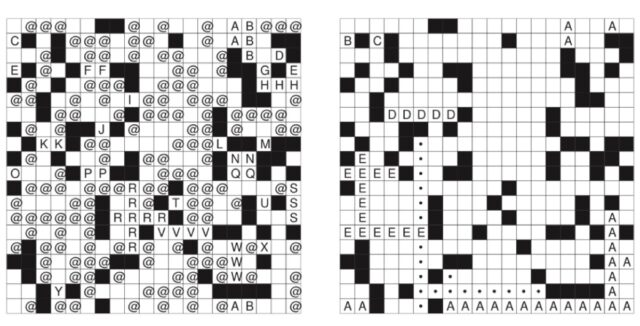
In this sample realization, sites with black sites are shown in black; empty sites are white; and occupied sites contain symbols and letters.

In this sample realization, black sites are shown in black; empty sites are white; and occupied sites contain symbols and letters. Credit: Alexander K. Hartmann, 2024

Hartmann’s new model incorporates elements of several nonstandard percolation models, including how much the solver benefits from partial knowledge of the answers. Letters correspond to sites (white squares) while words are segments of those sites, bordered by black squares. There is an a priori probability of being able to solve a given word if no letters are known. If some words are solved, the puzzler gains partial knowledge of neighboring unsolved words, which increases the probability of those words being solved as well.

Why solving crosswords is like a phase transition Read More »

nasa-defers-decision-on-mars-sample-return-to-the-trump-administration

NASA defers decision on Mars Sample Return to the Trump administration


“We want to have the quickest, cheapest way to get these 30 samples back.”

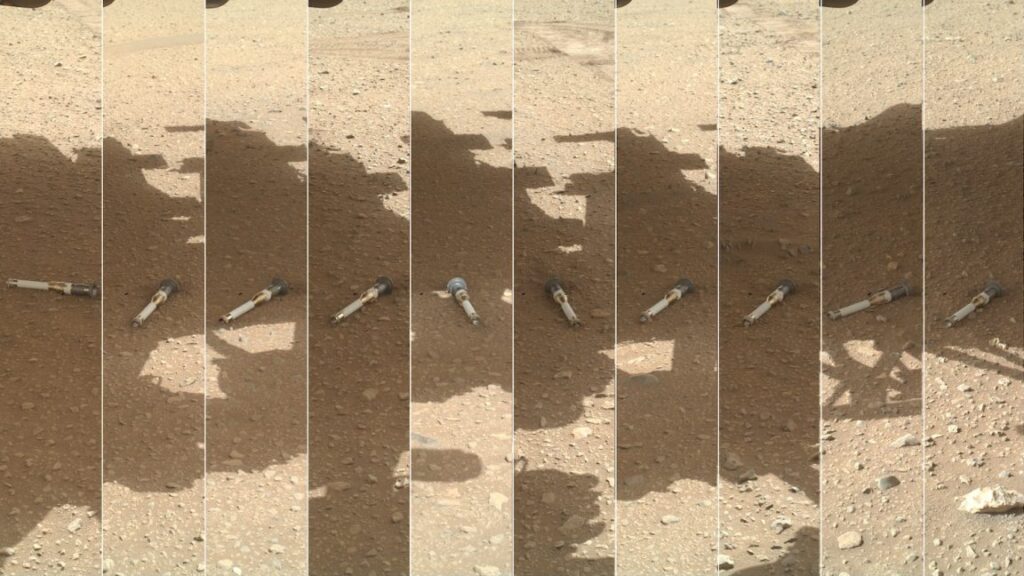
This photo montage shows sample tubes shortly after they were deposited onto the surface by NASA’s Perseverance Mars rover in late 2022 and early 2023. Credit: NASA/JPL-Caltech/MSSS

For nearly four years, NASA’s Perseverance rover has journeyed across an unexplored patch of land on Mars—once home to an ancient river delta—and collected a slew of rock samples sealed inside cigar-sized titanium tubes.

These tubes might contain tantalizing clues about past life on Mars, but NASA’s ever-changing plans to bring them back to Earth are still unclear.

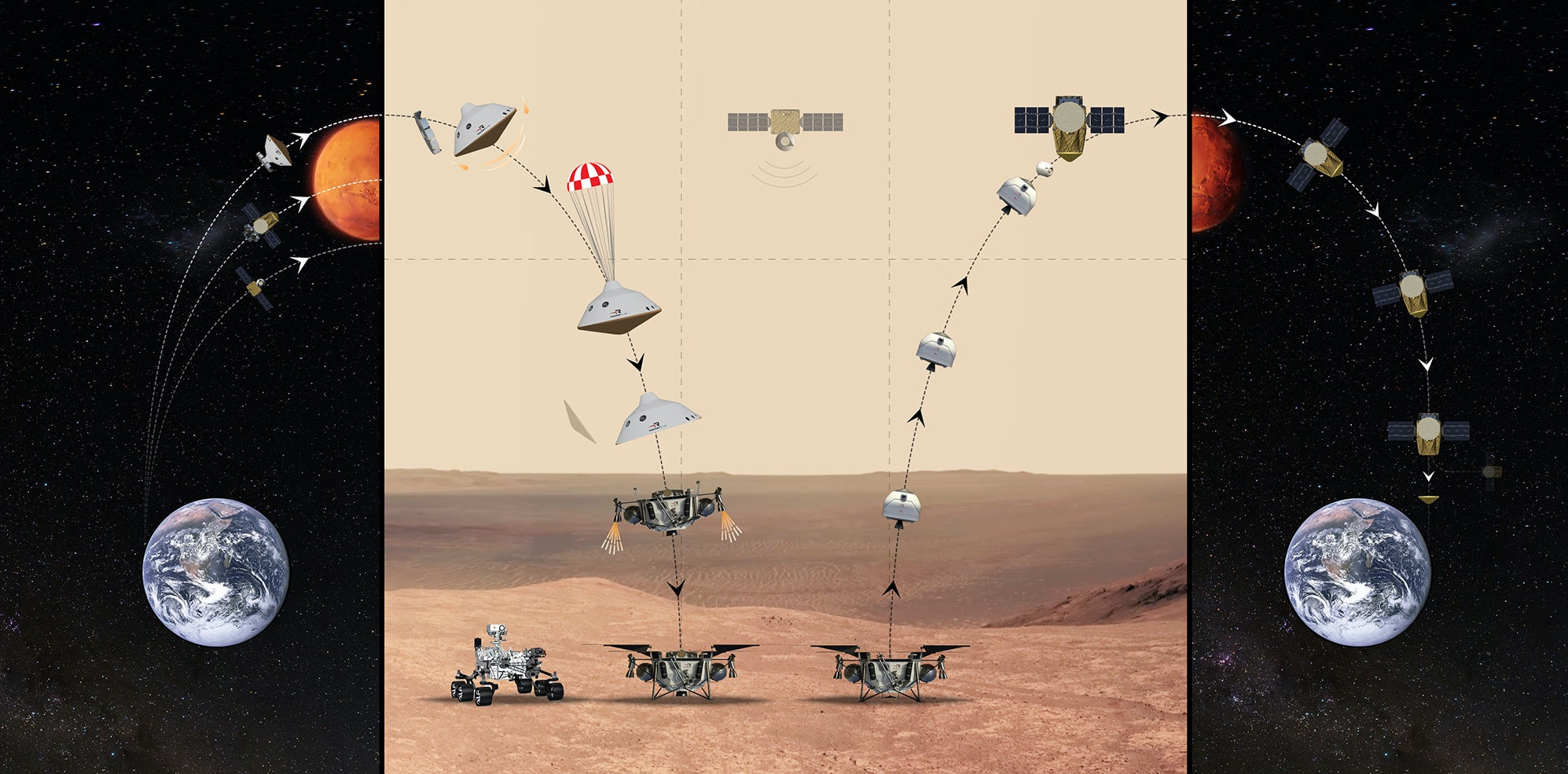
On Tuesday, NASA officials presented two options for retrieving and returning the samples gathered by the Perseverance rover. One alternative involves a conventional architecture reminiscent of past NASA Mars missions, relying on the “sky crane” landing system demonstrated on the agency’s two most recent Mars rovers. The other option would be to outsource the lander to the space industry.

NASA Administrator Bill Nelson left a final decision on a new mission architecture to the next NASA administrator working under the incoming Trump administration. President-elect Donald Trump nominated entrepreneur and commercial astronaut Jared Isaacman as the agency’s 15th administrator last month.

“This is going to be a function of the new administration in order to fund this,” said Nelson, a former Democratic senator from Florida who will step down from the top job at NASA on January 20.

The question now is: will they? And if the Trump administration moves forward with Mars Sample Return (MSR), what will it look like? Could it involve a human mission to Mars instead of a series of robotic spacecraft?

The Trump White House is expected to emphasize “results and speed” with NASA’s space programs, with the goal of accelerating a crew landing on the Moon and sending people to explore Mars.

NASA officials had an earlier plan to bring the Mars samples back to Earth, but the program slammed into a budgetary roadblock last year when an independent review team concluded the existing architecture would cost up to $11 billion—double the previous cost projectionand wouldn’t get the Mars specimens back to Earth until 2040.

This budget and schedule were non-starters for NASA. The agency tasked government labs, research institutions, and commercial companies to come up with better ideas to bring home the roughly 30 sealed sample tubes carried aboard the Perseverance rover. NASA deposited 10 sealed tubes on the surface of Mars a couple of years ago as insurance in case Perseverance dies before the arrival of a retrieval mission.

“We want to have the quickest, cheapest way to get these 30 samples back,” Nelson said.

How much for these rocks?

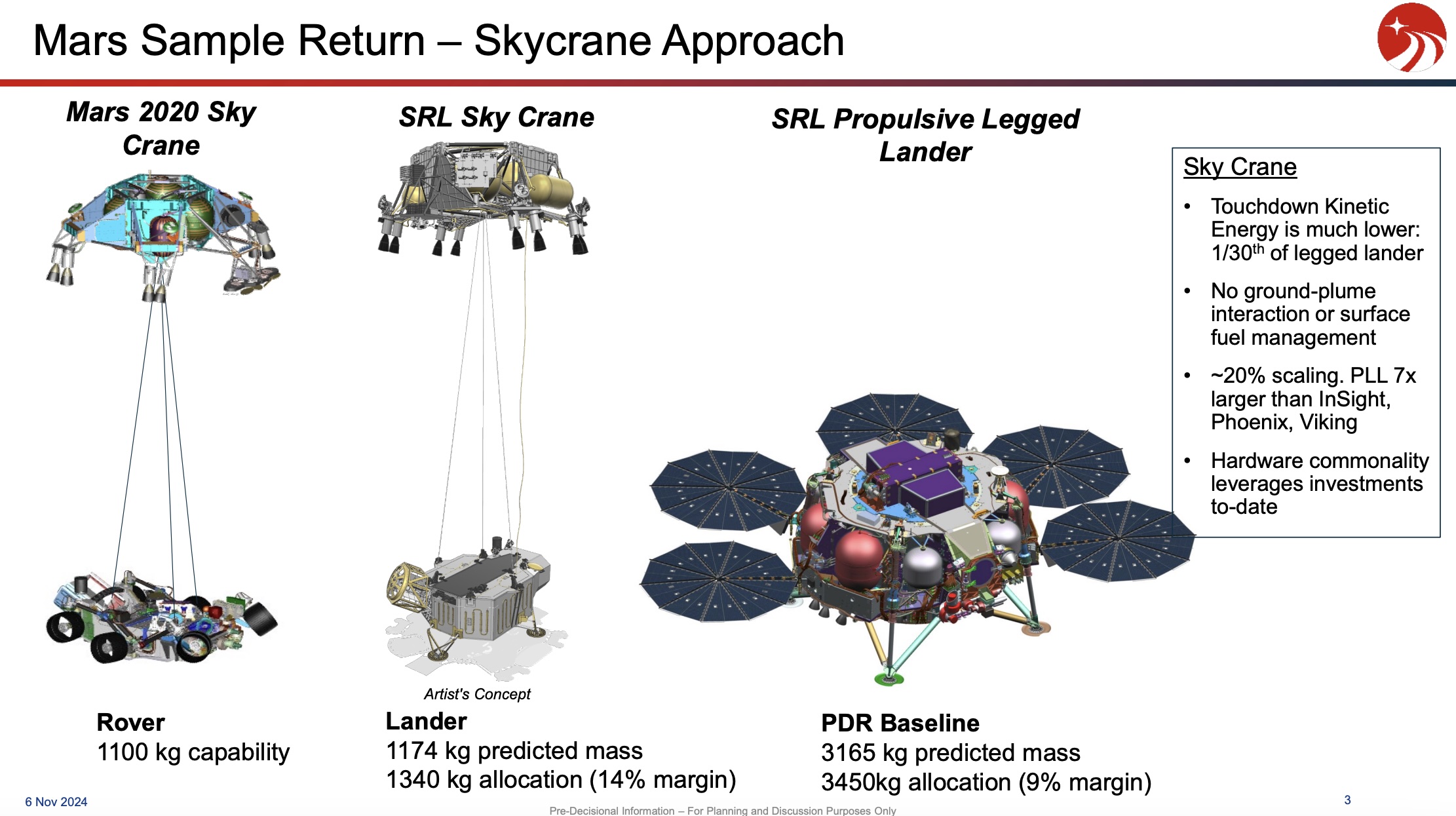
NASA officials said they believe a stripped-down concept proposed by the Jet Propulsion Laboratory in Southern California, which previously was in charge of the over-budget Mars Sample Return mission architecture, would cost between $6.6 billion and $7.7 billion, according to Nelson. JPL’s previous approach would have put a heavier lander onto the Martian surface, with small helicopter drones that could pick up sample tubes if there were problems with the Perseverance rover.

NASA previously deleted a “fetch rover” from the MSR architecture and instead will rely on Perseverance to hand off sample tubes to the retrieval lander.

An alternative approach would use a (presumably less expensive) commercial heavy lander, but this concept would still utilize several elements NASA would likely develop in a more traditional government-led manner: a nuclear power source, a robotic arm, a sample container, and a rocket to launch the samples off the surface of Mars and back into space. The cost range for this approach extends from $5.1 billion to $7.1 billion.

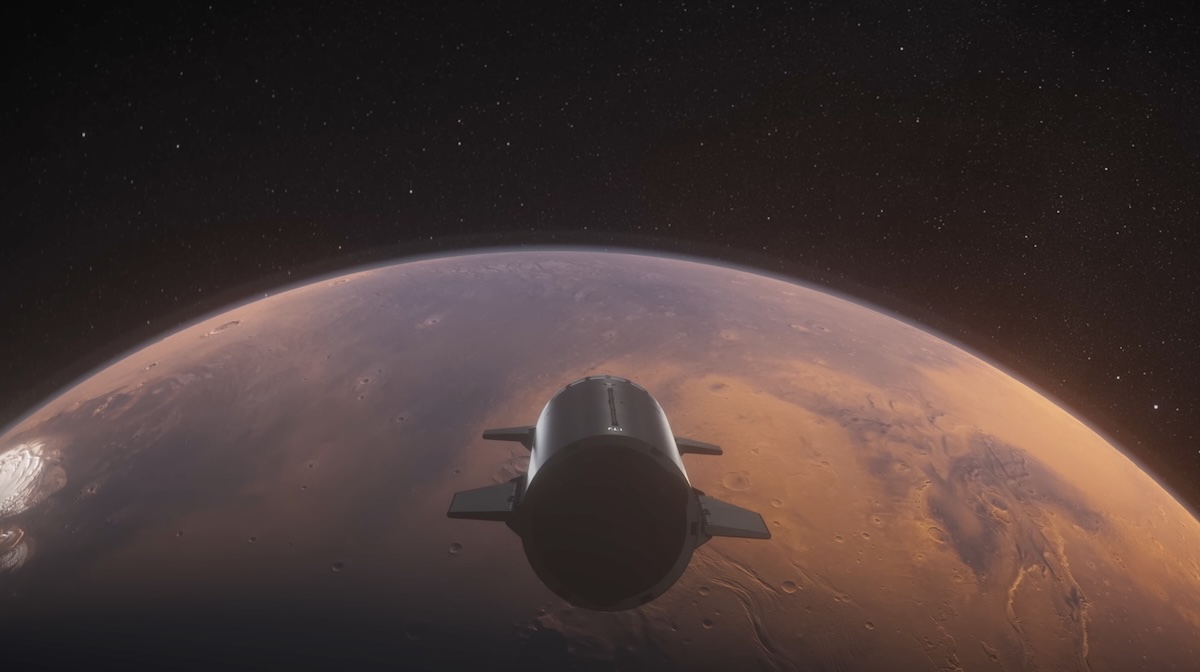
Artist’s illustration of SpaceX’s Starship approaching Mars. Credit: SpaceX

JPL will have a “key role” in both paths for MSR, said Nicky Fox, head of NASA’s science mission directorate. “To put it really bluntly, JPL is our Mars center in NASA science.”

If the Trump administration moves forward with either of the proposed MSR plans, this would be welcome news for JPL. The center, which is run by the California Institute of Technology under contract to NASA, laid off 955 employees and contractors last year, citing budget uncertainty, primarily due to the cloudy future of Mars Sample Return.

Without MSR, engineers at the Jet Propulsion Laboratory don’t have a flagship-class mission to build after the launch of NASA’s Europa Clipper spacecraft last year. The lab recently struggled with rising costs and delays with the previous iteration of MSR and NASA’s Psyche asteroid mission, and it’s not unwise to anticipate more cost overruns on a project as complex as a round-trip flight to Mars.

Ars submitted multiple requests to interview Laurie Leshin, JPL’s director, in recent months to discuss the lab’s future, but her staff declined.

Both MSR mission concepts outlined Tuesday would require multiple launches and an Earth return orbiter provided by the European Space Agency. These options would bring the Mars samples back to Earth as soon as 2035, but perhaps as late as 2039, Nelson said. The return orbiter and sample retrieval lander could launch as soon as 2030 and 2031, respectively.

“The main difference is in the landing mechanism,” Fox said.

To keep those launch schedules, Congress must immediately approve $300 million for Mars Sample Return in this year’s budget, Nelson said.

NASA officials didn’t identify any examples of a commercial heavy lander that could reach Mars, but the most obvious vehicle is SpaceX’s Starship. NASA already has a contract with SpaceX to develop a Starship vehicle that can land on the Moon, and SpaceX founder Elon Musk is aggressively pushing for a Mars mission with Starship as soon as possible.

NASA solicited eight studies from industry earlier this year. SpaceX, Blue Origin, Rocket Lab, and Lockheed Martin—each with their own lander concepts—were among the companies that won NASA study contracts. SpaceX and Blue Origin are well-capitalized with Musk and Amazon’s Jeff Bezos as owners, while Lockheed Martin is the only company to have built a lander that successfully reached Mars.

This slide from a November presentation to the Mars Exploration Program Analysis Group shows JPL’s proposed “sky crane” architecture for a Mars sample retrieval lander. The landing system would be modified to handle a load about 20 percent heavier than the sky crane used for the Curiosity and Perseverance rover landings. Credit: NASA/JPL

The science community has long identified a Mars Sample Return mission as the top priority for NASA’s planetary science program. In the National Academies’ most recent decadal survey released in 2022, a panel of researchers recommended NASA continue with the MSR program but stated the program’s cost should not undermine other planetary science missions.

Teeing up for cancellation?

That’s exactly what is happening. Budget pressures from the Mars Sample Return mission, coupled with funding cuts stemming from a bipartisan federal budget deal in 2023, have prompted NASA’s planetary science division to institute a moratorium on starting new missions.

“The decision about Mars Sample Return is not just one that affects Mars exploration,” said Curt Niebur, NASA’s lead scientist for planetary flight programs, in a question-and-answer session with solar system researchers Tuesday. “It’s going to affect planetary science and the planetary science division for the foreseeable future. So I think the entire science community should be very tuned in to this.”

Rocket Lab, which has been more open about its MSR architecture than other companies, has posted details of its sample return concept on its website. Fox declined to offer details on other commercial concepts for MSR, citing proprietary concerns.

“We can wait another year, or we can get started now,” Rocket Lab posted on X. “Our Mars Sample Return architecture will put Martian samples in the hands of scientists faster and more affordably. Less than $4 billion, with samples returned as early as 2031.”

Through its own internal development and acquisitions of other aerospace industry suppliers, Rocket Lab said it has provided components for all of NASA’s recent Mars missions. “We can deliver MSR mission success too,” the company said.

Rocket Lab’s concept for a Mars Sample Return mission. Credit: Rocket Lab

Although NASA’s deferral of a decision on MSR to the next administration might convey a lack of urgency, officials said the agency and potential commercial partners need time to assess what roles the industry might play in the MSR mission.

“They need to flesh out all of the possibilities of what’s required in the engineering for the commercial option,” Nelson said.

On the program’s current trajectory, Fox said NASA would be able to choose a new MSR architecture in mid-2026.

Waiting, rather than deciding on an MSR plan now, will also allow time for the next NASA administrator and the Trump White House to determine whether either option aligns with the administration’s goals for space exploration. In an interview with Ars last week, Nelson said he did not want to “put the new administration in a box” with any significant MSR decisions in the waning days of the Biden administration.

One source with experience in crafting and implementing US space policy told Ars that Nelson’s deferral on a decision will “tee up MSR for canceling.” Faced with a decision to spend billions of dollars on a robotic sample return or billions of dollars to go toward a human mission to Mars, the Trump administration will likely choose the latter, the source said.

If that happens, NASA science funding could be freed up for other pursuits in planetary science. The second priority identified in the most recent planetary decadal survey is an orbiter and atmospheric probe to explore Uranus and its icy moons. NASA has held off on the development of a Uranus mission to focus on the Mars Sample Return first.

Science and geopolitics

Whether it’s with robots or humans, there’s a strong case for bringing pristine Mars samples back to Earth. The titanium tubes carried by the Perseverance rover contain rock cores, loose soil, and air samples from the Martian atmosphere.

“Bringing them back will revolutionize our understanding of the planet Mars and indeed, our place in the solar system,” Fox said. “We explore Mars as part of our ongoing efforts to safely send humans to explore farther and farther into the solar system, while also … getting to the bottom of whether Mars once supported ancient life and shedding light on the early solar system.”

Researchers can perform more detailed examinations of Mars specimens in sophisticated laboratories on Earth than possible with the miniature instruments delivered to the red planet on a spacecraft. Analyzing samples in a terrestrial lab might reveal biosignatures, or the traces of ancient life, that elude detection with instruments on Mars.

“The samples that we have taken by Perseverance actually predate—they are older than any of the samples or rocks that we could take here on Earth,” Fox said. “So it allows us to kind of investigate what the early solar system was like before life began here on Earth, which is amazing.”

Fox said returning Mars samples before a human expedition would help NASA prioritize where astronauts should land on the red planet.

In a statement, the Planetary Society said it is “concerned that NASA is again delaying a decision on the program, committing only to additional concept studies.”

“It has been more than two years since NASA paused work on MSR,” the Planetary Society said. “It is time to commit to a path forward to ensure the return of the samples already being collected by the Perseverance rover.

“We urge the incoming Trump administration to expedite a decision on a path forward for this ambitious project, and for Congress to provide the funding necessary to ensure the return of these priceless samples from the Martian surface.”

China says it is developing its own mission to bring Mars rocks back to Earth. Named Tianwen-3, the mission could launch as soon as 2028 and return samples to Earth by 2031. While NASA’s plan would bring back carefully curated samples from an expansive environment that may have once harbored life, China’s mission will scoop up rocks and soil near its landing site.

“They’re just going to have a mission to grab and go—go to a landing site of their choosing, grab a sample and go,” Nelson said. “That does not give you a comprehensive look for the scientific community. So you cannot compare the two missions. Now, will people say that there’s a race? Of course, people will say that, but it’s two totally different missions.”

Still, Nelson said he wants NASA to be first. He said he has not had detailed conversations with Trump’s NASA transition team.

“I think it was a responsible thing to do, not to hand the new administration just one alternative if they want to have a Mars Sample Return,” Nelson said. “I can’t imagine that they don’t. I don’t think we want the only sample return coming back on a Chinese spacecraft.”

Photo of Stephen Clark

Stephen Clark is a space reporter at Ars Technica, covering private space companies and the world’s space agencies. Stephen writes about the nexus of technology, science, policy, and business on and off the planet.

NASA defers decision on Mars Sample Return to the Trump administration Read More »

us-sues-six-of-the-biggest-landlords-over-“algorithmic-pricing-schemes”

US sues six of the biggest landlords over “algorithmic pricing schemes”

The Justice Department says that landlords did more than use RealPage in the alleged pricing scheme. “Along with using RealPage’s anticompetitive pricing algorithms, these landlords coordinated through a variety of means,” such as “directly communicating with competitors’ senior managers about rents, occupancy, and other competitively sensitive topics,” the DOJ said.

There were “call arounds” in which “property managers called or emailed competitors to share, and sometimes discuss, competitively sensitive information about rents, occupancy, pricing strategies and discounts,” the DOJ said.

Landlords discussed their use of RealPage software with each other, the DOJ said. “For instance, landlords discussed via user groups how to modify the software’s pricing methodology, as well as their own pricing strategies,” the DOJ said. “In one example, LivCor and Willow Bridge executives participated in a user group discussion of plans for renewal increases, concessions and acceptance rates of RealPage rent recommendations.”

DOJ: Firms discussed “auto-accept” settings

The DOJ lawsuit says RealPage pushes clients to use “auto-accept settings” that automatically approve pricing recommendations. The DOJ said today that property rental firms discussed how they use those settings.

“As an example, at the request of Willow Bridge’s director of revenue management, Greystar’s director of revenue management supplied its standard auto-accept parameters for RealPage’s software, including the daily and weekly limits and the days of the week for which Greystar used ‘auto-accept,'” the DOJ said.

Greystar issued a statement saying it is “disappointed that the DOJ added us and other operators to their lawsuit against RealPage,” and that it will “vigorously” defend itself in court. “Greystar has and will conduct its business with the utmost integrity. At no time did Greystar engage in any anti-competitive practices,” the company said.

The Justice Department is joined in the case by the attorneys general of California, Colorado, Connecticut, Illinois, Massachusetts, Minnesota, North Carolina, Oregon, Tennessee, and Washington. The case is in US District Court for the Middle District of North Carolina.

US sues six of the biggest landlords over “algorithmic pricing schemes” Read More »

amd-launches-new-ryzen-9000x3d-cpus-for-pcs-that-play-games-and-work-hard

AMD launches new Ryzen 9000X3D CPUs for PCs that play games and work hard

AMD’s batch of CES announcements this year includes just two new products for desktop PC users: the new Ryzen 9 9950X3D and 9900X3D. Both will be available at some point in the first quarter of 2025.

Both processors include additional CPU cores compared to the 9800X3D that launched in November. The 9900X3D includes 12 Zen 5 CPU cores with a maximum clock speed of 5.5 GHz, and the 9950X3D includes 16 cores with a maximum clock speed of 5.7 GHz. Both include 64MB of extra L3 cache compared to the regular 9900X and 9950X, for a total cache of 144MB and 140MB, respectively; games in particular tend to benefit disproportionately from this extra cache memory.

But the 9950X3D and 9900X3D aren’t being targeted at people who build PCs primarily to game—the company says their game performance is usually within 1 percent of the 9800X3D. These processors are for people who want peak game performance when they’re playing something but also need lots of CPU cores for chewing on CPU-heavy workloads during the workday.

AMD estimates that the Ryzen 9 9950X3D is about 8 percent faster than the 7950X3D when playing games and about 13 percent faster in professional content creation apps. These modest gains are more or less in line with the small performance bump we’ve seen in other Ryzen 9000-series desktop CPUs.

AMD launches new Ryzen 9000X3D CPUs for PCs that play games and work hard Read More »

the-end-of-an-era:-dell-will-no-longer-make-xps-computers

The end of an era: Dell will no longer make XPS computers

After ditching the traditional Dell XPS laptop look in favor of the polarizing design of the XPS 13 Plus released in 2022, Dell is killing the XPS branding that has become a mainstay for people seeking a sleek, respectable, well-priced PC.

This means that there won’t be any more Dell XPS clamshell ultralight laptops, 2-in-1 laptops, or desktops. Dell is also killing its Latitude, Inspiron, and Precision branding, it announced today.

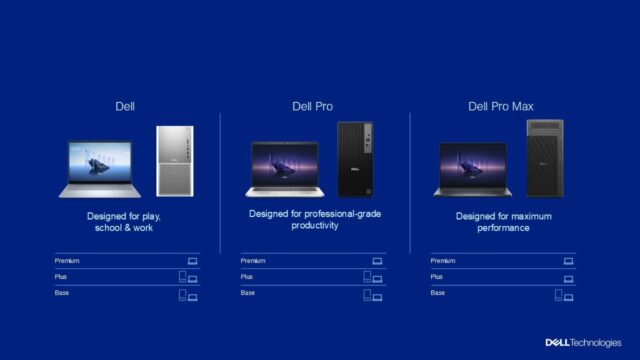
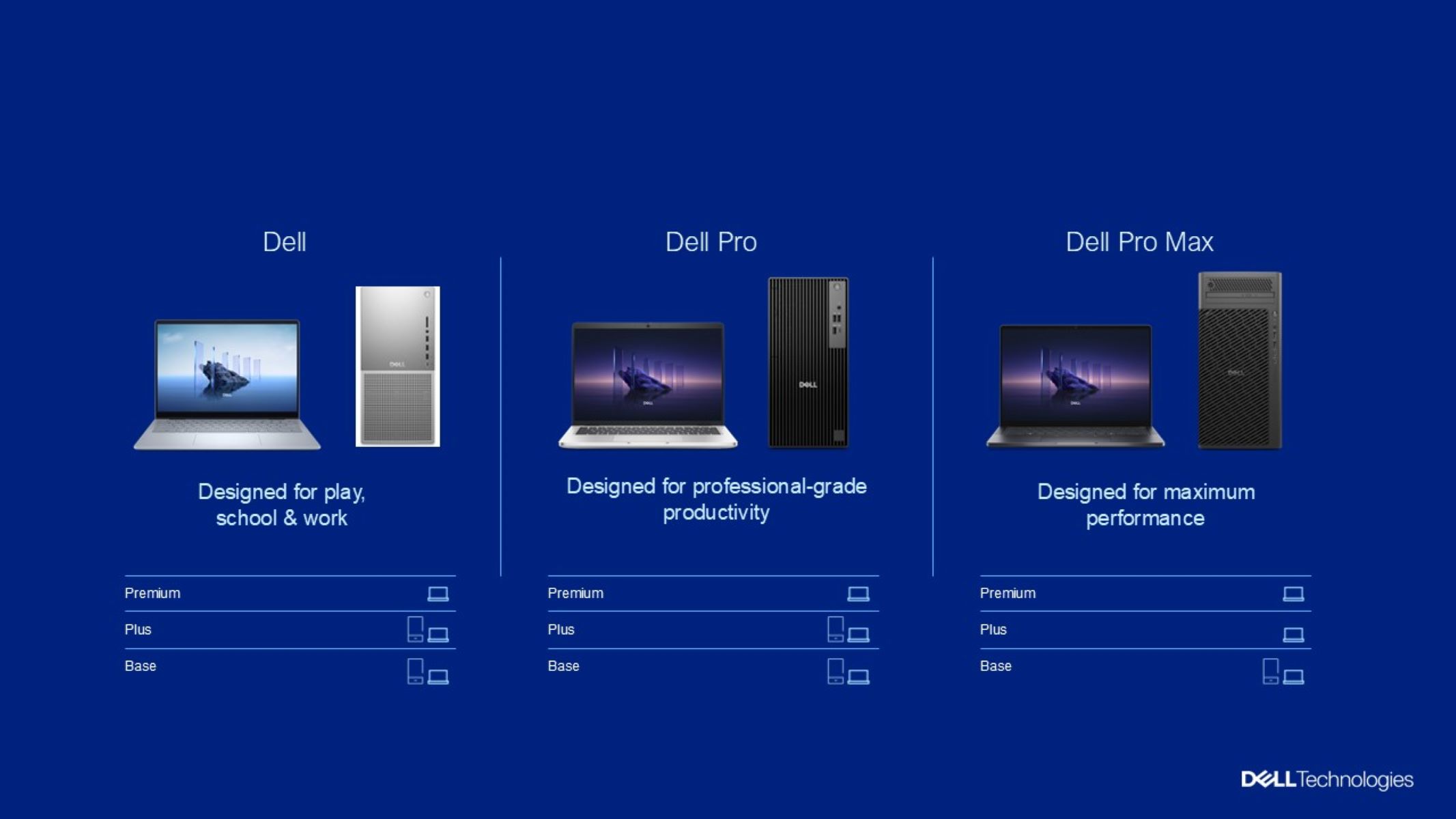
Moving forward, Dell computers will have either just Dell branding, which Dell’s announcement today described as “designed for play, school, and work,” Dell Pro branding “for professional-grade productivity,” or be Dell Pro Max products, which are “designed for maximum performance.” Dell will release Dell and Dell Pro-branded displays, accessories, and “services,” it said. The Pro Max line will feature laptops and desktop workstations with professional-grade GPU capabilities as well as a new thermal design.

Dell claims its mid-tier Pro line emphasizes durability, “withstanding three times as many hinge cycles, drops, and bumps from regular use as competitor devices.” The statement is based on “internal analysis of multiple durability tests performed” on the Dell Pro 14 Plus (released today) and HP EliteBook 640 G11 laptops conducted in November. Also based on internal testing conducted in November, Dell claims its Pro PCs boost “airflow by 20 percent, making these Dell’s quietest commercial laptops ever.”

Within each line are base models, Plus models, and Premium models. In a blog post, Kevin Terwilliger, VP and GM of commercial, consumer, and gaming PCs at Dell, explained that Plus models offer “the most scalable performance” and Premium models offer “the ultimate in mobility and design.”

Credit: Dell

By those naming conventions, old-time Dell users could roughly equate XPS laptops with new Dell Premium products.

“The Dell portfolio will expand later this year to include more AMD and Snapdragon X Series processor options,” Terwilliger wrote. “We will also introduce new devices in the base tier, which offers everyday devices that provide effortless use and practical design, and the Premium tier, which continues the XPS legacy loved by consumers and prosumers alike.”

Meanwhile, Dell Pro base models feel like Dell’s now-defunct Latitude lineup, while its Precision workstations may best align with 2025’s Dell Pro Max offerings.

The end of an era: Dell will no longer make XPS computers Read More »

childhood-and-education-#8:-dealing-with-the-internet

Childhood and Education #8: Dealing with the Internet

Related: On the 2nd CWT with Jonathan Haidt, The Kids are Not Okay, Full Access to Smartphones is Not Good For Children

It’s rough out there. In this post, I’ll cover the latest arguments that smartphones should be banned in schools, including simply because the notifications are too distracting (and if you don’t care much about that, why are the kids in school at all?), problems with kids on social media including many negative interactions, and also the new phenomenon called sextortion.

  1. How Many Notifications?.

  2. Ban Smartphones in Schools.

  3. Antisocial Media.

  4. Screen Time.

  5. Cyberbullying.

  6. Sextortion.

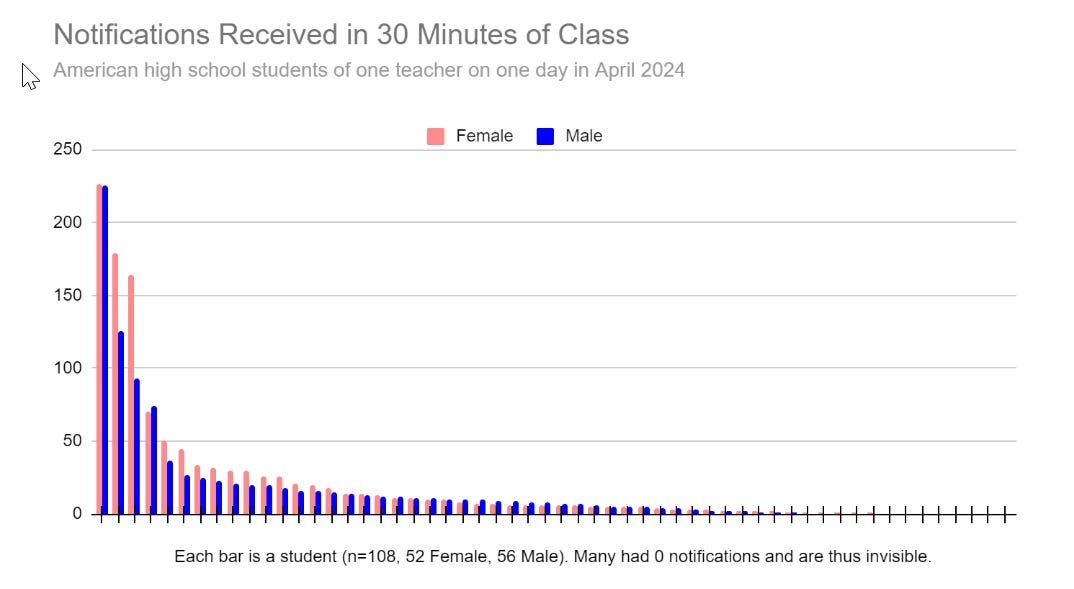
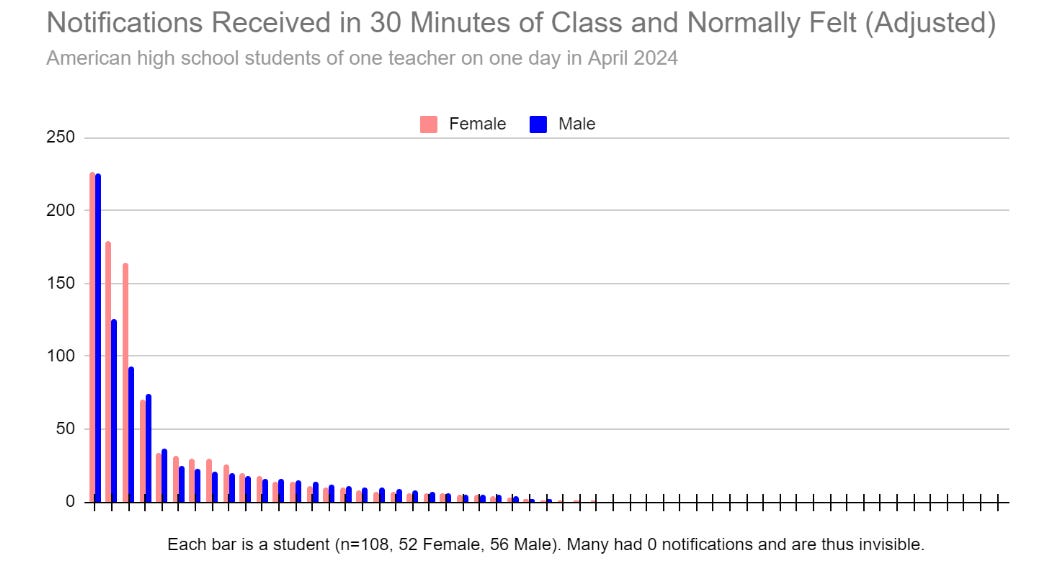
Tanagra Beast reruns the experiment of having a class tally their phone notifications. The results were highly compatible with the original experiment.

The tail, it was long.

Ah! So right away we can see a textbook long-tailed distribution. The top 20% of recipients accounted for 75% of all received notifications, and the bottom 20% for basically zero. We can also see that girls are more likely to be in that top tier, but they aren’t exactly crushing the boys.

What if you asked only about notifications that would actually distract?

There was even more concentration at the top. The more notifications you got, the more likely you were to be distracted by each one.

Here are some more highlights.

Which apps dominate? Instagram and Snapchat were nearly tied, and together accounted for 46% of all notifications. With vanilla text messages accounting for an additional 35%, we can comfortably say that social communications account for the great bulk of all in-class notifications.

There was little significant gender difference in the app data, with two minor apps accounting for the bulk of the variation: Ring (doorbell and house cameras) and Life 360 (friend/family location tracker), each of which sent several notifications to a few girls. (“Yeah,” said girls during our debriefing sessions, “girls are stalkers.” Other girls nodded in agreement.)

Notifications from Discord, Twitch, or other gaming-centric services were almost exclusively received by males, but there weren’t enough of these to pop out in the data.

  • The two top recipients, with their rate of 450 notifications per hour (!), or about one every eight seconds, had interesting stories to tell. One of these students had a job after school, and about half their messages (but only half) were work-related. The other was part of a large group chat, and additionally had a friend at home sick who was peltering them with a continuous rant about everything and nothing, three words at time.

  • Some students who receive very large numbers of notifications use settings to differentiate them by vibration patterns, and tell me that they “notice” some vibrations much more than others.

  • Official school business is a significant contributor to student notification loads. At least 4% of all notifications were directly attributable to school apps, and I would guess the indirect total (through standard texts, for example) might be closer to 10-15%. For students who get very few notifications, 30-50% of their notifications might be school-related. Our school’s gradebook app is the biggest offender, in part because it’s poorly configured and sends way more notifications than anyone wants.

  • Is our school unusually good or bad when it comes to phones? By a vote of 23 to 7, students who had been enrolled in another school during the last four years said our school was better than their previous school at keeping phones suppressed.

  • There’s still obvious room for improvement, though. I asked my students to imagine that, at the start of the hour, they had sent messages inviting a reply to 5 different friends elsewhere on our campus. How many would they expect to have replied before the end of the hour? The answer I consistently got was 4, and that this almost entirely depended on the phone-strictness of the teacher whose class each friend was in. (I’m on the list of phone-strict teachers, it seems. Phew!)

  • I asked students if they would want to press a magic button that would permanently delete all social media and messaging apps from the phones of their friend groups if nobody knew it was them. I got only a couple takers. There was more (but far from majority) enthusiasm for deleting all such apps from the whole world. I suspect rates would have been higher if I had asked this as an anonymous written question, but probably not much higher.

  • I asked if they thought education would be improved on campus if phones were forcibly locked away for the duration of the school day. Only one student gave me so much as an affirmative nod! Among students, the consensus was that kids generally tune into school at the level they care to, and that a phone doesn’t change that. A disinterested student without a phone will just tune out in some other way.

As I’ve mentioned before, I find phones distracting when doing non-internet activities even when there are zero notifications. Merely having the option to look is a tax on my attention. And as Gwern notes in the comments, the fact that a substantial minority of students would want to nuke messaging apps from orbit is more a case of ‘that is a lot’ rather than ‘that is only a minority.’ Messaging apps provide obvious huge upside in normal situations outside school, so a lot of kids must see big downsides.

New York City may ban phones in all public schools.

Julian Shen-Berro and Amy Zimmer: [NYC schools chancellor] Banks previously said he’s been talking with “hundreds” of principals, and they have overwhelmingly told him they’d like a citywide policy banning phones.

“We know [students] need to be in communication with their parents after school,” Banks said, “and if there’s something going on during the day, parents should just call the school the way they always did before we ever had cell phones.”

He previously had said we weren’t there yet, largely because bans are hard to enforce. To me that continues to make no sense. You can absolutely enforce it. In fact, it seems much easier to me to enforce a total ban on cell phones via sealed pouches than it is to enforce reasonable use of those phones while leaving them within reach.

WSJ reports many parents being the main barriers to banning phones in schools. Some strongly support bans, and the evidence here once again is strongly that bans work to improve matters, but other parents object because they demand direct access to their children at all times.

As always, school shootings are brought up, despite this worry being statistically crazy, and also that cell phone use during a school shooting is thought to be actively dangerous because it risks giving away one’s location. I can’t even.

The more reasonable objections are outside emergencies and scheduling issues, which is something, but wow is that a cart before horse situation. Also obviously there are vastly less disruptive ways to solve those problems. Mostly, I think staying in constant contact at that age is actively terrible for the students. You do want to be able to reach each other in an emergency, but there should be friction involved.

If a few parents pull their kids out in protest, let them. Others who support the policy can choose to transfer in. If my kids were at a school where everyone was on their phones all the time, and I had a viable alternative where phones were banned, I would not hesitate. At minimum we can let the market decide.

It can be done. Here is a story of one Connecticut middle school banning phones. All six middle schools in Providence use them, as do two high schools there. Teachers say sealing phones in pouches has been transformative.

Tyler Cowen reports on a new paper on the Norwegian ban of smartphones in middle schools. Here is the abstract:

How smartphone usage affects well-being and learning among children and adolescents is a concern for schools, parents, and policymakers.

Combining detailed administrative data with survey data on middle schools’ smartphone policies, together with an event-study design, I show that banning smartphones significantly decreases the health care take-up for psychological symptoms and diseases among girls. Post-ban bullying among both genders decreases.

Additionally, girls’ GPA improves, and their likelihood of attending an academic high school track increases. These effects are larger for girls from low socio-economic backgrounds.

Hence, banning smartphones from school could be a low-cost policy tool to improve student outcomes.

Tyler does his best to frame this effect as disappointing and Twitter summaries saying otherwise as misleading (he does not link to them), although he admits he is surprised that bullying fell by 0.39 SDs for boys and 0.42 SDs for girls. Grades did not improve much, only 0.08 SDs, of course we do not know how much this reflects the real changes in learning. Also as one commenter points out, phones are good for cheating.

A plausible explanation for why the math change was 0.22 SDs is that this was based on standardized tests, where the teachers aren’t adjusting the curve for the changes. Or it could be that it is helpful to not always have a calculator in your pocket.

I would also note his second point: ‘The girls consult less with mental health-related professionals, with visits falling by 0.22 on average to their GPs, falling by 2-3 visits to specialist care.’ That is a 29% decline in GP visits, and a 60% decline in specialist visits. That is a gigantic effect. Some of it is ‘phones cause kids to seek help more’ but at today’s margins I am fine with that, and this likely represents a large improvement in mental health.

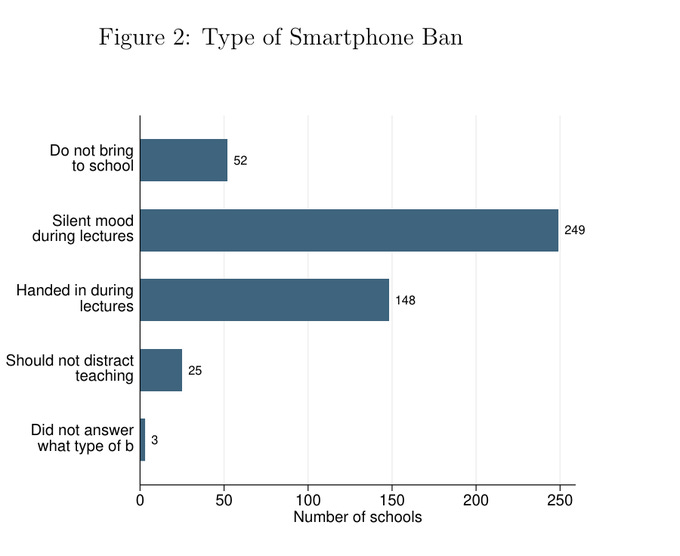
I also note that the paper shows that the effects are largest for schools that do a full ban, those that let phones remain on silent see smaller impacts. As the author points out, this is likely because a phone nearby is a constant distraction even when you ultimately ignore it. Silent mode was a little over half the sample (see Figure 2). So the statistics understate the effect size of a full ban.

This did not take phones away outside of school, so it is not a measure of full phone impact, only the marginal impact of phones in schools, and mostly only of making the phones go on silent.

Jay Van Bavel summarizes this way:

Jay Van Bavel, PhD: Banning #smartphones in over 400 schools led to:

-decreased psychological symptoms among girls by 29%

-decreased bullying by boys and girls by 43%

-increased GPA among girls by .08 SDs

Effects were larger for girls from low SES families

We should keep smartphones out of schools. This technology is a collective trap–Users are compelled to use it, even if they hate it.

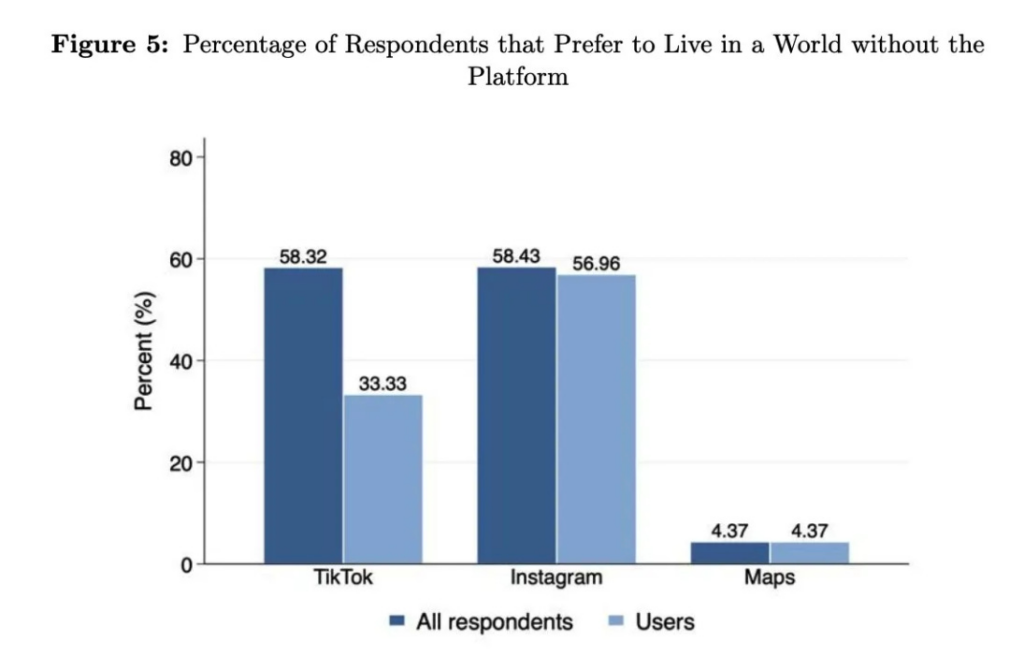
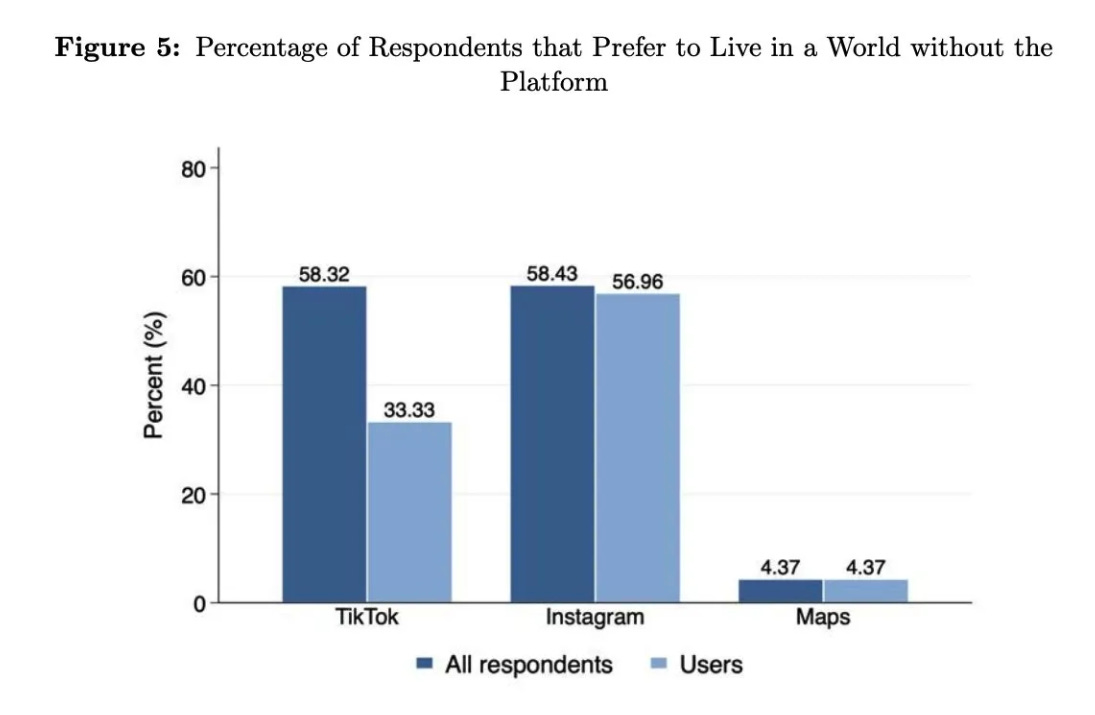
Most people would prefer a world without TikTok or Instagram: Nearly 60% of Instagram users wish the platform wasn’t invented. [link is to post discussing a successful no-ban pilot school program, and various social media issues]

If you take the results at face value, despite many of the ‘bans’ only being partial, don’t you still have to ban phones?

Tyler did not see it that way. He followed up noting that the bans were often not so strict, but claiming that the strict bans had only modest effect relative to the less strict bans. I don’t understand this interpretation of the data, or this perspective.

Consider the opposite situation. Suppose you were considering introducing a new device into schools, and it had all the opposite effects. People would consider you monstrous and insane for even raising the question.

Also I am happy to trust this kind of very straightforward anecdata:

John Arnold: Was walking through a random high school recently and was shocked by the number of kids with a phone in their lap playing games or scrolling and/or wearing headphones during a lesson. Made me very partial to ‘lock phones in pouch’ policies.

If kids constantly being on phones during class is not hurting academic achievement, then that tells you the whole ‘send kids to school’ thing is unnecessary, and you should disband the whole thing.

That is my actual position. Either ban phones in schools, or ban the schools.

California Governor Newsom calls for all schools to go phone free.

Governor Newsom: The evidence is clear: reducing phone-use in classrooms promote concentration, academic success & social & emotional development.

We’re calling on California schools to act now to restrict smartphone use in classrooms. Let’s do what’s best for our youth.

In 2019, Governor Newsom signed AB 272 (Muratsuchi) into law, which grants school districts the authority to regulate the use of smartphones during school hours. Building on that legislation, he is currently working with the California Legislature to further limit student smartphone use on campuses. In June, the Governor announced efforts to restrict the use of smartphones during the school day.

Leveraging the tools of this law, I urge every school district to act now to restrict smartphone use on campus as we begin the new academic year. The evidence is clear: reducing phone use in class leads to improved concentration, better academic outcomes, and enhanced social interactions.

You know what I’ve never heard? Someone who actually observed teenage girls using social media, and thought ‘yep this seems fine, I’ve updated towards not banning this.’

In a given week, 13% of users of Instagram between 13-15 said they had received unwanted sexual advances. 13% had seen ‘any violent, bloody or disturbing image’ which tells me nothing disturbs our kids anymore, and 19% saw ‘nudity or sexual images’ that they did not want to see.

Jon Haidt and Arturo Bejar demand that something (more) must be done. A lot is already being done to get the numbers this contained.

Arturo Bejar: My daughter and her friends—who were just 14—faced repeated unwanted sexual advances, misogynistic comments (comments on her body or ridiculing her interests because she is a woman), and harassment on these products. This has been profoundly distressing to them and to me. 

Also distressing: the company did nothing to help my daughter or her friends. My daughter tried reporting unwanted contacts using the reporting tools, and when I asked her how many times she received help after asking, her response was, ‘Not once.’

What would help look like? Would you even know if you were helped? Meta’s own AI believes that she should damn well hear back, and this was a failure of the system.

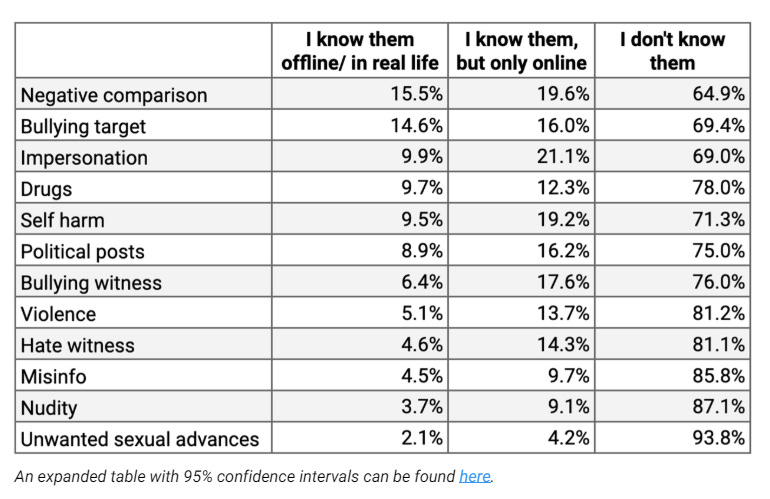
I was curious to see this broken down by source, so I looked at the original survey from 2021, and there is data.

We also see that about half of those who asked for support felt at least ‘somewhat’ supported. And that all problems including unwanted advances are similarly common for the 13-15 group as the other groups up to age 26, with males reporting unwanted advances more often than females in all age groups, whereas females got more unwanted comparisons.

This all happened back in 2021, before generative AI.

With Llama-3 and also vision models now available to Meta, it seems like we should be able to dramatically improve the situation. Many of these things have no reason to appear. So it seems fairly trivial to have an AI check to see if incoming messages or images from strangers contain some of the various things above, and if so then display a warning or silently censor the message, at least for underage users.

Things like political posts or ‘misinfo’ are trickier. There are obvious issues with letting an LLM or even a person decide what counts here and making censorship decisions. But also there is a reason the post does not talk about those issues. They are not where most of the damage lies.

The general consensus continues to be that if you look at what kids, especially teenage girls, are actually doing with social media, you’ll probably be horrified.

Zac Hill: After spending the weekend with a trio of normal, well-adjusted 14 y/o girls (courtesy of my goddaughter), never have I rolled harder for the “Ban Social Media For Teens Like Yesterday” posse.

Via this post by Jay Van Bavel, we are reminded of the ‘we would pay to get rid of social media, in particular TikTok and Instragram’ result.

This graph is pretty weird, right? Why would using Instagram not correlate with wishing the app did not exist? Whereas TikTok’s graph here makes sense (note that the dark blue bar is everyone, not only non-users, so if ~33% of Americans use TikTok then ~70% of non-users want it to not exist).

For Instagram, I suppose as a non-user I can be indifferent, whereas many users feel like they have to be on it?

For Maps, I assume almost everyone uses it, so the two samples are the same people?

There is a very big downside to limiting screen time.

Jawwwn: 🔮 $PLTR co-founder Peter Thiel on screen time for kids 📺:

“If you ask the executives in those companies, how much screen time do they let their kids use, and there’s probably an interesting critique one could make.

Andrew: What do you do?

Thiel: “An hour and a half a week.”

Gallabytes: Absolutely insane to me to see hackers grow up and try to raise their kids in a way that’s incompatible with becoming hackers.

The hard problem is, how do you differentially get the screen time you want?

At some point yes you want to impose a hard cap, but if I noticed my children doing hacking things, writing programs, messing with hardware, or playing games in a way that involved deliberate practice, or otherwise making good use, I would be totally fine with that up to many hours per day. The things they would naturally do with the screens? Largely not so much.

SF Chronicle: Among girls 15 and younger, 45% of those from abusive and disturbed families use social media frequently, compared to just 28% from healthy families.

Younger girls who frequently use social media are less likely to attempt suicide or harm themselves than those who don’t use social media.

The CDC survey shows that 5 in 6 cyberbullied teens are also emotionally and violently abused at home by parents and grownups. Teenagers from abusive, troubled families are far more likely to be depressed and more likely to use social media than non-abused teens.

It is super confusing trying to tease out treatment effects versus selection effects in situations like this. There’s a lot going on. The cyberbullying correlation pretty much has to be causal, because the effect size seems too big to be otherwise.

Bloomberg has an in depth look into the latest scammer tactic: Sextortion.

There is a subreddit with 32k members dedicated to helping victims.

The scam is simple, and is getting optimized as scammers exchange tips.

  1. You pretend to be a hot girl, find teenage boy with social media account.

  2. You message the teenage boy, express interest, offer to trade nude pics.

  3. Teenage boy sends nude pics.

  4. Blackmail the boy, threatening to ruin his entire life.

  5. If the boy threatens to kill himself, encourage that, for some reason?

Obviously any such story will attempt to be salacious and will select the worst cases.

It still seems highly plausible that this line of work attracts the worst of the worst. That a large portion of them are highly sadistic fs who revel in causing pain and suffering. Who are the types of people who would see suicide threats, actively drive the kid to suicide, and then message his girlfriend and other contacts to blackmail them in turn if they didn’t want the truth about what happened getting out. Yeah.

This is in a very different category than the classic internet scams.

What to do about it, before or after it happens to you?

SwiftOnSecurity: PARENTS: You need to sit your kid down and tell them about sextorsion. They are not going to know randos messaging them for sexting is a trap.

This is a really easy way for criminals onshore and overseas to make money. They convince you to link your real identity. There are suicides after ongoing threats to ruin their life after desperate attempts to pay. And they need to know if they fuck up they need to come to you.

Advice thread from a lawyer who deals with sextorsion. DO NOT ENGAGE. Block. Go private. Keep blocking. Show them NO ENGAGEMENT. That spending any time harassing will be worth it. They don’t have a reputation to uphold. Time is money. Apparently they sometimes just give up.

Lane Haygood, Attorney: About once a week I have someone call me in a blind panic about to send hundreds or thousands of dollars to a scammer. My advice to them is always the same: PAY NOTHING. Nothing about paying guarantees the person on the other end will do what they say.

They will continue to extort you as long as you are willing to pay.

The best thing to do is immediately block them. If they message you from new profiles, block, block, block.

The next best thing to do is reach out to an attorney. My brilliant paralegal @KathrynTewson has a great document on cybersecurity we will be happy to provide you with to help ameliorate these things.

All of this strongly matches my intuition. Paying, or engaging at all, raises the expected returns to more blackmail. Nothing they told you or committed to changes that fact, and they are well known liars with no moral compass. No, they are not going to honor their word, in any sense. Meanwhile actually sending the pics gets them nothing. Block, ignore and hope it goes away is the only play on all levels.

He also claims that with the rise of deepfakes you can always run the Shaggy defense if the scammer actually does pull the trigger.

Or you could shrug, if one has perspective. This is not obviously that big a deal, although obviously even if true that is hard for the victim to see.

In particular, one thing that I did not see in the article was talk about admission to college. Colleges will sometimes rescind or deny admission based on a social media post that offends or indicates ordinary kid behavior. Would they do that to a sextortion victim? The chances are not zero, but my guess is it would be rare, given that there is not a known-to-me example of this, and scammers would no doubt lean heavily on this threat if it was a common occurrence.

Discussion about this post

Childhood and Education #8: Dealing with the Internet Read More »

rocket-report:-avio-named-top-european-launch-firm;-new-glenn-may-launch-soon

Rocket Report: Avio named top European launch firm; New Glenn may launch soon


“We are making it simpler for new competitors to get consistent access to the spectrum they need.”

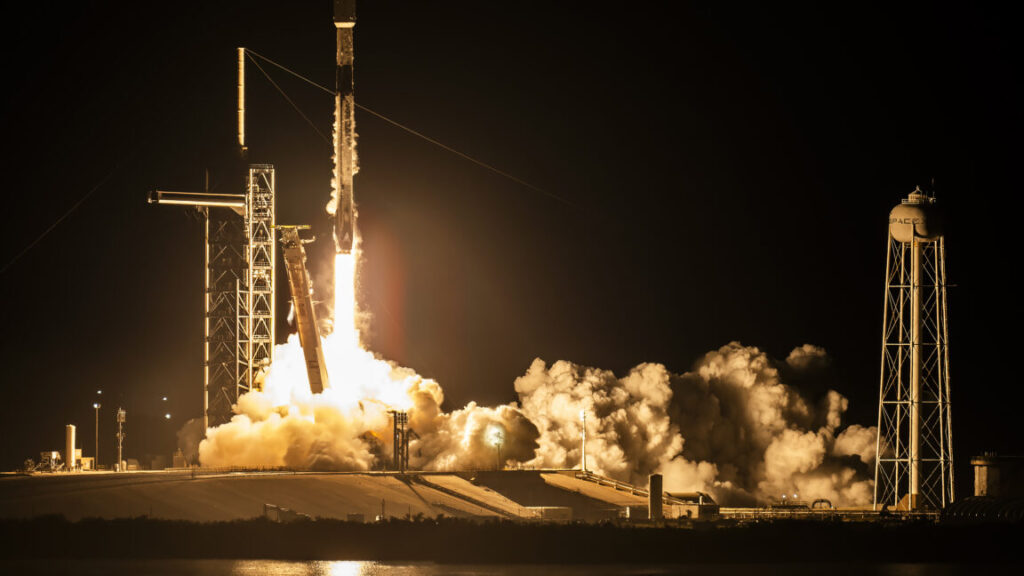
A Falcon 9 rocket lofts a Starlink mission on Dec. 30, the final SpaceX mission of 2024, completing the company’s 134th orbital launch. Credit: SpaceX

A Falcon 9 rocket lofts a Starlink mission on Dec. 30, the final SpaceX mission of 2024, completing the company’s 134th orbital launch. Credit: SpaceX

Welcome to Edition 7.25 of the Rocket Report! Happy New Year! It’s a shorter edition of the newsletter this week because most companies (not named Blue Origin, this holiday season) took things easier over the last 10 days. But after the break we’re back in the saddle for the new year, and eager to see what awaits us in the world of launch.

As always, we welcome reader submissions, and if you don’t want to miss an issue, please subscribe using the box below (the form will not appear on AMP-enabled versions of the site). Each report will include information on small-, medium-, and heavy-lift rockets, as well as a quick look ahead at the next three launches on the calendar.

Avio lands atop list of European launch firms. You know it probably was not a great year for European rocket firms when the top-ranked company on the continent is Avio, which launched a grand total of two rockets in 2024. The Italian rocket firm earned this designation from European Spaceflight after successfully completing the final flight of the Vega rocket in September and returning the Vega C rocket to flight in December.

Three European launches in 2024 … The only other firm to launch a rocket on the list was ArianeGroup, which had a single launch last year. Granted, it was an important flight, the successful debut of the Ariane 6 rocket. Germany-based Isar Aerospace came in third place, followed by a company I had never heard of, Germany-based Bayern-Chemie. It builds solid-fuel upper stages for sounding rockets. It’s hard to disagree with too much on the list, although it certainly demonstrates that Europe could do with more companies launching rockets, and fewer only talking about it.

India launches space docking demonstration mission. The Indian Space Research Organization launched a space docking experiment on a PSLV rocket at the end of the year, NASASpaceflight.com reports. This SpaDeX mission—yes, the name is a little confusing—will demonstrate the capability to rendezvous, dock, and undock in orbit. This technology is important for the country’s human spaceflight plans as well as future missions to the Moon.

Target and chaser … The SpaDeX experiment will be conducted around 10 days following launch when the two satellites, the SDX01 “Chaser” and the SDX02 “Target,” will be released with a small relative velocity between them. The pair will drift apart for around a day until they are separated by a distance of around 10 to 15 km. Once this is achieved, Target will eliminate the velocity difference between itself and Chaser using its propulsion system.

The easiest way to keep up with Eric Berger’s and Stephen Clark’s reporting on all things space is to sign up for our newsletter. We’ll collect their stories and deliver them straight to your inbox.

Sign Me Up!

HyPrSpace conducts hot-fire test. French launch services startup HyPrSpace has completed the first test of its second hot fire test campaign for its subscale Terminator stage demonstrator, European Spaceflight reports. HyPrSpace is developing a two-stage launch vehicle called Orbital Baguette One (OB-1) that will be capable of delivering up to 250 kilograms to low Earth orbit.

Like a finely baked bread … In July, the company completed an initial hot fire test campaign of Terminator, an eight-tonne demonstrator of a hybrid rocket stage. Over the course of this first test campaign, HyPrSpace completed a total of four hot fire tests. HyPrSpace CEO Alexandre Mangeot said the company achieved an average engine efficiency of 94 percent during the latest test. Mangeot added that this represented the “propulsive performance we need for our orbital launcher.”

A new annual record for orbital launches. The world set another record for orbital launches in 2024 in a continuing surge of launch activity driven almost entirely by SpaceX, Space News reports. There were 259 orbital launch attempts in 2024, a 17 percent increase from the previous record of 221 orbital launch attempts in 2023. That figure does not include suborbital launches, such as four SpaceX Starship/Super Heavy test flights or two launches of the HASTE suborbital variant of Rocket Lab’s Electron.

SpaceX v. world … That increase in overall launches matches the increase by SpaceX alone, which performed 134 Falcon 9 and Falcon Heavy launches in 2024, up from 96 in 2023. The company performed more orbital launches than the rest of the world combined. China performed 68 launches in 2024, breaking a record of 67 launches set in 2023. Russia performed 17 launches, followed by Japan (7), India (5), Iran (4), Europe (3) and North Korea (1).

Russian family of rockets reaches 2,000th launch. The Russian space program reached a significant milestone over the holidays with the 2,000th launch of a rocket from the “R-7” family of boosters. The launch took place on Christmas Day when an R-7 rocket lifted off, carrying a remote-sensing satellite from the Baikonur Cosmodrome, Ars reports. This family of rockets has an incredible heritage dating back nearly six decades. The first R-7 vehicle was designed by the legendary Soviet rocket scientist Sergei Korolev. It flew in 1957 and was the world’s first intercontinental ballistic missile.

Good and bad news … Although it’s certainly worth commemorating the 2,000th launch of the R-7 family of rockets, the fleet’s longevity also offers a cautionary tale. In many respects, the Russian space program continues to coast on the legacy of Korolev and the Soviet space feats of the 1950s and 1960s. That Russia has not developed a more cost-competitive and efficient booster in nearly six decades reveals the truth about its space program: It lacks innovation at a time when the rest of the space industry is rapidly sprinting toward reusability.

Overview of Chinese launch plans for 2025. New Long March rockets and commercially developed launch vehicles are expected to have their first flights in 2025, boosting China’s overall launch capabilities, Space News reports. The launchers will compete for contracts to launch satellites for China’s megaconstellation projects—Thousand Sails and Guowang—space station cargo missions and commercial and other contracts, helping to boost the country’s overall access to space and launch rate in the coming years.

Many new faces on the launch pad … Among the highlights for the coming year is the Long March 8A rocket, a variant of the existing Long March 8, but with a larger, more powerful second stage, boosting payload capacity to a 700-kilometer Sun-synchronous orbit from 5,000 kilograms to 7,000 kg. It is likely to be a workhorse for megaconstellation launches. The Long March 12A rocket could undergo vertical takeoff and landing tests. And the privately developed Zhuque-3 rocket could make its first orbital launch this year.

To deal with more launches, FCC adds spectrum. The Federal Communications Commission has formally allocated additional spectrum for launch applications, fulfilling a provision in a bill passed earlier this year, Space News reports. The FCC published December 31 a report and order that allocated spectrum between 2360 and 2395 megahertz for use in communications to and from commercial launch and reentry vehicles on a secondary basis. That band currently has a primary use for aircraft and missile testing communications.

Keep rockets talking to the ground … Both the FCC and launch companies have said the additional spectrum was needed to accommodate growth in launch activities. “By identifying more bandwidth for vital links to launch vehicles, we are making it simpler for new competitors to get consistent access to the spectrum they need,” Jessica Rosenworcel, chairwoman of the FCC, said in a December 19 statement calling for approval of the then-proposed report and order.

New Glenn completes static fire test. On Friday, December 27, Blue Origin successfully ignited the seven main engines on its massive New Glenn rocket for the first time, Ars reports. Blue Origin said it fired the vehicle’s engines for a duration of 24 seconds. They fired at full thrust for 13 of those seconds. Additionally, several hours before the test firing, the Federal Aviation Administration said it had issued a launch license for the rocket.

New Glenn wen? … These two milestones set up a long-anticipated launch of the New Glenn rocket in January. Although the company has yet to announce a date publicly, sources indicate that Blue Origin is working toward a launch time of no earlier than 1 am ET (06: 00 UTC) on Monday, January 6, from Cape Canaveral Space Force Station in Florida, though it could slip a few days. If all goes well with the debut flight of the vehicle, Blue Origin will also attempt to recover the first stage of the rocket on a drone ship down range in the Atlantic Ocean. (submitted by Jay5000001)

Next three launches

Jan. 4: Falcon 9 | Thuraya 4-NGS | Cape Canaveral Space Force Station, Florida | 01: 27 UTC

Jan. 6: New Glenn | Blue Ring pathfinder | Cape Canaveral Space Force Station, Florida | 06: 00 UTC

Jan. 6: Falcon 9 | Starlink 12-11 | Kennedy Space Center, Florida | 16: 19 UTC

Photo of Eric Berger

Eric Berger is the senior space editor at Ars Technica, covering everything from astronomy to private space to NASA policy, and author of two books: Liftoff, about the rise of SpaceX; and Reentry, on the development of the Falcon 9 rocket and Dragon. A certified meteorologist, Eric lives in Houston.

Rocket Report: Avio named top European launch firm; New Glenn may launch soon Read More »

one-less-thing-to-worry-about-in-2025:-yellowstone-probably-won’t-go-boom

One less thing to worry about in 2025: Yellowstone probably won’t go boom


There’s not enough melted material near the surface to trigger a massive eruption.

It’s difficult to comprehend what 1,000 cubic kilometers of rock would look like. It’s even more difficult to imagine it being violently flung into the air. Yet the Yellowstone volcanic system blasted more than twice that amount of rock into the sky about 2 million years ago, and it has generated a number of massive (if somewhat smaller) eruptions since, and there have been even larger eruptions deeper in the past.

All of which might be enough to keep someone nervously watching the seismometers scattered throughout the area. But a new study suggests that there’s nothing to worry about in the near future: There’s not enough molten material pooled in one place to trigger the sort of violent eruptions that have caused massive disruptions in the past. The study also suggests that the primary focus of activity may be shifting outside of the caldera formed by past eruptions.

Understanding Yellowstone

Yellowstone is fueled by what’s known as a hotspot, where molten material from the Earth’s mantle percolates up through the crust. The rock that comes up through the crust is typically basaltic (a definition based on the ratio of elements in its composition) and can erupt directly. This tends to produce relatively gentle eruptions where lava flows across a broad area, generally like you see in Hawaii and Iceland. But this hot material can also melt rock within the crust, producing a material called rhyolite. This is a much more viscous material that does not flow very readily and, instead, can cause explosive eruptions.

The risks at Yellowstone are rhyolitic eruptions. But it can be difficult to tell the two types of molten material apart, at least while they’re several kilometers below the surface. Various efforts have been made over the years to track the molten material below Yellowstone, but differences in resolution and focus have left many unanswered questions.

Part of the problem is that a lot of this data came from studies of seismic waves traveling through the region. Their travel is influenced by various factors, including the composition of the material they’re traveling through, its temperature, and whether it’s a liquid or solid. In a lot of cases, this leaves several potential solutions consistent with the seismic data—you can potentially see the same behavior from different materials at different temperatures.

To get around this issue, the new research measured the conductivity of the rock, which can change by as much as three orders of magnitude when transitioning from a solid to a molten phase. The overall conductivity we measure also increases as more of the molten material is connected into a single reservoir rather than being dispersed into individual pockets.

This sort of “magnetotelluric” data has been obtained in the past but at a relatively low resolution. For the new study, a dense array of sensors was placed in the Yellowstone caldera and many surrounding areas to the north and east. (You can compare the previous and new recording sites as black and red triangles on this map.)

Yellowstone’s plumbing

That has allowed the research team to build a three-dimensional map of the molten material underneath Yellowstone and to determine the fraction of the material in a given area that’s molten. The team finds that there are two major sources of molten material that extend up from the mantle-crust boundary at about 50 kilometers below the surface. These extend upward separately but merge about 20 kilometers below the surface.

Image of two large yellow lobes sitting below a smaller collection of reddish orange blobs of material. These are matched with features on the surface, including the present caldera and the sites of past eruptions.

Underneath Yellowstone: Two large lobs of hot material from the mantle (in yellow) melt rock closer to the surface (orange), creating pools of hot material (red and orange) that power hydrothermal systems and past eruptions, and may be the sites of future activity. Credit: Bennington, et al.

While they collectively contain a lot of molten basaltic material (between 4,000 and 6,500 cubic kilometers of it), it’s not very concentrated. Instead, this is mostly relatively small volumes of molten material traveling through cracks and faults in solid rock. This keeps the concentration of molten material below that needed to enable eruptions.

After the two streams of basaltic material merge, they form a reservoir that includes a significant amount of melted crustal material—meaning rhyolitic. The amount of rhyolitic material here is, at most, under 500 cubic kilometers, so it could fuel a major eruption, albeit a small one by historic Yellowstone standards. But again, the fraction of melted material in this volume of rock is relatively low and not considered likely to enable eruptions.

From there to the surface, there are several distinct features. Relative to the hotspot, the North American plate above is moving to the west, which has historically meant that the site of eruptions has moved from west to east across the continent. Accordingly, there is a pool off to the west of the bulk of near-surface molten material that no longer seems to be connected to the rest of the system. It’s small, at only about 100 cubic kilometers of material, and is too diffused to enable a large eruption.

Future risks?

There’s a similar near-surface blob of molten material that may not currently be connected to the rest of the molten material to the south of that. It’s even smaller, likely less than 50 cubic kilometers of material. But it sits just below a large blob of molten basalt, so it is likely to be receiving a fair amount of heat input. This site seems to have also fueled the most recent large eruption in the caldera. So, while it can’t fuel a large eruption today, it’s not possible to rule the site out for the future.

Two other near-surface areas containing molten material appear to power two of the major sites of hydrothermal activity, the Norris Geyser Basin and Hot Springs Basin. These are on the northern and eastern edges of the caldera, respectively. The one to the east contains a small amount of material that isn’t concentrated enough to trigger eruptions.

But the site to the northeast contains the largest volume of rhyolitic material, with up to nearly 500 cubic kilometers. It’s also one of only two regions with a direct connection to the molten material moving up through the crust. So, while it’s not currently poised to erupt, this appears to be the most likely area to trigger a major eruption in the future.

In summary, while there’s a lot of molten material near the current caldera, all of it is spread too diffusely within the solid rock to enable it to trigger a major eruption. Significant changes will need to take place before we see the site cover much of North America with ash again. Beyond that, the image is consistent with our big-picture view of the Yellowstone hotspot, which has left a trail of eruptions across western North America, driven by the movement of the North American plate.

That movement has now left one pool of molten material on the west of the caldera disconnected from any heat sources, which will likely allow it to cool. Meanwhile, the largest pool of near-surface molten rock is east of the caldera, which may ultimately drive a transition of explosive eruptions outside the present caldera.

Nature, 2025. DOI: 10.1038/s41586-024-08286-z  (About DOIs).

Photo of John Timmer

John is Ars Technica’s science editor. He has a Bachelor of Arts in Biochemistry from Columbia University, and a Ph.D. in Molecular and Cell Biology from the University of California, Berkeley. When physically separated from his keyboard, he tends to seek out a bicycle, or a scenic location for communing with his hiking boots.

One less thing to worry about in 2025: Yellowstone probably won’t go boom Read More »

why-half-life-3-speculation-is-reaching-a-fever-pitch-again

Why Half-Life 3 speculation is reaching a fever pitch again

The more than two decades since Half-Life 2‘s release have been filled with plenty of rumors and hints about Half-Life 3, ranging from the officialish to the thin to the downright misleading. As we head into 2025, though, we’re approaching something close to a critical mass of rumors and leaks suggesting that Half-Life 3 is really in the works this time, and could be officially announced in the coming months.

The latest tease came just before the end of 2024 via a New Year’s Eve social media video from G-Man voice actor Mike Shapiro. In the voice of the mysterious in-game bureaucrat, Shapiro expresses hopes that “the next quarter century [will] deliver as many unexpected surprises as did the millennium’s first (emphasis added)… See you in the new year.”

#Valve #Halflife #GMan #2025 pic.twitter.com/mdT5hlxKJT

— Mike Shapiro (@mikeshapiroland) December 31, 2024

The post is all the more notable because it’s Shapiro’s first in over four years, when he concluded a flurry of promotional posts surrounding the release of Half-Life: Alyx (many of which were in-character as G-Man). And in 2020, just after Alyx‘s release, Shapiro told USGamer that he had recently worked on a “blast from the past” project that he would “announce… on my Twitter feed when I’m allowed to” (no such announcement has been forthcoming for any other game).

“I was working on that game for quite a while before I knew [what it was],” Shapiro said at the time of the unannounced project. “There was a rehearsal and some recordings, and after one of the recording sessions I was having a drink with the director. He told me what the game was, and nobody knows that this is coming.

“This is going to be such a mindblowing re-up from what people have come to know,” Shapiro continued in 2020. “It’s going to really… it’s going to make people have a complete re-understanding of what they thought they knew about the story in the game prior to it, and I don’t even know if people are expecting it.”

Raised HLX-pectations

On its own, a single in-character post from a voice actor would probably be a bit too cryptic to excite Half-Life fans who have seen their sequel hopes dashed so often over the last two decades. But the unexpected tease comes amid a wave of leaks and rumors surrounding “HLX,” an internal Valve project that has been referenced in a number of other Source 2 engine game files recently.

Why Half-Life 3 speculation is reaching a fever pitch again Read More »

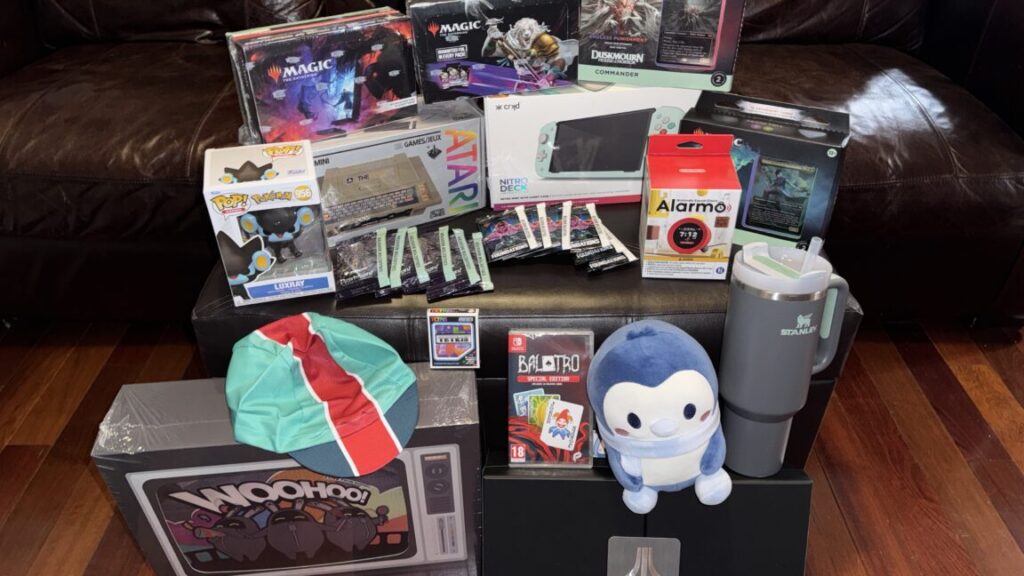
final-reminder:-donate-today-to-win-swag-in-our-annual-charity-drive-sweepstakes

Final reminder: Donate today to win swag in our annual Charity Drive sweepstakes

How it works

Donating is easy. Simply donate to Child’s Play using a credit card or PayPal or donate to the EFF using PayPal, credit card, or cryptocurrency. You can also support Child’s Play directly by using this Ars Technica campaign page or by picking an item from the Amazon wish list of a specific hospital on its donation page. Donate as much or as little as you feel comfortable with—every bit helps.

Once that’s done, it’s time to register your entry in our sweepstakes. Just grab a digital copy of your receipt (a forwarded email, a screenshot, or simply a cut-and-paste of the text) and send it to [email protected] with your name, postal address, daytime telephone number, and email address by 11: 59 pm ET Thursday, January 2, 2025.

One entry per person, and each person can only win up to one prize. US residents only. NO PURCHASE NECESSARY. See the official rules for more information, including how to enter without making a donation. Also, refer to the Ars Technica privacy policy (https://www.condenast.com/privacy-policy).

We’ll then contact the winners and have them choose their prize by January 31, 2025 (choosing takes place in the order the winners are drawn). Good luck!

Final reminder: Donate today to win swag in our annual Charity Drive sweepstakes Read More »

the-perfect-new-year’s-eve-comedy-turns-30

The perfect New Year’s Eve comedy turns 30

There aren’t that many movies specifically set on New Year’s Eve, but one of the best is The Hudsucker Proxy (1994), Joel and Ethan Coen’s visually striking, affectionate homage to classic Hollywood screwball comedies. The film turned 30 this year, so it’s the perfect opportunity for a rewatch.

(WARNING: Spoilers below.)

The Coen brothers started writing the script for The Hudsucker Proxy when Joel was working as an assistant editor on Sam Raimi’s The Evil Dead (1981). Raimi ended up co-writing the script, as well as making a cameo appearance as a brainstorming marketing executive.  The Coen brothers took their inspiration from the films of Preston Sturgess and Frank Capra, among others, but the intent was never to satirize or parody those films. “It’s the case where, having seen those movies, we say ‘They’re really fun—let’s do one!’; as opposed to “They’re really fun—let’s comment upon them,'” Ethan Coen has said.

They finished the script in 1985, but at the time they were small indie film directors. It wasn’t until the critical and commercial success of 1991’s Barton Fink that the Coen brothers had the juice in Hollywood to finally make The Hudsucker Proxy. Warner Bros. greenlit the project and producer Joel Silver gave the brothers complete creative control, particularly over the final cut.

Norville Barnes (Tim Robbins) is an ambitious, idealistic recent graduate of a business college in Muncie, Indiana, who takes a job as a mailroom clerk at Hudsucker Industries in New York, intent on working his way to the top. That ascent happens much sooner than expected. On the same December day in 1958, the company’s founder and president, Waring Hudsucker (Charles Durning), leaps to his death from the boardroom on the 44th floor (not counting the mezzanine).

A meteoric rise

Norville Barnes (Tim Robbins) gets a job at Hudsucker Industries Warner Bros.

To keep the company’s stock from going public as the bylaws dictate, board member Sidney Mussburger (Paul Newman) proposes they elect a patsy as the next president—someone so incompetent it will spook investors and temporarily depress the stock so the board can buy up controlling shares on the cheap. Enter Norville, who takes the opportunity of delivering a Blue Letter to Mussburger to pitch a new product, represented by a simple circle drawn on a piece of paper: “You know… for kids!” Thinking he’s found his imbecilic patsy, Mussburger names Norville the new president.

The perfect New Year’s Eve comedy turns 30 Read More »

power-company-hid-illegal-crypto-mine-that-may-have-caused-outages

Power company hid illegal crypto mine that may have caused outages

But Russia presumably gets no taxes on illegal crypto mining, and power outages can be costly for everyone in a region. So next year, Russia will ban crypto mining in 10 regions for six years and place seasonal restrictions that would disrupt some crypto mining operations during the coldest winter months in regions like Irkutsk, CoinTelegraph reported.

Illegal mining is still reportedly thriving in Irkutsk, though, despite the government’s attempts to shut down secret farms. To deter any illegal crypto mining disrupting power grids last year, authorities seized hundreds of crypto mining rigs in Irkutsk, Crypto News reported.

In July, Russian president Vladimir Putin linked blackouts to illegal crypto mines, warning that crypto mining currently consumes “almost 1.5 percent of Russia’s total electricity consumption,” but “the figure continues to go up,” the Moscow Times reported. And in September, Reuters reported that illegal mines were literally going underground to avoid detection as Russia’s crackdown continues.

Even though illegal mines are seemingly common in parts of Siberia and increasingly operating out of the public eye, finding an illegal mine hidden on state land controlled by an electrical utility was probably surprising to officials.

The power provider was not named in the announcement, and there are several in the region, so it’s not currently clear which one made the controversial decision to lease state land to an illegal mining operation.

Power company hid illegal crypto mine that may have caused outages Read More »