Author name: Beth Washington

in-a-not-so-subtle-signal-to-regulators,-blue-origin-says-new-glenn-is-ready

In a not-so-subtle signal to regulators, Blue Origin says New Glenn is ready

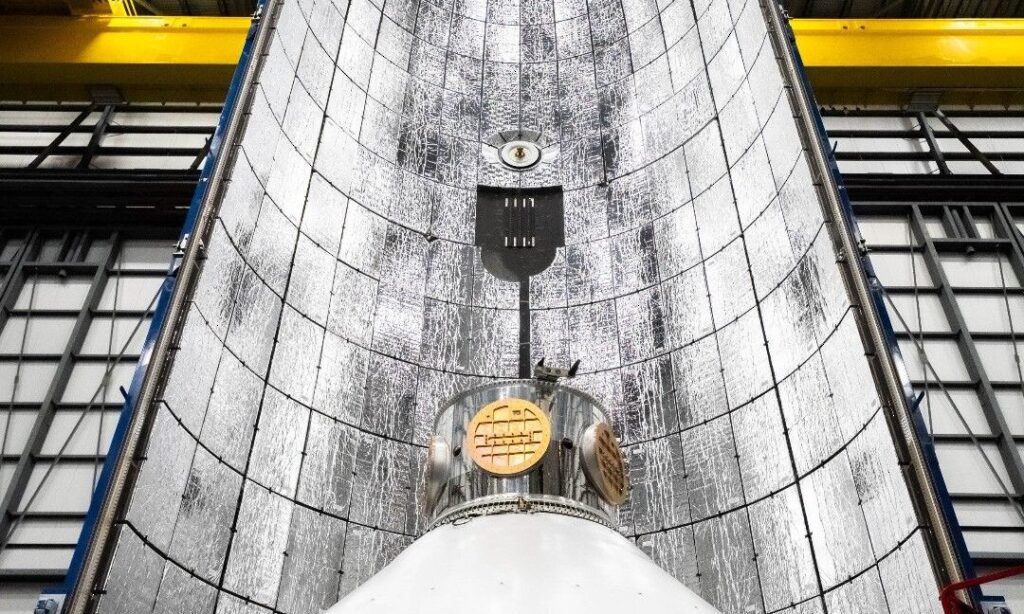
Blue Origin said Tuesday that the test payload for the first launch of its new rocket, New Glenn, is ready for liftoff. The company published an image of the “Blue Ring” pathfinder nestled up against one half of the rocket’s payload fairing.

“There is a growing demand to quickly move and position equipment and infrastructure in multiple orbits,” the company’s chief executive, Dave Limp, said on LinkedIn. “Blue Ring has advanced propulsion and communication capabilities for government and commercial customers to handle these maneuvers precisely and efficiently.”

This week’s announcement—historically Blue Origin has been tight-lipped about new products, but is opening up more as it nears the debut of its flagship New Glenn rocket—appears to serve a couple of purposes.

All Blue wants for Christmas is…

First of all, the relatively small payload contrasted with the size of the payload fairing highlights the greater volume the rocket offers over most conventional boosters. New Glenn’s payload fairing is 7 meters (23 feet) in diameter as opposed to the more conventional 5 meters (16.4 feet). It looks roomy inside.

Additionally, the company appears to be publicly signaling the Federal Aviation Administration and other regulatory agencies that it believes New Glenn is ready to fly, pending approval to conduct a hot fire test at Launch Complex-36, and then for a liftoff from Florida. This is a not-so-subtle message to regulators to please hurry up and complete the paperwork necessary for launch activities. It is not clear what is holding up the hot-fire and launch approval in this case, but it is often environmental issues or certification of a flight termination system.

Blue Origin’s release on Tuesday was carefully worded. The headline said New Glenn was “on track” for a launch this year and stated that the Blue Ring payload is “ready” for a launch this year. As yet there is no notional or public launch date. The hot-fire test has been delayed multiple times since the company put the rocket on its launch pad on Nov. 23. It had been targeting November for the test, and more recently, this past weekend.

After years of delays for the rocket, originally due to debut in 2020, Blue Origin founder Jeff Bezos hired a new chief executive to run the company a little more than a year ago. Limp, an executive from Amazon, was given the mandate to change Blue Origin’s slower-moving culture to be more nimble and urgent and was told to launch New Glenn by the end of 2024.

In a not-so-subtle signal to regulators, Blue Origin says New Glenn is ready Read More »

From Products to Customers: Delivering Business Transformation At Scale

Transformation is a journey, not a destination – so how to transform at scale? GigaOm Field CTOs Darrel Kent and Whit Walters explore the nuances of business and digital transformation, sharing their thoughts on scaling businesses, value-driven growth, and leadership in a rapidly evolving world.

Whit: Darrel, transformation is such a well-used word these days—digital transformation, business transformation. It’s tough enough at a project level, but for enterprises looking to grow, where should they begin?

Darrel: You’re right. Transformation has become one of those overused buzzwords, but at its core, it’s about fundamental change. What is digital transformation? What is business transformation? It’s about translating those big concepts into value-based disciplines—disciplines that drive real impact.

Whit: That sounds compelling. Can you give us an example of what that looks like in practice – how does transformation relate to company growth?

Darrel: Sure. Think of a company aiming to grow from 1 billion, to 2 billion, to 5 billion in revenue. That’s not just a numbers game; it’s a journey of transformation. To get to 1 billion, you can get there by focusing on product excellence. But you won’t get to 2 billion based on product alone – you need more. You need to rethink your approach to scaling—whether it’s through innovation, operations, or culture. Finance needs to invest strategically, sales needs to evolve, and leadership must align every decision with long-term goals.

Whit: It’s a fascinating shift. So, scaling isn’t just about selling more products?

Darrel: Exactly. Scaling requires a transformation in how you deliver value. For example, moving beyond transactional sales to consultative relationships. It’s about operational efficiency, customer experience, and innovation working together to create value at scale. I call these value-based disciplines.

Whit: Let’s break that down a bit more. You’ve mentioned product excellence, operational excellence, and customer excellence. How do these concepts build on each other?

Darrel: Great question. Product excellence is the foundation. When building a company, your product needs to solve a real problem and do it exceptionally well. That’s how you reach your first milestone—say, that 1-billion-dollar mark. But to scale beyond that, you can’t rely on product alone. This is where operational excellence comes in. It’s about streamlining your processes, reducing inefficiencies, and ensuring that every part of the organization is working in harmony.

Whit: And customer excellence? Where does that fit in?

Darrel: Customer excellence takes it to the next level beyond operational excellence. Once again, what gets you to 2 billion does not take you beyond that. You have to change again. It’s not just about creating a great product or running a smooth operation. It’s about truly understanding and anticipating your customers’ needs. Companies that master customer excellence create loyalty and advocacy. They don’t just react to customer feedback; they proactively shape the customer experience. This is where long-term growth happens, and it’s a hallmark of companies that scale successfully.

Whit: That makes so much sense. So, it’s a progression—starting with product, moving to operations, and finally centering everything around the customer?

Darrel: Exactly. Think of it as a ladder. Each step builds on the previous one. You need product excellence to get off the ground, operational excellence to scale efficiently, and customer excellence to ensure longevity and market leadership. And these aren’t isolated phases—they’re interconnected. A failure in one area can disrupt the whole system.

Whit: That’s a powerful perspective. What role does leadership play in this transformation?

Darrel: Leadership is everything. It starts with understanding that transformation isn’t optional—it’s survival. Leaders must champion change, align the organization’s culture with its strategy, and invest in the right areas. For example, what does the CFO prioritize? What technologies or processes does the COO implement? It all needs to work together.

Whit: That’s a powerful perspective. What would you say to leaders who are hesitant to embark on such a daunting journey?

Darrel: I’d tell them this: Transformation isn’t just about surviving the present; it’s about thriving in the future. It’s what Simon Sinek refers to as ‘the long game’. Companies that embrace these principles—aligning value creation with their business strategy—will not only grow but will set the pace in their industries.

Whit: Do you have any final thoughts for organizations navigating their own transformations?

Darrel: Focus on value. Whether it’s your customers, employees, or stakeholders, every transformation effort should return to delivering value. And remember, it’s a journey. You don’t have to get it perfect overnight, but you do have to start.

Whit: Thank you, Darrel. Your insights are invaluable.

From Products to Customers: Delivering Business Transformation At Scale Read More »

meet-hyperlight,-ars-technica’s-new,-even-brighter-“light”-mode

Meet Hyperlight, Ars Technica’s new, even brighter “Light” mode

Like many sites, apps, and operating systems, Ars Technica has both “Light” and “Dark” visual styles. They look great! But even the “Light” mode has darker elements in it, and after our recent redesign, some Ars readers asked for an even lighter “Light” mode, one that would allow them to absolutely sear their own retinas with various shades of blinding white. (I kid, of course; for some readers, it’s a serious visual comfort issue.)

We’ve spent the last month working up a third visual style to give the people what they want. Behold the fully armed and operational “Hyperlight” mode, our new visual theme featuring a white background, light gray headline boxes, and black text. You can activate it right now from the visual style menu on the navigation bar at the top of the page.

In total, we now have four visual modes. Hyperlight is the brightest of these, while Day & Night is our rebranded “Light mode” and mixes light and dark elements. Dark is all dark backgrounds with light text. The fourth mode is System, which automatically switches between Day & Night and Dark modes based on your operating system setting. (System will not switch the site to Hyperlight.)

Meet Hyperlight, Ars Technica’s new, even brighter “Light” mode Read More »

google-gets-an-error-corrected-quantum-bit-to-be-stable-for-an-hour

Google gets an error-corrected quantum bit to be stable for an hour


Using almost the entire chip for a logical qubit provides long-term stability.

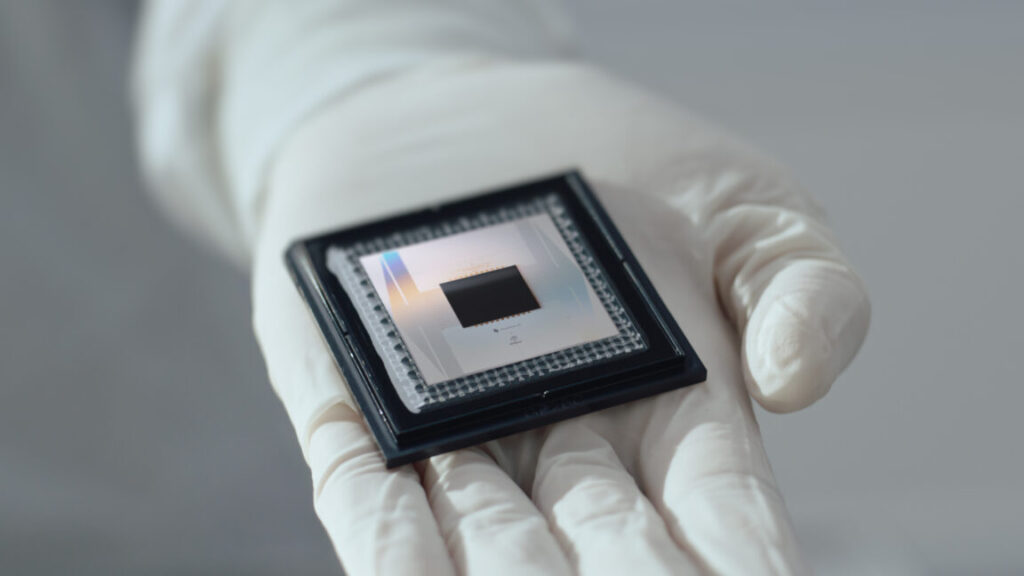
Google’s new Willow chip is its first new generation of chips in about five years. Credit: Google

On Monday, Nature released a paper from Google’s quantum computing team that provides a key demonstration of the potential of quantum error correction. Thanks to an improved processor, Google’s team found that increasing the number of hardware qubits dedicated to an error-corrected logical qubit led to an exponential increase in performance. By the time the entire 105-qubit processor was dedicated to hosting a single error-corrected qubit, the system was stable for an average of an hour.

In fact, Google told Ars that errors on this single logical qubit were rare enough that it was difficult to study them. The work provides a significant validation that quantum error correction is likely to be capable of supporting the execution of complex algorithms that might require hours to execute.

A new fab

Google is making a number of announcements in association with the paper’s release (an earlier version of the paper has been up on the arXiv since August). One of those is that the company is committed enough to its quantum computing efforts that it has built its own fabrication facility for its superconducting processors.

“In the past, all the Sycamore devices that you’ve heard about were fabricated in a shared university clean room space next to graduate students and people doing kinds of crazy stuff,” Google’s Julian Kelly said. “And we’ve made this really significant investment in bringing this new facility online, hiring staff, filling it with tools, transferring their process over. And that enables us to have significantly more process control and dedicated tooling.”

That’s likely to be a critical step for the company, as the ability to fabricate smaller test devices can allow the exploration of lots of ideas on how to structure the hardware to limit the impact of noise. The first publicly announced product of this lab is the Willow processor, Google’s second design, which ups its qubit count to 105. Kelly said one of the changes that came with Willow actually involved making the individual pieces of the qubit larger, which makes them somewhat less susceptible to the influence of noise.

All of that led to a lower error rate, which was critical for the work done in the new paper. This was demonstrated by running Google’s favorite benchmark, one that it acknowledges is contrived in a way to make quantum computing look as good as possible. Still, people have figured out how to make algorithm improvements for classical computers that have kept them mostly competitive. But, with all the improvements, Google expects that the quantum hardware has moved firmly into the lead. “We think that the classical side will never outperform quantum in this benchmark because we’re now looking at something on our new chip that takes under five minutes, would take 1025 years, which is way longer than the age of the Universe,” Kelly said.

Building logical qubits

The work focuses on the behavior of logical qubits, in which a collection of individual hardware qubits are grouped together in a way that enables errors to be detected and corrected. These are going to be essential for running any complex algorithms, since the hardware itself experiences errors often enough to make some inevitable during any complex calculations.

This naturally creates a key milestone. You can get better error correction by adding more hardware qubits to each logical qubit. If each of those hardware qubits produces errors at a sufficient rate, however, then you’ll experience errors faster than you can correct for them. You need to get hardware qubits of a sufficient quality before you start benefitting from larger logical qubits. Google’s earlier hardware had made it past that milestone, but only barely. Adding more hardware qubits to each logical qubit only made for a marginal improvement.

That’s no longer the case. Google’s processors have the hardware qubits laid out on a square grid, with each connected to its nearest neighbors (typically four except at the edges of the grid). And there’s a specific error correction code structure, called the surface code, that fits neatly into this grid. And you can use surface codes of different sizes by using progressively more of the grid. The size of the grid being used is measured by a term called distance, with larger distance meaning a bigger logical qubit, and thus better error correction.

(In addition to a standard surface code, Google includes a few qubits that handle a phenomenon called “leakage,” where a qubit ends up in a higher-energy state, instead of the two low-energy states defined as zero and one.)

The key result is that going from a distance of three to a distance of five more than doubled the ability of the system to catch and correct errors. Going from a distance of five to a distance of seven doubled it again. Which shows that the hardware qubits have reached a sufficient quality that putting more of them into a logical qubit has an exponential effect.

“As we increase the grid from three by three to five by five to seven by seven, the error rate is going down by a factor of two each time,” said Google’s Michael Newman. “And that’s that exponential error suppression that we want.”

Going big

The second thing they demonstrated is that, if you make the largest logical qubit that the hardware can support, with a distance of 15, it’s possible to hang onto the quantum information for an average of an hour. This is striking because Google’s earlier work had found that its processors experience widespread simultaneous errors that the team ascribed to cosmic ray impacts. (IBM, however, has indicated it doesn’t see anything similar, so it’s not clear whether this diagnosis is correct.) Those happened every 10 seconds or so. But this work shows that a sufficiently large error code can correct for these events, whatever their cause.

That said, these qubits don’t survive indefinitely. One of them seems to be a localized temporary increase in errors. The second, more difficult to deal with problem involves a widespread spike in error detection affecting an area that includes roughly 30 qubits. At this point, however, Google has only seen six of these events, so they told Ars that it’s difficult to really characterize them. “It’s so rare it actually starts to become a bit challenging to study because you have to gain a lot of statistics to even see those events at all,” said Kelly.

Beyond the relative durability of these logical qubits, the paper notes another advantage to going with larger code distances: it enhances the impact of further hardware improvements. Google estimates that at a distance of 15, improving hardware performance by a factor of two would drop errors in the logical qubit by a factor of 250. At a distance of 27, the same hardware improvement would lead to an improvement of over 10,000 in the logical qubit’s performance.

Note that none of this will ever get the error rate to zero. Instead, we just need to get the error rate to a level where an error is unlikely for a given calculation (more complex calculations will require a lower error rate). “It’s worth understanding that there’s always going to be some type of error floor and you just have to push it low enough to the point where it practically is irrelevant,” Kelly said. “So for example, we could get hit by an asteroid and the entire Earth could explode and that would be a correlated error that our quantum computer is not currently built to be robust to.”

Obviously, a lot of additional work will need to be done to both make logical qubits like this survive for even longer, and to ensure we have the hardware to host enough logical qubits to perform calculations. But the exponential improvements here, to Google, suggest that there’s nothing obvious standing in the way of that. “We woke up one morning and we kind of got these results and we were like, wow, this is going to work,” Newman said. “This is really it.”

Nature, 2024. DOI: 10.1038/s41586-024-08449-y  (About DOIs).

Photo of John Timmer

John is Ars Technica’s science editor. He has a Bachelor of Arts in Biochemistry from Columbia University, and a Ph.D. in Molecular and Cell Biology from the University of California, Berkeley. When physically separated from his keyboard, he tends to seek out a bicycle, or a scenic location for communing with his hiking boots.

Google gets an error-corrected quantum bit to be stable for an hour Read More »

itch.io-platform-briefly-goes-down-due-to-“ai-driven”-anti-phishing-report

Itch.io platform briefly goes down due to “AI-driven” anti-phishing report

The itch.io domain was back up and running by 7 am Eastern, according to media reports, “after the registrant finally responded to our notice and took appropriate action to resolve the issue.” Users could access the site throughout if they typed the itch.io IP address into their web browser directly.

Too strong a shield?

BrandShield’s website describes it as a service that “detects and hunts online trademark infringement, counterfeit sales, and brand abuse across multiple platforms.” The company claims to have multiple Fortune 500 and FTSE100 companies on its client list.

In its own series of social media posts, BrandShield said its “AI-driven platform” had identified “an abuse of Funko… from an itch.io subdomain.” The takedown request it filed was focused on that subdomain, not the entirety of itch.io, BrandShield said.

“The temporary takedown of the website was a decision made by the service providers, not BrandShield or Funko.”

The whole affair highlights how the delicate web of domain registrars and DNS servers can remain a key failure point for web-based businesses. Back in May, we saw how the desyncing of a single DNS root server could cause problems across the entire Internet. And in 2012, the hacking collective Anonymous highlighted the potential for a coordinated attack to take down the entire DNS system.

Itch.io platform briefly goes down due to “AI-driven” anti-phishing report Read More »

2025-lamborghini-urus-se-first-drive:-the-total-taurean-package

2025 Lamborghini Urus SE first drive: The total taurean package


A 789-horsepower Goldilocks moment

Adding electric power and a battery turns the Urus from hit-or-miss to just right.

The original Urus was an SUV that nobody particularly wanted, even if the market was demanding it. With luxury manufacturers tripping over themselves to capitalize on a seemingly limitless demand for taller all-around machines, Lamborghini was a little late to the party.

The resulting SUV has done its job, boosting Lamborghini’s sales and making up more than half of the company’s volume last year. Even so, the first attempt was just a bit tame. That most aggressive of supercar manufacturers produced an SUV featuring the air of the company’s lower, more outrageous performance machines, but it didn’t quite deliver the level of prestige that its price demanded.

The Urus Performante changed that, adding enough visual and driving personality to make itself a legitimately exciting machine to drive or to look at. Along the way, though, it lost a bit of the most crucial aspect of an SUV: everyday livability. On paper, the Urus SE is just a plug-in version of the Urus, with a big battery adding some emissions-free range. In reality, it’s an SUV with more performance and more flexibility, too. This is the Urus’ Goldilocks moment.

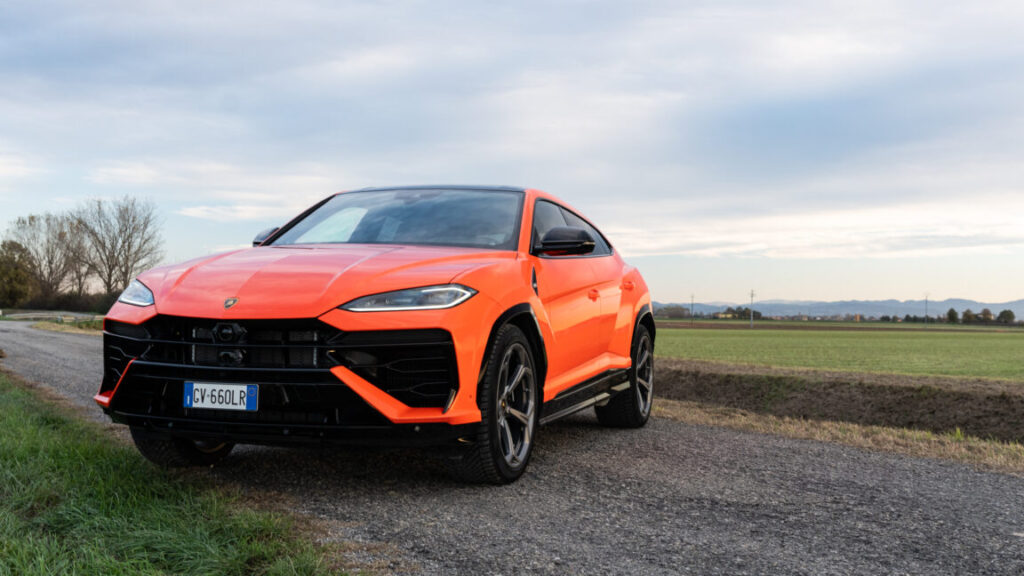
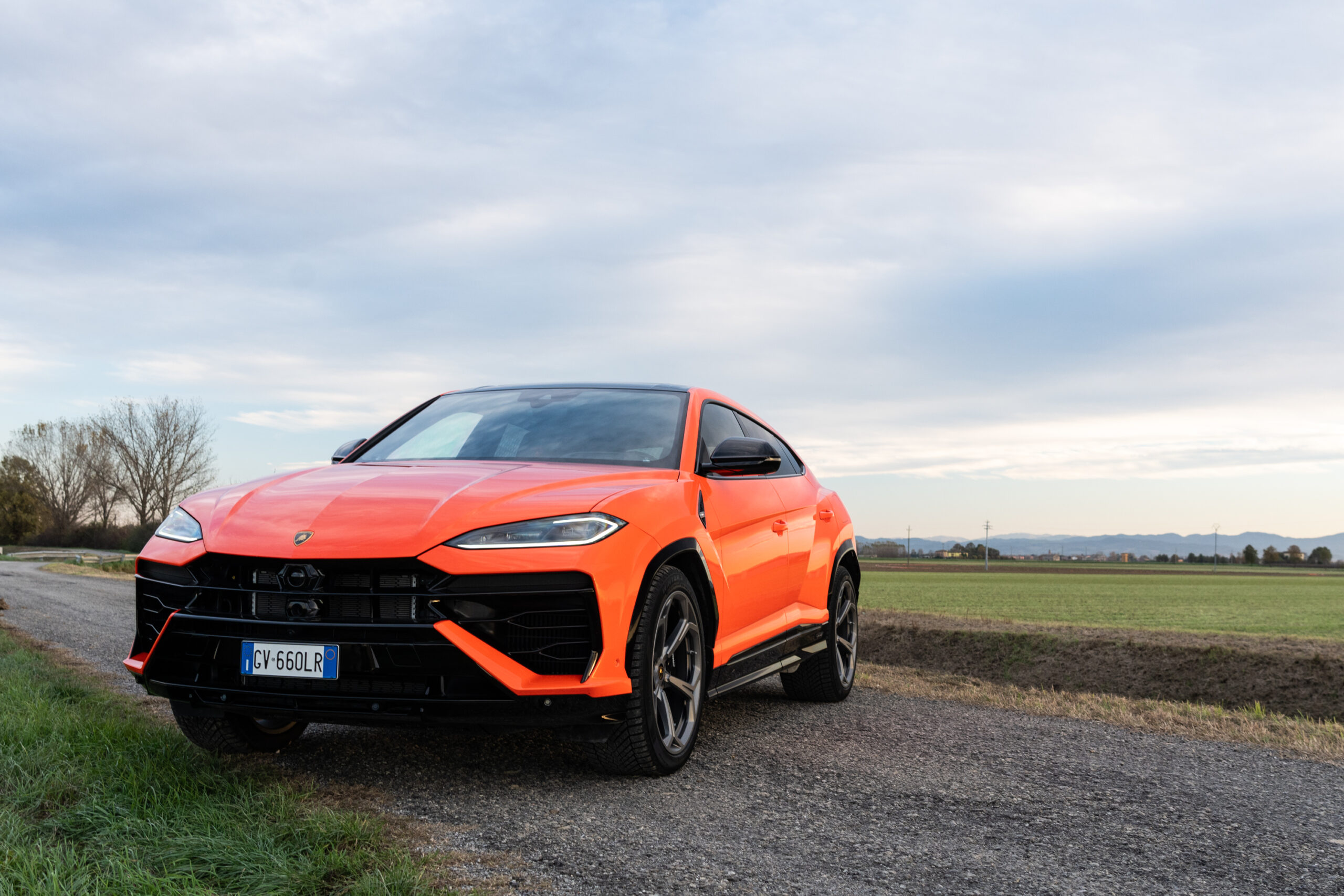
the front half of an orange Lamborghini Urus

If you’re looking for something subtle, you shouldn’t be looking at an Urus. Credit: Tim Stevens

The what

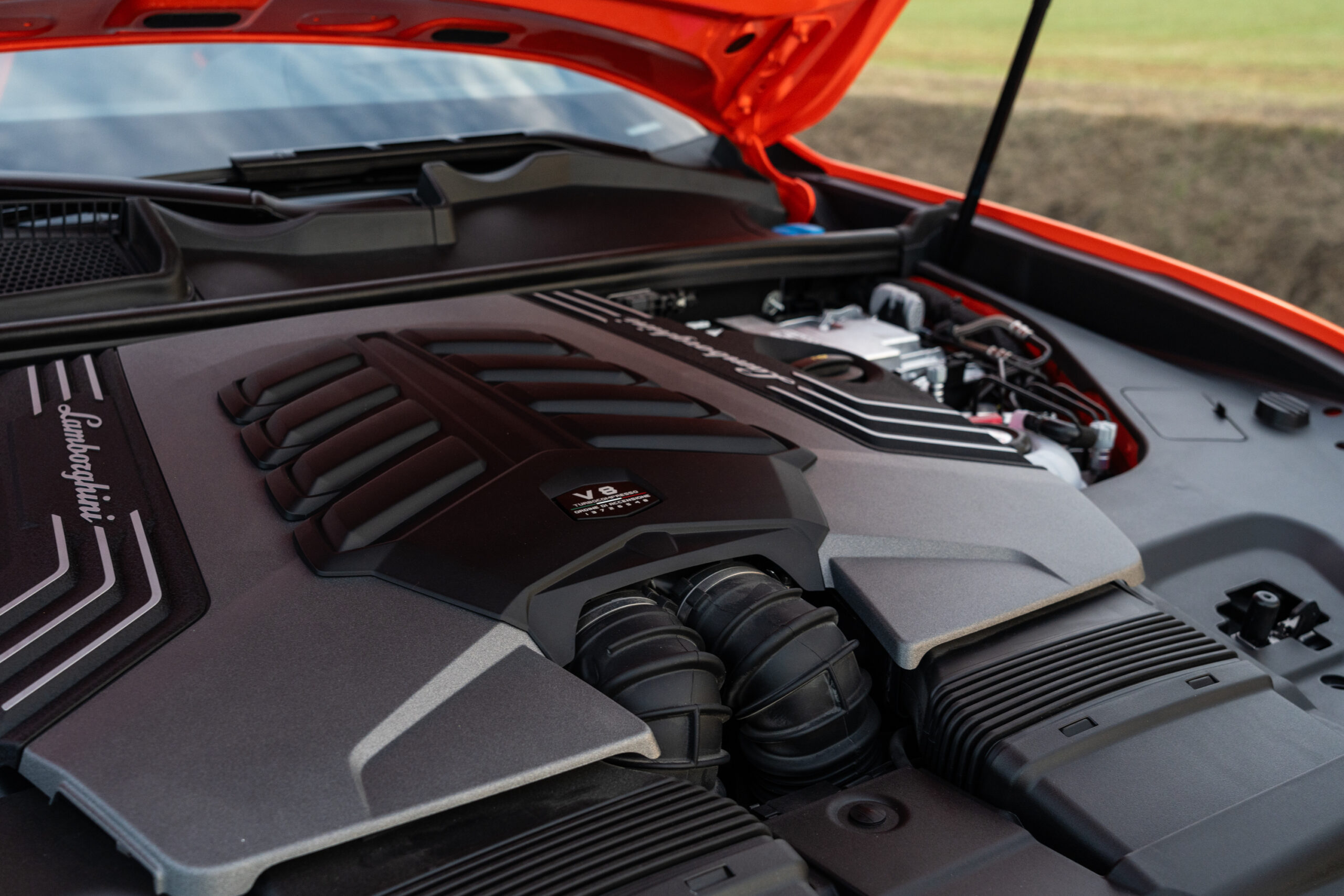
The Urus SE starts with the same basic platform as the other models in the line, including a 4.0 L turbocharged V8 that drives all four wheels through an eight-speed automatic and an all-wheel-drive system.

All that has received a strong dose of electrification, starting with a 25.9 kWh battery pack sitting far out back that helps to offset the otherwise nose-heavy SUV while also adding a playful bit of inertia to its tail. More on that in a moment.

That battery powers a 189 hp (141 kW) permanent-magnet synchronous electric motor fitted between the V8 and its transmission. The positioning means it has full access to all eight speeds and can drive the car at up to 81 mph (130 km/h). That, plus a Lamborghini-estimated 37 miles (60 km) of range, means this is a large SUV that could feasibly cover a lot of people’s commutes emissions-free.

Lamborghini urus engine bay

The V8 lives here. Credit: Tim Stevens

But when that electric motor’s power is paired with the 4.0 V8, the result is 789 hp (588 kW) total system power delivered to all four wheels. And with the electric torque coming on strong and early, it not only adds shove but throttle response, too.

Other updates

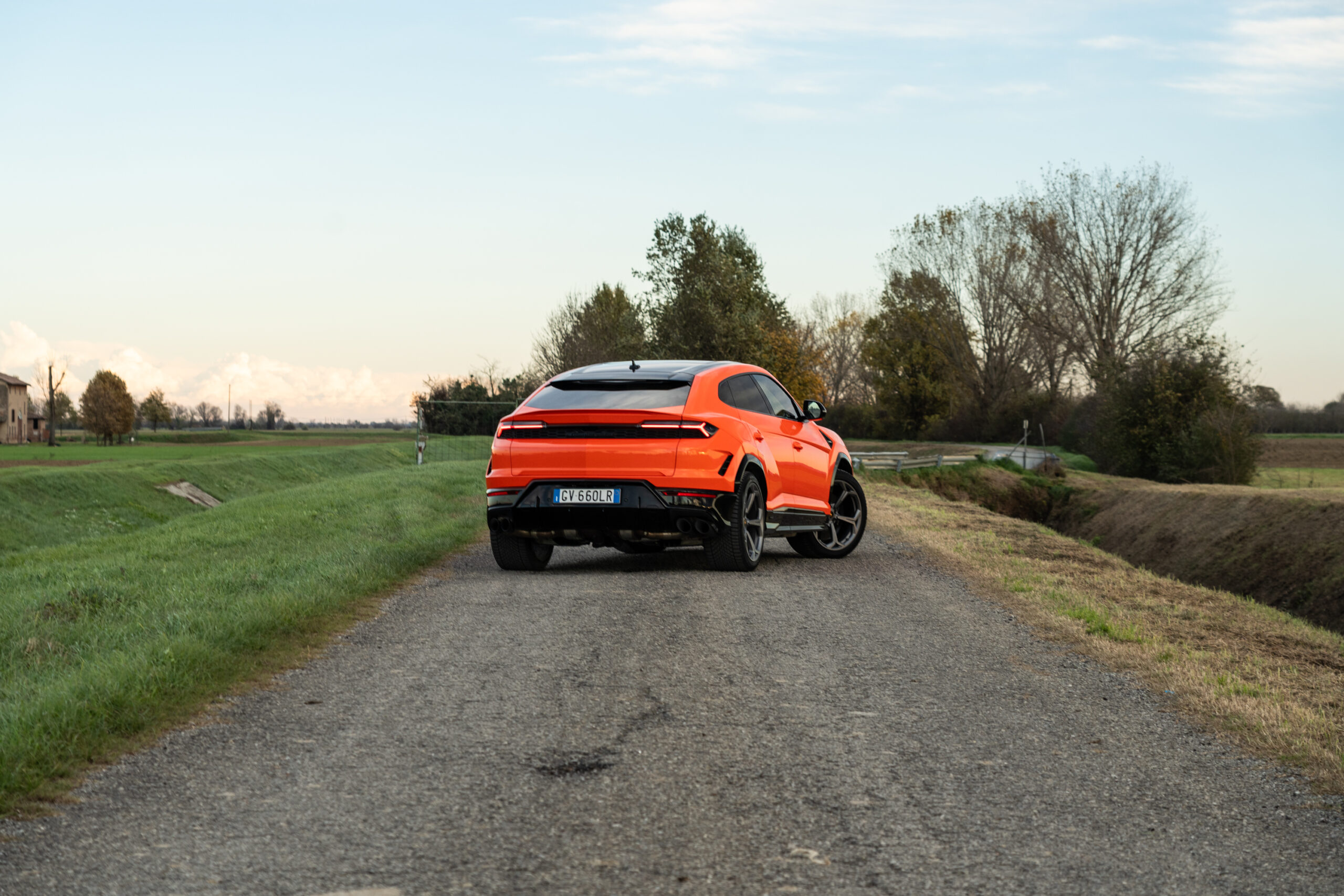
At a glance, the Urus SE looks more or less the same as the earlier renditions of the same SUV. Look closer, though, and you’ll spot several subtle changes, including a hood that eases more gently into the front fenders and a new spoiler out back that Lamborghini says boosts rear downforce by 35 percent over the Urus S.

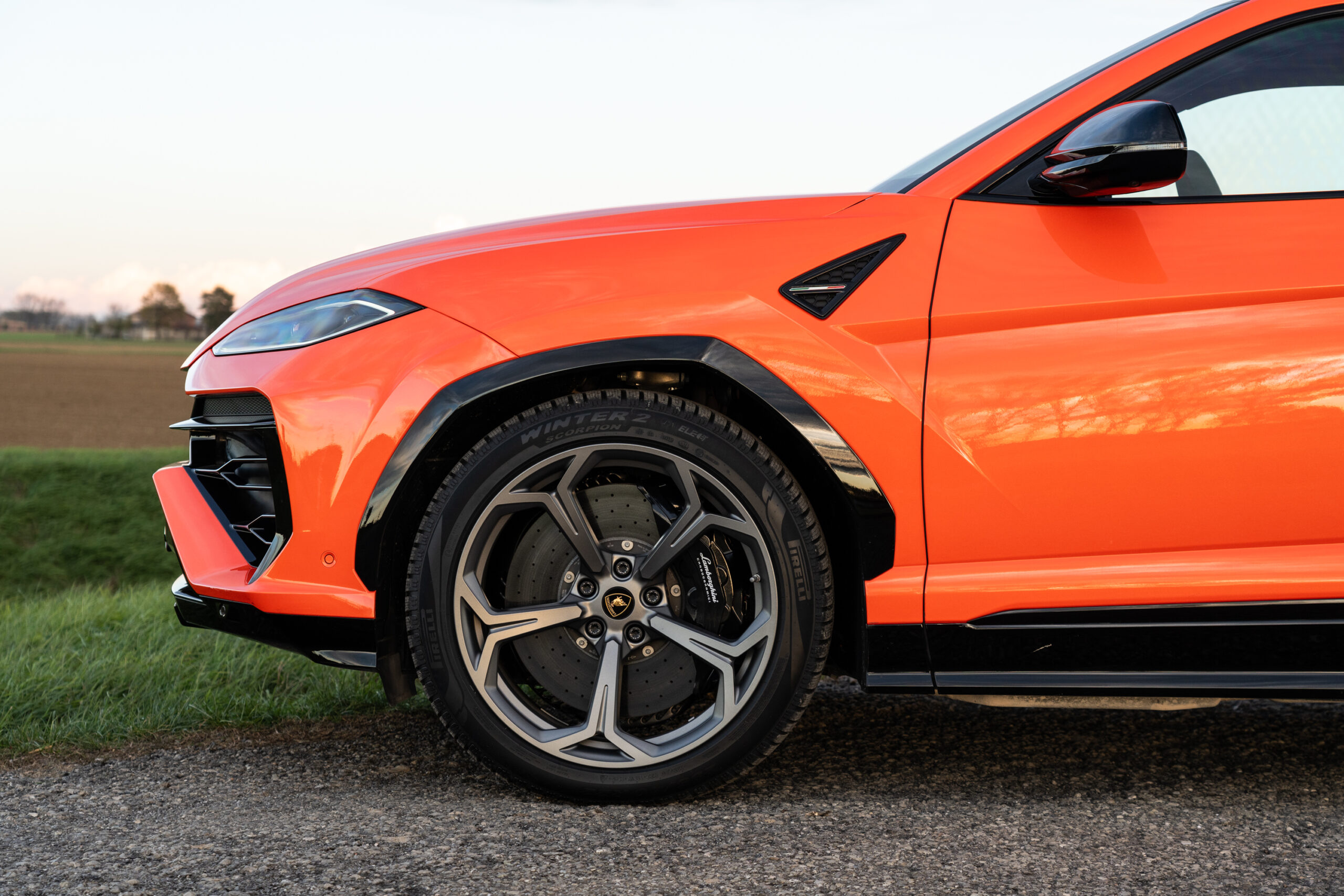
Far and away the most striking part of the car, though, are the 22-inch wheels wrapped around carbon-ceramic brakes. They give this thing the look of a rolling caricature of a sport SUV in the best way possible. On the body of the machine itself, you’ll want to choose a properly eye-catching color, like the Arancio Egon you see here. I’ve been lucky to drive some pretty special SUVs over the years, and none have turned heads like this one did when cruising silently through a series of small Italian towns.

Things are far more same-y on the inside. At first blush, nothing has changed inside the Urus SE, and that’s OK. You have a few new hues of Technicolor hides to choose from—the car you see here is outfitted in a similarly pungent orange to its exterior color, making it a citrus dream through and through. The sports seats aren’t overly aggressive, offering more comfort than squeeze, but I’d say that’s just perfect.

Buttons and touchscreens vie with less conventional controls inside the Urus. Tim Stevens

But that’s all much the same as prior Urus versions. The central infotainment screen is slightly larger at 12.3 inches, and the software is lightly refreshed, but it’s the same Audi-based system as before. A light skinning full of hexagons makes it look and feel a little more at home in a car with a golden bull on the nose.

Unfortunately, while the car is quicker than the original model, the software isn’t. The overall experience is somewhat sluggish, especially when moving through the navigation system. Even the regen meter on the digital gauge cluster doesn’t change until a good half-second after you’ve pressed the brake pedal, an unfortunate place for lag.

The Urus SE offers six drive modes: Strada (street), Sport, Corsa (track), Sabbia (sand), Terra (dirt), and Neve (snow). There’s also a seventh, customizable Ego mode. As on earlier Urus models, these modes must be selected in that sequence. So if you want to go from Sport back to Strada, you need to cycle the mode selector knob five times—or go digging two submenus deep on the touchscreen.

Those can be further customized via a few buttons added beneath the secondary drive mode lever on the right. The top button enables standard Hybrid mode, where the gasoline and electric powertrains work together as harmoniously as possible for normal driving. The second button enters Recharge mode, which instructs the car to prioritize battery charge. The third and lowest button enters Performance mode, which gives you maximum performance from the hybrid system at the expense of charge.

Finally, a quick tug on the mode selector on the right drops the Urus into EV Drive.

Silent running

I started my time in the Urus SE driving into the middle of town, which was full of narrow streets, pedestrian-friendly speed limits, and aggressively piloted Fiats. Slow and steady is the safest way in these situations, so I was happy to sample the Urus’ all-electric mode.

To put it simply, it delivers. There’s virtually no noise from the drivetrain, a near-silent experience at lower speeds that help assuage the stress such situations can cause. The experience was somewhat spoiled by some tire noise, but I’ll blame that on the Pirelli Scorpion Winter 2 tires outfitted here. I can’t, however, blame the tires for a few annoying creaks and rattles, which isn’t exactly what I’d expect from an SUV at this price point.

Though there isn’t much power at your disposal in this mode, the Urus can still scoot away from lights and stop signs quickly and easily, even ducking through small gaps in tiny roundabouts.

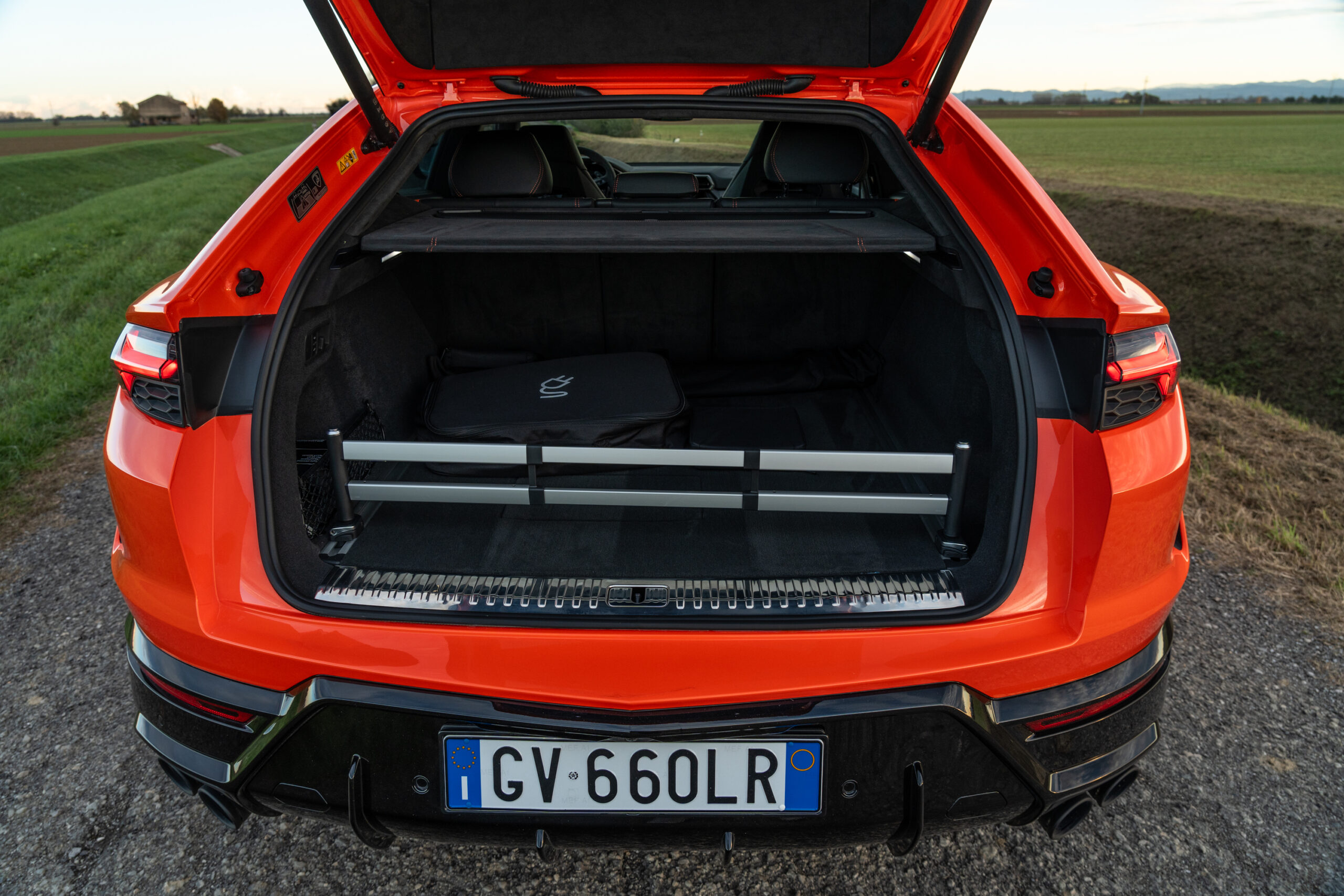
Lamborghini Urus cargo area

It might not be subtle, but it can be practical. Credit: Tim Stevens

Dip more than three-quarters of the way into the throttle, though, and that V8 fires up and quickly joins the fun. The hand-off here can be a little less than subtle as power output surges quickly, but in a moment, the car goes from a wheezy EV to a roaring Lamborghini. And unlike a lot of plug-ins that stubbornly refuse to shut their engines off again when this happens, another quick pull of the EV lever silences the thing.

When I finally got out of town, I shifted over to Strada mode, the default mode for the Urus. I found this mode a little too lazy for my tastes, as it was reluctant to shift down unless I dipped far into the throttle, resulting in a bucking bull of acceleration when the eight-speed automatic finally complied.

The car only really came alive when I put it into Sport mode and above.

Shifting to Sport

Any hesitation or reluctance to shift is quickly obliterated as soon as you tug the drive mode lever into Sport. The SUV immediately forgets all about trying to be efficient, dropping a gear or two and making sure you’re never far from the power band, keeping the turbo lag from the V8 to a minimum.

The tachometer gets some red highlights in this mode, but you won’t need to look at it. There’s plenty of sound from the exhaust, augmented by some digital engine notes I found to be more distracting and unnecessary than anything. Most importantly, the overall feel of the car changes dramatically. It leaps forward with the slightest provocation of the right pedal, really challenging the grip of the tires.

In my first proper sampling of the full travel of that throttle pedal, I was surprised at how quickly this latest Urus got frisky, kicking its tail out with an eager wag on a slight bend to the right. It wasn’t scary, but it was just lively enough to make me smile and feel like I was something more than a passenger in a hyper-advanced, half-electric SUV.

Credit: Tim Stevens

In other words, it felt like a Lamborghini, an impression only reinforced as I dropped the SUV down to Corsa mode and really let it fly. The transmission is incredibly eager to drop gears on the slightest bit of deceleration, enough so that I rarely felt the need to reach for the column-mounted shift paddles.

But despite the eagerness, the suspension remained compliant and everyday-livable in every mode. I could certainly feel the (many) imperfections in the rural Italian roads more when the standard air suspension was dialed over to its stiffest, but even then, it was never punishing. And in the softest setting, the SUV was perfectly comfortable despite those 22-inch wheels and tires.

I didn’t get a chance to sample the SUV’s off-road prowess, but the SE carries a torque-vectoring rear differential like the Performante, which should mean it will be as eager to turn and drift on loose surfaces as that other, racier Urus.

Both the Urus Performante and the SE start at a bit over $260,000, which means choosing between the two isn’t a decision to be made on price alone. Personally, I’d much prefer the SE. It offers plenty of the charm and excitement of the Performante mixed with even better everyday capability than the Urus S. This one’s just right.

2025 Lamborghini Urus SE first drive: The total taurean package Read More »

your-ai-clone-could-target-your-family,-but-there’s-a-simple-defense

Your AI clone could target your family, but there’s a simple defense

The warning extends beyond voice scams. The FBI announcement details how criminals also use AI models to generate convincing profile photos, identification documents, and chatbots embedded in fraudulent websites. These tools automate the creation of deceptive content while reducing previously obvious signs of humans behind the scams, like poor grammar or obviously fake photos.

Much like we warned in 2022 in a piece about life-wrecking deepfakes based on publicly available photos, the FBI also recommends limiting public access to recordings of your voice and images online. The bureau suggests making social media accounts private and restricting followers to known contacts.

Origin of the secret word in AI

To our knowledge, we can trace the first appearance of the secret word in the context of modern AI voice synthesis and deepfakes back to an AI developer named Asara Near, who first announced the idea on Twitter on March 27, 2023.

“(I)t may be useful to establish a ‘proof of humanity’ word, which your trusted contacts can ask you for,” Near wrote. “(I)n case they get a strange and urgent voice or video call from you this can help assure them they are actually speaking with you, and not a deepfaked/deepcloned version of you.”

Since then, the idea has spread widely. In February, Rachel Metz covered the topic for Bloomberg, writing, “The idea is becoming common in the AI research community, one founder told me. It’s also simple and free.”

Of course, passwords have been used since ancient times to verify someone’s identity, and it seems likely some science fiction story has dealt with the issue of passwords and robot clones in the past. It’s interesting that, in this new age of high-tech AI identity fraud, this ancient invention—a special word or phrase known to few—can still prove so useful.

Your AI clone could target your family, but there’s a simple defense Read More »

lower-cost-sodium-ion-batteries-are-finally-having-their-moment

Lower-cost sodium-ion batteries are finally having their moment

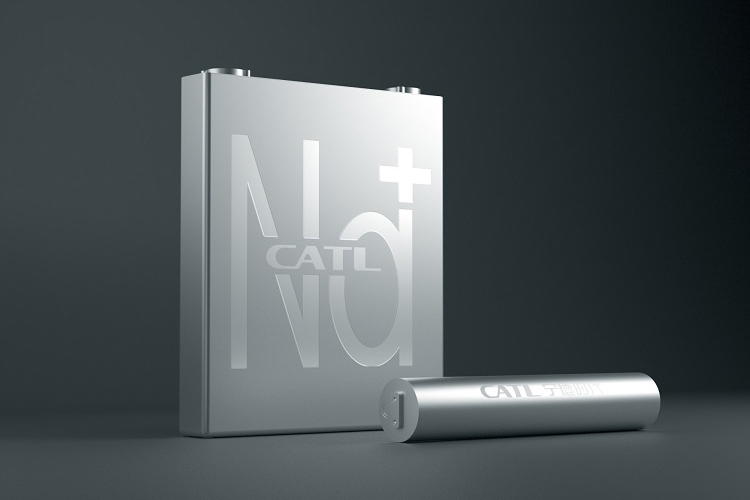
In contrast, a sodium-ion battery relies on an element—sodium—that you can find in table salt and ocean water.

Among the other benefits, sodium-ion batteries perform better than lithium-ion batteries in extreme cold. CATL has said its new battery works in temperatures as low as -40° Fahrenheit.

Also, a sodium-ion battery has much lower risk of fire. When lithium-ion batteries sustain damage, it can lead to “thermal runaway,” which triggers a dangerous and toxic fire.

The process of manufacturing sodium-ion batteries is similar to that of lithium-ion batteries, or at least similar enough that companies can shift existing assembly lines without having to spend heavily on retooling.

But sodium-ion batteries have some disadvantages. The big one is low energy density compared to lithium-ion. As a result, an EV running on a sodium-ion battery will go fewer miles per charge than a lithium-ion battery of the same size.

“That is just what nature has given us,” Srinivasan said. “From a physics perspective, sodium batteries inherently have lower energy density than lithium batteries.”

A typical sodium-ion battery has an energy density of about 150 watt-hours per kilogram at the cell level, he said. Lithium-ion batteries can range from about 180 to nearly 300 watt-hours per kilogram.

I asked Srinivasan what he makes of CATL’s claim of a sodium-ion battery with 200 watt-hours per kilogram.

“We tend to be skeptical of news releases from companies,” he said. He specified that his comment applies to all battery companies.

Venkat Srinivasan, director of the Argonne Collaborative Center for Energy Storage Science, discusses battery research with a materials scientist in one of the energy storage discovery labs at Argonne National Laboratory.

Credit: Argonne National Laboratory

Venkat Srinivasan, director of the Argonne Collaborative Center for Energy Storage Science, discusses battery research with a materials scientist in one of the energy storage discovery labs at Argonne National Laboratory. Credit: Argonne National Laboratory

The national labs’ initiative has a five-year timeline, with a goal of developing sodium-ion batteries with energy densities that match or exceed those of today’s iron phosphate-based lithium-ion batteries. Researchers would do this by finding various efficiencies in design and materials.

The project is happening alongside the labs’ ongoing work to develop and improve other kinds of batteries.

Lithium-ion batteries dominate today’s market. This year, global production of lithium-ion batteries was about 1,500 gigawatt-hours, and production of sodium-ion batteries was 11 gigawatt-hours, or less than 1 percent, according to Benchmark Mineral Intelligence.

Lower-cost sodium-ion batteries are finally having their moment Read More »

trump-nominates-jared-isaacman-to-become-the-next-nasa-administrator

Trump nominates Jared Isaacman to become the next NASA administrator

President-elect Donald Trump announced Wednesday he has selected Jared Isaacman, a billionaire businessman and space enthusiast who twice flew to orbit with SpaceX, to become the next NASA administrator.

“I am delighted to nominate Jared Isaacman, an accomplished business leader, philanthropist, pilot, and astronaut, as Administrator of the National Aeronautics and Space Administration (NASA),” Trump posted on his social media platform, Truth Social. “Jared will drive NASA’s mission of discovery and inspiration, paving the way for groundbreaking achievements in space science, technology, and exploration.”

In a post on X, Isaacman said he was “honored” to receive Trump’s nomination.

“Having been fortunate to see our amazing planet from space, I am passionate about America leading the most incredible adventure in human history,” Isaacman wrote. “On my last mission to space, my crew and I traveled farther from Earth than anyone in over half a century. I can confidently say this second space age has only just begun.”

Top officials who served at NASA under President Trump and President Obama endorsed Isaacman as the next NASA boss.

“Jared Isaacman will be an outstanding NASA Administrator and leader of the NASA family,” said Jim Bridenstine, who led NASA as administrator during Trump’s first term in the White House. “Jared’s vision for pushing boundaries, paired with his proven track record of success in private industry, positions him as an ideal candidate to lead NASA into a bold new era of exploration and discovery. I urge the Senate to swiftly confirm him.”

Lori Garver, NASA’s deputy administrator during the Obama administration, wrote on X that Isaacman’s nomination was “terrific news,” adding that “he has the opportunity to build on NASA’s amazing accomplishments to pave our way to an even brighter future.”

Isaacman, 41, is the founder and CEO of Shift4, a mobile payment processing platform, and co-founded Draken International, which owns a fleet of retired fighter jets to pose as adversaries for military air combat training. If the Senate confirms his nomination, Isaacman would become the 15th NASA administrator, and the fourth who has flown in space.

Trump nominates Jared Isaacman to become the next NASA administrator Read More »

no-more-ev-app-folders:-universal-plug-and-charge-is-due-to-launch-in-2025

No more EV app folders: Universal plug-and-charge is due to launch in 2025

To fill a car with gas, you generally just need a credit card or cash. To charge an EV at a DC fast charging station, you need any number of things to work—a credit card reader, an app for that charger’s network, a touchscreen that’s working—and they’re all a little different.

That situation could change next year if a new “universal Plug and Charge” initiative from SAE International, backed by a number of EV carmakers and chargers, moves ahead and gains ground. Launching in early 2025, the network could make charging an EV actually easier than gassing up: plug in, let the car and charger figure out the payment details over a cloud connection, and go.

Some car and charging network combinations already offer such a system through a patchwork of individual deals, as listed at Inside EVs. Teslas have always offered a plug-and-charge experience, given the tight integration between their Superchargers and vehicles. Now Tesla will join the plug-and-charge movement proper, allowing Teslas to have a roughly similar experience at other stations.

The Electric Vehicle Public Key Infrastructure, or EVPKI, has a good number of the major players on board, and it builds on the ISO standard (15118) to make it faster and more secure for cars to be authenticated and authorized to charge at stations. A whole bunch of certificates are in place at every step of the charging process, as detailed in an EVPKI presentation, and the system includes a Certified Trust List. With an open standard and authentication system, there should be room for new charging networks and vehicle makers.

No more EV app folders: Universal plug-and-charge is due to launch in 2025 Read More »

microsoft-reiterates-“non-negotiable”-tpm-2.0-requirement-for-windows-11

Microsoft reiterates “non-negotiable” TPM 2.0 requirement for Windows 11

Windows 11 has other system requirements, though they weren’t the focus of this TPM-centric blog post. Windows 11 systems must have Secure Boot enabled, and they have to use a supported processor—an 8th-gen Intel Core CPU, an AMD Ryzen 2000 CPU, or a Qualcomm Snapdragon 850 CPU or newer. In fact, these CPU requirements exclude a couple of generations’ worth of Intel and AMD chips with built-in TPM 2.0 support.

Windows 11 also has nominal requirements for RAM and processor speed, but any system that meets the CPU or TPM requirements will easily clear those bars. If you have a supported CPU and your PC doesn’t appear to support TPM 2.0, you should be able to enable it in your system’s BIOS, either manually or by installing a BIOS update for your motherboard.

Windows 11 can be installed on unsupported systems, either those with an older TPM 1.2 module or no TPM enabled at all. It’s more annoying to install major updates on those systems, and Microsoft reserves the right to pull updates from those systems at any time, but aside from that, Windows 11 usually runs about as well on these PCs as Windows 10 did.

Microsoft reiterates “non-negotiable” TPM 2.0 requirement for Windows 11 Read More »

“nightmare”-zipcar-outage-is-a-warning-against-complete-app-dependency

“Nightmare” Zipcar outage is a warning against complete app dependency

Zipcar’s rep declined to specify how many people were affected by the outage.

A warning against total app reliance

Zipcar’s app problems have not only cost it money but also traumatized some users who may think twice before using Zipcar again. The convenience of using apps to control physical products only exists if said apps are functioning and prepared for high-volume time periods, such as Thanksgiving weekend.

Despite Zipcar’s claims of a “small percentage” of users being affected, the company’s customer support system seemed overwhelmed. Long wait times coupled with misinformation regarding things like fees make already perturbed customers feel more deserted.

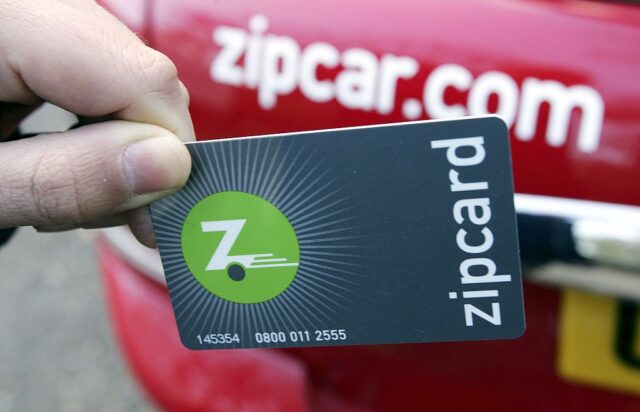
Those are the pitfalls of completely relying on apps for basic functionality. There was a time when Zipcar members automatically received physical “Zipcards” for opening doors. Now, they’re not really advertised, and users have to request one.

A Zipcard.

A Zipcard. Credit: Getty

Zipcars also used to include keys inside of locked cars more frequently. Reducing these physical aspects may have saved the company money but effectively put all of Zipcar’s eggs in one basket.

Nightmarish app problems like the one Zipcar experienced can be a deal-breaker. Just look at Sonos, whose botched app update is costing it millions. Further, turning something like car rentals into a virtually app-only service is a risky endeavor that can quickly overcomplicate simple tasks. Some New Zealand gas stations were out of luck earlier this year, for example, when a Leap Day glitch caused payment processing software to stop working. Gas stations that needed apps for payments weren’t able to make sales, and drivers were inconvenienced.

Apps can simplify and streamline while delivering ingenuity. But that doesn’t mean traditional, app-free measures should be eliminated as backups.

“Nightmare” Zipcar outage is a warning against complete app dependency Read More »