Rocket Report: Starship stacked; Georgia shuts the door on Spaceport Camden
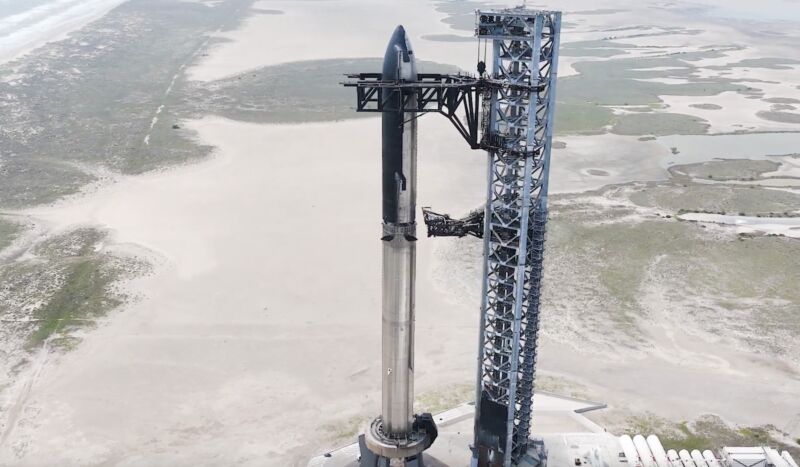
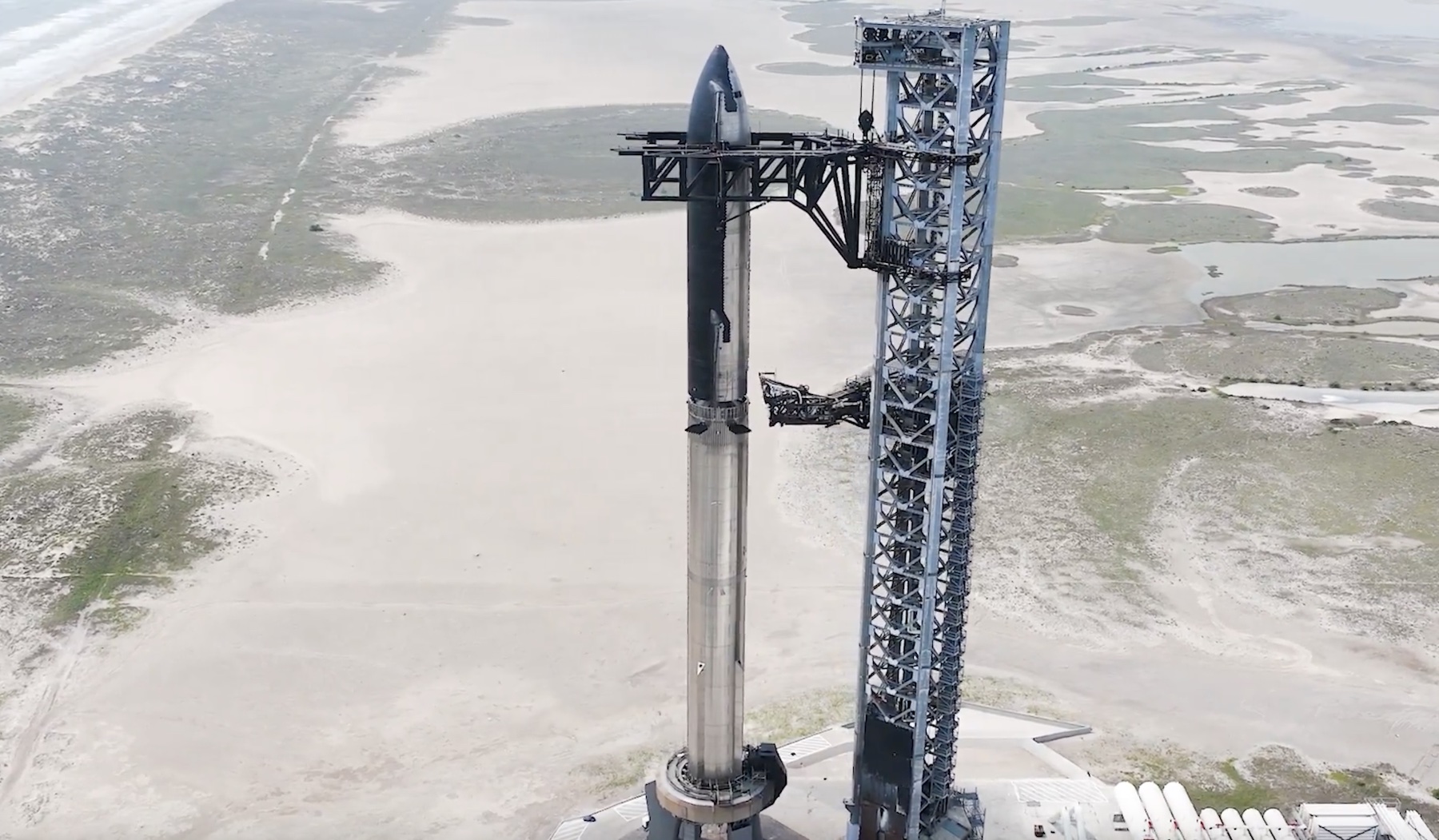
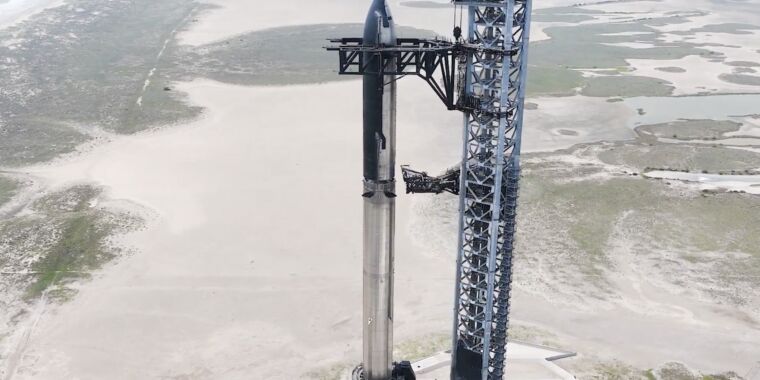
Enlarge / On Wednesday, SpaceX fully stacked the Super Heavy booster and Starship upper stage for the mega-rocket’s next test flight from South Texas.
Welcome to Edition 6.44 of the Rocket Report! Kathy Lueders, general manager of SpaceX’s Starbase launch facility, says the company expects to receive an FAA launch license for the next Starship test flight shortly after Memorial Day. It looks like this rocket could fly in late May or early June, about two-and-a-half months after the previous Starship test flight. This is an improvement over the previous intervals of seven months and four months between Starship flights.
As always, we welcome reader submissions, and if you don’t want to miss an issue, please subscribe using the box below (the form will not appear on AMP-enabled versions of the site). Each report will include information on small-, medium-, and heavy-lift rockets as well as a quick look ahead at the next three launches on the calendar.

Blue Origin launch on tap this weekend. Blue Origin plans to launch its first human spaceflight mission in nearly two years on Sunday. This flight will launch six passengers on a flight to suborbital space more than 60 miles (100 km) over West Texas. Blue Origin, Jeff Bezos’s space company, has not flown people to space since a New Shepard rocket failure on an uncrewed research flight in September 2022. The company successfully launched New Shepard on another uncrewed suborbital mission in December.
Historic flight … This will be the 25th flight of Blue Origin’s New Shepard rocket, and the seventh human spaceflight mission on New Shepard. Before Blue Origin’s rocket failure in 2022, the company was reaching a flight cadence of about one launch every two months, on average. The flight rate has diminished since then. Sunday’s flight is important not only because it marks the resumption of launches for Blue Origin’s suborbital human spaceflight business, but also because its six-person crew includes an aviation pioneer. Ed Dwight, 90, almost became the first Black astronaut in 1963. Dwight, a retired Air Force captain, piloted military fighter jets and graduated test pilot school, following a familiar career track as many of the early astronauts. He was on a short list of astronaut candidates the Air Force provided NASA, but the space agency didn’t include him. Dwight will become the oldest person to ever fly in space.
Spaceport Camden is officially no more. With the stroke of a pen, Georgia Governor Brian Kemp signed a bill that dissolved the Camden County Spaceport Authority, Action News Jax reported. This news follows a referendum in March 2022 where more than 70 percent of voters rejected a plan to buy land for the spaceport on the Georgia coastline between Savannah and Jacksonville, Florida. County officials still tried to move forward with the spaceport initiative after the failed referendum, but Georgia’s Supreme Court ruled in February that the county had to abide by the voters’ wishes.
$12 million for what?… The government of Camden County, with a population of about 55,000 people spent $12 million on the Spaceport Camden concept over the course of a decade. The goal of the spaceport authority was to lure small launch companies to the region, but no major launches ever took place from Camden County. State Rep. Steven Sainz, who sponsored the bill eliminating the spaceport authority, said in a statement that the legislation “reflects the community’s choice and opens a path for future collaborations in economic initiatives that are more aligned with local needs.” (submitted by zapman987)
The easiest way to keep up with Eric Berger’s space reporting is to sign up for his newsletter, we’ll collect his stories in your inbox.
Polaris Spaceplanes moves on to bigger things. German startup Polaris Spaceplanes says it is progressing with construction of its MIRA II and MIRA III spaceplane prototypes after MIRA, a subscale test vehicle, was damaged earlier this year, European Spaceflight reports. The MIRA demonstration vehicle crash-landed on a test flight in February. The incident occurred on takeoff at an airfield in Germany before the vehicle could ignite its linear aerospace engine in flight. The remote-controlled MIRA prototype measured about 4.25 meters long. Polaris announced on April 30 that will not repair MIRA and will instead move forward with the construction of a pair of larger vehicles.
Nearly 16 months without a launch … The MIRA II and MIRA III vehicles will be 5 meters long and will be powered by Polaris’s AS-1 aerospike engines, along with jet engines to power the craft before and after in-flight tests of the rocket engine. Aerospike engines are rocket engines that are designed to operate efficiently at all altitudes. The MIRA test vehicles are precursors to AURORA, a multipurpose spaceplane and hypersonic transporter Polaris says will be capable of delivering up to 1,000 kilograms of payload to low-Earth orbit. (submitted by Jay500001 and Tfargo04)
Rocket Report: Starship stacked; Georgia shuts the door on Spaceport Camden Read More »