CAFE standards

trump-wants-tiny-japanese-style-cars-for-us-even-as-he-cuts-mpg-goals

Trump wants tiny Japanese-style cars for US even as he cuts mpg goals

It’s been less than a year into the second Trump administration, and to many outside observers, US government policies appear confusing or incoherent. Yesterday provided a good example from the automotive sector. As has been widely expected, the White House is moving ahead with plans to significantly erode fuel economy standards, beyond even the permissive levels that were considered OK during the first Trump term.

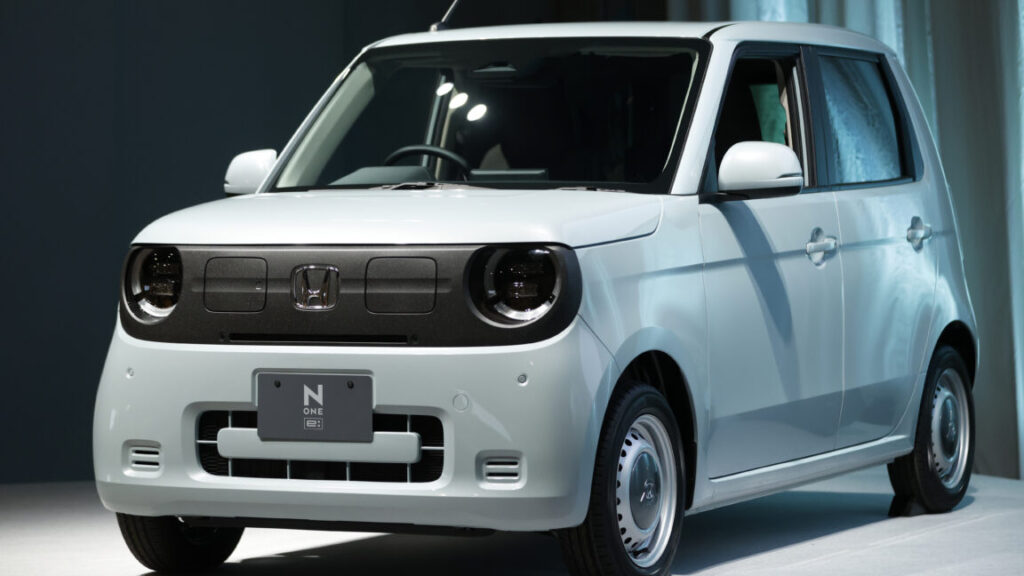
Yet at the very announcement of that rollback, surrounded by compliant US automotive executives, the president decided to go off piste to declare his admiration for tiny Japanese Kei cars, telling Transportation Secretary Sean Duffy to make them street-legal in the US.

50.4 mpg 40.4 mpg 34.5 mpg

A little over a decade ago, the Obama administration announced new fuel economy standards for light trucks and cars that were meant to go into effect this year, bringing the corporate fleet fuel economy average up to 50.4 mpg. As you can probably tell, that didn’t happen. It wasn’t a popular move with automakers, and the first Trump administration ripped up those rules and instituted new, weaker targets of just 40.4 mpg by 2026.

With the change of government from Trump to Biden, the rollback was reversed, and more ambitious fuel economy targets became official policy. The targets required a lot more EVs to be sold, at least until the second Trump administration began in January.

By the end of that month, Duffy had already ripped up the Biden fuel economy standards, blaming them for making cars too expensive. In March, the US Environmental Protection Agency threw out its versions of the fuel economy regulations, with the EPA claiming that the US auto industry had been “hamstrung by the crushing regulatory regime.”

Further attacks on an efficient, clean fleet arrived this summer. The budget bill passed by a Republican-controlled House and Senate stripped electric vehicle incentives from the tax code, and the federal government revealed it would no longer fine automakers who exceeded the corporate average fuel economy targets.

Now, automakers would only be required to reach a fleet average of 34.5 mpg by model year 2031, versus the 50.4 mpg that Biden wanted (and which was the original 2025 target for the Obama administration). This would make cars cheaper to the tune of a little more than $900, the Department of Transportation says, but that fails to take into account the added cost of all that extra fuel from cars that consume 30 percent more of it than they were going to.

Trump wants tiny Japanese-style cars for US even as he cuts mpg goals Read More »
car-dealers-step-up-opposition-to-white-house-fuel-efficiency-targets

Car dealers step up opposition to White House fuel efficiency targets

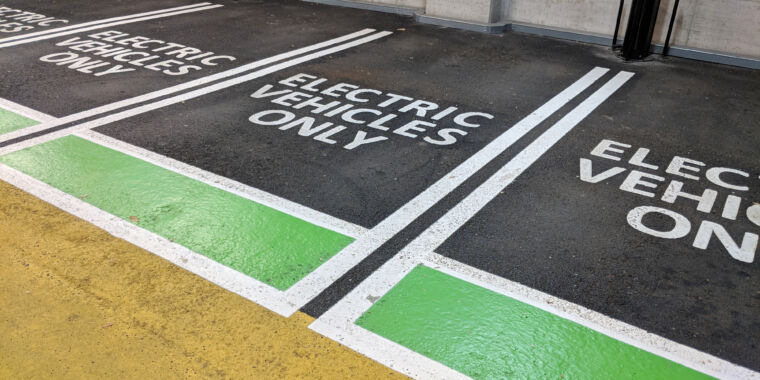
A row of empty EV charging spaces

Richard Newstead/Getty Images

Electric vehicle sales had a pretty good 2023 in North America, with more than 1.1 million battery EVs and just under 300,000 plug-in hybrid EVs finding new homes. That’s a 50 percent increase on 2022, yet the last few months have seen the trade and business presses report a string of negative stories about EV adoption. And it’s not just news stories—major automakers are scaling back their EV ambitions, and together with auto dealerships, they’re lobbying the White House to water down its plan to reduce transportation-related carbon emissions.

While US car buyers are still choosing EVs in greater numbers, the rate of increase is beginning to slow. According to a report from S&P Global, EV registrations grew by 23 percent in December, faster than the general increase in new light vehicle sales (15 percent year over year). But market leaders did not do so well. Tesla only grew sales by 11 percent; at Ford, they rose by 13 percent. Chevrolet saw EV sales drop by 26 percent as it finally exhausted its supply of the low-cost Bolt EV.

Car buyers’ concerns

Similarly, a survey from Deloitte provides a little more pessimism when it comes to EV adoption. It has found that only 6 percent of buyers are now considering a battery EV, down from 7 percent in 2023. Demand for plug-in hybrids has also fallen, from 7 percent in 2023 to 5 percent in 2024. Instead, more buyers want gasoline- or diesel-powered vehicles, a full two-thirds in 2024 compared to 58 percent last year.

The high cost of new plug-in vehicles doesn’t help, despite government subsidies in the form of a tax credit. Deloitte’s data shows that among people intending to buy an EV, 74 percent of them want to pay $50,000 or less.

“Despite availability of government incentives, the rise in interest rates is adding stress to people’s wallets,” said Masa Hasegawa, Deloitte’s principal for the US automotive sector. “In addition to affordability, our study shows that there are several key apprehensions consumers still have about purchasing and owning BEVs, such as the consistency and reliability of charging experience and range anxiety. This will evolve over time, but they remain at the top of mind for many consumers today.”

Misinformation abounds

Some of those apprehensions are well-founded; 40 percent cite a lack of home charging, for instance, and half are concerned about the time it takes to recharge an EV. Range anxiety continues to be a problem, too; 49 percent worried about driving range, one in three worried about cold-weather performance, and 28 percent were concerned about trips requiring more advanced planning than they were used to.

However, some other concerns suggest a real lack of knowledge among the general public regarding some aspects of EVs. Sixty-nine percent of people intending to buy an EV were somewhat or very concerned about the end-to-end environmental impact of an EV—higher than the 56 percent of people who intend their next car to have an internal combustion engine.

While it is correct that an EV requires more energy to build, an electric powertrain is so much more efficient than even the best hybrid powertrains that it only requires a few years of driving for the EV to come out ahead.

There are some unrealistic expectations out there, too. Forty-six percent of Deloitte’s survey respondents said they would need an EV with at least 400 miles of range before they’d consider purchasing one, a proportion that grew to 60 percent when just taking into account those living in suburban and rural areas. While battery energy density and EV powertrain efficiency both continue to improve, currently only Lucid sells an EV with more than 500 miles of range, while Tesla claims its Model S has a 405-mile range (something Tesla owners might dispute.)

Car dealers step up opposition to White House fuel efficiency targets Read More »