facebook

actor-paid-to-pose-as-crypto-ceo-“deeply-sorry”-about-$1.3-billion-scam

Actor paid to pose as crypto CEO “deeply sorry” about $1.3 billion scam
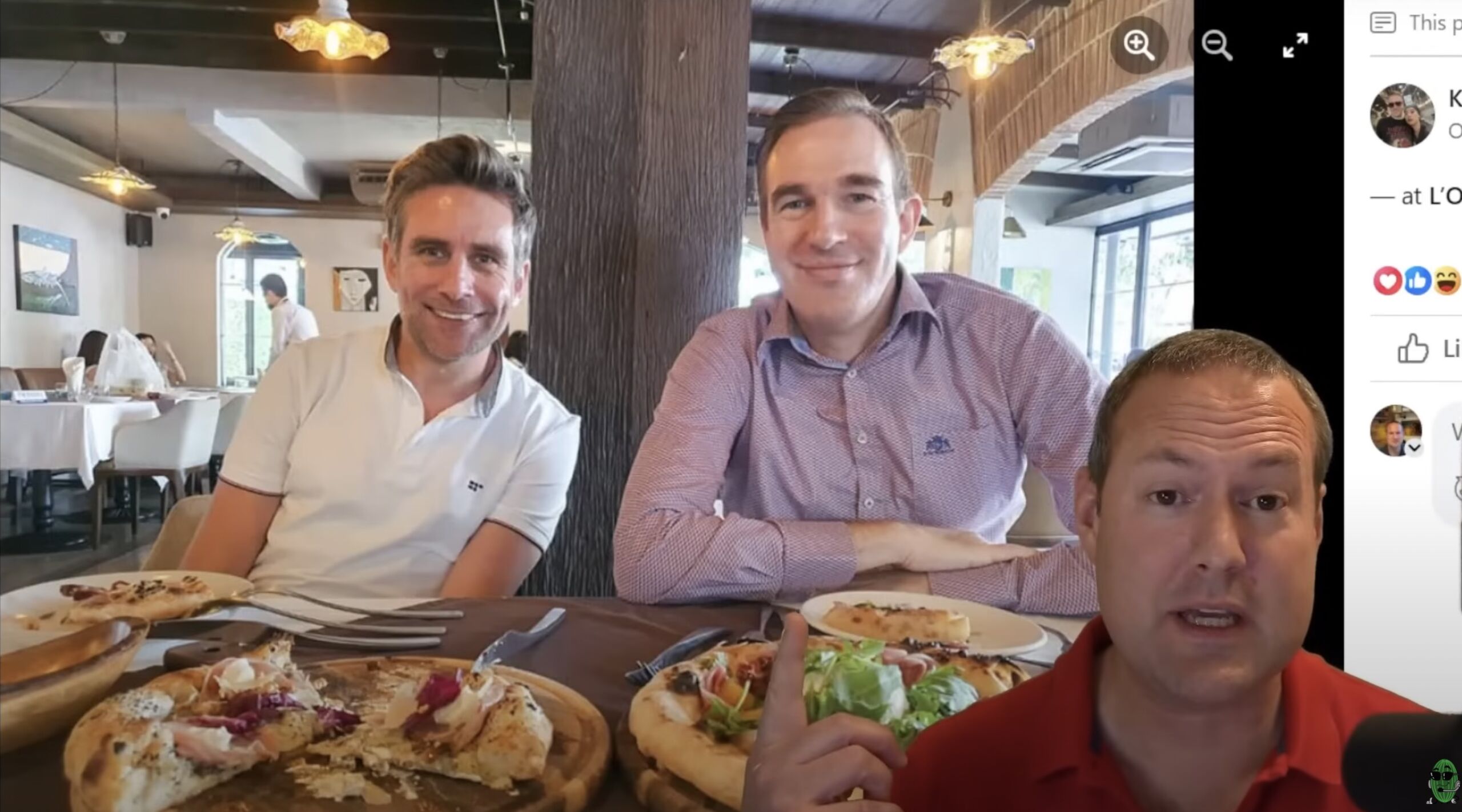
A screenshot from Jack Gamble's video outing Stephen Harrison as HyperVerse's fake CEO, posted on Gamble's

Enlarge / A screenshot from Jack Gamble’s video outing Stephen Harrison as HyperVerse’s fake CEO, posted on Gamble’s “Nobody Special Finance” YouTube channel.

An actor who was hired to pretend to be the highly qualified CEO of a shady, collapsed cryptocurrency hedge fund called HyperVerse has apologized after a YouTuber unmasked his real identity last week.

An Englishman currently living in Thailand, Stephen Harrison confirmed to The Guardian that HyperVerse hired him to pose as CEO Steven Reece Lewis. Harrison told The Guardian that he was “deeply sorry” to HyperVerse investors—who lost a reported $1.3 billion after buying into a cryptocurrency-mining operation that promised “double or triple returns,” but did not exist, Court Watch reported.

Harrison claimed that he had “certainly not pocketed” any portion of those funds. Instead, he told The Guardian that he was paid about $7,500 over nine months. To play the part of CEO, he was also given a “wool and cashmere suit, two business shirts, two ties, and a pair of shoes,” The Guardian reported.

Harrison said that he had no part in HyperVerse’s alleged scheme to woo investors with false promises of high returns.

“I am sorry for these people,” Harrison said. “Because they believed some idea with me at the forefront and believed in what I said, and God knows what these people have lost. And I do feel bad about this.”

He also said that he was “shocked” to find out that HyperVerse had falsified his credentials, telling investors that Harrison was a fintech whiz—supposedly earning prestigious degrees before working at Goldman Sachs, then selling a web development company to Adobe before launching his own IT startup.

Harrison claimed that he only found out about this resume fraud when The Guardian investigated and found that nothing on his resume checked out.

“When I read that in the papers, I was like, blooming heck, they make me sound so highly educated,” Harrison told The Guardian.

He confirmed that he had received general certificates of secondary education but that his expertise was “certainly not on that level” that HyperVerse claimed that it was.

“They painted a good picture of me, but they never told me any of this,” Harrison told The Guardian.

Getting hired as fake CEO

According to The Guardian, Harrison was working as an unpaid freelance sports commentator when a “friend of a friend” told him about the HyperVerse gig.

The contract that Harrison signed was with an Indonesian-based talent agency called Mass Focus Ltd. It stated that he would be hired as “presenter talent,” The Guardian reported. However, The Guardian could find “no record of a company of this name on the Indonesian company register.”

Harrison’s agent allegedly told him that it was common for companies to hire corporate “presenters” to “represent the business” and reassured him that HyperVerse was “legitimate.”

Even after those assurances, Harrison said that he was still worried that HyperVerse might be a “scam,” researching the company online but ultimately deciding that “everything seemed OK.”

“So, I rolled with it,” Harrison told The Guardian.

Harrison said that promotional videos that he recorded as HyperVerse CEO were filmed in “makeshift studios” in Bangkok. He said that he was asked to start using the fake name Steven Reece Lewis while filming the second video. When he questioned why a fake name was necessary, HyperVerse allegedly told him that he was “acting the role.”

His agent allegedly told him that this was “perfectly normal” and after that, he “never went online and checked about Steven Reece Lewis,” he told The Guardian.

“I looked on YouTube occasionally, way back when they put the presentations up, but apart from that I was detached from this role,” Harrison said.

Over nine months, Harrison mostly worked one to two hours monthly, making videos posing as HyperVerse’s CEO.

There was also a Twitter account launched under the fake name Steven Reece Lewis. The Guardian noted that the date of Harrison’s final paycheck from HyperVerse “coincided with the last date the Twitter account was active,” but Harrison told The Guardian that he “had no oversight” of that account. When he was ending his stint as fake CEO, Harrison told The Guardian that he “requested that the Twitter account be shut down.”

Harrison also told The Guardian that he had “no contact at any point” with HyperVerse heads Sam Lee and Ryan Xu, exclusively dealing with a local contact in Thailand.

Actor paid to pose as crypto CEO “deeply sorry” about $1.3 billion scam Read More »

meta-reaffirms-commitment-to-metaverse-vision,-has-no-plans-to-slow-billions-in-reality-labs-investments

Meta Reaffirms Commitment to Metaverse Vision, Has No Plans to Slow Billions in Reality Labs Investments

Meta announced its latest quarterly results, revealing that the company’s Reality Labs metaverse division is again reporting a loss of nearly $4 billion. The bright side? Meta’s still investing billions into XR, and it’s not showing any signs of stopping.

Meta revealed in its Q1 2023 financial results that its family of apps is now being used by over 3 billion people, an increase of 5% year-over-year, but its metaverse investments are still operating at heavy losses.

Reality Labs is responsible for R&D for its most forward-looking projects, including the Quest virtual reality headset platform, and its work in augmented reality and artificial intelligence. Meta CEO Mark Zuckerberg has warned shareholders in the past that Meta’s XR investments may not flourish until 2030.

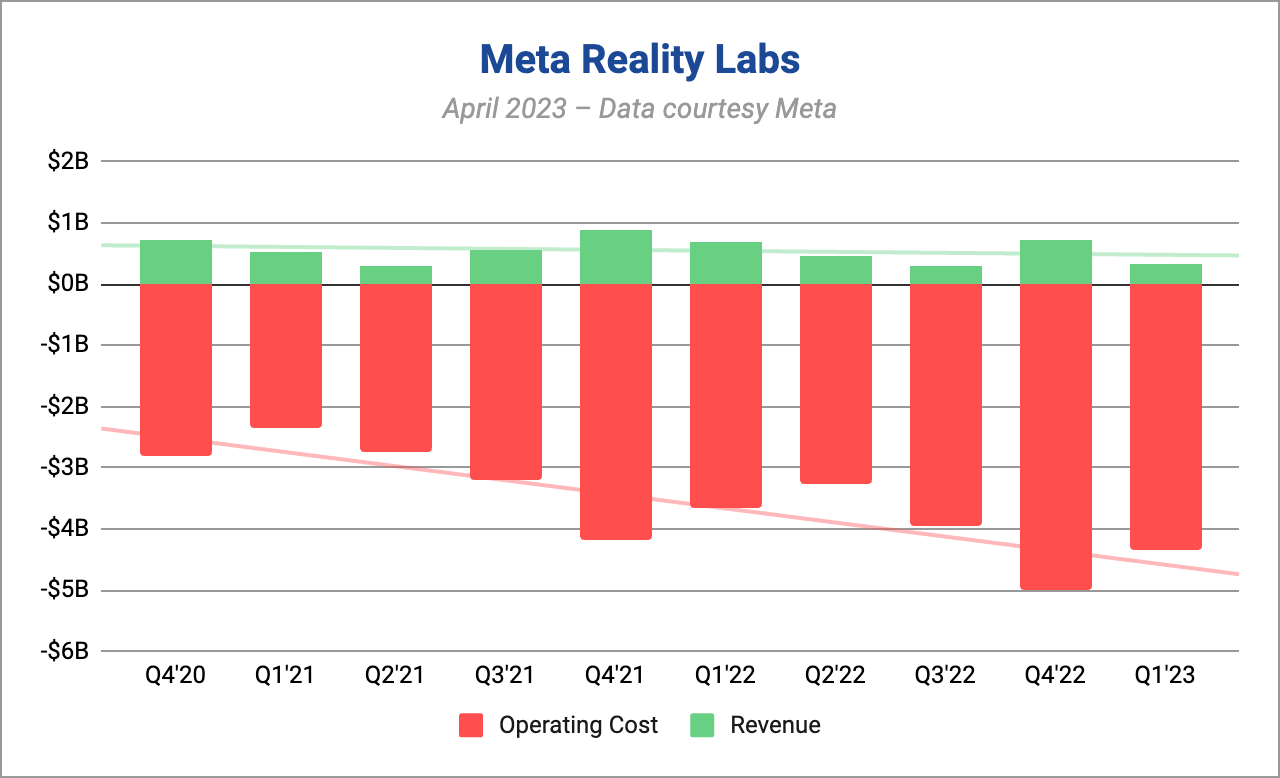
Here’s a look at the related income losses and revenue for Reality Labs since it was formed as a distinct entity in Q4 2020:

Image created by Road to VR using data courtesy Meta

Meta reports Reality Labs generated $339 million in revenue during its first quarter of the year, a small fraction of the company’s 28.65 billion quarterly revenue. The bulk of that was generated from its family of apps—Facebook, Messenger, Instagram, and WhatsApp.

While the $3.99 billion loss may show the company is tightening its belt in contrast to Q4 2022, which was at an eye-watering $4.28 billion, Meta says we should still expect those losses to continue to increase year-over-year in 2023.

This follows the company’s second big round of layoffs, the most recent of which this month has affected VR teams at Reality Labs, Downpour Interactive (Onward) and Ready at Dawn (Lone Echo, Echo VR). The company says a third round is due to come in May, which will affect the company’s business groups.

Dubbed by Zuckerberg as the company’s “year of efficiency,” the Meta founder and chief said this during the earning call regarding the company’s layoffs:

“This has been a difficult process. But after this is done, I think we’re going to have a much more stable environment for our employees. For the rest of the year, I expect us to focus on improving our distributed work model, delivering AI tools to improve productivity, and removing unnecessary processes across the company.”

Beyond its investment in AI, Zuckerberg says the recent characterization claiming the company has somehow moved away from focusing on the metaverse is “not accurate.”

“We’ve been focusing on both AI and the metaverse for years now, and we will continue to focus on both,” Zuckerberg says, noting that breakthroughs in both areas are essentially shared, such as computer vision, procedurally generated virtual worlds, and its work on AR glasses.

Notably, Zuckerberg says the number of titles in the Quest store with at least $25 million in revenue has doubled since last year, with more than half of Quest daily actives now spend more than an hour using their device.

The company previously confirmed a Quest 3 headset is set to release this year, which is said to be slightly pricier than the $400 Quest 2 headset with features “designed to appeal to VR enthusiasts.”

Meta Reaffirms Commitment to Metaverse Vision, Has No Plans to Slow Billions in Reality Labs Investments Read More »

meta-acquires-3d-lens-printing-firm-luxexcel-to-bolster-future-ar-glasses

Meta Acquires 3D Lens Printing Firm Luxexcel to Bolster Future AR Glasses

Meta has acquired the Belgian-Dutch company Luxexcel, a 3D printing firm creating complex glass lenses for use in AR optics.

As first reported by Belgian newspaper De Tijd (Dutch), the Turnhout, Belgium-based company was quietly acquired by Facebook parent Meta in an ostensible bid to bolster the development of its in-development AR glasses.

Details of the acquisition are still under wraps, however confirmation by Meta was obtained by English language publication The Brussels Times.

“We are delighted that the Luxexcel team has joined Meta. This extends the partnership between the two companies,” Meta says.

Founded in 2009, Luxexcel first focused on 3D printing lenses for automotive, industrial optics, and the aerospace industry. Over the years Luxexcel shifted to using its 3D printing tech to create prescription lenses for the eyewear market.

In 2020, the company made its first entry into the smart eyewear market by combining 3D printed prescription lenses with the integration of technology. One year later, Luxexcel partnered with UK-based waveguide company WaveOptics, which has since been acquired by Snapchat parent Snap.

Meta’s interest in Luxexcel undoubtedly stems from its ability to print complex optics for both smart glasses and AR headsets; Meta’s Project Aria is rumored to house Luxexcel-built lenses. Project Aria is a sensor-rich pair of glasses which the company created to train its AR perception systems, as well as asses public perception of the technology.

Meta Acquires 3D Lens Printing Firm Luxexcel to Bolster Future AR Glasses Read More »