fuel economy

trump-wants-tiny-japanese-style-cars-for-us-even-as-he-cuts-mpg-goals

Trump wants tiny Japanese-style cars for US even as he cuts mpg goals

It’s been less than a year into the second Trump administration, and to many outside observers, US government policies appear confusing or incoherent. Yesterday provided a good example from the automotive sector. As has been widely expected, the White House is moving ahead with plans to significantly erode fuel economy standards, beyond even the permissive levels that were considered OK during the first Trump term.

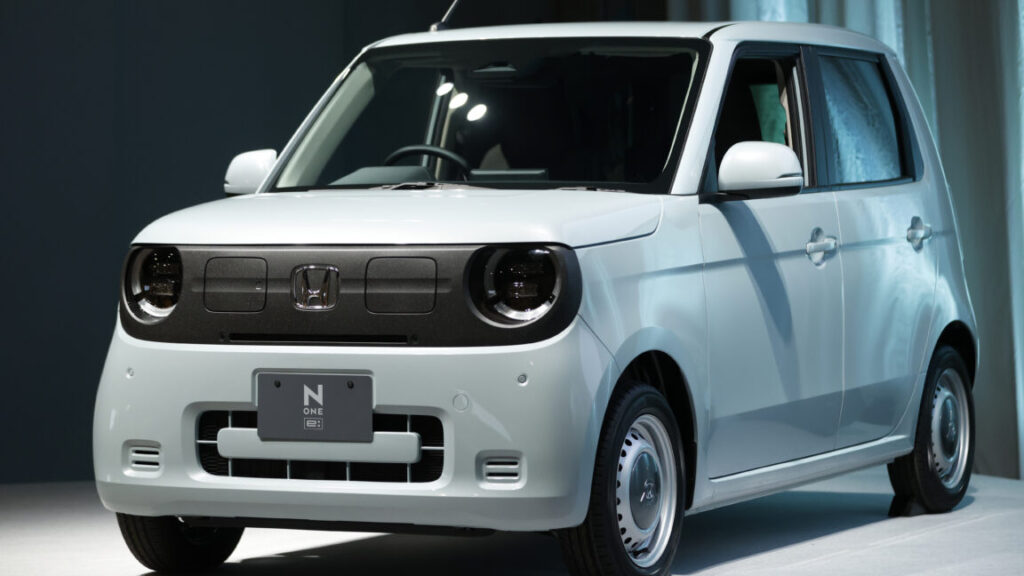
Yet at the very announcement of that rollback, surrounded by compliant US automotive executives, the president decided to go off piste to declare his admiration for tiny Japanese Kei cars, telling Transportation Secretary Sean Duffy to make them street-legal in the US.

50.4 mpg 40.4 mpg 34.5 mpg

A little over a decade ago, the Obama administration announced new fuel economy standards for light trucks and cars that were meant to go into effect this year, bringing the corporate fleet fuel economy average up to 50.4 mpg. As you can probably tell, that didn’t happen. It wasn’t a popular move with automakers, and the first Trump administration ripped up those rules and instituted new, weaker targets of just 40.4 mpg by 2026.

With the change of government from Trump to Biden, the rollback was reversed, and more ambitious fuel economy targets became official policy. The targets required a lot more EVs to be sold, at least until the second Trump administration began in January.

By the end of that month, Duffy had already ripped up the Biden fuel economy standards, blaming them for making cars too expensive. In March, the US Environmental Protection Agency threw out its versions of the fuel economy regulations, with the EPA claiming that the US auto industry had been “hamstrung by the crushing regulatory regime.”

Further attacks on an efficient, clean fleet arrived this summer. The budget bill passed by a Republican-controlled House and Senate stripped electric vehicle incentives from the tax code, and the federal government revealed it would no longer fine automakers who exceeded the corporate average fuel economy targets.

Now, automakers would only be required to reach a fleet average of 34.5 mpg by model year 2031, versus the 50.4 mpg that Biden wanted (and which was the original 2025 target for the Obama administration). This would make cars cheaper to the tune of a little more than $900, the Department of Transportation says, but that fails to take into account the added cost of all that extra fuel from cars that consume 30 percent more of it than they were going to.

Trump wants tiny Japanese-style cars for US even as he cuts mpg goals Read More »

new-epa,-doe-fuel-regs-give-automakers-longer-to-reduce-co2-emissions

New EPA, DOE fuel regs give automakers longer to reduce CO2 emissions

An EV charger and a fuel container on a balance

Aurich Lawson | Getty Images

This week, the US Department of Energy and the Environmental Protection Agency have published new fuel efficiency rules that will go into effect in 2026. The rules favor both battery-electric vehicles and also plug-in hybrid EVs, but not to the degree as proposed by each agency last April.

Those would have required automakers to sell four times as many electric vehicles as they do now. This was met with a rare display of solidarity across the industry—automakers, workers, and dealers all called on the White House to slow its approach.

Under the 2023 proposals, the DOE would change the way that Corporate Average Fuel Economy regulations are calculated for model years 2027-2032 (which would take place from partway through calendar-year 2026 until sometime in calendar-year 2031), and the EPA would implement tougher vehicle emissions standards for light- and medium-duty vehicles for the same time period.

Among the changes were a new “petroleum-equivalency factor,” which currently is extremely generous in the way it “converts the measured electrical energy consumption of an electric vehicle into a raw gasoline-equivalent fuel economy value” when determining an automaker’s fleet average.

According to the EPA, the proposed rules were met positively by “environmental and public health NGOs, states, consumer groups,” and EV-only automakers. But many other automakers told the agency that the rules were too ambitious, the EPA’s technical analysis was “overly optimistic,” and worries about supply chains, customer demand, and charging infrastructure delays could all throw big spanners in the works. Labor groups “urged a slower transition” to plug-in vehicles to prevent potential job losses.

What’s changed?

The DOE and EPA have tried to keep everyone happy with the final rules. The revised rules (DOE, EPA) arrive at roughly the same levels of emissions for model-year 2032 as before.

But the way that CAFE used DOE’s formulae gets a bit more complicated, with “a PEF value based on the expected survivability-weighted lifetime mileage schedule of the fleet of vehicles sold during the regulatory period,” and a revised balance of different energy sources used to determine how clean the grid will be for each model year.

Cars will be allowed to emit up to 85 grams of CO2 per mile, light trucks up to 90 CO2 g/mile, for a combined fleet average for light-duty vehicles of 85 CO2 g/mile. And medium-duty vehicles will need to emit less than 245 CO2 g/mile for vans and 290 CO2 g/mile for pickups by 2032.

One hopefully important change is a decrease in the allowable footprint for light trucks over time. The EPA hopes this will prevent automakers from “upsizing” trucks and SUVs and will emerge unscathed from the 2023 proposed rule.

Although the MY 2032 endpoints are almost in the same places, both DOE and EPA rules give automakers more time to meet them, with less strict goals than before for MY 2027–MY 2031.

In total, the White House says that the final rule will avoid 7.2 billion tons of CO2 emissions through 2055, with $99 billion in net benefits to society.

New EPA, DOE fuel regs give automakers longer to reduce CO2 emissions Read More »