It’s been nearly three years now since Destiny maker (and Sony subsidiary) Bungie formally announced a revival of the storied Marathon FPS franchise. And it has been about seven months since the game’s original announced release date of September 23, 2025 was pushed back indefinitely after a reportedly poor response to the game’s first Alpha test.
But today, in a post on the PlayStation Blog, Bungie revealed that the new Marathon would finally be hitting PS5, Windows, and Xbox Series X|S on March 5, narrowing down the month-long March release window announced back in December.
Today’s pre-rder trailer revealing the Marathon release date.
Unlike Destiny 2, which transitioned to a free-to-play model in 2019, the new Marathon sells for $40 in a Standard Edition or a $60 Deluxe Edition that includes some digital rewards and cosmetics. That mirrors the pricing of the somewhat similar Arc Raiders, which recently hit 12 million sales in less than 12 weeks.
A new kind of Marathon
Unlike the original Marathon trilogy on the ’90s Macintosh—which closely followed on the single-player campaign corridors and deathmatch multiplayer of the original Doom—the new Marathon is described as a “PvPvE survival extraction shooter.” That means gameplay based around exploring distinct zones and scavenging for cosmetics and gear upgrades in exploratory missions alone or with up to two friends, then seeing those missions “break into fast-paced PvP combat” at a moment’s notice, according to the game’s official description.
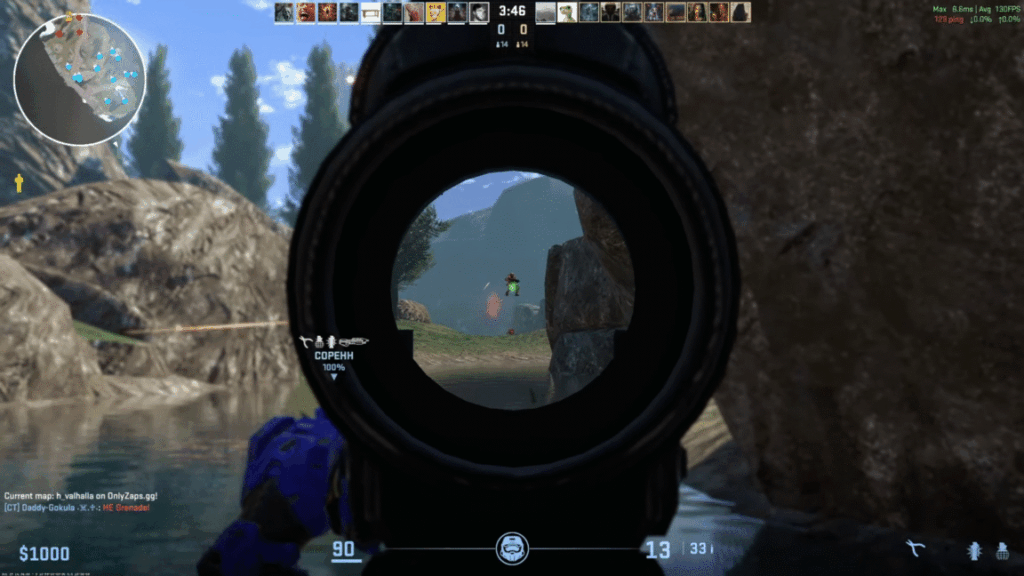
Last month saw the release of Project Misriah, an ambitious modding project that tried to re-create the feel of Halo 3 inside Valve’s Counter-Strike 2. That project has now been taken down from the Steam Workshop, though, after drawing a Digital Millennium Copyright Act complaint from Microsoft.
Modder Froddoyo introduced Project Misriah on November 16 as “a workshop collection of Halo ported maps and assets that aims to bring a Halo 3 multiplayer-like experience to Counter-Strike 2.” Far from just being inspired by Halo 3, the mod directly copied multiple sound effects, character models, maps, and even movement mechanics from Bungie and Microsoft’s popular series.
In the weeks since, Project Misriah has drawn a lot of praise from both Halo fans and those impressed by what modders could pull off with the Source 2 engine. But last Wednesday, modder Froddoyo shared a DMCA request from Microsoft citing the “unauthorized use of Halo game content in a [Steam] workshop not associated with Halo games.”
A trailer announcing Project Misriah, posted last month.
In a social media post sharing that DMCA text, Froddoyo ruefully said that players should “make sure to give your thanks to Microsoft” for the project’s fate. But in a comment on Project Misriah’s YouTube trailer, Froddoyo noted that, following the takedown, the project “will not be worked on or uploaded in the future. But hey, it was fun while it lasted. Thank you to all of the players and supporters of [the] project. We will use the knowledge and skills obtained from this to cook up something else!”
While Microsoft hasn’t directly commented on these reports, Xbox chief Phil Spencer wrote on social media that Microsoft is “planning a business update event for next week, where we look forward to sharing more details with you about our vision for the future of Xbox.”
The churning rumor mill has set off something of an existential crisis among some Xbox superfans, content creators, and influencers, who are worried that Microsoft is planning to essentially abandon their favored console. “Genuinely feel terrible for convincing my sister to get an Xbox instead of a PS5,” XboxYoda posted in a representative social media take. “Like I actually feel like I let her down… .”
“If you like being lied to that’s a you thing,” social media user XcloudTimdog posted. “I have a set of standards, that’s all. Cross them and, well, I respond.”
These and other more apocalyptic reactions might seem like hyperbolic whining from territorial console misanthropes. But they also have the germ of a point. Exclusive games have long been the primary way console makers argue for players to choose their console over the competition. If Microsoft effectively changes that argument in the middle of the current console generation, Xbox owners will have some legitimate reason to be upset.
A world without Xbox exclusives
To see why, start with a simple thought experiment. Say it’s early 2020 and Microsoft announces that it is abandoning the idea of console exclusives entirely. Upcoming Xbox Game Studios titles like Halo Infinite and Starfield would still be released on the upcoming Xbox Series X/S, of course, but they’d also all see equivalent versions launch on the PS5 (and sometimes the Switch) on the same day. Sony does not respond in kind and keeps major franchises like God of War and Spider-Man exclusive to the PS5.
Enlarge/ You mean I could have visited this planet and played Spider-Man 2 on the same console?
In this hypothetical world, convincing someone to buy an Xbox becomes much more difficult. On the one hand, you have a PlayStation console that can play all of the major big-budget games published by both Microsoft and Sony. On the other, you have an Xbox that doesn’t have access to the significant Sony half of that gaming equation.
There are other reasons you might still consider an Xbox in this world. Maybe you think the reduced price of the Xbox Series S delivers more “bang for the buck.” Maybe you prefer the Xbox controller layout or some of Xbox’s system-level OS features. Maybe you’re convinced cross-platform games will look or play better on Microsoft’s machine.
But in the console market, these kinds of concerns often take a back seat to the prospect of a system’s exclusive games and franchises. The biggest exclusive titles are called “system sellers” for a reason—they’re the games that make many gamers plunk down hundreds of dollars on hardware just for the possibility of spending more on this must-have software.
In this hypothetical, Microsoft would essentially be trying to sell the Xbox without any exclusive system sellers.