
k2

investors-commit-quarter-billion-dollars-to-startup-designing-“giga”-satellites

Investors commit quarter-billion dollars to startup designing “Giga” satellites

A startup established three years ago to churn out a new class of high-power satellites has raised $250 million to ramp up production at its Southern California factory.

The company, named K2, announced the cash infusion on Thursday. K2’s Series C fundraising round was led by Redpoint Ventures, with additional funding from investment firms in the United States, the United Kingdom, and Germany. K2 has now raised more than $400 million since its founding in 2022 and is on track to launch its first major demonstration mission next year, officials said.

K2 aims to take advantage of a coming abundance of heavy- and super-heavy-lift launch capacity, with SpaceX’s Starship expected to begin deploying satellites as soon as next year. Blue Origin’s New Glenn rocket launched twice this year and will fly more in 2026 while engineers develop an even larger New Glenn with additional engines and more lift capability.

Underscoring this trend toward big rockets are other launchers like SpaceX’s Falcon 9 and Falcon Heavy, United Launch Alliance’s Vulcan, and new vehicles from companies like Rocket Lab, Relativity Space, and Firefly Aerospace. K2’s founders believe satellites will follow a similar progression, reversing a trend toward smaller spacecraft in recent years, to address emerging markets like in-space computing and data processing.

Mega, then Giga

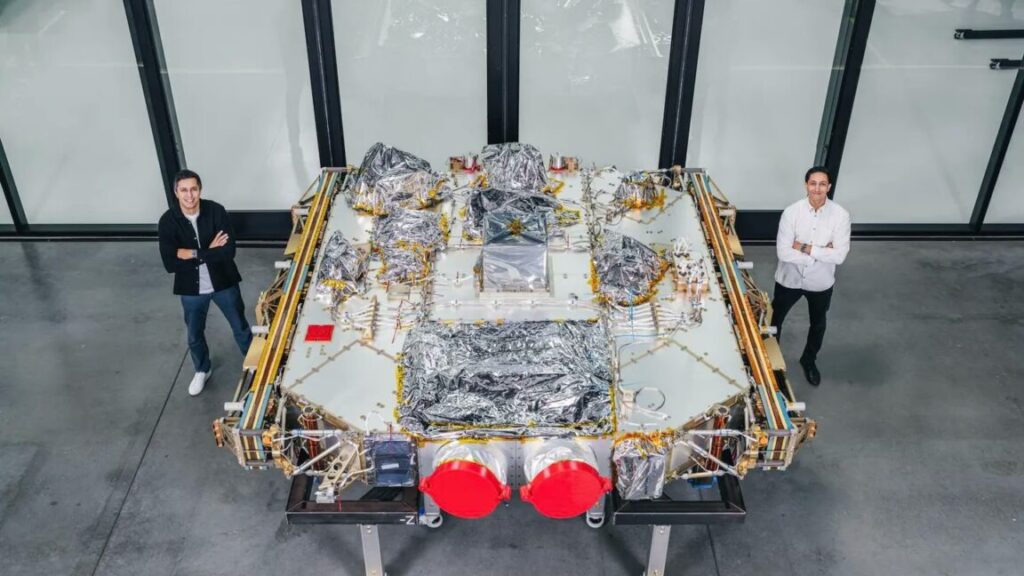
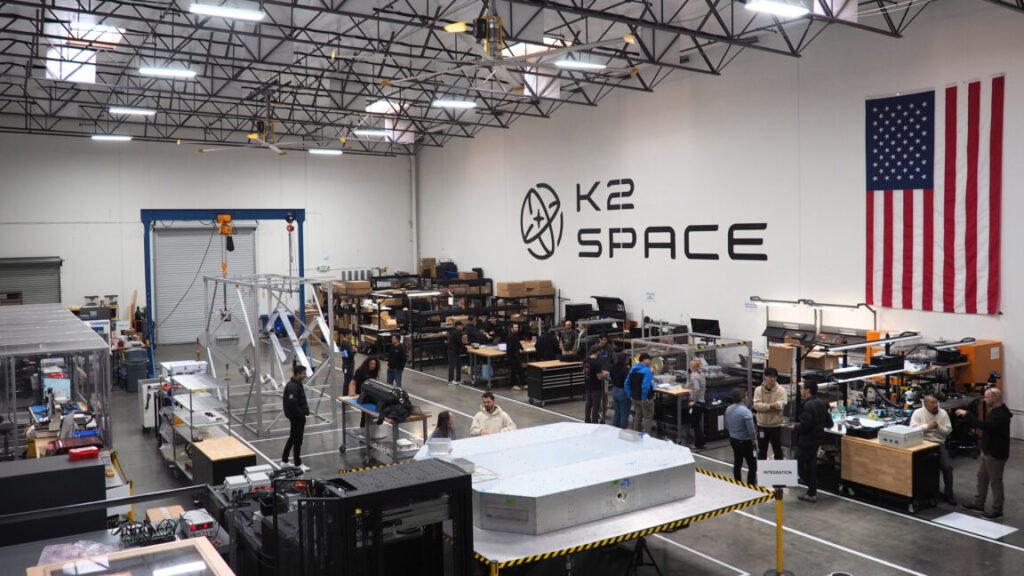
K2 is designing two classes of satellites—Mega and Giga—that it will build at an 180,000-square-foot factory in Torrance, California. The company’s first “Mega Class” satellite is named Gravitas. It is scheduled to launch in March 2026 on a Falcon 9 rocket. Once in orbit, Gravitas will test several systems that are fundamental to K2’s growth strategy. One is a 2o-kilowatt Hall-effect thruster that K2 says will be four times more powerful than any such thruster flown to date. Gravitas will also deploy twin solar arrays capable of generating 20 kilowatts of power.

“Gravitas brings our full stack together for the first time,” said Karan Kunjur, K2’s co-founder and CEO, in a company press release. “We are validating the architecture in space, from high-voltage power and large solar arrays to our guidance and control algorithms, and a 20 kW Hall thruster, and we will scale based on measured performance.”

Investors commit quarter-billion dollars to startup designing “Giga” satellites Read More »
satellite-firm-bucks-miniaturization-trend,-aims-to-build-big-for-big-rockets

Satellite firm bucks miniaturization trend, aims to build big for big rockets

Although the price of this satellite bus is proprietary, various estimates place the cost at between $100 million and $150 million. One reason for the expense is that Lockheed Martin buys most of the satellite’s elements, such as its reaction wheels, from suppliers.

“Lockheed is amazing at doing those missions with really complex requirements,” Kunjur said. “But they just have not changed the way they build these larger, more complex spacecraft in the last 15 or 20 years.”

Vertical integration is the way?

K2 aims to disrupt this ecosystem. For example, the reaction wheels that Honeywell Aerospace sells to Lockheed cost approximately $500,000 to $1 million apiece. K2 is now on its fourth iteration of an internally built reaction wheel and has driven the cost down to $35,000. Kunjur said about 80 percent of K2’s satellite production is vertically integrated.

The company is now building its first “Mega Class” satellite bus, intended to have similar capabilities to Lockheed’s LM2100: 20 kW of power, 1,000 kg of payload capacity, and propulsion to move between orbits. But it’s also stackable: Ten will fit within a Falcon 9 payload fairing and about 50 within Starship’s fairing. The biggest difference is cost. K2 aims to sell its satellite bus for $15 million.

The US government is definitely interested in this capability. About a month ago, K2 announced that it had signed a contract with the US Space Force to launch its first Mega Class satellite in early 2026. The $60 million contract for the “Gravitas” mission will demonstrate the ability of K2’s satellite bus to host several experiments and successfully maneuver from low-Earth orbit to middle-Earth orbit (several thousand km above the surface of Earth).

Although the Mega Class satellite is attractive to government and commercial customers—its lower cost could allow for larger constellations in middle- and geostationary orbits—Kunjur said he and his brother, Neel Kunjur, founded K2 to enable more frequent science missions to other planets in the Solar System.

“We looked at the decadal studies and saw all the mission concept studies that were done,” Kunjur said. “There were maybe 50 studies over a 10-year period. And we realized that if NASA funding remains level, we’ll be able to do one or maybe two of these. So we decided to go after one of the big problems.”

So, if we’re moving into an era of launch abundance, K2 might just solve the problem of affordable science satellites to launch on all these rockets—if it all works, of course.

Satellite firm bucks miniaturization trend, aims to build big for big rockets Read More »