kei cars

trump-wants-tiny-japanese-style-cars-for-us-even-as-he-cuts-mpg-goals

Trump wants tiny Japanese-style cars for US even as he cuts mpg goals

It’s been less than a year into the second Trump administration, and to many outside observers, US government policies appear confusing or incoherent. Yesterday provided a good example from the automotive sector. As has been widely expected, the White House is moving ahead with plans to significantly erode fuel economy standards, beyond even the permissive levels that were considered OK during the first Trump term.

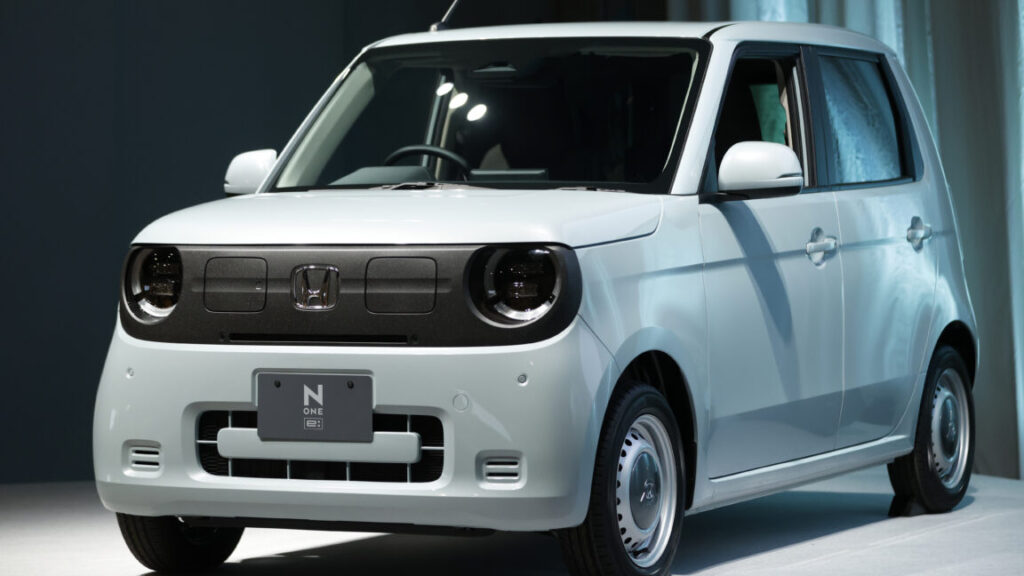
Yet at the very announcement of that rollback, surrounded by compliant US automotive executives, the president decided to go off piste to declare his admiration for tiny Japanese Kei cars, telling Transportation Secretary Sean Duffy to make them street-legal in the US.

50.4 mpg 40.4 mpg 34.5 mpg

A little over a decade ago, the Obama administration announced new fuel economy standards for light trucks and cars that were meant to go into effect this year, bringing the corporate fleet fuel economy average up to 50.4 mpg. As you can probably tell, that didn’t happen. It wasn’t a popular move with automakers, and the first Trump administration ripped up those rules and instituted new, weaker targets of just 40.4 mpg by 2026.

With the change of government from Trump to Biden, the rollback was reversed, and more ambitious fuel economy targets became official policy. The targets required a lot more EVs to be sold, at least until the second Trump administration began in January.

By the end of that month, Duffy had already ripped up the Biden fuel economy standards, blaming them for making cars too expensive. In March, the US Environmental Protection Agency threw out its versions of the fuel economy regulations, with the EPA claiming that the US auto industry had been “hamstrung by the crushing regulatory regime.”

Further attacks on an efficient, clean fleet arrived this summer. The budget bill passed by a Republican-controlled House and Senate stripped electric vehicle incentives from the tax code, and the federal government revealed it would no longer fine automakers who exceeded the corporate average fuel economy targets.

Now, automakers would only be required to reach a fleet average of 34.5 mpg by model year 2031, versus the 50.4 mpg that Biden wanted (and which was the original 2025 target for the Obama administration). This would make cars cheaper to the tune of a little more than $900, the Department of Transportation says, but that fails to take into account the added cost of all that extra fuel from cars that consume 30 percent more of it than they were going to.

Trump wants tiny Japanese-style cars for US even as he cuts mpg goals Read More »
a-cute,-cheap-deathtrap?-japanese-kei-cars-banned-by-yet-another-us-state

A cute, cheap deathtrap? Japanese Kei cars banned by yet another US state

not an easy one, tbh —

Limited in size and power, Kei cars are like fishes out of water on US roads.

A cute, cheap deathtrap? Japanese Kei cars banned by yet another US state

Aurich Lawson | Getty Images

Kei cars are the antithesis of the big American SUV. Where EPA regulations effectively penalize automakers for building smaller, more efficient cars, Japan’s Kei car regulations cap size, weight, and power to just fractions. Kei cars aren’t just small, they’re also pretty cheap, a fact that has made them a sales success in Japan and highly desirable as a gray-market import, particularly by people who think new cars have gotten too large, too complicated, and too expensive. A few years ago, Ars even wrote a guide on how to go about importing one from Japan.

But not everyone is a fan of the diminutive Kei import. As far as the federal government is concerned, as long as it’s more than 25 years old, an imported car does not have to comply with federal motor vehicle safety standards or fuel economy standards; just makes sure you pay all your import duties.

That’s because the federal government doesn’t license vehicles to operate on public roads. That task belongs to the individual states, and increasingly, they are giving Kei cars the thumbs down—sometimes even in cases where previously those cars posed no problem.

Some states restrict Kei cars—often Kei trucks, in this case—to working as farm vehicles; depending on the state, they may travel up to 20 miles from the farm. Some states like Alabama and Arkansas allow them with conditions such as speed restrictions or no highway use. And others are outright banning them. Georgia, Maine, and New York have all done so, and now Massachusetts is the latest to join that movement, helpfully even publishing a list of examples of Kei cars it won’t now register.

Are they safe on American roads?

The states aren’t all using exactly the same reasoning for their crackdowns. In some cases, Kei cars have been classified as “off-road vehicles,” deemed unfit for road use. In other cases, state DMVs have pointed to the lack of compliance with federal safety standards as justification for banning them.

The thing is, that’s not exactly a misleading argument. Kei cars really are small, even compared to cars you do think are small, like a Mini Cooper or Fiat 500e. In 2017, the fine people at the Lane Motor Museum held a microcar rally, giving me a chance to drive a whole array of tiny four-wheel vehicles, including more than a few Kei cars.

While it was mostly a wonderfully fun day, driving cars that small surrounded by hulking full-size SUVs and even bigger class 8 dump trucks and tractor-trailers was flat-out terrifying. As I wrote then and reiterate now, half of those trucks wouldn’t even have noticed if they’d run me over.

It’s a problem of context. In their natural setting—the narrow and crowded streets of dense, urban Japan, the Kei car makes pretty good sense. But Americans have always liked their cars on the massive side of things, preferring land yachts like the Ford Galaxie, Buick Roadmaster, and Cadillac Eldorado over compact hatchbacks every day of the week. And let’s not pretend the big SUV is a new phenomenon on North American roads—the oversized Chevy Suburban traces its birthday back to 1967.

Which brings up the harsh reality that is the laws of physics. When a big car hits a small car, the small car does worse. The fact that imported Kei cars are at least 25 years old adds a further snag—passive and active safety has come a long way in that time, and crashes that might not trouble a SmartCar may well mean severe injuries in a Kei car.

I reached out to the Insurance Institute for Highway Safety, the nation’s leading independent vehicle safety testing organization, to see if it had any data on the matter. IIHS hasn’t crash-tested any Kei cars recently, but it referred me to its position from a few years ago, which says that smaller, lighter vehicles that don’t conform to the FMVSS, which includes Kei cars as well as Low-Speed Vehicles (which are limited to surface streets and 25 mph) “should not share busy public roads with regular traffic.”

Although the Kei trucks that IIHS refers to are speed-limited to 25 mph, most Kei cars imported for road use are not similarly limited, and keeping up with the flow of traffic ought not to be an issue. But the crashworthiness should certainly give some pause.

A cute, cheap deathtrap? Japanese Kei cars banned by yet another US state Read More »