listicles

blast-from-the-past:-15-movie-gems-of-1985

Blast from the past: 15 movie gems of 1985


Beyond the blockbusters: This watch list has something for everyone over the long holiday weekend.

Peruse a list of films released in 1985 and you’ll notice a surprisingly high number of movies that have become classics in the ensuing 40 years. Sure, there were blockbusters like Back to the Future, The Goonies, Pale Rider, The Breakfast Club and Mad Max: Beyond Thunderdome, but there were also critical arthouse favorites like Kiss of the Spider Woman and Akira Kurosawa’s masterpiece, Ran. Since we’re going into a long Thanksgiving weekend, I’ve made a list, in alphabetical order, of some of the quirkier gems from 1985 that have stood the test of time. (Some of the films first premiered at film festivals or in smaller international markets in 1984, but they were released in the US in 1985.)

(Some spoilers below but no major reveals.)

After Hours
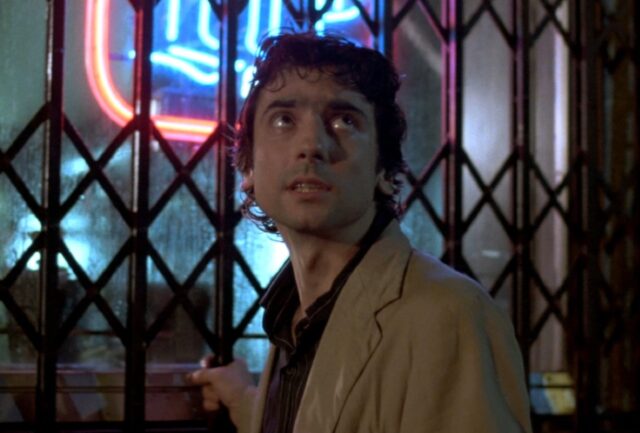
young nerdy man in black shirt and casual tan jacket looking anxious

Credit: Warner Bros.

Have you ever had a dream, bordering on a nightmare, where you were trying desperately to get back home but obstacle after obstacle kept getting in your way? Martin Scorsese’s After Hours is the cinematic embodiment of that anxiety-inducing dreamscape. Griffin Dunne stars as a nebbishy computer data entry worker named Paul, who meets a young woman named Marcy (Rosanna Arquette) and heads off to SoHo after work to meet her. The trouble begins when his $20 cab fare blows out the window en route. The date goes badly, and Paul leaves, enduring a string of increasingly strange encounters as he tries to get back to his uptown stomping grounds.

After Hours is an unlikely mix of screwball comedy and film noir, and it’s to Scorsese’s great credit that the film strikes the right tonal balance, given that it goes to some pretty bizarre and occasionally dark places. The film only grossed about $10 million at the box office but received critical praise, and it’s continued to win new fans ever since, even inspiring an episode of Ted Lasso. It might not rank among Scorsese’s masterworks, but it’s certainly among the director’s most original efforts.

Blood Simple
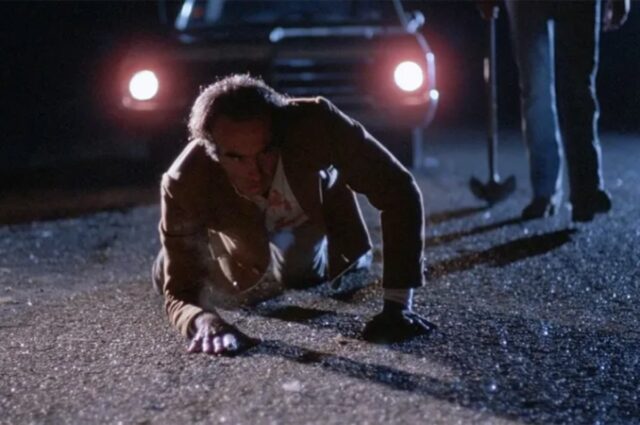
man in tan suit crawling on the pavement at night in front of truck with headlights glaring. Feet of a man holding an axe is off to the right.

Credit: Circle Films

Joel and Ethan Coen are justly considered among today’s foremost filmmakers; they’ve made some of my favorite films of all time. And it all started with Blood Simple, the duo’s directorial debut, a neo-noir crime thriller set in small-town Texas. Housewife Abby (Frances McDormand) is having an affair with a bartender named Ray (John Getz). Her abusive husband, Julian (Dan Hedaya), has hired a private investigator named Visser (M. Emmet Walsh) and finds out about the affair. He then asks Visser to kill the couple for $10,000. Alas, things do not go as planned as everyone tries to outsmart everyone else, with disastrous consequences.

Blood Simple has all the elements that would become trademarks of the Coen brothers’ distinctive style: it’s both brutally violent and acerbically funny, with low-key gallows humor, not to mention inventive camerawork and lighting. The Coens accomplished a lot with their $1.5 million production budget. And you can’t beat that cast. (It was McDormand’s first feature role; she would go on to win her first Oscar for her performance in 1996’s Fargo.) The menacing shot of Ray dragging a shovel across the pavement toward a badly wounded Julian crawling on the road, illuminated by a car’s headlights, is one for the ages.

Brazil
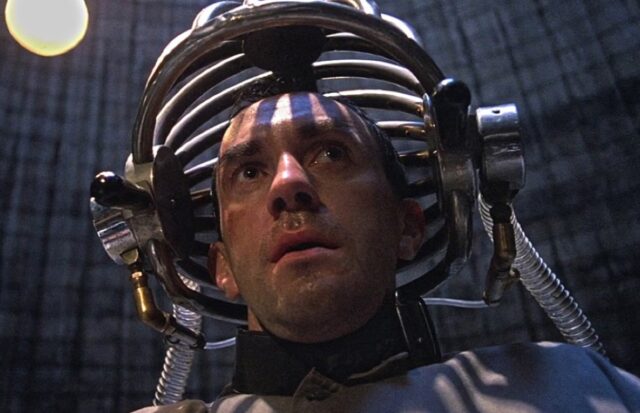
anxious man being restrained with his head in a weird futuristic helmet

Credit: Universal Pictures

Terry Gilliam’s Oscar-nominated, Orwellian sci-fi tragicomedy, Brazil, is part of what the director has called his “Trilogy of Imagination,” along with 1981’s Time Bandits and 1988’s The Adventures of Baron Munchausen. Jonathan Pryce stars as a low-ranking bureaucrat named Sam Lowry who combats the soul-crushing reality of his bleak existence with elaborate daydreams in which he is a winged warrior saving a beautiful damsel in distress. One day, a bureaucratic error confuses Sam with a wanted terrorist named Archibald Tuttle (Robert De Niro), setting off a darkly comic series of misadventures as Sam tries to prove his true identity (and innocence). That’s when he meets Jill (Kim Greist), a dead ringer for his dream woman.

Along with 12 Monkeys and Monty Python and the Holy Grail, Brazil represents Gilliam at his best, yet it was almost not released in the US because Gilliam refused the studio’s request to give the film a happy ending. Each side actually ran ads in Hollywood trades presenting their respective arguments, and Gilliam ultimately prevailed. The film has since become a critical favorite and an essential must-watch for Gilliam fans. Special shoutout to Katherine Helmond’s inspired supporting performance as Sam’s mother Ida and her addiction to bad plastic surgery (“It’s just a little complication….”).

Clue
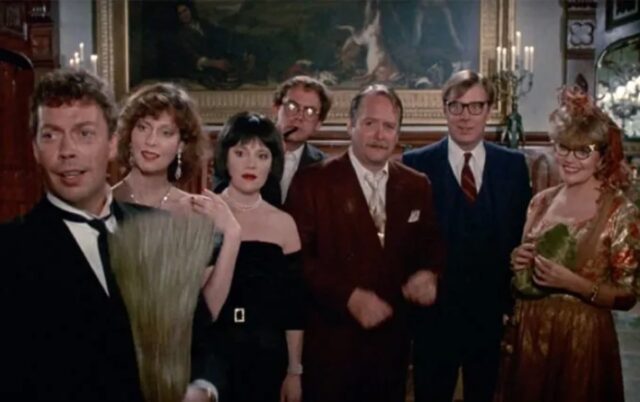
a group of people in dinner party fancy dress staring at the door.

Credit: Paramount Pictures

Benoit Blanc may hate the game Clue, but it’s delighted people of all ages for generations. And so has the deliciously farcical film adaptation featuring an all-star cast. Writer/director Jonathan Lynn (My Cousin Vinny) does a great job fleshing out the game’s premise and characters. A group of people is invited to an isolated mansion for a dinner with “Mr. Boddy” (Lee Ving) and are greeted by the butler, Wadsworth (Tim Curry). There is Mrs. Peacock (Eileen Brennan), Mrs. White (Madeline Kahn), Professor Plum (Christopher Lloyd), Mr. Green (Michael McKean), Colonel Mustard (Martin Mull), and Miss Scarlet (Lesley Ann Warren).

After dinner, Mr. Boddy reveals that he is the one who has been blackmailing them all, and when the lights suddenly go out, he is murdered. As everyone frantically tries to figure out whodunnit, more bodies begin to pile up, culminating in three different endings. (A different ending was shown in each theater but now all three are included.) The script is packed with bad puns and slapstick scenarios,  delivered with impeccable comic timing by the gifted cast. And who could forget Kahn’s famous ad-libbed line: “Flames… on the side of my face“? Like several films on this list, Clue got mixed reviews and bombed at the box office, but found its audience in subsequent decades. It’s now another cult classic that holds up even after multiple rewatchings.

The Company of Wolves
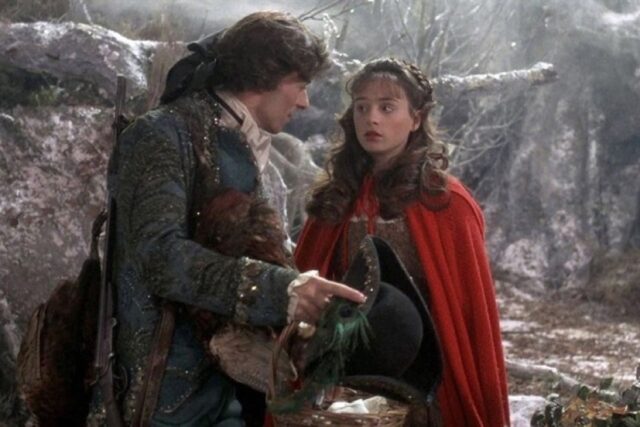
beautiful young dark-haired girl in a red hooded cape talking to a darkly handsome young man with a rakish look about him

Credit: ITC Entertainment

Director Neil Jordan’s sumptuous Gothic fantasy horror is a haunting twist on “Little Red Riding Hood” adapted from a short story by Angela Carter in her anthology of fairy-tale reinventions, The Bloody Chamber. The central narrative concerns a young girl named Rosaleen (Sarah Patterson) who sports a knitted red cape and encounters a rakish huntsman/werewolf (Micha Bergese) in the woods en route to her grandmother’s (Angela Lansbury) house. There are also several embedded wolf-centric fairy tales, two told by Rosaleen and two told by the grandmother.

Jordan has described this structure as “a story with very different movements,” all variations on the central theme and “building to the fairy tale that everybody knows.” The production design and gorgeously sensual cinematography—all achieved on a limited $2 million budget—further enhance the dreamlike atmosphere.  The Company of Wolves, like the fairy tale that inspired it, is an unapologetically Freudian metaphor for Rosaleen’s romantic and sexual awakening, in which she discovers her own power, which both frightens and fascinates her. It’s rare to find such a richly layered film rife with symbolism and brooding imagery.

Desperately Seeking Susan
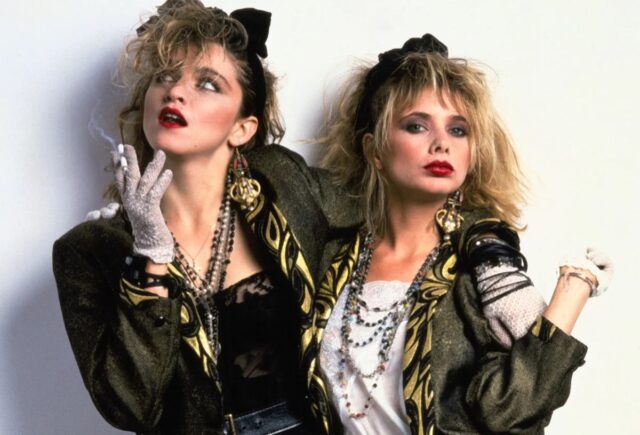
two young women, similar in appearance, dressed in 1980s New Wave outfits and striking a sultry pose for the camera

Credit: Orion Pictures

In this quintessential 1980s screwball comedy about mistaken identity, Roberta (Rosanna Arquette) is a dissatisfied upper-class New Jersey housewife fascinated by the local tabloid personal ads, especially messages between two free-spirited bohemian lovers, Susan (Madonna) and Jim (Robert Joy). She follows Susan one day and is conked on the head when a mob enforcer mistakes her for Susan, who had stolen a pair of valuable earrings from another paramour, who had stolen them from a mobster in turn. Roberta comes to with amnesia and, believing herself to be Susan, is befriended by Jim’s best friend, Dez (Aidan Quinn).

Desperately Seeking Susan is director Susan Seidelman’s love letter to the (admittedly sanitized) 1980s counterculture of Manhattan’s Lower East Side, peppered with cameo appearances by performance artists, musicians, comedians, actors, painters, and so forth of that time period. The script is rife with witty one-liners and a stellar supporting cast, including John Turturro as the owner of a seedy Magic Club, Laurie Metcalf as Roberta’s sister-in-law Leslie, and a deadpan Steven Wright as Leslie’s dentist love interest. It’s breezy, infectious, frothy fun, and easily Madonna’s best acting role, perhaps because she is largely playing herself.

Dreamchild
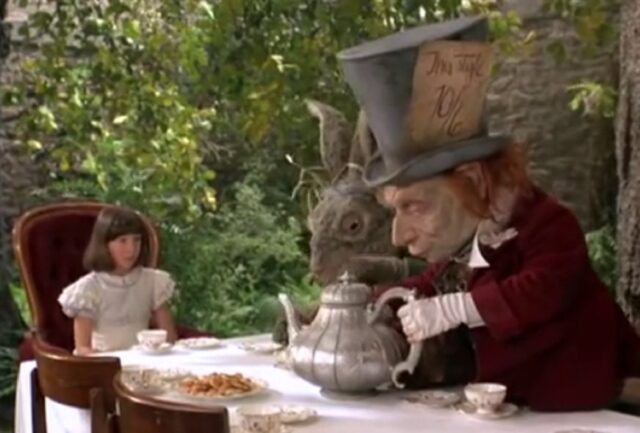
Young dark-haired girl with a bob in a white dress sitting down for tea with a a giant March Hare and the Mad Hatter

Credit: Thorn EMI

Dennis Potter (The Singing Detective) co-wrote the screenplay for this beautifully shot film about Alice Liddell, the 11-year-old girl who inspired Alice in Wonderland. Coral Browne plays the elderly widowed Alice, who travels by ship to the US to receive an honorary degree in celebration of Lewis Carroll’s birthday—a historical event. From there, things become entirely fictional, as Alice must navigate tabloid journalists, a bewildering modern world, and various commercial endorsement offers that emerge because of Alice’s newfound celebrity.

All the while, Alice struggles to process resurfaced memories—told via flashbacks and several fantasy sequences featuring puppet denizens of Wonderland—about her complicated childhood friendship with “Mr. Dodgson” (Ian Holm) and the conflicting emotions that emerge. (Amelia Shankley plays Alice as a child.) Also, romance blooms between Alice’s companion, an orphan named Lucy (Nicola Cowper), and Alice’s new US agent, Jack Dolan (Peter Gallagher).

Directed by Gavin Millar, Dreamchild taps into the ongoing controversy about Carroll’s fascination, as a pioneer of early photography, with photographing little girls in the nude (a fairly common practice in Victorian times). There is no evidence he photographed Alice Liddell in this way, however, and Potter himself told The New York Times in 1985 that he didn’t believe there was ever any improper behavior. Repressed romantic longing is what is depicted in Dreamchild, and it’s to Millar’s credit, as well as Holm’s and Browne’s nuanced performances, that the resulting film is heartbreakingly bittersweet rather than squicky.

Fandango
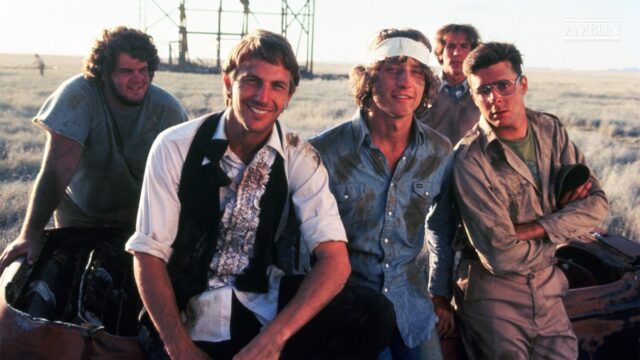
a group of young men in casual garb standing in a row in front of a car against a classic Americana small town background

Credit: Warner Bros.

Director Kevin Reynolds’ Fandango started out as a student film satirizing fraternity life at a Texas university. Steven Spielberg thought the effort was promising enough to fund a full-length feature. Set in 1971, the plot (such that it is) centers on five college seniors—the Groovers—who embark on a road trip to celebrate graduation. Their misadventures include running out of gas, an ill-advised parachuting lesson, and camping on the abandoned set of Giant, but it’s really about the group coming to terms with the harsh realities of adulthood that await, particularly since they’ve all been called up for the Vietnam draft.

Spielberg purportedly was unhappy with the final film, but it won over other fans (like Quentin Tarantino) and became a sleeper hit, particularly after its home video release. The humor is dry and quirky, and Reynolds has a knack for sight gags and the cadences of local dialect. Sure, the plot meanders in a rather quixotic fashion, but that’s part of the charm. And the young cast is relentlessly likable. Fandango featured Kevin Costner in his first starring role, and Reynolds went on to make several more films with Costner (Robin Hood: Prince of Thieves, Rapa Nui, Waterworld), with mixed success. But Fandango is arguably his most enduring work.

Ladyhawke

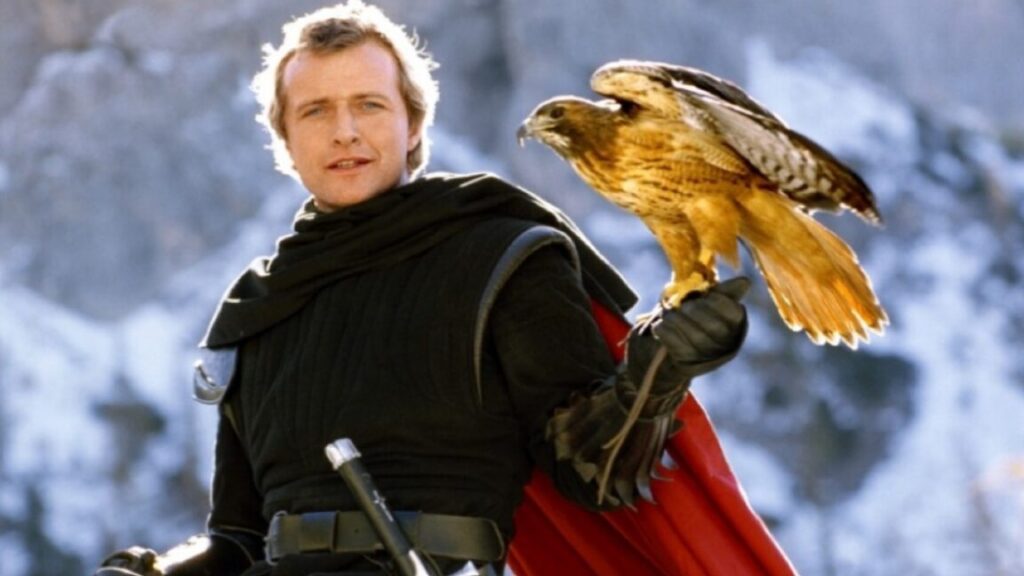
Handsome man in period dress standing close to a beautiful woman with short blonde hair, as they both look apprehensively into the distance.

Credit: Warner Bros.

Rutger Hauer and Michelle Pfeiffer star in director Richard Donner’s medieval fantasy film, playing a warrior named Navarre and his true love Isabeau who are cursed to be “always together, yet eternally apart.” She is a hawk by day, while he is a wolf by night, and the two cannot meet in their human forms, due to the jealous machinations of the evil Bishop of Aquila (John Wood), once spurned by Isabeau. Enter a young thief named Philippe Gaston (Matthew Broderick), who decides to help the couple lift the curse and exact justice on the bishop and his henchmen.

Ladyhawke only grossed $18.4 million at the box office, just shy of breaking even against its $20 million budget, and contemporary critical reviews were very much mixed, although the film got two Oscar nods for best sound and sound effects editing. Sure, the dialogue is occasionally clunky, and Broderick’s wisecracking role is a bit anachronistic (shades of A Knight’s Tale). But the visuals are stunning, and the central fairy tale—fueled by Hauer’s and Pfeiffer’s performances—succeeds in capturing the imagination and holds up very well as a rewatch.

Pee-Wee’s Big Adventure
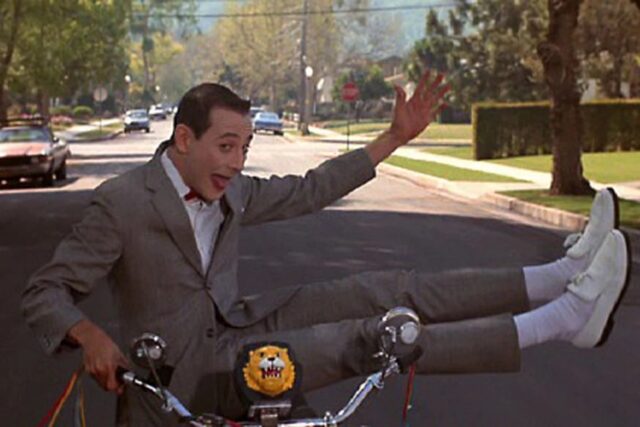
goofy man in tight fitting gray suit balancing sideways on a bicycle with a silly grin on his face

Credit: Warner Bros.

Paul Reubens originally created the Pee-Wee Herman persona for the Groundlings sketch comedy theater in Los Angeles, and his performances eventually snagged him an HBO special in 1981. That, in turn, led to Pee-Wee’s Big Adventure, directed by Tim Burton (who makes a cameo as a street thug), in which the character goes on a madcap quest to find his stolen bicycle. The quest takes Pee-Wee to a phony psychic, a tacky roadside diner, the Alamo Museum in San Antonio, Texas, a rodeo, and a biker bar, where he dances in platform shoes to “Tequila.” But really, it’s all about the friends he makes along the way, like the ghostly trucker Large Marge (Alice Nunn).

Some have described the film as a parodic homage to the classic Italian film, Bicycle Thieves, but tonally, Reubens wanted something more akin to the naive innocence of Pollyanna (1960). He chose Burton to direct after seeing the latter’s 1984 featurette, Frankenweenie, because he liked Burton’s visual sensibility. Pee-Wee’s Big Adventure is basically a surreal live-action cartoon, and while contemporary critics were divided—it’s true that a little Pee-Wee goes a long way and the over-the-top silliness is not to everyone’s taste—the film’s reputation and devoted fandom have grown over the decades.

A Private Function
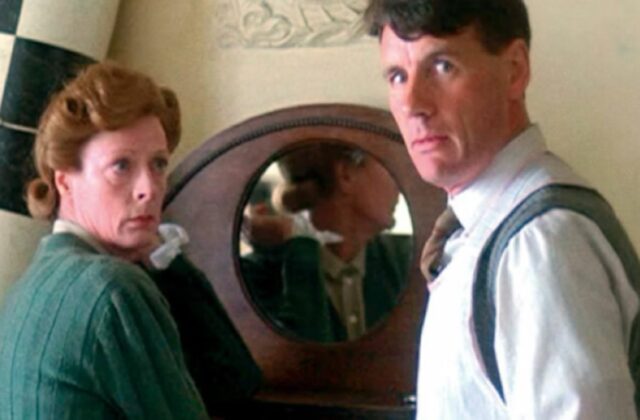
a woman in a green dress and tight bun looking at a nervous man in white shirt and suspenders as he looks over his shoulder.

Credit: HandMade Films

A Private Function is an homage of sorts to the British post-war black comedies produced by Ealing Studios between 1947 and 1957, including such timeless classics as Kind Hearts and Coronets, The Lavender Hill Mob, and The Ladykillers. It’s set in a small Yorkshire town in 1947, as  residents struggle to make ends meet amid strict government rations. With the pending royal wedding of Princess Elizabeth and Prince Philip, the wealthier townsfolk decide to raise a pig (illegally) to celebrate with a feast.

Those plans are put in jeopardy when local chiropodist Gilbert Chivers (Michael Palin) and his perennially discontented wife Joyce (Maggie Smith) steal the pig. Neither Gilbert nor Joyce knows the first thing about butchering said pig (named Betty), but she assures her husband that “Pork is power!” And of course, everyone must evade the local food inspector (Bill Paterson), intent on enforcing the rationing regulations. The cast is a veritable who’s who of British character actors, all of whom handle the absurd situations and often scatalogical humor with understated aplomb.

Prizzi’s Honor
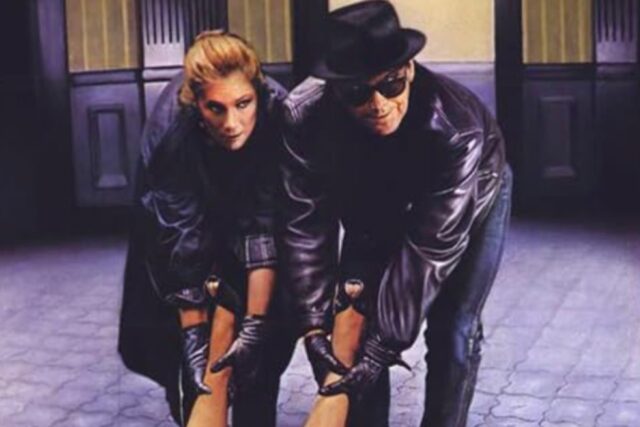
woman and man dressed all in black, dragging a body by the legs.

Credit: 20th Century Fox

The great John Huston directed this darkly cynical black comedy. Charley Partanna (Jack Nicholson) is a Mafia hitman for the Prizzi family in New York City who falls for a beautiful Polish woman named Irene (Kathleen Turner) at a wedding. Their whirlwind romance hits a snag when Charley’s latest hit turns out to be Irene’s estranged husband, who stole money from the Prizzis. That puts Charlie in a dilemma. Does he ice her? Does he marry her? When he finds out Irene is a contract killer who also does work for the mob, it looks like a match made in heaven. But their troubles are just beginning.

Turner and Nicholson have great on-screen chemistry and play it straight in outrageous circumstances, including the comic love scenes.  The rest of the cast is equally game, especially William Hickey as the aged Don Corrado Prizzi, equal parts ruthlessly calculating and affectionately paternal. “Here… have a cookie,” he offers his distraught granddaughter (and Charley’s former fiancée), Maerose (Anjelica Huston). Huston won a supporting actress Oscar for her performance, which probably made up for the fact that she was paid at scale and dismissed by producers as having “no talent,” despite—or perhaps because of—being the director’s daughter and Nicholson’s then-girlfriend. Prizzi’s Honor was nominated for eight Oscars all told, and it deserves every one of them.

The Purple Rose of Cairo
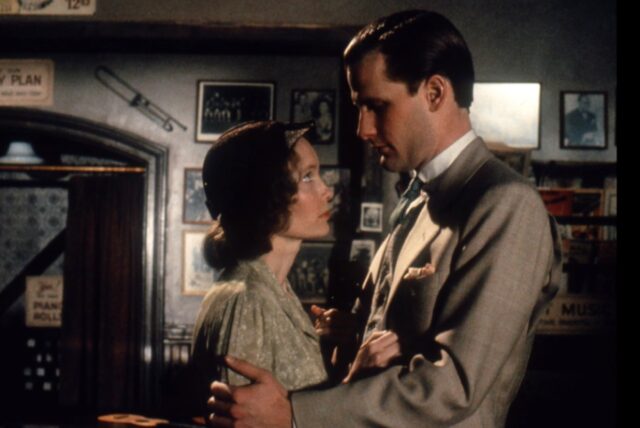
woman and a man in Depression-era garb gazing at each other in a loose embrace

Credit: Orion Pictures

Woody Allen has made so many films that everyone’s list of favorites is bound to differ. My personal all-time favorite is a quirky, absurdist bit of metafiction called The Purple Rose of Cairo. Mia Farrow stars as Cecelia, a New Jersey waitress during the Great Depression who is married to an abusive husband (Danny Aiello). She finds escape from her bleak existence at the local cinema, watching a film (also called The Purple Rose of Cairo) over and over again. One day, the male lead, archaeologist Tom Baxter (Jeff Daniels), breaks character to address Cecelia directly. He then steps out of the film and the two embark on a whirlwind romance. (“I just met a wonderful man. He’s fictional, but you can’t have everything.”)

Meanwhile, the remaining on-screen characters (who are also sentient) refuse to perform the rest of the film until Tom returns, insulting audience members to pass the time. Then the actor who plays Tom, Gil Shepherd (also Daniels), shows up to try to convince Cecilia to choose reality over her fantasy dream man come to life. Daniels is wonderful in the dual role, contrasting the cheerfully naive Tom against the jaded, calculating Gil.  This clever film is by turns wickedly funny, poignant, and ultimately bittersweet, and deserves a place among Allen’s greatest works.

Real Genius
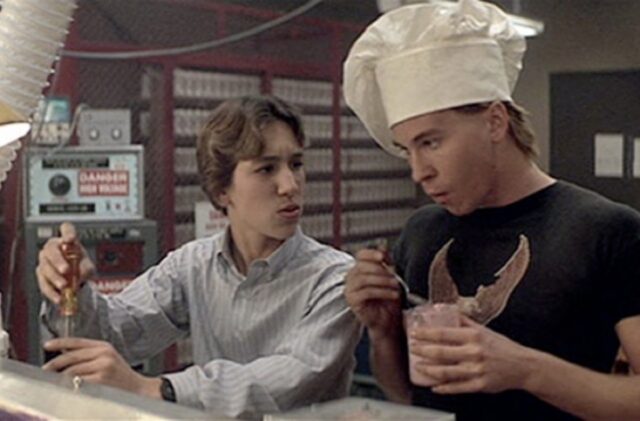
Credit: TriStar Pictures

How could I omit this perennial favorite? Its inclusion is a moral imperative. Fifteen-year-old Mitch Taylor (Gabriel Jarret) is a science genius and social outcast at his high school who is over the moon when Professor Jerry Hathaway (William Atherton), a star researcher at the fictional Pacific Technical University, handpicks Mitch to work in his own lab on a laser project. But unbeknownst to Mitch, Hathaway is in league with a covert CIA program to develop a space-based laser weapon for political assassinations. They need a 5-megawatt laser and are relying on Mitch and fellow genius/graduating senior Chris Knight (Val Kilmer) to deliver.

The film only grossed $12.9 million domestically against its $8 million budget. Reviews were mostly positive, however, and over time, it became a sleeper hit. Sure, the plot is predictable, the characters are pretty basic, and the sexually frustrated virgin nerds ogling hot cosmetology students in bikinis during the pool party reflects hopelessly outdated stereotypes on several fronts. But the film still offers smartly silly escapist fare, with a side of solid science for those who care about such things. Real Genius remains one of the most charming, winsome depictions of super-smart science whizzes idealistically hoping to change the world for the better with their work.

Witness
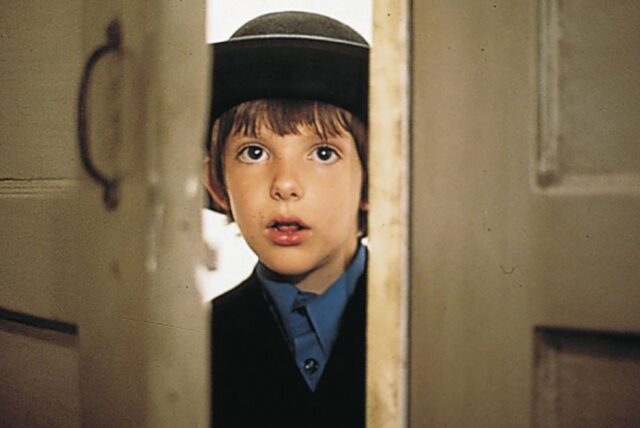
little Amish boy peeking through a crack in the door

Credit: Paramount

Witness stars Harrison Ford as John Book, a Philadelphia detective, who befriends a young Amish boy named Samuel (Lukas Haas) and his widowed mother Rachel (Kelly McGillis) after Samuel inadvertently witnesses the murder of an undercover cop in the Philadelphia train station. When Samuel identifies one of the killers as a police lieutenant (Danny Glover), Book must go into hiding with Rachel’s Amish family to keep Samuel safe until he can find a way to prove the murder was an inside job. And he must fight his growing attraction to Rachel to boot.

This was director Peter Weir’s first American film, but it shares the theme of clashing cultures that dominated Weir’s earlier work. The lighting and scene composition were inspired by Vermeer’s paintings and enhanced the film’s quietly restrained tone, making the occasional bursts of violence all the more impactful. The film has been praised for its depiction of the Amish community, although the extras were mostly Mennonites because the local Amish did not wish to appear on film. (The Amish did work on set as carpenters and electricians, however.) Witness turned into a surprise sleeper hit for Paramount. All the performances are excellent, including Ford and McGillis as the star-crossed lovers from different worlds, but it’s the young Haas who steals every scene with his earnest innocence.

Photo of Jennifer Ouellette

Jennifer is a senior writer at Ars Technica with a particular focus on where science meets culture, covering everything from physics and related interdisciplinary topics to her favorite films and TV series. Jennifer lives in Baltimore with her spouse, physicist Sean M. Carroll, and their two cats, Ariel and Caliban.

Blast from the past: 15 movie gems of 1985 Read More »
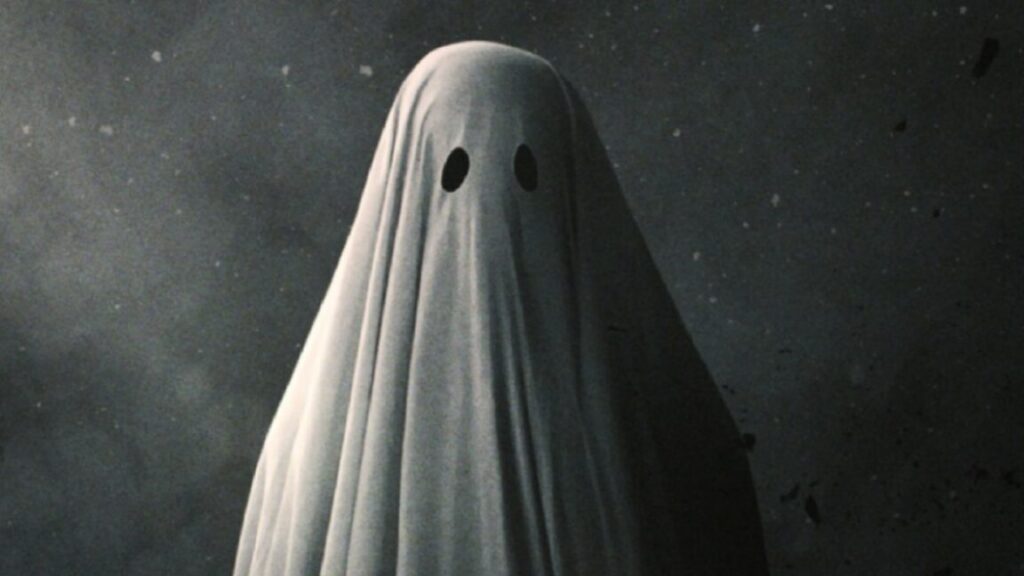
halloween-film-fest:-15-classic-ghost-stories

Halloween film fest: 15 classic ghost stories


From The Uninvited to Crimson Peak, these films will help you set the tone for spooky season.

It’s spooky season, and what better way to spend Halloween weekend than settling in to watch a classic Hollywood ghost story? To help you figure out what to watch, we’ve compiled a handy list of 15 classic ghost stories, presented in chronological order.

What makes a good ghost story? Everyone’s criteria (and taste) will differ, but for this list, we’ve focused on more traditional elements. There’s usually a spooky old house with a ghostly presence and/or someone who’s attuned to said presence. The living must solve the mystery of what happened to trap the ghost(s) there in hopes of setting said ghost(s) free. In that sense, the best, most satisfying ghost stories are mysteries—and sometimes also love stories. The horror is more psychological, and when it comes to gore, less is usually more.

As always, the list below isn’t meant to be exhaustive. Mostly, we’re going for a certain atmospheric vibe to set a mood. So our list omits overt comedies like Ghostbusters and (arguably) Ghost, as well as supernatural horror involving demonic possession—The Exorcist, The Conjuring, Insidious—or monsters, like The Babadook or Sinister. Feel free to suggest your own recommendations in the comments.

(Various spoilers below, but no major reveals.)

The Uninvited (1944)

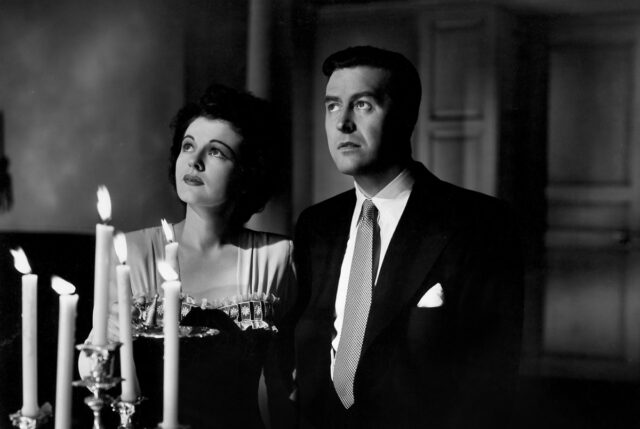
B&W image of man and woman in 1940s evening wear holding a candle and looking up a flight of stairs

Credit: Paramount Pictures

Brother and sister Rick and Pamela Fitzgerald (Ray Milland and Ruth Hussey) fall in love with an abandoned seaside abode called Windward House while vacationing in England. They pool their resources and buy it for a very low price, since its owner, Commander Beech (Donald Crisp), is oddly desperate to unload it. This upsets his 20-year-old granddaughter, Stella (Gail Russell), whose mother fell to her death from the cliffs near the house when Stella was just a toddler.

Rick, a musician and composer, becomes infatuated with the beautiful young woman. And before long, strange phenomena begin manifesting: a woman sobbing, an odd chill in the artist’s studio, a flower wilting in mere seconds—plus, the Fitzgeralds’ dog and their housekeeper’s cat both refuse to go upstairs. Whatever haunts the house seems to be focused on Stella.

The Uninvited was director Lewis Allen’s first feature film—adapted from a 1941 novel by Dorothy Macardle—but it has aged well. Sure, there are some odd tonal shifts; the light-hearted sibling banter between Rick and Pamela, while enjoyable, does sometimes weaken the scare factor. But the central mystery is intriguing and the visuals are striking, snagging an Oscar nomination for cinematographer Charles Lang. Bonus points for the tune “Stella by Starlight,” written specifically for the film and later evolving into a beloved jazz standard, performed by such luminaries as Ella Fitzgerald, Frank Sinatra, Charlie Parker, Chet Baker, and Miles Davis.

The Ghost and Mrs. Muir (1947)

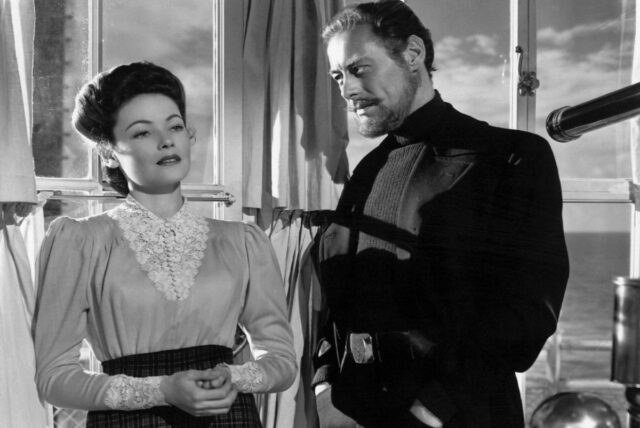
young woman and middle aged man standing and talking

Credit: 20th Century Fox

This is one of those old Hollywood classics that has ably withstood the test of time. Gene Tierney stars as the titular Mrs. Lucy Muir, a young widow with a little girl who decides to leave London and take up residence in the seaside village of Whitecliff. She rents Gull Cottage despite the realtor’s reluctance to even show it to her. Lucy falls in love with the house and is intrigued by the portrait of its former owner: a rough sea captain named Daniel Gregg (Rex Harrison), who locals say died by suicide in the house. Gregg’s ghost still haunts Gull Cottage, but he tries in vain to scare away the tough-minded Lucy. The two become friends and start to fall in love—but can any romance between the living and the dead truly thrive?

The Ghost and Mrs. Muir earned cinematographer Charles Lang another well-deserved Oscar nomination. Tierney and Harrison have great on-screen chemistry, and the film manages to blend wry humor and pathos into what is essentially a haunting love story of two people finding each other at the wrong time. There’s no revenge plot, no spine-tingling moments of terror, no deep, dark secret—just two people, one living and one dead, coming to terms in their respective ways with loss and regret to find peace.

The Innocents (1961)

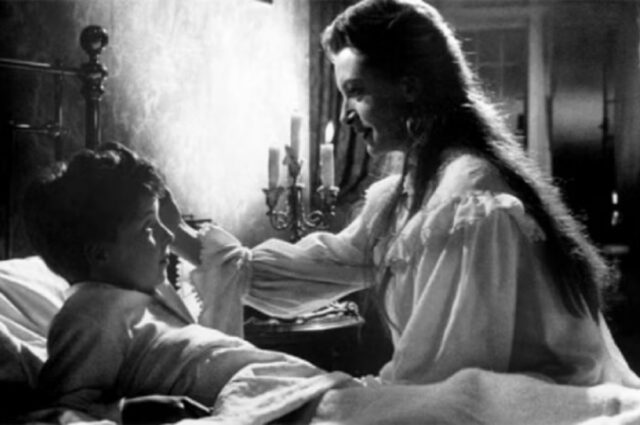
B&W still of young boy being tucked in by a young woman.

Credit: 20th Century Fox

Henry James’ 1898 novella The Turn of the Screw has inspired many adaptations over the years. Most recently, Mike Flanagan used the plot and central characters as the main narrative framework for his Netflix miniseries The Haunting of Bly Manor. But The Innocents is widely considered to be the best.

Miss Giddens (Deborah Kerr) has been hired for her first job as a governess to two orphaned children at Bly Manor, who sometimes exhibit odd behavior. The previous governess, Miss Jessel (Clytie Jessop), had died tragically the year before, along with her lover, Peter Quint (Peter Wyngarde). Miss Giddens becomes convinced that their ghosts have possessed the children so they can still be together in death. Miss Giddens resolves to free the children, with tragic consequences.

Literary scholars and critics have been debating The Turn of the Screw ever since it was first published because James was deliberately ambiguous about whether the governess saw actual ghosts or was simply going mad and imagining them. The initial screenwriter for The Innocents, William Archibald, assumed the ghosts were real. Director Jack Clayton preferred to be true to James’ original ambiguity, and the final script ended up somewhere in between, with some pretty strong Freudian overtones where our repressed governess is concerned.

This is a film you’ll want to watch with all the lights off. It’s dark—literally, thanks to Clayton’s emphasis on shadows and light to highlight Miss Giddens’ isolation. The first 45 seconds are just a black screen with a child’s voice humming a haunting tune. But it’s a beautifully crafted example of classic psychological horror that captures something of the chilly, reserved spirit of Henry James.

The Haunting (1963)

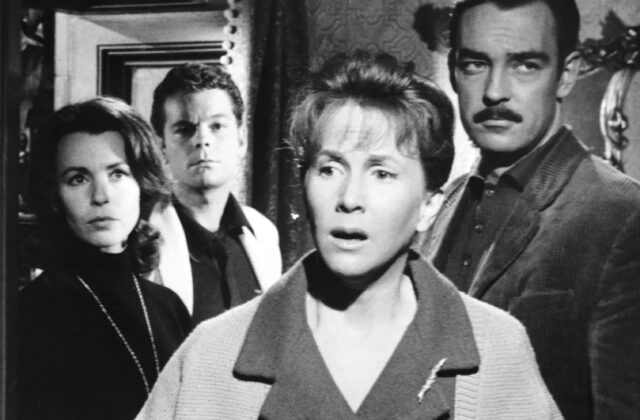
B&W still of group of people in 1960s clothing standing in drawing room of a haunted house

Credit: Metro-Goldwyn-Mayer

There have also been numerous adaptations of Shirley Jackson’s 1959 Gothic horror novel The Haunting of Hill House, including Mike Flanagan’s boldly reimagined miniseries for Netflix. But many people—Martin Scorsese and Steven Spielberg among them—consider director Robert Wise’s The Haunting to be not only the best adaptation but one of the best horror films of all time. (Please do not confuse the Wise version with the disappointing 1999 remake, which tried to make up for its shortcomings with lavish sets and showy special effects—to no avail.)

Psychologist Dr. John Markaway (Richard Johnson) brings three people to the titular Hill House, intent on exploring its legendary paranormal phenomena. There’s a psychic named Theodora (Claire Bloom); the emotionally vulnerable Eleanor (Julie Harris), who has experienced poltergeists and just lost her domineering mother; and the skeptical Luke (Russ Tamblyn), who will inherit the house when its elderly owner dies. The house does not disappoint, and the visitors experience strange sounds and mysterious voices, doors banging shut on their own, and a sinister message scrawled on a wall: “Help Eleanor come home.”

Initial reviews were mixed, but the film has grown in stature over the decades. Jackson herself was not a fan. Wise did make considerable changes, shortening the backstory and cutting out several characters. He also downplayed the overt supernatural elements in Jackson’s novel, focusing on Eleanor’s mental instability and eventual breakdown. Wise envisioned it as the house taking over her mind. Modern sensibilities accustomed to much more intense horror might not find The Haunting especially scary, but it is beautifully rendered with skillful use of clever special effects. For instance, to make the house seem alive, Wise filmed the exterior shots in infrared to give it an otherworldly vibe, framing the shots so that the windows resemble the house’s eyes.

The Shining (1980)

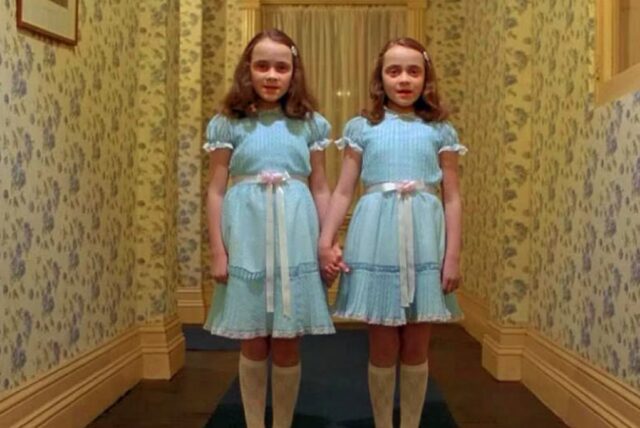
twin girls in matching light blue dresses and white knee socks standing in a hallway with yellow flowered wallpaper

Credit: Warner Bros.

Stanley Kubrick’s adaptation of the 1977 bestselling novel by Stephen King probably needs no introduction. But for those not familiar with the story, Jack Torrance (Jack Nicholson) takes a position as the winter caretaker of the remote Overlook Hotel in the Rocky Mountains, bringing his wife, Wendy (Shelley Duvall), and young son, Danny (Danny Lloyd). Danny has a psychic gift called “the shining,” which allows him to communicate telepathically with the hotel cook, Dick Halloran (Scatman Crothers). The previous caretaker went mad and murdered his family. Over the course of the film, Jack slowly begins to succumb to the same madness, putting his own wife and child in danger.

Initial reviews weren’t particularly favorable—King himself is not a fan of the film—but it’s now considered a horror classic and a subject of much academic study among film scholars. This is another film that has seen a lot of debate about whether the ghosts are real, with some arguing that Jack and Danny might just be hallucinating the Overlook’s malevolent ghosts into existence. Or maybe it’s the hotel manifesting ghosts to drive Jack insane. (I choose to interpret the ghosts in The Shining as real while appreciating the deliberate ambiguity.) There are so many memorable moments: the eerie twin girls (“Come and play with us”), the bathtub lady in Room 237, Lloyd the creepy bartender, the elaborate hedge maze, “REDRUM,” Jack hacking through a door and exclaiming, “Heeere’s Johnny!” and that avalanche of blood pouring down a hotel hallway. It’s a must-watch.

Ghost Story (1981)

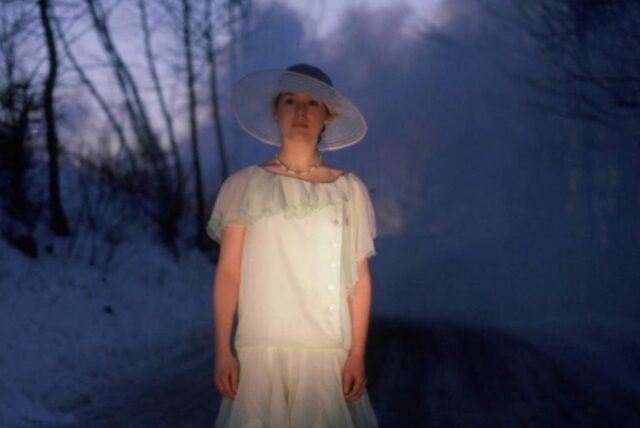
young woman with dark haired bob wearing a 1920s white dress and hat, standing in a road illuminated by headlights on a snowy night

Credit: Universal Pictures

Adapted from the 1979 novel by Peter Straub, Ghost Story centers on a quartet of elderly men in a New England town called Milburn. They are lifelong friends who call themselves the Chowder Society and gather every week to tell spooky stories. Edward Wanderly (Douglas Fairbanks Jr.) is the town’s mayor; Ricky Hawthorne (Fred Astaire) is a businessman; Sears James (John Houseman) is a lawyer; and John Jaffrey (Melvyn Douglas) is a physician. The trouble starts when Edward’s son, David (Craig Wasson), falls to his death from a New York City high-rise after the young woman he’s engaged to suddenly turns into a putrefying living corpse in their shared bed.

The apparent suicide brings Edward’s other son, Dan (also Wasson), back to Milburn. Dan doesn’t believe his brother killed himself and tells the Chowder Society his own ghost story: He fell in love with a young woman named Alma (Alice Krige) before realizing something was wrong with her. When he broke things off, Alma got engaged to David. And it just so happens that Alma bears a striking resemblance to a young woman named Eva Galli (also Krige) captured in an old photograph with all the members of the Chowder Society back in their youth. Yep, the old men share a dark secret, and the chickens are finally coming home to roost.

I won’t claim that Ghost Story is the best film of all time. It has its flaws, most notably the inclusion of two escaped psychiatric hospital patients purportedly in the service of Eva’s vengeful ghost. The tone is occasionally a bit over-the-top, but the film honors all the classic tropes, and there are many lovely individual scenes. The main cast is terrific; it was the final film for both Astaire and Fairbanks. And that spooky New England winter setting is a special effect all its own. The sight of Eva’s apparition materializing through the swirling snow to stand in the middle of the road in front of Sears’ car is one that has stuck with me for decades.

Poltergeist (1982)

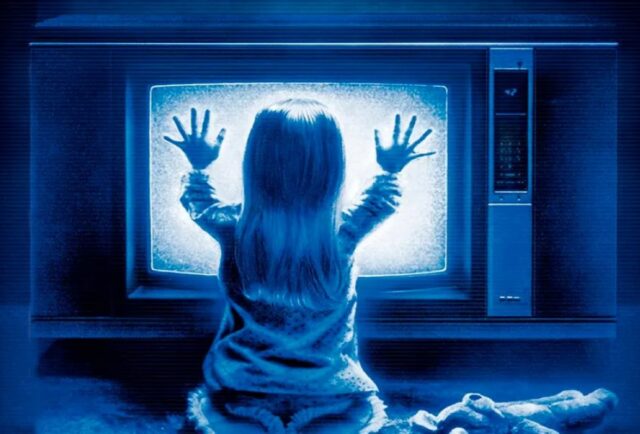
back view of little girl silhouetted against the TV glow; screen is all static and girl is holding both hands to the screen

Credit: MGM/UA Entertainment

“They’re heeere!” That might be one of the best-known movie lines from the 1980s, announcing the arrival of the titular poltergeists. In this Tobe Hooper tale of terror, Steven and Diane Freeling (Craig T. Nelson and JoBeth Williams) have just moved with their three children into a suburban dream house in the newly constructed community of Cuesta Verde, California. Their youngest, Carol Anne (Heather O’Rourke), starts hearing voices in the TV static late at night, and things soon escalate as multiple ghosts play pranks on the family. When Carol Anne mysteriously disappears, Steven and Diane realize at least one of the ghosts is far from friendly and call on local parapsychologists for help.

Steven Spielberg initiated the project, but his obligations to filming E.T. prevented him from directing, although he visited the set frequently. (There’s been considerable debate over whether Hooper or Spielberg really directed the film, but the consensus over time credits Hooper.) Despite the super-scary shenanigans, it definitely has elements of that lighter Spielberg touch, and it all adds up to a vastly entertaining supernatural thriller. Special shoutout to Zelda Rubinstein’s eccentric psychic medium with the baby voice, Tangina, who lends an element of whimsy to the proceedings.

Lady in White (1988)

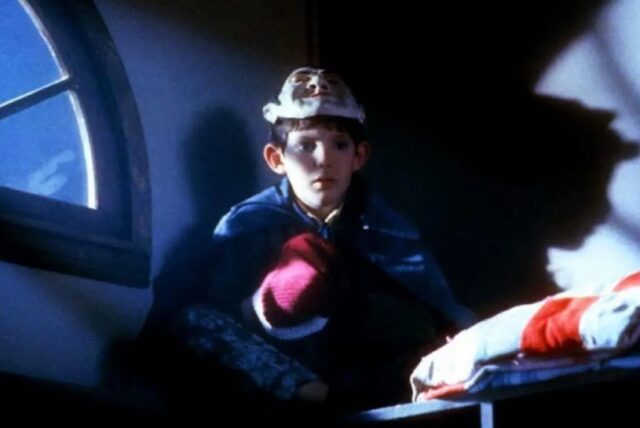
young boy curled up near an arched window at night with a har and wearing red gloves

Credit: New Century Vista Film

As a child actor, Lukas Haas won audience hearts when he played an Amish boy who sees a murder in the 1985 film Witness. Less well-known is his performance in Lady in White, playing 9-year-old Frankie Scarlatti. On Halloween in 1962, school bullies lock Frankie in the classroom coatroom, where he is trapped for the night. That’s when he sees the apparition of a young girl (Joelle Jacobi) being brutally murdered by an invisible assailant. Then an actual man enters, trying to recover something from a floor grate. When he realizes someone is there, he strangles Frankie unconscious; Frankie’s father, Angelo (Alex Rocco), finds and rescues him in the nick of time.

Frankie has a vision of that same girl while unconscious, asking him to help her find her mother. That little girl, it turns out, was one of 11 child victims targeted by a local serial killer. Frankie and his older brother, Geno (Jason Presson), decide to investigate. Their efforts lead to some shocking revelations about tragedies past and present as the increasingly desperate killer sets his sights on Frankie.

Director Frank LaLoggia based the story on the “lady in white” legend about a ghostly figure searching for her daughter in LaLoggia’s hometown of Rochester, New York. Granted, the special effects are cheesy and dated—the director was working with a lean $4.7 million budget—and LaLoggia can’t seem to end the film, adding twist after twist well after the audience is ready for a denouement. But overall, it’s a charming film, with plenty of warmth and heart to offset the dark premise, primarily because the Scarlattis are the quintessential Italian American New England family. Lady in White inexplicably bombed at the box office, despite positive critical reviews, but it’s a hidden 1980s gem.

Dead Again (1991)

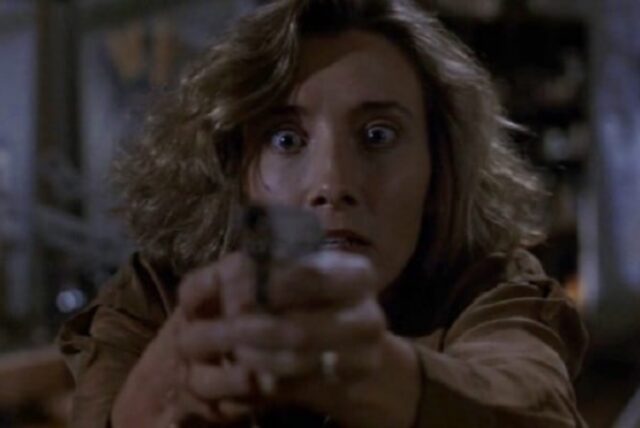
young woman, frightened, pointing gun at the camera

Credit: Paramount Pictures

In 1948, a composer named Roman Strauss is convicted of brutally stabbing his pianist wife, Margaret, to death with a pair of scissors and is executed. Over 40 years later, a woman (Emma Thompson) shows up with amnesia and is unable to speak at a Catholic orphanage that just happens to be the old Strauss mansion. The woman regularly barricades her door at night and inevitably wakes up screaming.

The nuns ask private investigator Mike Church (Kenneth Branagh) to find out her identity. Antiques dealer and hypnotist Franklyn Madson (Derek Jacobi) offers his assistance to help “Grace” recover her memory. Madson regresses her to a past life—that of Margaret and Roman Strauss’s doomed marriage. The truth about what really happened in 1948 unfolds in a series of black-and-white flashbacks—and they just might be the key to Grace’s cure.

As director, Branagh drew influences from various Hitchcock films, Rebecca, and Citizen Kane, as well as the stories of Edgar Allen Poe. The film is tightly written and well-plotted, and it ably balances suspense and sentiment. Plus, there are great performances from the entire cast, especially Robin Williams as a disgraced psychiatrist now working in a grocery store.

Some might question whether Dead Again counts as a bona fide ghost story instead of a romantic thriller with supernatural elements, i.e., hypnotherapy and past-life regression. It’s still two dead lovers, Roman and Margaret, reaching through the past to their reincarnated selves in the present to solve a mystery, exact justice, and get their happily ever after. That makes it a ghost story to me.

Stir of Echoes (1999)

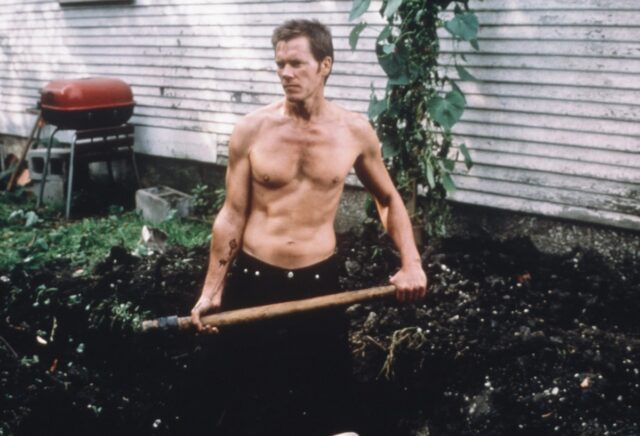
shirtless man in jeans digging a hole in his backyard

Credit: Artisan Entertainment

Stir of Echoes is one of my favorite Kevin Bacon films, second only to Tremors, although it hasn’t achieved the same level of cult classic success. Bacon plays Tom Witzky, a phone lineman in a working-class Chicago neighborhood. He loves his wife Maggie (Kathryn Erbe) and son Jake (Zachary David Cope), but he struggles with the fact that his life just isn’t what he’d imagined. One night, he agrees to be hypnotized by his sister-in-law (Illeana Douglas) after mocking her belief in the paranormal. This unlocks latent psychic abilities, which he shares with his far more gifted son, and he begins having disturbing visions of a young girl who disappeared from the neighborhood the year before. Naturally, Tom becomes obsessed with solving the mystery behind his intensifying visions.

Based on a novel by Richard Matheson, director David Koep drew on films like Repulsion, Rosemary’s Baby, and The Dead Zone for tonal inspiration, but Stir of Echoes still falls firmly into the ghost story genre. It’s just grounded in an ordinary real-world setting that makes the spooky suspense all the more effective, further aided by Bacon inhabiting the role of Tom so effortlessly that he barely seems to be acting. Alas, the film suffered at the box office and from unfavorable (and unfair) contemporary comparisons to The Sixth Sense (see below), released that same year. But it’s well worth a watch (and a rewatch).

The Sixth Sense (1999)

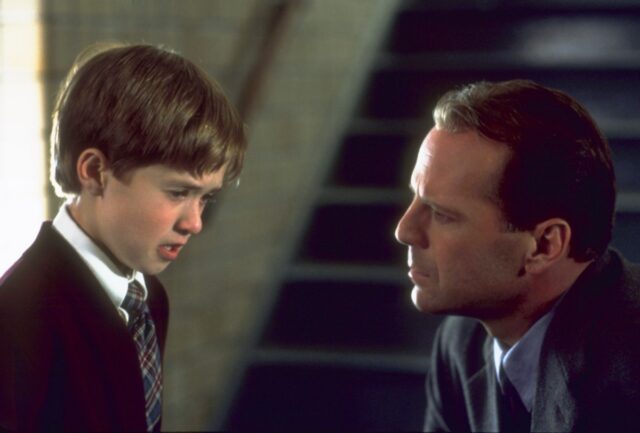
little boy looking scared being comforted by a man kneeling in front of him

Credit: Buena Vista Pictures

This is the film that launched director M. Night Shyamalan’s career, snagging him two Oscar nominations in the process. Child psychologist Malcolm Crowe (Bruce Willis) is shot by a troubled former patient, Vincent (Donnie Wahlberg), one night at home. A year later, he has a new case with striking similarities—9-year-old Cole Sears (Haley Joel Osment)—and devotes himself to helping the boy, as a way to atone for his failure to help Vincent. Malcolm thinks Cole’s problems might be even more severe, especially when Cole confesses (in a famous scene), “I see dead people.” And those dead people can be really scary, especially to a 9-year-old boy.

The Sixth Sense was a massive hit, grossing over $672 million globally, fueled in part by a jolting final plot twist that hardly anyone saw coming. But it’s Osment’s astonishing performance as Cole that anchored it all and marked the young actor as a rising talent. (It’s also one of Willis’ best, most nuanced performances.) Shyamalan has made many films since, and several are really good, but none have ever come close to this one.

What Lies Beneath (2000)

Beautiful blond woman in a sweater standing in the fog hugging herself to keep warm

Credit: DreamWorks Pictures

A luminous Michelle Pfeiffer stars as Claire Spencer, a gifted cellist who gave up her career for marriage to scientist Norman Spencer (Harrison Ford) and motherhood. But when their daughter goes off to college, Claire finds herself struggling to cope, particularly since there are tensions in her marriage. Plus, she’s still recovering psychologically from a car accident the year before, of which she has no memory. When mysterious psychic disturbances begin to manifest, Claire is convinced the ghost of a young woman is haunting her; everyone else thinks she’s just dealing with delayed grief and trauma. Claire nonetheless slowly begins to uncover the truth about the mysterious presence and her accident—and that truth just might end up costing her life.

What Lies Beneath started out as a treatment for Steven Spielberg, who envisioned something along the lines of a ghost story equivalent to Close Encounters of the Third Kind—primarily about discovery and first contact, while also exploring the psychological state of a new empty nester. But Spielberg ultimately passed on the project and handed it over to director Robert Zemeckis, who turned it into a psychological thriller/ghost story with a Hitchcockian vibe. Those earlier elements remain, however, and the leisurely pacing helps develop Claire as a character and gives Pfeiffer a chance to show off her acting chops, not just her exquisite beauty. It’s broody and satisfying and a perennial seasonal favorite for a rewatch.

The Others (2001)

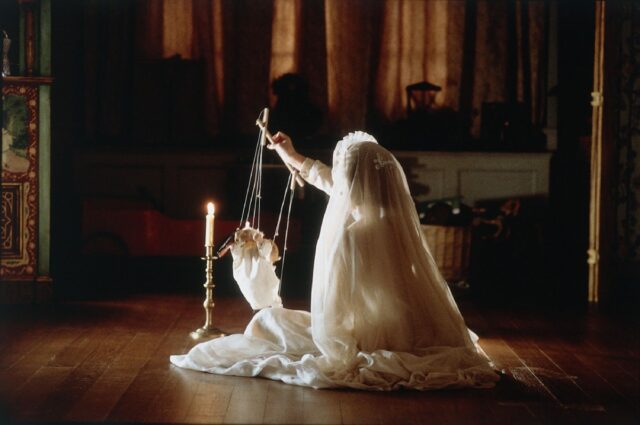
young girl, back to camera, dressed n white with a veil playing with a marionette

Credit: Dimension Films

This film might be director Alejandro Amenábar’s masterpiece, merging the sensibilities of arthouse cinema with mainstream movie-making. A young mother named Grace (Nicole Kidman) and her two children are living in a remote house on the Channel Island of Jersey, recently liberated from German occupation at the end of World War II. The house is kept in near darkness at all times because the children have a severe sensitivity to light. But there are disturbances in the house that Grace fears may be evidence of a haunting, and the three creepy new servants she hired seem to have ulterior motives for being there. And just who is buried in the small, overgrown cemetery on the grounds?

Much of the film’s success is due to Kidman’s incredibly disciplined, intense performance as the icily reserved, tightly wound Grace, whose gradual unraveling drives the plot. It’s a simple plot by design. All the complexity lies in the building tension and sense of oppressiveness, augmented by Amenábar’s claustrophobic sets and minimalist lighting of sepia-toned scenes. It all leads up to a chilling climax with an appropriately satisfying twist.

Crimson Peak (2015)

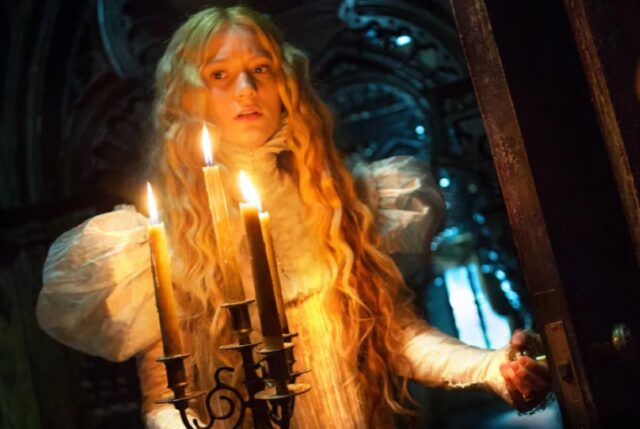
woman with long blonde hair in Gothic period dress holing a candelabra in a dark corridor

Credit: Universal Pictures

Guillermo del Toro has always had an extraordinary knack for lush visuals teeming with Gothic elements. The director went all in on the Gothic horror for this ghostly tale of a Victorian-era American heiress (Mia Wasikowska) who weds a handsome but impoverished English nobleman, Sir Thomas Sharpe (Tom Hiddleston). Edith finds herself living in his crumbling family mansion, which is definitely haunted. And Edith should know. She’s had ghostly visits from her dead mother since childhood, warning her to “beware of Crimson Peak,” so she’s sensitive to haunted vibes.

Edith really should have listened to her mother. Not only is Thomas strangely reluctant to consummate their marriage, but his sister, Lucille—played to perfection by Jessica Chastain—is openly hostile and might just be slipping a suspicious substance into Edith’s tea. Will Edith uncover the dark secret of Crimson Peak and escape a potentially terrible fate? Del Toro set out to put a modern twist on the classic haunted house genre, and he succeeded, drawing on several other films on this list for inspiration (The Haunting, The Innocents, and The Shining, specifically). But at its heart, Crimson Peak is pure del Toro: sinister, atmospheric, soaked in rich colors (and sometimes blood), with a spectacular payoff at the end.

A Ghost Story (2017)

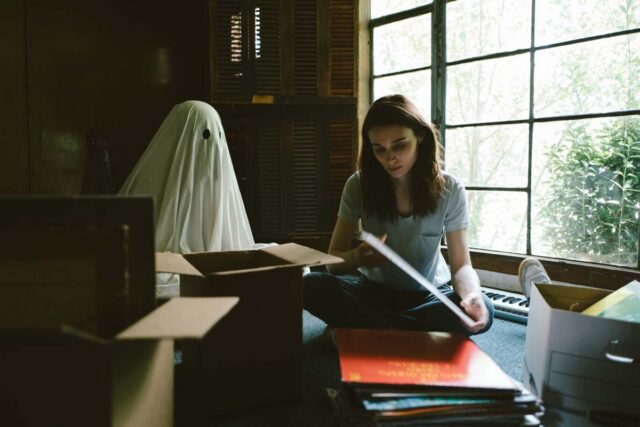
young woman seated at a desk with a small figure draped in a sheet wth eye holes cut out standing beside her

Credit: A24

This is probably the most unconventional approach to the genre on the list. Casey Affleck and Rooney Mara play a husband and wife known only as C and M, respectively, who have been at odds because M wants to move and C does not. Their house isn’t anything special—a small ranch-style affair in a semi-rural area—but it might be haunted.

One night, there is a mysterious bang, and the couple can’t locate the source when they search the house. Then C is killed in a car accident, his body covered with a sheet at the hospital morgue. C rises as a ghost, still wearing the sheet (now with two eyeholes) and makes his way back to the house, where he remains for a very long time, even long after M has moved out. (There’s also another ghost next door in a flowered sheet, waiting for someone it can no longer remember.)

There is almost no dialogue, Affleck spends most of the movie covered in a sheet, there is very little in the way of a musical soundtrack, and the entire film is shot in a 1.33:1 aspect ratio. Director David Lowery has said he made that choice because the film is “about someone trapped in a box for eternity, and I felt the claustrophobia of that situation could be amplified by the boxiness of the aspect ratio.” Somehow it all works. A Ghost Story isn’t about being scary; it’s a moody, poignant exploration of love lost—and it takes the audience to some conceptual spaces few films dare to tread.

Photo of Jennifer Ouellette

Jennifer is a senior writer at Ars Technica with a particular focus on where science meets culture, covering everything from physics and related interdisciplinary topics to her favorite films and TV series. Jennifer lives in Baltimore with her spouse, physicist Sean M. Carroll, and their two cats, Ariel and Caliban.

Halloween film fest: 15 classic ghost stories Read More »