Monthly

monthly-roundup-#14:-january-2024

Monthly Roundup #14: January 2024

There’s always lots of stuff going on. The backlog of other roundups keeps growing rather than shrinking. I have also decided to hold back a few things to turn them into their own posts instead.

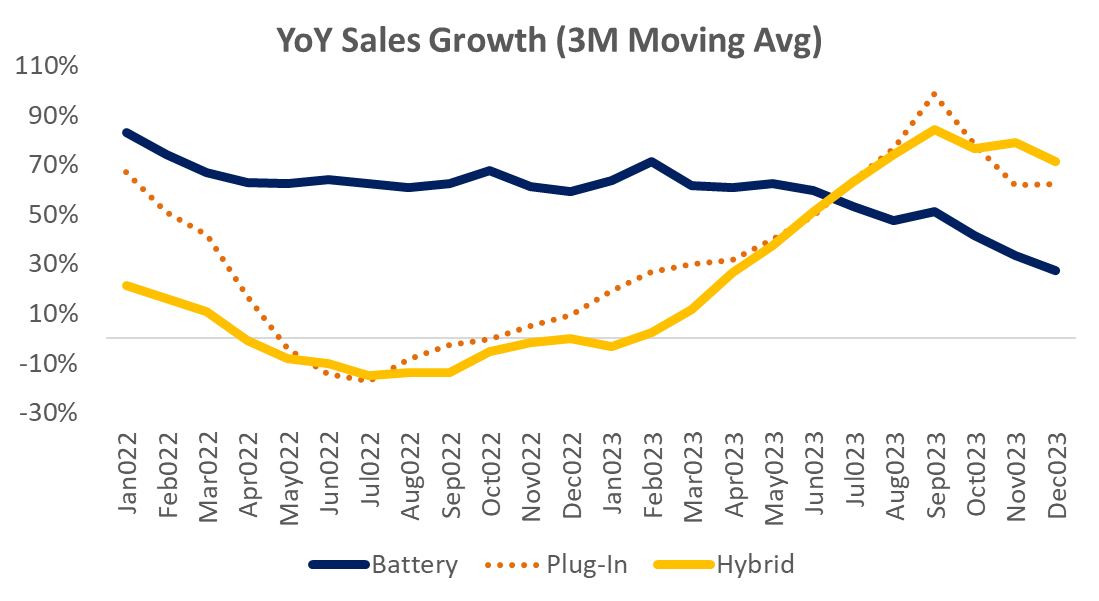
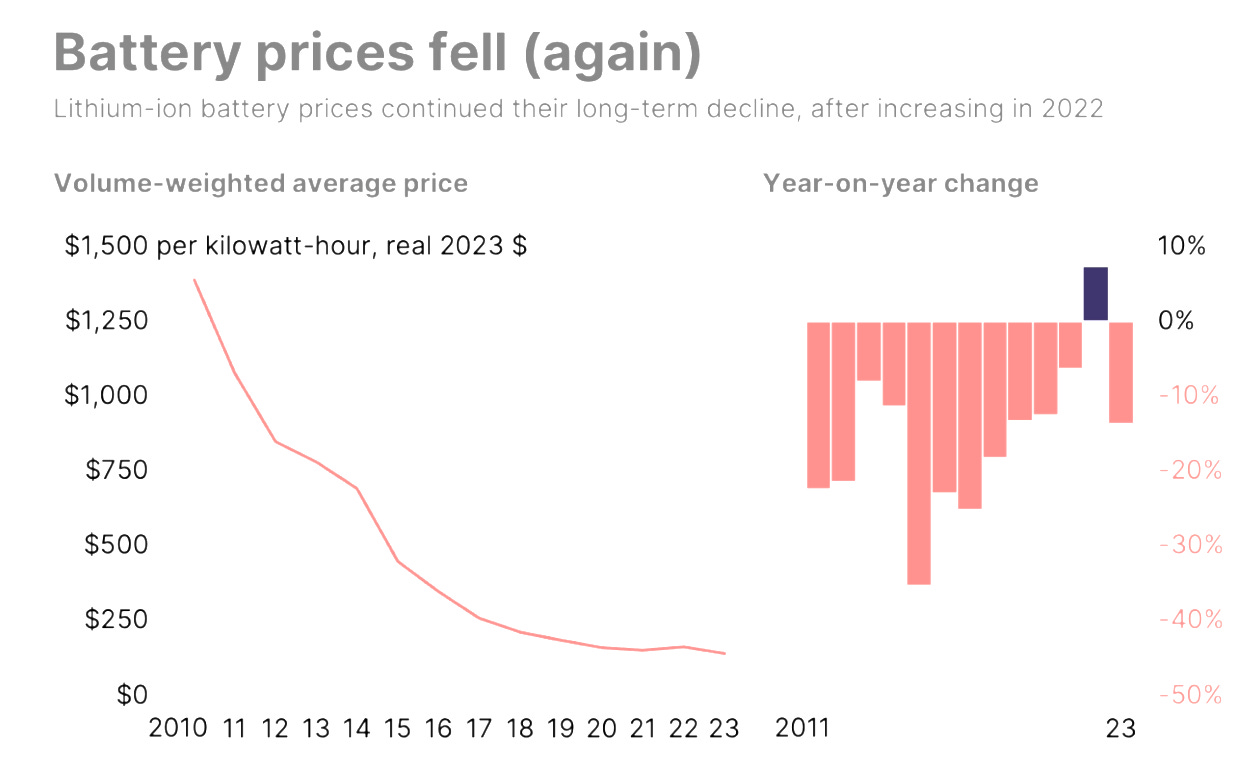
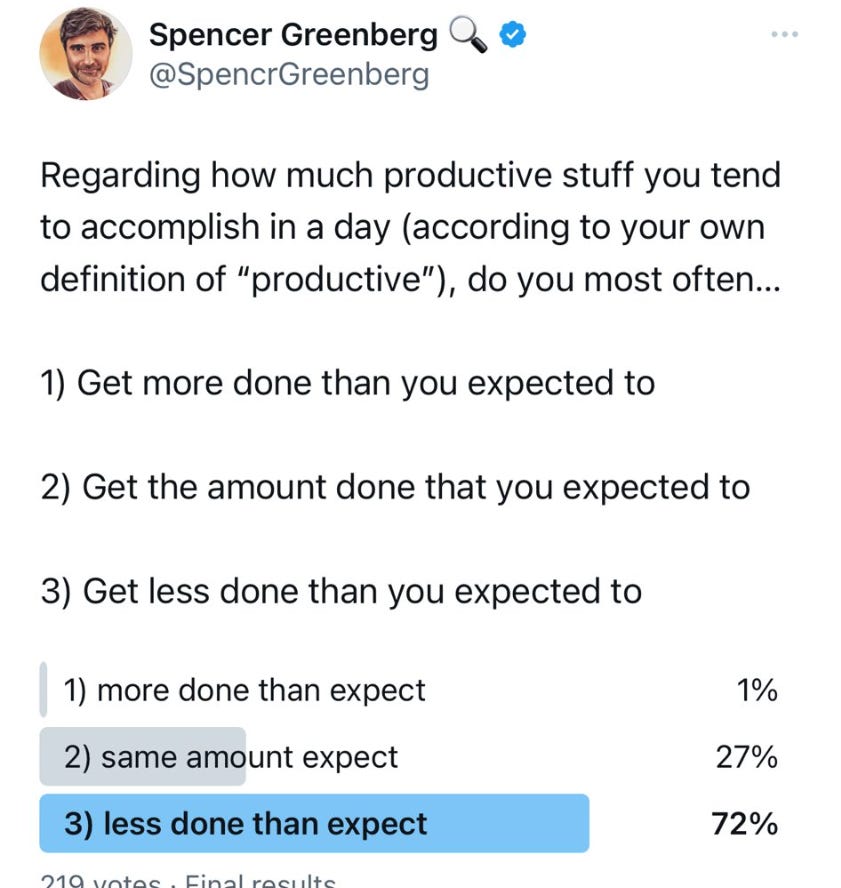
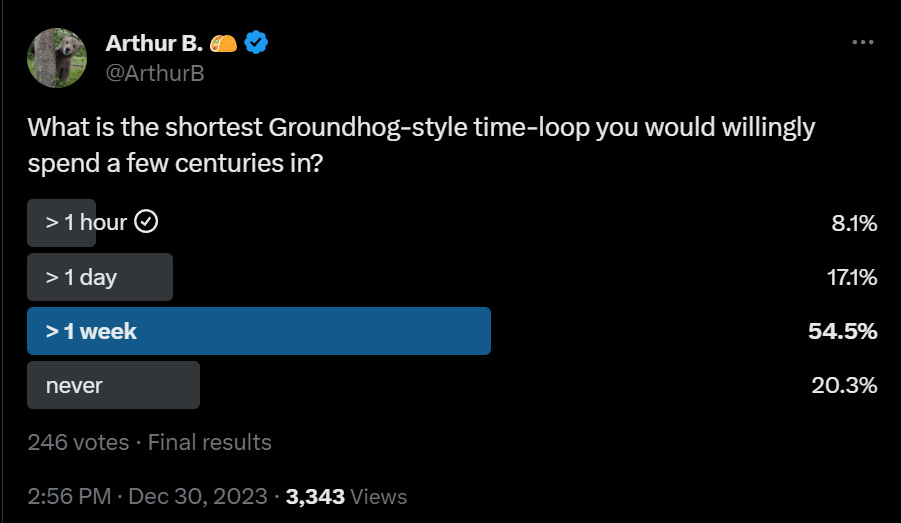
I wonder if it is meaningful that most of the bad news is about technology?

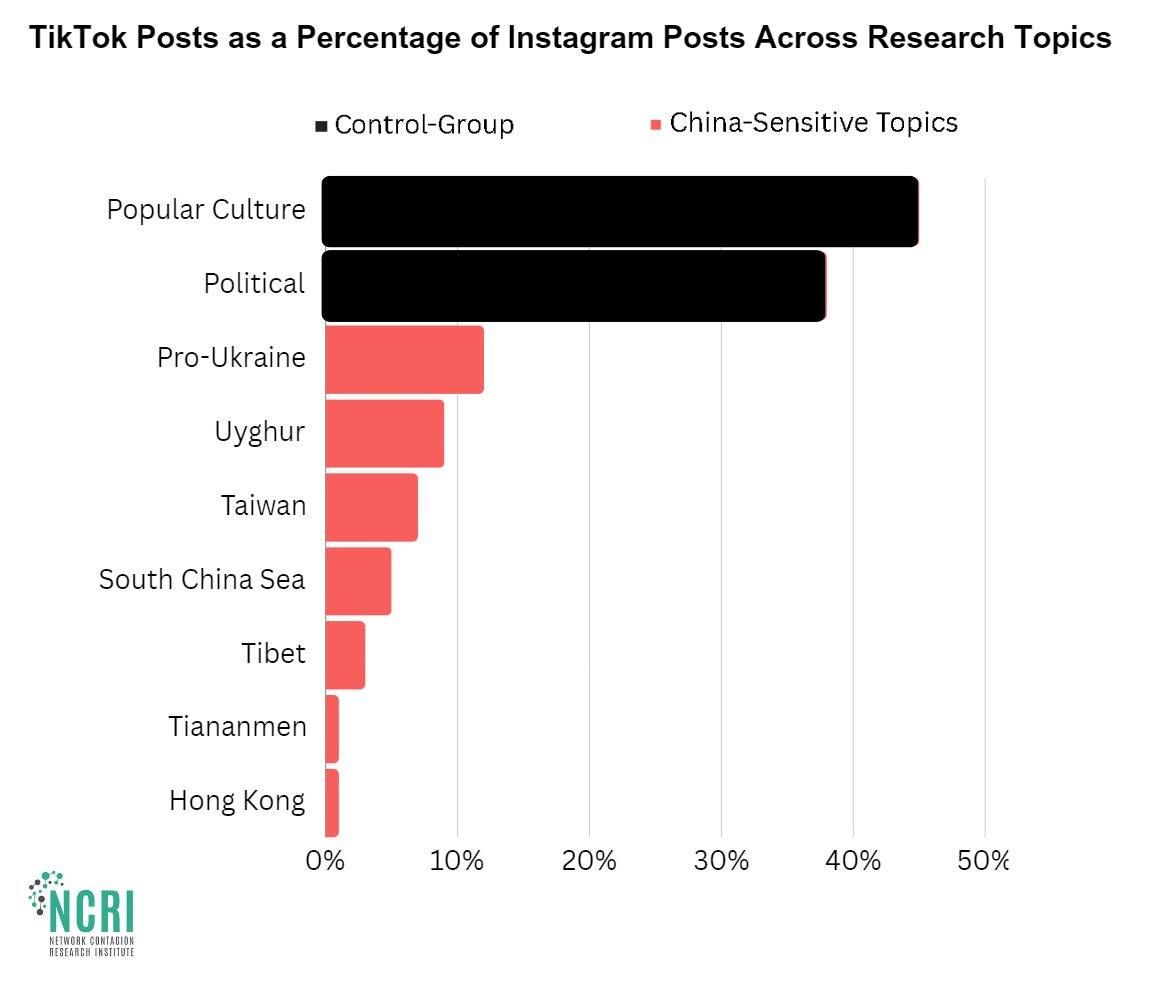
I don’t even know if this is news, but Rutgers finds TikTok amplifies and suppresses content based on whether it aligns with the CCP.

It would be great if we could find a way to ban or stop using TikTok that did not involve something crazy like the Restrict Act. I still think the Restrict Act is worse than nothing, if those are our only choices.

If the CCP limited its interference to explicitly internal Chinese topics, I would understand, but they do not: WSJ investigates the TikTok rabbit hole, in particular with respect to Gaza pro-Hamas content.

Noah Smith: At this point, whether America can bring itself to ban TikTok will determine whether it’s an actual country, or just a country-shaped sandbox for totalitarian states to play in

An analysis of Chinese censorship of American movies. Under their analysis, without such bans we would have 68% of the Chinese market instead of our current 28%. They emphasize factors like occult content, which has an effect but a remarkably small one, only raising an otherwise 50% to be banned movie to a 67% chance to be banned. An R rating similarly takes the odds to 70%, likely largely as a proxy for various things that get you the R rating.

I love buttons that do things. The thing I loved most about early iPhones was that they had a button. A nice, big, physical button, that bailed you out of pretty much anything. Things were simple. Alas.

Matt Palmer: Observation from younger brother: “Whenever I have to adjust the settings on my iPhone I have to Google how to do so, this seems like a red flag.”

Patrick McKenzie: No lie, I had to ask my wife how to turn my iPhone off, now that I have one that doesn’t have a physical home button.

“Isn’t it basically same as it is on an iPhone with a home button?” The thing which stopped was that you need to long press two things but Siri triggers immediately when on button(s) down and I would immediately release them thinking “No I didn’t want Siri.”

And almost every interaction with Settings or any part of the Apple ecosystem is brokered by a Google search leading to Apple dot com or a content farm explaining in four steps which buttons I need to hit. These don’t seem learnable or predictable in most cases.

A decade ago when I started using Macs seriously (quite late in my career for that relative to most geeks’ expectations) I was routinely surprised and delighted by how much the iOS experience on phone/iPad had prepared me for.

These days iPhone doesn’t prepare me for iPhone.

Can anyone explain why various meeting and calendar apps continuously fail to understand what time zone they are in? I’ve dealt with this a lot as well.

Patrick McKenzie: Why Google’s Calendly won’t crush Calendly’s Calendly in one image. Necessary context: I live in Chicago and am accessing this from a phone which knows it is currently 10: 15 AM to schedule an appointment with someone in San Francisco.

Patrick McKenzie: Here are two things Google PMs would say: “The default time zone set in your Google Calendar account is JST. I know a user could have two time zones there, but org politics will not allow me to override the default one.” and “This affects almost no users. Only millions.”

Meanwhile the businesses which actually care about calendaring for power users of calendaring know that many of their favorite users have two, three, or more home time zones and always getting this exactly right is important.

Do they? I am not convinced they do. I am also very convinced that it is utterly insane for a calendar app not to default to the time zone in its current location. It should also be loud about any conflicts, when it sees you moving around or in an unusual location.

Takeovers of phone numbers, especially important phone numbers, are getting worse. The system as it currently exists essentially lets any telecom worker give anyone your phone, and many of them are easy to either dupe or bribe. Meanwhile, everyone increasingly uses phones as account recovery and security, which you have to actively guard against to stop them from doing, and some of them will outright insist.

Twitter Safety: We can confirm that the account @SECGov was compromised and we have completed a preliminary investigation. Based on our investigation, the compromise was not due to any breach of X’s systems, but rather due to an unidentified individual obtaining control over a phone number associated with the @SECGov account through a third party. We can also confirm that the account did not have two-factor authentication enabled at the time the account was compromised. We encourage all users to enable this extra layer of security. More information and tips on how to keep your account secure can be found in our Help Center

SwiftOnSecurity: The attacker uses other channels to enumerate and guess the phone number attached to an account and then checks against the telco they have control over.

The insider only briefly temporarily forwards the victim number to a 3rd party then switches it back to normal once they’re in. This is how they stay quiet since most victims will not have leverage or telemetry to understand how they got hacked. It was their cell phone provider.

Make it so account recovery systems require multiple factors and remove telephony-based recovery for VIP accounts entirely. Go check your systems now. Go try to access all your stuff like you forgot your password.

At a minimum, it is insane at this point to allow verification of anything valuable via only a phone, you need to at least also require another source.

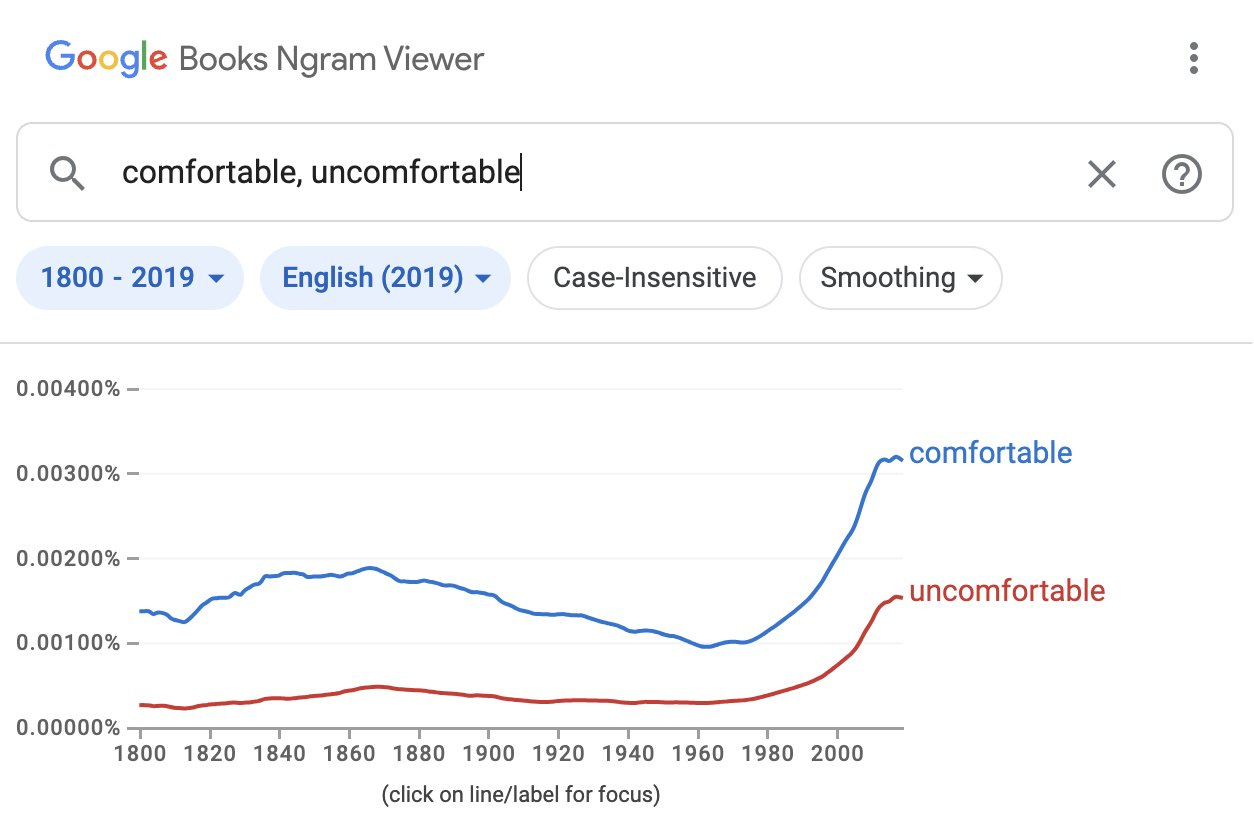
We increasingly care too much about comfort versus other things. But that’s peaked?

From November 2022 (!), 1 in 4 hiring managers said (he admit it!) they’re less likely to move forward with Jewish applicants.

When asked why they are less likely to move forward with Jewish applicants, the top reasons include Jews have too much power and control (38%), claim to be the ‘chosen people’ (38%), and have too much wealth (35%).

Seventeen percent of hiring managers say they have been told to not hire Jewish applicants by company leadership. This is true of more hiring managers in education (30%), entertainment (28%), and business (26%).

And that’s with it improving!

Nine percent of hiring managers say they have a less favorable attitude toward Jews now than 5 years ago, while 31% say they think more favorably of Jews; 60% say their attitude is unchanged.

So yeah, antisemitism was already quite alive and well, all the standard tropes. If anything, that’s still historically pretty good. We have been dealing with this for several millennia. In every generation they try to kill us. We all know Hamas aim at another holocaust. Some people were surprised at who joined the ‘they’ this time, that’s all. I wasn’t.

Sarah Constantin on various reasons she sometimes feels she can’t say various things.

US high skill immigration policy has figured out it can use the O-1A visa for extraordinary ability and also the STEM EB-2 for advanced STEM degrees.

Alec Stapp: Major win for the US on high-skilled immigration policy: “USCIS data show that the number of O-1A visas awarded in the first year of the revised guidance jumped by almost 30% The number of STEM EB-2 visas after a ‘national interest’ waiver shot up by 55%”

If you have an advanced STEM degree and want to put it to work, or have any valuable extraordinary ability, it seems rather insane to not let you come to America and become a citizen. I strongly support doing as much of this as possible.

The rest of the world standardized, but the USA and Canada have their own exclusive standard for elevators, excluding us from global parts markets.

State Farm stops writing new home insurance policies in California due to legal inability to raise prices and massive resulting losses. If you could be stuck selling insurance at or close to current prices indefinitely while facing adverse selection over customers, I don’t see how you can sell insurance priced in a reasonable way.

Federal highway officials hate us, tell local and state officials they must stop using humor and pop culture references on their road safety signs because they might ‘distract.’ That’s the point. You get people to pay attention. Also you brighten up their day. I sincerely despise people who issue rules like this. How do we fight back?

The Farm Bill is mostly subsidized crop insurance. Taxpayers cover 62% of premiums. Which is profitable enough for the farmers that it forces farmers to make decisions that are legible to the insurance, often preventing them from being flexible and adapting to weather conditions or doing proper crop rotations.

This is of course an utterly insane way to do some combination of lowering food prices (which we then try to raise with other programs, and lower again with yet others) and transferring wealth to farmers. It should be up to them how much and what type of insurance to buy. If we want to bribe farmers because we think that’s in our interest to do so or we want to be corrupt, let’s write some checks (or at least give out tax credits) and bribe farmers.

At least it’s not as bad as the part where we also pay people not to plant crops.

Agreed with retiring congressman Patrick McHenry, we need to pay Congress more. I think it was Robin Hanson who I saw say that either you pay them or someone else will pay them, you get to pick which one.

As was inevitable, meet the new Speaker, same as the old Speaker, cutting the same spending deal because of the same conditions, and the same people getting mad about it. Question is what they dare do about it at this point.

California Fatburger manager trims hours, eliminates vacation days and raises menu prices in anticipation of $20/hour fast food minimum wage. That seems like a best case scenario, unless the goal is to make fast food uncompetitive.

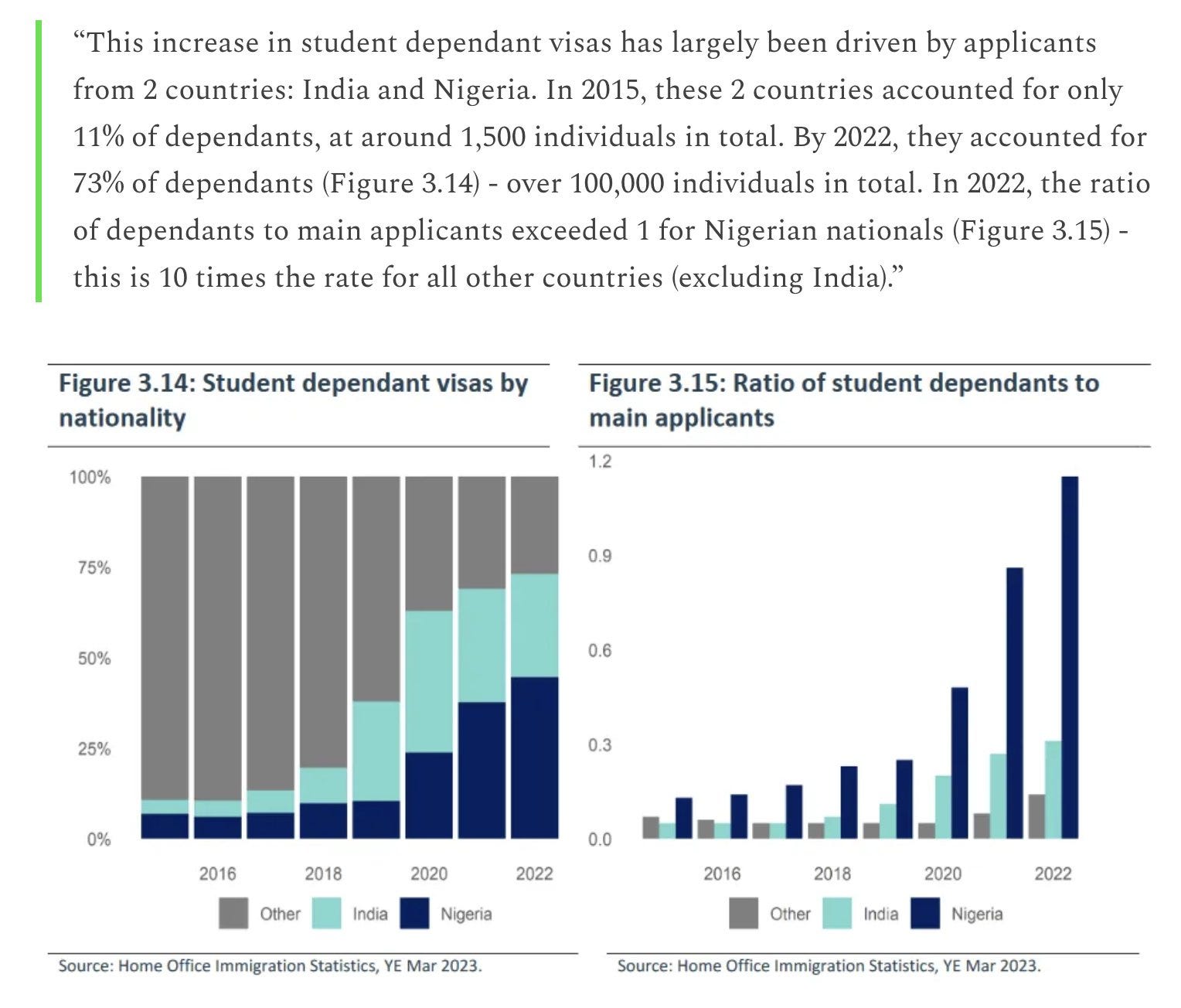
UK moves to exclude family members from coming in on student visas. The usual suspects pointed out how this is going to discourage students from coming. Nathan Young points out that this is one of those ‘ruining it for everyone’ situations.

The chart clearly shows that this was rapidly transforming into a backdoor immigration mechanism. If the situation is what it was in 2015, something like ‘5% of students take someone along because they need to,’ then you want to allow that. If the ratio starts exceeding 100%, then the policy is being gamed so much it is clearly unsustainable. If you want to allow more immigration, great, but you still do not want to give active preference to those who twist their lives to game the system.

UK’s lawyers advised the government that it was unable to legally discriminate against companies on the basis of their past performance.

Nathan Young: This is disastrous. The UK Government can’t discriminate based on performance. What on earth are we even doing?

Vegard Beyer: Aren’t the rules governing the UK Government’s discrimination between contractors based on past performance… within the sphere of influence of the UK Government…?

Nathan Young: I wouldn’t want to discriminate on past performance so I’m sure they’ll fix it this year.

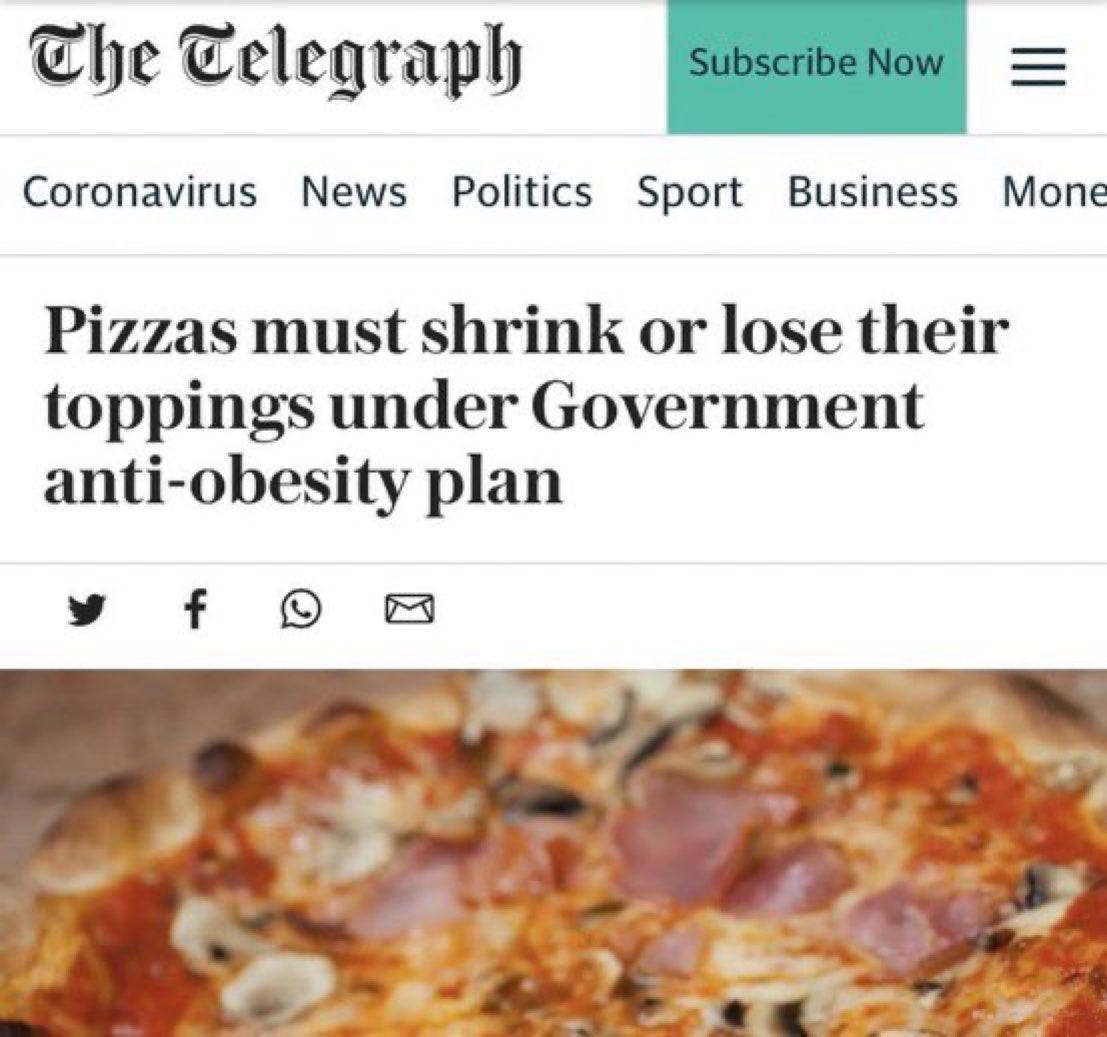
UK decides what is important to crack down upon.

Emmett Shear: We’re shutting you down. Your pizzas have consistently come in 1/2” too wide, and we have caught you five times distributing excess pepperonis.

Biggest surprise is that this is a UK pizza photo where the pizza looks edible.

Well, that and any productive activity whatsoever, like renewable energy.

In the past five years, the number of applications to connect to the electricity grid — many of them for solar energy generation and storage — has increased tenfold, with waits of up to 15 years. The underinvestment is restricting the flow of cheap energy from Scottish wind farms to population centers in England and adding to the delays for those with high power needs, like laboratories and factories. Laws that give local planning authorities considerable power are blamed for Britain’s shortage of housing and blocking the construction of pylons needed to carry electricity from offshore wind farms. Residents’ objections to noisy construction and changes to the landscapes have been a stumbling block.

One way the British government turned off investors was by changing planning measures in 2015, and tightening them further in 2018, so that a single objection could upend a planning application — effectively banning onshore wind in England. John Fairlie was a consultant in the wind industry at the time.

Mr. Fairlie is currently a managing director at AWGroup, a land development and renewable energy company that recently got an onshore wind turbine up and running in Bedfordshire, in the east of England, that will generate enough electricity to power 2,500 homes. Because of planning restrictions and grid connection delays, the project took seven years to complete.

It is amazing, and a statement about the expected returns to investment, that such projects still continue at all. Imagine what the UK could accomplish if people were allowed to build houses and generate energy, even if nothing else changed.

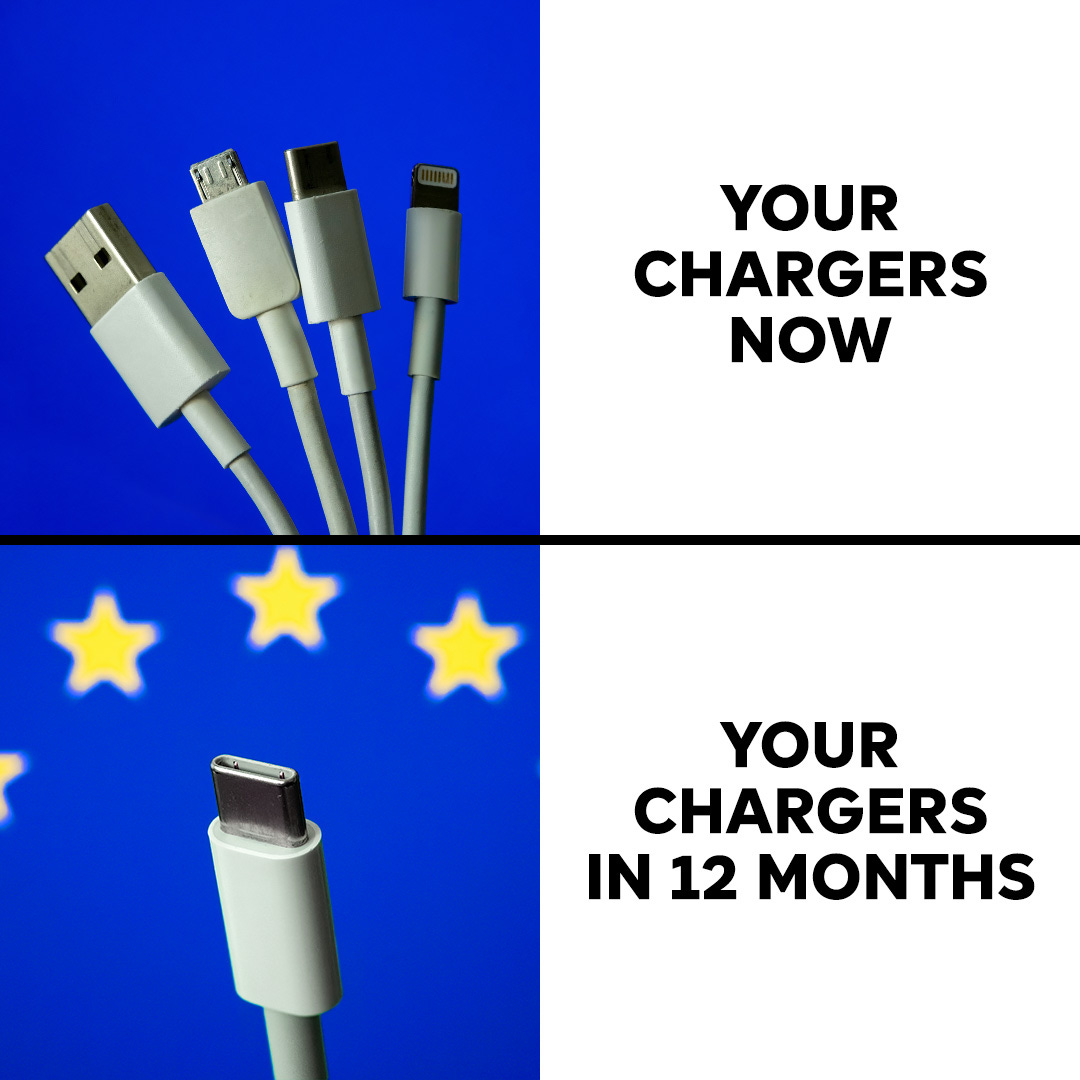
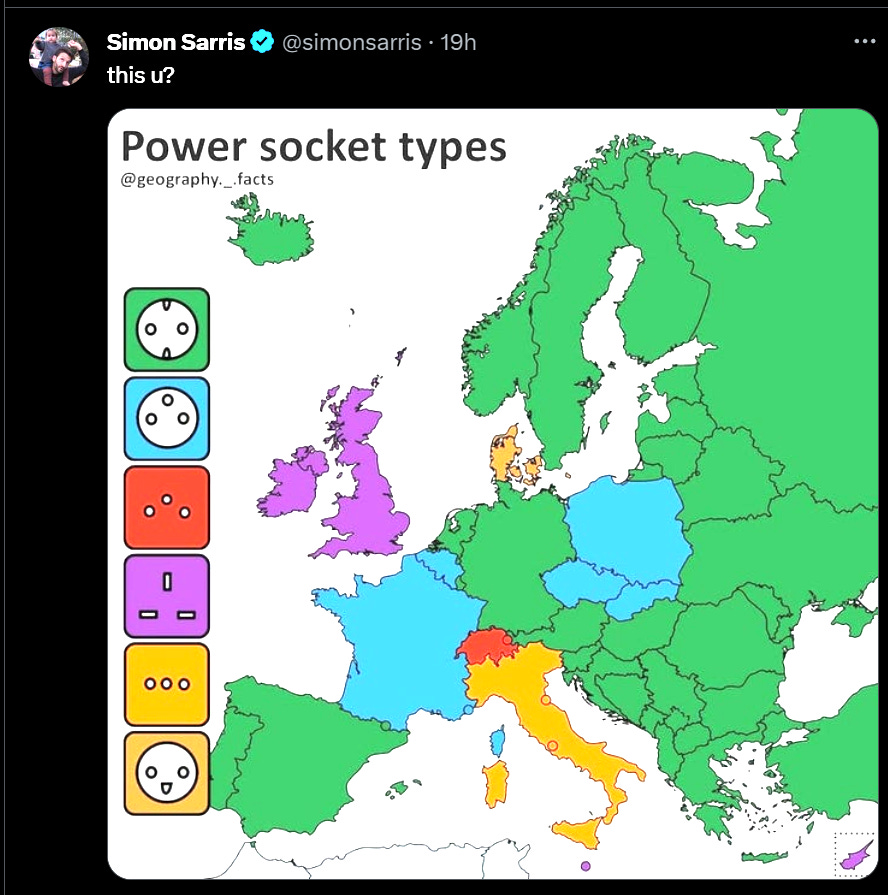
Ah, standard plugs.

European Parliment: From 28 December 2024 all mobile phones, tablets and cameras sold in the EU will be equipped with a standard USB Type-C charging port, making it easier for you and better for the environment.

How do they think that works exactly? In twelve months I get rid of all my existing devices? I note all the concerns about ‘what if they had done this five years ago with micro-USB’ and if a new better tech comes along in the future, and yeah, sure, but I’m still inclined to say Worth It at this point.

Also:

The map is full of little joys, like Cyprus being in purple.

It is insane that we are not doing our job of protecting international trade. A bunch of rebels shoot a few missiles, and we can’t stop them? We take weeks to even start responding?

There is a list of things you absolutely do not tolerate as leader of the free world. Disrupting international trade routes is near the top of that list. That’s the job.

Don’t tell me we can’t handle it. Point, counterpoint:

Almutawakkil: I advise Americans and British people to familiarize themselves with some points about the Yemeni fighters ( Houthis) before rushing into anything.

– They don’t follow your movies and TV shows at all.

– They are not bothered by your media or social media distractions.

– Psychological warfare is utterly useless against them.

– They are natural-born fighters, really, no kidding.

– Their life goal since childhood has been to fight America.

– The last will and testament passed down from their ancestors is to liberate Palestine.

– At the very least, they have 4 to 5 wars of military experience in various terrains.

– They have all written and recorded their life wills in both audio and video formats.

– The martyrdom of one of them is a tremendous source of pride for their children, family, village, province, and country.

– Their poets passionately glorify war more than any love, flirtation, or romance poetry.

– They all obey their leader, Abdul-Malik Badr al-Din al-Houthi, with absolute obedience.

– Their only fear is the punishment and wrath of Allah if they fail to support the people of Palestine and backtrack on their support.

– They love death as much as you love life, if not more.

In any confrontation they engage in… I won’t explain these words… you will come to know, understand, and feel them more when facing them.

Frank Fleming: I advise foreign countries to familiarize themselves with some points about United States citizens (Americans) before rushing into anything.

– They enjoy multiple streaming services.

– Each day they get worked up and outraged by something on social media that would be impossible to explain to you.

– Psychological warfare works really well on them but only for a few seconds before they get distracted by something else.

– They probably have no idea where your country is and maybe have never even heard of it.

– Their life goal since childhood is to be a popular influencer.

– The last will and testament passed down from their ancestors is to prefect their BBQ recipe.

– At the very least, they can walk up two flights of stairs before being winded. – They have 401ks, but probably not enough in them.

– Getting a post to go viral is an extensive source of pride among their community.

– Their poets passionately glorify getting superpowers and fighting supervillains.

– They only elect the dumbest idiots as leaders and never listen to them.

– Their only fear is their phone running out of power when they’re away from home.

– The only reason their enemies are still around is it feels unChristian to completely obliterate them.

In any confrontation they engage in… I won’t explain these words… you will come to know, understand, and feel lucky if your entire effort to fight against them merits you to even be a future question on Jeopardy!.

History is littered with tribes who studied nothing but war wiped about effeminate guys in white wigs. If you want to defeat America, learn to code or something.

There was a time, for thousands of years, when ‘we do nothing but fight for generations’ was the way to go to win wars. When the dudes on horseback periodically sacked the cities and became the new ruling class. When it was said, as in the end of Herodotus, let us live somewhere hard so we might win wars.

Now, not so much. I may not be ‘appreciating the complexities’ but if I am Biden I get on the phone, explain that either shipping is going to resume or there are not going to be any more rebels, as an example to the next ten generations, and I mean what I am saying.

We did not go that far. We did eventually start using force.

Bret Devereaux: There is a sort of performative naivete for the folks acting shocked, shocked! that it turns out that disrupting more than 10% of all global trade does, in fact, lead to a kinetic military response. Of course it did.

And just a reminder for the folks who think this is about Israel – the Houthis have been firing on ships indiscriminately. If they were just attacking ships bound to or from Israel, I doubt we’d see the same level of response.

You do not get to pirate ships chartered by Japanese companies to move from Turkey to India because you are mad about Israel. You don’t get to try to seize Danish ships moving from Singapore to Egypt because you are mad about Israel.

Or, well, you can, but then this happens.

I continue to be surprised and dismayed that we have not done more. The situation is completely unacceptable. Anyone who has an issue with using force to stop pirates, or thinks that the actions of unrelated nations could possibly excuse it whatever you think of those actions, can go to Davey Jones’s Locker.

It does seem that on the 22nd we did another set of airstrikes. This still does not seem to appreciate the stakes:

Jim Bianco: ~70% of all shipping is conducted on a long-term contract. A cargo ship is essentially a shuttle between ports. If they have to go around Africa, that adds 20+ days to the route.

So, if a ship can make six runs yearly, the extra distance means it can only do four or five runs yearly under current conditions.

To make up for this shortfall of runs, excess shipping capacity is contracted on the “spot” market. This chart shows worldwide “spot” rates are up 85% in the last two weeks, the largest two-week jump (bottom panel) since Drewey started its index in 2011.

Shippers are aggressively grabbing excess shipping capacity and will pay up big to do it.

The objective of the military action against the Houthis is to allow unarmed commercial ships to sail the Red Sea with affordable “war insurance” rates. These rates are up 300% to 500%.

I FEAR we are weeks or months away from commercial shipping returning to normal in the Red Sea. Until then, supply chains remain snarled, and the inflation pressure on goods is very real.

Meanwhile, the propaganda wars got weird. Why are we having propaganda wars where one side are literal pirates? How is this a call people are in doubt about?

Daniel Eth: Describe the last 500 years of great power conflict in a tweet:

Kane: the funniest part of the red sea houthi pirate conflict is that the pirates keep posting super macho propaganda videos only to be annihilated while the captain of the carrier doing the annihilating is just tweeting about cute dogs and stuff

Chowdah Hill: This captain only loves me for the snax. I was hoping for a more productive working relationship, perhaps a few team ups or something. Instead… just snax.

There are those here who are cheering on the rebels for trying to disrupt shipping. These people are enemies of civilization and of humanity. Treat them accordingly.

Periodic reminder: The rate of rape in prison is almost 5% per year, the majority of sexual abuse reports were of rapes by staff rather than other prisoners. It is pretty stunning that we all continue to accept this as part of our justice system.

If someone is indeed saying this (the video won’t load), many things have gone very wrong.

EndWokeness: Canadian police warn residents not to post photos of thugs stealing packages.

“You cannot post the images… we have a presumption of innocence & posting that could be a violation of private life” -Comms Officer Lt. Benoit Richard

If the police are unwilling to do their jobs and arrest people who steal, as often the police are unwilling to bother to do, the least they can do is not actively get in the way. You have a presumption of innocence in court, and only in court. Even if that was not true, a presumption of innocence does not mean no one can accuse you, and no one can post evidence. That is completely absurd. As is any ‘expectation of privacy’ while stealing a package off someone else’s private property.

Poor people commit more crimes. Alex Tabarrok asks, why? He points to a Swedish study by Cesarini et al, studying lottery winners there. Winning the Swedish lottery does not substantially decrease crime despite it paying out over time and looking a lot like a permanent income shock. This continues the pattern of lottery winners proving largely unable to use their money to get better life outcomes. I do not think it translates zero to other questions, but lottery winnings being very clearly luck and happening all at once I do think makes them categorically different.

The cost of crime is high, even when it does not happen to you.

Audrey (of San Francisco): I used to take dance classes at a studio on Market st 3-5 times a week. I was perplexed by people who would pay $25 for a 50min yoga class when a 90min ballet or jazz class with live music cost $9. I would usually jog there and walk back, but then the area got more sketchy so I started to call Ubers there (which made the yoga classes comparable in price).

Then the area got SO scary I basically go 0-1x a week (to just one ballet class during weekend day time since the instructor is dear to me). Meanwhile the building put metal over their glass doors and now has at least two people to guard the door and manager elevator.

I can’t imagine how hard this is for the dance studio to need to spend more money for building security and have fewer dancers come. I am also begrudgingly taking more yoga classes that are boring and expensive because I can walk there and back without having to dodge needles and people on some horrible drug shrieking and violently flailing around.

Nix: I think I know this dance studio… stopped going for same reason. The side street was so rough especially as it got dark (like people screaming etc)

I pay a huge portion of my discretionary income so my family can live in New York City. If crime was the way it was when I was growing up, my willingness to pay that would go way, way down. Luckily, things are much better.

Illinois eliminates cash bail. It seems the plan is to not charge bail, hope everyone shows up anyway and that it will all work out?

George Washington University law professor Kate Weisburd said in other states that have implemented bail reforms, like California and Texas, the use of ankle monitors has gone up while jail populations decreased. She said an increased reliance on monitoring isn’t “moving the ball forward when it comes to pretrial justice.”

“I think what makes the [Illinois law] so powerful is that judges are required to release people who are deemed not to be a safety risk and not likely to flee,” Weisburd said. “So that means that most people released under this new law don’t need to have an electronic monitor, because they’re not a safety risk, and they’re not a flight risk.”

I notice I am confused. How is going from ‘put you in jail’ to ‘have you wear an ankle bracelet’ not ‘moving the ball forward?’ That seems like moving the ball forward to me. Wearing an ankle bracelet is at least an order of magnitude less bad than being held in jail? I would say at least two? And for many people, far better than paying the bond to post bail even if they could? I mean, you could pay me to wear an ankle bracelet and it would not even be that expensive.

As always, people confuse ‘not available’ with ‘not available at this price’:

Garrison said even if they had more money, there aren’t attorneys available to hire. Macoupin County is part of Illinois’4th Judicial District. It includes 41 counties in central Illinois. This year, only 55 new lawyers were sworn in in the 4th District, fewer than 112 attorneys per county.

There are tons of lawyers, by all accounts, who are in need of work. AI will likely streamline much legal work further, expanding that pool. Do these people want to go to Macoupin Country to work with criminal defendants? No, mostly they do not want to do that. Also, if you raise your price, some of them will do it anyway.

RCTs on interventions in criminal justice almost always show no benefit. The obvious follow-up is, suppose we did anti-interventions, would we expect to see no harm?

What happened when judges were given algorithmic risk assessments on defendants, while still having discretion to make final decisions on sentencing?

Megan Stevenson (paper author): We find that the judges DO use the risk assessment tools, but mostly only during the first couple of years after adoption. After that, they seem to stop consulting them.

But even in high-use periods, they overrode the recommendations associated with the risk assessment frequently!

Although the risk assessment was implemented solely for the purpose of diverting people from prison, it had no effect on incarceration rates.

There are some curious expectations at play here. Megan seems surprised that judges frequently ‘overrode’ the recommendations, despite the recommendations being based on only a subset of the factors judges care about and considering only some of the evidence, and also judges being humans who think they know better.

Megan also seems surprised overall sentences stayed the same. Whereas of course judges are not going to think risk assessments should alter how tough they are on crime. Good job judges making the proper calibration adjustments. Yes, if you say some people are low risk hoping those people go to jail less, the ones it says are high risk will then be put in jail more.

Megan Stevenson: Below, we compare the *actualimpact of risk assessment in the hands of humans to the *simulatedimpact of sentencing by risk assessment alone (no discretion). [shows graph with no impact on average length of sentence]

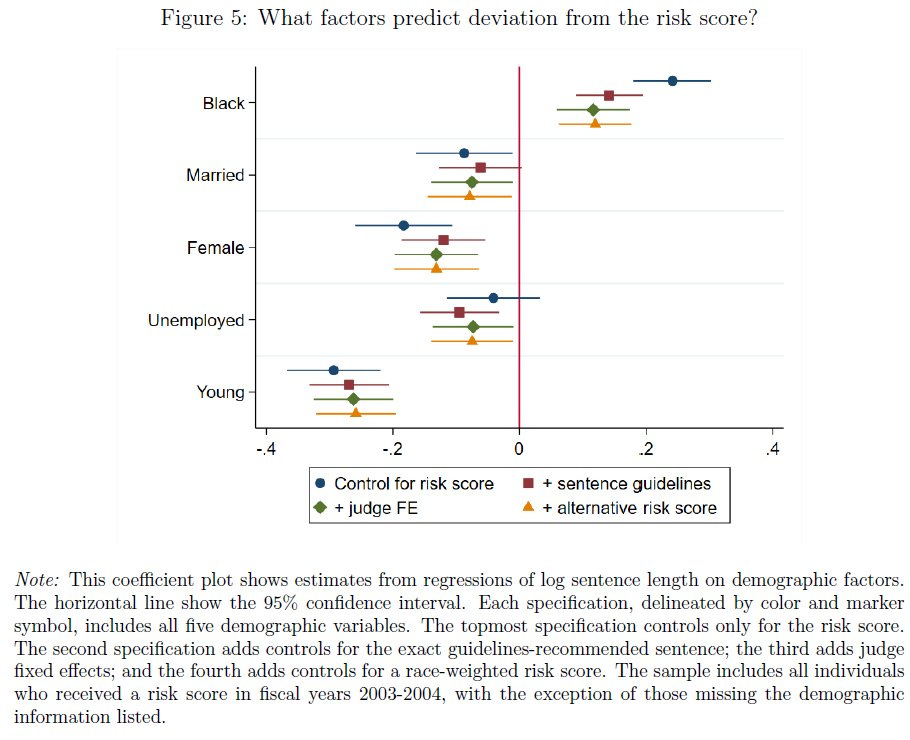
Deviation from the recommendations of the algorithm is systematic: longer sentences for Black defendants and shorter sentences for young defendants.

Risk assessment had not impact on racial disparities, likely because judges already sentenced in a racially disparate manner. It led to harsher punishment for young defendants — but human discretion mitigated the full negative impacts on young people!

I read this as: Judges care about things your risk assessment does not. They think younger people, and women, deserve consideration, for reasons that are not about risk.

Not sure what the story is here regarding unemployed? If I had to guess, the judges noticed (consciously and systematically, or otherwise) that the risk assessments made unemployed people very high risk, and did not think that was equitable or something they should get punished for so much, so they scaled it back.

What about black defendants? Certainly there is some amount of racism involved. There is also the possibility that the risk assessments deliberately ignored or controlled for various factors to correct for racial disparities or ensure equities, and the judges learned to correct for this or simply observed the facts and overruled.

Stevenson is framing this as ‘we had a risk score, and they overruled it.’ I am confident the judges instead were thinking ‘ah, good, a risk score, we can try using this as one of our considerations.’

If you thought this could convince a system to stop being racist, or stop putting people in prison so often, I would wonder why one would expect that to stick?

Instead, the risk scores worked in doing the thing one would hope, which is moving incarceration from those with low risk scores to those with high risk scores.

In sum, risk assessment use in the hands of humans led to a reshuffling of prison beds — no net decline, but a shift towards incarcerating those with higher risk scores and releasing those with lower scores.

And yet, this didn’t work?

Theoretically, this should have led to lower recidivism rates, since the highest risk people were locked up. This did not happen. We can reject even small declines in recidivism.

So what is going on there?

Why not? Maybe the tool had less novel information than expected. Maybe judge’s used it in the “wrong” way, over-riding it when they shouldn’t.

The tool meant more emphasis on the factors considered by the tool, excepting those undone intentionally by the judges, and less emphasis on other factors. Yet this did not help.

I find the ‘over-riding it when they shouldn’t’ hypothesis unconvincing. The model predicts that things should have improved given these choices. Things did not improve. Judges would have to be doing far worse than random, in terms of recidivism, in deciding when to overrule.

But “wrong” is subjective. If the only goal is preventing crime via incapacitation, teenagers should get the longest sentences. Young people are by FAR at the highest statistical risk of crime.

But there are lots of goals at sentencing. And many people — Virginia judges included — don’t love the idea of harsh punishment for teenagers.

In Virginia, discretion mitigated some of the adverse effects of risk assessment (harsh sentences for the young) at the expense of its benefits (reduced incarceration/recidivism).

Quite so. This is certainly a reason to expect judge final decisions to score worse than the algorithm on risk alone. But it would still predict that, given you saw a shift in who got sentenced from low risk to high risk, an improvement in results.

So the algorithm has some explaining to do. Why were judges unable to improve the production possibilities frontier?

Why did the judges ultimately decide the scores were not useful? Notice that they were correct about this.

To be useful, a risk score has to tell the judge something they do not already know. So we’d need to look at what makes up the scores. What is the new information?

Adam Grant suggests: “I’m giving you these comments because I have very high expectations for you, and I’m confident you can reach them. I’m trying to coach you. I’m trying to help you.” Then you give them the feedback. Love it.

Wind turbines are friendlier to birds than oil and gas drilling, purely in terms of directly damaging wildlife. And of course they are four (yes, 4) orders of magnitude less deadly than cats. A sane civilization would have a blanket ‘no you do not get to say what about the birds’ rule in place, certainly not if the particular bird is not endangered.

Claim that solar power and energy storage will eat all other power sources and reach total dominance. Certainly if you continue on an exponential for long enough that is what will happen. Predicting total dominance is a much better prediction than the continuous official predictions of linear increase every year.

Cost per hour for various digital media. Essentially all TV and video subscriptions are bargains for the average user, as is Twitter. The only issue is that this makes us unwilling to pay for the movies and shows we actually want if they’re not included, I am learning to stop doing that but it is tough. Games he treats strangely, with $60/game and also assuming very long play times. Games are reliably a bargain if you like them, the trick is finding the right games for you. That’s true for basically everything here. The real cost is always your time.

The Puritans would one-box in Newcomb’s Problem. So what if the decision on whether you are Elect has already been made and what you do now can’t change that? Have a good enough decision theory to do your best anyway. Generalize this!

Suhail notes a curious effect.

Suhail: One thing I’ve noticed that drastically reduces my screen time is not allowing my phone to be in the same room as I sleep. Unsurprisingly it’s the first thing I’ll reach for and I’ll clock in 30-45 min. What’s been surprising is how much less I’ll reach for it throughout the day.

The other benefit is it protects my mind. It’s subtle but if I read a tweet, news article, etc I’ll start thinking about it. If I wake up to my own thoughts, I find those thoughts far more satisfying to begin the day. Maybe it’s a personal thing or a project I was working on.

Everyone gives the ‘don’t have your phone there’ advice and almost no one follows it. I do believe I have gotten pretty good at not actually using the phone while it is there without a good reason, but there is a clear effect where doing that still requires effort. The part that is interesting is that he reports this also helping throughout the day.

Note that ‘out of the room’ need not be literal. Technically my computer and work area are within the bedroom. Leaving the phone there would be distant enough for me.

Emmett Shear threads on agency and how to cultivate or teach it. A key suggestion is ‘write down the dumbest plan that could possibly work’ to avoid having to find a plan that will work, and still verifying that your efforts could, somehow, end up working. Other good questions include ‘what’s the stupidest easiest one thing you could do to make even a little progress?’ ‘What if it was possible? What might be a good first step?’ and ‘It sounds like you’re sure you won’t succeed, what’s going on with that?’

He says agency is a complex skill. In some ways it is. In other ways it is simple. Or, it is functionally complex, but conceptually simple.

Modern elevators have overlapping failsafes. If the cable snaps, then most of the brakes would have to fail, and even then compression of air and the springs at the bottom should mostly prevent injury from a freefall.

JOMO, the Washington Post says, is the Joy of Missing Out, and you should cultivate it more. I was ready for a historically bad take. Then I got a good one, which is that ‘missing out’ on social media in particular is good, go live your life. You want to fear missing out on real activities, especially in person. You want the joy of not looking at your phone.

Bernie Sanders again quoting the claim “63% of Americans do not have $500 in the bank to pay for an emergency healthcare bill.” The good news is that this is obviously false. Median household net worth is $192k including $8k in checking.

Rampant corruption in Chinese military procurement led to purge of army, Bloomberg says, with missiles filled with water instead of fuel.

NPR reporter fired for ‘offensive’ stand-up jokes, was forcibly rehired because arbiter decided jokes were funny.

This seems true, and I have occasionally done this:

Paul Graham: A lot of essay writing is not so much telling people new things as helping them to reach conclusions they were already 90% of the way to themselves. It’s easy for an uncharitable reader to dismiss such essays as obvious.

That’s 90% true. And yet false; that last 10% is hard.

Nate Silver is optimistic about the new Las Vegas A’s.

I strongly agree with Tyler Cowen and his reasons that we want to keep sports teams playing within city centers. You want to encourage people to make trips to the city center. You want to enable people to combine trips to multiple locations. You want to allow easy transitions in and out of the stadium. You do not want to be locked into only the team’s offerings.

Location, location, location. All of this is vastly more important than a nominally nicer venue. I love Citi Field. It is an amazing ballpark. I would still happily prefer a lousy ballpark that was closer and within the heart of the city. And I would happily take the old lousy Shea Stadium over a Citi Field (or even the platonic ideal of a stadium) if the new place was not on a Subway line, or on a much less accessible subway line.

NBA in-season tournament is a big hit, everyone loves it. I agree that this is a great development and we need to see more things like this. If they never flop, we are not running enough experiments. What sports needs are storylines, stakes and motivation. With the expanded playoffs in every sport, if you don’t do anything to fix it, the regular season loses meaning. The NBA should also flat out reduce how many games they play, but there are understandable reasons they don’t.

NFL players go bankrupt at a constant rate regardless of how much money they earned over how many years. That is super weird to me. The amount of money really should matter, yet somehow it doesn’t? It is really hard to be that bad with money.

ESPN used fake names to get unearned Emmys for many of its stars, including those on College Gameday. It seems like what they actually did was get them Emmy-shaped physical statues which they never earned? Which is hilarious, also who cares. There is a very clear record of who did and did not earn one. An unearned trophy is nothing.

Ben Krauss calls for reform of sports betting, saying that the combination of mobile betting, aggressive notifications and other advertising tricks is increasingly causing big problems. It is a difficult balance to strike, but I agree things need to change. I actively like that College GameDay discusses point spreads and has someone making a few picks. I do not think it is fine that people are getting lots of in-game push notifications. Charles Barkley should not be able to, on television, offer ‘guaranteed parlays.’ Letting people bet on their phones is clearly dangerous at best. The balance is tricky.

One place the industry continuously offends me, that does not offend Ben Krauss as a purely casual gambler, is the prices. With the epic growth in gambling volumes, and the ability to bet in person with low transaction costs, we need to see a lot more competition on price. Alas, regulatory and advertising costs, and the cost of deposits and withdraws, are standing in the way. It is still insane and kind of criminal that ESPN is showing us truly obnoxious baseball lines that go -120/+100 or worse as if that is an acceptable thing to do.

As Seth Burn put it, math is not this hard.

Kirk Herbstreit: “I think the 12-team playoff is going to create a lot of buzz,” Herbstreit said on College GameDay. “How many games will that be, seven total?

“I think you eliminate the bowls,” Herbstreit added. “Nobody wants to play in them, don’t play the bowls. Just have the 12 teams—we’ll get excited about those—and if you want to add maybe five or six bowls outside of that, then do five or six. But we’re getting to a point where it’s ridiculous.

Kirk is actually pretty great both on GameDay and as one of the best full-spectrum play-by-play announcers. I agree that there are far too many bowls. You should only get a bowl if you accomplish something, which does not mean going 6-6. I think it would be fine to say you need either 8 wins, a conference title game or the top 25?

Tony Hawk one year made four million dollars off the Tony Hawk Pro Skater games.

Magic: The Gathering bans some cards. Channel Fireball’s LSV reacts. It is odd to read about such developments while this removed from the game.

Magic: The Gathering Arena introduces Timeless, their version of Vintage complete with original versions of all tabletop cards and an actual three-cards-only restricted list of Channel, Demonic Tutor and Tibalt’s Trickery.

Brilliant, passionate and scarily accurate thread from Cedric Phillips about what drives Magic players to attend tournaments. Decklists, feature matches, deck techs, chance to make your name, narratives and excitement, aspirational experiences, staying at top of the circuit. Not the prize money. Amazing points. Also someone hire this man please? He is very good at this sort of thing. Alas, I have nothing relevant for him to do.

I am not as down as he is on the importance of prize money, you need to give them that kind of hope too, especially if you want to let people turn fully pro. You also need enough to drive the proper attention and prestige, so they feel real. But what matters to people most is attention and prestige. Ben Seck confirms. Brian Kowal confirms. Sam Black confirms, was was never focused on asking for more money, but as he noted he made his money off content creation. LSV confirms that switching from aspirational to esports and entertainment was deadly, players need to think that could be them.

I continue to think Magic would get a huge ROI from a true return to form of the Pro Tour including very large prize pools. But to make it work, all the prestige stuff has to get knocked out of the park too.

Selling slots on a Magic Pro testing team for $300 is either way too much or way too little. The amount of labor and value here is intense. You’ll spend a lot of time with at least one dedicated pro. So either this is a sacred value that must be $0, or it is worth way more. I lean towards the latter. There was basically never a point at which I would have let someone I didn’t otherwise want onto my team this cheap, and I’d happily pay $300 for someone else to be handling all the logistics.

Crypto trader withdraws $25 million worth of ETH by spending it all on Magic: the Gathering cards that got handed to him in person. Patrick McKenzie is both offended as a geek and respects the genius of the move, where you buy an object you can move physically, using payments that look like product purchases, that then trades like a gold bar, without screaming ‘I am a gold bar.’

Advice to anyone building a new rogue deckbuilder is to not make it easy to assemble tiny decks, or to do something to seriously punish anyone who does it.

Jorbs reascends the Spire from scratch, going 80-3 on ascending over about 80 hours, with 3 additional losses in act 4 for 70-6 (since the first three runs weren’t allowed access to Act 4). One of the losses outside of act four (A17 Watcher) sounds clearly avoidable if not goofing around, the other two sound like whammies. He notes biggest difficulty spike was losing third potion slot, other notables are Ascender’s Bane, gold hits and worse events. He didn’t much notice stronger enemies, whereas I do notice, he notes that is likely a reflection of how he builds. He also notes he had fun playing janky decks that don’t work on A20. As he noticed right in his first run, the problem with such runs is that you spend a lot of time going through motions of runs you’ve already won, which is also the issue with many daily climbs.

Interview with Jonathan Rodgers, co-founder of Grinding Gear Games, about Path of Exile 2. He says that loot can only have value if it might have value to someone else, hence you must enable trade. I thought Diablo 3’s auction house proved the opposite, that if you allow trade then loot only has value that it holds in the marketplace, which means loot mostly has no value. The variance disappears, you can always trade for items that get the job done. Whereas if you are looting for yourself (e.g. Solo Self-Find, or at most a small group) and there is no fungibility, loot becomes more interesting.

I strongly agree with him to stop with the +2% modifiers, +20% or GTFO, you want to make sure everything each item does counts and you can feel it. I also agree on the power and necessity of the reset button, to strongly encourage everyone to start over.

I’m very much looking forward to Path of Exile 2. Path of Exile is far and away the best Action RPG of all time, and the only one I’d put in my Tier 1 of Must Play (I’d have considered putting Diablo 2 there, if Path of Exile didn’t exist, but it does.)

Exodus sounds like it’s going to have some cool things to do with time dilation.

Emmett Shear reminds us that if you are playing Street Fighter [2 Turbo, presumably] then the solution to the so-called ‘cheese’ moves that seem overpowered is not to ban them, it is to use them until someone shows you or figures out the counter, then everything is fine.

This works exactly because the game is well-designed, with good counters to every such move. If that was not true, this would fail. It also relies on having enough data to find the counter-moves, and enough practice to learn them, to get to the new equilibrium. It does genuinely ruin a different experience some people want. Keep those things in mind while generalizing.

China announces planned restrictions on video game monetization. They intend to ban daily log-in rewards, bonuses for first-time spenders, incentives for repeat 5spenders, not having a spending cap, offering loot boxes to minors, not letting items be purchased directly, and the auctioning off of game assets. Also unspent currency must be refunded at purchase price if a game shuts down.

Bravo. Mostly. I notice that there is a problem with Magic: The Gathering and other tradable or collectable card games. It would be nice to find a way to exempt sufficiently ‘real’ games. I presume Magic: The Gathering Arena and Modo can survive this in China, but it will be tricky. Emergents, had it survived, would have had to either leave China or radically change its economic system.

That is still a price I would be willing to pay. Gacha (I will always call this Gotcha in my head) and gambling games, and dopamine-based tricks like daily logins, are the bad money that drives out good due to how mobile customer acquisition works. Despite all the obvious reasons to be opposed, I think this is sufficiently good for human flourishing that I am fine with it.

Mahokenshi was a fun little game. I did a relaxed pace, no-information full-achievement run in about 15 hours. Think rogue deckbuilder, with a very small deck, on a hex grid with goodies and enemies, usually against a clock. I rank it Tier 3, worthwhile for fans of the genre, with two caveats. The first is that the game is not difficult. The other is that there is a huge lack of balance between the four characters or Samurai houses. One is very obviously busted, especially going for many challenges where you need to go fast. Then again, if you want the game to be more challenging, one way to do that is to say you have to rotate between the houses you can play, and then you can’t use the broken house (you’ll know which it is) once all four houses are unlocked.

Cobalt Core is a fun little roguelike deckbuilder in small doses, and it has its charm, but ultimately I can only put it at Tier 4. There is not enough variety in cards, strategies or enemies, you often know you’ve won a run before the first boss, there are severe balance issues and the game doesn’t encourage you to do challenging things, with the highest level being more ‘you randomly die easily’ than anything else and the game not gating anything behind playing on it. And it asks you to play way more games to unlock things than is reasonable. With some more work this could be Tier 3, but in its current state, diehards only. But did I have some fun? Sure.

I played a bunch of Backpack Hero. I wanted to like this game a lot, but ultimately can only classify it as Tier 4, for diehards only. I had fun with the core concepts. Alas, the balance was all off. It took quite a long time before I was in any danger of dying. When I occasionally did, it felt like carelessness, until I moved to secondary characters that had it much harder, were far more fiddly, and that I enjoyed less. You had to do a lot of runs before things unlocked properly. The powerful things are stupidly powerful, many options seem highly under-developed. The first two heroes are straightforward and fun at their core, the next two felt fiddly and not fun.

Octopath Traveler II is my current game, so I don’t yet know if they stick the landing (I’m wrapping up the first few of the individual stories now with the main party around level 51), although other reviews hint that it does. The first game didn’t lay sufficient groundwork for the real ending, whereas I am pretty sure I know more or less where the second one is going. Did you like Octopath Traveler? This is more of it, seems to be improved around many margins. There are a few places where one could reasonably say ‘are we really doing this again?’ and yes you are doing it again but that is mostly fine. It is impressive how the whole is greater than the sum of its parts. The flipping between stories makes them work. You do have to be in for a long journey. My guess is this is on pace to be Tier 3 but fighting for Tier 2.

Waymo crash data shows only three injuries in seven million miles, all minor, much lower rates than you expect with human drivers. They only generate 25% as many insurance claims as human drivers and generated zero injury claims. This does not tell us much yet about fatal crashes since those are one every 100 million miles, and tail risk could be different if there are weird failure modes, so the question is whether there are rare weird failure modes.

Not enough links? Astral Codex Ten’s monthly links are here, only a few are things I’ve linked to here or otherwise.

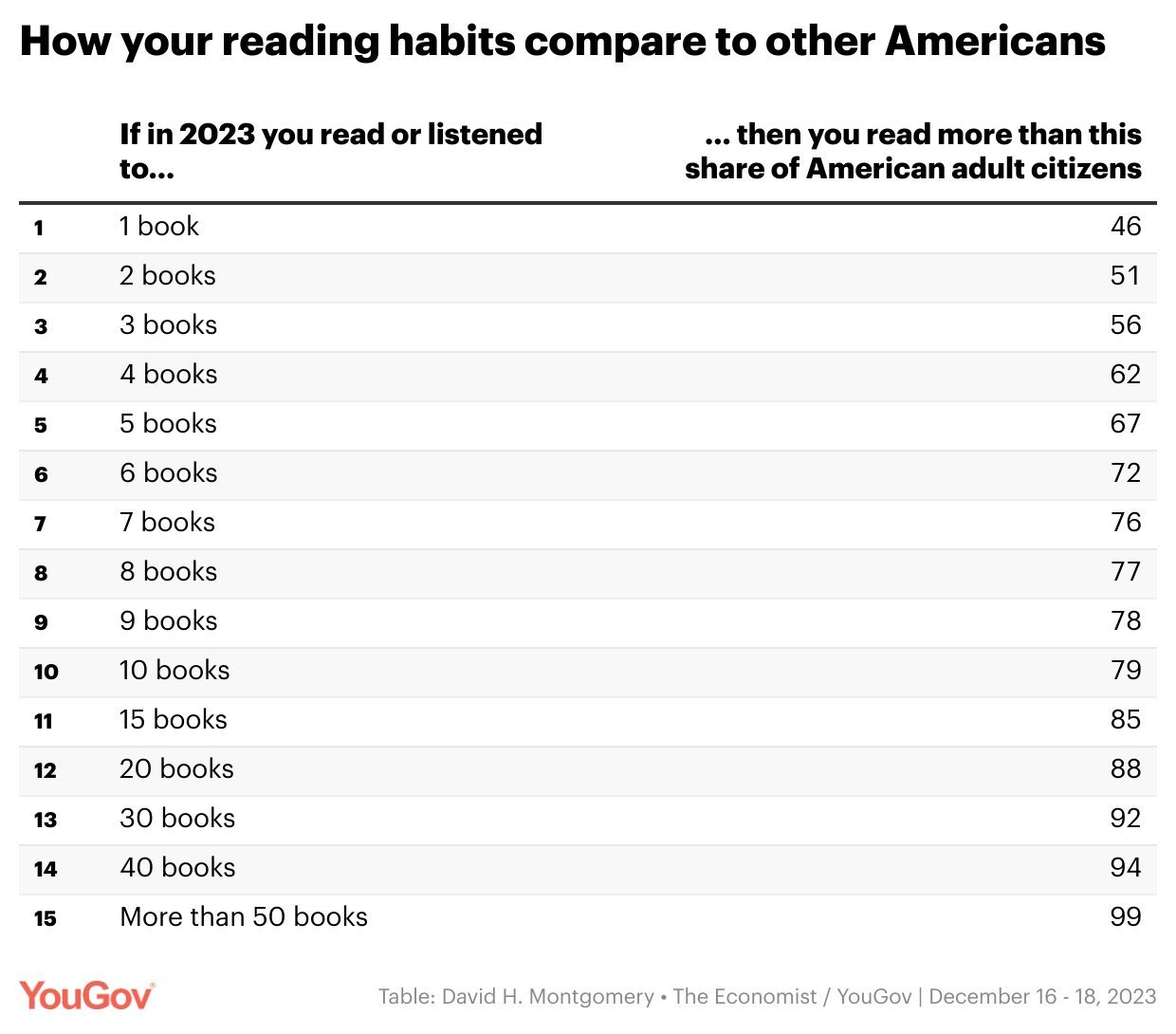
Americans do not read many books. Even listened to counts here.

It makes sense to me that not many people read exactly one book in a year. Once you’ve read one, about half the time you’ll read more than six, and half of that time you’ll read more than fifteen.

A fun study found via MR of how long chocolates last in hospitals. This is one case where it should have reversed its final statement and said ‘further study is not needed.’

I had a whole Christopher Alexander sequence planned before AI happened. There’s so much good stuff there, I am still glad I read A Pattern Language.

Made in Cosmos: Christopher Alexander is so wild. 80% of his ideas about home design make me go “wow, how come I never thought about it before?”, and then he’ll randomly come up with something like putting guest alcoves in your master bedroom so that you can all have big sleepovers together.

Charlie Page: Are you saying that’s not a phenomenal idea? Master bedrooms are too big anyway.

Made in Cosmos: lol our entire apartment is probably the size of an average American master bedroom. I dream of a time we’ll have a bed that can be approached from both sides.

A Pattern Language is very clear that not every pattern fits into every house. You choose the patterns that have the most value to you, that fit your space and your life. Also yes, alcoves in the master bedroom are an awesome idea if you have a lot on which you can build a non-standard structure, and therefore can choose to add alcoves. Remarkably efficient use of space to generate optionality. As Cosmos notes, not applicable for everyone, but also it would be a very good way to get extra beds into a tiny footprint if that was your puzzle.

Is this the year?

Paul Graham: Prediction: Wokeness will recede significantly in 2024. There were always more people against it than there seemed, but many were afraid to say so. Now that it’s safer to criticize it, more will.

Manifold traders say 39%, which is pretty good for a substantial move in one direction.

I mostly tried this for a few years. In my job it didn’t take.

Paul Graham: I don’t think journalists or universities grasp how much their reputation has suffered, and that it’s due to their own intellectual dishonesty. A generation ago newspapers and universities were esteemed institutions. Now you see open contempt for them.

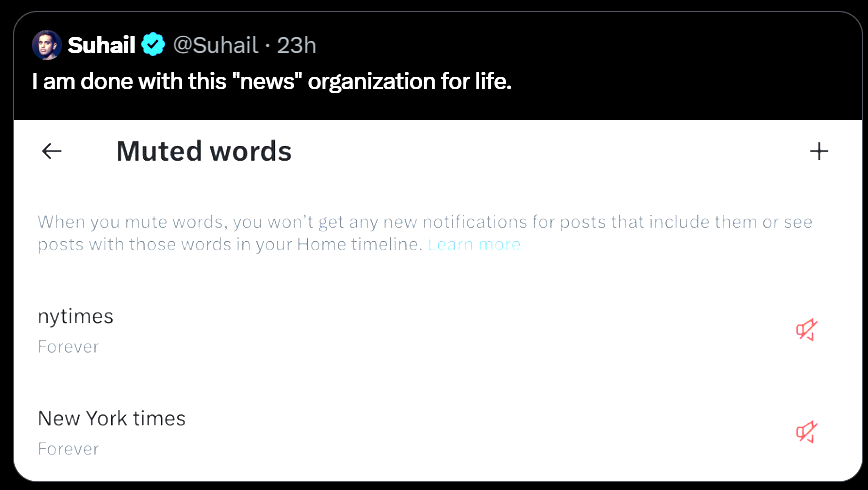
A journalist seeing Suhail’s tweet would presumably think “nutjobs are always saying things like that.” But Suhail is not a clueless extremist. Exactly the opposite. And yet is there any journalist in the world who can even see, let alone admit, that there’s a problem?

I mean, not quite the opposite. I’ve seen his views on AI. He does, from what I can tell, support building smarter than human intelligence as quickly as possible and letting it proliferate and thinks that would be good for us. He quoted his company’s written testimony to the House of Lords with pride, in which they commit outright fraud regarding the ‘integrity’ of their investment portfolio’s AI products, claiming we now understand such AI models. But definitely not a nutjob.

Amjad Masad (CEO Replit): Agreed, but what’s the alternative to find ground truth? I hoped Twitter/X + Community Notes + Free Speech + Transparency would be it. But it’s neither free nor transparent, and notes are easily gamed.

Paul Graham: One way is to follow people whose judgement you trust.

Andrej Dabrowski: It doesn’t scale though.

I disagree, Andrej. I think it scales fine. If everyone has a pool of people they trust, but is doing the work to adjust that pool to get it right, that absolutely scales. In my model, everyone has a ‘level’ (from 1-4 or so) of sense making production, and your goal is to follow people one level above you and those at your level, make sense of the worthy ones, and then make sense to those at or below your level in return.

Journalists used to be accepted into this as All-Level sources, without much question, in a way that rewarded reliability and allowed everyone to understand. Now they’ve lost the necessary faith in that institution. You need higher-level people you trust to be able to use Bounded Distrust on the outputs. Thank you for putting some of that trust in me, keep an eye and ensure I stay worthy of it.

Andrew Gelman reweighs himself on his bathroom scale 46 times to compute the standard error. I mention this partly because it is inherently cool, and partly to tell the story that you cannot do this on my bathroom scale. If you do, you will get an answer of zero. It will come back the same every time.

Is that because the scale is super accurate, or at worst off by a fixed amount? Oh, no. Nothing like that.

It is because someone decided that the scale should have memory. If it gives you 161.3, then it has decided that everything from about 160.9 to 161.7 is going to count as 161.3 for a while. You can even see it, sometimes, bouncing towards the ‘real’ number, then at the last moment it reverts to its baseline. So if you (for example) were to pick up something weighing 0.2 pounds before weighting yourself, then weigh yourself again without it, you’d get an answer 0.2 pounds higher than otherwise.

I am fascinated by who thought this was a desired behavior. Writing this inspired me to get a second scale, for now keeping both around because it is fascinating.

You want to complain? I want to complain about all your complaining. Or do I?

Owen Cyclops: There’s a culture divide you can go your whole life without pinpointing: groups where complaining is negative, and groups where complaining is a normal positive method of socializing. they cant understand each other. larger than a language gap. probably best if they never interact.

Emmet Shear: Games People Play names a bunch of these games, like “Wooden Leg” and “Ain’t It Awful.”

Lilibeth: I’ve found that the ones who don’t tend to thrive in the cultures of the ones who do. Mainly because they don’t know how good they have it, and so the ones who don’t can lap up all the good things. And thrive.

Ben Linzel: Those groups are called men and women and civilization is built around pairing them.

Emily: Been thinking about this all day with shame about my whole family’s complaining culture. So far I have not complained today and I’m going to try actively not to anymore. This tweet bodied me with embarrassment.

I would divide complainers into two key subcategories. One we could call the commiserators (or simply the complainers, or if you want to treat them with proper disdain rather than be even-handed, the whiners), the other the critiquers or the optimizers. The first group wants your social attention on the complaints they are making, the second group wants to fix the problem.

Then you can also divide the non-complainers. You have those who do not complain because they are in Guess Culture, and you have those who don’t complain because they choose to instead not expect their complaints to be heard, at least at this time. They don’t expect you to figure it out or tell you implicitly, they don’t ‘drop hints,’ they suck it up, do what needs to be done and keep things positive. The first group wants your attention on their complaints they aren’t making, the second group does not.

I love the culture where it is standard to critique and complain about everything in a good natured way. Magic: The Gathering culture is like that. When I was gambling it was like that. Rationalist culture is often like that.

Over time, I have also grown to appreciate the need, often, to prioritize a nice time and keeping things positive. You still need to strike a balance in a way that often doesn’t happen, where when it is sufficiently important you speak up. But yes, there is something pretty great about there being times and places to sit back and enjoy, and not be optimizing or complaining and not getting nerd sniped by everything.

There is also a time and place to enjoy a good rant, and loudly complain about how awful things are even if you don’t have a larger goal in mind. In small well-timed doses this is great. When people make it a habit or can’t stop or take it too seriously? Not so much.

There are also times when one must stop complaining because the social punishment would be too large, and find ways to indicate your information and preferences when you can. I hate this. The ‘upper classes’ seem to largely operate this way in most times and places, playing these comedies of manners, and I think this alone is bad enough that you mostly shouldn’t envy them. Their lives seem rather worse than mine.

I mean, I love it, too perfect, so even thought you’ve all seen it by now:

Gary Gensler (January 9): The @SECGov twitter account was compromised, and an unauthorized tweet was posted. The SEC has not approved the listing and trading of spot bitcoin exchange-traded products.

The ETFs were ultimately approved.

Vitalik Buterin offers financial advice, much of which many in crypto need to hear:

Vitalik Buterin: [not diversifying] is awful advice. Some actual financial advice:

Diversification is good.

Save. Get to the point where you have enough to cover multiple years of expenses. Financial safety is freedom.

Be boring with most of your portfolio.

Don’t use >2x leverage. Just don’t.

Nothing I ever say is investing advice, but I agree, especially about the leverage. I would add a general principle that one should not worry much about the details of things like diversification or ‘balancing.’ The point, once you have enough savings that it maters, is not to die on any one hill even if that hill is Nvidia. Or if that hill is cryptocurrency. I do not care how bullish you are, there is no reason to risk ruin.

We were promised a recession. Tyler Cowen reminds us of this, asks why we were promised one that then never arrived. As he notes, the correct response is to notice the confusion, not to sweep it under the rug or pretend you made a better prediction. Scott Sumner notes that this seems to be due to aggregate demand stubbornly refusing to fall. I did not predict a recession, but only because I did not make a prediction at all. No points.

My hypothesis is a little out there, and of course Cowen’s Third Law that all propositions about real interest rates being wrong applies, but my hypothesis is that this is not unrelated to AI.

Everyone keeps saying that expectations for AI should raise real interest rates. Well, what if they did raise real interest rates? Not a ton yet, but some. The mechanism is for now only a little bit productivity and consumption effects, although we do have a few areas like coding. It is mostly investment and the anticipation of future investment and opportunity and growth, leading to consumption smoothing and also greater willingness to borrow and such, and people who place bets on future rates impacting rates now. Real monetary policy is not a number like 5%, it is where the rate sits compared to its ‘natural’ setting, so it meant monetary policy was looser than it looked.

Congressman Sean Casten has a thread that explains some issues with banking regulations and the ‘inflation reduction act.’

The way the IRA works is that it declares some forms of investment related to climate ‘good’ so you get tax credits for them. Can you feel the inflation reduction? So that’s great, says Sean, because it means for every dollar in tax credits given out, you generate several dollars in investment activity. We pay $2, industry puts up $10 and we get $10 of windmill if and when it passes environmental reviews and isn’t stopped by the Jones Act.

Sometimes there will actually be a profitable windmill where they put up the same $10 they would have anyway and pocket the $2, but hey, that’s life, and they might do it bigger and faster. Not an obviously crazy strategy.

The problem is that the payment is in the form of tax credits rather than in the form of money. That means that if you are making money, you get paid money in the form of owing less money. But if you are not making money, and presumably need the money all the more, you get nothing. That’s by design. They could have written checks instead and didn’t.

Why didn’t we? Because a certain Senator threw a hissy fit over how it looked:

Sean Casten: Postscript because a few people have said that we fixed that with refundability / direct pay. The House version did that – but a certain Senator substantially limited its availability in exchange for his vote. Here’s to tax code (and Senate) inefficiency!

The good news is that banks can get you out of this. The bank invests in the project. As payment, instead of taking money, they take the tax credits, which are money to the bank because the bank owes taxes. So by rerouting banking capital to these projects, we allow the money we gave as tax credits to turn back into money, so everyone involved can feel like they kind of didn’t spend it, and it is only moderately convoluted.

But there is a problem. To do this, the bank must invest capital. We worry when banks invest capital, bank runs and solvency and all that, so we impose capital requirements on the banks before they can reroute our money that isn’t money back into money.

And the Basel III draft rules for how this works say that energy investments are four times ‘riskier’ than housing investments. They do this because there is greater risk in energy projects, much of it due to all the environmental and other regulations that could sink the project. And we are forcing the bank to take on that risk in order to facilitate the tax credit transfer, so it needs to account for that.

Oh no, Sean warns us. If we account for this risk by measuring it accurately, this will cripple the ability of banks to provide the capital, so we won’t be able to reconvert the tax credits. All because of this ‘oversight.’

None of this is an oversight. It is the result of negotiations and deliberate decisions. It would all be deeply funny if the stakes were lower.

Crypto has this issue where people keep getting their crypto stolen.

Crypto also has the problem where crypto people treat this as a marketing issue.

Approve infinity strikes again.

Do you think the user who just lost $4.4million will stay in crypto? Won’t he just sell everything and hate crypto after? It is so irresponsible to build on ERC-20 token standard, but with the current EVM, all token standards will fall to the same problems.

I say the responsibility here is not to the reputation and adaptation of crypto. It is to your users, whose money you want to not be stolen.

Nothing I say is ever investment advice, but we may have spotted Patrick McKenzie giving actual investment advice, and it is the best advice:

Patrick McKenzie: Almost all investment advice is written for people who cannot action the strategy “Choose to earn more.” My investment advice for most geeks begins with “Choose to earn more” and underlining that a lot, because NPV of your career and any optimization of that >>> your $ capital.

Read “cannot easily move the needle drastically” for “cannot choose to earn more” in above. A schoolteacher doesn’t have a static income but they don’t have nearly the dynamism of options available to the people this advice is for.

Thread occasioned by someone who asked for advice given particulars of personal situation which they felt rhymed with my life story.

In the my life story version, best investment in 2010 wasn’t Chipotle even though that was great. Best investment was quitting $40k salaryman job.

I strongly believe this as well, and have acted accordingly. Do something reasonable with your savings, there are various low-fee broad based ETFs available as a baseline option, and then focus on what matters. This holds until you have an extraordinarily large amount of savings relative to potential future earnings.

He also notes that a lot of people who believe that they need to worry about someone draining their bank account, and for the bank to refuse to fix the problem, whereas this is exceedingly rare. It is indeed weird that it is rare, and that we write our account numbers on every check and anyone with the account number can initiate arbitrary transfers out of the account. Somehow we do that, and we have a system on top of it that almost entirely prevents this from going wrong. It still baffles. And yeah, I’m still going to try to avoid putting my account number on various computer servers.

Pat Reginer: When I was in college someone stole my checkbook and used it to clear out my bank account. And then the bank… just gave me my money back. This has informed my intuitions about crypto.

A bold strategy, Cotton, let’s see if it works out:

Patrick McKenzie: The charmingly American healthcare experience of receiving a bill for $89 from a medical office you don’t recognize in a state you don’t live in for a service which sounds plausible but not actually remembered and wondering: scam, data entry error, or actual real bill?

So then you call them and of course that doesn’t work because why would a phone number on an invoice saying “If you have billing questions please call us.” actually result in reaching a human who can answer billing questions.

In Japan that would move the probability far, far towards “scam” but my general feeling is that it moves the probability precisely zero in America.

Anton: I stopped paying any bills that came by mail over a year ago and it’s had zero consequences. Any mail that isn’t obviously personal (hand written, addressed to me, from someone I know) immediately goes in the trash, i don’t even think about it.

“they’ll send it to collections, they’ll hit your credit score” – urban legend, never happened. “important! retain for your records!” – in the shredder with you, then the trash

I have explained to the mail carrier that they’re just creating waste but she refuses to listen to reason.

Anyone can send anyone else a bill for any amount, for any reason or no reason at all. If you don’t pay, they can keep sending the bill and potentially involve collections, again with or without any real reason to bill you for that amount. It is a strange system, or complete lack of a system.

In practical terms, Anton seems largely right. When you see a paper bill, if you do not think it is legitimate, and you ignore it, mostly all that happens is they keep sending you paper copies of the bill. There are exceptions if the size gets bigger, but mostly as far as I can tell they end up writing it off. Often they are ‘making the bill up’ in the sense that you did not agree to pay that amount, and sometimes it is entirely fake, and other times they also billed your insurance and paying the bill would be deeply stupid.

Meanwhile, every legitimate service I use that is not medical, to my knowledge, will bill me only electronically. Makes you think.

Tyler Cowen warns that with fertility on the decline, this could be the last chance for many countries to get rich. If they wait until their populations are in decline, they will face too many headwinds. The obvious response is that AI will change all that, whereas he only mentions AI as making it harder for low-wage economies to offer basic services such as call centers, which seems like such a minor part of the changes coming.

What frustrates me whenever I see such talk is that Tyler emphasizes that the causes of the trend, which he cites as reliable birth control and freedom for women, will not and should not be reversed. But then he does not call for other options or speak of potential interventions, instead he presumes this problem will go unsolved. There is a hell of a missing mood when you warn of countries failing to get rich, when what you are actually warning about is a dramatic and rapid fall in their populations.

Scott Sumner movie reviews for 2023 Q4. Such different worlds we live in. I’ve seen two movies here, Matchstick Men and The Sting. He given Matchstick Men a slightly higher rating, which is bold, but I suspect he is correct. I notice I am much more inspired to watch recent picks, and expect to enjoy similarly rated ones more.

For my own movie reviews, I have decided to try storing them at Letterboxd, with 10 movies so far. I am not claiming to be objective or correct in the way Sumner is. I am going to punish you if the movie is too slow developing, or is not pleasant to watch, although great is still great.

How I’m thinking about the scale:

5/5 is ‘drop what you are doing, see this and I will answer no questions’ and the only movie of 2023 that clearly qualifies is Across the Spiderverse, I think Barbie is my #2 and on the edge between 4.5 and 5.

My ‘Must See’ threshold is if something gets 4.5/5 stars, ideally this is also ‘see this and I will answer no questions’ but you don’t need to drop what you’re doing.

I think it is typically a good decision to see anything 3.5/5 or 4/5 as well. 3/5 is either inessential but fun, or has value but also downsides, and could go either way. A 2.5/5 means this is a subpar product but in the right mood or with a reason, and no better options, sure why not. A 2/5 means serious issues but there’s something there and it isn’t automatically a mistake. Below that, there isn’t, what are you doing, stop.

I notice that there are kind of two tracks, the ‘this is trying to be entertainment’ track and a ‘this is trying to be art or otherwise do something’ track. It is not the comedy/drama divide, although that is related. It is also related to Hollywood/independent, but again not the same and I can think of exceptions.

Of the 10 I saw recently, there were three excellent films that each got 4.5/5, and I can recommend them to any adult reading this: May/December, You Hurt My Feelings and Poor Things. I also gave 4/5 to Godzilla Minus One. I was relatively low on Anatomy of a Fall at 3.5, although I appreciated seeing a very different system in operation, and I was an outlier in the negative direction on Saltburn, which got the only 2.

Monthly Roundup #14: January 2024 Read More »
monthly-roundup-#13:-december-2023

Monthly Roundup #13: December 2023

I have not actually forgotten that the rest of the world exists. As usual, this is everything that wasn’t worth an entire post and is not being saved for any of the roundup post categories.

(Roundup post categories are currently AI, Medical and Health, Housing and Traffic, Dating, Childhood and Education, Fertility, Startups, and potentially NEPA and Clean Energy.)

Rebels from Yemen were firing on ships in the Red Sea, a problem dating back thousands of years. Here’s where we were on December 17, with the US government finally dropping the hammer.

Hidden fees exist, even when everyone knows they’re there, because they work. StubHub experimented, the hiding meant people spent 21% more money. Companies simply can’t pass that up. Government intervention could be justified. However, I also notice that Ticketmaster is now using ‘all-in’ pricing for many shows with zero hidden fees, despite this problem.

Pollution is a huge deal (paper, video from MRU).

Alec Stapp: Cars spew pollution while waiting at toll booths. Paper uses E-ZPass replacement of toll booths to identify impact of vehicle emissions on public health. Key result: E-ZPass reduced prematurity and low birth weight among mothers within 2km of a toll plaza by 10.8% and 11.8%.

GPT-4 estimated this could have cut vehicle emissions by 10%-30%, so the implied relationship is ludicrously large, even though my quick investigation into the paper said that the estimates above are somewhat overstated.

Optimal chat size can be anywhere from 2 to 8 people who ever actually talk. Ten is already too many.

Emmett Shear: The group chat with 100 incredibly impressive and interesting members is far less valuable than the one with 10.

Ideal in-person chat sizes are more like 2 to at most 5.

The good news in both cases is that if you only lurk, in many ways you do not count.

Simple language is indeed better.

Samo Burja: I’ve come to appreciate simple language more and more. Careful and consistent use of common words and simple sentences can be just as technically precise.

Ben Landau-Taylor: I’m reading two papers by the same author, one at the start of his career and one after he’d been in the field for two decades. It’s remarkable how academic experience makes his prose *worse*. At first his language is clear and straightforward, later it’s needlessly complex.

IRS changed Section 174, under the ‘Tax Cuts and Jobs Act,’ such that R&D expenses can only be expensed over 5 years, or overseas over 15 years. All software development counts as R&D for this. If you are big and profitable, you do less R&D but you survive. If you are VC-backed and losing tons of money, you don’t owe anything anyway and do not care. If you are a bootstrapping tech company, or otherwise trying to get by, this is death, at a minimum you have to lay off a bunch of staff whose cost you can no longer meaningfully expense.

This is complete insanity. It is obviously bad policy to discourage R&D in this way but I did not fully realize the magnitude of the error. If we do not fix it quickly, it will do massive damage. I don’t care whether it makes sense in theory in terms of value, in practice companies are getting tax bills exceeding 100% of their income.

IRS did also notch a recent win. They’re cutting college aid application process from over 100 questions down to 18 with auto populated IRS information.

Ashley Schapitl: Thank the IRS for the new 10-minute college aid application process! “The new FAFSA pulls from information the government already has through the IRS to automatically input family income details.”

Yes, Matt Bruenig is coming out in favor of all paychecks going directly to the government, which then gives you your cut after. Just think of the efficiency gains. This does not seem like a good idea to me.

Department of amazing news but you’re only telling me this now?

Alec Stapp: Good news of the day: DOE is proposing a new rule to give solar, energy storage, and transmission line upgrades a categorical exclusion from environmental review. Simple administrative fix that will speed up permitting for clean energy.

This is only a proposed rule. There is still time for us to continue not building anything and boiling the planet. But yes. It turns out we had the ability to do this the entire time. This will, if implemented, dramatically advance our ability to do such projects.

The weirdest part is this is still only partial. It does not include non-battery energy storage, carbon capture, direct air capture, wind, geothermal or hydrogen. Once you realize you can do this, why stop at solar, transmission and batteries?

If we can give all clean energy projects this massive advantage, then we have a real shot at getting the grid off fossil fuels.

Did you know that if you are doing work for the federal government, you are expressly forbidden from doing user research unless you go through a 6 month approval process first? This is of course exactly the opposite of how anyone capable of building anything ever builds anything. Everything government does ends up like this. Massive disruption and let-people-do-things energy is needed, instead everyone is mostly forced to focus on meeting a long list of technical requirements.

We should continuously be thankful that Americans enjoy basic rights like ‘freedom of speech’ and ‘if the courts say something is illegal the government has to stop doing it.’ Because places like the UK do not grant their citizens such rights. Prim Minister Sunak is trying to deport anyone who arrives illegally on a boat and leave them in Rwanda. The courts have said this is illegal, you have to put them somewhere they are safe, and his response is:

UK Prime Minister: We are a reasonable country, but our patience has now run out. Our Parliament is sovereign, and it should be able to make decisions that cannot be undone in our courts.

This is both a cautionary tale, in that it is rare and precious that we enjoy such protections, and also a non-cautionary tale, in that the UK would still be a fine place to live, at least if they built houses in which one could live there.

Matt Yglesias theorizes that work from home is a dysfunctional equilibrium that makes people miserable, but an empty office is worse so you can get stuck. There will be cases where this is true, but also ‘you need to be in the office for signaling and office politics’ or flat out ‘they wouldn’t let you work from home’ meant a lot of people were miserable the other way.

He illustrates one way that Choices are Bad:

Matthew Yglesias: When I was in college, for one class we were assigned a case study of a company that shifted to a flexible work schedule that gave everyone way more opportunity to take time off when needed to participate in kids’ events, family responsibilities, etc.

Everybody hated it because the flexibility meant in practice that a huge share of your non-work time was taken up by family responsibilities.

They’d lose the freedom of there just randomly sometimes being neither work nor any family shit and you could just do whatever.

But they were stuck in a virtue signaling trap. Nobody could actually *saythat they preferred going back to a more rigid schedule that forced them to miss some school plays and kid softball games and family dinners.

That seems like a different situation. Also I don’t really buy it? I can see the problem but seems so hard for that to dominate.

Study finds most college students would actively prefer a world without Instagram and TikTok, but don’t feel they can stay away if everyone else is using them.

Jonathan Haidt: New study shows that TikTok and Insta trap young people, who feel they MUST use the platforms because… everyone else does. But if offered the chance to PAY to have everyone in their college delete the apps, most on TikTok, and half on Insta, would pay.

Also: most students say they’d PREFER to live in a world with no TikTok or Insta. Even most active users of Insta say that. Social media is not a normal consumer product. The negative spillover effects are enormous, not just on non-users, but on active users as well, the authors conclude. The business models of Meta and TikTok require trapping young users in this way. The presence of major external costs imposed on others–especially children–is the textbook example of why societies impose regulations, and why class action lawsuits exist.

See the summary, and the full working paper, here.

Andrew Critch: This survey shows how platforms are like arms dealers: turning us against each other and selling us weapons to attack each other in self-defense. They literally manufacture a Prisoner’s Dilemma. Now imagine all the ways superintelligent AI could turn us against each other.

From paper:

  • Users would need to be paid $59 to deactivate TikTok and $47 to deactivate Instagram if others in their network were to continue using their accounts.

  • Users would be willing to pay $28 and $10 to have others, including themselves, deactivate TikTok and Instagram, respectively. Accounting for consumption spillovers to non-users reveals that 64% of active TikTok users and 48% of active Instagram users experience negative welfare from the products’ existence. Participants who do not have accounts would be willing to pay $67 and $39 to have others deactivate their TikTok and Instagram accounts, respectively.

  • Taken together, these results imply the existence of a “social media trap” for a large share of consumers, whose utility from the platforms is negative but would have been even more negative if they didn’t use social media.

Our price cheap. New cause area. Only $106 per college student to get them all off of TikTok and Instagram at the margin, flipping to a negative amount if enough others took the bribe? The average college student pays $104,108 over four years to attend college. I’d much rather charge them an even $104k and have them agree not to use TikTok and Instagram. Everybody wins.

Nikki Haley called for mandatory identify verification on social media, saying the alterative is a ‘national security threat.’ She was rightfully roasted for this and was forced to walk it back. I will note that I was never especially worried she would be able to implement this, even if there was a legal way to do it. We have not even been able to ban TikTok, and oh boy is TikTok doing its best to explain why we need to ban it.

Also note that the bottom graphic says she first discussed this during a segment on antisemitism. If you think that either forcing people to identify themselves to talk, or otherwise censoring ideas, is a good way to fight antisemitism, you do not understand how any of this works, least of all antisemitism.

Claim that X Premium+ gives a rather large boost to Twitter engagement. I have not noticed an obvious difference between Premium+ and regular Premium, other than access to Grok.

It is highly understandable, given how unreasonable many attacks upon EA have recently been, for its advocates to get a little carried away in its defense. It is vital to not do that, and instead use this opportunity to get the house in order. This includes things like better respect for stakeholders and norms, it means not using supposed fungibility of lives and money to justify almost anything. And it especially means proper condemnation of lying and fraud.

Either lives and money are centrally fungible or they are not. Either you are on board with not committing fraud no matter what on a pretty basic level, or you’re doing math. Consider this from Scott Alexander, the necessity and precision of which boggles in various ways:

Scott Alexander: In my defense of EA, I said of its failures (primarily SBF) that “I’m not sure they cancel out the effect of saving one life, let alone 200,000.” A friend convinced me that this was an unfair exaggeration. There are purported exchange rates between money and lives, destroying billions in value is pretty bad by all of them, and there are knock-on effects on social trust from fraud that suggest its negative effects should be valued even higher. I regret this sentence, no longer stand by it, and have added it to my Mistakes page.

I feel like the important mistake here has not been properly recognized yet?

The link goes to the EPA statistics on mortality, where a life is valued at $10 million. Meanwhile, Scott Alexander is using estimates of EA lives saved based on dollars spent on interventions times EA’s own estimated cost per life saved for the intervention. Which is, to say the least, quite a lot lower.

Effectiveness for me but not for thee. You almost need to justify why you wouldn’t commit fraud, here using secondary knock-on effects but they are unquantified and thus easy to largely disregard if you follow such a philosophy too closely.

This is then combined with an implied denial of action-inaction distinction. Which is good utilitarian logic and we very much go overboard the other way as a civilization, but this type of scenario is exactly why that distinction is often necessary in practice rather than confused or stupid.

More to the point, you can’t both make the case that everyone agrees you definitely shouldn’t ever commit fraud, and also make arguments like this that the fraud basically wasn’t inherently that big a deal. It was a big deal.

Even if and while you are determined to only look at specific quantifiable knock-on effects, advocates of EA must appreciate how stupendously bad SBF was for exactly what they most care about. The whole OpenAI incident had many causes, but an important one was a desire by Altman and others in management to distance from EA, caused largely by the direct aftermath of SBF and FTX. They are far from the only ones looking to create such distance.

In other EA criticism: Long thread from Eli Tyre critiquing EA as too focused on quantifying first order effects, in a way that works on the margin but does not scale. Can you improve the world a lot without deeply understanding it? On the margin, yes, relative to your efforts, there are various tricks to free ride on the information of others. Or you can deeply understand the local situation, and help locally. Or find unique opportunities that are overdetermined, where you don’t need deep understanding to know the right play. Helping at scale without deeply understanding what you are doing? No. Won’t work.

McKenzie Scott gives away $2.1 billion to 360 different charities. Focus is clearly to help Americans with things like health, poverty, hunger, community centers, child aid, legal aid and so on. Very conventional portfolio ‘this is a charity that helps the less fortunate by providing stuff,’ with broad diversification.

I love that she is so low key about all this, not making it all about her. Mad respect.

Matthew Yglesias: If you tell people you are trying to do the most good, inevitably people will end up disagreeing with some of your choices and getting mad.

If you do what Scott does and just throw money around semi-randomly with no particular reason given then people love it.

This is a ubiquitous issue. Taking default actions and avoiding agency and meaningful decisions means you are not blamed for things, rather than getting you blamed for not even trying to maximize. Trying to maximize gets you the opposite. This is a problem.

I am sad that she is missing the opportunity to do better. But that is supererogatory. What she is doing is still great. The origin of the mistake is, in large part, where people are mad at and blaming people for attempted maximization. And also where others are not laying the necessary groundwork for efficient passive investment.

In a world in which other people were doing the work of finding good charities and donating primarily to them, and responded to her actions by stepping up their work on that, Scott’s behavior as essentially a passive investor would work out well. Not everyone needs to be on the research team. Not everyone needs to be an active investor for market prices to work out.

The problem is that if the dumb money is outvoting the smart money in the nonprofit sector. If the grifters and emotional manipulators and storytellers and those with prestige and connections and reputations end up with the money. If the market is fundamentally failing, then putting in more passive money is going to encourage further bad behaviors and distortions. And that is indeed my model.

This compounds over time, if Scott’s decisions predictably reward funds raised. That will amplifies returns to raising funds. Doing this kind of passive investment once and only once is basically fine even in a pretty bad situation. Do it every year at this size, where people can plan for it, could become a real problem.

I love how it has proven essentially impossible to, even with essentially unlimited power, rig a vote in a non-obvious way. I am not saying it never happens deniably, and you may not like it, but this is what peaked rigged election somehow always seems to actually look like.

Kenny: This is the funniest way to start a war. Have a “should we invade?” Referendum and then rig the vote for yes. 10/10 no notes

That’s right. Exactly 95/5, exactly 10.5 million yes votes, exactly the same vote totals on both questions. It is a power move, rather than laziness or a mistake, making it clear to everyone what you did rather than having people ‘accuse you’ of anything. Which makes sense.

Police in San Francisco can get paid over $400k total compensation via overtime.

I have no problem with paying the market clearing price for talent. San Francisco’s tech community certainly understands this lesson. If no one wants to be a police officer, especially one who works lots of overtime, then the price should be high. Very few of you would take the job even at $500k. I certainly wouldn’t.

What we actually have here is different. We have a failure of marketing.

If you are going to pay this much, that’s fine, do what you have to do, but then structure it to induce supply and then you shout it from the rooftops.

Instead we get:

Give me one minute television adds during 49ers games that explain the full compensation package. You’ll get your new recruits.

Even better, structure it so base is stronger but system is harder to game and overtime pays less, I am confident there is a way to make everyone but a few extreme examples better off.

Police in San Francisco seem increasingly to have zero ability to enforce the law. This could have something to do with their recruiting problems.

Garry Tan (CEO Y-Combinator): I just got forwarded the craziest email from SF Parking Enforcement

A vehicle used in narcotics trafficking with over $2600 worth of tickets has been parked for weeks across from the Marina Safeway.

A citizen asked to get it removed and this was the response. 🤯

Parking tickets are more of a suggestion, then. As are the laws against narcotics trafficking. I continue to be impressed at how slowly things are escalating.

Then again, they might reasonably wonder why they would bother.

Kane: Judges released ~90% [284 of 316] of the most egregious suspects in San Francisco, and basically none of them re-appeared for their court date. Incredible.

Kron 4 News: There are 535 suspected San Francisco drug dealers with open bench warrants who failed to show up in court to face narcotics sales charges, the DA’s Office said. Judges had granted their freedom from custody pending trial.

And then there’s this. Quite the headline from the San Francisco Standard.

San Francisco Homeless Man Camped Outside a School With ‘Free Fentanyl’ Sign Is Convicted Pedophile

The story backs this up, hard.

Joseph Adam Moore, 46, is camped opposite the Stella Maris Academy K-8 Catholic school on Geary Boulevard at Ninth Avenue. Convictions in Santa Cruz in the mid-’90s that are listed on the state’s registry of sex offenders say he was found guilty of forcible unlawful sex in 1997 and committed lewd acts with a child under 14 in 1996.

“We don’t want anything of that nature anywhere near our schools, but we want to be able to work with law enforcement to establish the guidelines,” he said. “The school works with law enforcement and city officials to manage unhoused individuals who are perhaps too close to the students. It’s a frequent thing.”

Marlow said the school would be looking into Moore’s claims that he is selling drugs near the school. He said that police had come to the location multiple times. 

San Francisco Superior Court documents show Moore has been arrested five times in the city since 2007 for allegedly failing to re-register his address as a sex offender every 30 days. 

I would think that picture would be sufficient to have the police deal with the situation, even if this wasn’t across from the school, a convicted sex offender and recurring over months. I would however be wrong about that, at least in San Francisco.

We need bold new ideas. Instead, we are told to beware the hot dogs, or anyone that might dare try and do business?

London Breed (Mayor of San Francisco): We want food vendors to be permitted so we can ensure the food being sold on our streets is safe and healthy. @SF_DPH will continue to enforce our food safety laws. They’ll also continue educating unpermitted vendors on how to get into compliance with the support from the City.

Paul Graham: Could you maybe start classing fentanyl as food, so that you’ll also be able to crack down on unlicensed street vendors of that?

near: cant believe this website is only $8.

Whatever it takes.

Other drugs sold in San Francisco (and presumably many other places) are increasingly laced with Fentanyl. As Garry Tan point out, this is very much on purpose, and officials are complacent. What to do about it? On a practical level, it is worth paying a premium to carefully source your recreational drugs, and get them from sources that are reliable and have no incentive to contaminate. I’m mostly in the ‘drugs (and alcohol) are bad’ camp even without this concern, but if you go a different way definitely get the good stuff.

Or are they finally turning the corner, completely unrelated to Xi’s visit?

Brooke Jenkins (District Attorney of San Francisco): We have now turned the corner on the culture in San Francisco with respect to retail theft. I have made it clear that we will prosecute those who commit theft in our City. No longer can we view retail theft as a low level crime. No longer can we view it as less serious.

She talks tough, even brags about getting a guilty verdict in a theft case. Let us see if she can keep it up.

Meanwhile, the whole city cleaned up its act just in time for Xi’s arrival, As is suggested in the video, how about we do it this way all year round?

Newsome shows refreshing honesty and says yes, we are only cleaning up the city because the fancy leaders are coming into town (0: 17 video).

Or perhaps it is all very Potemkin village, and they are only cleaning up their act in exactly the ways and places that impact the summit?

Misha Guervich: People keep saying this but it’s just not even close to true that they “managed to clean up the city” Just walk around downtown and you’ll see at best a tiny fraction is kind of cleaned up.

It seems like the courts can tell prisons how they have to treat prisoners, the prisoner can literally bring a copy of the court’s decision with him, and then the prison workers can choose to ignore that and then are immune to being sued ? Which means, effectively, you have no rights, and courts have no power over prisons.

Raffi Melkonian: A devoted Rastafarian wanted to keep his locks while imprisoned, and TOOK a copy of the Fifth Circuit’s opinion saying he could with him to intake. The guards threw it away and forcibly shaved him. However, he loses his case for damages under circuit precedent.

Here is the opinion, which explains in greater detail why under CA5 precedent the inmate loses.

Wayne Burkett has a Twitter thread pointing out that we very much send those who break the rules the message that as long as they don’t want to be respectable they can get away with ignoring the rules. Right up until they can’t. You can misbehave in school quite a lot without much happening to you. Authority figures will look right at you while you steal on camera and mostly do nothing. You might get arrested 20 times with no major ill effects, again so long as you give zero anythings. And then, suddenly, wham, without any clear differential from your own perspective, years in prison.

As Wayne notes, everyone says that certainty and consistency of punishment is what keeps would-be criminals and rulebreakers in line. If you want to rehabilitate or deter, you need consistent proportional punishments, not improbable oversized ones. We do the opposite, in part out of compassion, mostly because it is cheaper and easier. There is no cheap or easy way to do the proportional punishment thing. It is expensive to catch those involved. We lack the knobs to punish them afterwards, once they don’t care much about things like credit ratings or not spending a night in jail. We essentially can’t fine them, we don’t want to take away economic opportunities or deny them benefits, we don’t want to beat them, we don’t know how to meaningfully shame them, we don’t want to jail them long enough to matter. What are our options? I can think of a number of additional ones that might work, but most people are going to like them even less, usually due to something about ‘ethics.’

Armed gangs are stealing huge quantities of high value goods from shipping containers when they pass through New Mexico. The theft of transport cargo seems to be getting worse, and the plot is thickening.

Bill Schieder (VP of Global Physical Security, Flexport): In mid-2021 a ‘red zone’ was established around the ports of Los Angeles/Long Beach. Encompassing a vast swath of the Inland Empire, cargo trucks are no longer permitted to stop (not including drayage trucks) within this zone, which also includes heightened security measures around cargo facilities. It didn’t take long for the criminals to learn of this and set up shop around the edges of that zone, which for trains means along the tracks of southeastern Arizona and into New Mexico.

Our team has investigated roughly 100 cases globally thus far in 2023. These are not all rail theft, mind you, however, we would estimate that ~30% are. In those 100 cases, we’ve been able to help retrieve close to $1 million worth of stolen goods for our customers.

Those shipping cargo are advised on how to improve their physical security. This would be a bigger problem if America wasn’t so woefully short on trains.

Shrinkage, or theft from stores, is 1.5% of inventory for stores with ‘traditional’ checkout. It jumps to nearly 4% for self-checkout. So from the store’s perspective, it saves 2.5% by having a human check you out.

The math is clear. If the clerk is indeed continuously serving customers, the direct shrinkage costs saved exceed, on their own, the cost of the employee. Then you have to add the costs of self-checkout, including employee assistance, cost of the new setup and also the damage to the customer experience and customer preferences. It seems like a no brainer to mostly not use self-checkout. So why is it so popular? Is this simply a miscalculation?

Among the somehow standard Very Online response that no one should ever take action against those who break the law in various petty ways and make our lives miserable, there are two things to consider. Here’s one of them.

Misha Gurevich: I think something that leads to a lot of flawed reasoning about crime is nice people imagining what it would take to get them to commit that crime, which, because they’re nice, is desperation or emergencies.

Nice upper middle class people do not instinctually consider shoplifting bulk baby food to resell it on the street for personal profit. If you try to make things better for desperate poor moms by not punishing shoplifting you actually make it worse because the professional shoplifters can move in.

You need a way to not punish (too harshly or reliably) the shoplifting mom in need, without enabling roving gangs. If someone is engaged in organized behavior, is doing crime as a job or as a means of making a living, and lesser punishment didn’t work and we don’t want to consider the alternatives we don’t want to consider, we should all be able to agree that they need to go to jail.

The other issue is simple impact. If the conduct is too damaging, causing too much reduced quality of life or too much damage, then it has to stop. Again, if warnings and lesser punishments don’t work, then we have little choice. Or again, things escalate.

The International Longshore and Warehouse Union (ILWU) has filed for bankruptcy. Despite having a monopoly on West Coast shipping they have used to earn what Alex Tabarrok links to as an average of $200k in salary and $100k in benefits, it seems they tried to coerce a port operator into bullying the International Brotherhood of Electrical Workers into transferring two of their jobs to the dockworkers union, the port operator didn’t do it, the union shut down the entire port, and the port operator sued and got $19 million. All over a dispute over who would have union jurisdiction over two jobs. And they still signed a new contract that includes an agreement not to automate the ports for six years.

I do not much begrudge the workers their pay or their jobs. Highly affordable. It is the lost capacity that matters. Failing to automate our ports is an ongoing catastrophe for America. And mkt42 claims things are so bad from various slowdowns that Portland is effectively no longer a port. There’s so much profit to be made, you would think a deal could be struck to divide it.

Ouch: Washington DC only tests 7% of DNA samples from crime scenes and the labs involved have to apply for re-accreditation?

Washington D.C. gives residents tracking tags for their soon-to-be stolen vehicles?

DC Mayor Muriel Bowser: Today, we announced a pilot program to provide DC residents with free digital tracking tags for their vehicles. We’ll continue to use all the tools we have, and add new tools, to keep our city safe.

It is odd that someone could say ‘if you would shoot someone who tried to steal your dog, then you value your dog’s life more than a human’s life.’ It is important to note the general case of this fallacy – if you are unwilling to inflict more harm, or endure a higher cost, in response to hostile action, then yeah, it being ‘your’ anything is pretty much a suggestion. Consider that this generalizes kind of a lot.

One of SBF’s lawyers says he may be the worst witness he’s ever seen. That part is unsurprising. The strange part is the lawyer actually thinks Sam is innocent, that he never formed the requisite intent. But he couldn’t convince Sam to use that defense.

Trump promises to pay off the entire $35 trillion debt within his second term. Glad we are finally going to take care of that. What do you mean, completely impossible?

George Mack on how to spot high agency people.

  1. Weird teenage hobbies.

  2. Leaves you energized.

  3. You’d call them to get you out of a foreign prison.

  4. Can never guess their opinions.

  5. Immigrant mentality.

  6. Send you niche content.

  7. Mean to your face but nice behind your back.

Paul Graham approves, asks to what extent it could be used as a recipe.

A thread of handy graphics to have on hand for explanations. I have a Google Doc that I save such things to when I remember to do so, for easy reference later.

How did people become more hard working? The top answer was, essentially, to stop listening to advice that does not work for you. Ask what actually works on your brain, not what would work for others. In this case, avoid anything suggesting work is aversive or requires incentives, and be as comfortable as possible. He realized for him taking breaks was actively harmful. In your case, perhaps something very different. Work from home gives the opportunity to try very different setups.

David Friedberg announces CEO role at Ohalo, a company dedicated to reimagining agriculture via gene editing. One should of course not trust the big hype talk here, but you still love to see it.

CEO of Cruise resigns. Seems appropriate in wake of everything. I worry that the honorable people resign in such spots, and the dishonorable scum don’t.

Meaning is important. Seek where someone has to, and no one else will?

Peter Thiel: Meaning is found in doing things that are important, that otherwise wouldn’t get done. Aim to work on things which without you, wouldn’t / couldn’t get done by anyone else. [Link has 30 second video]

Paul Graham: This is an important point. A lot of the most successful people, not just in startups but in many fields, do what they do because there’s something they want to exist, or some mystery they want solved, and no one else is working on it.

There’s a triple reason this is such a powerful filter. These people are highly motivated because they want the thing themselves, they understand both the problem and (when applicable) the market better than outsiders, and the problem is usually a good match for their abilities.

And the fact that there’s no one else working on the problem means that they’ll have few competitors. Which means they’ll have more time to work on their solution, and whatever they come up with will be all the more valuable for being unique.

There is wisdom here. Is there also a claim that those not doing startups or other ambitious projects lack meaning?

No. Or, at least, there should not be. The thing that you find important, that no one else would do, need not be world changing. It can be an artistic vision. It can be providing for your family or helping out your friends or community. Even if you spend your day as a cog in the machine that does not itself have meaning, what you do with the proceeds can still be your great work.

And while knowing no one else would step up without you certainly helps on this front, I think that ‘someone else would have likely done this instead’ need take the meaning away. Someone else doing it does not mean it would have been done properly, with the necessary care, the way it needs to be done.

Scott Alexander attempts book review of Girard’s I Saw Satan Fall Like Lightning.

About 80% of people don’t much care if you recline your airline seat, but 20% care quite a lot.

Not quite the graphs I would have expected (source)? As always, do not confuse causation with correlation.

I disagree strongly with many of the claims in this post where Benjamin Hoffman explains why he is no longer anti-Trump. I would describe Hoffman’s stance as continuing to expect Trump to intend great harm, but no longer being able to meaningfully differentiate Trump from the salient alternatives and standard practices in this regard. Reading the post was insightful, even though Hoffman’s reasoning is idiosyncratic in key places, as he is honestly reporting what his stance feels like from the inside. Understanding what such stances feel like and where they come from and what they imply is important. You can and should imagine what the more common version of this sounds and feels like. Then, if you desire to convince, ask what arguments would be potentially convincing. Note that the arguments most frequently made will reliably fall flat or backfire.

Some interesting facts in this thread and paper about academic scientific research, but difficult to find anything actionable.

Proposal to use ‘highest median’ to determine winner on a multi-way ballot, as evidenced by an IRV of 2024 encouraging Democrats to falsify their preferences to get rid of Biden in an early round, to get a better final matchup against Trump. Which is also, of course, centrally what what our current primary system does, a smart primary voter is strategic.

Highest median however has its own problems, potentially far worse ones. The party that unites around its top choice has a huge advantage over those that do not. Irrelevant additional alternatives can be hugely important. There are even some cases where deception and bluffing becomes important, although at the Presidential level such strategies obviously would not work.

I continue to see essentially no actually good solutions, only least bad options.

Why is this true in practice? I think the ‘there is a primary and there is a general election’ or ‘who I want versus who would win’ problem has no good solutions. We think there should be a way to not have voters trade off between candidate electability and candidate preference, that they should instead be able to rank their true preferences and an algorithm gets you the right answer. But as Arrow tells us there is no ‘right answer.’

Thus ranked choice voting, with an early round to cut the field to manageable size, continues to me to seem like the clear least bad option. There are weird cases where it gets an answer we would consider wrong or it rewards strategic behavior, but from what I can tell every alternative is far worse. RCV can be tricky to resolve in practice, although I have no idea why, in the age of computers, this need take non-trivial time. It still maintains a clear legitimacy, in a way that further complexity would threaten.

Movies in Bold are recommended. Movies in Italics are anti-recommended. Movies in neither are in the middle.

Another echo of the standard ‘superhero movies and adaptations and streaming killed Hollywood and now movies suck’ argument went around recently. I am not as high as Tyler Cowen on 2023’s movies, and do not see as many as I would like, but it was clearly a good year for the movies and I generally think things are fine.

We have more lousy stuff than before, and our sorting mechanisms are moving towards streaming service algorithms and away from critics and other measures of value, so it is easy to end up watching worse movies. Where you would previously rent what you wanted, now you watch whatever is prominent on Netflix and company. But if you wanted to watch the best, you could.

I need to improve my algorithm for seeing movies. I saw 16 in total that were released this year, which should have been more like 30-50, and several of my selections were clear mistakes at the time. Tyler’s list of favorites contains many movies (at least 4) I clearly should have made time to see, yet that I have not yet seen.

It also has two movies I thought were actively bad and that made my life worse, although neither inclusion on the list shocks me. The Creator is truly atrocious and anvilicious anti-human reversed-morality Vietnam War parallel of which the less said the better.

The other, Dream Scenario, is a more complicated case. Actors including Nicolas Cage are excellent throughout. It is clearly original and trying to explore ideas. But it was deeply unpleasant and sad to watch, and I felt it did not deliver on its premise. Ultimately I do not have anything to take away from it, and instead of a refreshing break I came out sadder. I can sort of see what it was trying to say? But also no?

I affirm: Across the Spiderverse (Clear #1), John Wick 4 and Bottoms are excellent.

Interestingly missing from Tyler’s list are both Oppenheimer and Barbie, and also Mission Impossible: Dead Reckoning despite its impact on Biden making it potentially the best movie of all time (and even without that, it was fun).

Here is everything else I ended up seeing that I can recall:

  1. Ant-Man and the Wasp: Quantumaina was not as bad as people said but aside from Jonathan Majors it was pretty bad and I haven’t seen a Marvel movie since.

  2. The Super Mario Bros. Movie’s 46 on Metacritic isn’t objectively wrong, exactly, but the movie does its job, my kids love it and I’m glad I saw it once.

  3. No Hard Feelings exactly meets your expectations.

  4. Cocaine Bear lives its best life. As Tyler said about Napoleon, it isn’t exactly a ‘good’ movie, but I was never bored or tempted to walk out.

  5. Ghosted was a great example of how laziness gets us to watch movies we know are not worth watching, it’s lousy, but not a 34-level bomb. Too bad.

  6. Heart of Stone was not only disappointing as an action movie, it did not even pass my only real plot goal of ‘not being about AI.’ Whoops.

  7. Hypnotic was neither good nor fun and I really should have known better.

  8. Dumb Money was not good exactly but it was fun as hell.

Public perception of inflation more reflects past inflation rather than present and expected future inflation (source).

The other problem is that most Americans continue to say prices are increasing a lot, likely because they are measuring over a longer time scale than economists would like.

Presumably that means that people will feel ‘inflation is high’ until a substantial period where inflation is low in the lived experience of people, not only low on charts.

Meanwhile, people do not think their personal household income is doing so well.

This is noteworthy because mostly people say ‘the economy sucks but my family is doing all right.’ Here people think their family is making no progress.

Inflation really sucks for people, and people hate it even more than it sucks.

Also, real earnings might be back on trend, but they are still down since Biden took office, and between mortgage rates and other fluctuations they do not feel back on track.

How are both these numbers so low?

Michael Yeh: “One toxic employee wipes out the gains for more than two superstars. In fact, a superstar, defined as the top 1% of workers in terms of productivity, adds about $5,000 per year to the company’s profit, while a toxic worker costs about $12,000 per year.”

The recommendation to check for civility is fine, that does seem important, but a top 1% worker is only $5k better when the average salary is $60k plus benefits? They are less than 10% better than average? You would rather have 11 average workers than 10 top 1% workers? No way in hell. I realize not everything is programming where the top employee is going to be 10x or 100x, but this seems so absurd.

Certainly my experiences as an employer scream this is all quite nuts. A superstar top-1% employee, even in a seemingly low-leverage job, is a big deal. A truly toxic worker is also a big deal. Your talent is worth so much more than this.

Tyler Cowen argues that even the pre-tax income share of the top 1% has only risen 2.6% since the 1960s, and after-tax there has been essentially no change.

Tyler Cowen: Auten and Splinter have a methodological explanation for why their results differ. The share of true income missing in tax data has increased over time, and they attempt to adjust for that discrepancy, as well as for how income is sheltered in corporations has changed. Auten and Splinter also include cash and in-kind transfers for the lower income groups, to better measure their true incomes.

Splinter has explored this theme of underreported income in detail in previous work, directly comparing his results to those of Piketty, Saez and Zucman. It appears that Auten and Splinter really do have more complete numbers.

It seems everyone involved in such debates is highly motivated. They all want it to be one way, or the want it to be the other way. This is because such statistics are being used by one side to justify interventions and vibes, so the other side feels compelled to fight back, even though ultimately they do not care. My guess from what evidence I have seen is that Cowen, Auten and Splinter are mostly right here on the facts, that the measures showing rising inequality are mostly a function of failing to properly account for various taxes and transfers.

I would also add that such unequal shares matter less as we get richer, or at least that they should. If you have enough, that is what matters, not whether someone else has more. A lot more people have more than they used to. The real problem is why this is not translating into people’s felt and lived experience, and affordances to have children.

The Bond Villain compliance strategy. About Binance by Patrick McKenzie.

Monthly Roundup #13: December 2023 Read More »
monthly-roundup-#12:-november-2023

Monthly Roundup #12: November 2023

Things on the AI front have been rather hectic. That does not mean other things stopped happening. Quite the opposite. So here we are again.

PSA: Crumbl Cookies, while delicious, have rather a lot of calories, 720 in the basic cookie. Yes, they display this as 180, by deciding serving size is a quarter of a cookie. This display strategy is pretty outrageous and should not be legal, we need to do something about unrealistic serving sizes – at minimum, require that the serving size be displayed in same size font as the calorie count.

It really is weird that we don’t think about Russia, and especially the USSR, more in terms of the universal alcoholism.

Reminder that there really is an architecture conspiracy to make life worse. Peter Eisnman straight out says: “Anxiety and alienation is the modern condition. The point of architecture is to constantly remind you of it. I feel anxious. I want buildings to make you anxious!” There is also, in response to being asked if perhaps it would be better for there to be less anxiety not more: “And so the role of art or architecture might be just to remind people that everything wasn’t all right. And I’m not convinced, by the way, that it is all right.”

My wife is exploring anime recently. It has its charms, but the rate of ‘this thing multiple friends recommended is actually pretty boring’ is remarkably high. New generations have other concerns.

Avary: growing up is realizing a lot of the anime you watched and loved as a kid is actually problematic af so you’re stuck between exposing yourself with defending it or hating on it with everyone else…

Tom Kitten: Zoomers basically exist in a technological panopticon of continual anxiety about conforming to the latest updates in moral standards & moral panics, but they’re told the alternative is Nazism so many just try to adopt a “haha isn’t it weird” attitude about it.

Can I suggest a third way? You don’t have to say anything. If you love an anime and others are calling it problematic, you don’t have to defend it and you don’t have to condemn it. You can enjoy your anime in peace. I get that there’s a lot more of the ‘silence is violence’ and compelled speech thing going on, but I will need a lot more evidence of real consequences of silence before I stop pushing it as a strategy in such spots.

As a bioethicist, I support requiring students to take ethics.’ Ethics professors continue to show why they are no more ethical than the general population. We badly need ethics, but almost nothing labeled with the term ‘ethics’ contains ethics. Recent events have made this far clearer.

Republicans continue to prioritize not letting the IRS build a free digital tax filing system. I have other priorities, but important to note pure unadulterated evil. Even an ethicists get this one right.

Tipping indeed completely out of control, potential AI edition?

Flo Crivello: TK tried to warn us but you wouldn’t listen.

Molson: I was just asked to tip a hotel booking website.

Lighthaven, a campus in Berkeley, California, is now available for bookings for team retreats, conferences, parties and lodgings. Parties are $25-$75 per person, other uses are $100-$250 per day per person. I have been to two events here, and the space worked exceptionally well as a highly human-friendly, relaxing and beautiful place, with solid catering, good snacks and other resources, and lots of breakout areas. Future events being held here definitely raises my chance of attending, versus other locations in The Bay.

All is once again right with the world, Patrick McKenzie now gets his insurance from Warren Buffet. Because of course he does. Fun thread.

Magnolia Bakery to make weed edibles, but for now only for dispensaries in other states: Illinois, Nevada and Massachusetts.

iCarly revival is cancelled on a cliffhanger, and we will never find out about her mom. Seems somehow highly appropriate? Not that I’ve ever watched. Some cliffhangers are good endings.

Vitalik Buterin reports success in the creation of Zuzalu, a two-month-long intentional community of 200 people formed out of a resort during its off season. Give people a gorgeous and affordable setting, with likeminded people excited by a core group of projects, with people who want to be there and have no other commitments, and it can go great. I encourage more such experiments to happen with more ambition, but no I do not see this as heralding a Network State or other such nonsense.

You don’t have to worry about trying not to offend philosopher Agnes Callard. Oh, you’ll offend her, but not in the usual ways, so there is no avoiding it, and she doesn’t mind. So don’t worry about it. Also, I am guessing that she would get offended by you holding back to try and not offend her, rather than speaking or seeking truth.

Electric car growth is not slowing.

The tragedy is our continued focus on the symbolically superior pure electrics over the what could instead be a much larger number of hybrid vehicles.

It’s true, figuring out how to fund good science is complicated. Choose your fighter.

Stuart Buck: It is a testament to how little we know about metascience that two of the most prominent suggestions are:

1) Fund the person without regard for what the project is;

2) Fund the project without regard for who the person is (that is, anonymize grant applications).

Daniel Eth: Also we see both:

• complaints that scientists perform the actual work before applying for the grant and then use the grant money for their next project

• suggestions that we move from grants to prizes

I agree that we would get better results funding the person and letting them choose the project. I have zero faith in our process to choose valuable projects, instead predicting that the process will choose reliable projects over valuable ones. I also don’t love our ability to choose the best scientists, but I think we are capable of making at least some good decisions there, and if we offer those scientists freedom then many of them would choose valuable projects.

A hybrid approach might be good as well. If you make your mark we let you do what you want, if you don’t then you need to make a great proposal, but you can’t use your reputation for that at all and there are not many slots available, so it needs to be ambitious and awesome, you can’t play it safe. Or at least, that would be the idea.

Wait, non-creative types don’t use every moment as an opportunity to learn and train and figure things out (includes 2 minute clip)? Not all work looks like work, and it is not only the comedian that is (as Seinfeld explains elsewhere) mining actual everything that happens to them for material.

It is the torture that many of the rest of us embrace as well. Why wouldn’t I scan a new restaurant menu for font designs or think about the sound acoustics, isn’t that cool? That does not mean one cannot relax. Relaxing is imperative. But when people’s relaxing involves getting zero useful training data, it confuses me. I love me a relaxing bath, but I’m usually going to be listening to a podcast.

For the true value of working, most of you are slacking off, big time.

I cannot condone anything Meta does but yes, this is a good point:

Arc: I want the Zuck smart camera glasses to succeed mainly because the aesthetic of a bunch of people holding their phones up at events, especially concerts, is horrible, just looks like no one is there for the thing itself (though they may be, they’re distracted!)

Meta also seems to have had people who wanted to take various steps to protect mental health and make their products less addictive, including disabling some filters, and Mark Zuckerberg ultimately said no, citing lack of causal data on the harm, whereas the demand was clear as day. Reports involve noting things like the products providing dopamine hits and satisfying novelty seeking.

This all sounds quite bad, with talk of ‘worse than tobacco.’ But let us remember, also, the story of the man who read smoking was bad for him. So he quit reading.

I fear that if we punish Meta for having reports on harm and considering harm reduction interventions, the main effect will be that they and others censor and render illegible all discussions of harm and harm reduction.

Meta has much to answer for, but let us beware of hitting them on their internal processes until we know what incentives that would create.

Government actually working! IRS makes 83(b) election electronic signatures permanently valid, hopefully avoiding future time bombs exploding on founders when their stock vests. Still insane that the law works this way, but in practice should claim a lot fewer victims.

Even better, IRS launches free online tax filing service for 2024 season. For the pilot program, you need to be in one of 13 states (Arizona, California, Massachusetts, New York or the ones without a state income tax, so either obnoxious-tax city or no-tax city) and have a relatively simple tax return. Let’s fing go.

No10 is listening to my conversations, and I am here for it.

BBC: Smoking age in England should rise by one year, every year, so that eventually no-one can buy them, Rishi Sunak says.

The idea was put forward by a government-commissioned review in 2022.

Makes sense to me. If you are already addicted, and you can’t buy legally, you’ll have to buy illegally. Whereas if you choose to start knowing you will never be able to legally buy, that is a choice. Alternatively, we keep cigarettes legal, and the barrier to sell anything else is you show it is safer and less addictive than a cigarette.

Imagine this as well.

Joe Biden: Today, I’m proud to announce that we are taking our most comprehensive action ever to eliminate junk fees.

The Federal Trade Commission is proposing a new rule that would ban hidden fees across the economy and require companies to show consumers the all-in pricing upfront. The Consumer Financial Protection Bureau is also banning banks and credit unions from charging fees for basic services like checking your account balance.

These actions are going to save Americans tens of billions of dollars.

Danielle Fong: Do this for medicine and the consumer surplus will be in the trillions.

In a world where consumers increasingly see product offerings sorted by headline price, and with related human biases and adjustments of expectations, there is continuous pressure to utilize hidden ‘junk’ fees. Everyone is better off if all the prices are displayed in full up front.

As Danielle notes, the real value is in places like medicine. The junk fees there are even more outrageous, the true prices more hidden and out of our control.

How much should we worry that business will pass on costs to consumers in other ways here? That depends on execution details but my prior is not much. Yes, most of the costs get passed on in the base price, but that is the point. That is good. A lot of the surplus here is reduced cognitive load on the customer, a lot is in better customer choices. We are not actually trying to lower effective prices as such, although I expect a little of that on net.

Give SSI beneficiaries $3,200 stimulus checks, notice they have a bank balance over $2,000, attempt to claw back years of benefits that this balance proves they shouldn’t have gotten, stop the checks while the victims appeal? Yep.

FAA offers us new MOSAIC rulemaking for light-sport aircraft. Eli Dourado reports that the new rules are actually pretty great, giving much greater experimental flexibility on numerous fronts and plausibly hitting the safety sweet spot. You’ll get more passenger seats, higher speeds, more takeoff weight and more.

Eli says this could be transformative, allowing us to to maybe even get our flying cars some day.

Buy American rules are far worse than they look. Not only do you need to source everything from American suppliers (who are in turn sourcing from American suppliers and so on) but also everyone involved needs complex chain of custody systems in order to prove the Americanness of all the objects involved. Often entire projects incur massive delays. If one is determined to shoot oneself in the foot, one can do a lot less damage by using a mix of tariffs and subsidies.

The saga of SpaceX continues.

DabIsBad: >FWS was worried about a rocket hitting a shark No way. Absolutely zero fucking way. Are you kidding me?

>FWS was worried about the infinitesimally low chance of the rocket hitting a shark

>FWS asks SpaceX to calculate the risk of a shark hitting it

>SpaceX asks for data to calculate this

>FWS refuses to give data because it might somehow spread to shark fin hunters

>SpaceX asks if they could get another department of the FWS to do the calculation since they have the data

>FWS says they don’t trust the other department of the FWS

>Took them a bunch of time to resolve this shit

>Another agency asked about chance of rocket hitting a whale

This we have a tight lid on. Training AI models that could kill everyone, not so much. Can we please concentrate our anti-regulatory fire where it is so richly deserved?

Ro Khanna (team blue) says to Matt Gaetz (officially team red, mostly team schmuck), let’s have the house vote on the things like term limits and bans on member stock trading that the public 80% supports but that members for obvious reasons do not want, speculates that an actual vote might shame some into voting for it. Certainly it creates a prisoner’s (legistlato’s?) dilemma, where no one wants to vote against but also no one wants it to pass. Except most of the American people, but who cares about them? Forget it Matt, this is Congress.

Even better would be to go back to letting individual members introduce bills and then the House votes on them. We have computers, this need not disrupt regular business, perhaps if something passes that way you then do a traditional vote for real.

Scott Sumner’s film ratings for Q3. He is always exactly correct in his ratings, on the dimensions he is evaluating. If you want to see the highest Quality films, the objectively best films, he is here to tell you what they are.

Yes, Barbie is a 3.3 on his scale, and MI: Dead Reckoning is a 3.0 (out of 4) – I’d have said 2.8 or 2.9 for MI before learning it impacted Biden, and 3.4 or 3.5 for Barbie, but then I remember Scott is never wrong.

However, as always, one must remember that the dimension Scott is measuring is merely one dimension, which is also composed of its own subdivisions. There are many other dimensions to measure as well, that mostly are of no concern to Scott, but which I care about quite a bit. Is this something I actually want to watch, and would enjoy? Which is highly correlated with Scott’s ratings… once you control for certain factors. And which much more favors relatively recent films.

It is on my project list to do my own film rankings some day. They would look very different. Also at some point when things are quieter, to watch at least all of Scott’s 4.0s and 3.9s.

Note that this search cleanly brings up all his reviews.

I also completely endorse Scott’s horror at the ‘4DX’ theater, and would continue to happily pay a lot to never be in one again.

Dumb Money review: Kind of dumb. Also money. Would invest again. If Scott Sumner saw it he would probably give it at most a 2.5, but again, not why I saw it. Enjoy life.

Saw old movie The Adjustment Bureau, which was okay. Most unrealistic thing was that New York Senate elections were treated as competitive. Was enough about AI to not stand up to scrutiny in any way. Predicted Scott review that would be fair in its own way: Uninventive, seen it all before, philosophically incoherent, 2.2.

Wanted a short-ass dumb action movie one night and watched Avarice on Paramount+, which has no plot, no characters, no acting, no action and no movie. The gimmick is ‘she is an archer and has a bow’ I guess but if you replace it with ‘she carries a gun’ actual nothing changes. Actual 0.0.

Mostly I need to find time to watch more movies, and to always check reviews first and choose my targets more deliberately.

Warner Brothers attempts to bury a third movie, Coyote vs. Acme, as a tax write-off, despite a great concept, a finished product and good audience testing. This was not a ‘this is so bad we must pretend this never happened’ situation, whereas they said Batgirl was unreleasable and my imagination can suffice for a project entitled Scoob! Holiday Haunt. After creatives cancelled a lot of meetings with Warner Brothers, understandably concerned this might happen to their projects as well, WB agreed to let Coyote vs. Acme be shopped around instead. It sounds like fun.

Twitter’s algorithm is severely punishing external links, and on top of that they’ve stopped displaying the headline text of the links. As Nate Silver points out, this might sound like a good short term idea, but it’s a terrible long term plan, and no this is not a purely Elon Musk style of mistake.

Philippe Lemoine: It’s clear at this point that Twitter’s algorithm is now severely penalizing external links, which as Nate explains kind of makes sense in a short-sighted way from their point of view, but as a pretty niche writer relying on Twitter to disseminate his work it massively sucks.

Nate Silver: Yeah and I do think it’s short-sighted. It’s basically replicating the mistakes of Facebook’s News Feed. I’ve always liked Twitter >> Facebook because it isn’t a walled garden and contains my well-curated list of links/sources. (Or even For You, which actually works OK for me.)

It’s sort of a Tyranny of Algorithms thing because it’s easy to know what maxes out time on site in the short term (i.e. forcing you to stay there) but very hard to know in the long term.

Daniel Eth predicted sites will start putting the headline into the graphic. Paul Graham predicts it will be obnoxious.

Meanwhile Simon Willison offers a practical solution to auto-generate social media display cards.

Paul Graham: If Twitter doesn’t revert to the old way of displaying links, sites will start putting text onto the images. And they won’t just put a little text at the bottom, the way it used to be. Your feed will resemble a series of billboards.

The sites will optimize for clicks, so whatever is the most linkbaitish way to put text on images, that’s what we’ll get.

Up until now, I have found Twitter has retained most of its prior usefulness, so long as you use a chronological feed and lists.

I have found the lack of titles on links only mildly annoying. The severe punishment of links does not directly impact my feed. But together they mean less people are posting links, which has been a non-trivial downgrade.

An illustration: Referrals from Facebook and Twitter to top news sites have cratered.

Odd choice to not have the y-axis start at zero here, this decline is dramatic.

Axios blames this on lack of positive selection, that tech companies no longer try to ‘elevate quality information.’ There is doubtless some of that, there is also the factor that these news organizations keep trying to forcibly extract payments, and that links to outside are being intentionally throttled across the board, partly to avoid those payments, partly to keep social media users from leaving the website.

I would support a rule saying that major social media sites cannot throddle posts with outside links, but if they are also going to try and extract payment, not so much.

Also every ‘major news’ site is now behind a paywall. I can read links to the two were I have subscriptions, not to the others. Without a unified subscription option, most people will be unable to follow most links. If I can’t easily share WSJ or NYT links, the value of a subscription goes down a lot, which feeds the cycle. Even I chose one mainstream source to stay grounded on that (WaPo). I also find Bloomberg valuable enough to pay for. Most people don’t even go that far.

Tyler Cowen claims that it is good Elon Musk bought Twitter. Here is his reasoning:

I have disagreed with most of his design decisions, do not like the name change or rebrand, and I have been disappointed by many of his tweets and points of view, often disagreeing vehemently. That said, allowing the videos to be seen on Twitter is the right decision, and it is a very, very important decision.

So I end up glad that he bought Twitter. I also very much like the general feed and also the “Community Notes” features.

I am not sure how widely acknowledged this will be, but someone should say it, and I am happy to be the one. In general, more attention needs to be paid to “getting one big thing right.”

I strongly agree with the underlying principle of ‘getting one big thing right.’ Often this will indeed prove more important than ten or a hundred little things you get wrong, and the reverse would have been true as well.

The question is, what is the particular big thing one must get right? That is itself the big thing one must get right. I do not see the videos as so important one way or another. Freedom of speech in general is a plausible candidate for the big thing, and the past month has reminded us of its importance. Community notes is very good, it could perhaps be the big thing. Or they could together be the next big thing, with notes allowing much more free speech.

An example of a big thing one could get wrong, that might be going wrong, is to give too many interactive advantages to paid users, especially across multiple tiers. Asking for $8 a month is one thing, but I would be very careful with the new additional tiers.

On the bright side Bloomberg’s Aisha Counts says Twitter CEO Linda Yaccarino is claiming Twitter is cash flow positive excluding debt service and expects to be cash flow positive including debt service by 2024.

Nate Silver makes the case that a run by RFK Jr would more likely favor Biden than Trump. This seems right to me, with wide uncertainty bars. Kennedy does not hold positions compatible with the Democrats, and Libertarian runs typically hurt Republicans for obvious reasons.

Free speech is super important. I highly value free speech, and deeply thankful for the first amendment every time I see what happens in countries without one.

Presumably in response to some people not taking kindly to Paul Graham saying things one can totally say, he responded by posting this image, note the date on the older conversation:

Allow me to demonstrate what level we are on by saying this and noticing I do not expect any negative consequences whatsoever for saying it, because come on:

Zvi Mowshowitz hereby says: There are things in our society which are true that you cannot say.

Thus, by this scale, we are at Level 1. Which, by the definition of the scale, is the minimum level that has ever existed in any society, so it is not some huge indictment or big whoop. I do agree that the set of such things is larger now than it was in 2003, but less than in 2020, and again, I feel completely comfortable saying that, and would even if I lacked any power.

I would also not confuse level 1 here with the actual situation, which is that when there is an issue where lots of people are accusing each other of supporting genocide, saying pretty much anything is going to get one side, the other or both mad at you to some extent, that does not mean we can’t say things.

Also, my lord, reversed stupidity is not intelligence, the scale is not the territory, etc:

Rina Artstain: You’re at level -1, where you’re distorting “the truth” to look cool for level 4ers.

Paul Graham: Since higher = worse, level -1, whatever it was, would be good.

The ideal censorship level is zero, the same way the ideal Simulacra level is 1.

(Since everything is also about AI now, note the danger of an AI concluding things like ‘whatever seems like it would metaphorically be the -1 level must be good.’)

If you are surprised that new findings say the Eaterlin Paradox was bogus and money does indeed increase happiness indefinitely on a log scale, I am curious why.

Yes, obviously. No need to read the paper, yet an important paper to ensure exists.

Working Paper: We find that consumer surplus is the primary component of social impact (dwarfing profits, worker surplus, and externalities), suggesting that consumer impacts deserve more attention from impact investors. Existing ESG and social impact ratings are essentially unrelated to our economically grounded measures.

Increasing the minimum wage 10% increases low-end local rents 2.5%-4.5%.

Patrick McKenzie talked anti money laundering law back in February 2023, recommended for those interested if you haven’t seen it.

His new related piece, also recommended, is Seeing Like a Bank. The core idea is that banks could in theory solve your problems using bespoke professionals who can track information and understand the underling dynamics and use reason, but those people cost a hundred times as much the way doctors and lawyers do, and most bank issues very much do not require or justify such action and involve That Guy calling in time and again, so instead you get a three-tier calling system gating everything. But, if you know the right shibboleths, you can get the professional involved on your behalf and make things actually work. Banks also could in theory have software that worked well and kept good track of everything, but mostly they don’t and it will be a while before they do.

Historians do not know their economics, and thus do not know their history. Economists say the Great Depression was a story of aggregate demand contraction, monetary contraction, protectionism and failed Federal Reserve policy. History textbooks talk about income inequality, under-consumption and a stock market crash. Of course, the economists are also making big mistakes here, especially their failure to emphasize the gold standard and various contractionary policies implemented throughout, as always I recommend Scott Sumner’s The Midas Paradox.

No, it’s not free under $5, but if you want justifications for spending money you don’t have, ‘girl math’ and ‘boy math’ are now here for you. Why rationalize away your money all by yourself when you can have professionals help you do it, for free? Given your hourly, that means you’re making money. Which you can now spend. That’s math.

With a little software work, Mercury has routed around the requirement that every payment to a new person effectively requires a new W-9, because all the info in the W-9 is already known.

Paper claims the Tax Cuts and Jobs Act of 2017 substantially increased corporate investment, those with mean tax change increased domestic investment 20%, with equilibrium long-run effect of 6% greater domestic capital and 9% greater total capital, while net tax revenue declines less than 2% of baseline corporate revenue due to feedback effects. As Tyler Cowen notes, this will not settle the matter, very few will be convinced. In my model, those who want higher corporate taxes would not change their position even if they were indeed convinced, they care about some mix of fairness and equality and perception of fairness and equality, so efficiency and positive-sum arguments will land on deaf ears.

Is it this simple?

Alec Stapp: The massive divergence between consumer sentiment and economic reality is mind-boggling.

Joe Weisenthal asks: Inflation has been coming down, and the unemployment rate is low. Yet measures of consumer sentiment are still in the tank. Curious if anyone has any thoughts or theories? Would love to hear some takes.

Joe Light: A lot of the things I buy, outside of food and transit, are things I haven’t had to shop for in years, and each time I run into them, it’s like the inflation happened right at that moment

Matt Stroller: The CPI doesn’t include interest charges, aka cars and houses.

Tren Griffin: That people will focus on the *rate of changein core inflation rather than how much they pay for real world goods and services now, is a triumph of hope over experience. What did I pay for potatoes or laundry soap five years ago? How much higher is my grocery payment now?

Threadass: My rent went up 50% in one year, my utilities are about 30% more expensive, groceries and household goods are expensive, and avg interest rates on mortgages have doubled. I know many friends and (now former) colleagues who have been laid off in the past 6 months or so.

George (other thread): The economy can be summed up by an experience I had at a recent family reunion. Everyone was complaining about how shit the economy was and how expensive everything was

I pointed out that for the first time ever, every adult present had a good paying job they liked. Three people present had just been bragging about doubling their salaries. 2 people had just gotten back from their first ever Europe trips.

The raises and the jobs were things they felt they had earned. The prices going up were the government’s fault.

Kind of yeah. Things are no longer rapidly getting more expensive. Things are still much more expensive than they used to be, and interest rates rising means rent, mortgages and car payments are way up. It’s kind of a big deal. And for whatever reason, the government is responsible for the price level, and isn’t responsible for your raise or new job.

The results of the UAW strike illustrate the real effective rise in wages and the cost of living, with the minimum raise being 25%. Yes, there was some catchup there, but also they quote someone jumping from $20/hour to $35/hour. In my experience hiring people, I have also had to pay a lot more than I did a few years ago, far more than the official inflation rate.

Relatedly, Tyler Cowen notes income stability in America has been rising for decades. Yet workers do not seem less nervous. I posit this is partly because workers are more risk averse, partly both are caused by us otherwise giving people less margin for error, giving people less affordance to survive being down on your luck and still keep your life on track. Having a volatile income is not that scary if you think you will still get a family in the end. I do agree with Tyler that if you are not too risk averse, there are great rewards at start-ups and for other forms of risk taking here.

I also would presume that people notice the specter of future changes from AI.

Danielle Fong: ambient grift fields surround pools of persuadable capital (crypto, nonprofits, esg) and to first order, work to kick out alternative legitimate investments for that capital in time this parasitic behavior starves the host; not always killing it, but limiting growth, liveness.

Andrew Rettek: Yep. At equilibrium, this grift brings those pools of capital down to the average rate of return. Some things die there or die getting there.

Danielle Fong: having witnessed this happen three times, the decay time constant varies with the smart money (eg ~1 week for lottery winners, ~months to years for crypto wealth, ~1 decade for top tier big tech, generational for legendary investors)

Andrew Rettek: This is the EMH at work, and it will win eventually. It can only be slowed by some other force at least as strong. Agency is best.

Danielle Fong: everything I have ever witnessed, you always have major nonequilibrium. it’s practically never that case that every company or technology that could exist, should — especially because the frontier of the possible, important, or labor/resource competitive is always changing.

At equilibrium I would say that such effects do not merely bring pools of capital down to the average rate of return. It goes far lower than that, the equilibrium is that a vulnerable pool of money will be entirely extracted. Something about a fool and his money.

Banks increasingly give people the option to pay to access money from a check right away. Patrick McKenzie notes that notes that banks used to instead turn to their risk department, and also that you could ask for a waiver and someone in the bank was authorized to credit your account today.

Letting people pay to get the money now seems an odd combination of price discrimination against the poor that does not seem great, and adverse selection against the bank that seems far worse. The whole point of placing a hold on the money is to guard against cases where the check is fishy and the customer does not have the money when the check bounces. When do you think people will pay to cash it now? When they suspect the check will not clear and they intend to use the money right away. The market for this service does not seem like it should clear?

529 savings plans are technically owned by the account owner, not the beneficiary, because otherwise colleges would impose an effective tax rate of 95% by reducing aid awarded. Kids should essentially never save for college with their own money for the same reason, unless the plan is to actually pay the whole thing, because you will not make college any cheaper. It still boggles my mind that we allow colleges to demand to know your assets and then perform ~100% asset confiscation.

Thread by Chris Conlon on the FTC’s case against Amazon. The core case is that Amazon causes prices to be too high, which is perhaps the most absurd allegation I have heard in a long time. Conlon says the FTC does perhaps have a case on the part where charging a lower price elsewhere leads to a demotion in Amazon’s rankings, although as he notes what would be the remedy there? Also how exactly is the consumer harmed by that?

Ben Thompson covers the FTC complaint, says this is the key paragraph.

This case is about the illegal course of exclusionary conduct Amazon deploys to block competition, stunt rivals’ growth, and cement its dominance. The elements of this strategy are mutually reinforcing. Amazon uses a set of anti-discounting tactics to prevent rivals from growing by offering lower prices, and it uses coercive tactics involving its order fulfillment service to prevent rivals from gaining the scale they need to meaningfully compete. Amazon deploys this interconnected strategy to block off every major avenue of competition — including price, product selection, quality, and innovation — in the relevant markets for online superstores and online marketplace services.

Amazon’s coercive tactics to thwart competition lie within the Amazon website. You are totally free to offer products elsewhere. Amazon’s ‘anti-discounting’ is, as noted below, that they will price match. The rest of the complaint is found to be even less compelling, and the FTC framing every ordinary business offering such as Amazon Prime, bundling or (gasp) store-branded goods as inherently suspicious does it no favors.

Thread on the details of that FTC complaint against Amazon. What are the actual objections?

Douglas Farrar: Amazon pursues a pay-to-play scheme forcing sellers to buy ads. Worse, many of these ads are junk ads that aren’t relevant to what users search for. Jeff Bezos and co. call these Junk Ads “defects,” and sellers pay big bucks for them.

These ads do two things. First, they make the customer experience much worse, which is why you might search for “water bottles” and end up with offers to buy “buck urine”

They know this harms consumers, but they don’t care because maximizing advertising profit at all costs “has effectively become ‘law’ even if it has many flaws” according to a senior Amazon executive

The second thing all of Amazon’s ads do is raise prices for consumers. Sellers are forking over big money in a pay-to-play scheme. That cost goes directly to you according to Amazon’ own executives.

Forcing ad buys seems worse than a straightforward fee. Amazon gets the revenue either way, and it ‘pays for’ the ad buys by having the customer experience get worse. As described, this is a perverse process that Amazon has every reason to fix. Corporations make these kinds of errors all the time, no idea why it requires an FTC action other than a political hit job. There’s some strange underlying assumption that Amazon shouldn’t have control over or profit from its own website.

Amazon’s own economists even pointed out that by flooding search results with paid ads, Amazon steers shoppers towards higher-priced products and makes comparison shopping harder on the platform.

By the way, you as you can see above Amazon is still trying to keep some of the material in the complaint out of the public eye…

Amazon is really excited about how much money these ads are earning them by the way. In their Q3 report last week they said that revenue from ads grew 25%, which is faster than AWS.

Amazon being excited by this is bad news for Amazon if the ads are like this. Ads you have to buy are a zero sum game at best, again is this about disguising how much it cots to list on Amazon?

Amazon harmed price competition in other ways too. Former Amazon exec Jeff Wilke came up with the idea for an algorithm to avoid a “perfectly competitive market” where Amazon’s rivals lower their prices!

The concept is that Amazon will match any price drops by rivals, but not move to lower prices first. A price match. You’re calling out a price match. Ben Thompson notes that Amazon will also punish the seller (via lower prominence on the website) if they offer a higher price for an identical product at Amazon and a lower one elsewhere. So Amazon is demanding that prices on its website not be too high, at the cost of not featuring the related product if it isn’t listed at a competitive price, and that’s bad because it leads to high prices. Got it.

Those foolish enough to compete with Amazon by lowering prices met the full force of Amazon’s monopoly power. Take Jet dot com, which tried to compete by lowering seller fees.

Amazon also harms competition and extracts monopoly rents from sellers by requiring them to use Fulfilled By Amazon to have Prime eligibility. They once launched a program called Seller Fulfilled Prime which was a huge hit.

Amazon shut SFP down because they said deliveries weren’t on time. But new info today shows sellers using SFP met the delivery requirement set up by Amazon more than 95% of the time.

Yeah, 95% is… not actually that great, especially if the 5% is non-trivially late, and if there is not proper accountability and repair when something goes wrong. Also, your 95% on time is not my 95% on time.

Eric Boehm: Just read the line in the FTC’s own lawsuit, as helpfully screenshotted by Farrar: “Sellers enrolled in SFP met their promised ‘delivery estimate’ requirement set by Amazon more than 95% of the time in 2018.”

How many of those sellers were actually meeting the standards for Prime-level shipping? According to Amazon spokesman Tim Doyle, it was about 16 percent.

Were there also other motivations? Amazon’s rule is, as Ben Thompson points out, that if you pay Amazon for guaranteed delivery services, that it provides those services.

This freaked Amazon out. One Amazon exec said splitting Prime eligibility from FBA was an “oh crap” moment. Another one said a growing third-party logistics marketplace “keeps me up at night.”

There is plenty more I didn’t cover. And you can view all the newly unredacted material at the link below, thanks to the heroic work by the FTC attorneys working on this huge case.

None of that matters if Amazon’s shipping standards were rarely met.

The case rests, as Thompson notes, on the accusation that Amazon is a monopoly. Amazon does not seem like a monopoly to me, except that it has a monopoly on selling via Amazon. Which I would hope does not count?

Freddie DeBoer asks how the NBA can survive its current era of player empowerment. If star players keep demanding trades to the same handful of teams in attractive locations – such as Miami, New York and Los Angeles – and their teams feel forced to then do so for what amounts to pennies on the dollar, how do the teams in less fun places ever win?

Rules enforcing parity in pay and limiting hiring of superstars help mitigate the damage somewhat, but they also lock in the result. If we each get to pay the same fixed pool of money, but superstars are the best deals to begin with and can choose to take pay cuts in order to play in places they prefer and with better teams, solve for the equilibrium. Even if everyone plays it straight without loopholes, it only ends one way.

This is compounded by the NBA being highly skill-intensive with best-of-seven series that lack large sources of variance, with results being dominated by the superstars.

I see two plausible ways this goes. Option one is to embrace it, or at least accept it. The Indiana Pacers of the world will be second-division teams that occasionally threaten to break through. Perhaps that is fine. The Lakers and Heat generate more excitement anyway. Like in college football, each team can have its own baselines and goals. People come to the NBA to see star personalities playing exceptional ball, to enjoy that the players are off the hook. So release that hook.

Alternatively, we could go back to a world in which the players largely don’t control their fate or where they play. Except no, we can’t and we won’t. So option one then.

Which I really do think is fine. Then again, the NBA rarely holds my interest.

The MLB strike zone is in theory a function of player height and stance. In practice, with human umpires, any attempt to abuse this for technical loopholes would run afoul of the ‘who are you kidding’ clause, and the umpire would call strikes anyway. With robot umpires, there is no such clause. They are now testing, in the minor leagues, an automatic system that measures from knees to a baseball above the belt. For now, in the minors, that should work, because no one cares about winning and the goal is to make it to The Show, if you game the robot umpire it won’t do you any good. So the system might work fine.

However, if you move that system to The Show, the munchkins will be out in force, and you won’t like the results. Another illustration that the rule that a computer must follow to the letter often needs to be very different from the human rule. This is on top of the fact that umpires widen or narrow the strike zone based on the count to favor whoever is behind on it, and also that they favor the home team a bit and veterans and stars a bit, and sometimes the team trailing, all of which they are very much not supposed to do but very much do anyway.

I would be in favor of actively codifying all those quirky preferences, as long as they are symmetrical. Home teams winning more than half the the is good for the game if played fairly, as are the other adjustments. But the fans would not stand for it.

Remember the principle of Leaders of Men, to focus on what matters most.

Don Van Natta Jr. (ESPN): If you need two timeouts to put 12 men on the field for a FG try that hands your opponent a second chance to beat you, you should be fired.

Such incompetence is indeed a hint that perhaps some firing-worthy things are happening. On the margin it can cost you games. But we need periodic reminders that you pick your coach mostly on whether they can draft or recruit, sculpt, script and motivate a team. The things that fans rightfully yell about as dumb or incompetent? The fans are right, but ask how much they matter.

Zac Hill gives his perspective on what is wrong with Magic: The Gathering’s Standard format. He sees Standard as about board presence and doing powerful individual things players like to do, giving a ‘standard’ play experience. Variety is good, but the ‘good stuff’ midrange style strategies need to remain the heart of the format. When the dominant play patterns depart too much from this, and the best decks you see all the time are all about walls of text and detailed interactions or they fog until they take infinite turns or their curves only go up to three, the heart is gone.

I think there’s something to be said for that, although I do not take it as far as he does. I would instead place a lot more responsibility on the ‘too many words’ problem. Cards now are too complex, are too fiddly and noisy, and there are too many cards released. Players cannot keep up or keep track, driving them into evergreen formats that change more slowly or where universal awareness is not expected. Cards often not ever being in Standard at all compounds this problem.

Having Standard rotations every three years instead of two seems if anything anti-helpful. Yes, your core concept can last longer, but you also need to keep 50% more things in your head at once, and there is less room for new concepts to breathe. As Sam Black notes, a lot of Standard is letting new cards shine. You want it small.

Sam Black goes farther, saying that Standard no longer makes sense. When Magic was designed around Standard, especially when it included mechanically unified blocks, Standard was great. Now that many cards are never in Standard, and the releases offering the best value include many non-Standard-legal cards, what are we even doing? There is no grassroots support for Standard, no reason for there to be any, and tournament support alone won’t cut it.

Sam’s suggestion is to sunset Standard without replacement, as Magic is trying to do too many different things, and Standard is no longer key to the business model. I do not think, long term, that this works. I think Standard is serving several purposes other formats don’t. It lets new cards shine, allows play at a more modest power level, offers a compact set of cards players can hope to fully learn or have access to as a gateway to being competitive. More than that, it is constantly changing.

Commander, Modern, Pioneer and all the rest are mostly static. Sure there are changes, but also there mostly are not. It is cool to visit those worlds on occasion, but Magic requires a place players can innovate, 1-on-1 with 20 life, without being up against years or decades of refinement.

That does not strictly have to be Standard. I have always loved Block Constructed, although to have that you would need to have blocks, and Wizards says people don’t like blocks. So mostly we are talking rotation speed, also known as talking price, and figuring out how to navigate the desire to aggressively power creep with some new releases, to create something sustainable.

I admit I do not know how to do that. I fear that Magic has in important ways peaked, having picked its low-hanging fruit of low-complexity cards and simple concepts, and now picking the fruit of connection with other franchises. That the future is a game built around Commander, which means a whole sort of general mish mash of stuff that people do for fun but that holds little interest for me outside of perhaps occasional limited play or something like Premodern.

Magic: The Gathering unifies its two types of boosters into new play boosters, designed for draft and also sometimes with multiple rares.

Saffron Olive: Big news on booster packs. Both draft boosters *andset boosters are going away with Murders of Karlov Manor in a few months to be replaced by play boosters (which are essentially set boosters, but made to be draftable).

Overall this seems like a good change. Makes thing simpler – having draft, set and collector boosters seems excessive – plus the idea of drafting something akin to set boosters is interesting thanks to multiple rares and wildcard slots.

The biggest drawback is that it will make limited more expensive, at least in paper, since play boosters will sell for set booster prices and there will no longer be a cheaper “draft booster” option.

Seth Burn: Obviously this will mean different things to different players. As someone who buys draft booster boxes specifically to draft, or play team sealed (remember that), this change is absolutely miserable.

Drafts are not cheap. This will make them less cheap. Or perhaps it will make them slightly more cheap? A draft will cost more money, but before draft boosters gave you worse value than set boosters, so if you get full value from the cards you could come out ahead. If all you care about is drafting, not as good.

Magic has gone from three rarities, to four rarities, to having relatively more copies of its higher rarities. Which seems like going around in a circle. The rarer cards will be less bomb-like, which seems good. All of that with some price raises along the way, but one has to keep up with inflation somehow I suppose.

I am still out. I experimented briefly with Wilds of Eldraine limited, but the online experience failed to hold my interest, the logistics of playing in person are not great for me, and the continuous investment cost of keeping up is way too high. So perhaps a draft or two right around release when reading the cards as I go is still fine, some occasional light Premodern, and that’s probably about it.

It is simultaneously amazing the ways people talk about and frame questions about the dangers of self-driving cars, and also amazing that it is all not so much worse.

In this case, I mean, wow.

SAN FRANCISCO — A pedestrian crossing a busy intersection was struck by a regular car Monday night and hurled beneath a Cruise autonomous vehicle where she was trapped for several minutes until firefighters freed her, according to emergency responders and a video of the crash viewed by The Washington Post.

Nothing in the article suggested what the driverless car could have done, even in theory, to be safer, other than not being on the road in the first place.

Except, actually there was something. It seems that after the woman flew under the car, the driverless car dragged her along a bit in a way it shouldn’t have, causing more damage. This is not itself shocking or worrying to me, because ‘another accident flies a person under the car’ is exactly the kind of not-in-the-training-set situation that you’re not going to handle so well the first time.

Except, actually there was a bigger problem, you idiots.

Cruise’s initial tweets the day after the crash didn’t mention its vehicle dragging the woman as it pulled over. Indeed, the DMV says that when it met with Cruise the day after the incident, the company only showed footage from the initial crash, leaving out the part where the victim got dragged under the vehicle as it pulled over.

That got Cruise suspended in California, and then Cruise voluntarily suspended their other operations. Intentionally misleading officials about accidents is rather not okay. This is an existential threat to Cruise. If they actually did what they are accused of doing, they brought it on themselves, and have single-handedly pushed back development of self-driving cars for years.

I say if because California has a history of pulling tricks around this issue. I would not rule out, based on what I know, that Cruise did cooperate and they are twisting this all around somehow. Otherwise, yeah, this is something a company should fry for.

Cruise also has this little other issue.

Dan Elton: On Cruise’s driverless cars: “Those vehicles were supported by a vast operations staff, with 1.5 workers per vehicle. The workers intervened to assist the company’s vehicles every 2.5 to five miles” Huh, is that true? (I don’t believe anything I read in the @NYTimes these days).

Timothy Lee: People (rodney Brooke’s on bluesky and Gary Marcus) are describing the the 2.5 to 5 mile figure as “stunning” but I am not that surprised. You encounter a lot of stuff in 5 miles of driving in San Francisco.

That doesn’t mean cruise cars would have made a mistake once every 5 miles without help. It means that once every 5 miles there was a situation where the car wasn’t 100 percent sure what to do.

I bet in most of those cases it had the right idea with 99 percent confidence. But that’s not good enough when lives are potentially on the line. We shouldn’t fault companies for being careful.

With that said these details should not be secret. Waymo and cruise should tell the public a lot more about what is going behind the scenes.

Dan Elton: Wow. Cruise’s cars are being remotely operated 2-4% of the time? Am I reading this correctly? I feel like we’ve been lied to.

Cruise CEO (on Reddit): Cruise CEO here. Some relevant context follows.

Cruise AVs are being remotely assisted (RA) 2-4% of the time on average, in complex urban environments. This is low enough already that there isn’t a huge cost benefit to optimizing much further, especially given how useful it is to have humans review things in certain situations.

The stat quoted by NYT is how frequently the AVS initiate an RA session. Of those, many are resolved by the AV itself before the human even looks at things, since we often have the AV initiate proactively and before it is certain it will need help. Many sessions are quick confirmation requests (it is ok to proceed?) that are resolved in seconds. There are some that take longer and involve guiding the AV through tricky situations. Again, in aggregate this is 2-4% of time in driverless mode.

In terms of staffing, we are intentionally over staffed given our small fleet size in order to handle localized bursts of RA demand. With a larger fleet we expect to handle bursts with a smaller ratio of RA operators to AVs. Lastly, I believe the staffing numbers quoted by NYT include several other functions involved in operating fleets of AVS beyond remote assistance (people who clean, charge, maintain, etc.) which are also something that improve significantly with scale and over time.

Gary Marcus: How I am feeling, too. Lied to.

This is how it always starts. You have to bootstrap to get data, given how crazy the public is about every little thing that goes wrong. How else would you do it?

Except, why are they still doing this? Why does the CEO think this situation is long term stable? In some sense this is 97% less human driving, but this is very much not 97% of the way there nor does it provide 97% of the value. In the beginning, This Is Fine. Given how long they were on the road? Very much not fine.

Waymo vehicles at a minimum generated fewer insurance claims and generally have a strong safety record. Seems robust, even taking into account that Waymo has no reason to ever file an insurance claim, or to not pay money before letting anyone else write one. What is happening behind the scenes at Waymo? I don’t doubt some amount of support, but I presume they are much farther along in reducing the need.

Mr Beast provided clean water for up to 500,000 Africans. Some people were (checks notes) unhappy about this. He will keep doing such things. Anyone upset about this should notice the skulls on their uniforms. Doing good that earns you back the costs is the most effective of altruisms.

But yes, such people do exist.

Annamarie Forcino: “oh poor me, I’m getting canceled because I’m so nice 🥺” when in reality any criticism comes from the fact that people shouldn’t have to rely on a rich youtuber to get access to clean water.

Sydney Humanism Group: I understand that it can be frustrating to feel misunderstood or unfairly judged. However, it’s important to remember that being nice doesn’t exempt anyone from accountability.

Chris Freiman:

I will take a bold stance that it is good to help people even if those people should not have to rely on you.

I will also note that I am confident this bold stance is very popular.

Effective altruism too is rather popular among those who have heard of it. Which it had better be, if your whole plan is to dedicate everything to helping others as much as possible given fixed resources.

I’d certainly hope that the definition would be popular, to those who don’t know about the movement. And indeed, seems to go pretty well, and better with those who are familiar with the concept?

Stefan Schubert: YouGov finds that most Americans who have heard of effective altruism approve of it. Unclear how much to infer from it, though.

22% say they’re familiar with effective altruism; fairly strongly related to education level.

Next time an EA thinks they need to hide their affiliations, notice that this about as good as approval numbers ever get.

Scott Alexander writes up the experiment with impact markets. Judges found that the projects collectively were not worth what investors paid for them. Of 18 invested projects, 17 had negative ROI until Austin and Scott decided to overpay for two more, leaving 15 with negative returns.

The remaining one project got a 25x return, but that was because it was sold for $300 total, and it was pure community building at the University of Maryland future. Which I am assured is technically a Big 10 school. But for recruitment to be valuable, there needs to be something else effective going on.

Effective Altruism’s major organizations are largely under a single legal umbrella, which is inhibiting risk taking and information sharing quite a bit. This seems quite bad and I do not see sufficient corresponding upside.

Monthly Roundup #12: November 2023 Read More »