For many independent developers, of course, spending nine years on a single game idea is an unthinkable luxury. Financial constraints mean many game ideas have to be shipped “as soon as you get to the point where it’s fun and shippable,” Blow said, leading to games that “kind of converge to a certain level of complexity and then stop there.”
But thanks to the sales success of The Witness—which reportedly grossed over $5 million in just its first week—Blow said he and his team have had the freedom to spend years “generat[ing] this giant space that’s much more complex than where you go with a typical puzzle game… When we create that much possibility, we feel like we have to explore it. Otherwise we’re not doing our duty as designers and correctly pursuing this agenda of design research.”
The sales success of The Witness helped enable the extended development time for Order of the Sinking Star.
The sales success of The Witness helped enable the extended development time for Order of the Sinking Star.
Blow also said the size of this project helped get him past his general distaste for playtesting, which he said he was “not that big on” for his previous games. “Even The Witness didn’t have that much play testing, because I always felt like that was a way to make games a little more generic or something, you know? Like playtesters have complaints and then you file down the complaints and then you get a generic game.”
After being immersed in Order of the Sinking Star development for so long, though, Blow said he realized it was important to get a fresh perspective from playtesters who had no experience with the idea. “We have to playtest it because it doesn’t fit in my brain all at once, you know?” he said.
Some might say a nine-plus-year development cycle might be a sign of perfectionist tinkering past the point of diminishing returns. But Blow said that while he “might have been a perfectionist” in his younger days, the difficult process of game development has beaten the tendency out of him. “But I have the remnants of perfectionism,” he said. “I have… wanting to do something really good.”
And eventually, even an idea you’ve been tinkering with for roughly a decade needs to see the light of day. “Even for us, this was very expensive,” Blow admitted. “Man, I’ll be happy to get it out and have a new game making some money, because we need to make that happen at this point.”
Firmament was created in the spirit of Myst, the studio’s genre-defining puzzle adventure which maroons you in a strange realm with some very imposing architecture, all of which houses a smorgasbord of some patently challenging puzzles. In this respect, Firmament is kind of an old dog with a few new tricks, as it brings modern beauty and narrative finesse, although the game’s VR implementation sadly feels like a bit of an afterthought.
Firmament Details:
Available On: SteamVR, PSVR 2 (coming later) Release Date: May 11th, 2023 Price: $35 Developer: Cyan Worlds Reviewed On: Quest 2 via Link
Gameplay
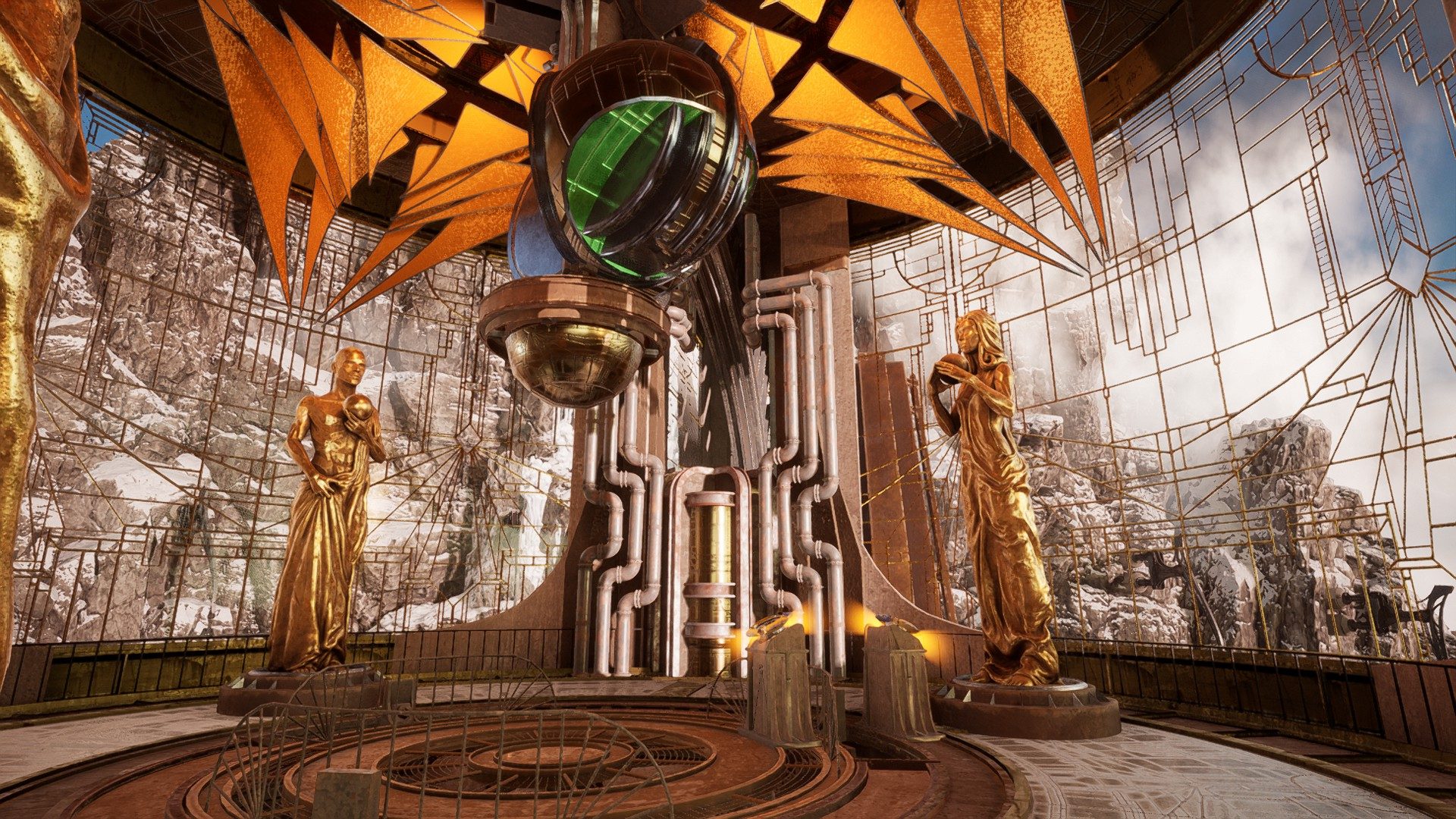
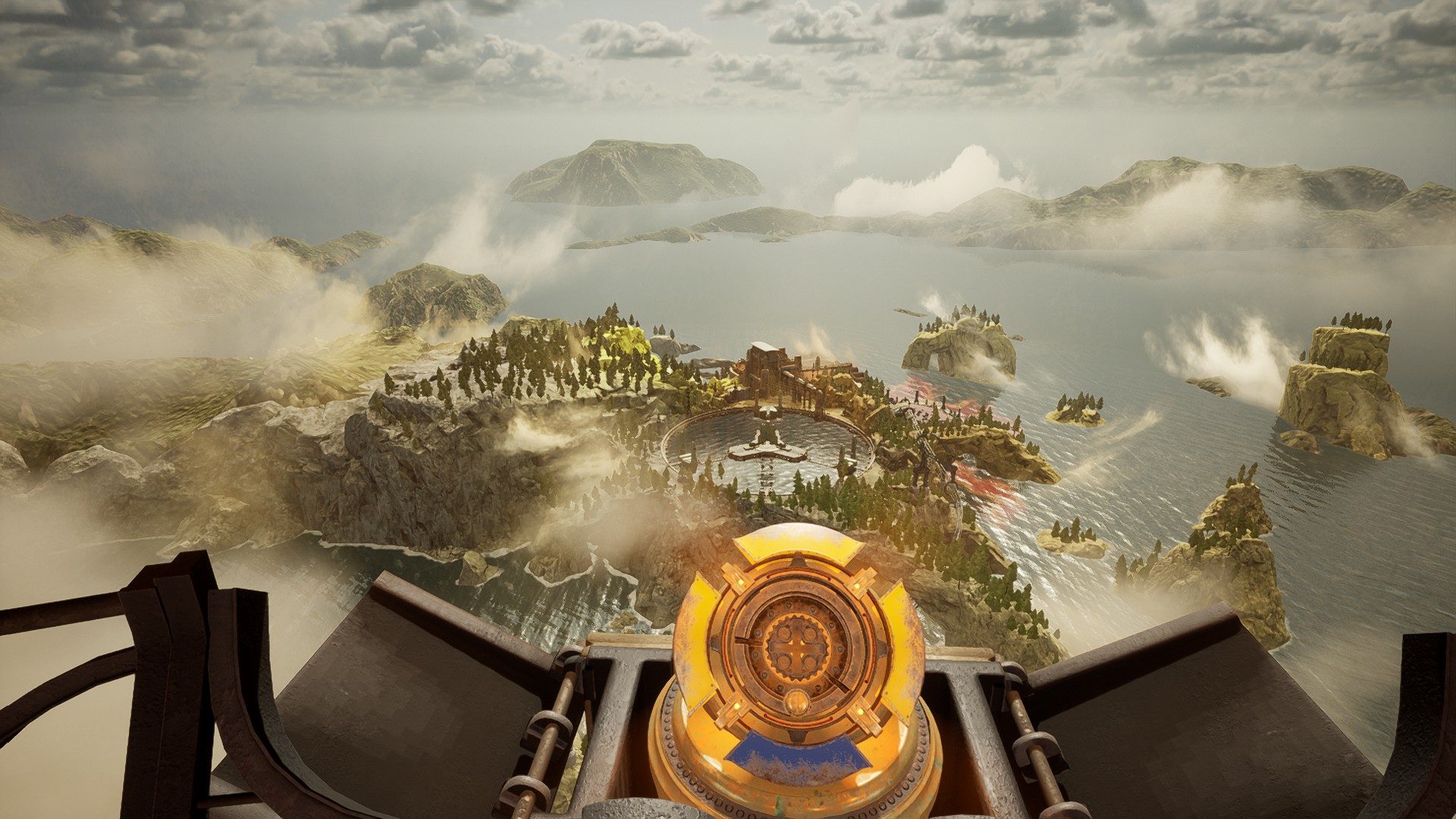
Firmament: from Latin firmamentum—that which strengthens or supports. In an ancient cosmological sense, the word was also used to refer to the sky, or the vault of the heavens fixed above Earth. You’ll have plenty of time to ponder meaning that as you teleport between the four realms via the game’s conveniently located conveyance pods, which automagically shuttle you Dr. Who-style atop wind-swept mountains and steampunk botanical gardens just waiting to be explored (and fixed).
Image captured by Road to VR
Firmament dishes out real moments of awe between serving up maddeningly complex puzzles—basically a Cyan Worlds game through and through. The game’s gigantic machines will leave you scratching your head as you run back and forth just to make sure the figurative pilot light is on. While you have some narrative-based voice recordings and found notes to go by, you’re basically on your own when it comes to puzzling, meaning you won’t be babied by a ‘helpful robot’ who feeds answers into your ear. You’ll need to pay close attention to everything, and really get a grip of all the pieces in play before you can make sense of things. Beating your head against puzzles rarely works, so you’ll be greeted by some very familiar frustration if you’ve played any of Cyan’s most recent games, like Obduction or Myst VR.
Anyway, here are some useful hints: Watch out for every ladder. Watch out for every socket. Keep your head on a swivel and mess with everything a little just to see if it moves, but not so much that you scramble puzzles beyond their intended solvability.
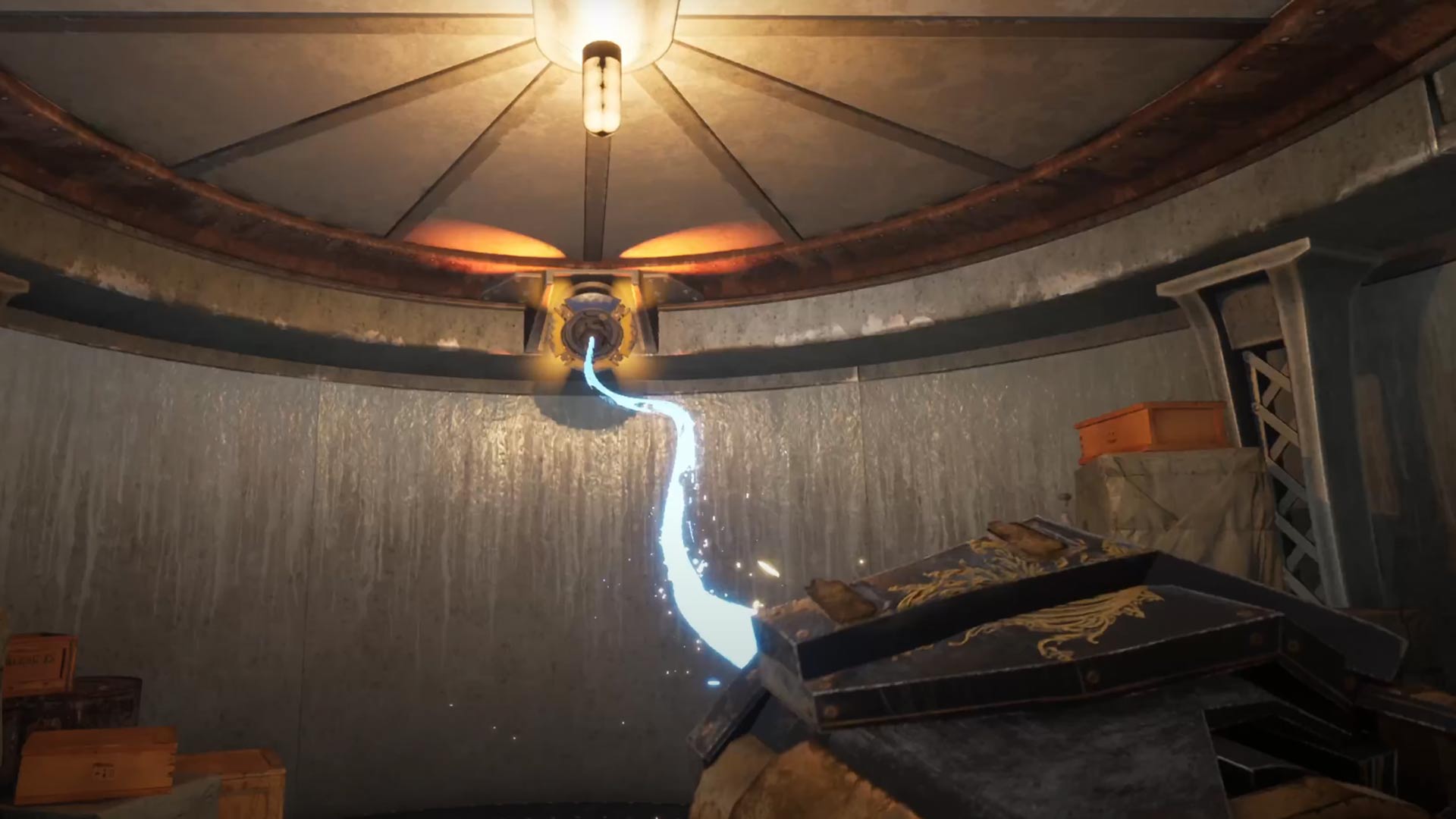
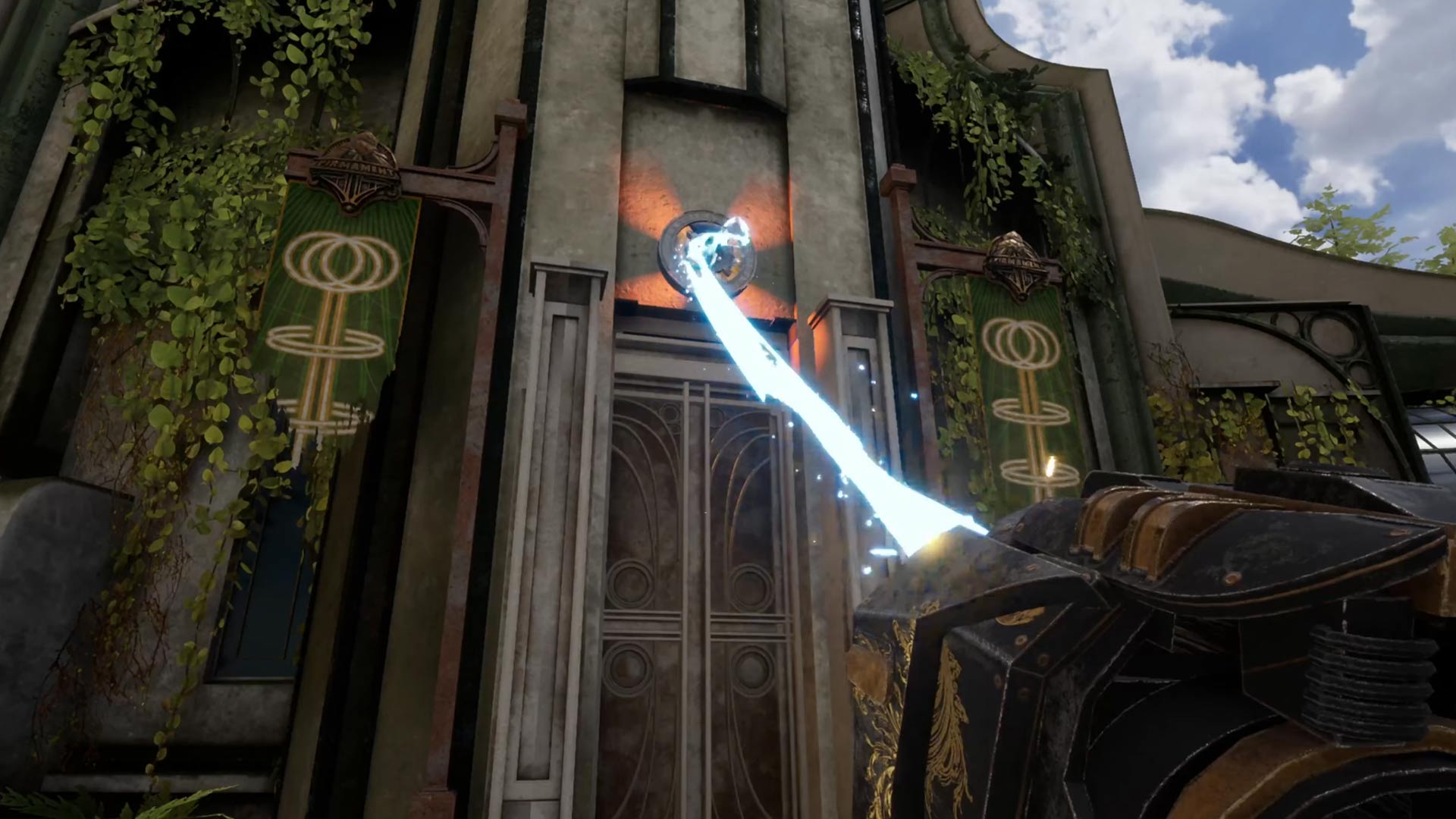
Interacting with the world is done by way of activating a swath of standardized sockets, which pair to your hand-held ‘adjunct’ tool—kind of like a remote-controlled sonic screwdriver that lets you tether and interact with machines. Some sockets only have a single function, like opening and closing a door, while others have multiple functions that you’ll need to flip through. More on that in the Immersion section below.
Image courtesy Cyan Worlds
There is a lot of running back and forth, which feels more like a chore in VR than on traditional monitors. That frustration is compounded by moments when I wasn’t sure whether the game was borked, making me wonder whether it was me who screwed up or the game. It seems Firmament came well prepared for this eventuality at least, as you can safely reset back to a central location, which typically also resets puzzles too. While complex and mostly logical, a minority of puzzle solutions can be downright obtuse. I was provided with a solutions guide, which included hints as well as solutions, and I’m not ashamed to say I needed a few of those hints to complete the game, which I did in about nine hours.
In the end the juice is generally worth the squeeze with Firmament, as you’re whisked off to new, even more impressive areas of the game. While the ending left me feeling a little perplexed, the overall level of world-building is extremely high. I only wish I could be more present in the game and given more agency than casting my tether to manipulate glorified on-off buttons.
Immersion
Firmament is a sumptuous and potentially beautiful game that I wish I could be more present in. My aging GTX 1080 was able to play along decently on medium graphics settings in most areas, which is more than I can say for Obduction. Still, some of the inherent beauty of the game is marred by jagged edges and a muddiness in some areas that feel like it’s really pushing the boundaries of what’s possible. My GPU, which is probably the minimum spec for VR at this point, was much happier sipping along on all low settings, so make sure to curb your expectations if you’re running an older or less powerful setups like mine.
I touched on some of the frustration of puzzle solving above, or rather, when solving puzzles goes wrong, but there’s another frustration that has more to do with level design, and not whether things are actually working properly. While slick and in line with ‘AAA’ games in terms of graphics, level design is still very much rooted in the studio’s point-and-click past, which means you’ll have less physical agency than you’d probably think is rational given the expectation of working hands and feet.
Image captured by Road to VR
In VR, I’m used to being able to not only do what I can in physical reality, like climbing and jumping, but even more. Some of the game’s level design feels like a step backwards in terms of what should be logically possible, like scrambling over a simple banister railing, or sidestepping a box to get to another area. I know that’s part and parcel of the studio’s puzzle style, but if I’m not offered some explanation beyond “no, you just can’t because of reasons,” it negatively impacts my perception of the inherent solidity of the world around me.
And while the world is so rich with possibility, the only meaningful way to interact with it is by using your adjunct tool to manipulate sockets, save a single other tool you’re given that disperses ice and other crusty bits in your way. This raises the question whether Firmament is making good use of VR beyond giving you a more immersive view of the game. Sadly, it doesn’t. It feels more like a flatscreen game with an optional VR mode that hasn’t really informed many of the game’s puzzles or much of its level design. While the amount of backtracking from place to place isn’t such an issue on traditional monitors, it feels way more like a chore in VR.
Image captured by Road to VR
And yet, all of the frustrations of Firmament never seemed to completely overwhelm me. The game’s score is excellent, complementing both its strong voice acting and mostly well-reasoned narrative. I only wish it were just a little more sympathetic to the modern VR gamer, and a little less of an optional mode that basically works, but not as well as you’d hope.
Comfort
The game’s a bit at odds with standard VR movement schemes. While teleport and smooth movement are options, the game default movement scheme puts turning on one stick, and forward movement on another—something I’m not generally used to. Besides a few cart ride-style vehicles, the game is ultimately comfortable enough for most players.