Science

adhd-med-shortages-push-dea-to-up-drug-allotment-by-23.5%

ADHD med shortages push DEA to up drug allotment by 23.5%

drug boost —

The DEA’s quota increase is for Vyvanse and its generic forms.
ADHD med shortages push DEA to up drug allotment by 23.5%

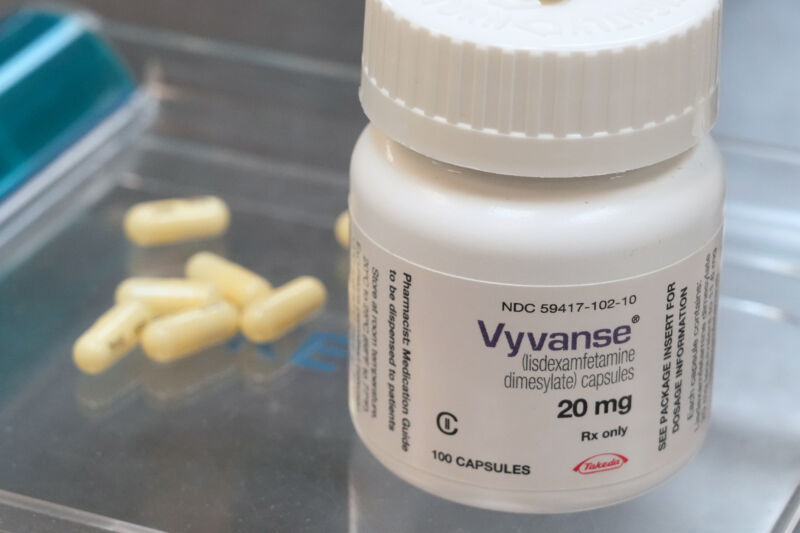
While supplies of Adderall and its generic versions are finally recovering after a yearslong shortage, the Drug Enforcement Administration is now working to curb the short supply of another drug for attention-deficit/hyperactivity disorder: Vyvanse (lisdexamfetamine) and its generic versions.

This week, the DEA said it will increase the allowed production amount of lisdexamfetamine by roughly 23.5 percent, increasing the current 26,500 kg quota by 6,236 kg, for a new total of 32,736 kg. The DEA also allowed for a corresponding increase in d-amphetamine, which is needed for production of lisdexamfetamine.

“These adjustments are necessary to ensure that the United States has an adequate and uninterrupted supply of lisdexamfetamine to meet legitimate patient needs both domestically and globally,” the DEA said.

Quotas

Just like Adderall (amphetamine/dextroamphetamine salts), Vyvanse (lisdexamfetamine) is an amphetamine-class stimulant classified by the DEA as a Schedule II drug. As such, the DEA controls its production levels to ensure demand is met while preventing excess supply that could find its way to the black market. The administration does this by setting an “aggregate production quota”—which is what the DEA adjusted for lisdexamfetamine this week—and doling out undisclosed allotments to drug manufacturers.

While various factors have contributed to the shortages of ADHD medications, some medical and industry groups have placed blame on the DEA’s quota system for underestimating demand and choking supply. For instance, the Adderall shortage began in 2022 following a labor shortage on the product’s production line at Teva, Adderall’s maker. But, while that production snag was resolved, prescription rates increased significantly, in part due to increased awareness of ADHD, broadening diagnosis criteria, and an increase in access with the rise of telehealth services, which boomed during the COVID-19 pandemic. In a report earlier this year, the American Society of Health-System Pharmacists pointed to the DEA’s quotas, saying they’re “exacerbating” shortages.

In an August 2023 joint letter, the DEA and the FDA responded to such criticism, suggesting that the quotas aren’t to blame. Rather, it’s that some manufacturers are not using up their allotment of controlled drugs.

“Based on DEA’s internal analysis of inventory, manufacturing, and sales data submitted by manufacturers of amphetamine products [which include the two ADHD drugs], manufacturers only sold approximately 70 percent of their allotted quota for the year, and there were approximately 1 billion more doses that they could have produced but did not make or ship. Data for 2023 so far show a similar trend,” the FDA and DEA wrote.

The FDA and DEA said they would work with manufacturers to ensure they would ramp up production of drugs in short supply or relinquish their remaining allotments.

Vyvanse shortage

A similarly complicated situation is seen with the current shortfall of Vyvanse and its generics. The DEA raised the quota after prodding from the Food and Drug Administration. In July, the FDA sent the DEA a letter requesting a quota increase. However, the shortage had actually begun in June 2023. At that time, Vyvanse’s maker, Takeda, said that a “manufacturing delay compounded by increased demand” had led to low inventory.

In August 2023, the FDA approved multiple generic versions of Vyvanse after Takeda’s patent exclusivity expired, raising hopes that the shortage would ease with the injection of new generics. But supply problems have persisted. In November, the Association for Accessible Medicines, which represents generic drugmakers, sent a letter to the DEA saying that generic manufacturers weren’t able to obtain enough raw material to “launch their products at full commercial scale,” because the quotas were standing in the way, according to reporting by Bloomberg.

FiercePharma reported another potential factor raised by lawmakers and industry watchers. Those onlookers took note of the timing of Takeda’s “manufacturing delays” just months before generics entered the market. With the significantly thinner profit margin of generic and off-patent drugs, there’s concern that manufacturers may de-prioritize production.

Last, the DEA flagged yet another factor in the supply chain: exports to foreign markets. While the FDA estimated a 6 percent increase in the domestic need for lisdexamfetamine between 2023 and 2024, the DEA’s export data showed a 34 percent increase in exports of lisdexamfetamine between 2022 and 2023, with expectations that exports would continue to increase this year and beyond. As such, the current 23.5 percent quota increase for lisdexamfetamine is only partly for domestic production. In fact, only a quarter of the 6,236 kg is intended for the US. Of the increased allotment, 1,558 kg is for domestic drug production, while the other 4,678 kg addresses increases in foreign demand, the DEA said.

ADHD med shortages push DEA to up drug allotment by 23.5% Read More »

with-nasa’s-plan-faltering,-china-knows-it-can-be-first-with-mars-sample-return

With NASA’s plan faltering, China knows it can be first with Mars sample return

Questions to heaven —

“China is likely to become the first country to return samples from Mars.”

A

Enlarge / A “selfie” photo of China’s Zhurong rover and the Tianwen-1 landing platform on Mars in 2021.

China plans to launch two heavy-lift Long March 5 rockets with elements of the Tianwen-3 Mars sample return mission in 2028, the mission’s chief designer said Thursday.

In a presentation at a Chinese space exploration conference, the chief designer of China’s robotic Mars sample return project described the mission’s high-level design and outlined how the mission will collect samples from the Martian surface. Reports from the talk published on Chinese social media and by state-run news agencies were short on technical details and did not discuss any of the preparations for the mission.

Public pronouncements by Chinese officials on future space missions typically come true, but China is embarking on challenging efforts to explore the Moon and Mars. China aims to land astronauts on the lunar surface by 2030 in a step toward eventually building a Moon base called the International Lunar Research Station.

Liu Jizhong, chief designer of the Tianwen-3 mission, did not say when China could have Mars samples back on Earth. In past updates on the Tianwen-3 mission, the launch date has alternated between 2028 and 2030, and officials previously suggested the round-trip mission would take about three years. This would suggest Mars rocks could return to Earth around 2031, assuming an on-time launch in 2028.

NASA, meanwhile, is in the middle of revamping its architecture for a Mars sample return mission in cooperation with the European Space Agency. In June, NASA tapped seven companies, including SpaceX and Blue Origin, to study ways to return Mars rocks to Earth for less than $11 billion and before 2040, the cost and schedule for NASA’s existing plan for Mars sample return.

That is too expensive and too long to wait for Mars sample return, NASA Administrator Bill Nelson said in April. Mars sample return is the highest priority for NASA’s planetary science division and has been the subject of planning for decades. The Perseverance rover currently on Mars is gathering several dozen specimens of rock powder, soil, and Martian air in cigar-shaped titanium tubes for eventual return to Earth.

This means China has a shot at becoming the first country to bring pristine samples from Mars back to Earth, and China doesn’t intend to stop there.

“If all the missions go as planned, China is likely to become the first country to return samples from Mars,” said Wu Weiren, chief designer of China’s lunar exploration program, in a July interview with Chinese state television. “And we will explore giant planets, such as Jupiter. We will also explore some of the asteroids, including sample return missions from an asteroid, and build an asteroid defense system.”

The asteroid sample return mission is known as Tianwen-2, and is scheduled for launch next year. Tianwen means “questions to heaven.”

China doesn’t have a mission currently on Mars gathering material for its Tianwen-3 sample return mission. The country’s first Mars mission, Tianwen-1, landed on the red planet in May 2021 and deployed a rover named Zhurong. China’s space agency hasn’t released any update on the rover since 2022, suggesting it may have succumbed to the harsh Martian winter.

So, the Tianwen-3 mission must carry everything it needs to land on Mars, collect samples, package them for return to Earth, and then launch them from the Martian surface back into space. Then, the sample carrier will rendezvous with a return vehicle in orbit around Mars. Once the return spacecraft has the samples, it will break out of Mars orbit, fly across the Solar System, and release a reentry capsule to bring the Mars specimens to the Earth.

All of the kit for the Tianwen-3 mission will launch on two Long March 5 rockets, the most powerful operational launcher in China’s fleet. One Long March 5 will launch the lander and ascent vehicle, and another will propel the return spacecraft and Earth reentry capsule toward Mars.

Liu, Tianwen-3’s chief designer, said an attempt to retrieve samples from Mars is the most technically challenging space exploration mission since the Apollo program, according to China’s state-run Xinhua news agency. Liu said China will adhere to international agreements on planetary protection to safeguard Mars, Earth, and the samples themselves from contamination. The top scientific goal of the Tianwen-3 mission is to search for signs of life, he said.

Tianwen-3 will collect samples with a robotic arm and a subsurface drill, and Chinese officials previously said the mission may carry a helicopter and a mobile robot to capture more diverse Martian materials farther away from the stationary lander.

Liu said China is open to putting international payloads on Tianwen-3 and will collaborate with international scientists to analyze the Martian samples the mission returns to Earth. China is making lunar samples returned by the Chang’e 5 mission available for analysis by international researchers, and Chinese officials have said they anticipate a similar process to loan out samples from the far side of the Moon brought home by the Chang’e 6 mission earlier this year.

With NASA’s plan faltering, China knows it can be first with Mars sample return Read More »

study:-playing-dungeons-&-dragons-helps-autistic-players-in-social-interactions

Study: Playing Dungeons & Dragons helps autistic players in social interactions

We can be heroes —

“I can make a character quite different from how I interact with people in real life.”

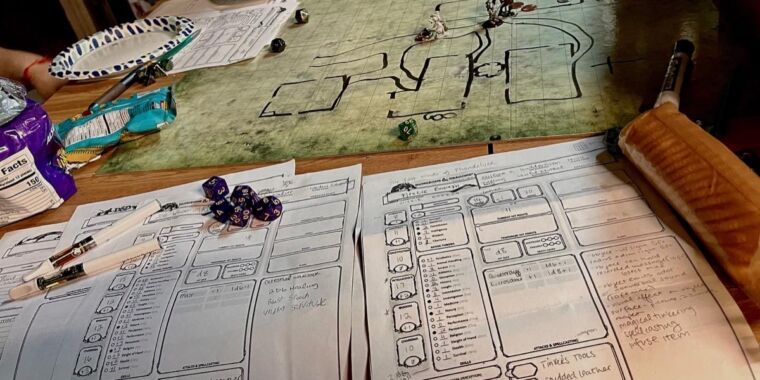
A Dungeons & Dragons game session featuring a map, miniatures, dice, and character sheets

Enlarge / Researchers say that Dungeons & Dragons can give autistic players a way to engage in low-risk social interactions.

Since its introduction in the 1970s, Dungeons & Dragons has become one of the most influential tabletop role-playing games (TRPGs) in popular culture, featuring heavily in Stranger Things, for example, and spawning a blockbuster movie released last year. Over the last decade or so, researchers have turned their focus more heavily to the ways in which D&D and other TRPGs can help people with autism form healthy social connections, in part because the gaming environment offers clear rules around social interactions. According to the authors of a new paper published in the journal Autism, D&D helped boost players’ confidence with autism, giving them a strong sense of kinship or belonging, among other benefits.

“There are many myths and misconceptions about autism, with some of the biggest suggesting that those with it aren’t socially motivated, or don’t have any imagination,” said co-author Gray Atherton, a psychologist at the University of Plymouth. “Dungeons & Dragons goes against all that, centering around working together in a team, all of which takes place in a completely imaginary environment. Those taking part in our study saw the game as a breath of fresh air, a chance to take on a different persona and share experiences outside of an often challenging reality. That sense of escapism made them feel incredibly comfortable, and many of them said they were now trying to apply aspects of it in their daily lives.”

Prior research has shown that autistic people are more likely to feel lonely, have smaller social networks, and often experience anxiety in social settings. Their desire for social connection leads many to “mask” their neurodivergent traits in public for fear of being rejected as a result of social gaffes. “I think every autistic person has had multiple instances of social rejection and loss of relationships,” one of the study participants said when Atherton et al. interviewed them about their experiences. “You’ve done something wrong. You don’t know what it is. They don’t tell you, and you find out when you’ve been just, you know, left shunned in relationships, left out…. It’s traumatic.”

TPRGs like D&D can serve as a social lubricant for autistic players, according to a year-long study published earlier this year co-authored by Atherton, because there is less uncertainty around how to behave in-game—unlike the plethora of unwritten social rules that make navigating social settings so anxiety-inducing. Such games immerse players in a fantastical world where they create their characters with unique backstories, strengths, and weaknesses and cooperate with others to complete campaigns. A game master guides the overall campaign, but the game itself evolves according to the various choices different players make throughout.

A critical hit

Small wonder, then, that there tend to be higher percentages of autistic TRPG players than in the general populace. For this latest study. Atherton et al. wanted to specifically investigate how autistic players experience D&D when playing in groups with other autistic players. It’s essentially a case study with a small sample size—just eight participants—and qualitative in nature, since the post-play analysis focused on semistructured interviews with each player after the conclusion of the online campaign, the better to highlight their individual voices.

The players were recruited through social media advertisements within the D&D, Reddit and Discord online communities; all had received an autism diagnosis by a medical professional. They were split into two groups of four players, with one of the researchers (who’s been playing D&D for years) acting as the dungeon master. The online sessions featured in the study was the Waterdeep: Dragonheist campaign. The campaign ran for six weeks, with sessions lasting between two and four hours (including breaks).

Participants spoke repeatedly about the positive benefits they received from playing D&D, providing a friendly environment that helped them relax about social pressures. “When you’re interacting with people over D&D, you’re more likely to understand what’s going on,” one participant said in their study interview. “That’s because the method you’ll use to interact is written out. You can see what you’re meant to do. There’s an actual sort of reference sheet for some social interactions.” That, in turn, helped foster a sense of belonging and kinship with their fellow players.

Participants also reported feeling emotionally invested and close to their characters, with some preferring to separate themselves from their character in order to explore other aspects of their personality or even an entirely new persona, thus broadening their perspectives. “I can make a character quite different from how I interact with people in real-life interactions,” one participant said. “It helps you put yourself in the other person’s perspective because you are technically entering a persona that is your character. You can then try to see how it feels to be in that interaction or in that scenario through another lens.” And some participants said they were able to “rewrite” their own personal stories outside the game by adopting some of their characters’ traits—a psychological phenomenon known as “bleed.”

“Autism comes with several stigmas, and that can lead to people being met with judgment or disdain,” said co-author Liam Cross, also of the University of Plymouth. “We also hear from lots of families who have concerns about whether teenagers with autism are spending too much time playing things like video games. A lot of the time that is because people have a picture in their minds of how a person with autism should behave, but that is based on neurotypical experiences. Our studies have shown that there are everyday games and hobbies that autistic people do not simply enjoy but also gain confidence and other skills from. It might not be the case for everyone with autism, but our work suggests it can enable people to have positive experiences that are worth celebrating.”

Autism, 2024. DOI: 10.1177/13623613241275260  (About DOIs).

Study: Playing Dungeons & Dragons helps autistic players in social interactions Read More »

the-moon-had-volcanic-activity-much-more-recently-than-we-knew

The Moon had volcanic activity much more recently than we knew

New Moon —

Eruptions seem to have continued long after widespread volcanism had ended.

Image of the face of the Moon.

Enlarge / The eruptions that produced the dark mare on the lunar surface ended billions of years ago.

Signs of volcanic activity on the Moon can be viewed simply by looking up at the night-time sky: The large, dark plains called “maria” are the product of massive outbursts of volcanic material. But these were put in place relatively early in the Moon’s history, with their formation ending roughly 3 billion years ago. Smaller-scale additions may have continued until roughly 2 billion years ago. Evidence of that activity includes samples obtained by China’s Chang’e-5 lander.

But there are hints that small-scale volcanism continued until much more recent times. Observations from space have identified terrain that seems to be the product of eruptions, but only has a limited number of craters, suggesting a relatively young age. But there’s considerable uncertainty about these deposits.

Now, further data from samples returned to Earth by the Chang’e-5 mission show clear evidence of volcanism that is truly recent in the context of the history of the Solar System. Small beads that formed during an eruption have been dated to just 125 million years ago.

Counting beads

Obviously, some of the samples returned by Chang’e-5 are solid rock. But it also returned a lot of loose material from the lunar regolith. And that includes a decent number of rounded, glassy beads formed from molten material. There are two potential sources of those beads: volcanic activity and impacts.

The Moon is constantly bombarded by particles ranging in size from individual atoms to small rocks, and many of these arrive with enough energy to melt whatever it is they smash into. Some of that molten material will form these beads, which may then be scattered widely by further impacts. The composition of these beads can vary wildly, as they’re composed of either whatever smashed into the Moon or whatever was on the Moon that got smashed. So, the relative concentrations of different materials will be all over the map.

By contrast, any relatively recent volcanism on the Moon will be extremely rare, so is likely to be from a single site and have a single composition. And, conveniently, the Apollo missions already returned samples of volcanic lunar rocks, which provide a model for what that composition might look like. So, the challenge was one of sorting through the beads returned from the Chang’e-5 landing site, and figuring out which ones looked volcanic.

And it really was a challenge, as there were over 3,000 beads returned, and the vast majority of them would have originated in impacts.

As a first cutoff, the team behind the new work got rid of anything that had a mixed composition, such as unmelted material embedded in the bead, or obvious compositional variation. This took the 3,000 beads down to 764. Those remaining beads were then subject to a technique that could determine what chemicals were present. (The team used an electron probe microanalyzer, which bombards the sample with electrons and uses the photons that are emitted to determine what elements are present.) As expected, compositions were all over the map. Some beads were less than 1 percent magnesium oxide; others nearly 30 percent. Silicon dioxide ranged from 16 to 60 percent.

Based on the Apollo samples, the researchers selected for beads that were high in magnesium oxide relative to calcium and aluminum oxides. That got them down to 13 potentially volcanic samples. They also looked for low nickel, as that’s found in many impactors, which got the number down to six. The final step was to look at sulfur isotopes, as impact melting tends to preferentially release the lighter isotope, altering the ratio compared to intact lunar rocks.

After all that, the researchers were left with three of the glassy beads, which is a big step down from the 3,000 they started with.

Erupted

Those three were then used to perform uranium-based radioactive dating, and they all produced numbers that were relatively close to each other. Based on the overlapping uncertainties, the researchers conclude that all were the product of an eruption that took place about 123 million years ago, give or take 15 million years. Considering that the most recent confirmed eruptions were about 2 billion years ago, that’s a major step forward in timing.

And that’s quite a bit of a surprise, as the Moon has had plenty of time to cool, and that cooling would have increased the distance between its surface and any molten material left in the interior. So it’s not obvious what could be creating sufficient heating to generate molten material at present. The researchers note that the Moon has a lot of material called KREEP (potassium, rare earth elements, phosphorus) that is high in radioactive isotopes and might lead to localized heating in some circumstances.

Unfortunately, it will be tough to associate this with any local geology, since there’s no indication of where the eruption occurred. Material this small can travel quite a distance in the Moon’s weak gravitational field and then could be scattered even farther by impacts. So, it’s possible that these belong to features that have been identified as potentially volcanic through orbital images.

In the meantime, the increased exploration of the Moon planned for the next few decades should get us more opportunities to see whether similar materials are widespread on the lunar surface. Eventually, that might potentially allow us to identify an area with higher concentrations of volcanic material than one particle in a thousand.

Science, 2024. DOI: 10.1126/science.adk6635  (About DOIs).

The Moon had volcanic activity much more recently than we knew Read More »
parenting-nightmare:-kiss-on-the-cheek-causes-child’s-incurable-infection

Parenting nightmare: Kiss on the cheek causes child’s incurable infection

Stress of parenting —

Puzzle of child’s misdiagnosed cheek lesion solved with one look at dad

Herpes simplex virus, (HSV). Image taken with transmission electron microscopy.

Enlarge / Herpes simplex virus, (HSV). Image taken with transmission electron microscopy.

As the US Surgeon General recently highlighted, parenting is stressful. From navigating social media to facing a youth mental health crisis, challenges abound. But, for one father in Spain, even the simple, loving, everyday act of giving your child a peck on the cheek has turned to nightmare fuel.

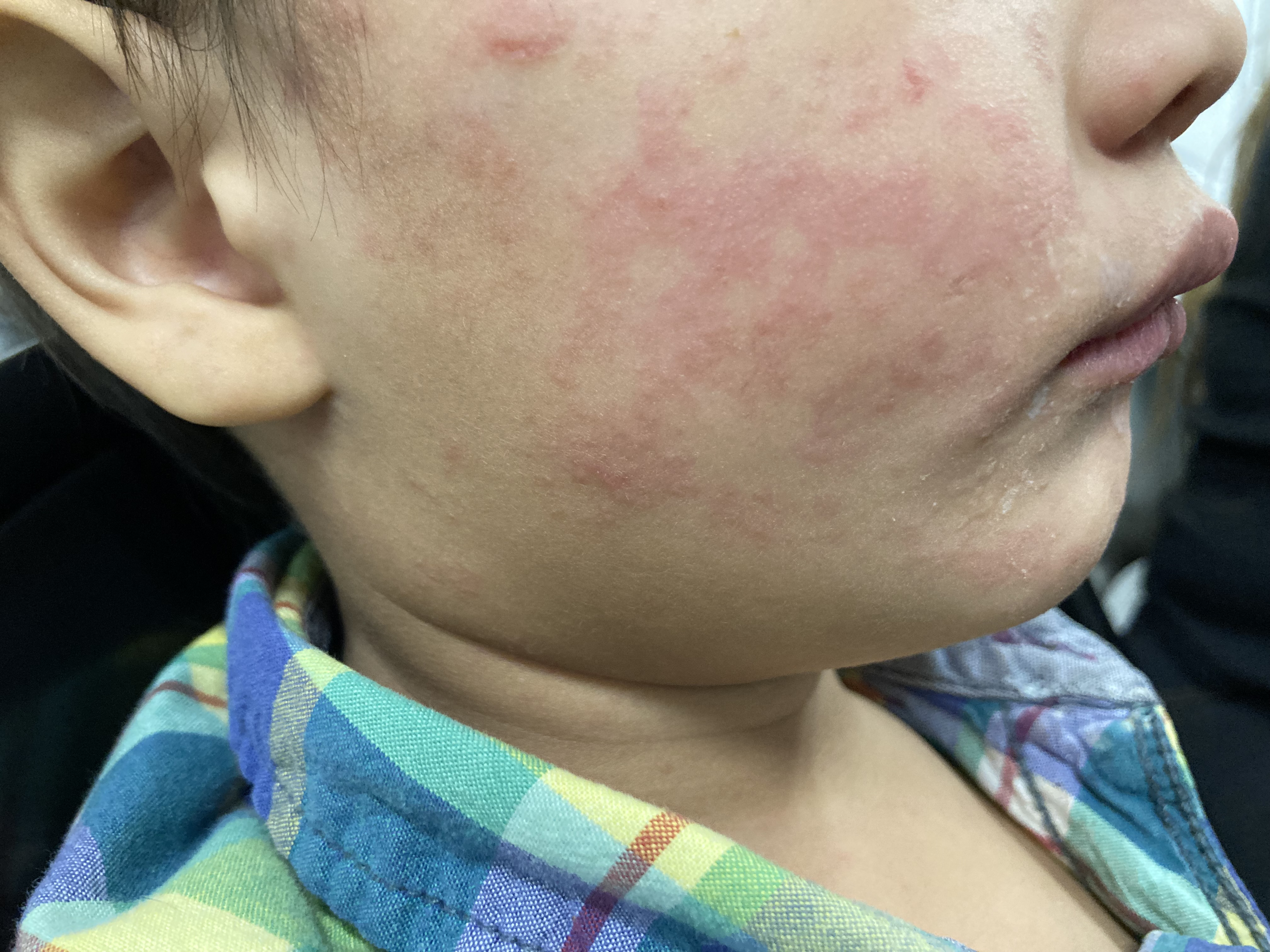
According to a case report in the New England Journal of Medicine, the man’s 9-year-old daughter developed a fever along with a crusty, blistering lesion on her left cheek. Doctors initially diagnosed the blotch as impetigo, a bacterial infection on the skin’s surface layers that is fairly common in children. It’s often caused by Staphylococcus aureus or Streptococcus bacteria and is generally easily treated with antibiotics.

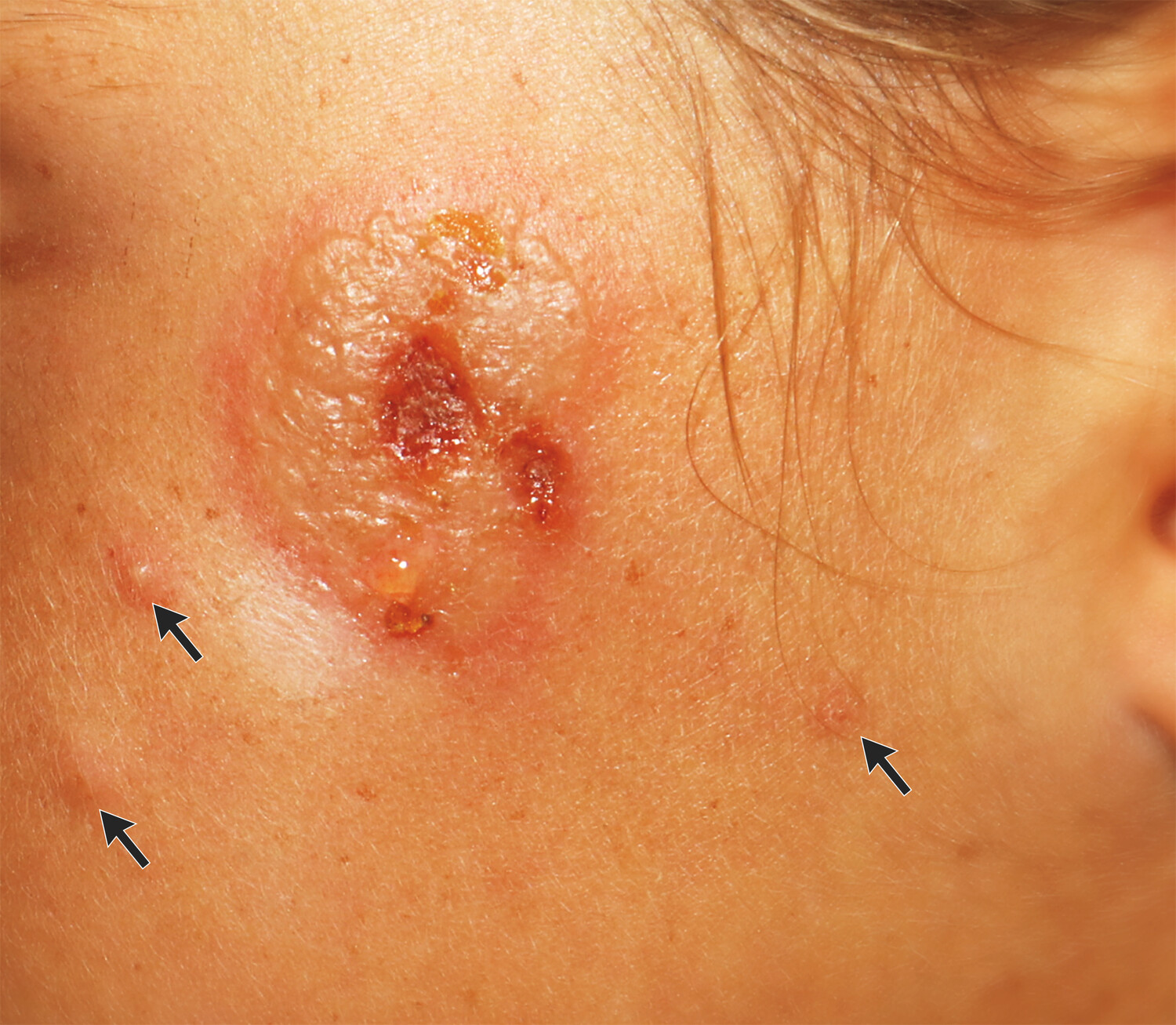
The lesion on the girl's cheek with satellite blisters noted by arrows.

Enlarge / The lesion on the girl’s cheek with satellite blisters noted by arrows.

But, after several days of treatment for impetigo, the child’s symptoms weren’t getting better. At that point, it had been seven days since the lesion erupted, and it was 3 centimeters in diameter on the side of her face. So, he took her to a dermatology clinic. There, specialists closely examined the lesion, noting the red, raised area with blisters and a “honey-crusted appearance,” which is a classic sign of impetigo. They also noted smaller “satellite” blisters around the cheek, as well as swollen lymph nodes on the left side of her neck, the same side as the lesion. All of the symptoms still lined up with impetigo. But then the specialists looked over at her dad.

The doctors took note of a crusting on her father’s lower lip, which he said had started 10 days earlier. It looked like a classic case of common cold sores, aka oral herpes. And the doctors made a connection.

Stress begets stress

Cold sores are caused by herpes simplex virus type 1 (HSV-1), a highly contagious virus that is estimated to infect 3.7 billion people under the age of 50 globally. (There’s also HSV-2, which causes genital herpes). In an initial infection, herpes viruses invade cells on the body’s surfaces, but then go into hiding in nerve cells. From there, they can occasionally reactivate and produce new lesions and infections. For HSV-1, that usually means cold sores around the mouth.

There is no cure for herpes infections; the virus will lurk in a person’s nerve cells for the rest of their lives, with the potential to spur recurring outbreaks. However, there are antiviral treatments that can ease the symptoms of outbreaks and help them clear up a little faster.

When a cold sore develops, the lesions are highly infectious. It’s often transmitted through oral-oral contact, but any direct contact or contact with contaminated saliva can spread the virus. (HSV-2 primarily spreads through sexual contact.) And, while HSV-1 lesions typically erupt around the mouth and on mucosal surfaces, they can sometimes also flare elsewhere on the skin.

The dermatologists treating the 9-year-old ran a test for HSV-1, confirming the genetic traces of the virus were present. They started the girl on an oral antiviral drug. They also noted that there was no concern for sexual abuse. The lesion cleared without scarring.

In their report on the case, they end with a note of caution for other doctors: “When HSV-1 infection manifests in children as cutaneous lesions without mucosal involvement, it may be confused with the honey-crusted appearance of impetigo.”

For parents, the lesson is to be careful not to kiss your child (or anyone else) when you have a cold sore flare up. While those viral reactivations can be sparked by many things, one notable factor will likely strike home for parents: stress.

Parenting nightmare: Kiss on the cheek causes child’s incurable infection Read More »

after-starliner,-nasa-has-another-big-human-spaceflight-decision-to-make

After Starliner, NASA has another big human spaceflight decision to make

Heat shield a hot decision —

“We still have a lot of work to do to close out the heat shield investigation.”

The Artemis II Orion spacecraft being prepared for tests at NASA’S Kennedy Space Center in Florida in June 2024.

Enlarge / The Artemis II Orion spacecraft being prepared for tests at NASA’S Kennedy Space Center in Florida in June 2024.

NASA / Rad Sinyak

Now that NASA has resolved the question of the Starliner spacecraft and its two crew members on the International Space Station, the agency faces another high-stakes human spaceflight decision.

The choice concerns the Orion spacecraft’s heat shield and whether NASA will make any changes before the Artemis II mission that will make a lunar flyby. Although Starliner has garnered a lot of media attention, this will be an even higher-profile decision for NASA, with higher consequences—four astronauts will be on board, and hundreds of millions, if not billions of people, will be watching humanity’s first deep space mission in more than five decades.

The issue is the safety of the heat shield, located at the base of the capsule, which protects Orion’s crew during its return to Earth. During the Artemis I mission that sent Orion beyond the Moon in late 2022, without astronauts on board, chunks of charred material cracked and chipped away from Orion’s heat shield during reentry into Earth’s atmosphere. Once the spacecraft landed, engineers found more than 100 locations where the stresses of reentry damaged the heat shield.

After assessing the issue for more than a year, NASA convened an “independent review team” to conduct its analysis of NASA’s work. Initially, this review team’s work was due to be completed in June, but its deliberations continued throughout much of the summer, and it only recently concluded.

The team’s findings are not public yet, but NASA essentially faces two choices with the heat shield: It can fly Artemis II with a similar heat shield that Orion used on Artemis I, or the agency can revamp the design and construct a new heat shield, likely delaying Artemis II from its September 2025 launch date for multiple years.

What they’re saying

In recent comments, NASA officials have been relatively tight-lipped when asked how the heat shield issue will be resolved:

  • NASA Administrator Bill Nelson, in an interview with Ars, in early August: “They are still deciding. I’m very confident [in a launch date of September 2025] unless there is the problem with the heat shield. Obviously, that would be a big hit. But I have no indication at this point that the final recommendation is going to be to go with another heat shield.”
  • NASA Associate Administrator Jim Free, in conversation with Ars, in late August: “That’s on a good path right now.”
  • NASA Associate Administrator for Exploration Systems Development, Catherine Koerner, in an interview with Ars in mid-August: “The entire trade space is open. But as far as the actual Artemis II mission, right now, we’re still holding to the September ’25 launch date, knowing that we still have a lot of work to do to close out the heat shield investigation.”
  • NASA Deputy Associate Administrator for Moon to Mars Program Amit Kshatriya to the NASA Advisory Committee in late August: “The independent review team has just wrapped up their analysis, so I expect that to close out. We should have a disposition there in terms of how they incorporate those findings.”

In summary, the Independent Review Team’s work is done, and it has begun to brief NASA officials. A final decision will then be made by NASA’s senior leadership.

What happens now

In preparation for Artemis II, the Orion spacecraft underwent thermal and vacuum testing this year before it will be stacked onto the Space Launch System rocket. Initially, NASA planned to begin the stacking process this month but ultimately delayed this until there was clarity on the heat shield question. The shield is already attached to the spacecraft.

Most people Ars spoke to believe NASA will likely fly with the heat shield as is. Sources have indicated that NASA engineers believe the best way to preserve the heat shield during Artemis II is by changing its trajectory through Earth’s atmosphere.

The inspector general's report May 1 included new images of Orion's heat shield.

The inspector general’s report May 1 included new images of Orion’s heat shield.

NASA Inspector General

During Artemis I, the spacecraft followed a “skip” reentry profile, in which Orion dipped into the atmosphere, skipped back into space, and then made a final descent into the atmosphere. This allowed for precise control over Orion’s splashdown location and reduced g-forces on the vehicle. There are other options, including a ballistic reentry, with a steeper trajectory that is harder on the crew in terms of gravitational forces, and a direct reentry, which involves a miniature skip.

A steeper trajectory would allow Orion’s heat shield to be exposed to atmospheric heating and air resistance for a shorter period of time. NASA engineers believe that the cracking issues observed during Artemis I were due to the duration of exposure to atmospheric heating. So less time—theoretically—means that there would be less damage observed during the reentry of Orion during Artemis II.

After Starliner, NASA has another big human spaceflight decision to make Read More »
record-measles-outbreak-in-oregon-blamed-on-vaccine-exemptions

Record measles outbreak in Oregon blamed on vaccine exemptions

consequences —

Vaccine exemptions at nearly 9% in the state, enabling sustained transmission.

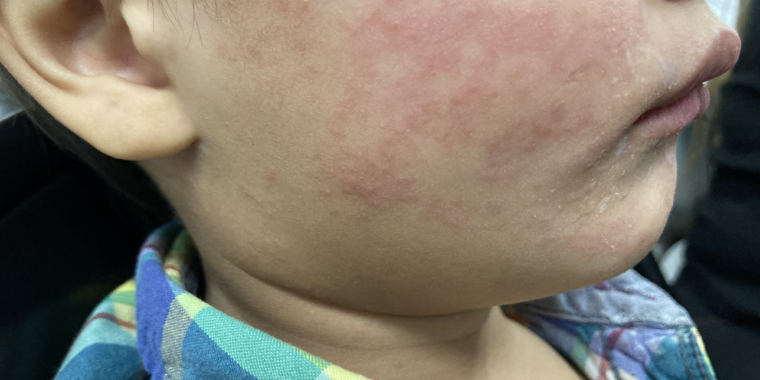
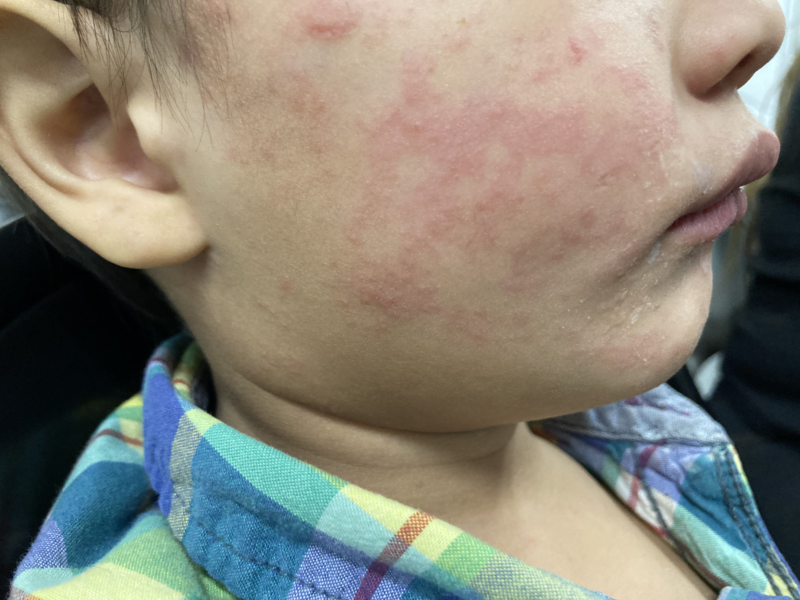
A US child infected with measles during a 2024 outbreak. The child’s cheek shows the characteristic rash associated with this viral infection.

Enlarge / A US child infected with measles during a 2024 outbreak. The child’s cheek shows the characteristic rash associated with this viral infection.

With one of the highest vaccine exemption rates in the country, Oregon is experiencing its largest measles outbreak in decades. This year’s count is now higher than anything seen since 2000, when the Centers for Disease Control and Prevention declared the highly contagious virus eliminated from the US.

Since the start of the year, Oregon has tallied 31 cases of measles, all in unvaccinated people. The cases have been accumulating in sustained waves of transmission since mid-June.

Last month, when the outbreak tally was still in the 20s, health officials noted that it was nearing a state record set in 2019. There were 28 cases that year, which were linked to a large outbreak across the border in Washington state. But, with that record now surpassed, the state is in pre-elimination territory.

“Before 2019, you have to go all the way back to the early 1990s to see case counts this high,” Paul Cieslak, medical director for communicable diseases and immunization at Oregon Health Authority, said in a statement. “The reason is, we maintained very high vaccination rates and very high population levels of immunity. Unfortunately, we’ve seen an erosion in the percentage of people who are getting vaccinated against measles.”

Vaccination decline

In 2000, when measles was declared officially eliminated, only about 1 percent of kindergarteners in the state had exemptions from childhood vaccines, such as measles. But in the years since, Oregon has become one of the states with the highest exemption rates in the country. In the 2022–2023 school year, 8.2 percent of Oregon kindergarteners had exemptions from vaccinations, according to a CDC analysis published in November. Only Idaho had a higher rate, with 12.1 percent of kindergarteners exempt. Utah was a close third, with 8.1 percent, followed by Arizona (7.4 percent) and Wisconsin (7.2 percent).

Oregon’s exemption rate has risen since then, with the exemption rate now at 8.8 percent, according to the Oregon Health Authority. Any exemption rate above 5 percent is concerning. At that threshold, even if every non-exempt child is vaccinated, a state will not be able to achieve the target of 95 percent vaccine coverage expected to prevent sustained transmission of infectious diseases.

Health officials are directly linking the rise of non-medical exemptions to the current measles outbreak, which is centered in Clackamas, Marion, and Multnomah counties. All three are in the northwestern corner of the state, with Clackamas and Multnomah in the Portland area.

“In Clackamas County, as in other Oregon counties, pockets of unvaccinated people raise risk of infection in communities where they live,” Clackamas County Health Officer Sarah Present said. “That’s why the counties reach out to every case that’s been identified and try to determine exactly where they’ve been while infectious.”

Notorious virus

Measles is among the most infectious viruses known. It is notorious for its ability to stay aloft in indoor air for up to two hours after an infected person has been present. For unvaccinated people who are exposed, up to 9 out of 10 will end up falling ill. Those who become infected are contagious from about four days before developing the tell-tale rash and four days after it erupts. Other common symptoms of the infection include high fever, runny nose, cough, and conjunctivitis (pink eye). Many children become severely ill, requiring hospitalization.

In a small percentage of cases, measles can lead to severe complications, including pneumonia, encephalitis, and a progressive neurological disorder (subacute sclerosing panencephalitis), which develops five to 10 years after an initial infection. Additionally, measles is known to cause “immune amnesia.” That is, being infected with measles virus wipes out existing antibodies and immune responses to other germs, leaving people more vulnerable to other diseases.

Two doses of MMR vaccine (measles, mumps, and rubella) are 97 percent effective against measles, and that protection is considered life-long.

So far this year, the US has logged 236 measles cases. Of those, 40 percent were in children under the age of 5, while 30 percent were in children and teens between the ages 5 and 19. Eighty-seven percent were either unvaccinated or had an unknown vaccination status. Forty-four percent (103 of 236) were hospitalized.

While Oregon’s current outbreak has broken its state records, the largest outbreak this year was in Illinois, where a total of 67 cases were reported amid spread at a Chicago-area migrant shelter.

This year’s tally is already well ahead of the total for 2023, which reached just 59 cases. It is still significantly lower than the 1,274 cases seen in 2019, when the US nearly lost its elimination status.

Record measles outbreak in Oregon blamed on vaccine exemptions Read More »

metal-bats-have-pluses-for-young-players,-but-in-the-end-it-comes-down-to-skill

Metal bats have pluses for young players, but in the end it comes down to skill

four different kinds of wood and metal bats laid flat on baseball diamond grass

Enlarge / Washington State University scientists conducted batting cage tests of wood and metal bats with young players.

There’s long been a debate in baseball circles about the respective benefits and drawbacks of using wood bats versus metal bats. However, there are relatively few scientific studies on the topic that focus specifically on young athletes, who are most likely to use metal bats. Scientists at Washington State University (WSU) conducted their own tests of wood and metal bats with young players. They found that while there are indeed performance differences between wooden and metal bats, a batter’s skill is still the biggest factor affecting how fast the ball comes off the bat, according to a new paper published in the Journal of Sports Engineering and Technology.

According to physicist and acoustician Daniel Russell of Penn State University—who was not involved in the study but has a long-standing interest in the physics of baseball ever since his faculty days at Kettering University in Michigan—metal bats were first introduced in 1974 and soon dominated NCAA college baseball, youth baseball, and adult amateur softball. Those programs liked the metal bats because they were less likely to break than traditional wooden bats, reducing costs.

Players liked them because it can be easier to control metal bats and swing faster, as the center of mass is closer to the balance point in the bat’s handle, resulting in a lower moment of inertia (or “swing weight”). A faster swing doesn’t mean that a hit ball will travel faster, however, since the lower moment of inertia is countered by a decreased collision efficiency. Metal bats are also more forgiving if players happen to hit the ball away from the proverbial “sweet spot” of the bat. (The definition of the sweet spot is a bit fuzzy because it is sometimes defined in different ways, but it’s commonly understood to be the area on the bat’s barrel that results in the highest batted ball speeds.)

“There’s more of a penalty when you’re not on the sweet spot with wood bats than with the other metal bats,” said Lloyd Smith, director of WSU’s Sport Science Laboratory and a co-author of the latest study. “[And] wood is still heavy. Part of baseball is hitting the ball far, but the other part is just hitting the ball. If you have a heavy bat, you’re going to have a harder time making contact because it’s harder to control.”

Metal bats may also improve performance via a kind of “trampoline effect.” Metal bats are hollow, while wood bats are solid. When a ball hits a wood bat, the bat barrel compresses by as much as 75 percent, such that internal friction forces decrease the initial energy by as much as 75 percent. A metal bat barrel behaves more like a spring when it compresses in response to a ball’s impact, so there is much less energy loss. Based on his own research back in 2004, Russell has found that improved performance of metal bats is linked to the frequency of the barrel’s mode of vibration, aka the “hoop mode.” (Bats with the lowest hoop frequency will have the highest performance.)

Metal bats have pluses for young players, but in the end it comes down to skill Read More »

natural-piezoelectric-effect-may-build-gold-deposits

Natural piezoelectric effect may build gold deposits

Building the bling —

How does an unreactive, barely soluble metal end up forming giant chunks?

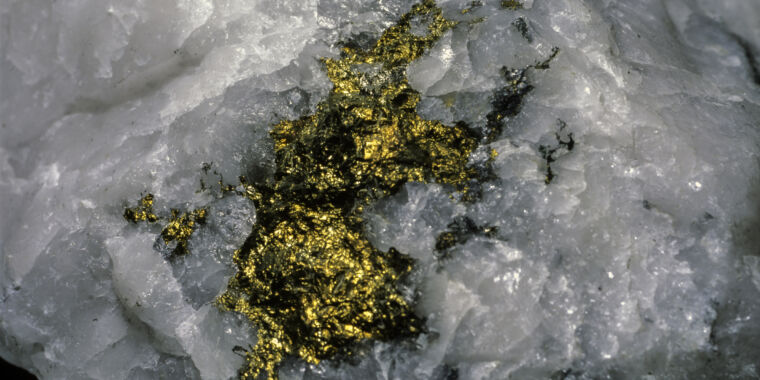
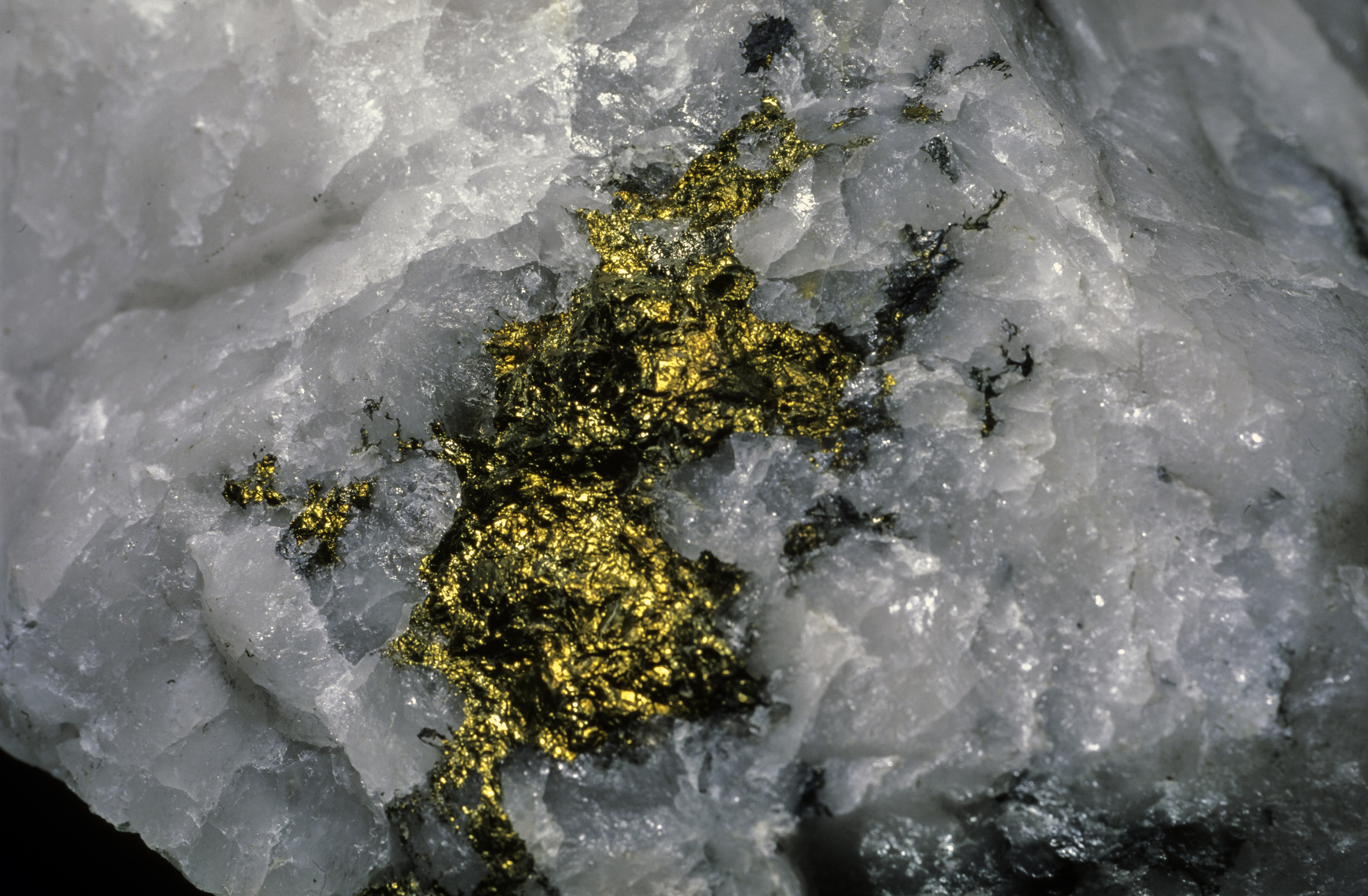
Image of a white rock with gold and black deposits speckled throughout it.

Enlarge / A lot of gold deposits are found embedded in quartz crystals.

One of the reasons gold is so valuable is because it is highly unreactive—if you make something out of gold, it keeps its lustrous radiance. Even when you can react it with another material, it’s also barely soluble, a combination that makes it difficult to purify away from other materials. Which is part of why a large majority of the gold we’ve obtained comes from deposits where it is present in large chunks, some of them reaching hundreds of kilograms.

Those of you paying careful attention to the previous paragraph may have noticed a problem here: If gold is so difficult to get into its pure form, how do natural processes create enormous chunks of it? On Monday, a group of Australian researchers published a hypothesis, and a bit of evidence supporting it. They propose that an earthquake-triggered piezoelectric effect essentially electroplates gold onto quartz crystals.

The hypothesis

Approximately 75 percent of the gold humanity has obtained has come from what are called orogenic gold deposits. Orogeny is a term for the tectonic processes that build mountains, and orogenic gold deposits form in the seams where two bodies of rock are moving past each other. These areas are often filled with hot hydrothermal fluids, and the heat can increase the solubility of gold from “barely there” to “extremely low,” meaning generally less than a single milligram in a liter of water.

The other striking thing about these deposits is that they’re generally associated with the mineral quartz, a crystalline form of silicon dioxide. And that fact formed the foundation for the new hypothesis, which brings together a number of topics that are generally considered largely unrelated.

It turns out that quartz is the only abundant mineral that’s piezoelectric, meaning that it generates a charge when it’s placed under strain. While you don’t need to understand why that’s the case to follow this hypothesis, the researchers’ explanation of the piezoelectric effect is remarkably cogent and clear, so I’ll just quote it here for people who want to come away from this having learned something: “Quartz is the only common mineral that forms crystals lacking a center of symmetry (non-centrosymmetric). Non-centrosymmetric crystals distorted under stress have an imbalance in their internal electric configuration, which produces an electrical potential—or voltage—across the crystal that is directly proportional to the applied mechanical force.”

Quartz happens to be an insulator, so this electric potential doesn’t easily dissipate on its own. It can, however, be eliminated through the transfer of electrons to or from any materials that touch the quartz crystals, including fluids. In practice, that means the charge can drive redox (reduction/oxidation) reactions in any nearby fluids, potentially neutralizing any dissolved ions and causing them to come out of solution.

This has the potential to be self-reinforcing. Once a small metal deposit forms on the surface of quartz, it will ease the exchange of electrons with the fluid in its immediate vicinity, meaning more metal will be deposited in the same location. This will also lower the concentration of the metal in the nearby solution, which will favor the diffusion of additional metal ions into the location, meaning that the fluid itself doesn’t need to keep circulating past the same spot.

Finally, the concept also needs a source of strain to generate the piezoelectric effect in the first place. But remember that this is all happening in an active fault zone, so strain is not in short supply.

And the evidence

Figuring out whether this happens in active fault zones would be extremely challenging for all sorts of reasons. But it’s relatively easy to dunk some quartz crystals in a solution containing gold and see what happens. So the latter is the route the Australians took.

The gold came in the form of either a solution of gold chloride ions or a suspension of gold nanoparticles. Quartz crystals were either pure quartz or obtained from a gold-rich area and already contained some small gold deposits. The crystals themselves were subject to strain at a frequency similar to that produced by small earthquakes, and the experiment was left to run for an hour.

An hour was enough to get small gold deposits to form on the pure quartz crystals, regardless of whether it was from dissolved gold or suspended gold nanoparticles. In the case of the naturally formed quartz, the gold ended up being deposited on the existing sites where gold metal is present, rather than forming additional deposits.

The researchers note that a lot of the quartz in deposits is disordered rather than in the form of single crystals. In disordered material, there are lots of small crystals oriented randomly, meaning the piezoelectric effect of any one of these crystals is typically canceled out by its neighbors. So, gold will preferentially form on single crystals, which also helps explain why it’s found in large lumps in these deposits.

So, this is a pretty compelling hypothesis—it explains something puzzling, relies on well-established processes, and has a bit of experimental support. Given that activity in active faults is likely to remain both slow and inaccessible, the next steps are probably going to involve getting longer-term information on the rate of deposition through this process and a physical comparison of these deposits with those found in natural settings.

Nature Geoscience, 2024. DOI: 10.1038/s41561-024-01514-1  (About DOIs).

Natural piezoelectric effect may build gold deposits Read More »

the-new-glenn-rocket’s-second-stage-set-to-roll-to-the-launch-pad-on-monday

The New Glenn rocket’s second stage set to roll to the launch pad on Monday

Rings of power —

The large rocket will attempt to land on its debut flight.

Image of the New Glenn second stage on its mobile test stand.

Enlarge / Image of the New Glenn second stage on its mobile test stand.

Blue Origin

Blue Origin plans to enter the final phase of its launch preparations for the New Glenn rocket on Monday by rolling the vehicle’s second stage to Launch Complex 36 in Florida. Pending weather and other final considerations, a rollout could occur as early as Monday afternoon.

This is the flight version of the vehicle, with the exception of a fixed adaptor for weather protection during a test campaign. The launch company is targeting a hot fire test of the upper stage, which is powered by two BE-3U engines, within the next week or so.

The launch company, founded by Amazon’s Jeff Bezos, is closing in on the debut launch of the massive New Glenn rocket, which will be one of the most powerful launch vehicles in the world. With a fully reusable first stage, New Glenn has a lift capacity of 45 metric tons to low-Earth orbit.

A tight launch window

NASA has contracted with Blue Origin for the first launch of New Glenn, seeking to boost two relatively small spacecraft to Mars. These ESCAPADE orbiters have a tight launch window, from October 13 to October 21. Managed by the Space Sciences Laboratory at the University of California, Berkeley, the ESCAPADE spacecraft will analyze the Martian magnetic field.

It is an open question as to whether Blue Origin can integrate, test, and launch ESCAPADE within the launch window, which opens in less than six weeks. Between now and then the company must successfully test fire the second stage, and then roll the first stage out to the company’s facilities at the Cape Canaveral launch complex.

The company’s plan is to mate the second and first stages of the rocket, and add the payload fairing with the spacecraft inside of it, before conducting a short hot fire test of the first stage. If all goes well, Blue Origin plans to attempt a launch during the October window for ESCAPADE. These spacecraft arrived at the company’s launch facilities a couple of weeks ago.

This seems like an ambitious timeline for the new rocket, as final integration of stages is often where issues are discovered with new launch vehicles. However, Blue Origin has found a new sense or urgency under chief executive Dave Limp, who joined the company in December—hence the frenetic activity with the second stage over the Labor Day holiday weekend in the United States.

The road to commercial heavy lift

Limp led devices and services at Amazon for more than a decade, which included oversight of the Project Kuiper satellite project. In his nine months at Blue Origin, he has prioritized completion and launch of the New Glenn rocket amid a large portfolio of projects at the company.

New Glenn will join SpaceX’s Falcon Heavy and Starship rockets as privately developed, heavy lift rockets. Its debut will confirm the trend in US spaceflight toward commercial developed large rockets that can be reused. Both Bezos and SpaceX founder Elon Musk have identified lower cost, rapidly reusable rockets as a key to expanding human activity in outer space. Bezos would like to see mining and other destructive industrial activities moved off world in order to preserve the natural vitality of Earth.

Whether it launches ESCAPADE next month, or some other payload on its debut flight after October, New Glenn will attempt an ambitious drone ship landing of the first stage on its debut launch. Success is unlikely—SpaceX did not manage to land its first Falcon 9 at sea until the 23rd launch of this rocket.

However, Bezos and Blue Origin are determined to gather all of the data possible from New Glenn’s initial flight in order to reach reusability of the larger booster as soon as possible. The attempt, whether successful or not, should make for compelling viewing.

The New Glenn rocket’s second stage set to roll to the launch pad on Monday Read More »

the-starliner-spacecraft-has-started-to-emit-strange-noises

The Starliner spacecraft has started to emit strange noises

Submarines in space —

“I don’t know what’s making it.”

Boeing's Starliner spacecraft is seen docked at the International Space Station on June 13.

Enlarge / Boeing’s Starliner spacecraft is seen docked at the International Space Station on June 13.

On Saturday NASA astronaut Butch Wilmore noticed some strange noises emanating from a speaker inside the Starliner spacecraft.

“I’ve got a question about Starliner,” Wilmore radioed down to Mission Control, at Johnson Space Center in Houston. “There’s a strange noise coming through the speaker … I don’t know what’s making it.”

Wilmore said he was not sure if there was some oddity in the connection between the station and the spacecraft causing the noise, or something else. He asked the flight controllers in Houston to see if they could listen to the audio inside the spacecraft. A few minutes later, Mission Control radioed back that they were linked via “hardline” to listen to audio inside Starliner, which has now been docked to the International Space Station for nearly three months.

Wilmore, apparently floating in Starliner, then put his microphone up to the speaker inside Starliner. Shortly thereafter, there was an audible pinging that was quite distinctive. “Alright Butch, that one came through,” Mission control radioed up to Wilmore. “It was kind of like a pulsing noise, almost like a sonar ping.”

“I’ll do it one more time, and I’ll let y’all scratch your heads and see if you can figure out what’s going on,” Wilmore replied. The odd, sonar-like audio then repeated itself. “Alright, over to you. Call us if you figure it out.”

A space oddity

A recording of this audio, and Wilmore’s conversation with Mission Control, was captured and shared by a Michigan-based meteorologist named Rob Dale.

It was not immediately clear what was causing the odd, and somewhat eerie noise. As Starliner flies to the space station, it maintains communications with the space station via a radio frequency system. Once docked, however, there is a hardline umbilical that carries audio.

Astronauts notice such oddities in space from time to time. For example, during China’s first human spaceflight int 2003, astronaut Yang Liwei said he heard what sounded like an iron bucket being knocked by a wooden hammer while in orbit. Later, scientists realized the noise was due to small deformations in the spacecraft due to a difference in pressure between its inner and outer walls.

This weekend’s sonar-like noises most likely have a benign cause, and Wilmore certainly did not sound frazzled. But the odd noises are worth noting given the challenges that Boeing and NASA have had with the debut crewed flight of Starliner, including substantial helium leaks in flight, and failing thrusters. NASA announced a week ago that, due to uncertainty about the flyability of Starliner, it would come home without its original crew of Wilmore and Suni Williams.

Starliner is now due to fly back autonomously to Earth on Friday, September 6. Wilmore and Williams will return to Earth next February, flying aboard a Crew Dragon spacecraft scheduled to launch with just two astronauts later this month.

The Starliner spacecraft has started to emit strange noises Read More »

blood-puddles,-mold,-tainted-meat,-bugs:-boar’s-head-inspections-are-horrifying

Blood puddles, mold, tainted meat, bugs: Boar’s Head inspections are horrifying

“ample amounts of blood” —

The USDA recorded 69 violations in a year. So far, 9 people have died in the outbreak.

A recall notice is posted next to Boar's Head meats that are displayed at a Safeway store on July 31, 2024, in San Rafael, California.

Enlarge / A recall notice is posted next to Boar’s Head meats that are displayed at a Safeway store on July 31, 2024, in San Rafael, California.

Federal inspections found 69 violations—many grisly—at the Boar’s Head meat facility at the center of a deadly, nationwide Listeria outbreak that has now killed nine people, sickened and hospitalized a total of 57 across 18 states, and spurred the nationwide recall of more than 7 million pounds of meat.

The Jarratt, Virginia-based facility had repeated problems with mold, water leaks, dirty equipment and rooms, meat debris stuck on walls and equipment, various bugs, and, at one point, puddles of blood on the floor, according to inspection reports from the US Department of Agriculture’s Food Safety and Inspection Services. The reports were obtained by CBS News through a Freedom of Information Act Request. In all, the reports outline 69 violations just between the dates of August 1, 2023, and August 2, 2024.

The findings in the reports reveal the perfect conditions for the company’s meat to become contaminated with the germ behind the deadly outbreak, Listeria monocytogenes. This is a hardy germ that is ubiquitous in the environment, including in soil and water, and it spreads among people via the fecal-oral route. In healthy people, it usually only causes gastrointestinal infections. But for older people, newborns, and the immunocompromised, it can cause a life-threatening invasive infection with a fatality rate of around 17 percent. It’s also a significant danger to pregnant people, causing miscarriage, stillbirth, premature delivery, and life-threatening infections in newborns.

While it’s always lurking, L. monocytogenes especially plagues the food industry because it has the notable ability to reproduce at refrigerator temperatures—a condition that typically limits the growth of other nasty germs.

Buildup and bugs

In the Boar’s Head facility, L. monocytogenes appeared to have various opportunities to beef up its numbers. For one, the facility had a long track record of trash and meat debris in various places, which was sometimes reported alongside insect sightings. For instance, on June 10, an inspector entered the “pickle vat pump room” and noted “heavy meat buildup” on the walls, which were also crawling with flies and gnats. On the same day, an inspection of a different area found a rollup door with meat buildup on it, and a water pipe over the door leaked a steady stream of water down the wall and onto the floor. There was also a “steady line of ants” and an inventory of ladybugs, a cockroach, and a beetle of some sort.  Earlier, on March 13, an inspection of a room next to where netted hams were handled, an inspector found trash and meat protein on the floor, including “whole pork muscles.”

Going back to August 8, 2023, an inspection likewise found processing lines covered in meat particles and trash. “Heavy discolored meat buildup” was found covering a hydraulic pump, and pieces of meat and fat clung to the support braces of a catwalk. An inspection-line scale had meat pieces and trash in it—and it smelled bad. “Multiple instances of meat were found around the department on the floor. As well as standing water containing a brown mud/dirt-like substance,” the inspection read.

The facility had numerous problems with water leaks and condensation, which fits with the other numerous sightings of mold. The facility temporarily fixed water pipe leaks by wrapping the pipes in plastic. On October 26, an inspector noticed a plastic-wrapped pipe in the cure cooler. The plastic was dated August 17, and there was “orange/brown water pooled in the lowest hanging point.”

Bubbles and blood

On January 9, the inspection of a holding cooler found spots of black mold as large as a quarter throughout the room. On July 23, an inspector noticed bubbled paint on the wall around employee hand-washing sinks. The bubbles were filled with water. And under the sinks, the inspector found black mold and pink mildew.

On July 17, the inspector found “green algal growth” in a puddle of standing water in a raw holding cooler. And on July 27, an inspector noted clear liquid leaking out from a square patch on the ceiling. Behind the patch, there were two other patches that were also leaking. An employee came and wiped the liquid away with a sponge, but it returned within 10 seconds. The employee wiped it again, and the liquid again returned within 10 seconds. Meanwhile, a ceiling fan mounted close by was blowing the leaking liquid onto uncovered hams in a hallway outside the room.

To top if off, a report on February 21 found a raw cooler with “ample amounts of blood in puddles on the floor” and a “rancid smell.”

According to USDA documents, the agency has not taken enforcement actions against Boar’s Head, and there is no data available on swab testing for Listeria at the Virginia facility. The plant has been shut down since late July after health investigators found the outbreak strain of L. monocytogenes in unopened containers of Boar’s Head liverwurst.

In a statement updated on August 29, Boar’s Head said, “We are conducting an extensive investigation, working closely with the USDA and government regulatory agencies, as well as with the industry’s leading food safety experts, to determine how our liverwurst produced at our Jarratt, Virginia facility was adulterated and to prevent it from happening again… We will not resume operations at this facility until we are confident that it meets USDA regulatory standards and Boar’s Head’s highest quality and safety standards.”

Blood puddles, mold, tainted meat, bugs: Boar’s Head inspections are horrifying Read More »