Researchers make “neuromorphic” artificial skin for robots
The nervous system does an astonishing job of tracking sensory information, and does so using signals that would drive many computer scientists insane: a noisy stream of activity spikes that may be transmitted to hundreds of additional neurons, where they are integrated with similar spike trains coming from still other neurons.
Now, researchers have used spiking circuitry to build an artificial robotic skin, adopting some of the principles of how signals from our sensory neurons are transmitted and integrated. While the system relies on a few decidedly not-neural features, it has the advantage that we have chips that can run neural networks using spiking signals, which would allow this system to integrate smoothly with some energy-efficient hardware to run AI-based control software.
Location via spikes
The nervous system in our skin is remarkably complex. It has specialized sensors for different sensations: heat, cold, pressure, pain, and more. In most areas of the body, these feed into the spinal column, where some preliminary processing takes place, allowing reflex reactions to be triggered without even involving the brain. But signals do make their way along specialized neurons into the brain, allowing further processing and (potentially) conscious awareness.
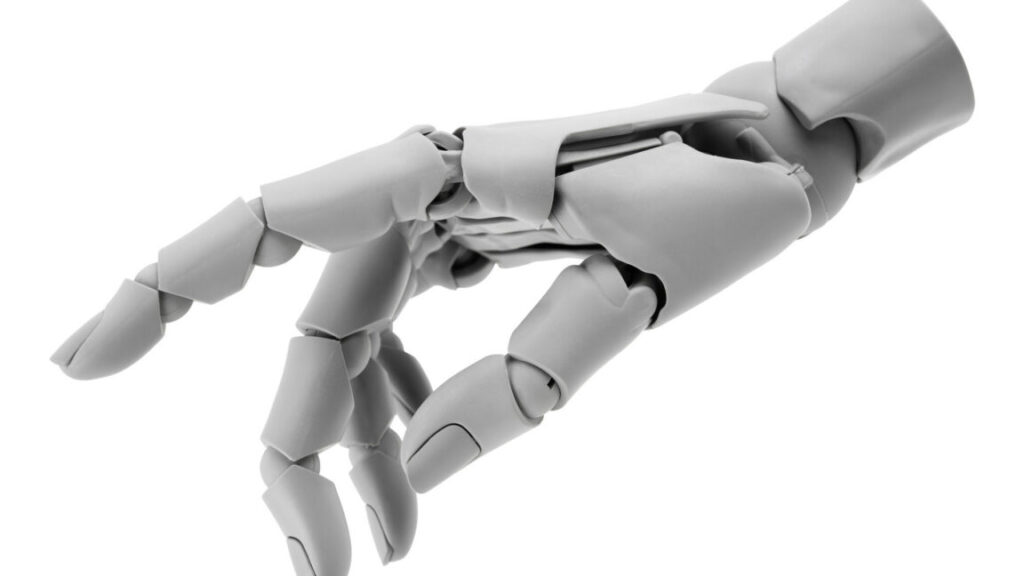
The researchers behind the recent work, based in China, decided to implement something similar for an artificial skin that could be used to cover a robotic hand. They limited sensing to pressure, but implemented other things the nervous system does, including figuring out the location of input and injuries, and using multiple layers of processing.
All of this started out by making a flexible polymer skin with embedded pressure sensors that were linked up to the rest of the system via conductive polymers. The next layer of the system converted the inputs from the pressure sensors to a series of activity spikes—short pulses of electrical current.
There are four ways that these trains of spikes can convey information: the shape of an individual pulse, through their magnitude, through the length of the spike, and through the frequency of the spikes. Spike frequency is the most commonly used means of conveying information in biological systems, and the researchers use that to convey the pressure experienced by a sensor. The remaining forms of information are used to create something akin to a bar code that helps identify which sensor the reading came from.
Researchers make “neuromorphic” artificial skin for robots Read More »