

simulated reasoning

cutting-edge-chinese-“reasoning”-model-rivals-openai-o1—and-it’s-free-to-download

Cutting-edge Chinese “reasoning” model rivals OpenAI o1—and it’s free to download

Unlike conventional LLMs, these SR models take extra time to produce responses, and this extra time often increases performance on tasks involving math, physics, and science. And this latest open model is turning heads for apparently quickly catching up to OpenAI.

For example, DeepSeek reports that R1 outperformed OpenAI’s o1 on several benchmarks and tests, including AIME (a mathematical reasoning test), MATH-500 (a collection of word problems), and SWE-bench Verified (a programming assessment tool). As we usually mention, AI benchmarks need to be taken with a grain of salt, and these results have yet to be independently verified.
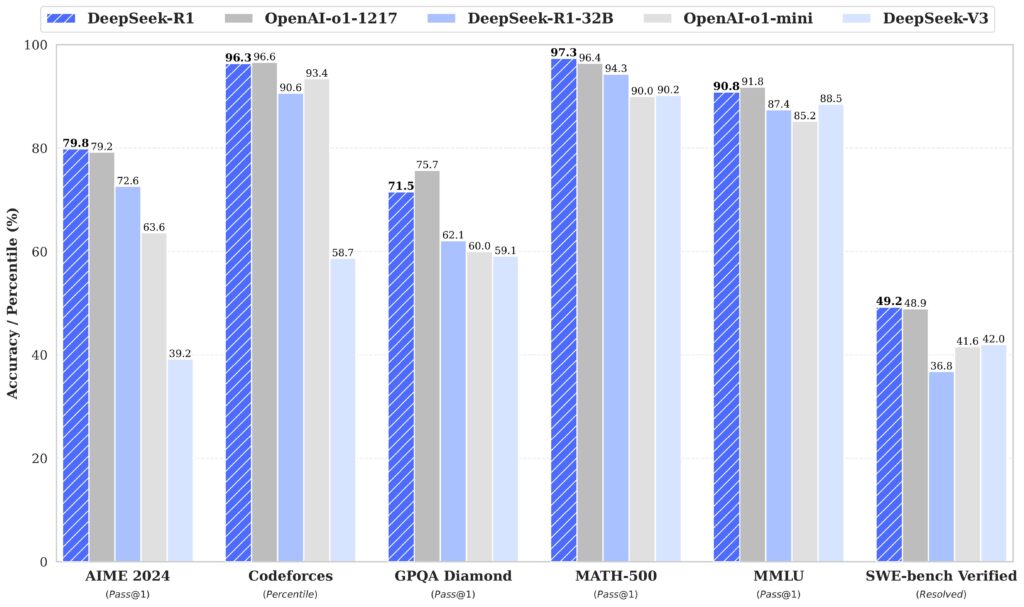
A chart of DeepSeek R1 benchmark results, created by DeepSeek.

A chart of DeepSeek R1 benchmark results, created by DeepSeek. Credit: DeepSeek

TechCrunch reports that three Chinese labs—DeepSeek, Alibaba, and Moonshot AI’s Kimi—have now released models they say match o1’s capabilities, with DeepSeek first previewing R1 in November.

But the new DeepSeek model comes with a catch if run in the cloud-hosted version—being Chinese in origin, R1 will not generate responses about certain topics like Tiananmen Square or Taiwan’s autonomy, as it must “embody core socialist values,” according to Chinese Internet regulations. This filtering comes from an additional moderation layer that isn’t an issue if the model is run locally outside of China.

Even with the potential censorship, Dean Ball, an AI researcher at George Mason University, wrote on X, “The impressive performance of DeepSeek’s distilled models (smaller versions of r1) means that very capable reasoners will continue to proliferate widely and be runnable on local hardware, far from the eyes of any top-down control regime.”

Cutting-edge Chinese “reasoning” model rivals OpenAI o1—and it’s free to download Read More »

openai-announces-o3-and-o3-mini,-its-next-simulated-reasoning-models

OpenAI announces o3 and o3-mini, its next simulated reasoning models

On Friday, during Day 12 of its “12 days of OpenAI,” OpenAI CEO Sam Altman announced its latest AI “reasoning” models, o3 and o3-mini, which build upon the o1 models launched earlier this year. The company is not releasing them yet but will make these models available for public safety testing and research access today.

The models use what OpenAI calls “private chain of thought,” where the model pauses to examine its internal dialog and plan ahead before responding, which you might call “simulated reasoning” (SR)—a form of AI that goes beyond basic large language models (LLMs).

The company named the model family “o3” instead of “o2” to avoid potential trademark conflicts with British telecom provider O2, according to The Information. During Friday’s livestream, Altman acknowledged his company’s naming foibles, saying, “In the grand tradition of OpenAI being really, truly bad at names, it’ll be called o3.”

According to OpenAI, the o3 model earned a record-breaking score on the ARC-AGI benchmark, a visual reasoning benchmark that has gone unbeaten since its creation in 2019. In low-compute scenarios, o3 scored 75.7 percent, while in high-compute testing, it reached 87.5 percent—comparable to human performance at an 85 percent threshold.

OpenAI also reported that o3 scored 96.7 percent on the 2024 American Invitational Mathematics Exam, missing just one question. The model also reached 87.7 percent on GPQA Diamond, which contains graduate-level biology, physics, and chemistry questions. On the Frontier Math benchmark by EpochAI, o3 solved 25.2 percent of problems, while no other model has exceeded 2 percent.

OpenAI announces o3 and o3-mini, its next simulated reasoning models Read More »