space collectible

lego-announces-nasa-artemis-sls-rocket-set-to-lift-off-(literally)-in-2026

Lego announces NASA Artemis SLS rocket set to lift off (literally) in 2026

How do you top a highly detailed scale model of NASA’s new moon-bound rocket and its support tower? If you’re Lego, you make it so it can actually lift off.

Lego’s NASA Artemis Space Launch System Rocket, part of its Technic line of advanced building sets, will land on store shelves for $60 on January 1, 2026, and then “blast off” from kitchen tables, office desks and living room floors. The 632-piece set climbs skyward, separating from its expendable stages along the way, until the Orion crew spacecraft and its European Service Module top out the motion on their way to the moon—or wherever your imagination carries it.

“The educational LEGO Technic set shows the moment a rocket launches, in three distinct stages,” reads the product description on Lego’s website. “Turn the crank to see the solid rocket boosters separate from the core stage, which then also detaches. Continue turning to watch the upper stage with its engine module, Orion spacecraft and launch abort system separate.”

Crank it up
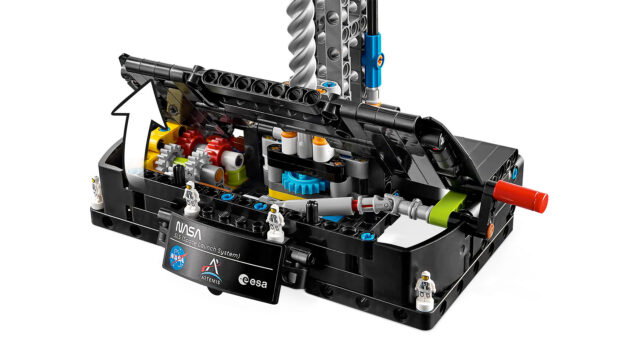
Illustration

The lid of the mobile launcher opens to reveal the gears that set the Lego Technic NASA Artemis Space Launch System Rocket into motion. Credit: LEGO

The new set captures all the major milestones of the first eight and a half minutes of an Artemis mission (with the exception of the jettison of the abort system tower, which on the real rocket occurs before the Orion separates from the core stage). Lego worked with NASA and the European Space Agency (ESA) to ensure the overall accuracy of the display.

“On the way up, there is sound. You can hear it—it is really noisy, the rocket,” said Olaf Kegger, the set’s designer at Lego, at an unveiling of his creation. He added that there is no sound when the motion is reversed, as the real SLS, “of course, does not go [back] down like this.”

Lego announces NASA Artemis SLS rocket set to lift off (literally) in 2026 Read More »
‘not-that-into-peace-doves’:-the-apollo-soyuz-patch-nasa-rejected

‘Not that into peace doves’: The Apollo-Soyuz patch NASA rejected

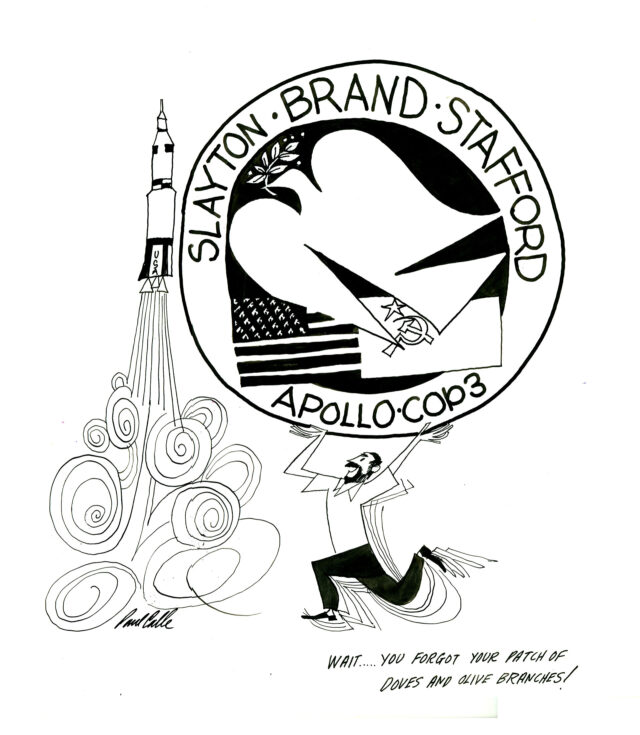
a black and white ink drawing of a man carrying an oversized space mission patch running towards a launching rocket

Paul Calle’s July 1975 cartoon poking fun at his own rejected mission patch for the joint Apollo-Soyuz Test Project. Credit: Calle Space Art

Rejects and revivals

Calle’s patch design was not the only one ruled out by NASA’s officials.

At first, Stafford, Brand, and Slayton chose a design from a contest among the US space program’s workforce. The winner, Jean Pinataro of North American Rockwell (the prime contractor for the Apollo command module), came up with a concept that the astronauts liked, but the agency’s leaders rejected it for not having enough “international significance” (unofficially, it was also said to be “cartoonish”).

That led to NASA accepting the cost of hiring an artist from the NASA art program and Calle being invited to offer his ideas. It also resulted in the patch that flew.

When Calle stepped away, the decision was made to repurpose the work of Bob McCall, an artist who had designed the Apollo 17 mission patch and in 1974 had painted the scene of the Apollo and Soyuz spacecraft nearing a docking. McCall would go on to create similar art for a pair of postage stamps issued in the United States and the Soviet Union, while Pinataro adapted McCall’s original painting as the central image of the US ASTP emblem.

The cosmonauts had their own design—in fact, it was the first Russian mission patch to involve the crew’s input—but wore both their own and the US patch during their six days in space.

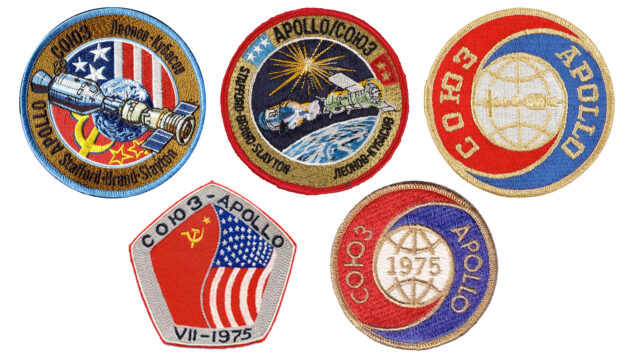
five colorful embroidered space patches each related to the 1975 Apollo -Soyuz Test Project

Apollo-Soyuz Test Project (ASTP) patches, from top left to right: 2021 embroidered replica of Jean Pinataro’s original design; the Soviet Soyuz 18 crew patch; the Apollo-Soyuz Test Project crew patch; souvenir ASTP program patch; and ASTP program patch. Credit: AB Emblem/Roscosmos/collectSPACE.com

Today, 50 years later, the McCall-inspired design, the cosmonauts’ patch, and the Apollo-Soyuz program insignia are used interchangeably to represent the mission. Calle’s designs have been largely forgotten but are now getting a revival for the golden anniversary.

“I wanted to reimagine them. Not redo them, but bring them to life,” said Chris.

Working with a fellow artist Tim Gagnon, who created a number of the mission patches worn by space shuttle and International Space Station crews, Chris has begun the process of producing a limited number of embroidered patches based on his and his late father’s ideas.

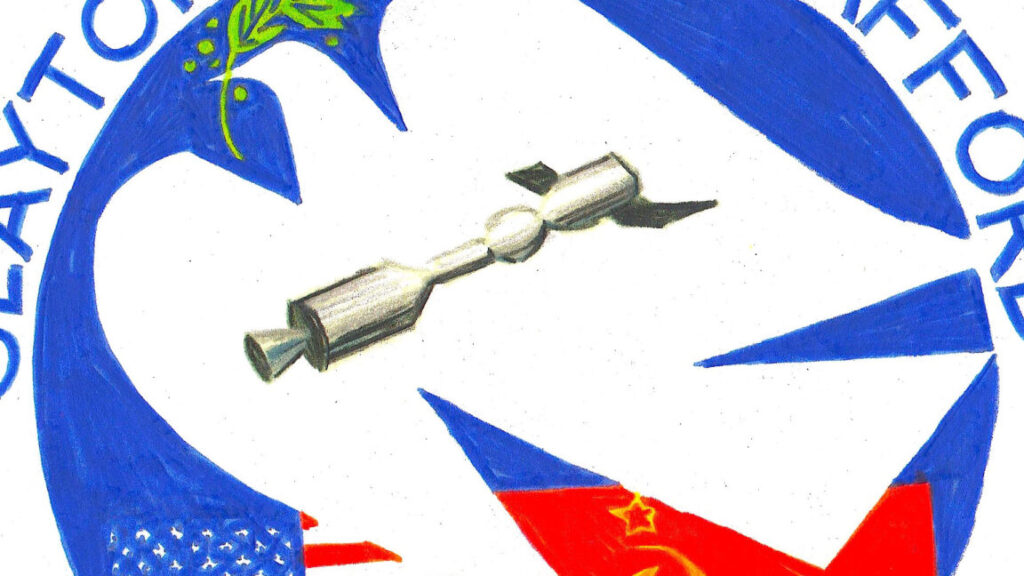
Chris primarily focused on Calle’s dove and olive branch design.

“It certainly keeps to the spirit of my dad’s original idea,” Chris said.

Chris Calle asks readers to contact him via his website to be informed about when the limited-edition Apollo-Soyuz patches are available.

Click through to collectSPACE to see more of Paul Calle’s original designs and the reimagined versions by Chris Calle and Tim Gagnon.

‘Not that into peace doves’: The Apollo-Soyuz patch NASA rejected Read More »