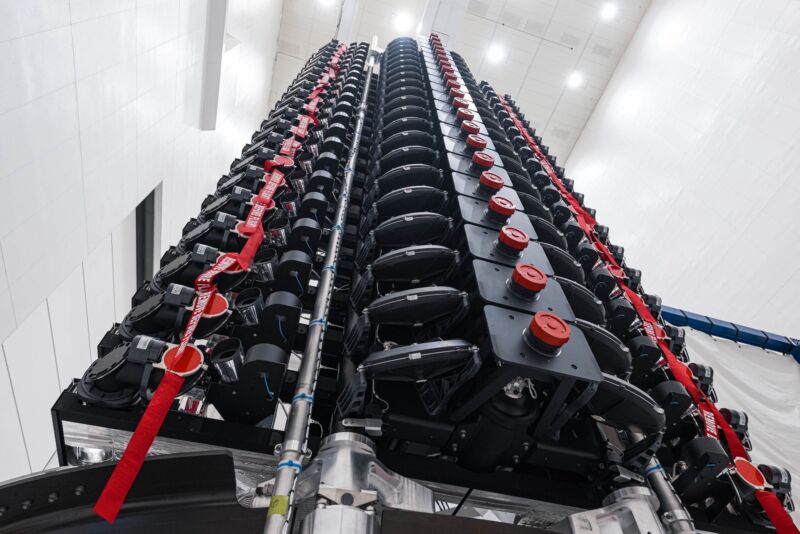
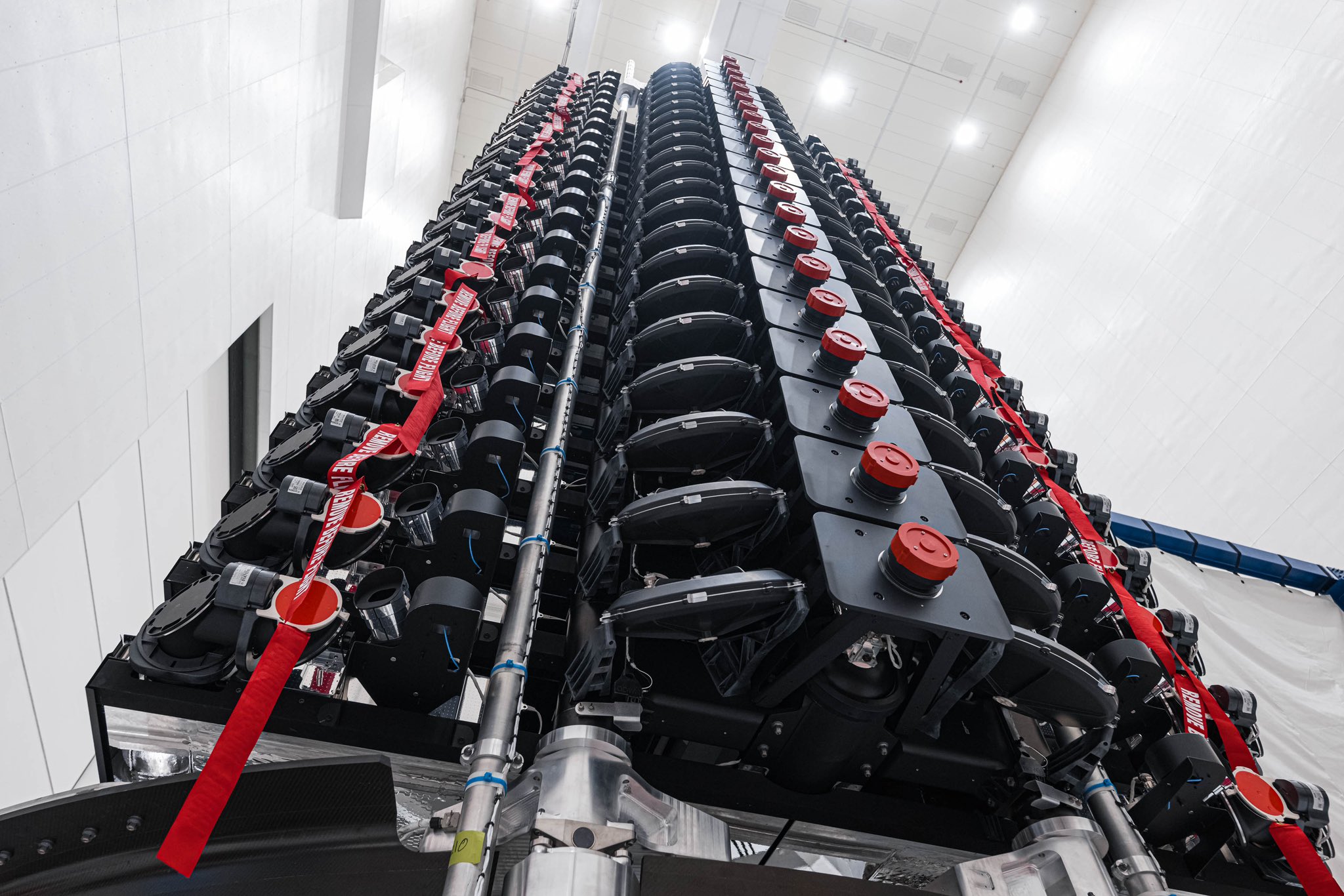
Enlarge/ SpaceX’s V2 Mini Starlink satellites awaiting launch.
SpaceX
SpaceX announced this week that it will voluntarily bring down about 100 of its first-generation Starlink satellites, which provide broadband Internet from low-Earth orbit, as part of its commitment to “space sustainability.”
The satellites are presently operational and serving Internet customers. However, in a statement, the company said, “The Starlink team identified a common issue in this small population of satellites that could increase the probability of failure in the future.”
This only represents a small fraction of the Starlink megaconstellation, which SpaceX has been launching on Falcon 9 rockets over the last half-decade. To date, SpaceX has put nearly 6,000 satellites into orbit a few hundred kilometers above the planet. This rapid growth in the company’s constellation has raised widespread concerns about the cluttering of low-Earth orbit and the potential for a profusion of debris.
Previously, SpaceX has initiated controlled de-orbits of 406 satellites. The vast majority of these have already entered Earth’s atmosphere and burnt up. However, 17 have become non-maneuverable. These are in decaying orbits and will eventually burn up in Earth’s atmosphere. Until such time, they are being tracked to prevent collisions with other satellites.
In its announcement this week, SpaceX is saying it will bring down about 100 additional Starlink satellites.
Why is SpaceX doing this?
The company said it is being proactive in deciding to bring down satellites that are currently operational.
“While this proactive approach comes at the cost of losing satellites that are serving users effectively, we believe it is the right thing to do to keep space safe and sustainable—SpaceX encourages all satellite owners and operators to safely de-orbit satellites before they become non-maneuverable,” the statement said.
If nothing else, this is a clever public relations move to get out ahead of satellite de-orbits that the space-tracking community would have spotted eventually. SpaceX is controlling the narrative, and it seems to have worked. The release of this information has, based upon several people I have spoken with, engendered goodwill in the community of scientists and activists who worry about orbital debris, clutter, and the sustainability of activity in low-Earth orbit.
However, there appears to be more to this announcement than simple public relations. SpaceX operates nearly two-thirds of all the active satellites in low-Earth orbit, and it is taking responsibility for reducing the likelihood of uncontrolled satellites whizzing around the planet hundreds of kilometers above the surface.
In this sense, SpaceX has taken an important step toward the establishment of a norm: proactive de-orbiting of one’s satellites.
What are the implications of it?
One of the fiercest protectors of low-Earth orbit is Moriba Jah, a co-founder and chief scientist at Privateer, a company that helps monitor congestion in orbit and seeks to enable sustainable growth of the new space economy. Jah told Ars he welcomed this step by SpaceX.
“Ensuring the safety and accessibility of space for all stakeholders is essential and we commend this commitment as a first step,” he said. “Proactive measures to deorbit satellites and share position information represent significant steps toward mitigating the risks associated with space debris.”
However, he added, this is just an interim step toward what should be a long-term goal—the recycling of satellites in space.
“While it may seem economically prudent to deorbit satellites and let them burn up in the atmosphere, the long-term implications of such practices on space sustainability, and the atmosphere itself, cannot be overlooked,” he said. “The long-term path to a circular space economy is in the adoption of reusable and recyclable satellites.”
This approach would reduce the potential for orbital debris and foster a culture of responsible space operations.
There has been some government leadership in this direction. The United States, primarily but not exclusively through NASA, has been pushing for in-space repairing and reviving of satellites to extend their useful lifetimes, including refurbishment activities. Additionally, the European Space Agency has embraced a “Zero Debris Charter” to drive the development of technologies required for no more debris to be left in orbit by 2030.
In releasing this statement, and proactively deorbiting its own spacecraft, the world’s largest operator of satellites has indicated that it wants to play ball.
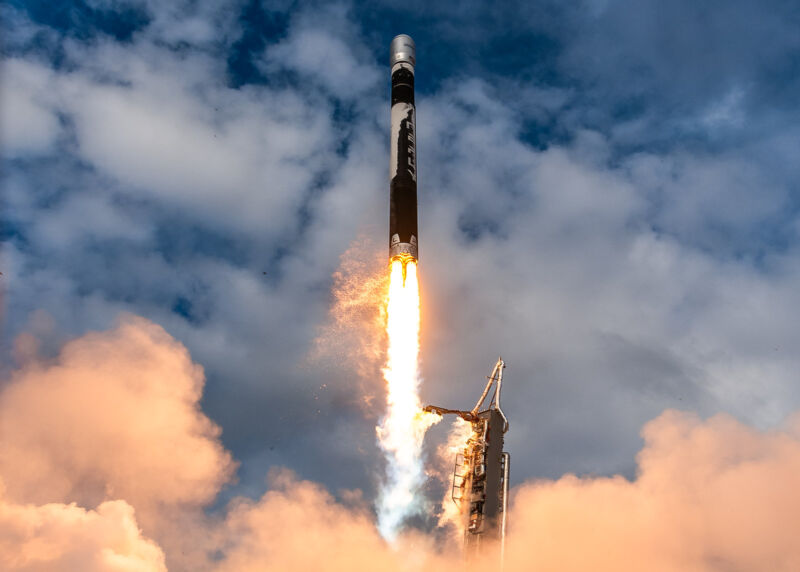
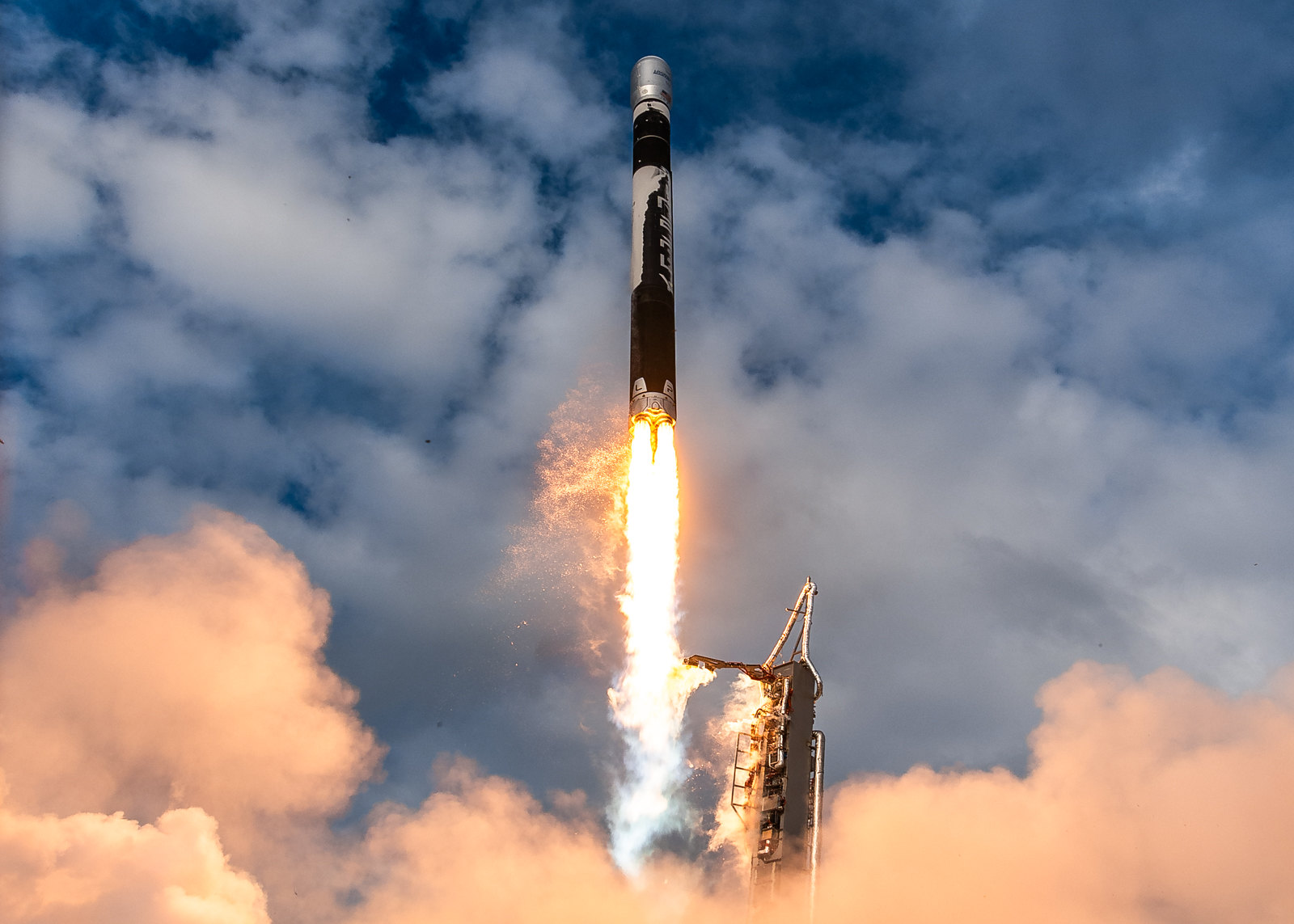
Enlarge/ Firefly Aerospace’s fourth Alpha rocket lifted off December 22 from Vandenberg Space Force Base, California.
Welcome to Edition 6.25 of the Rocket Report! We hope all our readers had a peaceful holiday break. While many of us were enjoying time off work, launch companies like SpaceX kept up the pace until the final days of 2023. Last year saw a record level of global launch activity, with 223 orbital launch attempts and 212 rockets successfully reaching orbit. Nearly half of these missions were by SpaceX.
As always, we welcome reader submissions, and if you don’t want to miss an issue, please subscribe using the box below (the form will not appear on AMP-enabled versions of the site). Each report will include information on small-, medium-, and heavy-lift rockets, as well as a quick look ahead at the next three launches on the calendar.
Firefly’s fourth launch puts payload in wrong orbit. The fourth flight of Firefly Aerospace’s Alpha rocket on December 22 placed a small Lockheed Martin technology demonstration satellite into a lower-than-planned orbit after lifting off from Vandenberg Space Force Base, California. US military tracking data indicated the Alpha rocket released its payload into an elliptical orbit ranging between 215 and 523 kilometers in altitude, not the mission’s intended circular target orbit. Firefly later confirmed the Alpha rocket’s second stage, which was supposed to reignite about 50 minutes after liftoff, did not deliver Lockheed Martin’s satellite into the proper orbit. This satellite, nicknamed Tantrum, was designed to test Lockheed Martin’s new wideband Electronically Steerable Antenna technology to demonstrate faster on-orbit sensor calibration to deliver rapid capabilities to US military forces.
Throwing a tantrum? … This was the third time in four flights that Firefly’s commercial Alpha rocket, designed to loft payloads up to a metric ton in mass, has not reached its orbital target. The first test flight in 2021 suffered an engine failure on the first stage before losing control shortly after liftoff. The second Alpha launch in 2022 deployed its satellites into a lower-than-planned orbit, leaving them unable to complete their missions. In September, Firefly launched a small US military satellite on a responsive launch demonstration. Firefly and the US Space Force declared that mission fully successful. Atmospheric drag will likely pull Lockheed Martin’s payload back into Earth’s atmosphere for a destructive reentry in a matter of weeks. The good news is ground teams are in contact with the satellite, so there could be a chance to complete at least some of the mission’s objectives. (submitted by Ken the Bin)
Australian startup nears first launch. The first locally made rocket to be launched into space from Australian soil is scheduled for liftoff from a commercial facility in Queensland early next year, the Australian Broadcasting Corporation reports. A company named Gilmour Space says it hopes to launch its first orbital-class Eris rocket in March, pending final approval from Australian regulatory authorities. This would be the first Australian-built orbital rocket, although a US-made rocket launched Australia’s first satellite from a military base in South Australia in 1967. The UK’s Black Arrow rocket also launched a satellite from the same remote Australian military base in 1971.
Getting to know Eris … The three-stage Eris rocket stands 25 meters (82 feet) tall with the ability to deliver up to 300 kilograms (660 pounds) of payload into low-Earth orbit, according to Gilmour Space. The company says the Eris rocket will be powered by Gilmour’s “new and proprietary hybrid rocket engine.” These kinds of propulsion systems use a solid fuel and a liquid oxidizer. We’ll be watching to see if Gilmour shares more tangible news about the progress toward the first Eris launch in March. In late 2022, the company targeted April 2023 for the first Eris flight, so this program has a history of delays. (submitted by Marzipan and Onychomys)
The easiest way to keep up with Eric Berger’s space reporting is to sign up for his newsletter, we’ll collect his stories in your inbox.
A commander’s lament on the loss of a historic SpaceX booster. The Falcon 9 rocket that launched NASA astronauts Doug Hurley and Bob Behnken on SpaceX’s first crew mission in 2020 launched and landed for the 19th and final time just before Christmas, then tipped over on its recovery ship during the trip back to Cape Canaveral, Florida, Ars reports. This particular booster, known by the tail number B1058, was special among SpaceX’s fleet of reusable rockets. It was the fleet leader, having tallied 19 missions over the course of more than three-and-a-half years. More importantly, it was the rocket that thundered into space on May 30, 2020, on a flight that made history.
A museum piece? … The lower third of the booster was still on the deck of SpaceX’s recovery ship as it sailed into Port Canaveral on December 26. This portion of the rocket contains the nine Merlin engines and landing legs, some of which appeared mangled after the booster tipped over in high winds and waves. Hurley, who commanded SpaceX’s Crew Dragon spacecraft on the booster’s historic first flight in 2020, said he hopes to see the remaining parts of the rocket in a museum. “Hopefully they can do something because this is a little bit of an inauspicious way to end its flying career, with half of it down at the bottom of the Atlantic Ocean,” said Hurley.
SpaceX opens 2024 campaign with a new kind of Starlink satellite. SpaceX has launched the first six Starlink satellites that will provide cellular transmissions for customers of T-Mobile and other carriers, Ars reports. A Falcon 9 rocket launched from California on January 2 carried 21 Starlink satellites overall, including the first six Starlinks with Direct to Cell capabilities. SpaceX says these satellites, and thousands of others to follow, will “enable mobile network operators around the world to provide seamless global access to texting, calling, and browsing wherever you may be on land, lakes, or coastal waters without changing hardware or firmware.” T-Mobile said that field testing of Starlink satellites with the T-Mobile network will begin soon. “The enhanced Starlink satellites have an advanced modem that acts as a cellphone tower in space, eliminating dead zones with network integration similar to a standard roaming partner,” SpaceX said.
Two of 144 … SpaceX followed this launch with another Falcon 9 flight from Florida on January 3 carrying a Swedish telecommunications satellite. These were the company’s first two missions of 2024, a year when SpaceX officials aim to launch up to 144 rockets, an average of 12 per month, exceeding the 98 rockets it launched in 2023. A big focus of SpaceX’s 2024 launch manifest will be delivering these Starlink Direct to Cell satellites into orbit. (submitted by Ken the Bin)
Chinese booster lands near homes. China added a new pair of satellites to its Beidou positioning and navigation system on December 25, but spent stages from the launch landed within inhabited areas, Space News reports. Meanwhile, a pair of the side boosters from the Long March 3B rocket used for the launch appeared to fall to the ground near inhabited areas in Guangxi region, downrange of the Xichang spaceport in Sichuan province, according to apparent bystander footage on Chinese social media. One video shows a booster falling within a forested area and exploding, while another shows a falling booster and later, wreckage next to a home.
Life downrange … Chinese government authorities reportedly issue warnings and evacuation notices for citizens living in regions where spent rocket boosters are likely to fall after launch, but these videos clearly show people are still close by as the rockets fall from the sky. We’ve seen this kind of imagery before, including views of a rocket that crashed into a rural building in 2019. What’s more, the rockets return to Earth with leftover toxic propellants—hydrazine and nitrogen tetroxide—that could be deadly to breathe or touch. Clouds of brownish-orange gas are visible around the rocket wreckage, an indication of the presence of nitrogen tetroxide. China built its three Cold War-era spaceports in interior regions to protect them from possible military attacks, while its newest launch site is at a coastal location on Hainan Island, allowing rockets launched there to drop boosters into the sea. (submitted by Ken the Bin and EllPeaTea)
Launch date set for next H3 test flight. The second flight of Japan’s new flagship H3 rocket is scheduled for February 14 (US time; February 15 in Japan), the Japan Aerospace Exploration Agency announced on December 28. This will come nearly one year after the first H3 test flight failed to reach orbit last March when the rocket’s second stage failed to ignite a few minutes after liftoff. This failure destroyed a pricey Japanese Earth observation satellite and dealt a setback to Japan’s rocket program. The H3 is designed to be cheaper and more capable than the H-IIA and H-IIB rockets it will replace. Eventually, the H3 will launch Japan’s scientific research probes, spy satellites, and commercial payloads.
Fixes since the first flight … Engineers narrowed the likely cause for the first H3 launch failure to an electrical issue, although Japanese officials have not provided an update on the investigation for several months. In August, Japan’s space agency said investigators had narrowed the cause of the H3’s second-stage malfunction to three possible failure scenarios. Nevertheless, officials are apparently satisfied the H3 is ready to fly again. But this time, there won’t be an expensive satellite aboard. A dummy payload will fly inside the H3 rocket’s nose cone, along with two relatively low-cost small satellites hitching a piggyback ride to orbit. (submitted by Ken the Bin and EllPeaTea)
India’s PSLV launches first space mission of 2024. The first orbital launch of the new year, as measured in the globally recognized Coordinated Universal Time, or UTC, was the flight of an Indian Polar Satellite Launch Vehicle (PSLV) on January 1 (December 31 in the United States). This launch deployed an X-ray astronomy satellite named XPoSat, which will measure X-ray emissions from black holes, neutron stars, active galactic nuclei, and pulsars. This is India’s first X-ray astronomy satellite, and its launch is another sign of India’s ascendence among the world’s space powers. India has some of the world’s most reliable launch vehicles, is developing a human-rated capsule to carry astronauts into orbit, and landed its first robotic mission on the Moon last year.
Going lower … After releasing the XPoSat payload, the PSLV’s fourth stage lowered its orbit to begin an extended mission hosting 10 scientific and technology demonstration experiments. These payloads will test new radiation shielding technologies, green propulsion, and fuel cells in orbit, according to the Indian Space Research Organization. On missions with excess payload capacity, India has started offering researchers and commercial companies the opportunity to fly experiments on the PSLV fourth stage, which has its own solar power source to essentially turn itself from a rocket into a satellite platform. (submitted by EllPeaTea and Ken the Bin)
Mixed crews will continue flying to the International Space Station. NASA and the Russian space agency, Roscosmos, will extend an agreement on flying each other’s crew members to the International Space Station through 2025, Interfax reports. This means SpaceX’s Crew Dragon spacecraft and Boeing’s Starliner capsule, once operational, will continue transporting Russian cosmonauts to and from the space station, as several recent SpaceX crew missions have done. In exchange, Russia will continue flying US astronauts on Soyuz missions.
There’s a good reason for this… Despite poor relations on Earth, the US and Russian governments continue to be partners on the ISS. While NASA no longer has to pay for seats on Soyuz spacecraft, the US space agency still wants to fly its astronauts on Soyuz to protect against the potential for a failure or lengthy delay with a SpaceX or Boeing crew mission. Such an event could lead to a situation where the space station has no US astronauts aboard. Likewise, Roscosmos benefits from this arrangement to ensure there’s always a Russian on the space station, even in the event of a problem with Soyuz. (submitted by Ken the Bin)
SpaceX sets new records to close out 2023. SpaceX launched two rockets, three hours apart, to wrap up a record-setting 2023 launch campaign, Ars reports. On December 28, SpaceX launched a Falcon Heavy rocket from NASA’s Kennedy Space Center in Florida with the US military’s super-secret X-37B spaceplane. Less than three hours later, a Falcon 9 rocket took off a few miles to the south with another batch of Starlink Internet satellites. These were SpaceX’s final launches of 2023. SpaceX ended the year with 98 flights, including 91 Falcon 9s, five Falcon Heavy rockets, and two test launches of the giant new Super Heavy-Starship rocket. These flights were spread across four launch pads in Florida, California, and Texas. It was also the shortest turnaround between two SpaceX flights in the company’s history, and set a modern-era record at Cape Canaveral, Florida, with the shortest span between two orbital-class launches there since 1966.
Where’s the X-37B?… The military’s reusable X-37B spaceplane that launched on the Falcon Heavy rocket apparently headed into an unusually high orbit, much higher than the spaceplane program’s previous six flights. But the military kept the exact orbit a secret, and amateur skywatchers will be closely watching for signs of the spaceplane passing overhead in hopes of estimating its apogee, perigee, and inclination. What the spaceplane is doing is also largely a mystery. The X-37B resembles a miniature version of NASA’s retired space shuttle orbiter, with wings, deployable landing gear, and black thermal protection tiles to shield its belly from the scorching heat of reentry.
Elon Musk says SpaceX needs to built a lot of Starships. Even with reusability, SpaceX will need to build Starships as often as Boeing builds 737 jetliners in order to realize Elon Musk’s ambition for a Mars settlement, Ars reports. “To achieve Mars colonization in roughly three decades, we need ship production to be 100/year, but ideally rising to 300/year,” Musk wrote on his social media platform X. SpaceX still aims to make the Starship and its Super Heavy booster rapidly reusable. The crux is that the ship, the part that would travel into orbit, and eventually to the Moon or Mars, won’t be reused as often as the booster. These ships will come in a number of different configurations, including crew and cargo transports, refueling ships, fuel depots, and satellite deployers.
Laws of physics… The first stage of the giant launch vehicle, named Super Heavy, is designed to return to SpaceX’s launch sites about six minutes after liftoff, similar to the way SpaceX recovers its Falcon boosters today. Theoretically, Musk wrote, the booster could be ready for another flight in an hour. With the Starship itself, the laws of physics and the realities of geography come into play. As an object flies in low-Earth orbit, the Earth rotates underneath it. This means that a satellite, or Starship, will find itself offset some 22.5 degrees in longitude from its launch site after a single 90-minute orbit around the planet. It could take several hours, or up to a day, for a Starship in low-Earth orbit to line up with one of the recovery sites. “The ship needs to complete at least one orbit, but often several to have the ground track line back up with the launch site, so reuse may only be daily,” Musk wrote. “This means that ship production needs to be roughly an order of magnitude higher than booster production.”
Next three launches
January 5: Kuaizhou 1A | Unknown Payload | Jiuquan Satellite Launch Center, China | 11: 20 UTC
January 7: Falcon 9 | Starlink 6-35 | Cape Canaveral Space Force Station, Florida | 21: 00 UTC
January 8: Falcon 9 | Starlink 7-10 | Vandenberg Space Force Base, California | 05: 00 UTC
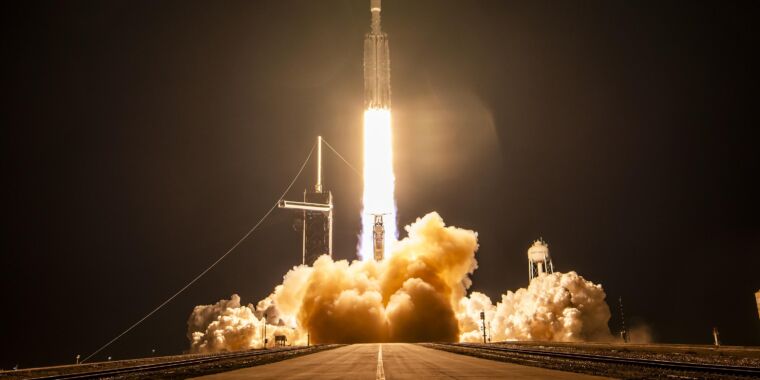
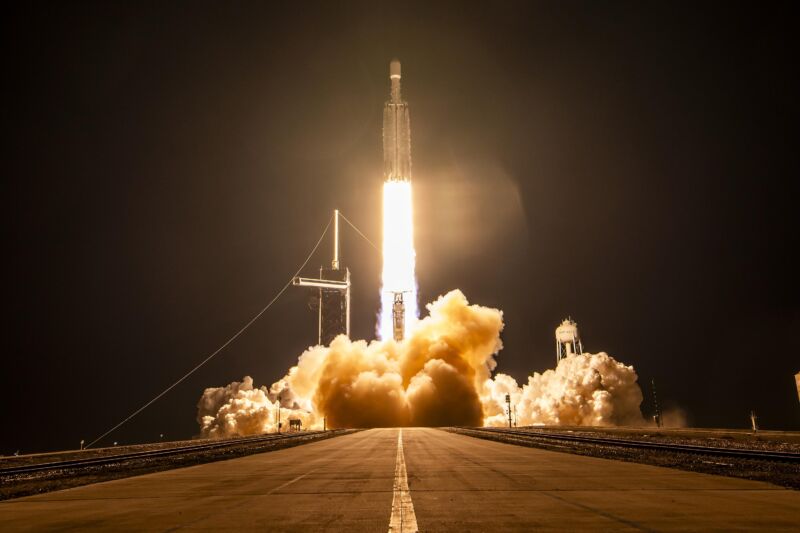
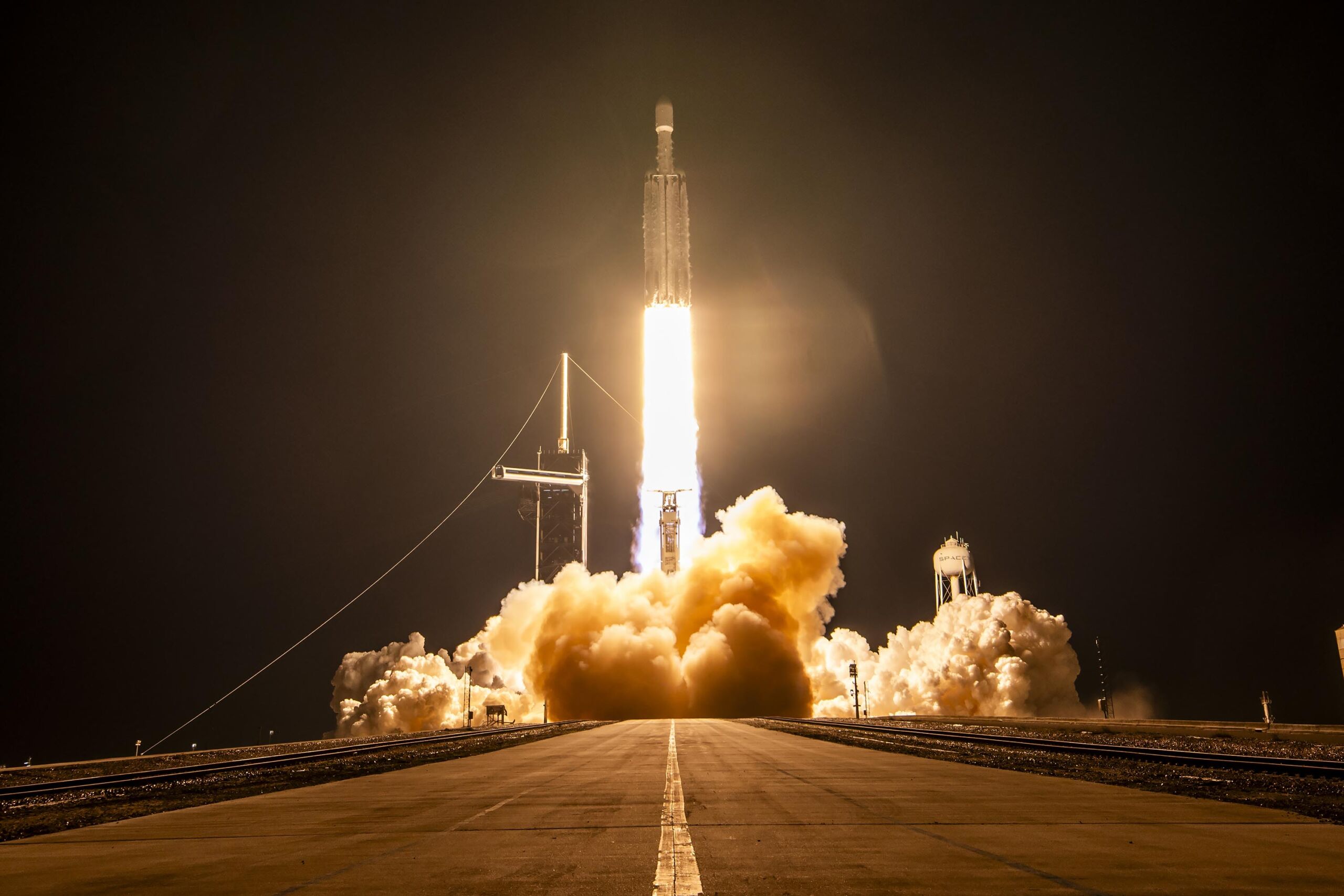
Enlarge/ SpaceX’s Falcon Heavy rocket lifted off Thursday night from NASA’s Kennedy Space Center in Florida.
It seems like SpaceX did everything this year but launch 100 times.
On Thursday night, the launch company sent two more rockets into orbit from Florida. One was a Falcon Heavy, the world’s most powerful rocket in commercial service, carrying the US military’s X-37B spaceplane from a launch pad at NASA’s Kennedy Space Center at 8: 07 pm EST (01: 07 UTC). Less than three hours later, at 11: 01 pm EST (04: 01 UTC), SpaceX’s workhorse Falcon 9 launcher took off a few miles to the south with a payload of 23 Starlink Internet satellites.
The Falcon Heavy’s two side boosters and the Falcon 9’s first stage landed back on Earth for reuse.
These were SpaceX’s final launches of 2023. SpaceX ends the year with 98 flights, including 91 Falcon 9s, five Falcon Heavy rockets, and two test launches of the giant new Super Heavy-Starship rocket. These flights were spread across four launch pads in Florida, California, and Texas.
Elon Musk, SpaceX’s founder and CEO, set a goal of 100 launches this year, up from the company’s previous record of 61 in 2022. For a while, it looked like SpaceX was on track to accomplish the feat, but a spate of bad weather and technical problems with the final Falcon Heavy launch of the year kept the company short of 100 flights.
King of ‘upmass’
“Congrats to the entire Falcon team at SpaceX on a record breaking 96 launches in 2023!” wrote Jon Edwards, vice president of Falcon launch vehicles at SpaceX, on the social media platform X. “I remember when Elon Musk first threw out a goal of 100 launches as a thought experiment, intended to unlock our thinking as to how we might accelerate Falcon across all levels of production and launch.
“Only a few years later and here we are,” Edwards wrote. “I’m so incredibly proud to work with the best team on Earth, and so excited to see what we achieve next year.”
It’s important to step back and put these numbers in context. No other family of orbit-class rockets has ever flown more than 63 times in a year. SpaceX’s Falcon rockets have now exceeded this number by roughly 50 percent. SpaceX’s competitors in the United States, such as United Launch Alliance and Rocket Lab, managed far fewer flights in 2023. ULA had three missions, and Rocket Lab launched its small Electron booster 10 times.
Nearly two-thirds of SpaceX’s missions this year were dedicated to delivering satellites to orbit for SpaceX’s Starlink broadband network, a constellation that now numbers more than 5,000 spacecraft.
SpaceX also launched five missions with the Falcon Heavy rocket, created by aggregating three Falcon 9 rocket boosters together. Highlights from SpaceX’s 2023 Falcon launch schedule included three crew missions to the International Space Station, and the launch of NASA’s Psyche mission to explore a metallic asteroid.
In all, SpaceX’s Falcon rockets hauled approximately 1,200 metric tons, or more than 2.6 million pounds, of payload mass into orbit this year. This “upmass” is equivalent to nearly three International Space Stations. Most of this was made up of mass-produced Starlink satellites.