the elder scrolls iii: morrowind

inside-the-quixotic-team-trying-to-build-an-entire-world-in-a-20-year-old-game

Inside the quixotic team trying to build an entire world in a 20-year-old game


Stories and lesson learned from an impossibly large community modding project.

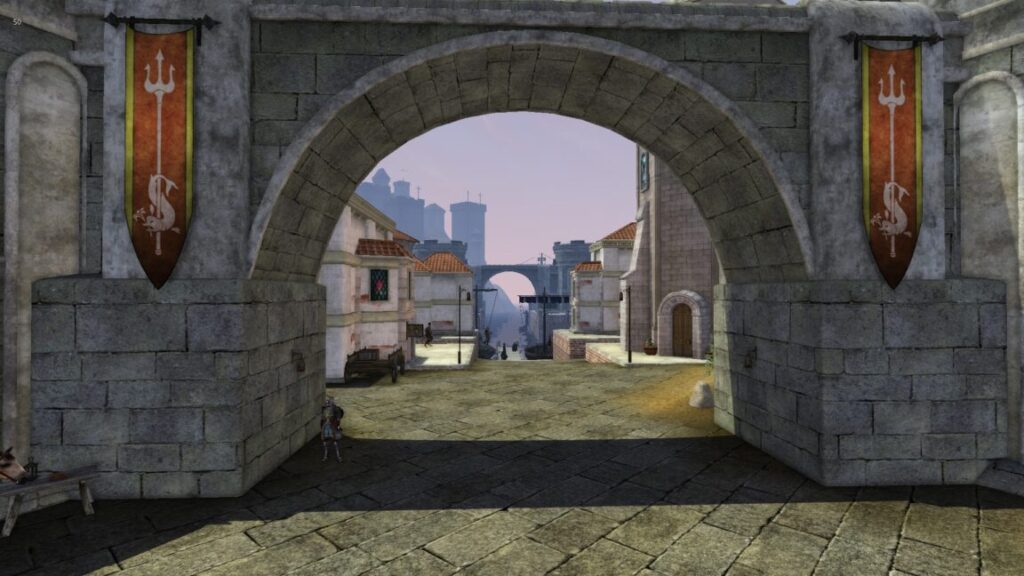
The city of Anvil, rendered in The Elder Scrolls III: Morrowind. Credit: Daniel Larlham Jr.

Despite being regarded as one of the greatest role-playing games of all time, The Elder Scrolls III: Morrowind disappointed some fans upon its release in 2002 because it didn’t match the colossal scope of its predecessor, The Elder Scrolls II: Daggerfall. Almost immediately, fans began modding the remaining parts of the series’ fictional continent, Tamriel, into the game.

Over 20 years later, thousands of volunteers have collaborated on the mod projects Tamriel Rebuilt and Project Tamriel, building a space comparable in size to a small country. Such projects often sputter out, but these have endured, thanks in part to a steady stream of small, manageable updates instead of larger, less frequent ones.

A tale of (at least two) mods

It’s true that Daggerfall included an entire continent’s worth of content, but it was mostly composed of procedurally generated liminal space. By contrast, Morrowind contained just a single island—not even the entire province after which the game was named. The difference was that it was handcrafted.

Still, a player called “Ender,” stewing in disappointment over Morrowind’s perceived scope, took to an Elder Scrolls forum to propose a collaborative effort to mod the rest of Tamriel into the game. Tamriel Rebuilt was born.

After realizing that re-creating the entire continent was too lofty a goal, the group decided to instead focus on the rest of the Morrowind province alone—but that didn’t last long.

There had been others working toward similar goals. The makers of the fan project “Skyrim: Home of The Nords” were working on putting the province of Skyrim into Morrowind well before that location was officially made the setting of the 2011 sequel The Elder Scrolls V: Skyrim.
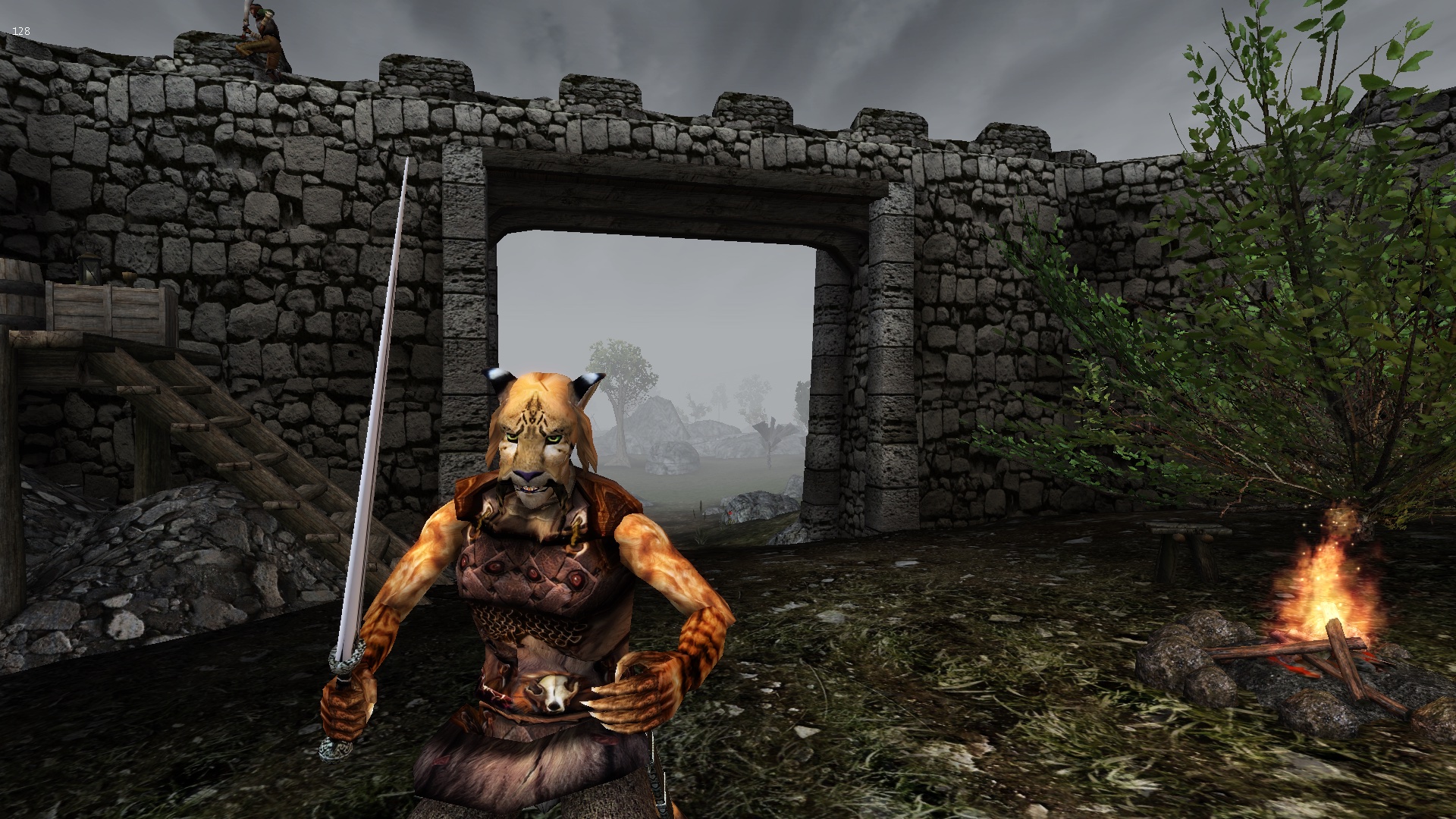
A Khajiit attacks inside a fort in Skyrim

A screenshot from Skyrim: Home of the Nords.

Credit: Daniel Larlham Jr.

A screenshot from Skyrim: Home of the Nords. Credit: Daniel Larlham Jr.

Other modders were working on “Project Cyrodilll,” an attempt to put The Elder Scrolls IV: Oblivion’s province into Morrowind. In 2015, those two projects combined to form Project Tamriel, reigniting the goal of adding the remaining provinces of Tamriel.

Tamriel Rebuilt and Project Tamriel first became connected when the modders decided to combine their asset repositories into Tamriel_Data, but they have since grown closer through their shared developers, training protocols, and tools.

“The entirety of Tamriel is, in our scale, roughly the size of the real-life country of Malta, which is small in real life, but quite big from a human perspective,” said Tiny Plesiosaur, a senior developer who has done mapping and planning for both projects but who spends most of her time on Project Tamriel these days.

Both projects aim to create a cohesive, lore-accurate representation of these realms as they would have looked during the fictional historical period in which Morrowind takes place. So far, they’ve made substantial progress.

One thing in their favor, said Mort, a 13-year veteran quest-designer of Tamriel Rebuilt, is that Morrowind design makes it especially amenable to large-scale modding.

“I’d say the thing that makes Morrowind most conducive to these kinds of projects is no voiced dialogue,” Mort said. “The reason that you see so many quest mods for Morrowind as opposed to Oblivion and Skyrim and even Fallout is that the barrier to make a quest is essentially nothing.”

Frequent, contained public releases also work to their advantage. “I know for a lot of projects, they want to [do a] ‘we’ll release it when it’s done’ kind of thing,” said Mort. “We’ve found that releasing content builds hype, it gives players what they want, and perhaps most importantly, it serves as a proof of life and a fantastic recruitment tool.”

Every time Tamriel Rebuilt pushes a release, he said, the team picks up at least a dozen devs almost immediately. So far, Tamriel Rebuilt has seen nine releases; the most recent is titled “Grasping Fortune.” The next release, “Poison Song,” is expected sometime in 2026 and will include a never-before-seen faction. The most optimistic estimate for when the project will be fully finished is 2035.
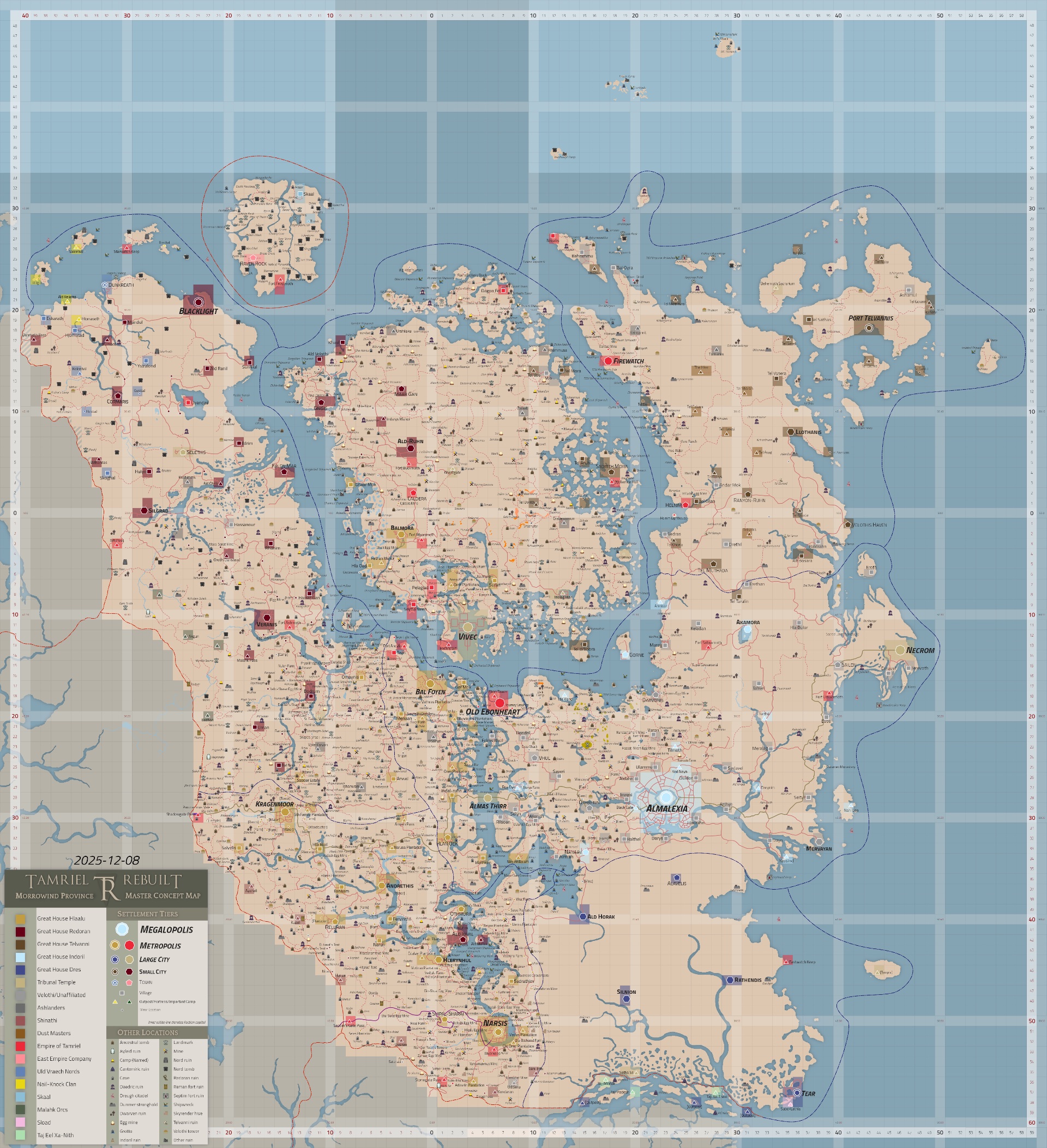
A map of the province of Morrowind for the Tamriel Rebuilt project. Note that the original game includes only the large island in the bay in the top half of the image.

Credit: Tamriel Rebuilt

A map of the province of Morrowind for the Tamriel Rebuilt project. Note that the original game includes only the large island in the bay in the top half of the image. Credit: Tamriel Rebuilt

Project Tamriel has made most of its progress in Skyrim and Cyrodiil. The release of “Abecean Shores,” the coastal section of Cyrodiil, came in late 2024. Together, the projects have added hundreds of hours of hand-crafted quests, dungeons, and landscapes to a game that was already robust.

Lus said the current timeline for Project Tamriel is a new release for Skyrim and then Cyrodill, followed by either High Rock—a comparatively smaller, peninsula province west of Skyrim—or the desert province of Hammerfell.

For many developers, the point isn’t to see these massive projects in a finished state but to complete the next task and hopefully bring the team closer to the next release.

A brief history of Tamriel Rebuilt

Sultan of Rum, a kind of historian for Tamriel Rebuilt, joked that the project was aptly named because of how many times it has been rebuilt—partly because the tools the modders use to build the project have gotten better over time, rendering work done before those advances obsolete.

But even then, Tamriel Rebuilt was more of a Wild West in its infancy: a ragtag bunch of video game enthusiasts working mostly independently and without very much oversight. As the project has become more unified, it has meant a lot of turnover and a fair share of setbacks.

“If you took a satellite picture of the game world in 2005, you’d have essentially a complete province already,” Sultan of Rum said. “But the trouble was that the quality wasn’t good; there was no coherence. The 5 percent of the work to just create a landmass was done, but the management wasn’t there.”

Much of the project’s history has been lost to time as Internet forums disappeared, but Sultan of Rum has been able to piece together some of the growing pains Tamriel Rebuilt has endured. A struggle between the need to centralize and the desire of some modders to remain independent is a recurring theme.

One period is considered a dark age for Tamriel Rebuilt. In the first couple of years, a significant group of modders had been working on a piece of content for the project called “Silgrad Tower,” while the project simultaneously began consolidating to build continuity.

Concept art for the project. ThomasRuz

There was debate among the modders about where Silgrid Tower should be located and which faction would have controlled it. This eventually led to an acrimonious split between the two groups. “The Silgrid Tower team was eventually put to the choice of either having to delete their work and restart it or, you know, leave the project. So they left the project,” said Sultan of Rum.

He said that much of the conflict has since been scrubbed from the forum archives, and the ordeal led to the deletion of the Tamriel Rebuilt forums, which were hosted by the Silgrid Tower team. This was probably the most drama the project has seen, he said.

There was also a period when the project moved to The Elder Scrolls IV: Oblivion’s construction set. “Maybe even a majority of the project jumped onto the [Oblivion] engine to start building out Hammerfell,” said Sultan of Rum. “So for a long time—four years—the sort of focus point of Tamriel Rebuilt was on Oblivion and on the province of Hammerfell, not on the Morrowind part, which of course was the successful one.”

Another event is solemnly referred to as “The Great Self-Decapitation.” Sultan of Rum explained that around 2015, some of the older guard—developers and administrators alike—left the project all at once. The exodus was due to the second scrapping of a large city in development.

“People were hoping that by 2013 it would come out. Literally thousands of hours of human labor were spent creating it in the construction set,” recalled Sultan of Rum. “It just turned out that it was non-viable as a playable space. It wasn’t thought out well enough, it didn’t coalesce into a compelling, playable world. The modders were faced with the prospect of having to throw out just a huge chunk of work.”

That decision sapped a lot of energy from the project, and others on the team began to move away from it as their personal lives became busier. Sultan of Rum said all this has made the project better in the long run. Project leaders soon instituted better planning and management systems that centralized information and preserved institutional knowledge in case longtime developers decide to leave.

Over the years, they’ve also refined their training practices, which has ultimately led to more developers joining both projects.

“If your goal is to get development done, providing as much detail and tutorializing and onboarding processes, making that as simple as possible is going to get you your best results,” said Mort. “Because, again, if you aren’t gaining devs, you’re losing devs.”

The parameters for onboarding new developers are now clearly defined, with a low barrier to entry focused on competence with the tools. These tests are called showcases.

Once the showcase is accepted, developers can begin working on both Tamriel Rebuilt and Project Tamriel, where much of the overlap between the two lies.

Mort added that the gap between a potential developer expressing interest and actively contributing can be as little as a week. This also allows movement between roles—for example, an interior designer training in exterior designing or someone starting in quest design moving elsewhere if it’s not a good fit.

Even more importantly, newer tech has improved the development process. The open source 3D modeling and animation tool Blender has become much friendlier to Morrowind modders, enabling teams to create custom assets more easily.

While this has required retouching some areas of Tamriel Rebuilt, it has also meant quicker turnaround times for custom assets. For Project Tamriel developers, the impact has been greater, as they can now reliably and routinely create assets to better represent Tamriel’s diverse cultures.

The old informs the new

The developers are well aware that both projects may still be unfinished 10 years from now, but most are just working toward the next release.

Discussing the project with just a few of the developers, it’s immediately clear how current work will inform future efforts.

For example, LogansGun is an exterior developer who did much of the work on the promotional videos for Tamriel Rebuilt’s last few releases. He joined the project because he wanted to leave his mark on this historical effort and ended up staying much longer than he thought he would.

Between work and raising a family, LogansGun often found himself working on Tamriel Rebuilt instead of playing video games, partly because of a childhood love for Morrowind and a desire to make the game more than it was.

“I remember playing it a lot, and it really stuck with me,” LogansGun said. “And it might have been like 5th or 6th grade that I had a friend and we all sat in like a four-student pod, and he would bring the map inside the plastic Xbox disc case. When we had some free time in class, he’d lay it out, and we’d all be looking all over the map of Vvardenfell and all the things that we had explored or wanted to explore.”
A city spire against the sky

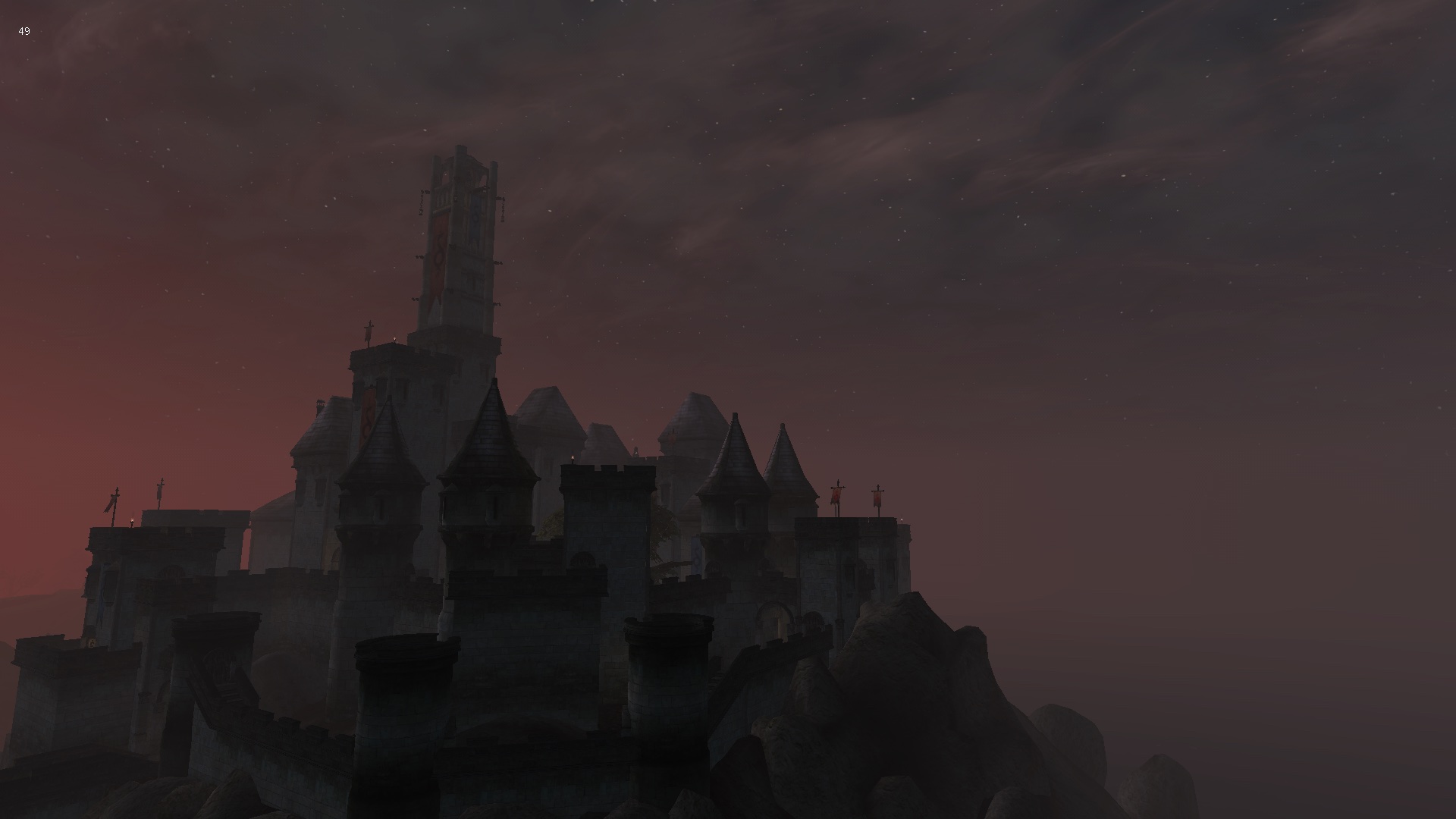
Another environment from the game, Old Ebonheart.

Credit: Daniel Larlham Jr.

Another environment from the game, Old Ebonheart. Credit: Daniel Larlham Jr.

Meadhainnigh, a college-aged chemical engineering student, first learned about Tamriel Rebuilt through the promotional video for Grasping Fortune, the project’s most recent update. The roughly three-minute video showcases some of the landscapes, cityscapes, and interiors, the culmination of thousands of hours of work. LogansGun is credited as the creator of that video, which has been used to inspire the next wave of contributors.

“I was thinking, well, this seems like a really cool project, and I just wanted to contribute and feel part of something bigger, and the rest is history, really,” said Meadhainnigh, who is now an asset dev for Project Tamriel. “But I joined the Discord server. I kind of learned the process of the project, and once I felt like I knew what I was going on, I tossed my hat in the ring.”

Meadhainnigh knew very little about development before he joined the project, and he said it’s the first online community he has been a part of. What keeps him going is that community—and to see his and others’ work become a part of a whole.

“We have some really wonderful people who are the old guard that feel like they are the comfortable welders, and they’re all very wise,” he said. “But even in the newest editions, we’re not here because we think that it’s all going to be done within our lifetimes. We like to joke about 2090 and about raising our children to work on the project. We just like to look at the next release, and that tends to be exciting enough to get us going.”

Inside the quixotic team trying to build an entire world in a 20-year-old game Read More »
ars’-favorite-games-of-2024-that-were-not-released-in-2024

Ars’ favorite games of 2024 that were not released in 2024


Look what we found laying around

The games that found us in 2024, from 2003 space sims to 2022 backyard survival.

More than 18,500 games will have been released onto the PC gaming platform Steam in the year 2024, according to SteamDB. Dividing that by the number of people covering games at Ars, or the gaming press at large, or even everybody who games and writes about it online, yields a brutal ratio.

Games often float down the river of time to us, filtered by friends, algorithms, or pure happenstance. They don’t qualify for our best games of the year list, but they might be worth mentioning on their own. Many times, they’re better games then they were at release, either by patching or just perspective. And they are almost always lower priced.

Inspired by the cruel logic of calendars and year-end lists, I asked my coworkers to tell me about their favorite games of 2024 that were not from 2024. What resulted were some quirky gems, some reconsiderations, and some titles that just happened to catch us at the right time.

Stardew Valley

Screenshot from Stardew Valley, in front of the blacksmith's shop, where a player character is holding up a bone (for some reason).

Credit: ConcernedApe


ConcernedApe; Basically every platform

After avoiding it forever and even bouncing off of it once or twice, I finally managed to fall face-first into Stardew Valley (2016) in 2024. And I’ve fallen hard—I only picked it up in October, but Steam says I’ve spent about 110 hours playing farmer.

In addition to being a fun distraction and a great way to kill both short and long stretches of time, what struck me is how remarkably soothing the game has been. I’m a nervous flyer, and it’s only gotten worse since the pandemic, but I’ve started playing Stardew on flights, and having my little farm to focus on has proven to be a powerful weapon against airborne anxiety—even when turbulence starts up. Ars sent me on three trips in the last quarter of the year, and Stardew got me through all the flights.

Hell, I’m even enjoying the multiplayer—and I don’t generally do multiplayer. My cousin Shaun and I have been meeting up most weekends to till the fields together, and the primary activity tends to be seeing who can apply the most over-the-top creatively scatological names to the farm animals. I’ve even managed to lure Ur-Quan Masters designer Paul Reiche III to Pelican Town for a few weekends of hoedowns and harvests. (Perhaps unsurprisingly, Paul was already a huge fan of the game. And also of over-the-top creatively scatological farm animal names. Between him and Shaun, I’m amassing quite a list!)

So here’s to you, Stardew Valley. You were one of the brightest parts of my 2024, and a game that I already know I’ll return to for years.

Lee Hutchinson

Grounded

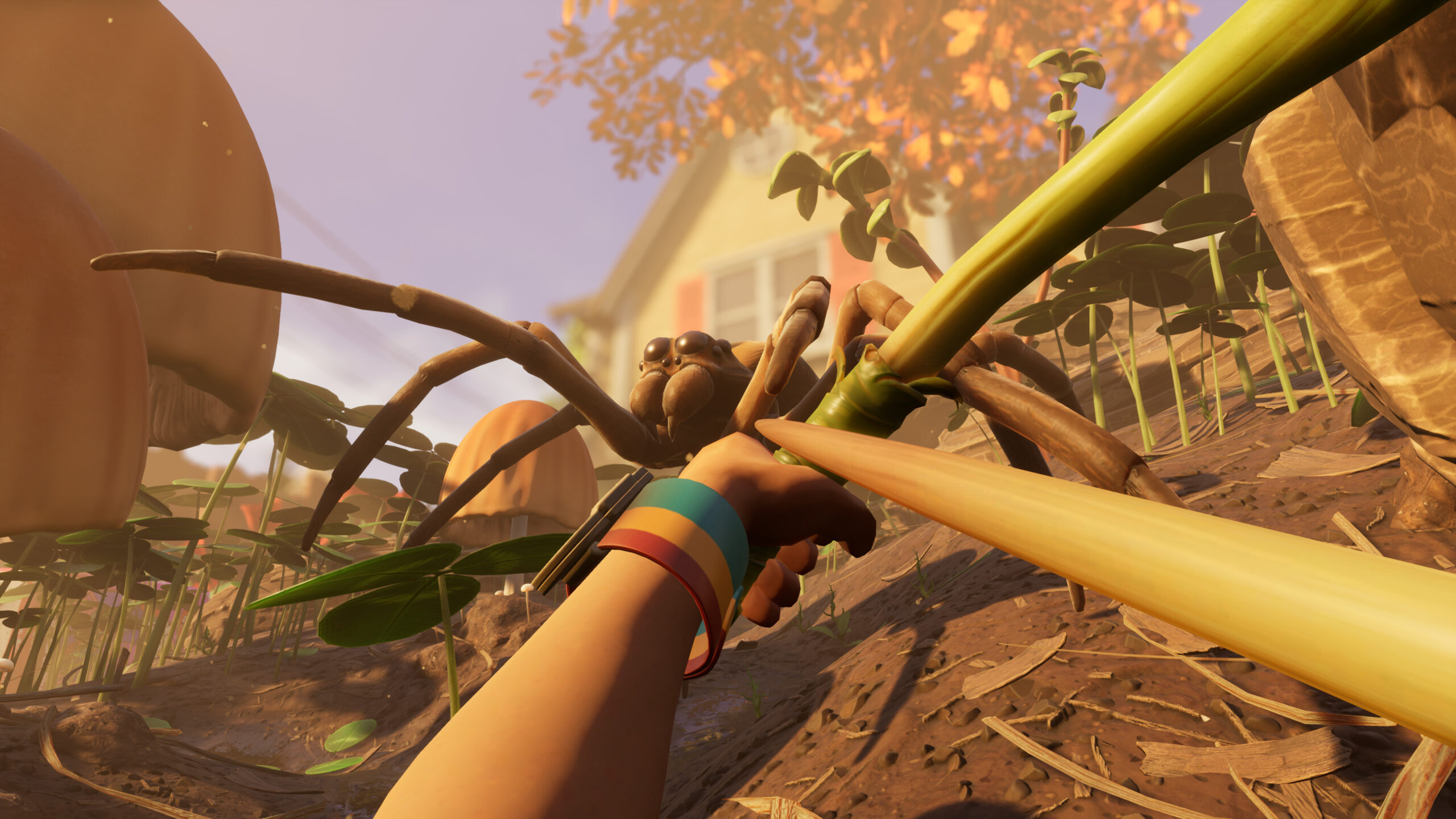
First-person perspective of a suburban house in the background, fall leaves on a tree nearby, and a relatively giant spider approaching the player, who is holding a makeshift bow and arrow, ready to fire.

Credit: Xbox Game Studios

Obsidian; Windows, Switch, Xbox, PlayStation

My favorite discovery this year has probably been Grounded, a Microsoft-published, Obsidian Entertainment-developed survival crafting game that was initially released back in 2022 (2020 if you count early access) but received its final planned content update back in April.

You play as one of four plucky tweens, zapped down to a fraction-of-an-inch high as part of a nefarious science experiment. The game is heavily inspired by 1989’s classic Honey, I Shrunk the Kids, both in its ’80s setting and its graphical design. Explore the backyard, fight bugs, find new crafting materials, build out a base of operations, and power yourself up with special items and steadily better equipment so you can figure out what happened to you and get back to your regular size.

Grounded came up because I was looking for another game for the four-player group I’ve also played Deep Rock Galactic and Raft with. Like RaftGrounded has a main story with achievable objectives and an endpoint, plus a varied enough mix of activities that everyone will be able to find something they like doing. Some netcode hiccups notwithstanding, if you like survival crafting-style games but don’t like Minecraft-esque, objective-less, make-your-own-fun gameplay, Grounded might scratch an itch for you.

Andrew Cunningham

Fights in Tight Spaces

A black-colored figure does a backwards flip kick on a red goon holding a gun, while three other red and maroon goons point guns at him from a perpendicular angle, inside a grayscale room.

Credit: Raw Fury

Ground Shatter; Windows, Switch, Xbox, PlayStation

I spent a whole lot of time browsing, playing, and thinking about roguelike deckbuilders in 2024. Steam’s recommendation algorithm noticed, and tossed 2021’s Fights in Tight Spaces at me. I was on a languid week’s vacation, with a Steam Deck packed, with just enough distance from the genre by then to maybe dip a toe back in. More than 15 hours later, Steam’s “Is this relevant to you?” question is easy to answer.

Back in college, I spent many weekends rounding out my Asian action film knowledge, absorbing every instance of John Woo, Jackie Chan, Jet Li, Flying Guillotine, Drunken Master, and whatever I could scavenge from friends and rental stores. I thrilled to frenetic fights staged in cramped, cluttered, or quirky spaces. When the hero ducks so that one baddie punches the other one, then backflips over a banister to two-leg kick the guy coming up from beneath? That’s the stuff.

Fights gives you card-based, turn-by-turn versions of those fights. You can see everything your opponents are going to do, in what order, and how much it would hurt if they hit you. Your job is to pick cards that move, hit, block, counter, slip, push, pull, and otherwise mess with these single-minded dummies, such that you dodge the pain and they either miss or take each other out. Woe be unto the guy with a pistol who thinks he’s got one up on you, because he’s standing right by a window, and you’ve got enough momentum to kick a guy right into him.

This very low-spec game has a single-color visual style, beautifully smooth animations, and lots of difficulty tweaking to prevent frustration. The developer plans to release a game “in the same universe,” Knights in Tight Spaces, in 2025, and that’s an auto-buy for me now.

Kevin Purdy

The Elder Scrolls III: Morrowind

Axe-wielding polygonal character, wearing furs and armor, complete with bear face above his head, in front of a wooden lodge in a snowy landscape.

Credit: Bethesda Game Studios

Bethesda; Windows, Xbox

The Elder Scrolls III: Morrowind always had a sort of mythic quality for me. It came out when I was 18 years old—the perfect age for it, really. And more than any other game I had ever played, it inspired hope and imagination for where the medium might go.

In the ensuing years, Morrowind (2002) ended up seeming like the end of the line instead of the spark that would start something new. With some occasional exceptions, modern games have emphasized predictable formulae and proven structures over the kind of experimentation, depth, and weirdness that Morrowind embraced. Even Bethesda’s own games gradually became stodgier.

So Morrowind lived in my memory for years, a sort of holy relic of what gaming could have been before AAA game design became quite so oppressively formalist.

After playing hundreds of hours of Starfield this year, I returned to Morrowind for the first time in 20 years.

To be clear: I quite liked Starfield, counter to the popular narrative about it—though I definitely understood why it wasn’t for everyone. But people criticized Starfield for lacking the magic of a game like Morrowind, and I was skeptical of that criticism. As such, my return to the island of Vvardenfell was a test: did Morrowind really have a magic that Starfield lacks, even when taken out of the context of its time and my youthful imagination and open-mindnedness?

I was surprised to find that the result was a strong affirmative. I still like Starfield, but its cardinal sin is that it is unimaginative because it is derivative—of No Man’s Sky, of Privateer and Elite, of Mass Effect, of various 70s and 80s sci-fi films and TV series, and most of all, of Bethesda Game Studios’ earlier work.

In contrast, Morrowind is a fever dream of bold experimentation that seems to come more from the creativity of ambitious designers who were too young to know any better, than from the proven designs of past hits.

I played well over a hundred hours of Morrowind this year, and while I did find it tedious at times, it’s engrossing for anyone who’s willing to put up with its archaic pacing and quirks.

To be clear, many of the design experiments in the game simply don’t work, with systems that are easily exploited. Its designers’ naivety shines through clearly, and its rough edges serve as clear reminders of why today’s strict formalism has taken root, especially in AAA games where too-big budgets and payrolls leave no room at all for risk.

Regardless, it’s been wild to go back and play this game from 2002 and realize that in the 22 years since there have been very few other RPGs that were nearly as brazenly creative. I love it for that, just as much as I did when I was 18.

Samuel Axon

Tetrisweeper

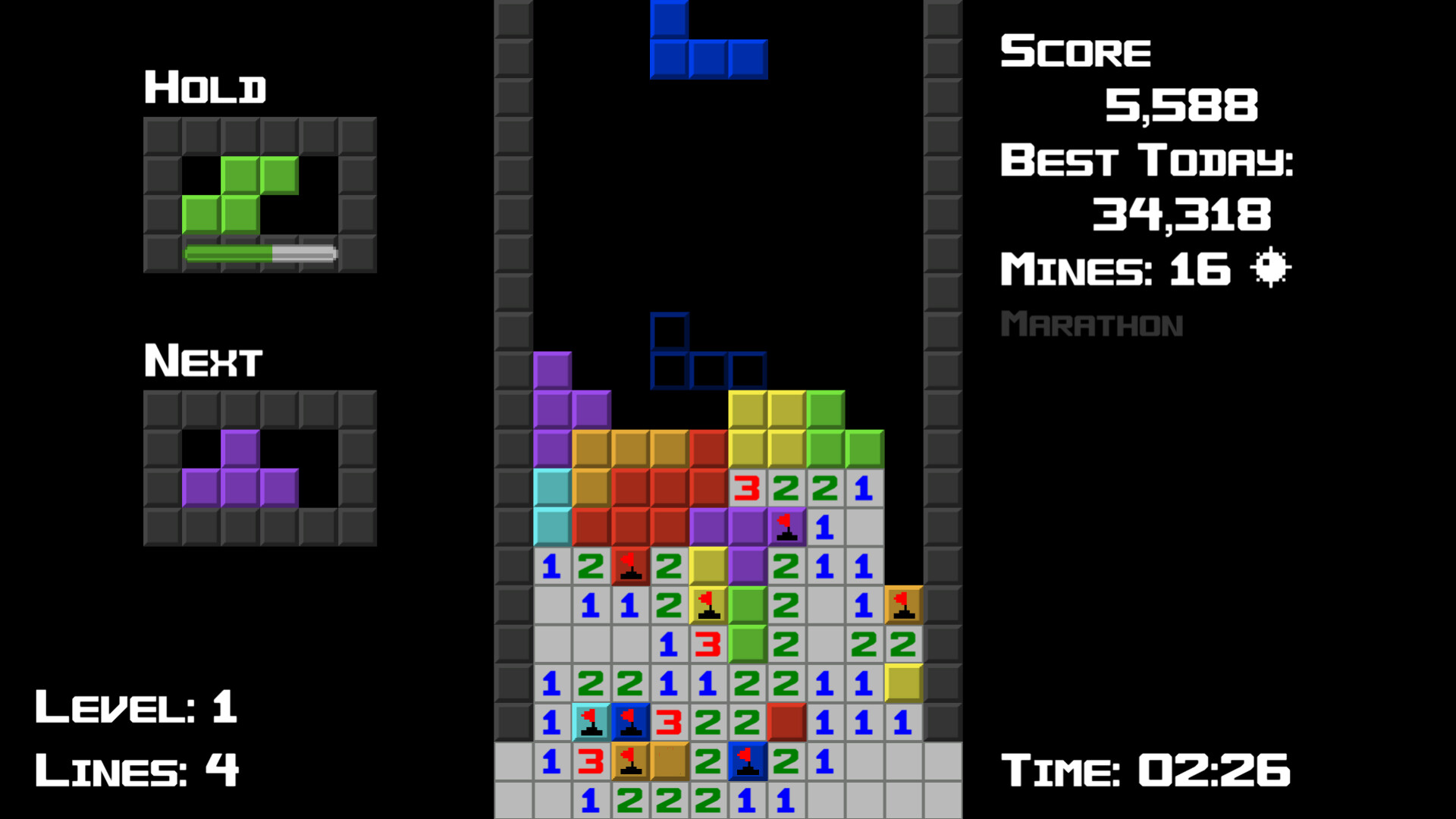
Tetris-style colored blocks fallen inside a column on top of settled blocks, most of which are gray and have Minesweeper-like numbers indicating an explosive tile nearby.

Credit: Kertis Jones Interactive

Kertis Jones; Itch.io, coming to Steam

If you ask someone to list the most addictive puzzle games of all time, Tetris and Minesweeper will probably be at or near the top of the list. So it shouldn’t be too surprising that Tetrisweeper makes an even more addictive experience by combining the two grid-based games together in a frenetic, brain-melting mess.

Tetrisweeper starts just like Tetris, asking you to arrange four-block pieces dropping down a well to make lines without gaps. But in Tetrisweeper, those completed lines won’t clear until you play a game of Minesweeper on top of those dropped pieces, using adjacency information and logical rules to mark which ones are safe and which ones house game-ending mines (if you want to learn more about Minesweeper, there’s a book I can recommend).

At first, playing Tetris with your keyboard fingers while managing Minesweeper with your mouse hand can feel a little unwieldy—a bit like trying to drive a car and cook an omelet at the same time. After a few games, though, you’ll learn how to split your attention effectively to drop pieces and solve complex mine patterns nearly simultaneously. That’s when you start to master the game’s intricate combo multiplier system and bonus scoring, striving for point-maximizing Tetrisweeps and T-spins (my high score is just north of 3 million, but pales in comparison to that of the best players).

While Tetrisweeper grew out of a 2020 Game Jam, I didn’t discover the game until this year, when it helped me clear my head during many a work break (and passed the time during a few dull Zoom calls as well). I’m hoping the game’s planned Steam release—still officially listed as “Coming Soon”—will help attract even more addicts than its current itch.io availability.

Kyle Orland

Freelancer

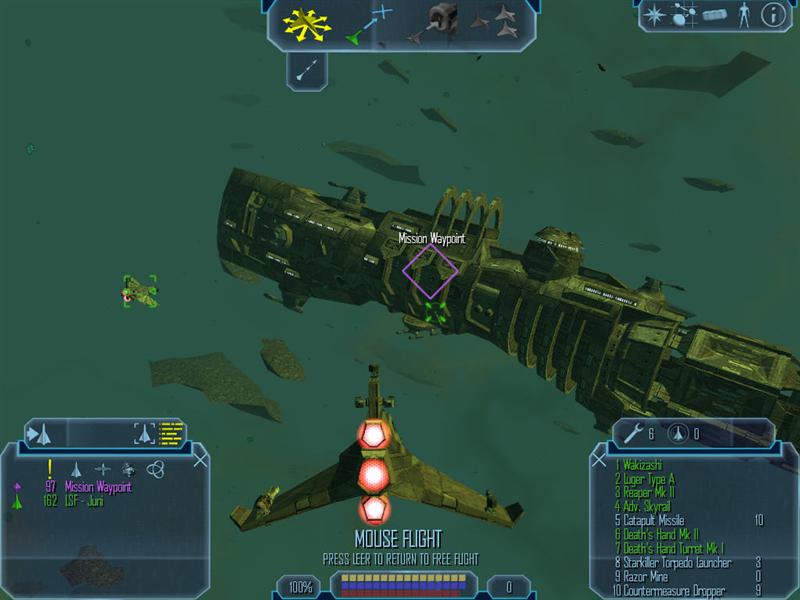
Ship with three thruster engines approaching a much larger freighter, long and slightly cylindrical, in murky green space, with a HUD around the borders.

Digital Anvil; Windows

What if I told you that Star Citizen creator Chris Roberts previously tried to make Star Citizen more than two decades ago but left the project and saw it taken over by real, non-crazy professionals who had the discipline to actually finish something?

That’s basically the story behind 2003’s forgotten PC game Freelancer. What started as a ludicrously ambitious space life sim concept ended up as a sincere attempt to make games like Elite and Wing Commander: Privateer far more accessible.

That meant a controversial, mouse-based control scheme instead of flight sticks, as well as cutting-edge graphics, celebrity voice actors, carefully designed economy and progression systems, and flashy cutscenes.

I followed the drama of Freelancer‘s development in forums, magazines, and gaming news websites when I was younger. I bought the hype as aggressively as Star Citizen fans did years later. The game that came out wasn’t what I was dreaming of, and that disappointment prevented me from finishing it.

Fast-forward to 2024: on a whim, I played Freelancer from beginning to end for the first time.

And honestly? It’s great. In a space trading sim genre that’s filled with giant piles of jank (the X series) or inaccessible titles that fly a little too far into the simulation zone for some (Elite Dangerous), Freelancer might be the most fun you can have with the genre even today.

It’s understandable that it didn’t have much lasting cultural impact since the developers who took it over lacked the wild ambition of the man who started it, but I enjoyed a perfectly pleasant 20–30 hours smuggling space goods and shooting pirates—and I didn’t have to spend $48,000 of real money on a ship to get that.

Samuel Axon

Cyberpunk 2077

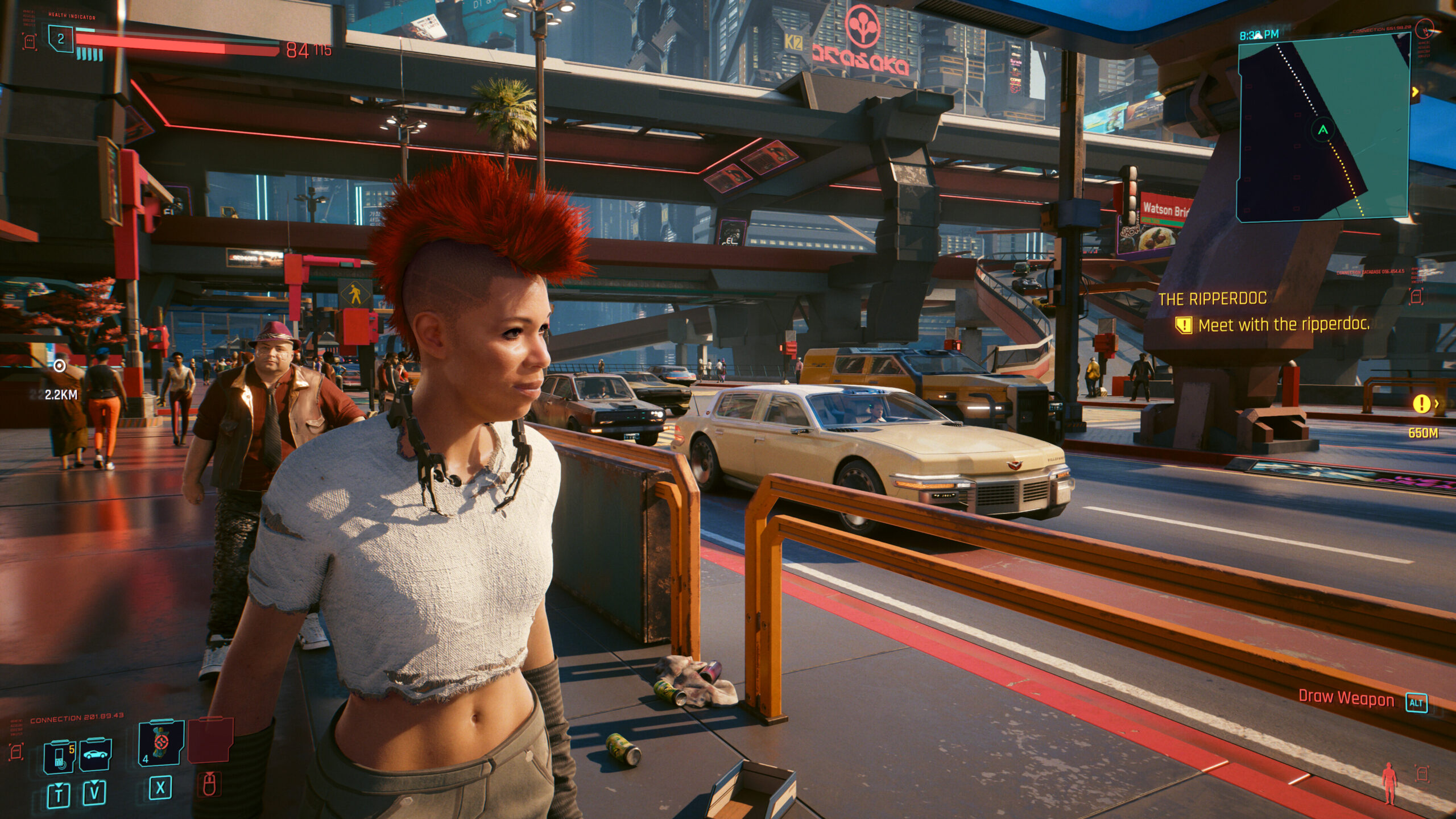
A woman with a red mohawk, wearing a belly shirt, amidst a dense, steel, multi-colored cityscape, suffused with neon.

Credit: CD Projekt Red

CD Projekt Red; Windows, Xbox, PlayStation (macOS in 2025)

Can one simply play, as a game, one of the biggest and most argued-over gaming narratives of all time? Four years after its calamitous launch sparked debates about AAA gaming sprawl, developer crunch, game review practicalities, and, eventually, post-release redemption arcs, what do you get when you launch Cyberpunk 2077?

I got a first-person shooter, one with some interesting ideas, human-shaped characters you’d expect from the makers of The Witcher 3, and some confused and unrefined systems and ideas. I enjoyed my time with it, appreciate the work put into it, and can recommend it to anyone who is okay with something that’s not quite an in-depth FPS RPG (or “immersive sim”) but likes a bit of narrative thrust to their shooting and hacking.

You can’t fit everything about Cyberpunk 2077 into one year-end blurb (or a 1.0 release, apparently), so I’ll stick to the highs and lows. I greatly enjoyed the voice performances, especially from Keanu Reeves and Idris Elba (the latter in the Phantom Liberty DLC), and those behind Jackie, Viktor Vektor, and the female version of protagonist V. I was surprised at how good the shooting felt, given the developer’s first time out; the discovery of how a “Smart” shotgun worked will stick with me a while. The driving: less so. There were moments of quiet, ambient world appreciation, now that the game’s engine is running okay. And the side quests have that Witcher-ish quality to them, where they’re never as straightforward as described and also tell little stories about life in this place.

What seems missing to me, most crucially, are the bigger pieces, the real choices and unexpected consequences, and the sense of really living in this world. You can choose one of three backgrounds, but it only comes up as an occasional dialogue option. You can build your character in myriad ways, and there are lots of dialogue options. But the main quest keeps you on a fairly strict path, with the options to talk, hack, or stealth your way past inevitable shootouts not as great as you might think. Once you’ve brought your character up to power-fantasy levels, the larger city becomes a playground, but not one I much enjoyed playing in. (Plus, the idea of idle wandering and amassing wealth, given the main plot contrivance, is kind of ridiculous, but this is a game, after all).

Phantom Liberty, in my experience, patches up every one of these weaknesses inside its smaller play space, providing more real choices and a tighter story, with more set pieces arriving at a faster pace. If you can buy this game bundled with its DLC, by all means, do so. I didn’t encounter any game-breaking bugs in my mid-2024 playthrough, nor even many crashes. Your mileage may vary, especially on consoles, as other late-coming players have seen.

Waiting on this game a good bit certainly helps me grade it on a curve; nobody today is losing $60 on something that looks like it’s playing over a VNC connection. When CD Projekt Red carries on in this universe, I think they’ll have learned a lot from what they delivered here, much like we’ve all learned about pre-release expectations. It’s okay to take your time getting to a gargantuan game; there are lots of games from prior years to look into.

Kevin Purdy

Photo of Kevin Purdy

Kevin is a senior technology reporter at Ars Technica, covering open-source software, PC gaming, home automation, repairability, e-bikes, and tech history. He has previously worked at Lifehacker, Wirecutter, iFixit, and Carbon Switch.

Ars’ favorite games of 2024 that were not released in 2024 Read More »