Toys

rubik’s-wowcube-adds-complexity,-possibility-by-reinventing-the-puzzle-cube

Rubik’s WOWCube adds complexity, possibility by reinventing the puzzle cube


Technology is a double-edged sword in the $399 Rubik’s Cube-inspired toy.
There’s something special about the gadget that “just works.” Technology can open opportunities for those devices but also complicate and weigh down products that have done just fine without things like sensors and software.

So when a product like the beloved Rubik’s Cube gets stuffed with wires, processors, and rechargeable batteries, there’s demand for it to be not just on par with the original—but markedly better.

The Cubios Rubik’s WOWCube successfully breathes fresh life into the classic puzzle, but it’s also an example of when too much technology can cannibalize a gadget’s main appeal.

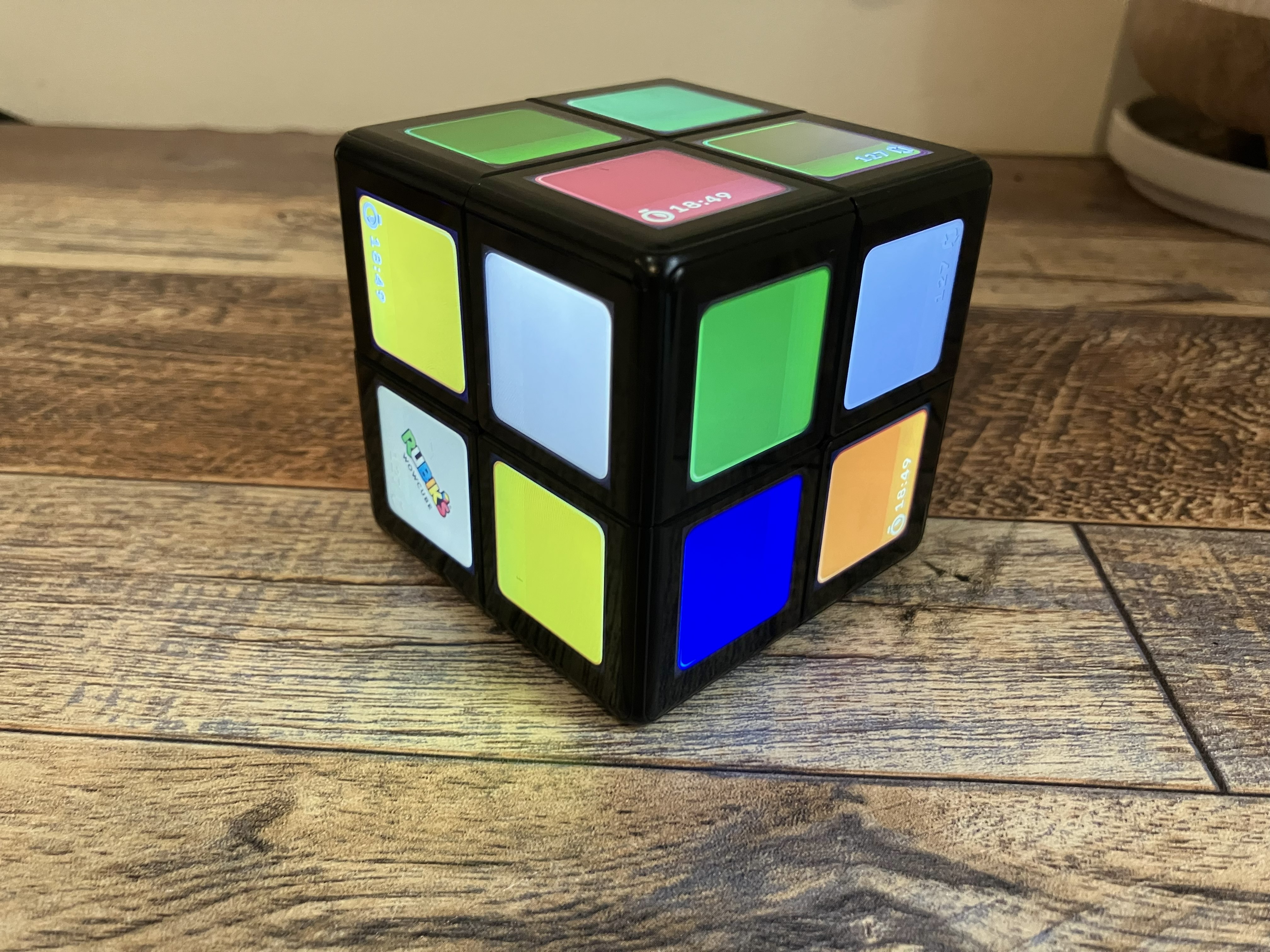
Rubik's WOWCube with hearts screensaver

The WOWCube showing off one of its screensavers.

Credit: Scharon Harding

The WOWCube showing off one of its screensavers. Credit: Scharon Harding

The WOWCube is a modern take on the Rubik’s Cube, an experiment from Hungarian architecture professor Ernő Rubik. Rubik aimed to make a structure composed of eight cubes that could move independently without the structure collapsing. The Rubik’s Cube became a widely distributed toy, an ’80s craze, and, eventually, a puzzle icon.

The Rubik’s Cube did all that without electronics and with a current MSRP of $10. The WOWCube takes the opposite approach. It’s $399 (as of this writing) and ditches the traditional 3×3 grid in favor of a 2×2 grid that can still do the traditional Rubik’s puzzle (albeit on a smaller scale) and perform a host of other tricks, including playing other games and telling the weather.

A smaller puzzle

The WOWCube’s 2×2 grid will disappoint hardcore puzzlers. There’s no way to play the traditional 3×3 version or even harder modified versions of the 2×2 grid. With only 24 squares, compared to the traditional 54, solving the WOWCube is significantly easier than solving a standard Rubik’s Cube. Although skilled players might enjoy the challenge of trying to solve the WOWCube extra rapidly.

For people who are awful at the original Rubik’s Cube, like this author, a more accessible version of the puzzle is welcome. Solving the new Rubik’s Cube feels more attainable and less frustrating.

The WOWCube is made up of eight modules. Each module has its own PCB, processor, gyroscope, and accelerometer. That may explain why Cubios went with this smaller design. The predicament also begs the question of whether electronics really improve the Rubik’s Cube.

Games and other apps

Once I played some of the WOWCube’s other games, I saw the advantage of the smaller grid. The 2×2 layout is more appropriate for games like White Rabbit, which is like Pac-Man but relies on tilting and twisting the cube, or Ladybug, where you twist the cube to create a path for a perpetually crawling ladybug. A central module might add unneeded complexity and space to these games and other WOWCube apps, like Pixel World, which is like a Rubik’s Cube puzzle but with images depicting global landmarks, or the WOWCube implementation of Gabriele Cirulli’s puzzle game, 2048.

At the time of writing, the WOWCube has 15 “games,” including the Rubik’s Cube puzzle. Most of the games are free, but some, such as Space Invaders Cubed ($30) and Sunny Side Up ($5), cost money.

Unlike the original Rubik’s Cube, which is content to live on your shelf until you need a brain exercise or go on a road trip, the WOWCube craves attention with dozens of colorful screens, sound effects, and efforts to be more than a toy.

With its Widgets app open, the cube can display information, like the time, temperature, and alerts, from a limited selection of messaging apps. More advanced actions, like checking the temperature for tomorrow or opening a WhatsApp message, are unavailable. There’s room for improvement, but further development, perhaps around features like an alarm clock or reminders, could turn the WOWCube into a helpful desk companion.

Technology overload

The new technology makes the Rubik’s Cube more versatile, exciting, and useful while bringing the toy back into the spotlight; at times, though, it also brought more complexity to a simple beloved concept.

Usually, to open an app, make a selection, or otherwise input yes, you “knock” on the side of WOWCube twice. You also have to shake the cube three times in order to exit an app, and you can’t open an app when another app is open. Being able to tap an icon or press an actual button would make tasks, like opening apps or controlling volume and brightness levels, easier. On a couple of occasions, my device got buggy and inadvertently turned off some, but not all, of its screens. The reliance on a battery and charging dock that plugs into a wall presents limitations, too.
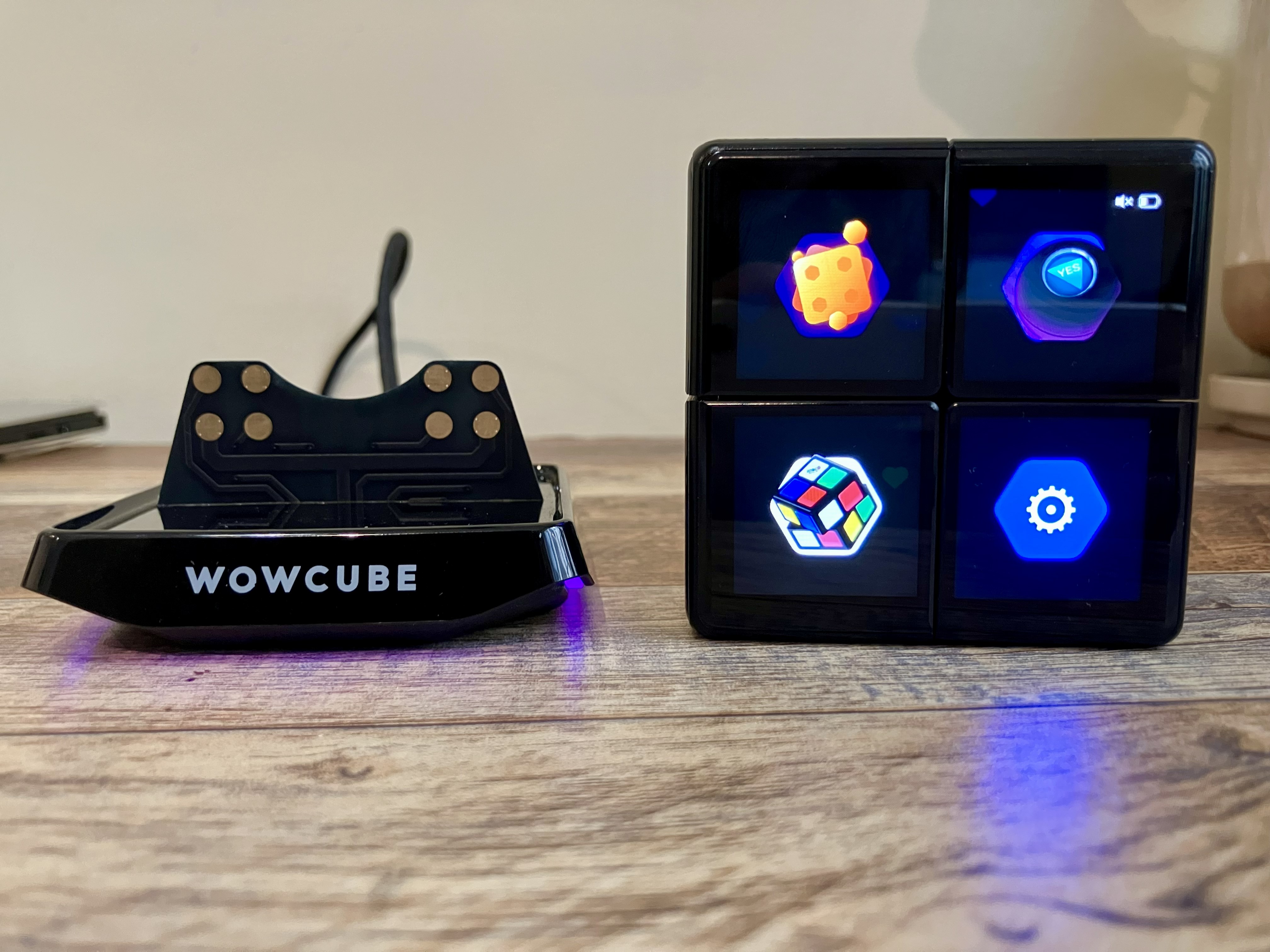
The WOWCube showing its main menu while sitting next to its charging dock.

The WOWCube showing its main menu while sitting next to its charging dock.

Credit: Scharon Harding

The WOWCube showing its main menu while sitting next to its charging dock. Credit: Scharon Harding

The WOWCube’s makers brag of the device’s octads of speakers, processors, accelerometer, and gyroscopes, but I found the tilting mechanism unreliable and, at times, frustrating for doing things like highlighting an icon. Perhaps I don’t hold the WOWCube at the angles that its creators intended. There were also times when the image was upside down, and main information was displayed on a side of the cube that was facing away from me.
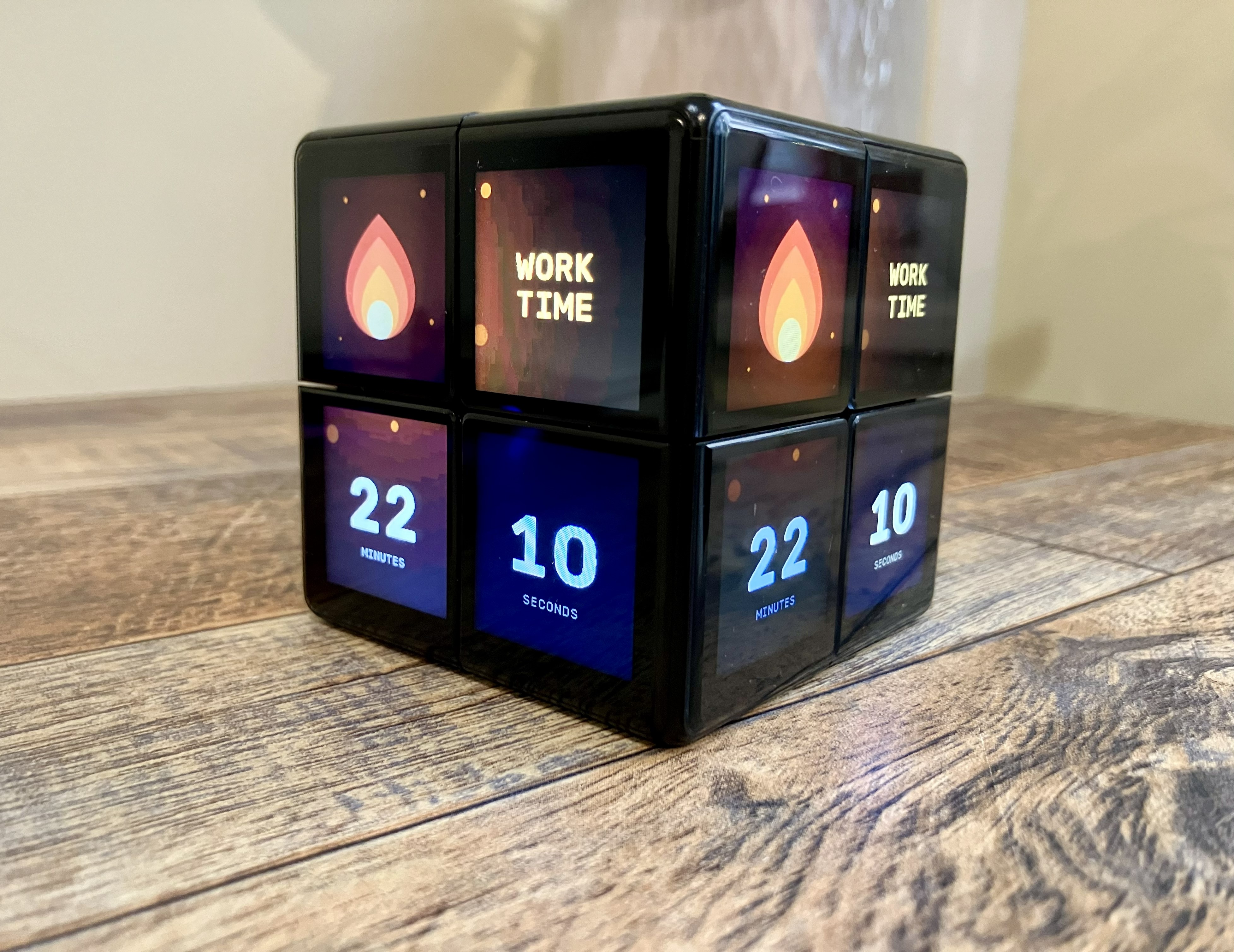
Rubik's WOWCube with pomodoro timer

One of my favorite features: WOWCube’s pomodoro-like timer app.

Credit: Scharon Harding

One of my favorite features: WOWCube’s pomodoro-like timer app. Credit: Scharon Harding

The WOWCube has its own iOS and Android app, WOWCube Connect, which lets you connect the toy to your phone via Bluetooth and download new apps to the device via the dock’s Wi-Fi connection. You can also use the app to customize things like widgets, screensavers, and display brightness. If you don’t want to do any of those things, you can disconnect the WOWCube from your phone and reconnect it only when you want to.

I wasn’t able to use the iOS app unless I agreed to allow the “app to track activity.” This gives me privacy concerns, and I’ve reached out to Cubios to ask if there’s a way to use the app without the company tracking your activity.

New-age Rubik’s Cube

Cubios attempted to reinvent a classic puzzle with the WOWCube. In the process, it added bells and whistles that detract from what originally made Rubik’s Cubes great.

The actual Rubik’s Cube puzzle is scaled back, and the idea of spending hours playing with the cube is hindered by its finite battery life (the WOWCube can last up to five hours of constant play, Cubios claims). The device’s reliance on sensors and chips doesn’t always yield a predictable user experience, especially when navigating apps. And all of its tech makes the puzzle about 40 times pricier than the classic toy.

IPS screens, integrated speakers, and app integration add more possibilities, but some might argue that the Rubik’s Cube was sufficient without them. Notably, the WOWCube began as its own product and got the rights to use Rubik’s branding in 2024.

We’ve seen technology come for the Rubik’s Cube before. The Rubik’s Revolution we tested years ago had pressure-sensitive, LED-lit buttons for faces. In 2020, Rubik’s Connected came out with its own companion app. Clearly, there’s interest in bringing the Rubik’s Cube into the 20th century. For those who believe in that mission, the WOWCube is a fascinating new chapter for the puzzle.

I applaud Cubios’ efforts to bring the Rubik’s Cube new relevance and remain intrigued by the potential of new software-driven puzzles and uses. But it’s hard to overlook the downfalls of its tech reliance.

And the WOWCube could never replace the classic.

Photo of Scharon Harding

Scharon is a Senior Technology Reporter at Ars Technica writing news, reviews, and analysis on consumer gadgets and services. She’s been reporting on technology for over 10 years, with bylines at Tom’s Hardware, Channelnomics, and CRN UK.

Rubik’s WOWCube adds complexity, possibility by reinventing the puzzle cube Read More »
web-portal-leaves-kids’-chats-with-ai-toy-open-to-anyone-with-gmail-account

Web portal leaves kids’ chats with AI toy open to anyone with Gmail account


Just about anyone with a Gmail account could access Bondu chat transcripts.

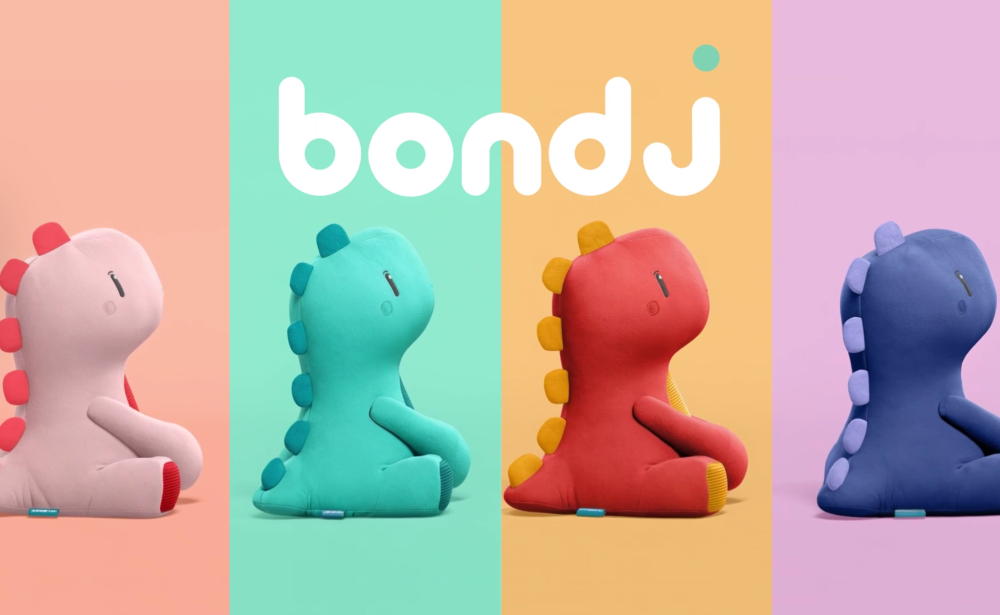
Earlier this month, Joseph Thacker’s neighbor mentioned to him that she’d preordered a couple of stuffed dinosaur toys for her children. She’d chosen the toys, called Bondus, because they offered an AI chat feature that lets children talk to the toy like a kind of machine-learning-enabled imaginary friend. But she knew Thacker, a security researcher, had done work on AI risks for kids, and she was curious about his thoughts.

So Thacker looked into it. With just a few minutes of work, he and a web security researcher friend named Joel Margolis made a startling discovery: Bondu’s web-based portal, intended to allow parents to check on their children’s conversations and for Bondu’s staff to monitor the products’ use and performance, also let anyone with a Gmail account access transcripts of virtually every conversation Bondu’s child users have ever had with the toy.

Without carrying out any actual hacking, simply by logging in with an arbitrary Google account, the two researchers immediately found themselves looking at children’s private conversations, the pet names kids had given their Bondu, the likes and dislikes of the toys’ toddler owners, their favorite snacks and dance moves.

In total, Margolis and Thacker discovered that the data Bondu left unprotected—accessible to anyone who logged in to the company’s public-facing web console with their Google username—included children’s names, birth dates, family member names, “objectives” for the child chosen by a parent, and most disturbingly, detailed summaries and transcripts of every previous chat between the child and their Bondu, a toy practically designed to elicit intimate one-on-one conversation. Bondu confirmed in conversations with the researchers that more than 50,000 chat transcripts were accessible through the exposed web portal, essentially all conversations the toys had engaged in other than those that had been manually deleted by parents or staff.

“It felt pretty intrusive and really weird to know these things,” Thacker says of the children’s private chats and documented preferences that he saw. “Being able to see all these conversations was a massive violation of children’s privacy.”

When Thacker and Margolis alerted Bondu to its glaring data exposure, they say, the company acted to take down the console in a matter of minutes before relaunching the portal the next day with proper authentication measures. When WIRED reached out to the company, Bondu CEO Fateen Anam Rafid wrote in a statement that security fixes for the problem “were completed within hours, followed by a broader security review and the implementation of additional preventative measures for all users.” He added that Bondu “found no evidence of access beyond the researchers involved.” (The researchers note that they didn’t download or keep any copies of the sensitive data they accessed via Bondu’s console, other than a few screenshots and a screen-recording video shared with WIRED to confirm their findings.)

“We take user privacy seriously and are committed to protecting user data,” Anam Rafid added in his statement. “We have communicated with all active users about our security protocols and continue to strengthen our systems with new protections,” as well as hiring a security firm to validate its investigation and monitor its systems in the future.

While Bondu’s near-total lack of security around the children’s data that it stored may be fixed, the researchers argue that what they saw represents a larger warning about the dangers of AI-enabled chat toys for kids. Their glimpse of Bondu’s backend showed how detailed the information is that it stored on children, keeping histories of every chat to better inform the toy’s next conversation with its owner. (Bondu thankfully didn’t store audio of those conversations, auto-deleting them after a short time and keeping only written transcripts.)

Even now that the data is secured, Margolis and Thacker argue that it raises questions about how many people inside companies that make AI toys have access to the data they collect, how their access is monitored, and how well their credentials are protected. “There are cascading privacy implications from this,” says Margolis. ”All it takes is one employee to have a bad password, and then we’re back to the same place we started, where it’s all exposed to the public internet.”

Margolis adds that this sort of sensitive information about a child’s thoughts and feelings could be used for horrific forms of child abuse or manipulation. “To be blunt, this is a kidnapper’s dream,” he says. “We’re talking about information that lets someone lure a child into a really dangerous situation, and it was essentially accessible to anybody.”

Margolis and Thacker point out that, beyond its accidental data exposure, Bondu also—based on what they saw inside its admin console—appears to use Google’s Gemini and OpenAI’s GPT5, and as a result may share information about kids’ conversations with those companies. Bondu’s Anam Rafid responded to that point in an email, stating that the company does use “third-party enterprise AI services to generate responses and run certain safety checks, which involves securely transmitting relevant conversation content for processing.” But he adds that the company takes precautions to “minimize what’s sent, use contractual and technical controls, and operate under enterprise configurations where providers state prompts/outputs aren’t used to train their models.”

The two researchers also warn that part of the risk of AI toy companies may be that they’re more likely to use AI in the coding of their products, tools, and web infrastructure. They say they suspect that the unsecured Bondu console they discovered was itself “vibe-coded”—created with generative AI programming tools that often lead to security flaws. Bondu didn’t respond to WIRED’s question about whether the console was programmed with AI tools.

Warnings about the risks of AI toys for kids have grown in recent months but have largely focused on the threat that a toy’s conversations will raise inappropriate topics or even lead them to dangerous behavior or self-harm. NBC News, for instance, reported in December that AI toys its reporters chatted with offered detailed explanations of sexual terms, tips about how to sharpen knives, and even seemed to echo Chinese government propaganda, stating for example that Taiwan is a part of China.

Bondu, by contrast, appears to have at least attempted to build safeguards into the AI chatbot it gives children access to. The company even offers a $500 bounty for reports of “an inappropriate response” from the toy. “We’ve had this program for over a year, and no one has been able to make it say anything inappropriate,” a line on the company’s website reads.

Yet at the same time, Thacker and Margolis found that Bondu was simultaneously leaving all of its users’ sensitive data entirely exposed. “This is a perfect conflation of safety with security,” says Thacker. “Does ‘AI safety’ even matter when all the data is exposed?”

Thacker says that prior to looking into Bondu’s security, he’d considered giving AI-enabled toys to his own kids, just as his neighbor had. Seeing Bondu’s data exposure firsthand changed his mind.

“Do I really want this in my house? No, I don’t,” he says. “It’s kind of just a privacy nightmare.”

This story originally appeared on wired.com.

Photo of WIRED

Wired.com is your essential daily guide to what’s next, delivering the most original and complete take you’ll find anywhere on innovation’s impact on technology, science, business and culture.

Web portal leaves kids’ chats with AI toy open to anyone with Gmail account Read More »

new-lego-building-ai-creates-models-that-actually-stand-up-in-real-life

New Lego-building AI creates models that actually stand up in real life

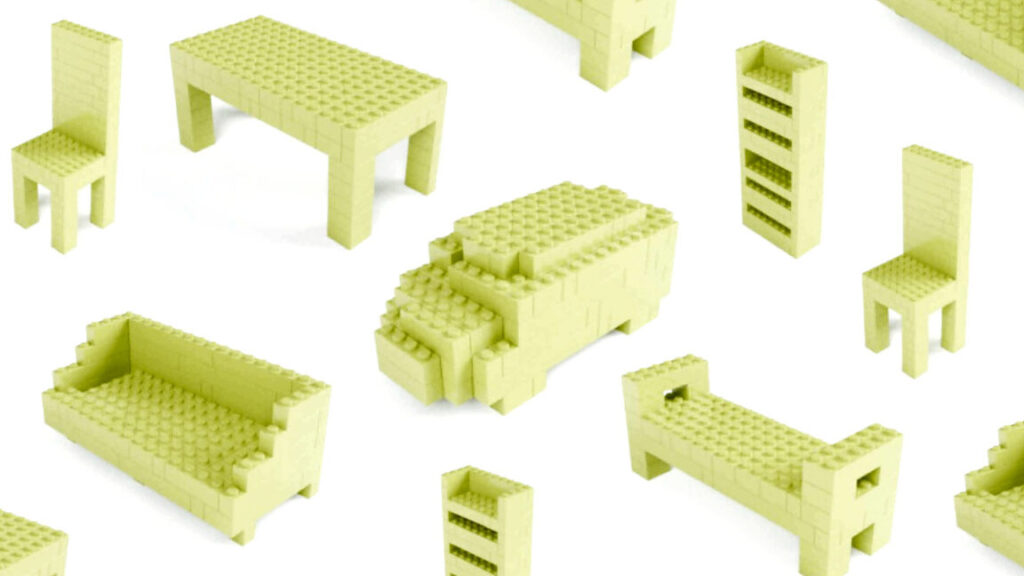
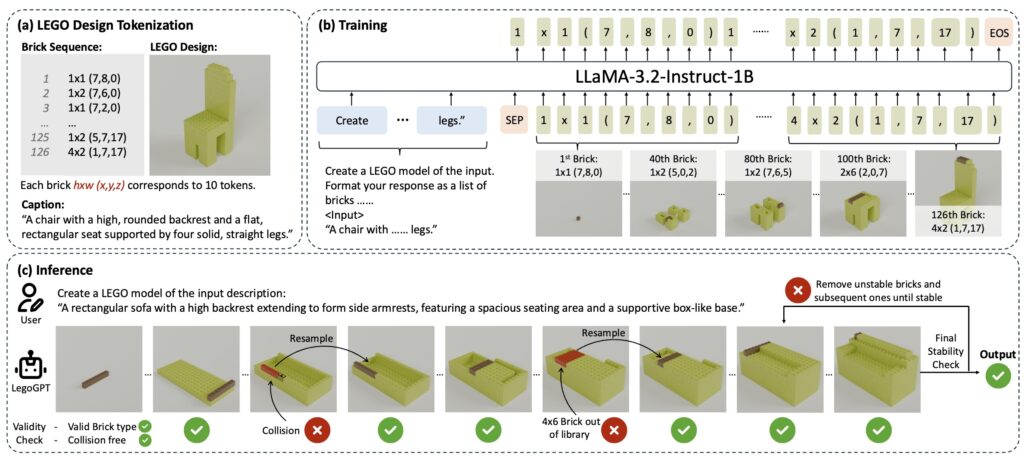
The LegoGPT system works in three parts, shown in this diagram.

The LegoGPT system works in three parts, shown in this diagram. Credit: Pun et al.

The researchers also expanded the system’s abilities by adding texture and color options. For example, using an appearance prompt like “Electric guitar in metallic purple,” LegoGPT can generate a guitar model, with bricks assigned a purple color.

Testing with robots and humans

To prove their designs worked in real life, the researchers had robots assemble the AI-created Lego models. They used a dual-robot arm system with force sensors to pick up and place bricks according to the AI-generated instructions.

Human testers also built some of the designs by hand, showing that the AI creates genuinely buildable models. “Our experiments show that LegoGPT produces stable, diverse, and aesthetically pleasing Lego designs that align closely with the input text prompts,” the team noted in its paper.

When tested against other AI systems for 3D creation, LegoGPT stands out through its focus on structural integrity. The team tested against several alternatives, including LLaMA-Mesh and other 3D generation models, and found its approach produced the highest percentage of stable structures.

A video of two robot arms building a LegoGPT creation, provided by the researchers.

Still, there are some limitations. The current version of LegoGPT only works within a 20×20×20 building space and uses a mere eight standard brick types. “Our method currently supports a fixed set of commonly used Lego bricks,” the team acknowledged. “In future work, we plan to expand the brick library to include a broader range of dimensions and brick types, such as slopes and tiles.”

The researchers also hope to scale up their training dataset to include more objects than the 21 categories currently available. Meanwhile, others can literally build on their work—the researchers released their dataset, code, and models on their project website and GitHub.

New Lego-building AI creates models that actually stand up in real life Read More »

toys-“r”-us-riles-critics-with-“first-ever”-ai-generated-commercial-using-sora

Toys “R” Us riles critics with “first-ever” AI-generated commercial using Sora

A screen capture from the partially AI-generated Toys

Enlarge / A screen capture from the partially AI-generated Toys “R” Us brand film created using Sora.

Toys R Us

On Monday, Toys “R” Us announced that it had partnered with an ad agency called Native Foreign to create what it calls “the first-ever brand film using OpenAI’s new text-to-video tool, Sora.” OpenAI debuted Sora in February, but the video synthesis tool has not yet become available to the public. The brand film tells the story of Toys “R” Us founder Charles Lazarus using AI-generated video clips.

“We are thrilled to partner with Native Foreign to push the boundaries of Sora, a groundbreaking new technology from OpenAI that’s gaining global attention,” wrote Toys “R” Us on its website. “Sora can create up to one-minute-long videos featuring realistic scenes and multiple characters, all generated from text instruction. Imagine the excitement of creating a young Charles Lazarus, the founder of Toys “R” Us, and envisioning his dreams for our iconic brand and beloved mascot Geoffrey the Giraffe in the early 1930s.”

The company says that The Origin of Toys “R” Us commercial was co-produced by Toys “R” Us Studios President Kim Miller Olko as executive producer and Native Foreign’s Nik Kleverov as director. “Charles Lazarus was a visionary ahead of his time, and we wanted to honor his legacy with a spot using the most cutting-edge technology available,” Miller Olko said in a statement.

In the video, we see a child version of Lazarus, presumably generated using Sora, falling asleep and having a dream that he is flying through a land of toys. Along the way, he meets Geoffery, the store’s mascot, who hands the child a small red car.

Many of the scenes retain obvious hallmarks of AI-generated imagery, such as unnatural movement, strange visual artifacts, and the irregular shape of eyeglasses. In February, a few Super Bowl commercials intentionally made fun of similar AI-generated video defects, which became famous online after fake AI-generated beer commercial and “Pepperoni Hug Spot” clips made using Runway’s Gen-2 model went viral in 2023.

  • A screen capture from the partially AI-generated Toys “R” Us brand film created using Sora.

    Toys “R” Us

  • A screen capture from the partially AI-generated Toys “R” Us brand film created using Sora.

    Toys “R” Us

  • A screen capture from the partially AI-generated Toys “R” Us brand film created using Sora.

    Toys “R” Us

  • A screen capture from the partially AI-generated Toys “R” Us brand film created using Sora.

    Toys R Us

  • A screen capture from the partially AI-generated Toys “R” Us brand film created using Sora.

    Toys R Us

  • A screen capture from the partially AI-generated Toys “R” Us brand film created using Sora.

    Toys “R” Us

  • A screen capture from the partially AI-generated Toys “R” Us brand film created using Sora.

    Toys “R” Us

  • A screen capture from the partially AI-generated Toys “R” Us brand film created using Sora.

    Toys “R” Us

  • A screen capture from the partially AI-generated Toys “R” Us brand film created using Sora.

    Toys “R” Us

  • A screen capture from the partially AI-generated Toys “R” Us brand film created using Sora.

    Toys “R” Us

  • A screen capture from the partially AI-generated Toys “R” Us brand film created using Sora.

    Toys “R” Us

AI-generated artwork receives frequent criticism online due to the use of human-created artwork to train AI models that create the works, the perception that AI synthesis tools will replace (or are currently replacing) human creative jobs, and the potential environmental impact of AI models, which are seen as energy-wasteful by some critics. Also, some people just think the output quality looks bad.

On the social network X, comedy writer Mike Drucker wrapped up several of these criticisms into one post, writing, “Love this commercial is like, ‘Toys R Us started with the dream of a little boy who wanted to share his imagination with the world. And to show how, we fired our artists and dried Lake Superior using a server farm to generate what that would look like in Stephen King’s nightmares.'”

Other critical comments were more frank. Filmmaker Joe Russo posted: “TOYS ‘R US released an AI commercial and it fucking sucks.”

Toys “R” Us riles critics with “first-ever” AI-generated commercial using Sora Read More »