US Grid

following-35%-growth,-solar-has-passed-hydro-on-us-grid

Following 35% growth, solar has passed hydro on US grid

On Tuesday, the US Energy Information Administration released full-year data on how the country generated electricity in 2025. It’s a bit of a good news/bad news situation. The bad news is that overall demand rose appreciably, and a fair chunk of that was met by additional coal use. On the good side, solar continued its run of astonishing growth, generating 35 percent more power than a year earlier and surpassing hydroelectric power for the first time.

Shifting markets

Overall, electrical consumption in the US rose by 2.8 percent, or about 121 terawatt-hours. Consumption had been largely flat for several decades, with efficiency and the decline of industry offsetting the effects of population and economic growth. There were plenty of year-to-year changes, however, driven by factors ranging from heating and cooling demand to a global pandemic. Given that history, the growth in demand in 2025 is a bit concerning, but it’s not yet a clear signal that the factors that will inevitably drive growth have kicked in.

(These factors include things like the switch to heat pumps, the electrification of transportation, and the growth in data centers. While the first two of those involve a more efficient use of energy overall, they involve electricity replacing direct use of fossil fuels, and so will increase demand on the grid.)

The story of the year is how that demand was met. If demand grows more slowly, the additional 85 terawatt-hours generated by expanded utility-scale and small solar installations would have easily met it. As it was, the growth of utility-scale solar was only sufficient to cover about two-thirds of the rising demand (or 73 percent if you include wind power). With no new nuclear plants on the horizon, the alternative was to meet it with fossil fuels.

Following 35% growth, solar has passed hydro on US grid Read More »
solar’s-growth-in-us-almost-enough-to-offset-rising-energy-use

Solar’s growth in US almost enough to offset rising energy use

If you add in nuclear, then the US has reached a grid that is 40 percent emissions-free over the first nine months of 2025. That’s up only 1 percent compared to the same period the year prior. And because coal emits more carbon than natural gas, it’s likely the US will see a net increase in electricity-related emissions this year.

If you would like to have a reason to feel somewhat more optimistic, however, the EIA used the new data to release an analysis of the state of the grid in California, where the production from utility-scale solar has nearly doubled over the last five years, thanks in part to another 17 percent increase so far in 2024.

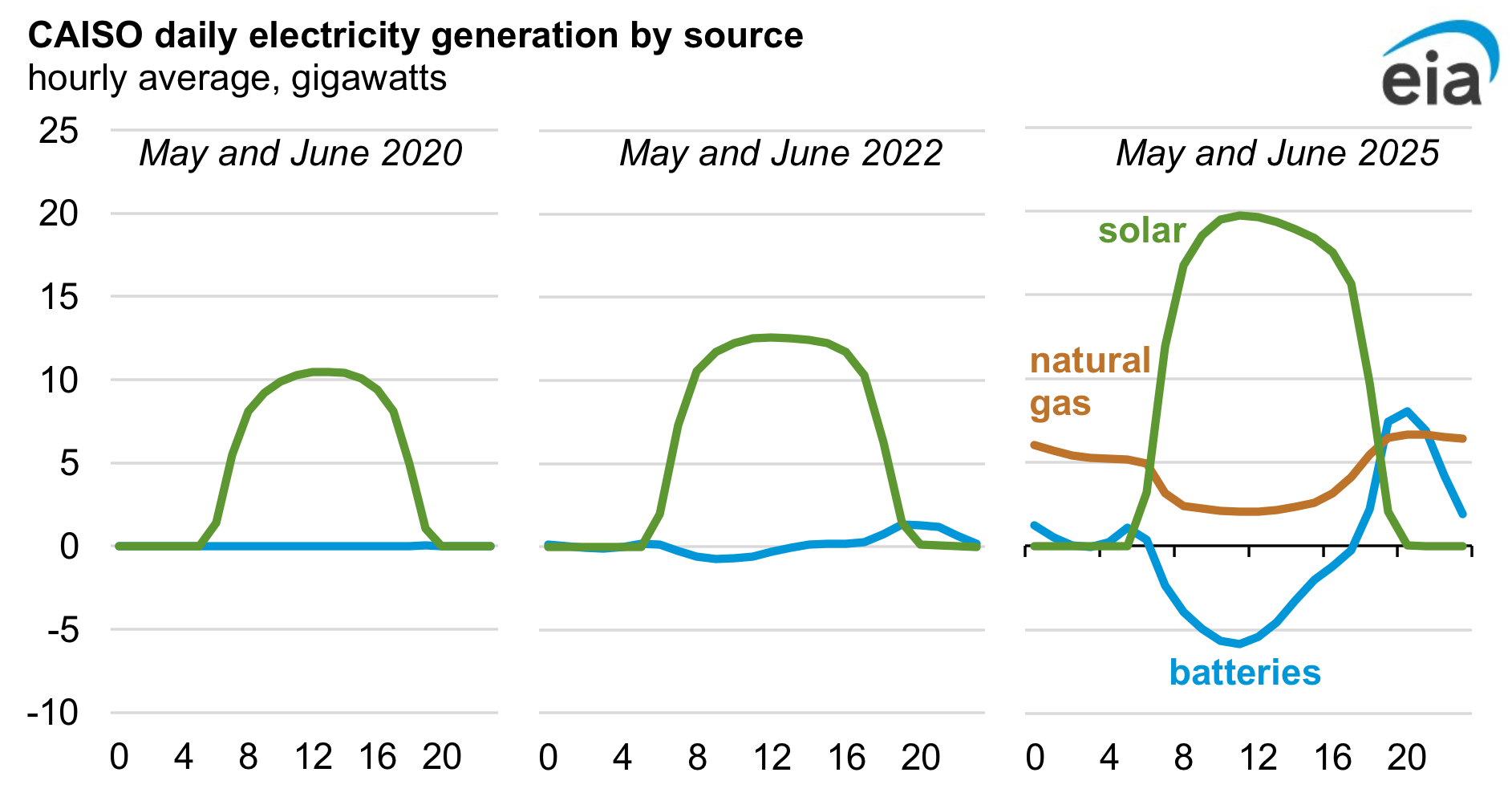
Through 2023, it was tough to discern any impact of that solar production on the rest of the grid, in part due to increased demand. But since then, natural gas use has dropped considerably (it’s down by 17 percent so far in 2025), placing it at risk of being displaced by solar as the largest source of electricity in California as early as next year. This displacement is happening even as California’s total consumption jumped by 8 percent so far in 2025 compared to the same period last year.

Image of three graphs representing spring electrical use over the last five years. All show a large green bump representing solar generation peaking at mid-day. A fblue line representing battery use is flat on the left, develops wiggles in the middle, then develops into a curve where energy is drawn in during the day and released in the evening.

Massive solar growth plus batteries means less natural gas on California’s grid. Credit: US EIA

The massive growth in solar has also led to overproduction of power in the spring and autumn, when heating/cooling demands are lowest. That, in turn, has led to a surge in battery construction to absorb the cheap power and sell it back after the Sun sets. The impact of batteries was nearly impossible to discern as recently as 2023, but data from May and June of 2025 shows batteries pulling in lots of power at mid-day, and using it in the early evening to completely offset what would otherwise be an enormous surge in the use of natural gas.

Not every state has the sorts of solar resources available to California. But the economics of solar power suggest that other states are likely to experience this sort of growth in the coming years. And, while the Trump administration has been openly hostile to solar power from the moment it took office, so far there is no sign of that hostility at the grid level.

Solar’s growth in US almost enough to offset rising energy use Read More »