EU accuses TikTok of failing to stop kids pretending to be adults
Getting TikTok’s priorities straight —
TikTok becomes the second platform suspected of Digital Services Act breaches.
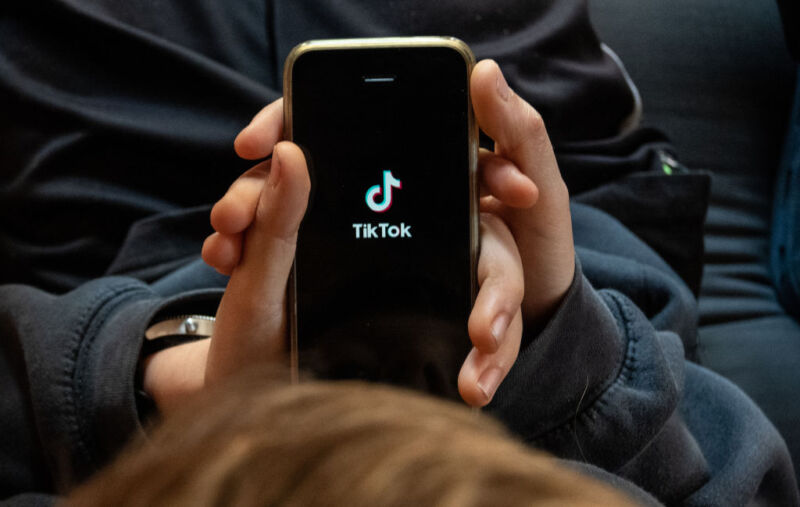
The European Commission (EC) is concerned that TikTok isn’t doing enough to protect kids, alleging that the short-video app may be sending kids down rabbit holes of harmful content while making it easy for kids to pretend to be adults and avoid the protective content filters that do exist.
The allegations came Monday when the EC announced a formal investigation into how TikTok may be breaching the Digital Services Act (DSA) “in areas linked to the protection of minors, advertising transparency, data access for researchers, as well as the risk management of addictive design and harmful content.”
“We must spare no effort to protect our children,” Thierry Breton, European Commissioner for Internal Market, said in the press release, reiterating that the “protection of minors is a top enforcement priority for the DSA.”
This makes TikTok the second platform investigated for possible DSA breaches after X (aka Twitter) came under fire last December. Both are being scrutinized after submitting transparency reports in September that the EC said failed to satisfy the DSA’s strict standards on predictable things like not providing enough advertising transparency or data access for researchers.
But while X is additionally being investigated over alleged dark patterns and disinformation—following accusations last October that X wasn’t stopping the spread of Israel/Hamas disinformation—it’s TikTok’s young user base that appears to be the focus of the EC’s probe into its platform.
“As a platform that reaches millions of children and teenagers, TikTok must fully comply with the DSA and has a particular role to play in the protection of minors online,” Breton said. “We are launching this formal infringement proceeding today to ensure that proportionate action is taken to protect the physical and emotional well-being of young Europeans.”
Likely over the coming months, the EC will request more information from TikTok, picking apart its DSA transparency report. The probe could require interviews with TikTok staff or inspections of TikTok’s offices.
Upon concluding its investigation, the EC could require TikTok to take interim measures to fix any issues that are flagged. The Commission could also make a decision regarding non-compliance, potentially subjecting TikTok to fines of up to 6 percent of its global turnover.
An EC press officer, Thomas Regnier, told Ars that the Commission suspected that TikTok “has not diligently conducted” risk assessments to properly maintain mitigation efforts protecting “the physical and mental well-being of their users, and the rights of the child.”
In particular, its algorithm may risk “stimulating addictive behavior,” and its recommender systems “might drag its users, in particular minors and vulnerable users, into a so-called ‘rabbit hole’ of repetitive harmful content,” Regnier told Ars. Further, TikTok’s age verification system may be subpar, with the EU alleging that TikTok perhaps “failed to diligently assess the risk of 13-17-year-olds pretending to be adults when accessing TikTok,” Regnier said.
To better protect TikTok’s young users, the EU’s investigation could force TikTok to update its age-verification system and overhaul its default privacy, safety, and security settings for minors.
“In particular, the Commission suspects that the default settings of TikTok’s recommender systems do not ensure a high level of privacy, security, and safety of minors,” Regnier said. “The Commission also suspects that the default privacy settings that TikTok has for 16-17-year-olds are not the highest by default, which would not be compliant with the DSA, and that push notifications are, by default, not switched off for minors, which could negatively impact children’s safety.”
TikTok could avoid steep fines by committing to remedies recommended by the EC at the conclusion of its investigation.
Regnier told Ars that the EC does not comment on ongoing investigations, but its probe into X has spanned three months so far. Because the DSA does not provide any deadlines that may speed up these kinds of enforcement proceedings, ultimately, the duration of both investigations will depend on how much “the company concerned cooperates,” the EU’s press release said.
A TikTok spokesperson told Ars that TikTok “would continue to work with experts and the industry to keep young people on its platform safe,” confirming that the company “looked forward to explaining this work in detail to the European Commission.”
“TikTok has pioneered features and settings to protect teens and keep under-13s off the platform, issues the whole industry is grappling with,” TikTok’s spokesperson said.
All online platforms are now required to comply with the DSA, but enforcement on TikTok began near the end of July 2023. A TikTok press release last August promised that the platform would be “embracing” the DSA. But in its transparency report, submitted the next month, TikTok acknowledged that the report only covered “one month of metrics” and may not satisfy DSA standards.
“We still have more work to do,” TikTok’s report said, promising that “we are working hard to address these points ahead of our next DSA transparency report.”
EU accuses TikTok of failing to stop kids pretending to be adults Read More »