
MST3K‘s 2010s revival looked forward; this one is emphatically looking backward.
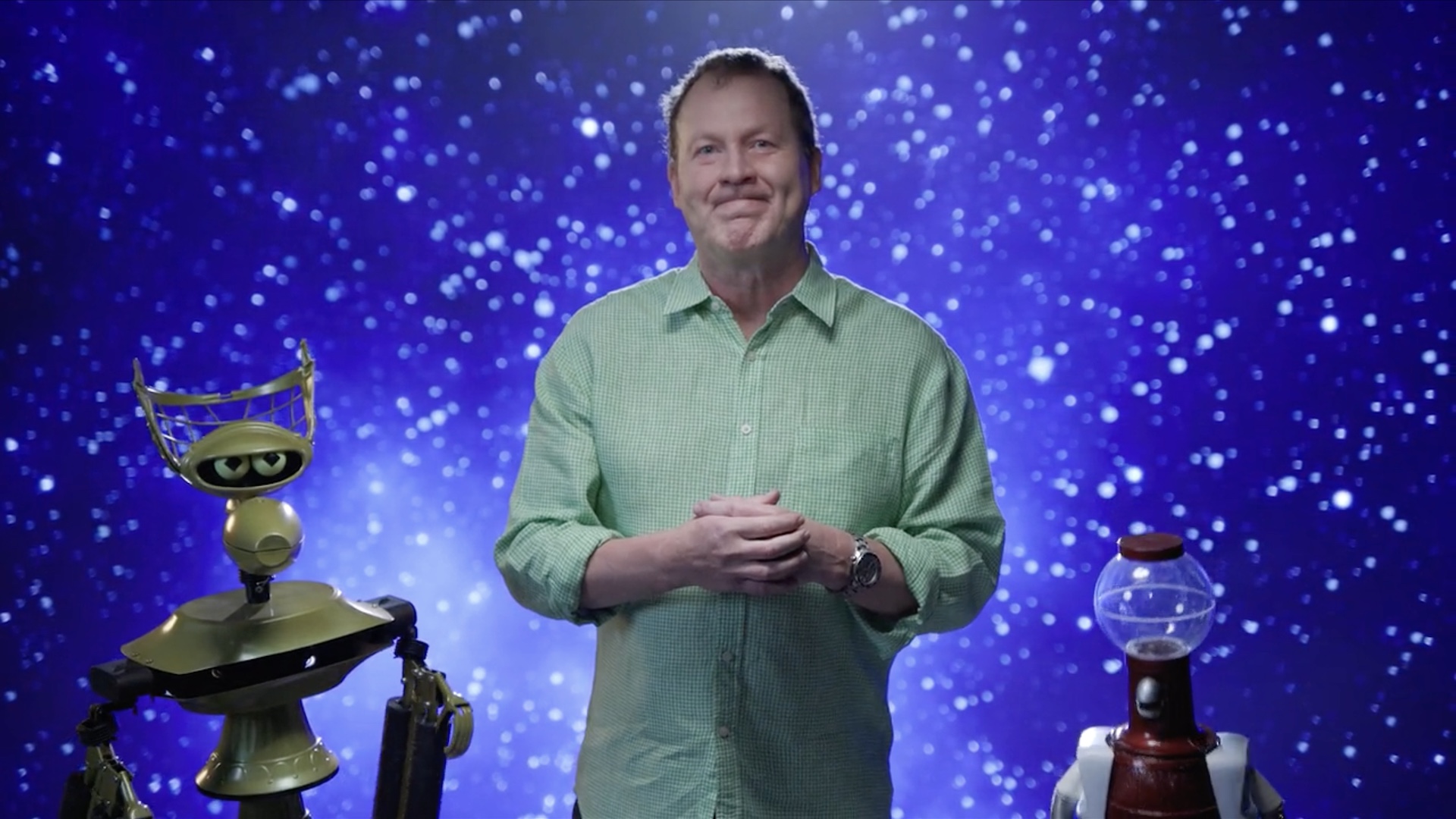
“I have to admit, the man looks good standing next to puppets.” – Joel Hodgson on Mike Nelson in 1993 Credit: MST3K/RiffTrax
“I have to admit, the man looks good standing next to puppets.” – Joel Hodgson on Mike Nelson in 1993 Credit: MST3K/RiffTrax
Longtime fans of the cult TV show Mystery Science Theater 3000 know that the series’ one constant is change (well, that and bad movies).
The show’s cast and crew were in a near-constant state of flux, a byproduct of the show’s existence as a perennial bubble show produced in the Twin Cities rather than a TV-and-comedy hub like New York or LA. It was rare, especially toward the middle of its 10-season original run on national TV, for the performers in front of the camera (and the writers’ room, since they were all the same people) to stay the same for more than a season or two.
Series creator Joel Hodgson embraced that spirit of change for the show’s Kickstarter-funded, Netflix-aired revival in the mid-2010s, featuring a brand-new cast and mostly new writers. And that change only accelerated in the show’s brief post-Netflix “Gizmoplex” era, which featured a revolving cast of performers that could change from episode to episode. Hodgson leaned into the idea that as long as there were silhouettes and puppets talking in front of a bad movie, it didn’t matter much who was doing the talking.
But the other thing longtime fans know about the original show is that many of its casting changes were extremely controversial, causing long-running old-school flame wars in the Usenet group that served as the fandom’s online hub back in the day. In retrospect, the original show’s quality and the hit rate of its jokes remained remarkably consistent from season 3 or 4 onward, but people watching it could be incredibly proprietary about their preferred performers and which of the show’s three or four major epochs they considered the best. Some blamed a combination of crowdfunding fatigue and frustration with the revived show’s constant changes for the failure of its third crowdfunding campaign in 2023.
The revived version of MST3K wasn’t a failure, exactly. I liked a lot of it. My loss of interest was partly because of me and my lack of energy and time—if you were doing the isolation phase of the COVID-19 pandemic with young children, you were doing it in hard mode—but it was also partly because I didn’t have the same connection with the new cast and because the new show was either unable to or uninterested in forming the old show’s reliable comfort-viewing grooves.
Doing it old-school
Back for one more spin.
Credit: MST3K/RiffTrax
Back for one more spin. Credit: MST3K/RiffTrax
That’s a whole lot of throat-clearing, and I have thoroughly buried my lede: MST3K is coming back—again. It’s on Kickstarter, again (it’s currently at $1.82 million pledged, against a humble $20,000 goal).
This time, though, the revival is intentionally casting its gaze backward: It’s a co-production with Mike Nelson’s RiffTrax, and he and many of the show’s original writers and performers are returning to their old roles for a limited four-episode engagement. These are all scheduled for release by the end of 2026. (Full disclosure: I am one of the Kickstarter’s 15,000-ish backers.)
It took me a minute to catch myself back up on the current state of the Mystery Science Theater IP. The original revival was possible because Hodgson bought the rights to the show in 2015 from Jim Mallon, who, for many years, was the only person with an actual ownership stake in the show or the company that produced it.
In January of this year, Hodgson officially sold those rights to Radial Entertainment, taking emeritus status as a “brand ambassador and consultant” but no longer serving as the show’s main creative force. This Rifftrax collaboration will be the new owners’ first project.
That’s exciting to me! See, “my” era of the show, the one I have the fondest feelings and the rosiest-colored glasses for, was its three-year run on what was then called the Sci-Fi Channel.
I had originally encountered MST3K during the Joel era, when it was airing on Comedy Central, but most of it went over my head—I liked the goofy puppets and low-rent effects, but during the theater segments, I was mainly watching my dad watch the show so I would know when to laugh.
But my dad eventually stopped watching, and a couple of years later, when I was old enough to want to seek it out for myself, the Sci-Fi version was what I found. Tom Servo (Kevin Murphy) was the same as I remembered, and I had seen episodes hosted by Mike Nelson (Mike Nelson) despite my dad’s clear preference for Joel. But there was a new Crow (Bill Corbett, replacing Trace Beaulieu), new mad scientists (Mary Jo Pehl, plus Murphy and Corbett again), a new Satellite of Love set, and a slightly more acidic sense of humor that meshed well with my teenage sensibilities.
I caught back up with MST3K just as its 10th and final season was airing. And episodes like Time Chasers, Werewolf, Overdrawn at the Memory Bank, and Merlin’s Shop of Mystical Wonders became familiar old friends to me, episodes I returned to over and over again even as I gradually expanded my library of old episodes via the tape-trading sites that were still active in the late ’90s into the early 2000s (it’s impossible to this day to own the complete run of the show without turning to bootlegs).
Many of the people involved in the Sci-Fi era of the show had lent their talents to the revival version in one way or another, either in cameo roles or as writers on individual episodes. But there was never a sense that Hodgson or anyone else was interested in doing a “get-the-band-back-together” version of the old show. The RiffTrax version is emphatically a “get-the-band-back-together” moment.
And as much as I hope for the best when long-running franchises try to move in new directions—I am enjoying the Starfleet Academy show much more than I expected to—it did do something to me to hear familiar voices coming out of those puppets again.
The project keeps rolling up former cast and crew members like a spaghetti ball katamari, including not just the core Nelson/Murphy/Corbett trio but Beaulieu and Frank Conniff (most familiar to viewers as Dr. Clayton Forrester and TV’s Frank), Pehl, and several familiar behind-the-camera names. Many of them will be directly creatively involved in the new production, which will feature a return to the original series’s handmade models and sets and charmingly low-rent practical effects (the Netflix revival relied heavily on green screens even during live-action segments, giving it an overly sterile look and feel).
Listen. I know that Mike Nelson can never truly go back into the theater; he is not the same Mike, and it is not the same theater. But in our current time of monsters, I find my heart thoroughly warmed by the idea of these people getting to work on this thing again.
These folks, especially Nelson and Murphy, were the soul of the old show but saw little financial benefit from years of DVD sales and streaming deals, since they never owned any of it. Reading between the lines (and through layers of Minnesota Nice), one got the sense that there were enduring hard feelings about this that made the RiffTrax contingent hold the new version of the show at arm’s length.
But it’s clear from the videos and photos that everyone involved in this new-old version of the show is having a blast, and the original MST3K was always at its best when the performers’ enthusiasm for the material and the obvious joy they took in working together shone through. It’s impossible for me to be impartial. But I think I’m going to have a good time.

Andrew is a Senior Technology Reporter at Ars Technica, with a focus on consumer tech including computer hardware and in-depth reviews of operating systems like Windows and macOS. Andrew lives in Philadelphia and co-hosts a weekly book podcast called Overdue.