
The culprit is a bacterium called Yersinia pestis, and it’s well known that it spreads among mammalian hosts via fleas, although it only rarely spills over to domestic animals and humans. The Black Death can be traced to a genetically distinct strain of Y. pestis that originated in the Tien Shan mountains west of what is now Kyrgyzstan, spreading along trade routes to Europe in the 1340s. However, according to the authors of this latest paper, there has been little attention focused on several likely contributing factors: climate, ecology, socioeconomic pressures, and the like.
The testimony of the tree rings
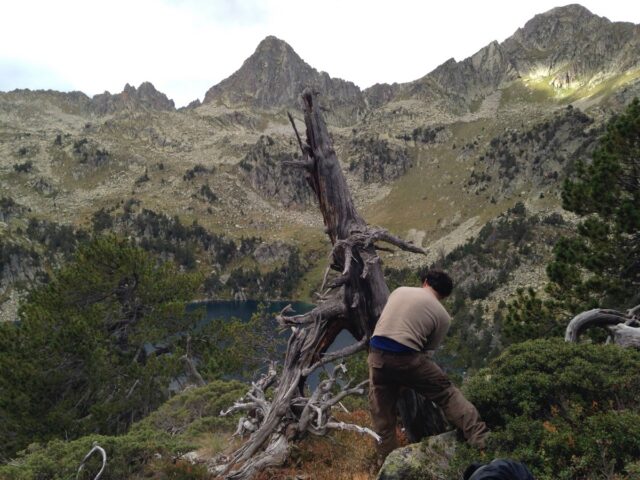
Taking tree samples from the Pyrenees. Credit: Ulf Büntgen
“This is something I’ve wanted to understand for a long time,” said co-author Ulf Büntgen of the University of Cambridge. “What were the drivers of the onset and transmission of the Black Death, and how unusual were they? Why did it happen at this exact time and place in European history? It’s such an interesting question, but it’s one no one can answer alone.”
Büntgen et al. collected core and disc samples from both living and relict trees at eight European sites to reconstruct summer temperatures for that time period. They then compared that data with estimates of sulphur injections into the atmosphere from volcanic eruptions, based on geochemical analyses of ice core samples collected from Antarctica and Greenland.
They studied a wide range of written sources across Eurasia—chronicles, treatises, historiography, and even a bit of poetry—looking for mention of atmospheric and optical phenomena linked to volcanic dust veils between 1345 and 1350 CE. They also looked for mentions of extreme weather events, economic conditions, and reports of dearth or famine across Eurasia during that time period. Information about the trans-Mediterranean grain trade was gleaned from administrative records and letters.