
DiskSat’s design offers “a power-to-weight ratio unmatched by traditional aluminum satellites.”
An artist’s illustration of DiskSats deploying from a rocket in low-Earth orbit. Credit: NASA
Four small satellites rode a Rocket Lab Electron launch vehicle into orbit from Virginia early Thursday, beginning a government-funded technology demonstration mission to test the performance of a new spacecraft design.
The satellites were nestled inside a cylindrical dispenser on top of the 59-foot-tall (18-meter) Electron rocket when it lifted off from NASA’s Wallops Flight Facility at 12: 03 am EST (05: 03 UTC). A little more than an hour later, the rocket’s upper stage released the satellites one at a time at an altitude of about 340 miles (550 kilometers).
The launch was the starting gun for a proof-of-concept mission to test the viability of a new kind of satellite called DiskSats. These satellites were designed by the Aerospace Corporation, a nonprofit federally funded research and development center. The project is jointly financed by NASA and the US Space Force, which paid for DiskSat’s development and launch, respectively.
“DiskSat is a lightweight, compact, flat disc-shaped satellite designed for optimizing future rideshare launches,” the Aerospace Corporation says in a statement.
The DiskSats are 39 inches (1 meter) wide, about twice the diameter of a New York-style pizza, and measure just 1 inch (2.5 centimeters) thick. Made of composite carbon fiber, each satellite carries solar cells, control avionics, reaction wheels, and an electric thruster to change and maintain altitude.
“The launch went perfectly, and the DiskSat dispenser worked exactly as designed,” said Darren Rowen, the project’s chief engineer, in a statement. “We’re pleased to have established contact with all four of the DiskSats, and we’re looking forward to the rest of the demonstration mission.”
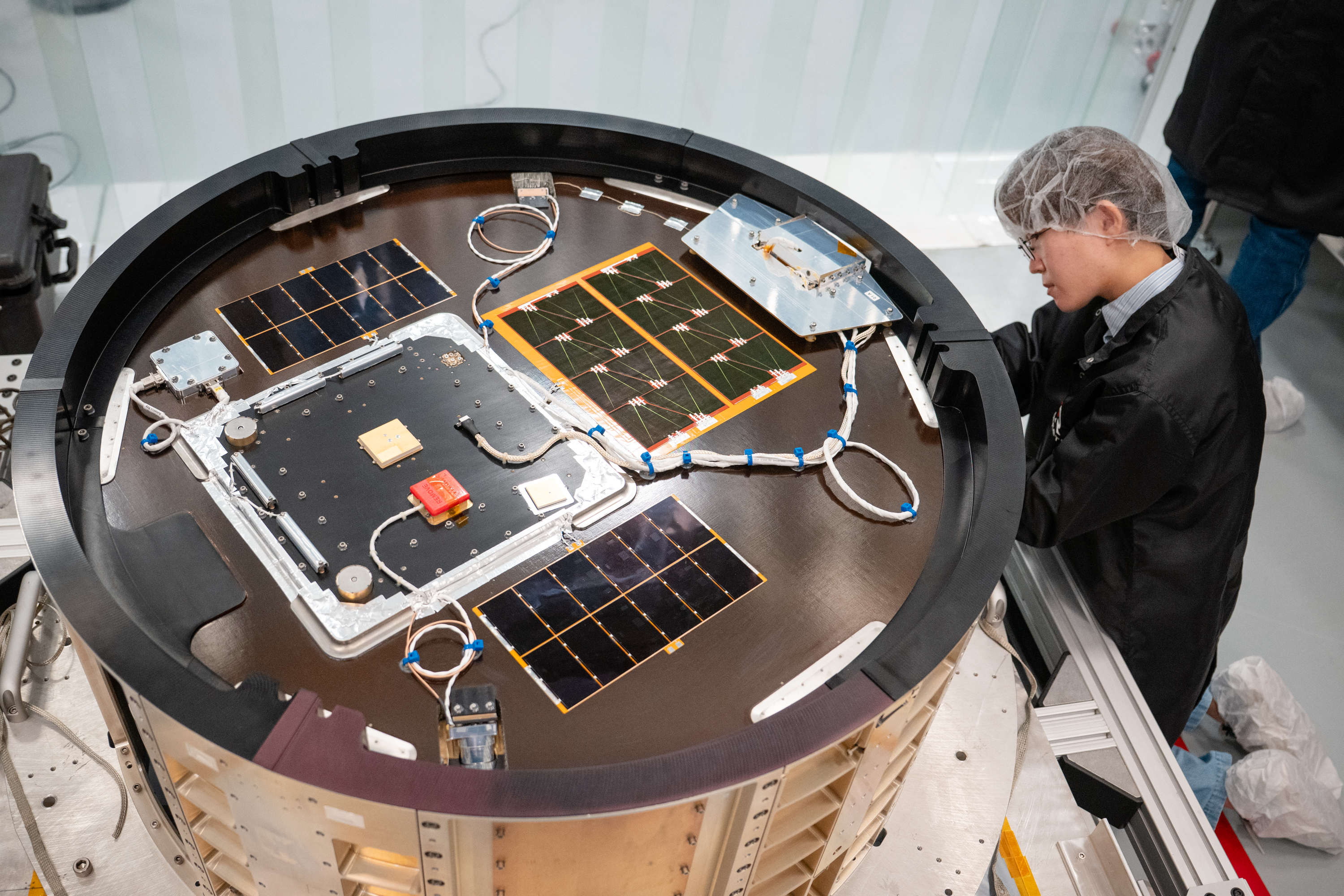
An engineer prepares Aerospace Corporation’s DiskSats for launch at NASA’s Wallops Flight Facility in Virginia. Credit: Aerospace Corporation
A new form factor
The Aerospace Corporation has a long history of supporting the US military and NASA since its founding in 1960. A few years ago, engineers at the center developed the DiskSat concept after surveying the government’s emerging needs in spaceflight.
CubeSats have been a ubiquitous part of the satellite industry for nearly a quarter-century. They are based on a cube-shaped design, measuring about 10 centimeters per side, but can be scaled from a single cube “unit” to three, six, 12, or more, depending on mission requirements. The CubeSat standard has become a popular choice for commercial companies, the military, NASA, and universities looking to build small satellites on a tight budget.
By one measure, nearly 3,000 CubeSats have launched since the first one soared into orbit in 2003. After originally being confined to low-Earth orbit, they have now flown to high-altitude orbits, to the Moon, and to Mars.
While CubeSats are now prolific, engineers at the Aerospace Corporation saw an opportunity to improve on the concept. Debra Emmons, Aerospace’s chief technology officer, said the idea originated from Rich Welle, a scientist recently retired from the center’s Experiments Lab, or xLab, division.
“They were asking questions,” Emmons told Ars. “They were looking at CubeSat studies and looking at some alternatives. The typical CubeSat is, in fact, a cube. So, the idea was could you look at some different types of form factors that might be able to generate more power … and offer up benefit for certain mission applications?”
Aerospace’s research team arrived at the DiskSat design. Emmons said the stackable flat-panel format is easier to pack for launch than a CubeSat. The concept is similar to SpaceX’s pioneering approach to launching stackable Starlink Internet satellites, but DiskSats are significantly smaller, lighter, and adaptable to different kinds of missions.

A stack of Starlink satellites prior to launch. Credit: SpaceX
DiskSats have several advantages over CubeSats, according to the Aerospace Corporation. Each of the four DiskSats launched Thursday has a mass of about 35 pounds (16 kilograms), less than that of a typical 12U CubeSat. But a DiskSat has more than 13 times the surface area on a single side, providing valuable real estate for developers to load up the satellite with power-generating solar arrays, sensors, antennas, or other payloads that simply won’t fit on a CubeSat.
SpaceX’s current generation of mass-produced Starlink V2 satellites, by comparison, each has a mass of more than 1,100 pounds, or 500 kilograms.
DiskSat’s design offers “a power-to-weight ratio unmatched by traditional aluminum satellites,” the Aerospace Corporation says. In a research paper published earlier this year, engineers from the Aerospace Corporation claimed DiskSat can generate five to 10 times more power than a CubeSat.
A disruptive solution?
What kinds of missions might DiskSat be useful for? One idea involves placing a large radar antenna—too big to fit on any other low-mass satellite—on the broadside of a DiskSat to collect all-weather surveillance imagery. Similarly-sized antennas on other DiskSats could support high-bandwidth communications.
With this demo mission, the Aerospace Corporation will test the performance of the DiskSat platform in space for the first time. Engineers will initially look at how the satellites function at 340 miles, then use their electric thrusters to gradually step down to lower altitudes, where another aspect of DiskSat’s design will shine.
Flying edge-on, the satellite’s pancake shape will minimize aerodynamic drag as the DiskSats encounter thicker air below 250 miles. Continual pulsing from the satellites’ electric thrusters will allow the DiskSats to maintain altitude as they glide through the uppermost layers of the atmosphere.
“The primary mission is to demonstrate and to understand the performance, functionality, and maneuverability of the DiskSat buses on orbit, particularly in low-Earth orbit, or LEO, and very low-Earth orbit, or VLEO,” said Catherine Venturini, DiskSat’s principal investigator.
“In theory, I think you could operate down to 200 kilometers (124 miles) with electric propulsion,” Emmons said. That is two to three times closer to Earth than most commercial radar imaging satellites. Other satellite operators are also assessing the viability of flying remote sensing missions in VLEO.
Flying closer to the ground delivers higher-resolution imagery, bringing cities, ships, airports, and military bases into sharper view. So it’s easy to see why the Space Force is interested in the DiskSat concept.
DiskSat’s engineers acknowledge there are drawbacks to the format. With such a large surface area, it’s more difficult to manage the temperature extremes of low-Earth orbit than it is with a conventional cube-shaped satellite. While DiskSats carry a lot of oomph to change altitude, their shape makes them somewhat clunky and hard to turn, and engineers say they aren’t well-suited for missions requiring agile pointing.
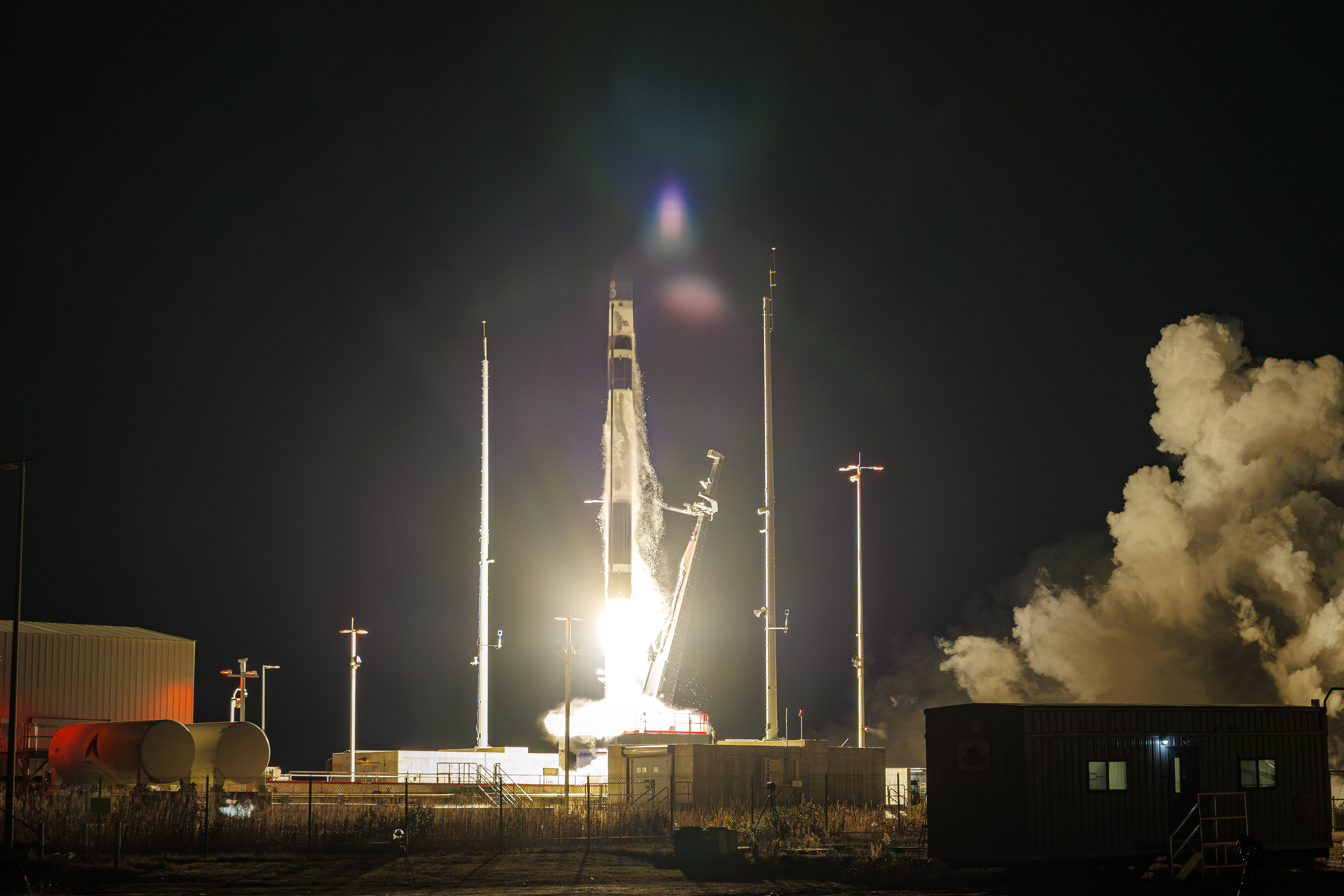
Rocket Lab’s Electron launcher lifts off to begin the DiskSat demo mission, a program co-funded by NASA and the US military’s Space Test Program. Credit: Austin DeSisto/Rocket Lab
The Aerospace Corporation is a research center, not a commercial satellite manufacturer. Officials at the nonprofit are looking to hand over the DiskSat design to industry through a technology transfer agreement. “The plan is to release or license the technology to partners once it is flight-proven,” the Aerospace Corporation says on its website.
“We think this new technology will be disruptive to the small spacecraft enterprise and ecosystem,” said Eric Breckheimer, DiskSat’s program manager.
DiskSat’s stackable design makes it possible to launch a fleet of high-power, low-mass satellites in one go, according to Emmons.
Following the trend toward bigger CubeSats, the DiskSat format could also grow larger to take advantage of heavier rockets. “There’s a key scalability aspect, and with that in mind, you could bring an entire constellation of DiskSats with you in a single launch,” Breckheimer said.

Stephen Clark is a space reporter at Ars Technica, covering private space companies and the world’s space agencies. Stephen writes about the nexus of technology, science, policy, and business on and off the planet.