Author name: 9u50fv

time-to-check-if-you-ran-any-of-these-33-malicious-chrome-extensions

Time to check if you ran any of these 33 malicious Chrome extensions
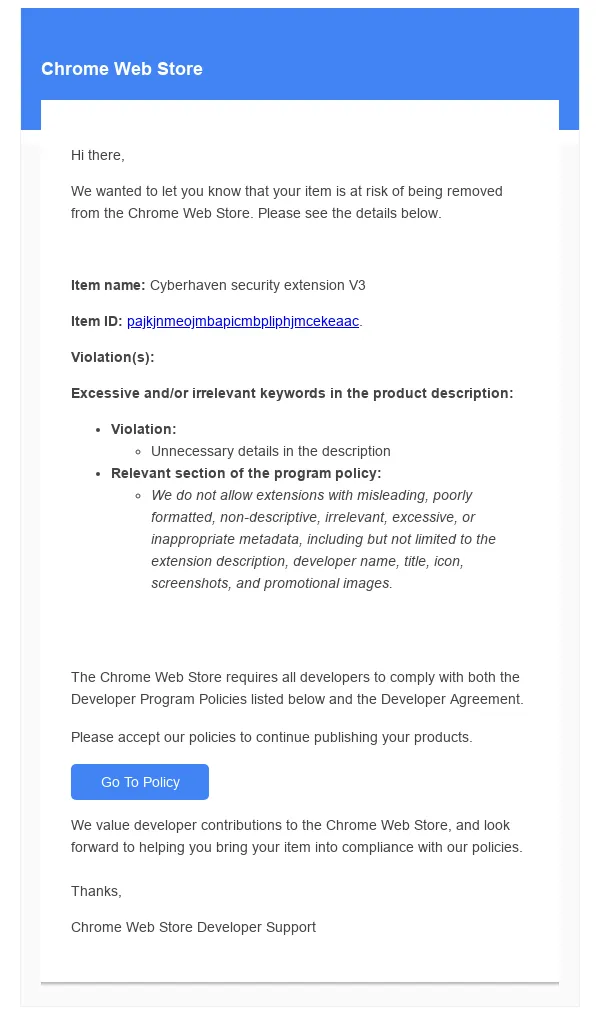
Screenshot showing the phishing email sent to Cyberhaven extension developers. Credit: Amit Assaraf

A link in the email led to a Google consent screen requesting access permission for an OAuth application named Privacy Policy Extension. A Cyberhaven developer granted the permission and, in the process, unknowingly gave the attacker the ability to upload new versions of Cyberhaven’s Chrome extension to the Chrome Web Store. The attacker then used the permission to push out the malicious version 24.10.4.
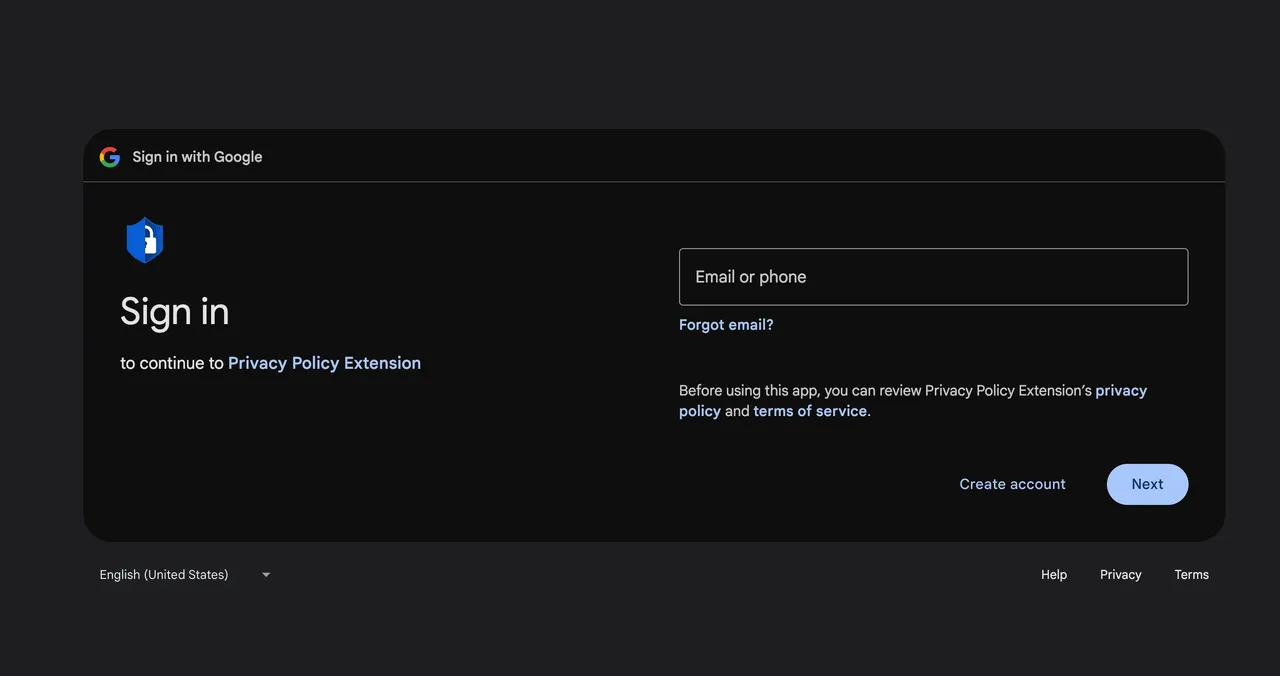
Screenshot showing the Google permission request. Credit: Amit Assaraf

As word of the attack spread in the early hours of December 25, developers and researchers discovered that other extensions were targeted, in many cases successfully, by the same spear phishing campaign. John Tuckner, founder of Secure Annex, a browser extension analysis and management firm, said that as of Thursday afternoon, he knew of 19 other Chrome extensions that were similarly compromised. In every case, the attacker used spear phishing to push a new malicious version and custom, look-alike domains to issue payloads and receive authentication credentials. Collectively, the 20 extensions had 1.46 million downloads.

“For many I talk to, managing browser extensions can be a lower priority item in their security program,” Tuckner wrote in an email. “Folks know they can present a threat, but rarely are teams taking action on them. We’ve often seen in security [that] one or two incidents can cause a reevaluation of an organization’s security posture. Incidents like this often result in teams scrambling to find a way to gain visibility and understanding of impact to their organizations.”

The earliest compromise occurred in May 2024. Tuckner provided the following spreadsheet:

Name ID Version Patch Available Users Start End
VPNCity nnpnnpemnckcfdebeekibpiijlicmpom 2.0.1 FALSE 10,000 12/12/24 12/31/24
Parrot Talks kkodiihpgodmdankclfibbiphjkfdenh 1.16.2 TRUE 40,000 12/25/24 12/31/24
Uvoice oaikpkmjciadfpddlpjjdapglcihgdle 1.0.12 TRUE 40,000 12/26/24 12/31/24
Internxt VPN dpggmcodlahmljkhlmpgpdcffdaoccni 1.1.1 1.2.0 TRUE 10,000 12/25/24 12/29/24
Bookmark Favicon Changer acmfnomgphggonodopogfbmkneepfgnh 4.00 TRUE 40,000 12/25/24 12/31/24
Castorus mnhffkhmpnefgklngfmlndmkimimbphc 4.40 4.41 TRUE 50,000 12/26/24 12/27/24
Wayin AI cedgndijpacnfbdggppddacngjfdkaca 0.0.11 TRUE 40,000 12/19/24 12/31/24
Search Copilot AI Assistant for Chrome bbdnohkpnbkdkmnkddobeafboooinpla 1.0.1 TRUE 20,000 7/17/24 12/31/24
VidHelper – Video Downloader egmennebgadmncfjafcemlecimkepcle 2.2.7 TRUE 20,000 12/26/24 12/31/24
AI Assistant – ChatGPT and Gemini for Chrome bibjgkidgpfbblifamdlkdlhgihmfohh 0.1.3 FALSE 4,000 5/31/24 10/25/24
TinaMind – The GPT-4o-powered AI Assistant! befflofjcniongenjmbkgkoljhgliihe 2.13.0 2.14.0 TRUE 40,000 12/15/24 12/20/24
Bard AI chat pkgciiiancapdlpcbppfkmeaieppikkk 1.3.7 FALSE 100,000 9/5/24 10/22/24
Reader Mode llimhhconnjiflfimocjggfjdlmlhblm 1.5.7 FALSE 300,000 12/18/24 12/19/24
Primus (prev. PADO) oeiomhmbaapihbilkfkhmlajkeegnjhe 3.18.0 3.20.0 TRUE 40,000 12/18/24 12/25/24
Cyberhaven security extension V3 pajkjnmeojmbapicmbpliphjmcekeaac 24.10.4 24.10.5 TRUE 400,000 12/24/24 12/26/24
GraphQL Network Inspector ndlbedplllcgconngcnfmkadhokfaaln 2.22.6 2.22.7 TRUE 80,000 12/29/24 12/30/24
GPT 4 Summary with OpenAI epdjhgbipjpbbhoccdeipghoihibnfja 1.4 FALSE 10,000 5/31/24 9/29/24
Vidnoz Flex – Video recorder & Video share cplhlgabfijoiabgkigdafklbhhdkahj 1.0.161 FALSE 6,000 12/25/24 12/29/24
YesCaptcha assistant jiofmdifioeejeilfkpegipdjiopiekl 1.1.61 TRUE 200,000 12/29/24 12/31/24
Proxy SwitchyOmega (V3) hihblcmlaaademjlakdpicchbjnnnkbo 3.0.2 TRUE 10,000 12/30/24 12/31/24

But wait, there’s more

One of the compromised extensions is called Reader Mode. Further analysis showed it had been compromised not just in the campaign targeting the other 19 extensions but in a separate campaign that started no later than April 2023. Tuckner said the source of the compromise appears to be a code library developers can use to monetize their extensions. The code library collects details about each web visit a browser makes. In exchange for incorporating the library into the extensions, developers receive a commission from the library creator.

Time to check if you ran any of these 33 malicious Chrome extensions Read More »
rumors-say-next-gen-rtx-50-gpus-will-come-with-big-jumps-in-power-requirements

Rumors say next-gen RTX 50 GPUs will come with big jumps in power requirements

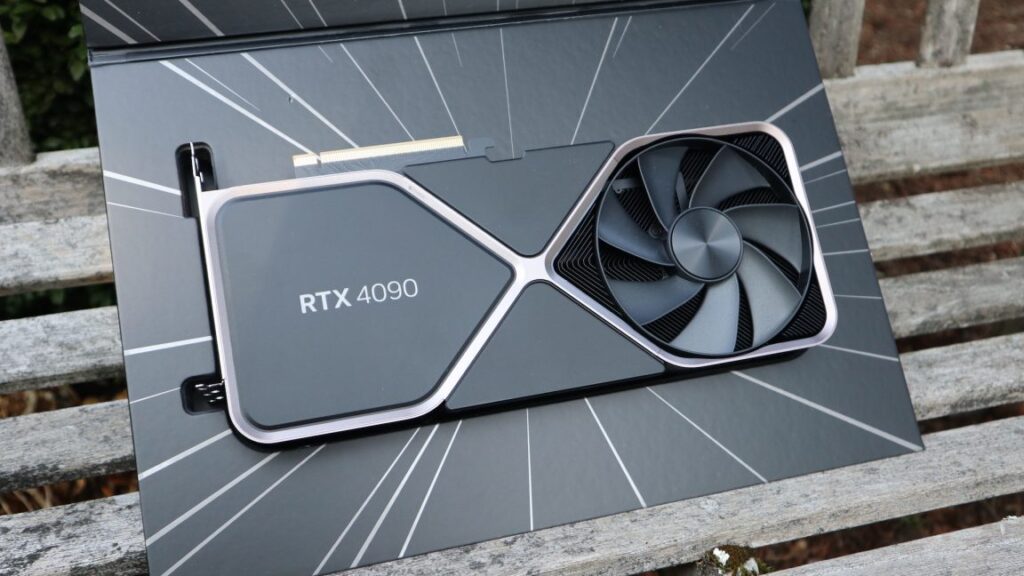
Nvidia is reportedly gearing up to launch the first few cards in its RTX 50-series at CES next week, including an RTX 5090, RTX 5080, RTX 5070 Ti, and RTX 5070. The 5090 will be of particular interest to performance-obsessed, money-is-no-object PC gaming fanatics since it’s the first new GPU in over two years that can beat the performance of 2022’s RTX 4090.

But boosted performance and slower advancements in chip manufacturing technology mean that the 5090’s maximum power draw will far outstrip the 4090’s, according to leakers. VideoCardz reports that the 5090’s thermal design power (TDP) will be set at 575 W, up from 450 W for the already power-hungry RTX 4090. The RTX 5080’s TDP is also increasing to 360 W, up from 320 W for the RTX 4080 Super.

That also puts the RTX 5090 close to the maximum power draw available over a single 12VHPWR connector, which is capable of delivering up to 600 W of power (though once you include the 75 W available via the PCI Express slot on your motherboard, the actual maximum possible power draw for a GPU with a single 12VHPWR connector is a slightly higher 675 W).

Higher peak power consumption doesn’t necessarily mean that these cards will always draw more power during actual gaming than their 40-series counterparts. And their performance could be good enough that they could still be very efficient cards in terms of performance per watt.

But if you’re considering an upgrade to an RTX 5090 and these power specs are accurate, you may need to consider an upgraded power supply along with your new graphics card. Nvidia recommends at least an 850 W power supply for the RTX 4090 to accommodate what the GPU needs while leaving enough power left over for the rest of the system. An additional 125 W bump suggests that Nvidia will recommend a 1,000 W power supply as the minimum for the 5090.

We’ll probably know more about Nvidia’s next-gen cards after its CES keynote, currently scheduled for 9: 30 pm Eastern/6: 30 pm Pacific on Monday, January 6.

Rumors say next-gen RTX 50 GPUs will come with big jumps in power requirements Read More »

meet-squid-game-s3’s-new-killer-doll

Meet Squid Game S3’s new killer doll

S2 is set three years later, and by the end of the second episode, Gi-hun has successfully finagled his way back into the game after winning Russian roulette against the game’s recruiter and tracking down game overseer Front Man (Lee Byung-hun) at a Halloween party. The desperate players this time include a YouTuber who launched a failed crypto scam and a couple of victims of said scam bent on revenge. There’s also a compulsive gambler and his mother, a rapper addicted to ecstasy, a loud and neurotic self-appointed shaman, a former Marine, and a transgender woman who once served in special forces.

Meanwhile, Front Man’s police officer brother, Jun-ho (Wi Ha-joon), has hired mercenaries to track down the island where the game is staged. As in the first season, alliances form and shift as the games proceed, and betrayals abound, culminating in a cliffhanger ending. That’s because series creator Hwang Dong-hyuk conceived of S2 and S3 as a single season, but there were too many episodes, so he split them over two seasons.

Squid Game S3 will premiere on Netflix later this year. Other than the new killer doll, we don’t know much about what’s in store for Gi-hun and his quest to destroy the game other than that it will pick up where S2 left off and will most likely end with a final showdown against Front Man. Is the cynical Front Man right about human nature ensuring that the game will never end?

Meet Squid Game S3’s new killer doll Read More »

how-nascar-and-its-teams-are-embracing-3d-printing

How NASCAR and its teams are embracing 3D printing

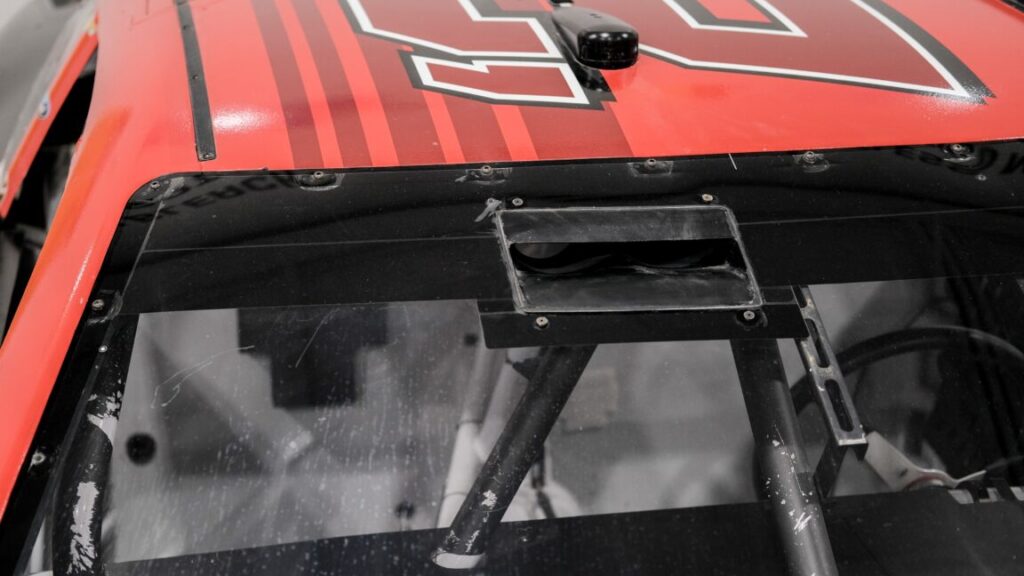
Carbon fiber, aluminum, maybe the odd bit of titanium here or there: These are the materials we usually expect race cars to be made of. Now you can start adding thermoplastics like Ultem to the list. Additive manufacturing has become a real asset in the racer’s toolbox, although the technology has actually been used at the track longer than you might think.

“Some people think that 3D printing was invented last year,” said Fadi Abro, senior global director of automotive and mobility at Stratasys. The company recently became NASCAR’s official 3D printing partner, but it has a relationship with one of the teams—Joe Gibbs Racing—that stretches back two decades.

“Now the teams only have certain things that they can touch in the vehicle, but what that does is it makes it so that every microscopic advantage you can get out of that one tiny detail that you have control over is so meaningful to your team,” Abro said.

Currently, JGR has five printers, which it uses in a variety of applications. Some are common to other industries—additive manufacturing is a good way to quickly develop new prototypes, as well as tooling and fixtures. But the team also prints parts that go straight onto the race car, like housings, ducts, and brackets.

“These are elements that are really integral for the vehicle to be on the track. If there are changes they want to make, they throw it to the printer, it prints overnight, and you have a part that can go on a track that’s specific to that track. So that gives them a competitive advantage,” Abro said.

How NASCAR and its teams are embracing 3D printing Read More »

frogfish-reveals-how-it-evolved-the-“fishing-rod”-on-its-head

Frogfish reveals how it evolved the “fishing rod” on its head

In most bony fish, or teleosts, motor neurons for fins are found on the sides (ventrolateral zone) of the underside (ventral horn) of the spinal cord. The motor neurons controlling the illicium of frogfish are in their own cluster and located in the dorsolateral zone. In fish, this is unusual.

“The peculiar location of fishing motor neurons, with little doubt, is linked with the specialization of the illicium serving fishing behavior,” the team said in a study recently published in the Journal of Comparative Neurology.

Fishing for answers

So what does this have to do with evolution? The white-spotted pygmy filefish might look nothing like a frogfish and has no built-in fishing lure, but it is still a related species and can possibly tell us something.

While the first dorsal fin of the filefish doesn’t really move—it is thought that its main purpose is to scare off predators by looking menacing—there are still motor neurons that control it. Motor neurons for the first dorsal fin of filefish were found in the same location as motor neurons for the second, third and fourth dorsal fins in frogfish. In frogfish, these fins also do not move much while swimming, but can appear threatening to a predator.

If the same types of motor neurons control non-moving fins in both species, the frogfish has something extra when it comes to the function and location of motor neurons controlling the illicium.

Yamamoto thinks the unique group of fishing motor neurons found in frogfish suggests that, as a result of evolution, “the motor neurons for the illicium [became] segregated from other motor neurons” to end up in their own distinct cluster away from motor neurons controlling other fins, as he said in the study.

What exactly caused the functional and locational shift of motor neurons that give the frogfish’s illicium its function is still a mystery. How the brain influences their fishing behavior is another area that needs to be investigated.

While Yamamoto and his team speculate that specific regions of the brain send messages to the fishing motor neurons, they do not yet know which regions are involved, and say that more studies need to be carried out on other species of fish and the groups of motor neurons that power each of their dorsal fins.

In the meantime, the frogfish will continue being its freaky self.

Journal of Comparative Neurology, 2024. DOI: 10.1002/cne.25674

Frogfish reveals how it evolved the “fishing rod” on its head Read More »

you-can-love-or-hate-ai,-but-it’s-killed-crappy-8gb-versions-of-pricey-pcs-and-macs

You can love or hate AI, but it’s killed crappy 8GB versions of pricey PCs and Macs

I’d describe myself as a skeptic of the generative AI revolution—I think the technology as it currently exists is situationally impressive and useful for specific kinds of tasks, but broadly oversold. I’m not sure it will vanish from relevance to quite the extent that other tech fads like the metaverse or NFTs did, but my suspicion is that companies like Nvidia and OpenAI are riding a bubble that will pop or deflate over time as more companies and individuals run up against the technology’s limitations, and as it fails to advance as quickly or as impressively as its most ardent boosters are predicting.

Maybe you agree with me and maybe you don’t! I’m not necessarily trying to convince you one way or the other. But I am here to say that even if you agree with me, we can all celebrate the one unambiguously positive thing that the generative AI hype cycle has done for computers this year: the RAM floor for many PCs and all Macs is now finally 16GB instead of 8GB.

Companies like Apple and Microsoft have, for years, created attractive, high-powered hardware with 8GB of memory in it, most egregiously in $1,000-and-up putative “pro” computers like last year’s $1,599 M3 MacBook Pro or the Surface Pro 9.

This meant that, for the kinds of power users and professionals drawn to these machines, that their starting prices were effectively mirages; “pay for 16GB if you can” has been my blanket advice to MacBook buyers for years now, since there’s basically no workload (including Just Browsing The Web) that won’t benefit at least a little. It also leaves more headroom for future software bloat and future hobby discovery. Did you buy an 8GB Mac, and then decide you wanted to try software development, photo or video editing, CAD design, or Logic Pro? Good luck!

You can love or hate AI, but it’s killed crappy 8GB versions of pricey PCs and Macs Read More »

after-a-24-second-test-of-its-engines,-the-new-glenn-rocket-is-ready-to-fly

After a 24-second test of its engines, the New Glenn rocket is ready to fly

After a long day of stops and starts that stretched well into the evening, and on what appeared to be the company’s fifth attempt Friday, Blue Origin successfully ignited the seven main engines on its massive New Glenn rocket.

The test firing as fog built over the Florida coast marks the final major step in the rocket company’s campaign to bring the New Glenn rocket—a privately developed, super-heavy lift vehicle—to launch readiness. Blue Origin said it fired the vehicle’s engines for a duration of 24 seconds. They fired at full thrust for 13 of those seconds.

“This is a monumental milestone and a glimpse of what’s just around the corner for New Glenn’s first launch,” said Jarrett Jones,  senior vice president of the New Glenn program, in a news release. “Today’s success proves that our rigorous approach to testing–combined with our incredible tooling and design engineering–is working as intended.”

Completion of the dynamic hot-fire test sets up a historic moment for the company founded by Jeff Bezos nearly a quarter of a century ago, the firm’s first ever orbital launch attempt. It will occur from Launch Complex-36, at Cape Canaveral Space Force Station.

Blue Origin’s post-test update did not include a launch date, but based on flight advisory information, a no-earlier than launch date is likely to be January 6.

A license to fly

Friday was important for New Glenn’s debut mission in another way. Several hours before the test firing, the Federal Aviation Administration said it had issued a launch license for the rocket. The license allows Blue Origin to conduct orbital missions from Cape Canaveral with New Glenn, as well as to attempt first stage landings on a barge in the Atlantic Ocean. The license is valid for five years.

After years of waiting, the much-anticipated mission is finally coming together. The hot-fire test, taking place just two days after the Christmas holiday in the United States, reflects the urgency that Bezos has injected into his rocket company over the last 18 months. In the fall of 2023, Bezos ousted Bob Smith as chief executive of Blue Origin, and tapped a long-time Amazon executive, Dave Limp, to lead the company.

After a 24-second test of its engines, the New Glenn rocket is ready to fly Read More »

could-microwaved-grapes-be-used-for-quantum-sensing?

Could microwaved grapes be used for quantum sensing?

The microwaved grape trick also shows their promise as alternative microwave resonators for quantum sensing applications, according to the authors of this latest paper. Those applications include satellite technology, masers, microwave photon detection, hunting for axions (a dark matter candidate), and various quantum systems, and driving spin in superconducting qubits for quantum computing, among others.

Prior research had specifically investigated the electrical fields behind the plasma effect. “We showed that grape pairs can also enhance magnetic fields which are crucial for quantum sensing applications,” said co-author Ali Fawaz, a graduate student at Macquarie University.

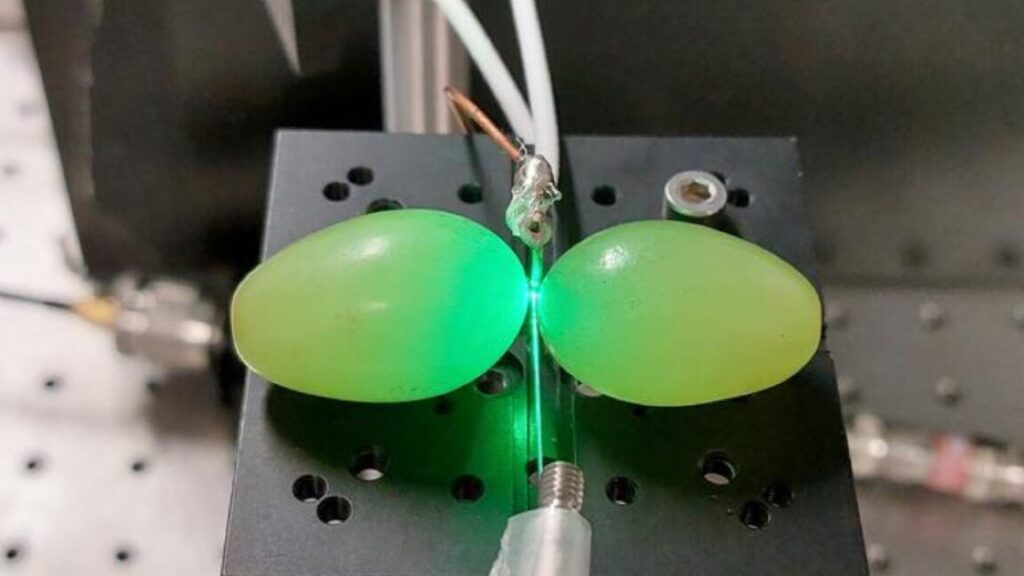
Fawaz and co-authors used specially fabricated nanodiamonds for their experiments. Unlike pure diamonds, which are colorless, some of the carbon atoms in the nanodiamonds were replaced, creating tiny defect centers that act like tiny magnets, making them ideal for quantum sensing. Sapphires are typically used for this purpose, but Fawaz et al. realized that water conducts microwave energy better than sapphires—and grapes are mostly water.

So the team placed a nanodiamond atop a thin glass fiber and placed it between two grapes. Then they shone green laser light through the fiber, making the defect centers glow red. Measuring the brightness told them the strength of the magnetic field around the grapes, which turned out to be twice as strong with grapes than without.

The size and shape of the grapes used in the experiments proved crucial; they must be about 27 millimeters long to get concentrated microwave energy at just the right frequency for the quantum sensor. The biggest catch is that using the grapes proved to be less stable with more energy loss. Future research may identify more reliable potential materials to achieve a similar effect.

DOI: Physical Review Applied, 2024. 10.1103/PhysRevApplied.22.064078 (About DOIs).

Could microwaved grapes be used for quantum sensing? Read More »

ftc-launches-probe-of-microsoft-over-bundling

FTC launches probe of Microsoft over bundling

John Lopatka, a former consultant to the FTC who now teaches antitrust law at Penn State, told ProPublica that the Microsoft actions detailed in the news organization’s recent reporting followed “a very familiar pattern” of behavior.

“It does echo the Microsoft case” from decades ago, said Lopatka, who co-authored a book on that case.

In the new investigation, the FTC has sent Microsoft a civil investigative demand, the agency’s version of a subpoena, compelling the company to turn over information, people familiar with the probe said. Microsoft confirmed that it received the document.

Company spokesperson David Cuddy did not comment on the specifics of the investigation but said the FTC’s demand is “broad, wide ranging, and requests things that are out of the realm of possibility to even be logical.” He declined to provide on-the-record examples. The FTC declined to comment.

The agency’s investigation follows a public comment period in 2023 during which it sought information on the business practices of cloud computing providers. When that concluded, the FTC said it had ongoing interest in whether “certain business practices are inhibiting competition.”

The recent demand to Microsoft represents one of FTC Commissioner Lina Khan’s final moves as chair, and the probe appears to be picking up steam as the Biden administration winds down. The commission’s new leadership, however, will decide the future of the investigation.

President-elect Donald Trump said this month that he will elevate Commissioner Andrew Ferguson, a Republican attorney, to lead the agency. Following the announcement, Ferguson said in a post on X, “At the FTC, we will end Big Tech’s vendetta against competition and free speech. We will make sure that America is the world’s technological leader and the best place for innovators to bring new ideas to life.”

Trump also said he would nominate Republican lawyer Mark Meador as a commissioner, describing him as an “antitrust enforcer” who previously worked at the FTC and the Justice Department. Meador is also a former aide to Sen. Mike Lee, a Utah Republican who introduced legislation to break up Google.

Doris Burke contributed research.

This story originally appeared on ProPublica.

FTC launches probe of Microsoft over bundling Read More »

i-keep-turning-my-google-sheets-into-phone-friendly-webapps,-and-i-can’t-stop

I keep turning my Google Sheets into phone-friendly webapps, and I can’t stop


Software is eating the world and I have snacks for it

How I tackled takeout, spices, and meal ideas with spreadsheets and Glide.

It started, like so many overwrought home optimization projects, during the pandemic.

My wife and I, like many people stuck inside, were ordering takeout more frequently. We wanted to support local restaurants, reduce the dish load, and live a little. It became clear early on that app-based delivery services like DoorDash and Uber Eats were not the best way to support local businesses. If a restaurant had its own ordering site or a preferred service, we wanted to use that—or even, heaven forfend, call the place.

The secondary issue was that we kept ordering from the same places, and we wanted to mix it up. Sometimes we’d want to pick something up nearby. Sometimes we wanted to avoid an entire category (“Too many carbs this week, no pasta”) or try the newest places we knew about, or maybe a forgotten classic. Or just give me three places randomly, creative constraints, please—it’s Friday.

At its core, this is a shared list, i.e. spreadsheet. But my spreadsheet maintenance enthusiasm greatly outweighs that of my spouse. More than that, have you ever pulled up a Google Sheet or online Excel file on your normal-sized phone to make changes? I do so only in moments of true desperation.

For things that are bigger than a note or dry-erase board but smaller than paying for some single-use, subscription-based app, I build little private webapps with Glide. You might use something else, but Glide is a really nice entry into the spreadsheet-to-app milieu. The apps it creates are the kind that can easily be shared and installed (i.e., “Add to Home Screen”) on phones, tablets, or desktops, from a browser. Here’s how it worked for me.

Why you might want to make a little personal webapp

Glide is technically a no-code tool aimed at businesses, but you get one user-based published app for free, and you can have more “private” apps if you’re truly keeping it to your household or friend group. Each full-fledged app can have 10 users and up to 25,000 rows, which should probably be enough for most uses.

I do wish there was a “prosumer” kind of account that billed for less than $828 per year. If you want more than one (relatively) small-scale apps, there are alternatives, like Google’s AppSheet (included in most paid Google Workspace accounts). But most are just as business-oriented, and none have struck me as elegant a tool as Glide.

As mentioned, my primary use for a sheet-based app is to make searching, filtering, reading, and editing that sheet far easier. In the case of my takeout app, that meant being able to search anything—a specific restaurant, “tacos,” a quadrant of the District of Columbia. And a sorting option for when I added a restaurant, so I can find the place I added while a friend was recommending it.

Let’s whip up a webapp

Google Sheet showing the columns Restaurant, Category, Address, Order Link, Phone, Quadrant, Notes/Hours, and Added

The spreadsheet behind my “DC Takeout” app.

Credit: Kevin Purdy

The spreadsheet behind my “DC Takeout” app. Credit: Kevin Purdy

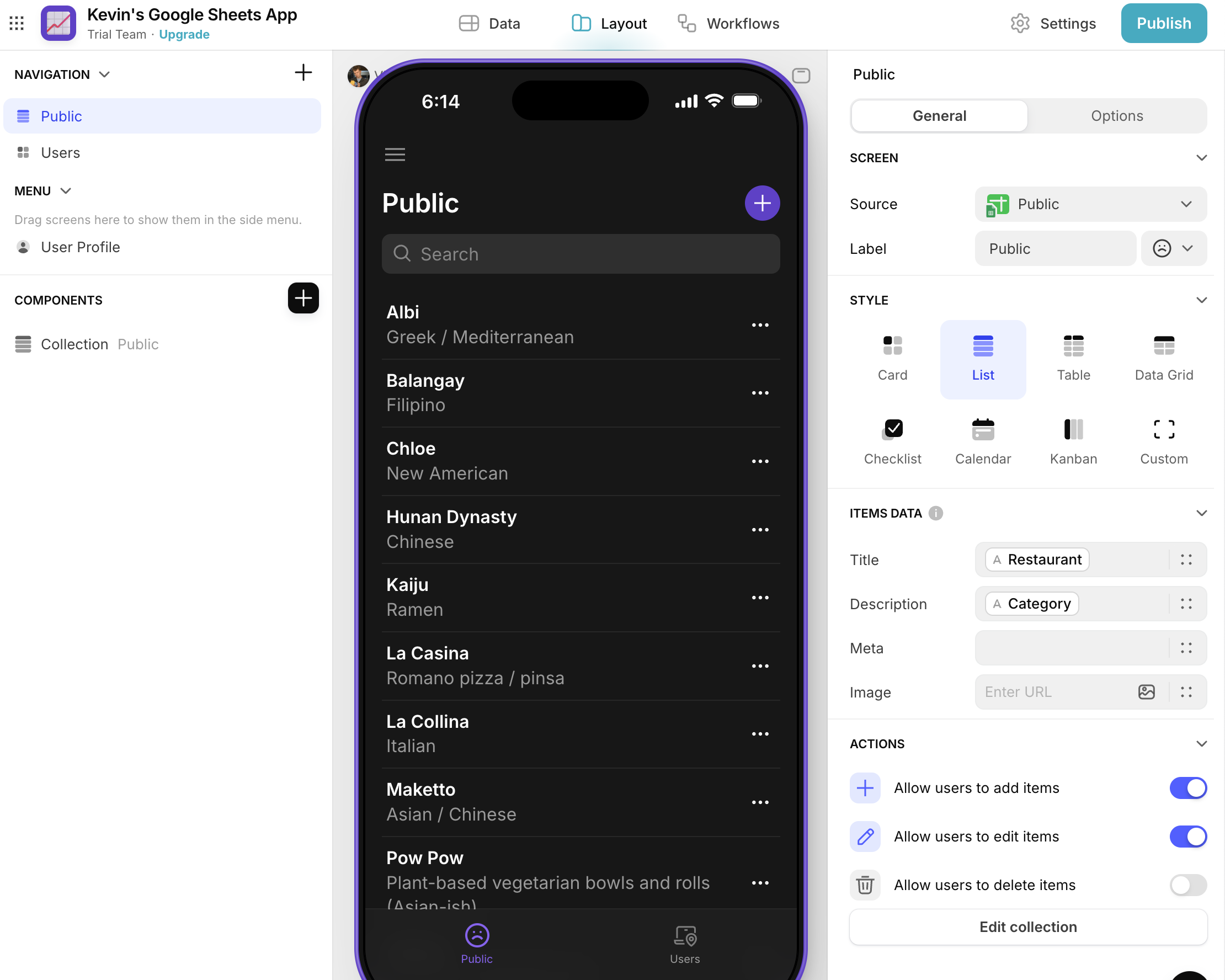
Throwing that sheet fresh into Glide, it’s not off to a bad start. The main view of Glide is a usable version of your app, and I can see that I can already type whatever I want into the search bar, and it will search across fields.

First version of takeout app, with a

I could honestly stop here if I wasn’t picky about some of the quirks I’m seeing. The app is showing screens, “Public” and “Users,” and I want to hide them. In the upper-left corner, in Navigation, I’ll click an eye icon to hide the “Users” section. With “Public” selected, I’ll change the Label in the upper-right to “DC Takeout,” and, if I was going to have more than one screen, give it an icon.

The app already provided a “+” button for adding restaurants, just a simple vertical stack of entry boxes, along with a date picker for Date Added. If you prefer something static, toggle off the options in the “Actions” field in the bottom-right.

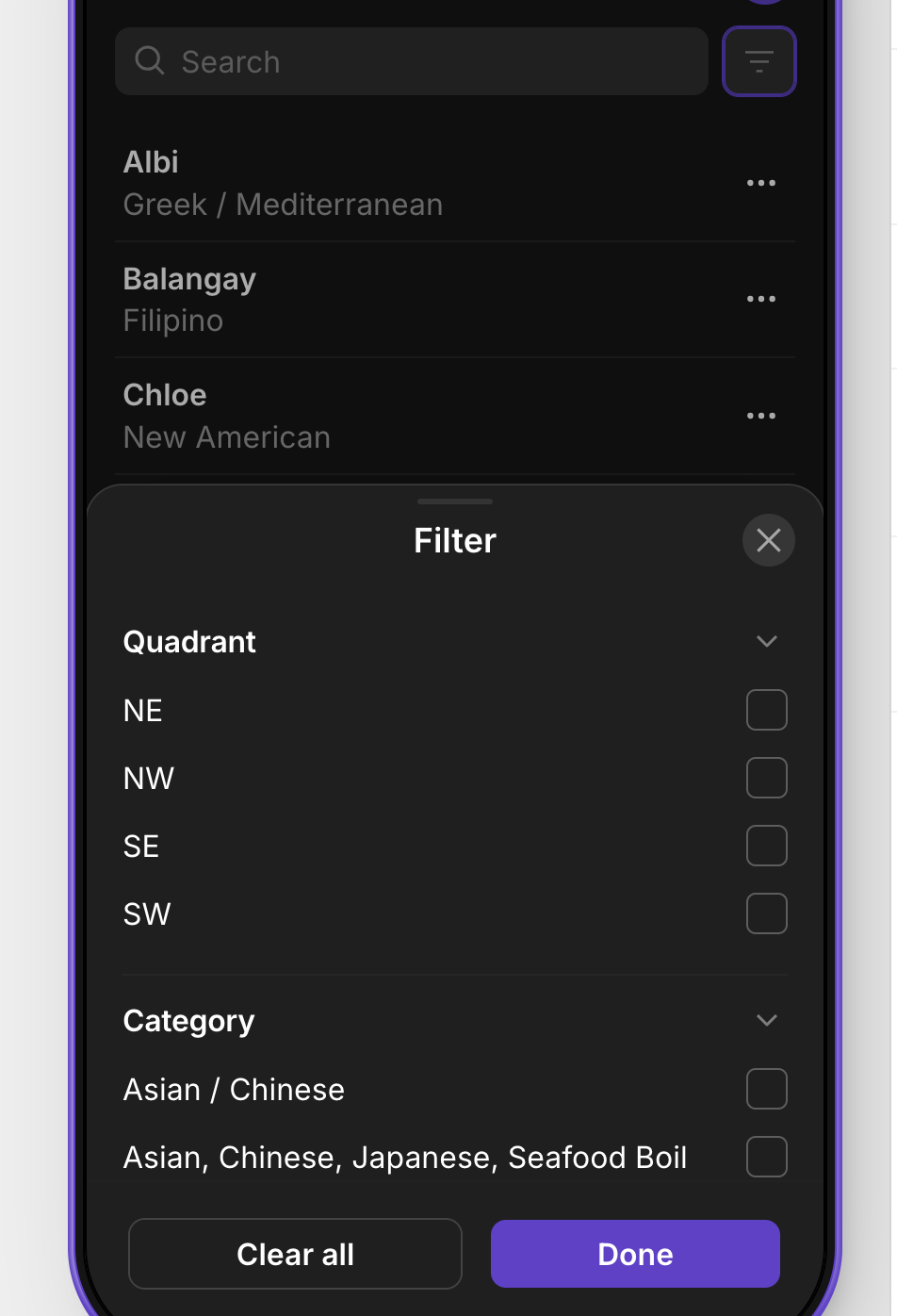
Searching is pretty robust, but what if you want to browse a broad category or just see stuff that’s nearby? In the “Options” section to the right, you can add in In-App Filter, which creates a familiar arrow-shaped three-bar button to the right of the search bar. I’ve added Quadrant and Category filters. If I want to go further here, it’s on me and my spreadsheet. Open on Mondays? Offers pick-up? Has a bar? The possibilities are endless, even if my weekend spreadsheet time is not.

Phone app showing a filter for quadrant and restaurant catgegory.

Simple filter for my takeout app. I need to get the category to be comma-separate values, not a single pile of descriptors.

Credit: Kevin Purdy

Simple filter for my takeout app. I need to get the category to be comma-separate values, not a single pile of descriptors. Credit: Kevin Purdy

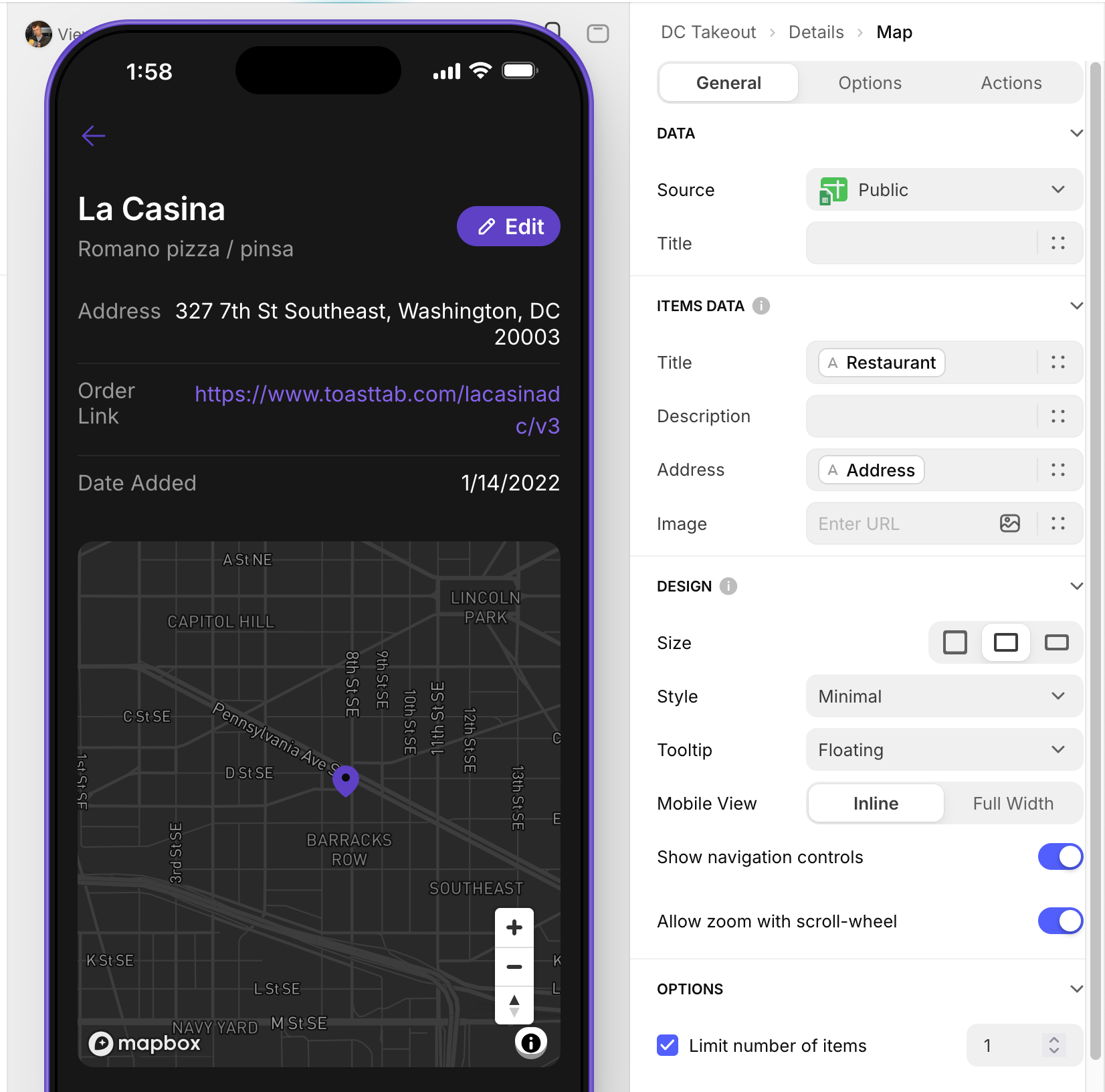
What happens when you click on a restaurant? Right now, you see, essentially, a vertical readout of everything in that spreadsheet row. What could you see? Well, you’ve got an address there, so how about a map?

Click on a restaurant in the fake phone, and on the left you can see “Components,” one of which is our map. Set the address to equal the address column in your sheet, and, in “Options,” set Visibility so that it only shows up when the address field is not empty. In “Actions,” you can set it so that clicking the map opens the phone’s default mapping app, set to the proper address. (If you’re struggling to get the right place to show up, you might want to check out a sample address in Mapbox’s API; it can be a little finicky about how it parses them.)

Map showing on a phone layout, with La Casina, a Romano pizza place, selected with details showing.

Take me to the slightly different pizza!

Credit: Kevin Purdy

Take me to the slightly different pizza! Credit: Kevin Purdy

Glide offers dozens more ways to customize every little thing about your app.

That’s about all I need from a “mix up your takeout and use the right apps” app, one made mostly for me, my spouse, and nearby friends and visitors. Pretty much anything you’d find useful while sitting down at a spreadsheet, you can also make useful through a little phone webapp.

Joyful overkill

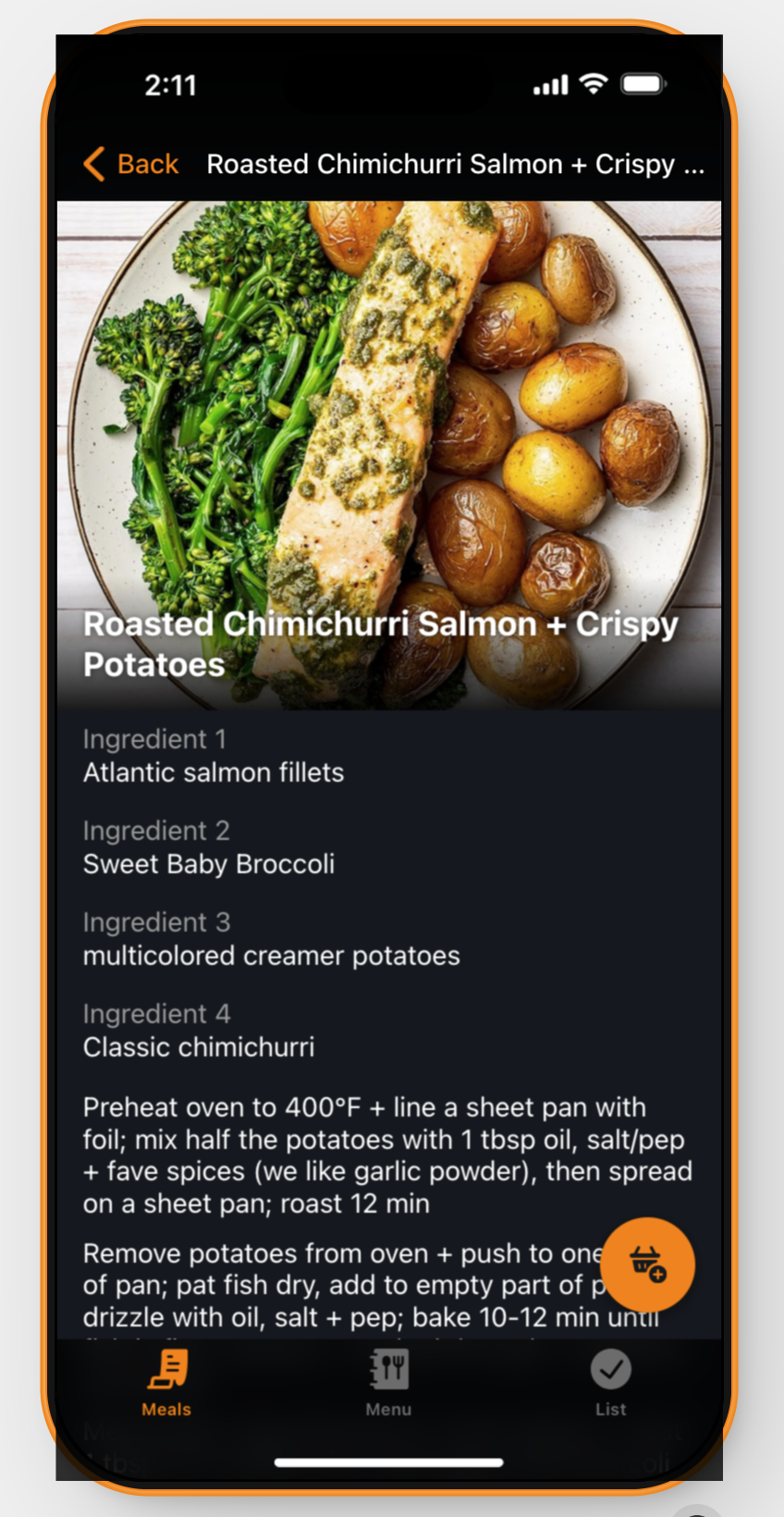
I went a good deal further with my “DIYRoot” app. After using a couple meal delivery services, I sussed out the kinds of recipe formulas they were mixing up each week, plus the items or equivalents I had found at nearby stores. Knowing that I could figure out the basic cooking, I made an app that listed as many recipes as I could find, broke them into components, let me add them to an erasable menu plan and shopping list, and even had some pictures.

Image of a phone app, showing

The best version of an entry has an image, ingredients, and recipe. There’s a button to add it to the menu and all the items to a list.

Credit: Kevin Purdy

The best version of an entry has an image, ingredients, and recipe. There’s a button to add it to the menu and all the items to a list. Credit: Kevin Purdy

I didn’t quite master this app (the shopping list is plagued by blank items/rows), and it’s now technically an outdated “Classic” Glide app; maybe I’ll give it another shot. More successful is my most recent effort, “Pantry Items,” which is just a searchable list of spices and sauces, a note about how much I have left of each, and, through a webhook, add anything I see missing to a shopping list on Bring.

I can feel some people reading this article demanding that I just learn Swift or some mobile-friendly JavaScript package and make some real apps, but I steadfastly refuse. I enjoy the messy middle of programming, where I have just enough app, API, and logic knowledge to make something small for my friends and family that’s always accessible on this little computer I carry everywhere, but I have no ambitions to make it “real.” Anyone can add to it through the relatively simple spreadsheet. Heck, I’ll even take feature requests if I’m feeling gracious.

I use Glide, but you might have something else even simpler (and should recommend it as such in the comments). Just be warned that once you start thinking (or overthinking) along these lines, it can be hard to stop, even without the worldwide pandemic.

Photo of Kevin Purdy

Kevin is a senior technology reporter at Ars Technica, covering open-source software, PC gaming, home automation, repairability, e-bikes, and tech history. He has previously worked at Lifehacker, Wirecutter, iFixit, and Carbon Switch.

I keep turning my Google Sheets into phone-friendly webapps, and I can’t stop Read More »

flu-surges-in-louisiana-as-health-department-barred-from-promoting-flu-shots

Flu surges in Louisiana as health department barred from promoting flu shots

The statement seemed to offer an assurance that other vaccines were not subject to the new restrictions. “Changes regarding seasonal vaccines like COVID and influenza do not change the Department’s policy or messaging regarding childhood immunizations,” it read.

This flu season, the health department has reportedly canceled standard vaccination events and clinics. On social media, the department has avoided mentioning flu shots in posts about the flu, instead advising people to wash their hands and cover their coughs.

While Louisiana is seeing an early surge in influenza, the rest of the country is on an upward trend in what appears to be a normal-looking season so far. Nationally, the percentage of doctor visits that were for ILIs is 3.8 percent, with the upswing in ILI activity similar to what was seen in the 2019–2020 flu season at this point in the year. At the peak of flu seasons, the percentage of visits for ILIs usually tops out around 7 percent to 8 percent.

US ILI activity charted by week across several flu seasons Credit: CDC

Two children died last week of flu, bringing the season’s total pediatric deaths to four. In the 2023–2024 season, 206 children died with influenza-associated disease. Most of the deaths occurred in early 2024.

COVID-19 is also ramping up a winter wave. While standard disease burden indicators—hospitalization and deaths—are low, they’re trending positive. Wastewater surveillance, meanwhile, is showing a steep incline, with levels of the virus being detected at “moderate” levels.

Flu surges in Louisiana as health department barred from promoting flu shots Read More »