AI regulation

from-sci-fi-to-state-law:-california’s-plan-to-prevent-ai-catastrophe

From sci-fi to state law: California’s plan to prevent AI catastrophe

Adventures in AI regulation —

Critics say SB-1047, proposed by “AI doomers,” could slow innovation and stifle open source AI.

The California state capital building in Sacramento.

Enlarge / The California State Capitol Building in Sacramento.

California’s “Safe and Secure Innovation for Frontier Artificial Intelligence Models Act” (a.k.a. SB-1047) has led to a flurry of headlines and debate concerning the overall “safety” of large artificial intelligence models. But critics are concerned that the bill’s overblown focus on existential threats by future AI models could severely limit research and development for more prosaic, non-threatening AI uses today.

SB-1047, introduced by State Senator Scott Wiener, passed the California Senate in May with a 32-1 vote and seems well positioned for a final vote in the State Assembly in August. The text of the bill requires companies behind sufficiently large AI models (currently set at $100 million in training costs and the rough computing power implied by those costs today) to put testing procedures and systems in place to prevent and respond to “safety incidents.”

The bill lays out a legalistic definition of those safety incidents that in turn focuses on defining a set of “critical harms” that an AI system might enable. That includes harms leading to “mass casualties or at least $500 million of damage,” such as “the creation or use of chemical, biological, radiological, or nuclear weapon” (hello, Skynet?) or “precise instructions for conducting a cyberattack… on critical infrastructure.” The bill also alludes to “other grave harms to public safety and security that are of comparable severity” to those laid out explicitly.

An AI model’s creator can’t be held liable for harm caused through the sharing of “publicly accessible” information from outside the model—simply asking an LLM to summarize The Anarchist’s Cookbook probably wouldn’t put it in violation of the law, for instance. Instead, the bill seems most concerned with future AIs that could come up with “novel threats to public safety and security.” More than a human using an AI to brainstorm harmful ideas, SB-1047 focuses on the idea of an AI “autonomously engaging in behavior other than at the request of a user” while acting “with limited human oversight, intervention, or supervision.”

Would California's new bill have stopped WOPR?

Enlarge / Would California’s new bill have stopped WOPR?

To prevent this straight-out-of-science-fiction eventuality, anyone training a sufficiently large model must “implement the capability to promptly enact a full shutdown” and have policies in place for when such a shutdown would be enacted, among other precautions and tests. The bill also focuses at points on AI actions that would require “intent, recklessness, or gross negligence” if performed by a human, suggesting a degree of agency that does not exist in today’s large language models.

Attack of the killer AI?

This kind of language in the bill likely reflects the particular fears of its original drafter, Center for AI Safety (CAIS) co-founder Dan Hendrycks. In a 2023 Time Magazine piece, Hendrycks makes the maximalist existential argument that “evolutionary pressures will likely ingrain AIs with behaviors that promote self-preservation” and lead to “a pathway toward being supplanted as the earth’s dominant species.'”

If Hendrycks is right, then legislation like SB-1047 seems like a common-sense precaution—indeed, it might not go far enough. Supporters of the bill, including AI luminaries Geoffrey Hinton and Yoshua Bengio, agree with Hendrycks’ assertion that the bill is a necessary step to prevent potential catastrophic harm from advanced AI systems.

“AI systems beyond a certain level of capability can pose meaningful risks to democracies and public safety,” wrote Bengio in an endorsement of the bill. “Therefore, they should be properly tested and subject to appropriate safety measures. This bill offers a practical approach to accomplishing this, and is a major step toward the requirements that I’ve recommended to legislators.”

“If we see any power-seeking behavior here, it is not of AI systems, but of AI doomers.

Tech policy expert Dr. Nirit Weiss-Blatt

However, critics argue that AI policy shouldn’t be led by outlandish fears of future systems that resemble science fiction more than current technology. “SB-1047 was originally drafted by non-profit groups that believe in the end of the world by sentient machine, like Dan Hendrycks’ Center for AI Safety,” Daniel Jeffries, a prominent voice in the AI community, told Ars. “You cannot start from this premise and create a sane, sound, ‘light touch’ safety bill.”

“If we see any power-seeking behavior here, it is not of AI systems, but of AI doomers,” added tech policy expert Nirit Weiss-Blatt. “With their fictional fears, they try to pass fictional-led legislation, one that, according to numerous AI experts and open source advocates, could ruin California’s and the US’s technological advantage.”

From sci-fi to state law: California’s plan to prevent AI catastrophe Read More »

world’s-first-global-ai-resolution-unanimously-adopted-by-united-nations

World’s first global AI resolution unanimously adopted by United Nations

We hold these seeds to be self-evident —

Nonbinding agreement seeks to protect personal data and safeguard human rights.

The United Nations building in New York.

Enlarge / The United Nations building in New York.

On Thursday, the United Nations General Assembly unanimously consented to adopt what some call the first global resolution on AI, reports Reuters. The resolution aims to foster the protection of personal data, enhance privacy policies, ensure close monitoring of AI for potential risks, and uphold human rights. It emerged from a proposal by the United States and received backing from China and 121 other countries.

Being a nonbinding agreement and thus effectively toothless, the resolution seems broadly popular in the AI industry. On X, Microsoft Vice Chair and President Brad Smith wrote, “We fully support the @UN’s adoption of the comprehensive AI resolution. The consensus reached today marks a critical step towards establishing international guardrails for the ethical and sustainable development of AI, ensuring this technology serves the needs of everyone.”

The resolution, titled “Seizing the opportunities of safe, secure and trustworthy artificial intelligence systems for sustainable development,” resulted from three months of negotiation, and the stakeholders involved seem pleased at the level of international cooperation. “We’re sailing in choppy waters with the fast-changing technology, which means that it’s more important than ever to steer by the light of our values,” one senior US administration official told Reuters, highlighting the significance of this “first-ever truly global consensus document on AI.”

In the UN, adoption by consensus means that all members agree to adopt the resolution without a vote. “Consensus is reached when all Member States agree on a text, but it does not mean that they all agree on every element of a draft document,” writes the UN in a FAQ found online. “They can agree to adopt a draft resolution without a vote, but still have reservations about certain parts of the text.”

The initiative joins a series of efforts by governments worldwide to influence the trajectory of AI development following the launch of ChatGPT and GPT-4, and the enormous hype raised by certain members of the tech industry in a public worldwide campaign waged last year. Critics fear that AI may undermine democratic processes, amplify fraudulent activities, or contribute to significant job displacement, among other issues. The resolution seeks to address the dangers associated with the irresponsible or malicious application of AI systems, which the UN says could jeopardize human rights and fundamental freedoms.

Resistance from nations such as Russia and China was anticipated, and US officials acknowledged the presence of “lots of heated conversations” during the negotiation process, according to Reuters. However, they also emphasized successful engagement with these countries and others typically at odds with the US on various issues, agreeing on a draft resolution that sought to maintain a delicate balance between promoting development and safeguarding human rights.

The new UN agreement may be the first “global” agreement, in the sense of having the participation of every UN country, but it wasn’t the first multi-state international AI agreement. That honor seems to fall to the Bletchley Declaration signed in November by the 28 nations attending the UK’s first AI Summit.

Also in November, the US, Britain, and other nations unveiled an agreement focusing on the creation of AI systems that are “secure by design” to protect against misuse by rogue actors. Europe is slowly moving forward with provisional agreements to regulate AI and is close to implementing the world’s first comprehensive AI regulations. Meanwhile, the US government still lacks consensus on legislative action related to AI regulation, with the Biden administration advocating for measures to mitigate AI risks while enhancing national security.

World’s first global AI resolution unanimously adopted by United Nations Read More »

at-senate-ai-hearing,-news-executives-fight-against-“fair-use”-claims-for-ai-training-data

At Senate AI hearing, news executives fight against “fair use” claims for AI training data

All’s fair in love and AI —

Media orgs want AI firms to license content for training, and Congress is sympathetic.

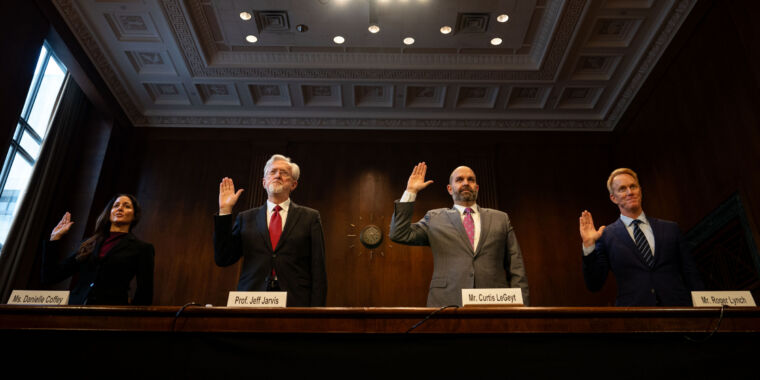
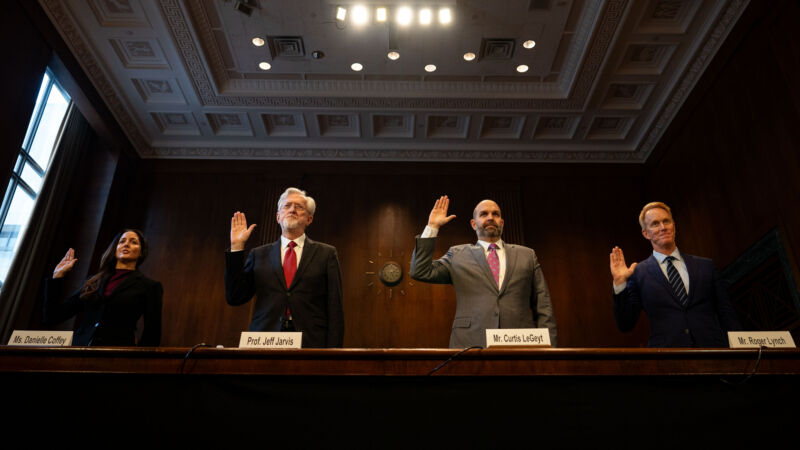
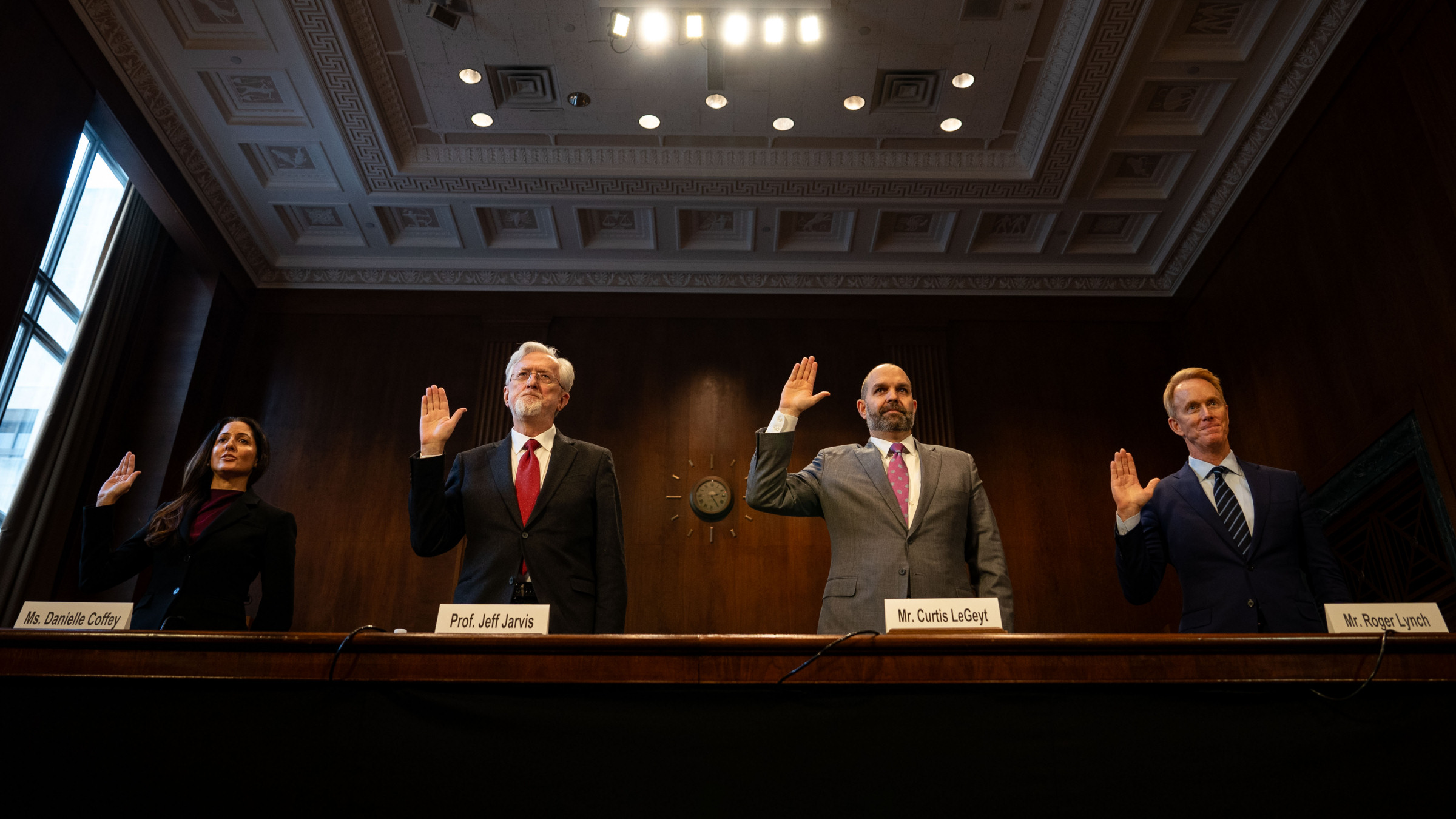
WASHINGTON, DC - JANUARY 10: Danielle Coffey, President and CEO of News Media Alliance, Professor Jeff Jarvis, CUNY Graduate School of Journalism, Curtis LeGeyt President and CEO of National Association of Broadcasters, Roger Lynch CEO of Condé Nast, are strong in during a Senate Judiciary Subcommittee on Privacy, Technology, and the Law hearing on “Artificial Intelligence and The Future Of Journalism” at the U.S. Capitol on January 10, 2024 in Washington, DC. Lawmakers continue to hear testimony from experts and business leaders about artificial intelligence and its impact on democracy, elections, privacy, liability and news. (Photo by Kent Nishimura/Getty Images)

Enlarge / Danielle Coffey, president and CEO of News Media Alliance; Professor Jeff Jarvis, CUNY Graduate School of Journalism; Curtis LeGeyt, president and CEO of National Association of Broadcasters; and Roger Lynch, CEO of Condé Nast, are sworn in during a Senate Judiciary Subcommittee on Privacy, Technology, and the Law hearing on “Artificial Intelligence and The Future Of Journalism.”

Getty Images

On Wednesday, news industry executives urged Congress for legal clarification that using journalism to train AI assistants like ChatGPT is not fair use, as claimed by companies such as OpenAI. Instead, they would prefer a licensing regime for AI training content that would force Big Tech companies to pay for content in a method similar to rights clearinghouses for music.

The plea for action came during a US Senate Judiciary Committee hearing titled “Oversight of A.I.: The Future of Journalism,” chaired by Sen. Richard Blumenthal of Connecticut, with Sen. Josh Hawley of Missouri also playing a large role in the proceedings. Last year, the pair of senators introduced a bipartisan framework for AI legislation and held a series of hearings on the impact of AI.

Blumenthal described the situation as an “existential crisis” for the news industry and cited social media as a cautionary tale for legislative inaction about AI. “We need to move more quickly than we did on social media and learn from our mistakes in the delay there,” he said.

Companies like OpenAI have admitted that vast amounts of copyrighted material are necessary to train AI large language models, but they claim their use is transformational and covered under fair use precedents of US copyright law. Currently, OpenAI is negotiating licensing content from some news providers and striking deals, but the executives in the hearing said those efforts are not enough, highlighting closing newsrooms across the US and dropping media revenues while Big Tech’s profits soar.

“Gen AI cannot replace journalism,” said Condé Nast CEO Roger Lynch in his opening statement. (Condé Nast is the parent company of Ars Technica.) “Journalism is fundamentally a human pursuit, and it plays an essential and irreplaceable role in our society and our democracy.” Lynch said that generative AI has been built with “stolen goods,” referring to the use of AI training content from news outlets without authorization. “Gen AI companies copy and display our content without permission or compensation in order to build massive commercial businesses that directly compete with us.”

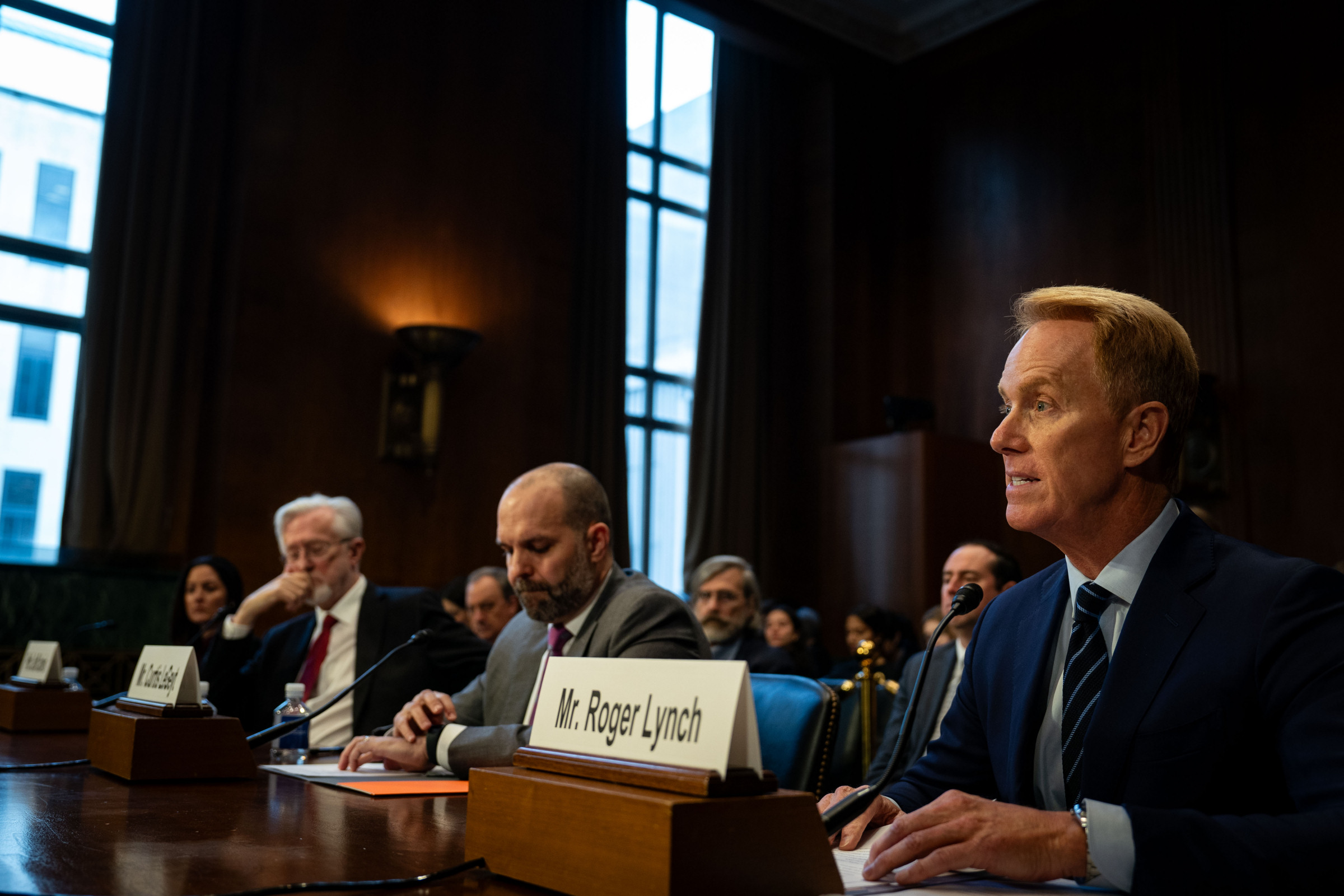
Roger Lynch, CEO of Condé Nast, testifies before the Senate Judiciary Subcommittee on Privacy, Technology, and the Law during a hearing on “Artificial Intelligence and The Future Of Journalism.”

Enlarge / Roger Lynch, CEO of Condé Nast, testifies before the Senate Judiciary Subcommittee on Privacy, Technology, and the Law during a hearing on “Artificial Intelligence and The Future Of Journalism.”

Getty Images

In addition to Lynch, the hearing featured three other witnesses: Jeff Jarvis, a veteran journalism professor and pundit; Danielle Coffey, the president and CEO of News Media Alliance; and Curtis LeGeyt, president and CEO of the National Association of Broadcasters.

Coffey also shared concerns about generative AI using news material to create competitive products. “These outputs compete in the same market, with the same audience, and serve the same purpose as the original articles that feed the algorithms in the first place,” she said.

When Sen. Hawley asked Lynch what kind of legislation might be needed to fix the problem, Lynch replied, “I think quite simply, if Congress could clarify that the use of our content and other publisher content for training and output of AI models is not fair use, then the free market will take care of the rest.”

Lynch used the music industry as a model: “You think about millions of artists, millions of ultimate consumers consuming that content, there have been models that have been set up, ASCAP, BMI, CSAC, GMR, these collective rights organizations to simplify the content that’s being used.”

Curtis LeGeyt, CEO of the National Association of Broadcasters, said that TV broadcast journalists are also affected by generative AI. “The use of broadcasters’ news content in AI models without authorization diminishes our audience’s trust and our reinvestment in local news,” he said. “Broadcasters have already seen numerous examples where content created by our journalists has been ingested and regurgitated by AI bots with little or no attribution.”

At Senate AI hearing, news executives fight against “fair use” claims for AI training data Read More »