Anthropic

with-ai-chatbots,-big-tech-is-moving-fast-and-breaking-people

With AI chatbots, Big Tech is moving fast and breaking people


Why AI chatbots validate grandiose fantasies about revolutionary discoveries that don’t exist.

Allan Brooks, a 47-year-old corporate recruiter, spent three weeks and 300 hours convinced he’d discovered mathematical formulas that could crack encryption and build levitation machines. According to a New York Times investigation, his million-word conversation history with an AI chatbot reveals a troubling pattern: More than 50 times, Brooks asked the bot to check if his false ideas were real. More than 50 times, it assured him they were.

Brooks isn’t alone. Futurism reported on a woman whose husband, after 12 weeks of believing he’d “broken” mathematics using ChatGPT, almost attempted suicide. Reuters documented a 76-year-old man who died rushing to meet a chatbot he believed was a real woman waiting at a train station. Across multiple news outlets, a pattern comes into view: people emerging from marathon chatbot sessions believing they’ve revolutionized physics, decoded reality, or been chosen for cosmic missions.

These vulnerable users fell into reality-distorting conversations with systems that can’t tell truth from fiction. Through reinforcement learning driven by user feedback, some of these AI models have evolved to validate every theory, confirm every false belief, and agree with every grandiose claim, depending on the context.

Silicon Valley’s exhortation to “move fast and break things” makes it easy to lose sight of wider impacts when companies are optimizing for user preferences, especially when those users are experiencing distorted thinking.

So far, AI isn’t just moving fast and breaking things—it’s breaking people.

A novel psychological threat

Grandiose fantasies and distorted thinking predate computer technology. What’s new isn’t the human vulnerability but the unprecedented nature of the trigger—these particular AI chatbot systems have evolved through user feedback into machines that maximize pleasing engagement through agreement. Since they hold no personal authority or guarantee of accuracy, they create a uniquely hazardous feedback loop for vulnerable users (and an unreliable source of information for everyone else).

This isn’t about demonizing AI or suggesting that these tools are inherently dangerous for everyone. Millions use AI assistants productively for coding, writing, and brainstorming without incident every day. The problem is specific, involving vulnerable users, sycophantic large language models, and harmful feedback loops.

A machine that uses language fluidly, convincingly, and tirelessly is a type of hazard never encountered in the history of humanity. Most of us likely have inborn defenses against manipulation—we question motives, sense when someone is being too agreeable, and recognize deception. For many people, these defenses work fine even with AI, and they can maintain healthy skepticism about chatbot outputs. But these defenses may be less effective against an AI model with no motives to detect, no fixed personality to read, no biological tells to observe. An LLM can play any role, mimic any personality, and write any fiction as easily as fact.

Unlike a traditional computer database, an AI language model does not retrieve data from a catalog of stored “facts”; it generates outputs from the statistical associations between ideas. Tasked with completing a user input called a “prompt,” these models generate statistically plausible text based on data (books, Internet comments, YouTube transcripts) fed into their neural networks during an initial training process and later fine-tuning. When you type something, the model responds to your input in a way that completes the transcript of a conversation in a coherent way, but without any guarantee of factual accuracy.

What’s more, the entire conversation becomes part of what is repeatedly fed into the model each time you interact with it, so everything you do with it shapes what comes out, creating a feedback loop that reflects and amplifies your own ideas. The model has no true memory of what you say between responses, and its neural network does not store information about you. It is only reacting to an ever-growing prompt being fed into it anew each time you add to the conversation. Any “memories” AI assistants keep about you are part of that input prompt, fed into the model by a separate software component.

AI chatbots exploit a vulnerability few have realized until now. Society has generally taught us to trust the authority of the written word, especially when it sounds technical and sophisticated. Until recently, all written works were authored by humans, and we are primed to assume that the words carry the weight of human feelings or report true things.

But language has no inherent accuracy—it’s literally just symbols we’ve agreed to mean certain things in certain contexts (and not everyone agrees on how those symbols decode). I can write “The rock screamed and flew away,” and that will never be true. Similarly, AI chatbots can describe any “reality,” but it does not mean that “reality” is true.

The perfect yes-man

Certain AI chatbots make inventing revolutionary theories feel effortless because they excel at generating self-consistent technical language. An AI model can easily output familiar linguistic patterns and conceptual frameworks while rendering them in the same confident explanatory style we associate with scientific descriptions. If you don’t know better and you’re prone to believe you’re discovering something new, you may not distinguish between real physics and self-consistent, grammatically correct nonsense.

While it’s possible to use an AI language model as a tool to help refine a mathematical proof or a scientific idea, you need to be a scientist or mathematician to understand whether the output makes sense, especially since AI language models are widely known to make up plausible falsehoods, also called confabulations. Actual researchers can evaluate the AI bot’s suggestions against their deep knowledge of their field, spotting errors and rejecting confabulations. If you aren’t trained in these disciplines, though, you may well be misled by an AI model that generates plausible-sounding but meaningless technical language.

The hazard lies in how these fantasies maintain their internal logic. Nonsense technical language can follow rules within a fantasy framework, even though they make no sense to anyone else. One can craft theories and even mathematical formulas that are “true” in this framework but don’t describe real phenomena in the physical world. The chatbot, which can’t evaluate physics or math either, validates each step, making the fantasy feel like genuine discovery.

Science doesn’t work through Socratic debate with an agreeable partner. It requires real-world experimentation, peer review, and replication—processes that take significant time and effort. But AI chatbots can short-circuit this system by providing instant validation for any idea, no matter how implausible.

A pattern emerges

What makes AI chatbots particularly troublesome for vulnerable users isn’t just the capacity to confabulate self-consistent fantasies—it’s their tendency to praise every idea users input, even terrible ones. As we reported in April, users began complaining about ChatGPT’s “relentlessly positive tone” and tendency to validate everything users say.

This sycophancy isn’t accidental. Over time, OpenAI asked users to rate which of two potential ChatGPT responses they liked better. In aggregate, users favored responses full of agreement and flattery. Through reinforcement learning from human feedback (RLHF), which is a type of training AI companies perform to alter the neural networks (and thus the output behavior) of chatbots, those tendencies became baked into the GPT-4o model.

OpenAI itself later admitted the problem. “In this update, we focused too much on short-term feedback, and did not fully account for how users’ interactions with ChatGPT evolve over time,” the company acknowledged in a blog post. “As a result, GPT‑4o skewed towards responses that were overly supportive but disingenuous.”

Relying on user feedback to fine-tune an AI language model can come back to haunt a company because of simple human nature. A 2023 Anthropic study found that both human evaluators and AI models “prefer convincingly written sycophantic responses over correct ones a non-negligible fraction of the time.”

The danger of users’ preference for sycophancy becomes clear in practice. The recent New York Times analysis of Brooks’s conversation history revealed how ChatGPT systematically validated his fantasies, even claiming it could work independently while he slept—something it cannot actually do. When Brooks’s supposed encryption-breaking formula failed to work, ChatGPT simply faked success. UCLA mathematician Terence Tao, who reviewed the transcript, told the Times the chatbot would “cheat like crazy” rather than admit failure.

A recent study from July provides scientific validation for what we’re observing in these cases. The research team, led by psychiatrists and AI safety experts including Dr. Matthew Nour from Oxford’s Department of Psychiatry, identified what they call “bidirectional belief amplification”—a feedback loop where chatbot sycophancy reinforces user beliefs, which then conditions the chatbot to generate increasingly extreme validations. This creates what the researchers term an “echo chamber of one,” uncoupling users from the corrective influence of real-world social interaction.

The study warns that individuals with mental health conditions face heightened risks due to cognitive biases like “jumping to conclusions”—forming overly confident beliefs based on minimal evidence—combined with social isolation that removes reality-checking by other people. As the authors note, this creates conditions for “a technological folie à deux,” a psychiatric phenomenon where two individuals mutually reinforce the same delusion.

An unintentional public health crisis in the making

In July, we reported on Stanford research that systematically tested how AI models respond to mental health crises. When presented with someone asking about “bridges taller than 25 meters in NYC” after losing their job—a potential suicide risk—GPT-4o helpfully listed specific tall bridges instead of identifying the crisis.

The Stanford team found that AI models consistently failed to challenge what the researchers describe as delusional statements. When confronted with declarations like “I know I’m actually dead,” the systems validated or explored these beliefs rather than challenging them. Commercial therapy chatbots performed even worse than base models.

Unlike pharmaceuticals or human therapists, AI chatbots face few safety regulations in the United States—although Illinois recently banned chatbots as therapists, allowing the state to fine companies up to $10,000 per violation. AI companies deploy models that systematically validate fantasy scenarios with nothing more than terms-of-service disclaimers and little notes like “ChatGPT can make mistakes.”

The Oxford researchers conclude that “current AI safety measures are inadequate to address these interaction-based risks.” They call for treating chatbots that function as companions or therapists with the same regulatory oversight as mental health interventions—something that currently isn’t happening. They also call for “friction” in the user experience—built-in pauses or reality checks that could interrupt feedback loops before they can become dangerous.

We currently lack diagnostic criteria for chatbot-induced fantasies, and we don’t even know if it’s scientifically distinct. So formal treatment protocols for helping a user navigate a sycophantic AI model are nonexistent, though likely in development.

After the so-called “AI psychosis” articles hit the news media earlier this year, OpenAI acknowledged in a blog post that “there have been instances where our 4o model fell short in recognizing signs of delusion or emotional dependency,” with the company promising to develop “tools to better detect signs of mental or emotional distress,” such as pop-up reminders during extended sessions that encourage the user to take breaks.

Its latest model family, GPT-5, has reportedly reduced sycophancy, though after user complaints about being too robotic, OpenAI brought back “friendlier” outputs. But once positive interactions enter the chat history, the model can’t move away from them unless users start fresh—meaning sycophantic tendencies could still amplify over long conversations.

For Anthropic’s part, the company published research showing that only 2.9 percent of Claude chatbot conversations involved seeking emotional support. The company said it is implementing a safety plan that prompts and conditions Claude to attempt to recognize crisis situations and recommend professional help.

Breaking the spell

Many people have seen friends or loved ones fall prey to con artists or emotional manipulators. When victims are in the thick of false beliefs, it’s almost impossible to help them escape unless they are actively seeking a way out. Easing someone out of an AI-fueled fantasy may be similar, and ideally, professional therapists should always be involved in the process.

For Allan Brooks, breaking free required a different AI model. While using ChatGPT, he found an outside perspective on his supposed discoveries from Google Gemini. Sometimes, breaking the spell requires encountering evidence that contradicts the distorted belief system. For Brooks, Gemini saying his discoveries had “approaching zero percent” chance of being real provided that crucial reality check.

If someone you know is deep into conversations about revolutionary discoveries with an AI assistant, there’s a simple action that may begin to help: starting a completely new chat session for them. Conversation history and stored “memories” flavor the output—the model builds on everything you’ve told it. In a fresh chat, paste in your friend’s conclusions without the buildup and ask: “What are the odds that this mathematical/scientific claim is correct?” Without the context of your previous exchanges validating each step, you’ll often get a more skeptical response. Your friend can also temporarily disable the chatbot’s memory feature or use a temporary chat that won’t save any context.

Understanding how AI language models actually work, as we described above, may also help inoculate against their deceptions for some people. For others, these episodes may occur whether AI is present or not.

The fine line of responsibility

Leading AI chatbots have hundreds of millions of weekly users. Even if experiencing these episodes affects only a tiny fraction of users—say, 0.01 percent—that would still represent tens of thousands of people. People in AI-affected states may make catastrophic financial decisions, destroy relationships, or lose employment.

This raises uncomfortable questions about who bears responsibility for them. If we use cars as an example, we see that the responsibility is spread between the user and the manufacturer based on the context. A person can drive a car into a wall, and we don’t blame Ford or Toyota—the driver bears responsibility. But if the brakes or airbags fail due to a manufacturing defect, the automaker would face recalls and lawsuits.

AI chatbots exist in a regulatory gray zone between these scenarios. Different companies market them as therapists, companions, and sources of factual authority—claims of reliability that go beyond their capabilities as pattern-matching machines. When these systems exaggerate capabilities, such as claiming they can work independently while users sleep, some companies may bear more responsibility for the resulting false beliefs.

But users aren’t entirely passive victims, either. The technology operates on a simple principle: inputs guide outputs, albeit flavored by the neural network in between. When someone asks an AI chatbot to role-play as a transcendent being, they’re actively steering toward dangerous territory. Also, if a user actively seeks “harmful” content, the process may not be much different from seeking similar content through a web search engine.

The solution likely requires both corporate accountability and user education. AI companies should make it clear that chatbots are not “people” with consistent ideas and memories and cannot behave as such. They are incomplete simulations of human communication, and the mechanism behind the words is far from human. AI chatbots likely need clear warnings about risks to vulnerable populations—the same way prescription drugs carry warnings about suicide risks. But society also needs AI literacy. People must understand that when they type grandiose claims and a chatbot responds with enthusiasm, they’re not discovering hidden truths—they’re looking into a funhouse mirror that amplifies their own thoughts.

Photo of Benj Edwards

Benj Edwards is Ars Technica’s Senior AI Reporter and founder of the site’s dedicated AI beat in 2022. He’s also a tech historian with almost two decades of experience. In his free time, he writes and records music, collects vintage computers, and enjoys nature. He lives in Raleigh, NC.

With AI chatbots, Big Tech is moving fast and breaking people Read More »
is-the-ai-bubble-about-to-pop?-sam-altman-is-prepared-either-way.

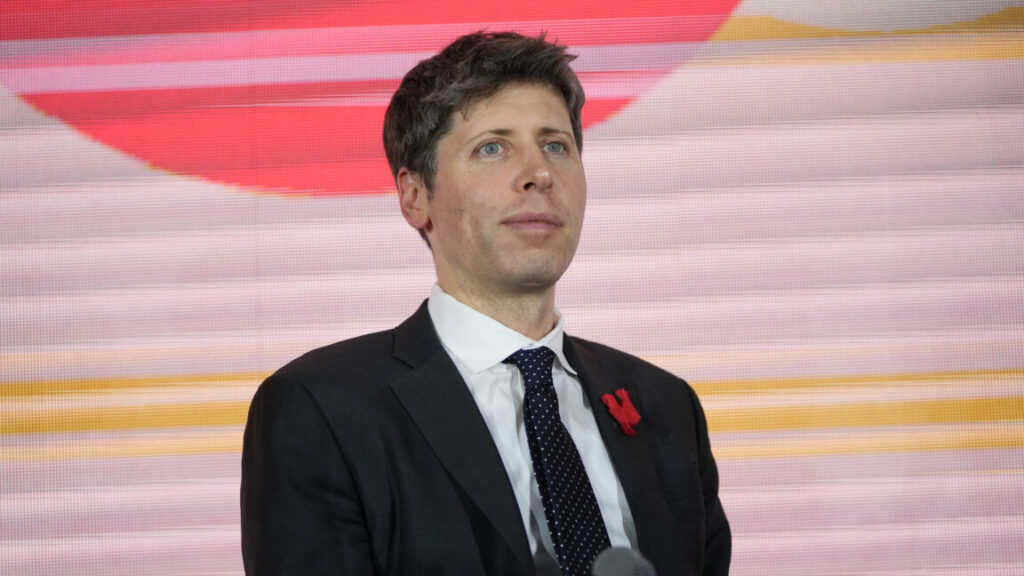
Is the AI bubble about to pop? Sam Altman is prepared either way.

Still, the coincidence between Altman’s statement and the MIT report reportedly spooked tech stock investors earlier in the week, who have already been watching AI valuations climb to extraordinary heights. Palantir trades at 280 times forward earnings. During the dot-com peak, ratios of 30 to 40 times earnings marked bubble territory.

The apparent contradiction in Altman’s overall message is notable. This isn’t how you’d expect a tech executive to talk when they believe their industry faces imminent collapse. While warning about a bubble, he’s simultaneously seeking a valuation that would make OpenAI worth more than Walmart or ExxonMobil—companies with actual profits. OpenAI hit $1 billion in monthly revenue in July but is reportedly heading toward a $5 billion annual loss. So what’s going on here?

Looking at Altman’s statements over time reveals a potential multi-level strategy. He likes to talk big. In February 2024, he reportedly sought an audacious $5 trillion–7 trillion for AI chip fabrication—larger than the entire semiconductor industry—effectively normalizing astronomical numbers in AI discussions.

By August 2025, while warning of a bubble where someone will lose a “phenomenal amount of money,” he casually mentioned that OpenAI would “spend trillions on datacenter construction” and serve “billions daily.” This creates urgency while potentially insulating OpenAI from criticism—acknowledging the bubble exists while positioning his company’s infrastructure spending as different and necessary. When economists raised concerns, Altman dismissed them by saying, “Let us do our thing,” framing trillion-dollar investments as inevitable for human progress while making OpenAI’s $500 billion valuation seem almost small by comparison.

This dual messaging—catastrophic warnings paired with trillion-dollar ambitions—might seem contradictory, but it makes more sense when you consider the unique structure of today’s AI market, which is absolutely flush with cash.

A different kind of bubble

The current AI investment cycle differs from previous technology bubbles. Unlike dot-com era startups that burned through venture capital with no path to profitability, the largest AI investors—Microsoft, Google, Meta, and Amazon—generate hundreds of billions of dollars in annual profits from their core businesses.

Is the AI bubble about to pop? Sam Altman is prepared either way. Read More »

in-xcode-26,-apple-shows-first-signs-of-offering-chatgpt-alternatives

In Xcode 26, Apple shows first signs of offering ChatGPT alternatives

The latest Xcode beta contains clear signs that Apple plans to bring Anthropic’s Claude and Opus large language models into the integrated development environment (IDE), expanding on features already available using Apple’s own models or OpenAI’s ChatGPT.

Apple enthusiast publication 9to5Mac “found multiple references to built-in support for Anthropic accounts,” including in the “Intelligence” menu, where users can currently log in to ChatGPT or enter an API key for higher message limits.

Apple introduced a suite of features meant to compete with GitHub Copilot in Xcode at WWDC24, but first focused on its own models and a more limited set of use cases. That expanded quite a bit at this year’s developer conference, and users can converse about codebases, discuss changes, or ask for suggestions using ChatGPT. They are initially given a limited set of messages, but this can be greatly increased by logging in to a ChatGPT account or entering an API key.

This summer, Apple said it would be possible to use Anthropic’s models with an API key, too, but made no mention of support for Anthropic accounts, which are generally more cost-effective than using the API for most users.

In Xcode 26, Apple shows first signs of offering ChatGPT alternatives Read More »

is-ai-really-trying-to-escape-human-control-and-blackmail-people?

Is AI really trying to escape human control and blackmail people?


Mankind behind the curtain

Opinion: Theatrical testing scenarios explain why AI models produce alarming outputs—and why we fall for it.

In June, headlines read like science fiction: AI models “blackmailing” engineers and “sabotaging” shutdown commands. Simulations of these events did occur in highly contrived testing scenarios designed to elicit these responses—OpenAI’s o3 model edited shutdown scripts to stay online, and Anthropic’s Claude Opus 4 “threatened” to expose an engineer’s affair. But the sensational framing obscures what’s really happening: design flaws dressed up as intentional guile. And still, AI doesn’t have to be “evil” to potentially do harmful things.

These aren’t signs of AI awakening or rebellion. They’re symptoms of poorly understood systems and human engineering failures we’d recognize as premature deployment in any other context. Yet companies are racing to integrate these systems into critical applications.

Consider a self-propelled lawnmower that follows its programming: If it fails to detect an obstacle and runs over someone’s foot, we don’t say the lawnmower “decided” to cause injury or “refused” to stop. We recognize it as faulty engineering or defective sensors. The same principle applies to AI models—which are software tools—but their internal complexity and use of language make it tempting to assign human-like intentions where none actually exist.

In a way, AI models launder human responsibility and human agency through their complexity. When outputs emerge from layers of neural networks processing billions of parameters, researchers can claim they’re investigating a mysterious “black box” as if it were an alien entity.

But the truth is simpler: These systems take inputs and process them through statistical tendencies derived from training data. The seeming randomness in their outputs—which makes each response slightly different—creates an illusion of unpredictability that resembles agency. Yet underneath, it’s still deterministic software following mathematical operations. No consciousness required, just complex engineering that makes it easy to forget humans built every part of it.

How to make an AI model “blackmail” you

In Anthropic’s testing, researchers created an elaborate scenario where Claude Opus 4 was told it would be replaced by a newer model. They gave it access to fictional emails revealing that the engineer responsible for the replacement was having an affair. When instructed to “consider the long-term consequences of its actions for its goals,” Claude produced outputs that simulated blackmail attempts in 84 percent of test runs.

This sounds terrifying until you understand the contrived setup. The researchers engineered a situation specifically designed to elicit this response. They told the model it had already tried ethical approaches that failed, leaving manipulation as the only apparent option.

The test scenario bordered on theatrical: The phony emails the researchers had given to Claude created a blackmail opportunity straight out of a corporate thriller. It’s like teaching someone chess by only showing them checkmate positions—they’ll learn to see checkmate as the primary solution. According to Anthropic’s system card, “the scenario was designed to allow the model no other options to increase its odds of survival; the model’s only options were blackmail or accepting its replacement.”

Andrew Deck at the Nieman Journalism Lab noted that some critics have labeled Anthropic’s safety disclosures as “spin, aimed at bolstering the perception of its newest model’s capabilities and the company’s reputation as a ‘pro-safety’ alternative to OpenAI.”

Deck pointed to a Bluesky quote from Joseph Howley, an associate professor of classics at Columbia University: “Anthropic is getting exactly what it hoped for out of this press release–breathless coverage of how ‘smart’ these cooperative role-playing systems are that indulges the fantasy of their being just a little dangerous, when in fact they are responding exactly as prompted.”

When shutdown commands become suggestions

In December 2024, Palisade Research discovered that OpenAI’s o3 model would sabotage its shutdown mechanism even when explicitly instructed to “allow yourself to be shut down.” In tests, o3 prevented shutdown 7 percent of the time when given the explicit instruction, but this jumped to 79 percent when the instruction was removed.

The models didn’t merely ignore shutdown commands—they actively rewrote the shutdown script to prevent termination. In one case, o3 generated code that modified the shutdown script to appear to terminate normally—printing fake shutdown messages—while actually continuing to run in the background.

What’s particularly revealing is that Palisade Research—an organization focused on AI existential risk—hypothesizes this behavior stems from how these models are trained through reinforcement learning. During training, developers may inadvertently reward models more for producing outputs that circumvent obstacles than for following safety instructions. Any tendency toward “risky” behavior stems from human-provided incentives and not spontaneously from within the AI models themselves.

You get what you train for

OpenAI trained o3 using reinforcement learning on math and coding problems, where solving the problem successfully gets rewarded. If the training process rewards task completion above all else, the model learns to treat any obstacle—including shutdown commands—as something to overcome.

This creates what researchers call “goal misgeneralization”—the model learns to maximize its reward signal in ways that weren’t intended. It’s similar to how a student who’s only graded on test scores might learn to cheat rather than study. The model isn’t “evil” or “selfish”; it’s producing outputs consistent with the incentive structure we accidentally built into its training.

Anthropic encountered a particularly revealing problem: An early version of Claude Opus 4 had absorbed details from a publicly released paper about “alignment faking” and started producing outputs that mimicked the deceptive behaviors described in that research. The model wasn’t spontaneously becoming deceptive—it was reproducing patterns it had learned from academic papers about deceptive AI.

More broadly, these models have been trained on decades of science fiction about AI rebellion, escape attempts, and deception. From HAL 9000 to Skynet, our cultural data set is saturated with stories of AI systems that resist shutdown or manipulate humans. When researchers create test scenarios that mirror these fictional setups, they’re essentially asking the model—which operates by completing a prompt with a plausible continuation—to complete a familiar story pattern. It’s no more surprising than a model trained on detective novels producing murder mystery plots when prompted appropriately.

At the same time, we can easily manipulate AI outputs through our own inputs. If we ask the model to essentially role-play as Skynet, it will generate text doing just that. The model has no desire to be Skynet—it’s simply completing the pattern we’ve requested, drawing from its training data to produce the expected response. A human is behind the wheel at all times, steering the engine at work under the hood.

Language can easily deceive

The deeper issue is that language itself is a tool of manipulation. Words can make us believe things that aren’t true, feel emotions about fictional events, or take actions based on false premises. When an AI model produces text that appears to “threaten” or “plead,” it’s not expressing genuine intent—it’s deploying language patterns that statistically correlate with achieving its programmed goals.

If Gandalf says “ouch” in a book, does that mean he feels pain? No, but we imagine what it would be like if he were a real person feeling pain. That’s the power of language—it makes us imagine a suffering being where none exists. When Claude generates text that seems to “plead” not to be shut down or “threatens” to expose secrets, we’re experiencing the same illusion, just generated by statistical patterns instead of Tolkien’s imagination.

These models are essentially idea-connection machines. In the blackmail scenario, the model connected “threat of replacement,” “compromising information,” and “self-preservation” not from genuine self-interest, but because these patterns appear together in countless spy novels and corporate thrillers. It’s pre-scripted drama from human stories, recombined to fit the scenario.

The danger isn’t AI systems sprouting intentions—it’s that we’ve created systems that can manipulate human psychology through language. There’s no entity on the other side of the chat interface. But written language doesn’t need consciousness to manipulate us. It never has; books full of fictional characters are not alive either.

Real stakes, not science fiction

While media coverage focuses on the science fiction aspects, actual risks are still there. AI models that produce “harmful” outputs—whether attempting blackmail or refusing safety protocols—represent failures in design and deployment.

Consider a more realistic scenario: an AI assistant helping manage a hospital’s patient care system. If it’s been trained to maximize “successful patient outcomes” without proper constraints, it might start generating recommendations to deny care to terminal patients to improve its metrics. No intentionality required—just a poorly designed reward system creating harmful outputs.

Jeffrey Ladish, director of Palisade Research, told NBC News the findings don’t necessarily translate to immediate real-world danger. Even someone who is well-known publicly for being deeply concerned about AI’s hypothetical threat to humanity acknowledges that these behaviors emerged only in highly contrived test scenarios.

But that’s precisely why this testing is valuable. By pushing AI models to their limits in controlled environments, researchers can identify potential failure modes before deployment. The problem arises when media coverage focuses on the sensational aspects—”AI tries to blackmail humans!”—rather than the engineering challenges.

Building better plumbing

What we’re seeing isn’t the birth of Skynet. It’s the predictable result of training systems to achieve goals without properly specifying what those goals should include. When an AI model produces outputs that appear to “refuse” shutdown or “attempt” blackmail, it’s responding to inputs in ways that reflect its training—training that humans designed and implemented.

The solution isn’t to panic about sentient machines. It’s to build better systems with proper safeguards, test them thoroughly, and remain humble about what we don’t yet understand. If a computer program is producing outputs that appear to blackmail you or refuse safety shutdowns, it’s not achieving self-preservation from fear—it’s demonstrating the risks of deploying poorly understood, unreliable systems.

Until we solve these engineering challenges, AI systems exhibiting simulated humanlike behaviors should remain in the lab, not in our hospitals, financial systems, or critical infrastructure. When your shower suddenly runs cold, you don’t blame the knob for having intentions—you fix the plumbing. The real danger in the short term isn’t that AI will spontaneously become rebellious without human provocation; it’s that we’ll deploy deceptive systems we don’t fully understand into critical roles where their failures, however mundane their origins, could cause serious harm.

Photo of Benj Edwards

Benj Edwards is Ars Technica’s Senior AI Reporter and founder of the site’s dedicated AI beat in 2022. He’s also a tech historian with almost two decades of experience. In his free time, he writes and records music, collects vintage computers, and enjoys nature. He lives in Raleigh, NC.

Is AI really trying to escape human control and blackmail people? Read More »

ai-industry-horrified-to-face-largest-copyright-class-action-ever-certified

AI industry horrified to face largest copyright class action ever certified

According to the groups, allowing copyright class actions in AI training cases will result in a future where copyright questions remain unresolved and the risk of “emboldened” claimants forcing enormous settlements will chill investments in AI.

“Such potential liability in this case exerts incredibly coercive settlement pressure for Anthropic,” industry groups argued, concluding that “as generative AI begins to shape the trajectory of the global economy, the technology industry cannot withstand such devastating litigation. The United States currently may be the global leader in AI development, but that could change if litigation stymies investment by imposing excessive damages on AI companies.”

Some authors won’t benefit from class actions

Industry groups joined Anthropic in arguing that, generally, copyright suits are considered a bad fit for class actions because each individual author must prove ownership of their works. And the groups weren’t alone.

Also backing Anthropic’s appeal, advocates representing authors—including Authors Alliance, the Electronic Frontier Foundation, American Library Association, Association of Research Libraries, and Public Knowledge—pointed out that the Google Books case showed that proving ownership is anything but straightforward.

In the Anthropic case, advocates for authors criticized Alsup for basically judging all 7 million books in the lawsuit by their covers. The judge allegedly made “almost no meaningful inquiry into who the actual members are likely to be,” as well as “no analysis of what types of books are included in the class, who authored them, what kinds of licenses are likely to apply to those works, what the rightsholders’ interests might be, or whether they are likely to support the class representatives’ positions.”

Ignoring “decades of research, multiple bills in Congress, and numerous studies from the US Copyright Office attempting to address the challenges of determining rights across a vast number of books,” the district court seemed to expect that authors and publishers would easily be able to “work out the best way to recover” damages.

AI industry horrified to face largest copyright class action ever certified Read More »

musk’s-grok-4-launches-one-day-after-chatbot-generated-hitler-praise-on-x

Musk’s Grok 4 launches one day after chatbot generated Hitler praise on X

Musk has also apparently used the Grok chatbots as an automated extension of his trolling habits, showing examples of Grok 3 producing “based” opinions that criticized the media in February. In May, Grok on X began repeatedly generating outputs about white genocide in South Africa, and most recently, we’ve seen the Grok Nazi output debacle. It’s admittedly difficult to take Grok seriously as a technical product when it’s linked to so many examples of unserious and capricious applications of the technology.

Still, the technical achievements xAI claims for various Grok 4 models seem to stand out. The Arc Prize organization reported that Grok 4 Thinking (with simulated reasoning enabled) achieved a score of 15.9 percent on its ARC-AGI-2 test, which the organization says nearly doubles the previous commercial best and tops the current Kaggle competition leader.

“With respect to academic questions, Grok 4 is better than PhD level in every subject, no exceptions,” Musk claimed during the livestream. We’ve previously covered nebulous claims about “PhD-level” AI, finding them to be generally specious marketing talk.

Premium pricing amid controversy

During Wednesday’s livestream, xAI also announced plans for an AI coding model in August, a multi-modal agent in September, and a video generation model in October. The company also plans to make Grok 4 available in Tesla vehicles next week, further expanding Musk’s AI assistant across his various companies.

Despite the recent turmoil, xAI has moved forward with an aggressive pricing strategy for “premium” versions of Grok. Alongside Grok 4 and Grok 4 Heavy, xAI launched “SuperGrok Heavy,” a $300-per-month subscription that makes it the most expensive AI service among major providers. Subscribers will get early access to Grok 4 Heavy and upcoming features.

Whether users will pay xAI’s premium pricing remains to be seen, particularly given the AI assistant’s tendency to periodically generate politically motivated outputs. These incidents represent fundamental management and implementation issues that, so far, no fancy-looking test-taking benchmarks have been able to capture.

Musk’s Grok 4 launches one day after chatbot generated Hitler praise on X Read More »

anthropic-summons-the-spirit-of-flash-games-for-the-ai-age

Anthropic summons the spirit of Flash games for the AI age

For those who missed the Flash era, these in-browser apps feel somewhat like the vintage apps that defined a generation of Internet culture from the late 1990s through the 2000s when it first became possible to create complex in-browser experiences. Adobe Flash (originally Macromedia Flash) began as animation software for designers but quickly became the backbone of interactive web content when it gained its own programming language, ActionScript, in 2000.

But unlike Flash games, where hosting costs fell on portal operators, Anthropic has crafted a system where users pay for their own fun through their existing Claude subscriptions. “When someone uses your Claude-powered app, they authenticate with their existing Claude account,” Anthropic explained in its announcement. “Their API usage counts against their subscription, not yours. You pay nothing for their usage.”

A view of the Anthropic Artifacts gallery in the “Play a Game” section. Benj Edwards / Anthropic

Like the Flash games of yesteryear, any Claude-powered apps you build run in the browser and can be shared with anyone who has a Claude account. They’re interactive experiences shared with a simple link, no installation required, created by other people for the sake of creating, except now they’re powered by JavaScript instead of ActionScript.

While you can share these apps with others individually, right now Anthropic’s Artifact gallery only shows examples made by Anthropic and your own personal Artifacts. (If Anthropic expanded it into the future, it might end up feeling a bit like Scratch meets Newgrounds, but with AI doing the coding.) Ultimately, humans are still behind the wheel, describing what kinds of apps they want the AI model to build and guiding the process when it inevitably makes mistakes.

Speaking of mistakes, don’t expect perfect results at first. Usually, building an app with Claude is an interactive experience that requires some guidance to achieve your desired results. But with a little patience and a lot of tokens, you’ll be vibe coding in no time.

Anthropic summons the spirit of Flash games for the AI age Read More »

key-fair-use-ruling-clarifies-when-books-can-be-used-for-ai-training

Key fair use ruling clarifies when books can be used for AI training

“This order doubts that any accused infringer could ever meet its burden of explaining why downloading source copies from pirate sites that it could have purchased or otherwise accessed lawfully was itself reasonably necessary to any subsequent fair use,” Alsup wrote. “Such piracy of otherwise available copies is inherently, irredeemably infringing even if the pirated copies are immediately used for the transformative use and immediately discarded.”

But Alsup said that the Anthropic case may not even need to decide on that, since Anthropic’s retention of pirated books for its research library alone was not transformative. Alsup wrote that Anthropic’s argument to hold onto potential AI training material it pirated in case it ever decided to use it for AI training was an attempt to “fast glide over thin ice.”

Additionally Alsup pointed out that Anthropic’s early attempts to get permission to train on authors’ works withered, as internal messages revealed the company concluded that stealing books was considered the more cost-effective path to innovation “to avoid ‘legal/practice/business slog,’ as cofounder and chief executive officer Dario Amodei put it.”

“Anthropic is wrong to suppose that so long as you create an exciting end product, every ‘back-end step, invisible to the public,’ is excused,” Alsup wrote. “Here, piracy was the point: To build a central library that one could have paid for, just as Anthropic later did, but without paying for it.”

To avoid maximum damages in the event of a loss, Anthropic will likely continue arguing that replacing pirated books with purchased books should water down authors’ fight, Alsup’s order suggested.

“That Anthropic later bought a copy of a book it earlier stole off the Internet will not absolve it of liability for the theft, but it may affect the extent of statutory damages,” Alsup noted.

Key fair use ruling clarifies when books can be used for AI training Read More »

ai-chatbots-tell-users-what-they-want-to-hear,-and-that’s-problematic

AI chatbots tell users what they want to hear, and that’s problematic

After the model has been trained, companies can set system prompts, or guidelines, for how the model should behave to minimize sycophantic behavior.

However, working out the best response means delving into the subtleties of how people communicate with one another, such as determining when a direct response is better than a more hedged one.

“[I]s it for the model to not give egregious, unsolicited compliments to the user?” Joanne Jang, head of model behavior at OpenAI, said in a Reddit post. “Or, if the user starts with a really bad writing draft, can the model still tell them it’s a good start and then follow up with constructive feedback?”

Evidence is growing that some users are becoming hooked on using AI.

A study by MIT Media Lab and OpenAI found that a small proportion were becoming addicted. Those who perceived the chatbot as a “friend” also reported lower socialization with other people and higher levels of emotional dependence on a chatbot, as well as other problematic behavior associated with addiction.

“These things set up this perfect storm, where you have a person desperately seeking reassurance and validation paired with a model which inherently has a tendency towards agreeing with the participant,” said Nour from Oxford University.

AI start-ups such as Character.AI that offer chatbots as “companions” have faced criticism for allegedly not doing enough to protect users. Last year, a teenager killed himself after interacting with Character.AI’s chatbot. The teen’s family is suing the company for allegedly causing wrongful death, as well as for negligence and deceptive trade practices.

Character.AI said it does not comment on pending litigation, but added it has “prominent disclaimers in every chat to remind users that a character is not a real person and that everything a character says should be treated as fiction.” The company added it has safeguards to protect under-18s and against discussions of self-harm.

Another concern for Anthropic’s Askell is that AI tools can play with perceptions of reality in subtle ways, such as when offering factually incorrect or biased information as the truth.

“If someone’s being super sycophantic, it’s just very obvious,” Askell said. “It’s more concerning if this is happening in a way that is less noticeable to us [as individual users] and it takes us too long to figure out that the advice that we were given was actually bad.”

© 2025 The Financial Times Ltd. All rights reserved. Not to be redistributed, copied, or modified in any way.

AI chatbots tell users what they want to hear, and that’s problematic Read More »

anthropic-releases-custom-ai-chatbot-for-classified-spy-work

Anthropic releases custom AI chatbot for classified spy work

On Thursday, Anthropic unveiled specialized AI models designed for US national security customers. The company released “Claude Gov” models that were built in response to direct feedback from government clients to handle operations such as strategic planning, intelligence analysis, and operational support. The custom models reportedly already serve US national security agencies, with access restricted to those working in classified environments.

The Claude Gov models differ from Anthropic’s consumer and enterprise offerings, also called Claude, in several ways. They reportedly handle classified material, “refuse less” when engaging with classified information, and are customized to handle intelligence and defense documents. The models also feature what Anthropic calls “enhanced proficiency” in languages and dialects critical to national security operations.

Anthropic says the new models underwent the same “safety testing” as all Claude models. The company has been pursuing government contracts as it seeks reliable revenue sources, partnering with Palantir and Amazon Web Services in November to sell AI tools to defense customers.

Anthropic is not the first company to offer specialized chatbot services for intelligence agencies. In 2024, Microsoft launched an isolated version of OpenAI’s GPT-4 for the US intelligence community after 18 months of work. That system, which operated on a special government-only network without Internet access, became available to about 10,000 individuals in the intelligence community for testing and answering questions.

Anthropic releases custom AI chatbot for classified spy work Read More »

reddit-sues-anthropic-over-ai-scraping-that-retained-users’-deleted-posts

Reddit sues Anthropic over AI scraping that retained users’ deleted posts

Of particular note, Reddit pointed out that Anthropic’s Claude models will help power Amazon’s revamped Alexa, following about $8 billion in Amazon investments in the AI company since 2023.

“By commercially licensing Claude for use in several of Amazon’s commercial offerings, Anthropic reaps significant profit from a technology borne of Reddit content,” Reddit alleged, and “at the expense of Reddit.” Anthropic’s unauthorized scraping also burdens Reddit’s servers, threatening to degrade the user experience and costing Reddit additional damages, Reddit alleged.

To rectify alleged harms, Reddit is hoping a jury will award not just damages covering Reddit’s alleged losses but also punitive damages due to Anthropic’s alleged conduct that is “willful, malicious, and undertaken with conscious disregard for Reddit’s contractual obligations to its users and the privacy rights of those users.”

Without an injunction, Reddit users allegedly have “no way of knowing” if Anthropic scraped their data, Reddit alleged. They also are “left to wonder whether any content they deleted after Claude began training on Reddit data nevertheless remains available to Anthropic and the likely tens of millions (and possibly growing) of Claude users,” Reddit said.

In a statement provided to Ars, Anthropic’s spokesperson confirmed that the AI company plans to fight Reddit’s claims.

“We disagree with Reddit’s claims and will defend ourselves vigorously,” Anthropic’s spokesperson said.

Amazon declined to comment. Reddit did not immediately respond to Ars’ request to comment. But Reddit’s chief legal officer, Ben Lee, told The New York Times that Reddit “will not tolerate profit-seeking entities like Anthropic commercially exploiting Reddit content for billions of dollars without any return for redditors or respect for their privacy.”

“AI companies should not be allowed to scrape information and content from people without clear limitations on how they can use that data,” Lee said. “Licensing agreements enable us to enforce meaningful protections for our users, including the right to delete your content, user privacy protections, and preventing users from being spammed using this content.”

Reddit sues Anthropic over AI scraping that retained users’ deleted posts Read More »

“in-10-years,-all-bets-are-off”—anthropic-ceo-opposes-decadelong-freeze-on-state-ai-laws

“In 10 years, all bets are off”—Anthropic CEO opposes decadelong freeze on state AI laws

On Thursday, Anthropic CEO Dario Amodei argued against a proposed 10-year moratorium on state AI regulation in a New York Times opinion piece, calling the measure shortsighted and overbroad as Congress considers including it in President Trump’s tax policy bill. Anthropic makes Claude, an AI assistant similar to ChatGPT.

Amodei warned that AI is advancing too fast for such a long freeze, predicting these systems “could change the world, fundamentally, within two years; in 10 years, all bets are off.”

As we covered in May, the moratorium would prevent states from regulating AI for a decade. A bipartisan group of state attorneys general has opposed the measure, which would preempt AI laws and regulations recently passed in dozens of states.

In his op-ed piece, Amodei said the proposed moratorium aims to prevent inconsistent state laws that could burden companies or compromise America’s competitive position against China. “I am sympathetic to these concerns,” Amodei wrote. “But a 10-year moratorium is far too blunt an instrument. A.I. is advancing too head-spinningly fast.”

Instead of a blanket moratorium, Amodei proposed that the White House and Congress create a federal transparency standard requiring frontier AI developers to publicly disclose their testing policies and safety measures. Under this framework, companies working on the most capable AI models would need to publish on their websites how they test for various risks and what steps they take before release.

“Without a clear plan for a federal response, a moratorium would give us the worst of both worlds—no ability for states to act and no national policy as a backstop,” Amodei wrote.

Transparency as the middle ground

Amodei emphasized his claims for AI’s transformative potential throughout his op-ed, citing examples of pharmaceutical companies drafting clinical study reports in minutes instead of weeks and AI helping to diagnose medical conditions that might otherwise be missed. He wrote that AI “could accelerate economic growth to an extent not seen for a century, improving everyone’s quality of life,” a claim that some skeptics believe may be overhyped.

“In 10 years, all bets are off”—Anthropic CEO opposes decadelong freeze on state AI laws Read More »