
art and science

embark-on-a-visual-voyage-of-art-inspired-by-black-holes

Embark on a visual voyage of art inspired by black holes

Gamwell sees echoes of Mitchell’s dark stars, for instance, in Edgar Allan Poe’s short story, “A Descent Into the Maelstrom,” particularly the evocative 1919 illustration by Harry Clarke. “This seemed to have been an early analogy to a black hole for many people when the concept was first proposed,” said Gamwell. “It’s a mathematical construct at that point and it’s very difficult to imagine a mathematical construct. Poe actually envisioned a dark star [elsewhere in his writings].”

The featured art spans nearly every medium: charcoal sketches, pen-and-ink drawings, oil or acrylic paintings, murals, sculptures, traditional and digital photography, and immersive room-sized multimedia installations, such as a 2021-2022 piece called Gravitational Arena by Chinese artist Xu Bing. “Xu Bing does most of his work about language,” said Gamwell. For Gravitational Arena, “He takes a quote about language from Wittgenstein and translates it into his own script, the English alphabet written to resemble Chinese characters. Then he applies gravity to it and makes a singularity. [The installation] is several stories high and he covered the gallery floor with a mirror. So you walk upstairs and you see it’s like a wormhole, which he turns into an analogy for translation.”

“Anything in the vicinity of a black hole is violently torn apart owing to its extreme gravity—the strongest in the universe,” Gamwell writes about the enduring appeal of black holes as artistic inspiration. “We see this violence in the works of artists like Cai Guo-­ Qiang and Takashi Murakami, who have used black holes to symbolize the brutality unleashed by the atomic bomb. The inescapable pull of a black hole is also a ready metaphor for depression in the work of artists such as Moonassi. Thus, on the one hand, the black hole provides artists with a symbol to express the devastations and anxieties of the modern world. On the other hand, however, a black hole’s extreme gravity is the source of stupendous energy, and artists such as Yambe Tam invite viewers to embrace darkness as a path to transformation, awe, and wonder.”

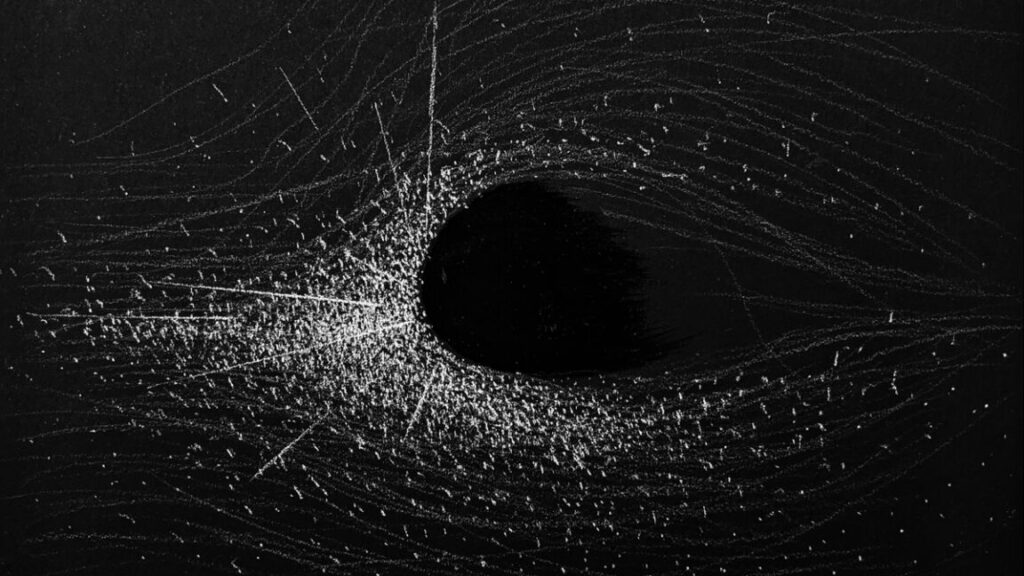
One of the earliest scientific images of a black hole, 1979. Ink on paper, reversed photographically. Jean-Pierre Luminet/Astronomy and Astrophysics 1979

Embark on a visual voyage of art inspired by black holes Read More »
study:-kids’-drip-paintings-more-like-pollock’s-than-those-of-adults

Study: Kids’ drip paintings more like Pollock’s than those of adults

Taylor thought there might be a way to put this new hypothesis to the test, particularly in light of numerous experimental studies showing the prevalence of fractals in human physiology: walking, dancing, martial arts, and balancing motion, such as postural sway while standing. “Let’s think about that balance mechanism,” he said. “You go off-balance, you’re swaying around, so you’ve got big sways mixed in with smaller and smaller and smaller sways. It’s a multi-scale thing.”

Drip, drip, drip

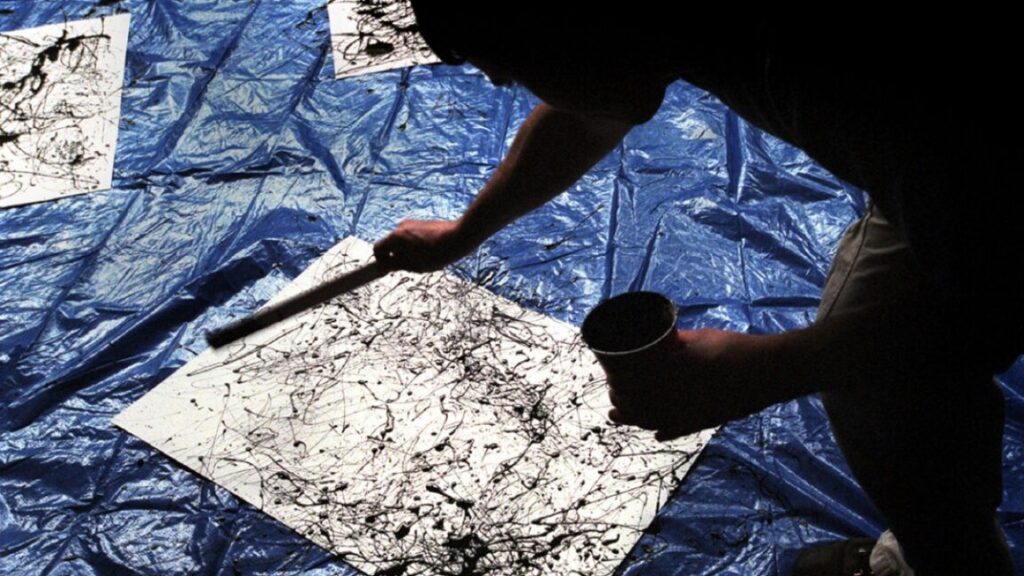
Serendipitously, Taylor even had a built-in laboratory environment in which to conduct such experiments: the public “Dripfests” he regularly organized, in which both adults and children had the opportunity to create their own Pollock-like artworks by splattering diluted paint on sheets of paper on the floor. Life changes intervened before Taylor could implement the experiment, and the concept got pushed to the back burner. But he revived it a few years ago.

The study subjects were 18 children between the ages of four and six, and 34 adults ages 18 to 25. The age discrepancy was crucial, since those two groups are at markedly different stages of biomechanical balance development. And this time around, Taylor and his co-authors didn’t just look at the fractal dimensions of the resulting paintings, i.e., measuring the self-similar scaling behavior of the splatter patterns. They also looked at something called “lacunarity,” examining the variations in the gaps between paint clusters.

The results: Splatter paintings by adults had higher paint densities and wider, more varied paint trajectories. The children’s paintings had smaller fine-scale patterns, more gaps between paint clusters, and simpler one-dimensional trajectories that didn’t change direction nearly as often. “They both have coarse-scale motions, but the adults have lots of fine-scale structure,” said Taylor. “Not only did the kids have less fine structure, the fine structure they did have was very clumpy, while the adults’ fine structure was very uniform. So when the person is moving and how they regain their balance, we think it’s to do with how much structure there is at these different scales and how uniform it is.”

Study: Kids’ drip paintings more like Pollock’s than those of adults Read More »