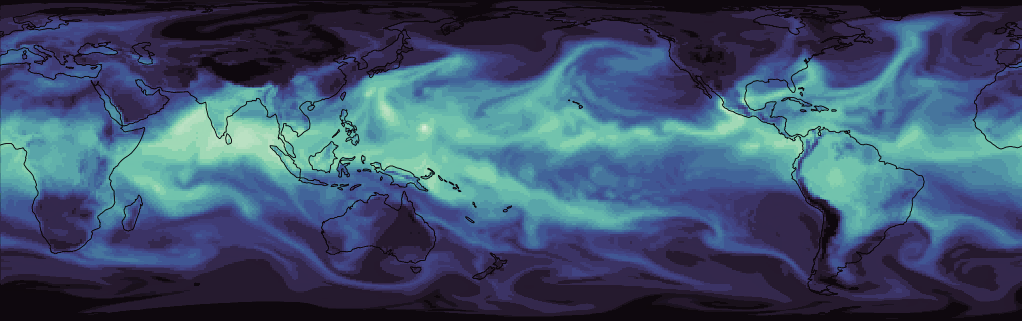
atmospheric science

when-clouds-flock-together

When clouds flock together


Scientists discover that clumping clouds supercharge storms in surprising ways.

Caroline Muller looks at clouds differently than most people. Where others may see puffy marshmallows, wispy cotton candy or thunderous gray objects storming overhead, Muller sees fluids flowing through the sky. She visualizes how air rises and falls, warms and cools, and spirals and swirls to form clouds and create storms.

But the urgency with which Muller, a climate scientist at the Institute of Science and Technology Austria in Klosterneuburg, considers such atmospheric puzzles has surged in recent years. As our planet swelters with global warming, storms are becoming more intense, sometimes dumping two or even three times more rain than expected. Such was the case in Bahía Blanca, Argentina, in March 2025: Almost half the city’s yearly average rainfall fell in less than 12 hours, causing deadly floods.

Atmospheric scientists have long used computer simulations to track how the dynamics of air and moisture might produce varieties of storms. But existing models hadn’t fully explained the emergence of these fiercer storms. A roughly 200-year-old theory describes how warmer air holds more moisture than cooler air: an extra 7 percent for every degree Celsius of warming. But in models and weather observations, climate scientists have seen rainfall events far exceeding this expected increase. And those storms can lead to severe flooding when heavy rain falls on already saturated soils or follows humid heatwaves.

Clouds, and the way that they cluster, could help explain what’s going on.

A growing body of research, set in motion by Muller over a decade ago, is revealing several small-scale processes that climate models had previously overlooked. These processes influence how clouds form, congregate, and persist in ways that may amplify heavy downpours and fuel larger, long-lasting storms. Clouds have an “internal life,” Muller says, “that can strengthen them or may help them stay alive longer.”

Other scientists need more convincing, because the computer simulations researchers use to study clouds reduce planet Earth to its simplest and smoothest form, retaining its essential physics but otherwise barely resembling the real world.

Now, though, a deeper understanding beckons. Higher-resolution global climate models can finally simulate clouds and the destructive storms they form on a planetary scale — giving scientists a more realistic picture. By better understanding clouds, researchers hope to improve their predictions of extreme rainfall, especially in the tropics where some of the most ferocious thunderstorms hit and where future rainfall projections are the most uncertain.

First clues to clumping clouds

All clouds form in moist, rising air. A mountain can propel air upward; so, too, can a cold front. Clouds can also form through a process known as convection: the overturning of air in the atmosphere that starts when sunlight, warm land or balmy water heats air from below. As warm air rises, it cools, condensing the water vapor it carried upwards into raindrops. This condensation process also releases heat, which fuels churning storms.

But clouds remain one of the weakest links in climate models. That’s because the global climate models scientists use to simulate scenarios of future warming are far too coarse to capture the updrafts that give rise to clouds or to describe how they swirl in a storm—let alone to explain the microphysical processes controlling how much rain falls from them to Earth.

To try to resolve this problem, Muller and other like-minded scientists turned to simpler simulations of Earth’s climate that are able to model convection. In these artificial worlds, each the shape of a shallow box typically a few hundred kilometers across and tens of kilometers deep, the researchers tinkered with replica atmospheres to see if they could figure out how clouds behaved under different conditions.

The top frame of this computer simulation shows an atmosphere where the movements of air are somewhat disorganized, leading to clouds popping up in random locations. At the bottom is a simulation of an atmosphere where patterns of convection have become organized, and clouds spontaneously clump together into one large region—forming a storm.

Intriguingly, when researchers ran these models, the clouds spontaneously clumped together, even though the models had none of the features that usually push clouds together—no mountains, no wind, no Earthly spin or seasonal variations in sunlight. “Nobody knew why this was happening,” says Daniel Hernández Deckers, an atmospheric scientist at the National University of Colombia in Bogotá.

In 2012, Muller discovered a first clue: a process known as radiative cooling. The Sun’s heat that bounces off Earth’s surface radiates back into space, and where there are few clouds, more of that radiation escapes—cooling the air. The cool spots set up atmospheric flows that drive air toward cloudier regions—trapping more heat and forming more clouds. A follow-up study in 2018 showed that in these simulations, radiative cooling accelerated the formation of tropical cyclones. “That made us realize that to understand clouds, you have to look at the neighborhood as well—outside clouds,” Muller says.

Once scientists started looking not just outside clouds, but also underneath them and at their edges, they found other small-scale processes that help to explain why clouds flock together. The various processes, described by Muller and colleagues in the Annual Review of Fluid Mechanics, all bring or hold together pockets of warm, moist air so more clouds form in already-cloudy regions. These small-scale processes hadn’t been understood much before because they are often obscured by larger weather patterns.

Hernández Deckers has been studying one of the processes, called entrainment—the turbulent mixing of air at the edges of clouds. Most climate models represent clouds as a steady plume of rising air, but in reality “clouds are like a cauliflower,” he says. “You have a lot of turbulence, and you have these bubbles [of air] inside the clouds.” This mixing at the edges affects how clouds evolve and thunderstorms develop; it can weaken or strengthen storms in various ways, but, like radiative cooling, it encourages more clouds to form as a clump in regions that are already moist.

Such processes are likely to be most important in storms in Earth’s tropical regions, where there’s the most uncertainty about future rainfall. (That’s why Hernández Deckers, Muller, and others tend to focus their studies there.) The tropics lack the cold fronts, jet streams, and spiraling high- and low-pressure systems that dominate air flows at higher latitudes.

Supercharging heavy rains

There are other microscopic processes happening inside clouds that affect extreme rainfall, especially on shorter timescales. Moisture matters: Condensed droplets falling through moist, cloudy air don’t evaporate as much on their descent, so more water falls to the ground. Temperature matters too: When clouds form in warmer atmospheres, they produce less snow and more rain. Since raindrops fall faster than snowflakes, they evaporate less on their descent—producing, once again, more rain.

These factors also help explain why more rain can get squeezed from a cloud than the 7 percent rise per degree of warming predicted by the 200-year-old theory. “Essentially you get an extra kick … in our simulations, it was almost a doubling,” says Martin Singh, a climate scientist at Monash University in Melbourne, Australia.

Cloud clustering adds to this effect by holding warm, moist air together, so more rain droplets fall. One study by Muller and her collaborators found that clumping clouds intensify short-duration rainfall extremes by 30 to 70 percent, largely because raindrops evaporate less inside sodden clouds.

Other research, including a study led by Jiawei Bao, a postdoctoral researcher in Muller’s group, has likewise found that the microphysical processes going on inside clouds have a strong influence over fast, heavy downpours. These sudden downpours are intensifying much faster with climate change than protracted deluges, and often cause flash flooding.

The future of extreme rainfall

Scientists who study the clumping of clouds want to know how that behavior will change as the planet heats up—and what that will mean for incidences of heavy rainfall and flooding.

Some models suggest that clouds (and the convection that gives rise to them) will clump together more with global warming — and produce more rainfall extremes that often far exceed what theory predicts. But other simulations suggest that clouds will congregate less. “There seems to be still possibly a range of answers,” says Allison Wing, a climate scientist at Florida State University in Tallahassee who has compared various models.

Scientists are beginning to try to reconcile some of these inconsistencies using powerful types of computer simulations called global storm-resolving models. These can capture the fine structures of clouds, thunderstorms, and cyclones while also simulating the global climate. They bring a 50-fold leap in realism beyond the global climate models scientists generally use—but demand 30,000 times more computational power.

Using one such model in a paper published in 2024, Bao, Muller, and their collaborators found that clouds in the tropics congregated more as temperatures increased—leading to less frequent storms but ones that were larger, lasted longer, and, over the course of a day, dumped more rain than expected from theory.

But that work relied on just one model and simulated conditions from around one future time point—the year 2070. Scientists need to run longer simulations using more storm-resolving models, Bao says, but very few research teams can afford to run them. They are so computationally intensive that they are typically run at large centralized hubs, and scientists occasionally host “hackathons” to crunch through and share data.

Researchers also need more real-world observations to get at some of the biggest unknowns about clouds. Although a flurry of recent studies using satellite data linked the clustering of clouds to heavier rainfall in the tropics, there are large data gaps in many tropical regions. This weakens climate projections and leaves many countries ill-prepared. In June of 2025, floods and landslides in Venezuela and Colombia swept away buildings and killed at least a dozen people, but scientists don’t know what factors worsened these storms because the data are so paltry. “Nobody really knows, still, what triggered this,” Hernández Deckers says.

New, granular data are on their way. Wing is analyzing rainfall measurements from a German research vessel that traversed the tropical Atlantic Ocean for six weeks in 2024. The ship’s radar mapped clusters of convection associated with the storms it passed through, so the work should help researchers see how clouds organize over vast tracts of the ocean.

And an even more global view is on the horizon. The European Space Agency plans to launch two satellites in 2029 that will measure, among other things, near-surface winds that ruffle Earth’s oceans and skim mountaintops. Perhaps, scientists hope, the data these satellites beam back will finally provide a better grasp of clumping clouds and the heaviest rains that fall from them.

Research and interviews for this article were partly supported through a journalism residency funded by the Institute of Science & Technology Austria (ISTA). ISTA had no input into the story. This story originally appeared on Knowable Magazine

Photo of Knowable Magazine

Knowable Magazine explores the real-world significance of scholarly work through a journalistic lens.

When clouds flock together Read More »

trump-admin-threatens-to-break-up-major-climate-research-center

Trump admin threatens to break up major climate research center

UCAR, for its part, has issued a statement indicating that the USA Today article was the first it has heard of the matter.

In many cases where the administration has attempted to take drastic actions like this, courts have ruled that they run afoul of a legal prohibition against “arbitrary and capricious” federal actions. That said, courtroom losses haven’t inhibited the administration’s willingness to try, and the time spent waiting for legal certainty can often accomplish many of its aims, such as disrupting research on politically disfavored subjects and forcing scientists to look elsewhere for career stability.

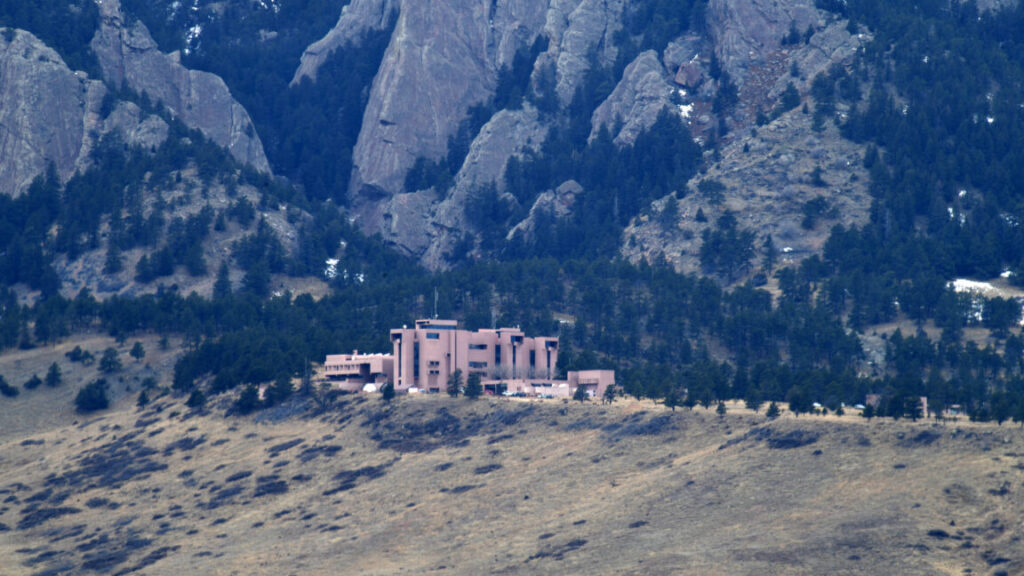
Scientists, meanwhile, are reacting with dismay. “Dismantling NCAR is like taking a sledgehammer to the keystone holding up our scientific understanding of the planet,” said Texas Tech climate researcher Katharine Hayhoe. “Everyone who works in climate and weather has passed through its doors and benefited from its incredible resources.”

Gavin Schmidt, director of NASA’s Goddard Institute for Space Studies, called NCAR a “unique and valuable asset” and emphasized the wide range of research conducted there.

Obviously, shutting down one source of information about climate change won’t alter what’s happening—greenhouse gases will continue to behave as physics dictates, raising global temperatures. But the Trump administration seemingly views everything through the lens of ideology. It has concluded that scientists are its ideological opponents and thus that its own ideologically driven conclusions are equal to the facts produced by science. Because of that perspective, it has been willing to harm scientists, even if the cost will eventually be felt by the public that Trump ostensibly represents.

Story was updated on Dec. 17 to reflect a recently issued statement by the NSF.

Trump admin threatens to break up major climate research center Read More »

study:-warming-has-accelerated-due-to-the-earth-absorbing-more-sunlight

Study: Warming has accelerated due to the Earth absorbing more sunlight

The concept of an atmospheric energy imbalance is pretty straightforward: We can measure both the amount of energy the Earth receives from the Sun and how much energy it radiates back into space. Any difference between the two results in a net energy imbalance that’s either absorbed by or extracted from the ocean/atmosphere system. And we’ve been tracking it via satellite for a while now as rising greenhouse gas levels have gradually increased the imbalance.

But greenhouse gases aren’t the only thing having an effect. For example, the imbalance has also increased in the Arctic due to the loss of snow cover and retreat of sea ice. The dark ground and ocean absorb more solar energy compared to the white material that had previously been exposed to the sunlight. Not all of this is felt directly, however, as a lot of the areas where it’s happening are frequently covered by clouds.

Nevertheless, the loss of snow and ice has caused the Earth’s reflectivity, termed its albedo, to decline since the 1970s, enhancing the warming a bit.

Vanishing clouds

The new paper finds that the energy imbalance set a new high in 2023, with a record amount of energy being absorbed by the ocean/atmosphere system. This wasn’t accompanied by a drop in infrared emissions from the Earth, suggesting it wasn’t due to greenhouse gases, which trap heat by absorbing this radiation. Instead, it seems to be due to decreased reflection of incoming sunlight by the Earth.

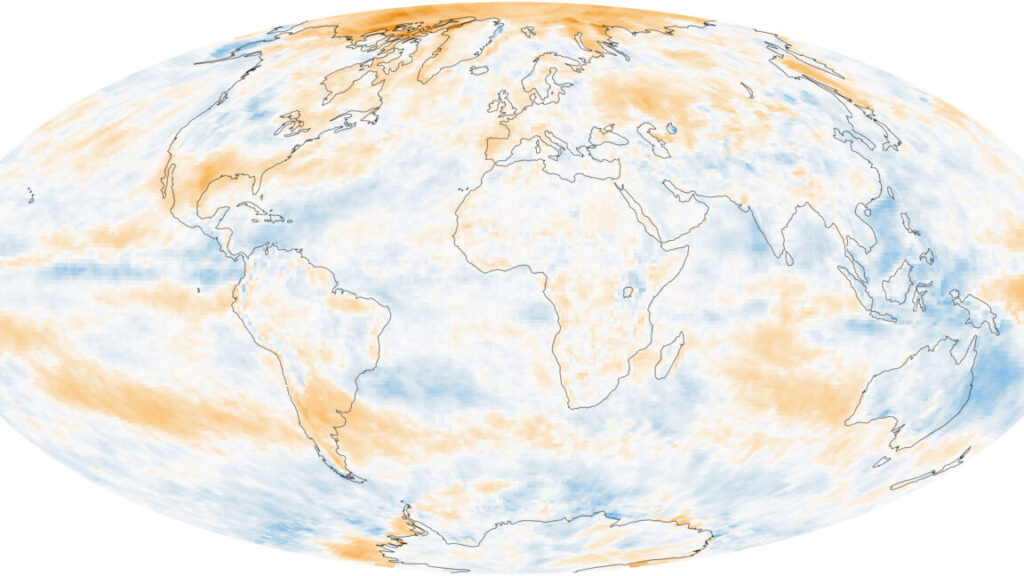
While there was a general trend in that direction, the planet set a new record low for albedo in 2023. Using two different data sets, the teams identify the areas most effected by this, and they’re not at the poles, indicating loss of snow and ice are unlikely to be the cause. Instead, the key contributor appears to be the loss of low-level clouds. “The cloud-related albedo reduction is apparently largely due to a pronounced decline of low-level clouds over the northern mid-latitude and tropical oceans, in particular the Atlantic,” the researchers say.

Study: Warming has accelerated due to the Earth absorbing more sunlight Read More »

google’s-deepmind-tackles-weather-forecasting,-with-great-performance

Google’s DeepMind tackles weather forecasting, with great performance

By some measures, AI systems are now competitive with traditional computing methods for generating weather forecasts. Because their training penalizes errors, however, the forecasts tend to get “blurry”—as you move further ahead in time, the models make fewer specific predictions since those are more likely to be wrong. As a result, you start to see things like storm tracks broadening and the storms themselves losing clearly defined edges.

But using AI is still extremely tempting because the alternative is a computational atmospheric circulation model, which is extremely compute-intensive. Still, it’s highly successful, with the ensemble model from the European Centre for Medium-Range Weather Forecasts considered the best in class.

In a paper being released today, Google’s DeepMind claims its new AI system manages to outperform the European model on forecasts out to at least a week and often beyond. DeepMind’s system, called GenCast, merges some computational approaches used by atmospheric scientists with a diffusion model, commonly used in generative AI. The result is a system that maintains high resolution while cutting the computational cost significantly.

Ensemble forecasting

Traditional computational methods have two main advantages over AI systems. The first is that they’re directly based on atmospheric physics, incorporating the rules we know govern the behavior of our actual weather, and they calculate some of the details in a way that’s directly informed by empirical data. They’re also run as ensembles, meaning that multiple instances of the model are run. Due to the chaotic nature of the weather, these different runs will gradually diverge, providing a measure of the uncertainty of the forecast.

At least one attempt has been made to merge some of the aspects of traditional weather models with AI systems. An internal Google project used a traditional atmospheric circulation model that divided the Earth’s surface into a grid of cells but used an AI to predict the behavior of each cell. This provided much better computational performance, but at the expense of relatively large grid cells, which resulted in relatively low resolution.

For its take on AI weather predictions, DeepMind decided to skip the physics and instead adopt the ability to run an ensemble.

Gen Cast is based on diffusion models, which have a key feature that’s useful here. In essence, these models are trained by starting them with a mixture of an original—image, text, weather pattern—and then a variation where noise is injected. The system is supposed to create a variation of the noisy version that is closer to the original. Once trained, it can be fed pure noise and evolve the noise to be closer to whatever it’s targeting.

In this case, the target is realistic weather data, and the system takes an input of pure noise and evolves it based on the atmosphere’s current state and its recent history. For longer-range forecasts, the “history” includes both the actual data and the predicted data from earlier forecasts. The system moves forward in 12-hour steps, so the forecast for day three will incorporate the starting conditions, the earlier history, and the two forecasts from days one and two.

This is useful for creating an ensemble forecast because you can feed it different patterns of noise as input, and each will produce a slightly different output of weather data. This serves the same purpose it does in a traditional weather model: providing a measure of the uncertainty for the forecast.

For each grid square, GenCast works with six weather measures at the surface, along with six that track the state of the atmosphere and 13 different altitudes at which it estimates the air pressure. Each of these grid squares is 0.2 degrees on a side, a higher resolution than the European model uses for its forecasts. Despite that resolution, DeepMind estimates that a single instance (meaning not a full ensemble) can be run out to 15 days on one of Google’s tensor processing systems in just eight minutes.

It’s possible to make an ensemble forecast by running multiple versions of this in parallel and then integrating the results. Given the amount of hardware Google has at its disposal, the whole process from start to finish is likely to take less than 20 minutes. The source and training data will be placed on the GitHub page for DeepMind’s GraphCast project. Given the relatively low computational requirements, we can probably expect individual academic research teams to start experimenting with it.

Measures of success

DeepMind reports that GenCast dramatically outperforms the best traditional forecasting model. Using a standard benchmark in the field, DeepMind found that GenCast was more accurate than the European model on 97 percent of the tests it used, which checked different output values at different times in the future. In addition, the confidence values, based on the uncertainty obtained from the ensemble, were generally reasonable.

Past AI weather forecasters, having been trained on real-world data, are generally not great at handling extreme weather since it shows up so rarely in the training set. But GenCast did quite well, often outperforming the European model in things like abnormally high and low temperatures and air pressure (one percent frequency or less, including at the 0.01 percentile).

DeepMind also went beyond standard tests to determine whether GenCast might be useful. This research included projecting the tracks of tropical cyclones, an important job for forecasting models. For the first four days, GenCast was significantly more accurate than the European model, and it maintained its lead out to about a week.

One of DeepMind’s most interesting tests was checking the global forecast of wind power output based on information from the Global Powerplant Database. This involved using it to forecast wind speeds at 10 meters above the surface (which is actually lower than where most turbines reside but is the best approximation possible) and then using that number to figure out how much power would be generated. The system beat the traditional weather model by 20 percent for the first two days and stayed in front with a declining lead out to a week.

The researchers don’t spend much time examining why performance seems to decline gradually for about a week. Ideally, more details about GenCast’s limitations would help inform further improvements, so the researchers are likely thinking about it. In any case, today’s paper marks the second case where taking something akin to a hybrid approach—mixing aspects of traditional forecast systems with AI—has been reported to improve forecasts. And both those cases took very different approaches, raising the prospect that it will be possible to combine some of their features.

Nature, 2024. DOI: 10.1038/s41586-024-08252-9  (About DOIs).

Google’s DeepMind tackles weather forecasting, with great performance Read More »

climate-change-boosted-milton’s-landfall-strength-from-category-2-to-3

Climate change boosted Milton’s landfall strength from Category 2 to 3

Using this simulated data set, called IRIS, the researchers selected for those storms that made landfall along a track similar to that of Milton. Using these, they show that the warming climate has boosted the frequency of storms of Milton’s intensity by 40 percent. Correspondingly, the maximum wind speeds of similar storms have been boosted by about 10 percent. In Milton’s case, that means that, in the absence of climate change, it was likely to have made landfall as a Category 2 storm, rather than the Category 3 it actually was.

Rainfall

The lack of full meteorological data caused a problem when it came to analyzing Milton’s rainfall. The researchers ended up having to analyze rainfall more generally. They took four data sets that do track rainfall across these regions and tracked the link between extreme rainfall and the warming climate to estimate how much more often extreme events occur in a world that is now 1.3° C warmer than it was in pre-industrial times.

They focus on instances of extreme one-day rainfall within the June to November period, looking specifically at 1-in-10-year and 1-in-100-year events. Both of these produced similar results, suggesting that heavy one-day rainfalls are about twice as likely in today’s climates, and the most extreme of these are between 20 and 30 percent more intense.

These results came from three of the four data sets used, which produced largely similar results. The fourth dataset they used suggested a far stronger effect of climate change, but since it wasn’t consistent with the rest, these results weren’t used.

As with the Helene analysis, it’s worth noting that this work represents a specific snapshot in time along a long-term warming trajectory. In other words, it’s looking at the impact of 1.3° C of warming at a time when our emissions are nearly at the point where they commit us to at least 1.5° C of warming. And that will tilt the scales further in favor of extreme weather events like this.

Climate change boosted Milton’s landfall strength from Category 2 to 3 Read More »

rapid-analysis-finds-climate-change’s-fingerprint-on-hurricane-helene

Rapid analysis finds climate change’s fingerprint on Hurricane Helene

The researchers identified two distinct events associated with Helene’s landfall. The first was its actual landfall along the Florida coast. The second was the intense rainfall on the North Carolina/Tennessee border. This rainfall came against a backdrop of previous heavy rain caused by a stalled cold front meeting moisture brought north by the fringes of the hurricane. These two regions were examined separately.

A changed climate

In these two regions, the influence of climate change is estimated to have caused a 10 percent increase in the intensity of the rainfall. That may not seem like much, but it adds up. Over both a two- and three-day window centered on the point of maximal rainfall, climate change is estimated to have increased rainfall along the Florida Coast by 40 percent. For the southern Appalachians, the boost in rainfall is estimated to have been 70 percent.

The probability of storms with the wind intensity of Helene hitting land near where it did is about a once-in-130-year event in the IRIS dataset. Climate change has altered that so it’s now expected to return about once every 50 years. The high sea surface temperatures that helped fuel Helene are estimated to have been made as much as 500 times more likely by our changed climate.

Overall, the researchers estimate that rain events like Helene’s landfall should now be expected about once every seven years, although the uncertainty is large (running from three to 25 years). For the Appalachian region, where rainfall events this severe don’t appear in our records, they are likely to now be a once-in-every-70-years event thanks to climate warming (with an uncertainty of between 20 and 3,000 years).

“Together, these findings show that climate change is enhancing conditions conducive to the most powerful hurricanes like Helene, with more intense rainfall totals and wind speeds,” the researchers behind the work conclude.

Rapid analysis finds climate change’s fingerprint on Hurricane Helene Read More »

model-mixes-ai-and-physics-to-do-global-forecasts

Model mixes AI and physics to do global forecasts

Cloudy with a chance of accuracy —

Google/academic project is great with weather, has some limits for climate.

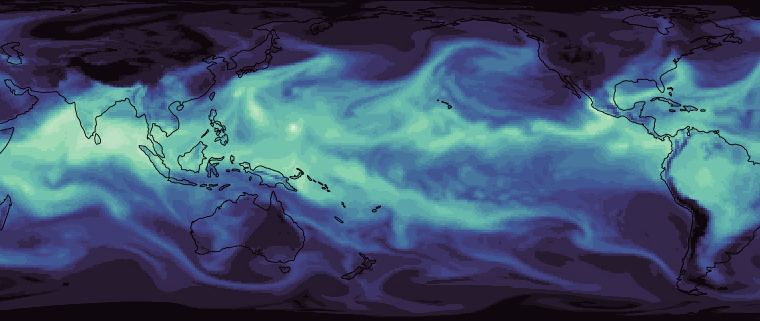
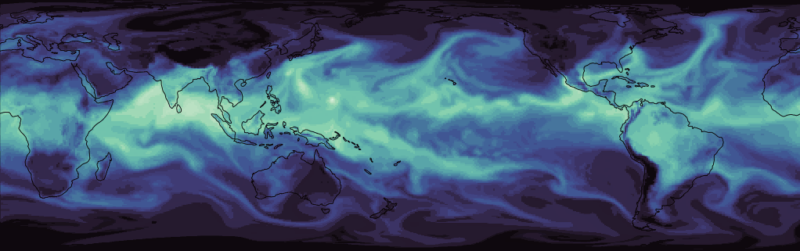
Image of a dark blue flattened projection of the Earth, with lighter blue areas showing the circulation of the atmosphere.

Enlarge / Image of some of the atmospheric circulation seen during NeuralGCM runs.

Google

Right now, the world’s best weather forecast model is a General Circulation Model, or GCM, put together by the European Center for Medium-Range Weather Forecasts. A GCM is in part based on code that calculates the physics of various atmospheric processes that we understand well. For a lot of the rest, GCMs rely on what’s termed “parameterization,” which attempts to use empirically determined relationships to approximate what’s going on with processes where we don’t fully understand the physics.

Lately, GCMs have faced some competition from machine-learning techniques, which train AI systems to recognize patterns in meteorological data and use those to predict the conditions that will result over the next few days. Their forecasts, however, tend to get a bit vague after more than a few days and can’t deal with the sort of long-term factors that need to be considered when GCMs are used to study climate change.

On Monday, a team from Google’s AI group and the European Centre for Medium-Range Weather Forecasts are announcing NeuralGCM, a system that mixes physics-based atmospheric circulation with AI parameterization of other meteorological influences. Neural GCM is computationally efficient and performs very well in weather forecast benchmarks. Strikingly, it can also produce reasonable-looking output for runs that cover decades, potentially allowing it to address some climate-relevant questions. While it can’t handle a lot of what we use climate models for, there are some obvious routes for potential improvements.

Meet NeuralGCM

NeuralGCM is a two-part system. There’s what the researchers term a “dynamical core,” which handles the physics of large-scale atmospheric convection and takes into account basic physics like gravity and thermodynamics. Everything else is handled by the AI portion. “It’s everything that’s not in the equations of fluid dynamics,” said Google’s Stephan Hoyer. “So that means clouds, rainfall, solar radiation, drag across the surface of the Earth—also all the residual terms in the equations that happen below the grid scale of about roughly 100 kilometers or so.” It’s what you might call a monolithic AI. Rather than training individual modules that handle a single process, such as cloud formation, the AI portion is trained to deal with everything at once.

Critically, the whole system is trained concurrently rather than training the AI separately from the physics core. Initially, performance evaluations and updates to the neural network were performed at six-hour intervals since the system isn’t very stable until at least partially trained. Over time, those are stretched out to five days.

The result is a system that’s competitive with the best available for forecasts running out to 10 days, often exceeding the competition depending on the precise measure used (in addition to weather forecasting benchmarks, the researchers looked at features like tropical cyclones, atmospheric rivers, and the Intertropical Convergence Zone). On the longer forecasts, it tended to produce features that were less blurry than those made by pure AI forecasters, even though it was operating at a lower resolution than they were. This lower resolution means larger grid squares—the surface of the Earth is divided up into individual squares for computational purposes—than most other models, which cuts down significantly on its computing requirements.

Despite its success with weather, there were a couple of major caveats. One is that NeuralGCM tended to underestimate extreme events occurring in the tropics. The second is that it doesn’t actually model precipitation; instead, it calculates the balance between evaporation and precipitation.

But it also comes with some specific advantages over some other short-term forecast models, key among them being that it isn’t actually limited to running over the short term. The researchers let it run for up to two years, and it successfully reproduced a reasonable-looking seasonal cycle, including large-scale features of the atmospheric circulation. Other long-duration runs show that it can produce appropriate counts of tropical cyclones, which go on to follow trajectories that reflect patterns seen in the real world.

Model mixes AI and physics to do global forecasts Read More »

the-earth-heated-up-when-its-day-was-22-hours-long

The Earth heated up when its day was 22 hours long

The Earth heated up when its day was 22 hours long

Because most things about Earth change so slowly, it’s difficult to imagine them being any different in the past. But Earth’s rotation has been slowing due to tidal interactions with the Moon, meaning that days were considerably shorter in the past. It’s easy to think that a 22-hour day wouldn’t be all that different, but that turns out not to be entirely true.

For example, some modeling has indicated that certain day lengths will be in resonance with other effects caused by the planet’s rotation, which can potentially offset the drag caused by the tides. Now, a new paper looks at how these resonances could affect the climate. The results suggest that it would shift rain to occurring in the morning and evening while leaving midday skies largely cloud-free. The resulting Earth would be considerably warmer.

On the Lamb

We’re all pretty familiar with the fact that the daytime Sun warms up the air. And those of us who remember high school chemistry will recall that a gas that is warmed will expand. So, it shouldn’t be a surprise to hear that the Earth’s atmosphere expands due to warming on its day side and contracts back again as it cools (these lag the daytime peak in sunlight). These differences provide something a bit like a handle that the gravitational pulls of the Sun and Moon can grab onto, exerting additional forces on the atmosphere. This complicated network of forces churns our atmosphere, helping shape the planet’s weather.

Two researchers, Russell Deitrick and Colin Goldblatt at Canada’s University of Victoria, were curious as to what would happen to these forces as the day length got shorter. Specifically, they were interested in a period where the day’s length would be at resonance with phenomena called Lamb waves.

Lamb waves aren’t specific to the atmosphere. Rather, they’re a specific manner in which a disturbance can travel through a medium, from vibrations in a solid to sound through the air.

Although various forces can create Lamb waves in the atmosphere, they’ll travel with a set of characteristic frequencies. One of those is roughly 10.5 to 11 hours. As you go back in time to shorter days, you’ll reach a point where the Earth’s day was a bit shorter than 22 hours, or twice the period of the Lamb waves. At this point, any disturbances in the atmosphere related to day length would have the ability to interact with the Lamb waves that were set off the day prior. This resonance could potentially strengthen the impact of any atmospheric phenomena related to day length.

Figuring out whether they do turned out to be a bit of a challenge. There are plenty of climate models to let researchers explore what’s going on in the modern atmosphere. But a lot of these have key features, like day length and solar output, hard coded into them. Others don’t let you do things like rearrange the Earth’s continents or change some atmospheric components.

The researchers did find a model that would allow them to change day length, solar intensity, and carbon dioxide concentrations to those present when Earth’s day length was 22 hours (which was likely to be in the pre-Cambrian). But it wasn’t able to reset the ozone concentrations, and ozone is also a greenhouse gas. So, they ran simulations without ozone, which are expected to be an under-estimate, and one where they elevated methane concentrations in order to mimic ozone’s greenhouse effect.

The Earth heated up when its day was 22 hours long Read More »