
botany

how-moss-helped-convict-grave-robbers-of-a-chicago-cemetery

How moss helped convict grave robbers of a Chicago cemetery

The official records were a bit of a mess, to say the least, but the ensuing investigation revealed that while the cemetery had space for 130,000 graves, between 140,000 and 147,500 people were listed as buried there. And some areas had apparently never been used for burials. The cemetery’s then-director, Carolyn Towns, grounds foreman Keith Nicks, Nicks’ brother Terrence, and another employee, Maurice Dailey, were charged.

The only reason they were caught is because they became increasingly reckless about their grave-robbing, even using a backhoe to dig up old graves, smashing skeletons to bits as they did so. Some 1,500 bones were recovered and identified as belonging to at least 38 individuals, but between 200 and 400 graves had been desecrated, per official estimates. Emmett Till’s decaying casket was found covered by a tarp and surrounded by debris in a garage behind the cemetery. (The restored casket is now housed at the Smithsonian’s Museum of African American History.)

The evidence of the moss

The tiny bits of dirt and moss collected in Burr Oak Cemetery in 2009, which were a key piece of evidence in the criminal case.

The tiny bits of dirt and moss collected in Burr Oak Cemetery in 2009, which were a key piece of evidence in the criminal case.

Credit: Field Museum

The tiny bits of dirt and moss collected in Burr Oak Cemetery in 2009, which were a key piece of evidence in the criminal case. Credit: Field Museum

Prosecutors still had to prove their case. In addition to the skeletal remains, the FBI had collected broken mulberry branches and buried grass fragments for expert analysis. Von Konrat was just going about his museum business in 2009 when the FBI called, seeking expert advice on pieces of moss their team had found, inexplicably buried eight inches below the topsoil with the reburied remains. They needed his help identifying the species as well as determining how long it had been buried. This would provide the FBI with a crucial timeline of when the remains had been reburied.

“Moss is a little bit freaky,” said von Konrat. “Mosses have an interesting physiology, where even if they’re dry and dead and preserved, they can still have an active metabolism, a few cells that are still active. The amount of metabolic activity deteriorates over time, and that can tell us how long ago a moss sample was collected.” The key was chlorophyll, a green pigment central to photosynthesis. Chlorophyll degrades as a decaying plant’s cells stop functioning, so the museum team could measure how much light was being absorbed by the chlorophyll in control specimens whose age was known (both fresh and dried). Then they could compare those measurements to the forensic sample.

How moss helped convict grave robbers of a Chicago cemetery Read More »

new-critique-debunks-claim-that-trees-can-sense-a-solar-eclipse

New critique debunks claim that trees can sense a solar eclipse

“He puts forward logical alternative hypotheses,” said Cahill of Novoplansky’s critique. “The original work should have tested among a number of different hypotheses rather than focusing on a single interpretation. This is in part what makes it pseudoscience and promoting a worldview.”

Granted, “[p]lants have extensive and well established mechanisms of communication, with that of volatiles being the most well studied and understood,” he added. “There is also growing recognition that root exudates play a role in plant-plant interactions, though this is only now being deeply investigated. Nothing else, communication through mychorriza, has withstood independent investigation.”

Chiolerio and Gagliano stand by their research, saying they have always acknowledged the preliminary nature of their results. “We measured [weather-related elements like] temperature, relative humidity, rainfall and daily solar radiation,” Chiolerio told Ars. “None of them shows strong correlation with the transients of the electrome during the eclipse. We did not measure environmental electric fields, though; therefore, I cannot exclude effects induced by nearby lightnings. We did not have gravitational probes, did not check neutrinos, cosmic rays, magnetic fields, etc.”

“I’m not going to debate an unpublished critique in the media, but I can clarify our position,” Gagliano told Ars. “Our [2025] paper reports an empirical electrophysiological/synchrony pattern in the eclipse window, including changes beginning prior to maximum occultation, and we discussed candidate cues explicitly as hypotheses rather than demonstrated causes. Describing weather/lightning as ‘more parsimonious’ is not evidence of cause. Regional lightning strike counts and other proxies can motivate a competing hypothesis, but they do not establish causal attribution at the recording site without site-resolved, time-aligned field measurements. Without those measurements, the lightning/weather account remains a hypothesis among other possibilities rather than a supported or default explanation for the signals we recorded.”

“We acknowledged the limited sample size and described the work as an initial field report; follow-up work is ongoing and will be communicated through peer-reviewed channels,” Gagliano added. As for the suggestion of pseudoscience, “I won’t engage with labels; scientific disagreements should be resolved with transparent methods, data, and discriminating tests.”

“It seems that the public appeal is something particularly painful for the colleagues who published their opinion on Trends in Plant Science,” Chiolerio said. “We did not care about public appeal, we wanted to share as much as possible the results of years of hard work that led to interesting data.”

DOI: Trends in Plant Science, 2026. 10.1016/j.tplants.2025.12.001  (About DOIs).

DOI: A. Chiolerio et al., Royal Society Open Science, 2025. 10.1098/rsos.241786  (About DOIs).

New critique debunks claim that trees can sense a solar eclipse Read More »

scientists-unlock-secret-to-venus-flytrap’s-hair-trigger-response

Scientists unlock secret to Venus flytrap’s hair-trigger response

To trap its prey, the Venus flytrap sends rapid electrical impulses, which are generated in response to touch or stress. But the molecular identity of the touch sensor has remained unclear. Japanese scientists have identified the molecular mechanism that triggers that response and have published their work in a new paper in the journal Nature Communications.

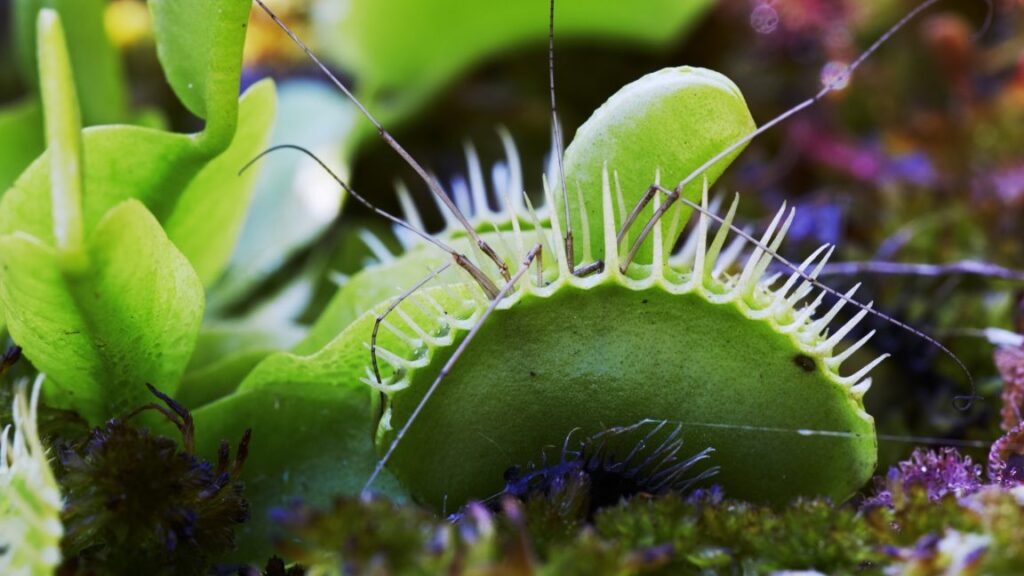
As previously reported, the Venus flytrap attracts its prey with a pleasing fruity scent. When an insect lands on a leaf, it stimulates the highly sensitive trigger hairs that line the leaf. When the pressure becomes strong enough to bend those hairs, the plant will snap its leaves shut and trap the insect inside. Long cilia grab and hold the insect in place, much like fingers, as the plant begins to secrete digestive juices. The insect is digested slowly over five to 12 days, after which the trap reopens, releasing the dried-out husk of the insect into the wind.

In 2016, Rainer Hedrich, a biophysicist at Julius-Maximilians-Universität Würzburg in Bavaria, Germany, led the team that discovered that the Venus flytrap could actually “count” the number of times something touches its hair-lined leaves—an ability that helps the plant distinguish between the presence of prey and a small nut or stone, or even a dead insect. The plant detects the first “action potential” but doesn’t snap shut right away, waiting until a second zap confirms the presence of actual prey, at which point the trap closes. But the Venus flytrap doesn’t close all the way and produce digestive enzymes to consume the prey until the hairs are triggered three more times (for a total of five stimuli).

And in 2023, scientists developed a bioelectronic device to better understand the Venus flytrap’s complex signaling mechanism by mapping how those signals propagate. They confirmed that the electrical signal starts in the plant’s sensory hairs and then spreads radially outward with no clear preferred direction. And sometimes the signals were spontaneous, originating in sensory hairs that had not been stimulated.

Glowing green

This latest research is an outgrowth of a 2020 paper detailing how the Japanese authors genetically altered a Venus flytrap to gain important clues about how the plant’s short-term “memory” works. They introduced a gene for a calcium sensor protein called GCaMP6, which glows green whenever it binds to calcium. That green fluorescence allowed the team to visually track the changes in calcium concentrations in response to stimulating the plant’s sensitive hairs with a needle. They concluded that the waxing and waning of calcium concentrations in the leaf cells seem to serve as a kind of short-term memory for the Venus flytrap, though precisely how calcium concentrations work with the plant’s electrical network remained unclear.

Scientists unlock secret to Venus flytrap’s hair-trigger response Read More »