Entertainment

review:-thunderbolts*-is-a-refreshing-return-to-peak-marvel-form

Review: Thunderbolts* is a refreshing return to peak Marvel form

It looks like Marvel has another critical and box office hit on its hands—and deservedly so—with Thunderbolts*, a follow-up of sorts to 2021’s Black Widow and the final film in the MCU’s Phase Five.

Yes, the asterisk is part of the title. Yes, I found that choice inexplicable when it was first announced. And yes, having seen the film, the asterisk makes perfect sense now as a well-timed joke. I won’t spill the beans because that would spoil the fun. Instead, I’ll simply say that Thunderbolts* is a refreshing return to peak Marvel form: well-paced, witty, and action-packed with enough heart to ensure you care about the characters.

(Some spoilers below.)

It’s basically the MCU’s version of The Suicide Squad (2021) with less over-the-top R-rated violence. In fact, that film’s director, James Gunn, was originally attached to direct Thunderbolts* but bowed out because he felt the projects were just too similar. Yet the PG-13 film definitely boasts that irreverent Gunn sensibility, with a vibe on par with the director’s delightful Guardians of the Galaxy (2014). Thunderbolts* might not reach the spectacular box office heights of last year’s R-rated Deadpool and Wolverine, but so far I’m optimistic about the MCU’s future.

Black Widow introduced us to Natasha Romanoff’s (Scarlett Johansson) backstory as a child recruited for training as an elite assassin, along with her adoptive sister (and equally lethal assassin) Yelena Belova (Florence Pugh). Thunderbolts* finds Yelena working as a hired mercenary for CIA director Valentina Allegra de Fontaine (Julia Louis-Dreyfus), but she’s still grieving the loss of Natasha, and her heart just isn’t in.

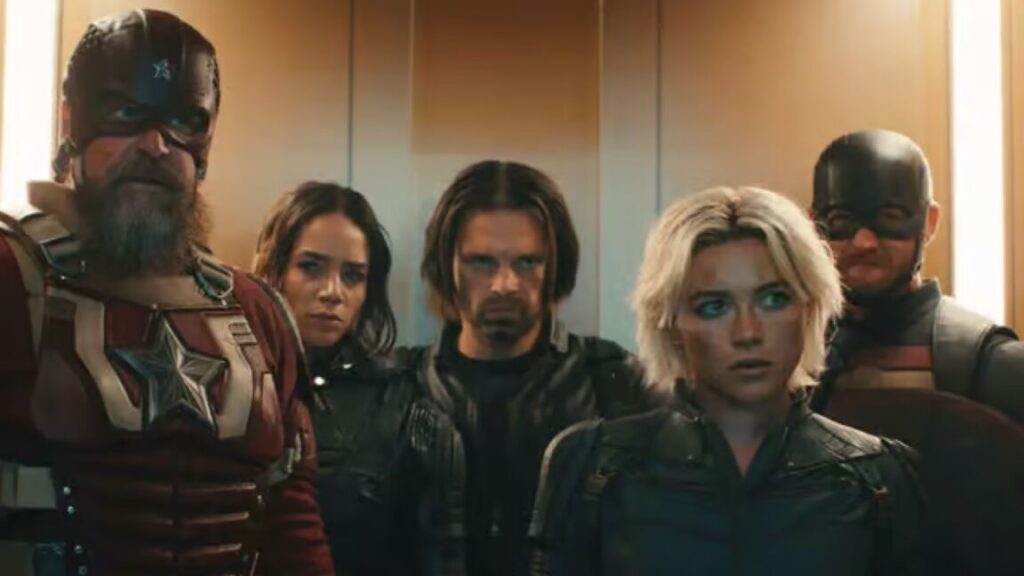
Yelena’s existential ennui leads her to seek out her adoptive father, Alexei/Red Guardian (David Harbour), the Russian super soldier counterpart to Captain America. He’s not doing much better, working as a limo driver and living off takeout, and tells Yelena that Natasha found the secret to fulfillment: be a superhero.

Review: Thunderbolts* is a refreshing return to peak Marvel form Read More »
monty-python-and-the-holy-grail-turns-50

Monty Python and the Holy Grail turns 50


Ars staffers reflect upon the things they love most about this masterpiece of absurdist comedy.

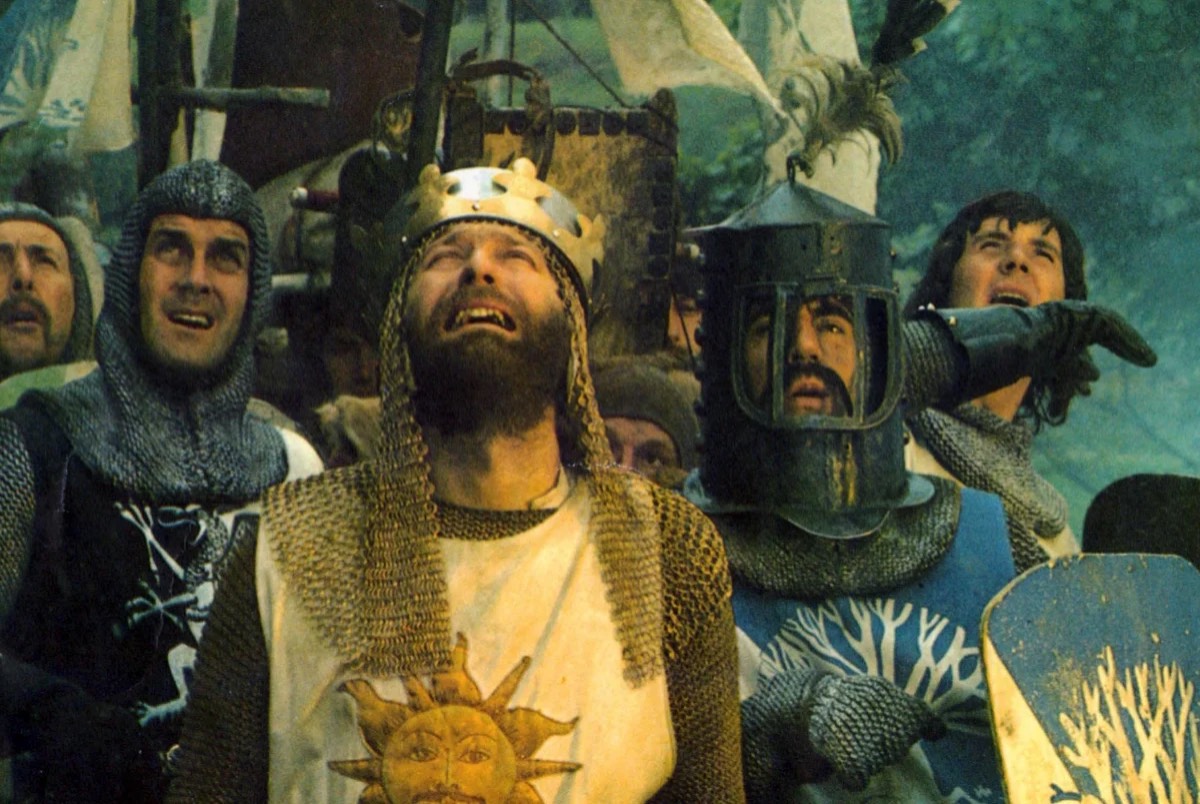
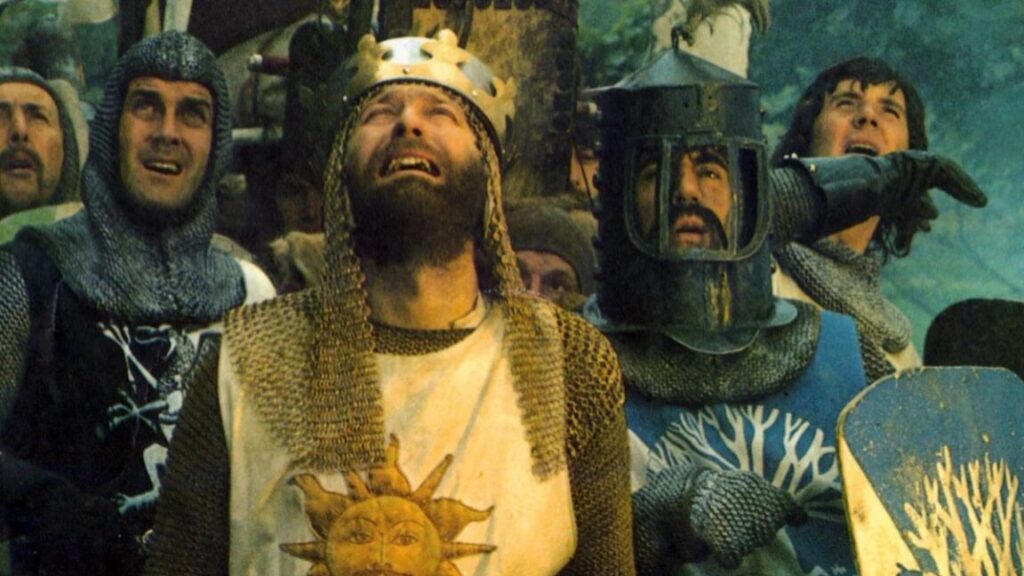
king arthur's and his knights staring up at something.

Credit: EMI Films/Python (Monty) Pictures

Credit: EMI Films/Python (Monty) Pictures

Monty Python and the Holy Grail is widely considered to be among the best comedy films of all time, and it’s certainly one of the most quotable. This absurdist masterpiece sending up Arthurian legend turns 50 (!) this year.

It was partly Python member Terry Jones’ passion for the Middle Ages and Arthurian legend that inspired Holy Grail and its approach to comedy. (Jones even went on to direct a 2004 documentary, Medieval Lives.) The troupe members wrote several drafts beginning in 1973, and Jones and Terry Gilliam were co-directors—the first full-length feature for each, so filming was one long learning process. Reviews were mixed when Holy Grail was first released—much like they were for Young Frankenstein (1974), another comedic masterpiece—but audiences begged to differ. It was the top-grossing British film screened in the US in 1975. And its reputation has only grown over the ensuing decades.

The film’s broad cultural influence extends beyond the entertainment industry. Holy Grail has been the subject of multiple scholarly papers examining such topics as its effectiveness at teaching Arthurian literature or geometric thought and logic, the comedic techniques employed, and why the depiction of a killer rabbit is so fitting (killer rabbits frequently appear drawn in the margins of Gothic manuscripts). My personal favorite was a 2018 tongue-in-cheek paper on whether the Black Knight could have survived long enough to make good on his threat to bite King Arthur’s legs off (tl;dr: no).

So it’s not at all surprising that Monty Python and the Holy Grail proved to be equally influential and beloved by Ars staffers, several of whom offer their reminiscences below.

They were nerd-gassing before it was cool

The Monty Python troupe famously made Holy Grail on a shoestring budget—so much so that they couldn’t afford to have the knights ride actual horses. (There are only a couple of scenes featuring a horse, and apparently it’s the same horse.) Rather than throwing up their hands in resignation, that very real constraint fueled the Pythons’ creativity. The actors decided the knights would simply pretend to ride horses while their porters followed behind, banging halves of coconut shells together to mimic the sound of horses’ hooves—a time-honored Foley effect dating back to the early days of radio.

Being masters of absurdist humor, naturally, they had to call attention to it. Arthur and his trusty servant, Patsy (Gilliam), approach the castle of their first potential recruit. When Arthur informs the guards that they have “ridden the length and breadth of the land,” one of the guards isn’t having it. “What, ridden on a horse? You’re using coconuts! You’ve got two empty halves of coconut, and you’re bangin’ ’em together!”

That raises the obvious question: Where did they get the coconuts? What follows is one of the greatest examples of nerd-gassing yet to appear on film. Arthur claims he and Patsy found them, but the guard is incredulous since the coconut is tropical and England is a temperate zone. Arthur counters by invoking the example of migrating swallows. Coconuts do not migrate, but Arthur suggests they could be carried by swallows gripping a coconut by the husk.

The guard still isn’t having it. It’s a question of getting the weight ratios right, you see, to maintain air-speed velocity. Another guard gets involved, suggesting it might be possible with an African swallow, but that species is non-migratory. And so on. The two are still debating the issue as an exasperated Arthur rides off to find another recruit.

The best part? There’s a callback to that scene late in the film when the knights must answer three questions to cross the Bridge of Death or else be chucked into the Gorge of Eternal Peril. When it’s Arthur’s turn, the third question is “What is the air-speed velocity of an unladen swallow?” Arthur asks whether this is an African or a European swallow. This stumps the Bridgekeeper, who gets flung into the gorge. Sir Belvedere asks how Arthur came to know so much about swallows. Arthur replies, “Well, you have to know these things when you’re a king, you know.”

The plucky Black Knight (“It’s just a flesh wound!”) will always hold a special place in my heart, but that debate over air-speed velocities of laden versus unladen swallows encapsulates what makes Holy Grail a timeless masterpiece.

Jennifer Ouellette

A bunny out for blood

“Oh, it’s just a harmless little bunny, isn’t it?”

Despite their appearances, rabbits aren’t always the most innocent-looking animals. Recent reports of rabbit strikes on airplanes are the latest examples of the mayhem these creatures of chaos can inflict on unsuspecting targets.

I learned that lesson a long time ago, though, thanks partly to my way-too-early viewings of the animated Watership Down and Monty Python and the Holy Grail. There I was, about 8 years old and absent of paternal accompaniment, watching previously cuddly creatures bloodying each other and severing the heads of King Arthur’s retinue. While Watership Down’s animal-on-animal violence might have been a bit scarring at that age, I enjoyed the slapstick humor of the Rabbit of Caerbannog scene (many of the jokes my colleagues highlight went over my head upon my initial viewing).

Despite being warned of the creature’s viciousness by Tim the Enchanter, the Knights of the Round Table dismiss the Merlin stand-in’s fear and charge the bloodthirsty creature. But the knights quickly realize they’re no match for the “bad-tempered rodent,” which zips around in the air, goes straight for the throat, and causes the surviving knights to run away in fear. If Arthur and his knights possessed any self-awareness, they might have learned a lesson about making assumptions about appearances.

But hopefully that’s a takeaway for viewers of 1970s British pop culture involving rabbits. Even cute bunnies, as sweet as they may seem initially, can be engines of destruction: “Death awaits you all with nasty, big, pointy teeth.”

Jacob May

Can’t stop the music

The most memorable songs from Monty Python and the Holy Grail were penned by Neil Innes, who frequently collaborated with the troupe and appears in the film. His “Brave Sir Robin” amusingly parodied minstrel tales of valor by imagining all the torturous ways that one knight might die. Then there’s his “Knights of the Round Table,” the first musical number performed by the cast—if you don’t count the monk chants punctuated with slaps on the head with wooden planks. That song hilariously rouses not just wild dancing from knights but also claps from prisoners who otherwise dangle from cuffed wrists.

But while these songs have stuck in my head for decades, Monty Python’s Terry Jones once gave me a reason to focus on the canned music instead, and it weirdly changed the way I’ve watched the movie ever since.

Back in 2001, Jones told Billboard that an early screening for investors almost tanked the film. He claimed that after the first five minutes, the movie got no laughs whatsoever. For Jones, whose directorial debut could have died in that moment, the silence was unthinkable. “It can’t be that unfunny,” he told Billboard. “There must be something wrong.”

Jones soon decided that the soundtrack was the problem, immediately cutting the “wonderfully rich, atmospheric” songs penned by Innes that seemed to be “overpowering the funny bits” in favor of canned music.

Reading this prompted an immediate rewatch because I needed to know what the first bit was that failed to get a laugh from that fateful audience. It turned out to be the scene where King Arthur encounters peasants in a field who deny knowing that there even was a king. As usual, I was incapable of holding back a burst of laughter when one peasant woman grieves, “Well, I didn’t vote for you” while packing random clumps of mud into the field. It made me wonder if any song might have robbed me of that laugh, and that made me pay closer attention to how Jones flipped the script and somehow meticulously used the canned music to extract more laughs.

The canned music was licensed from a British sound library that helped the 1920s movie business evolve past silent films. They’re some of the earliest songs to summon emotion from viewers whose eyes were glued to a screen. In Monty Python and the Holy Grail, which features a naive King Arthur enduring his perilous journey on a wood stick horse, the canned music provides the most predictable soundtrack you could imagine that might score a child’s game of make-believe. It also plays the straight man by earnestly pulsing to convey deep trouble as knights approach the bridge of death or heavenly trumpeting the anticipated appearance of the Holy Grail.

It’s easy to watch the movie without noticing the canned music, as the colorful performances are Jones’ intended focus. Not relying on punchlines, the group couldn’t afford any nuance to be lost. But there is at least one moment where Jones obviously relies on the music to overwhelm the acting to compel a belly laugh. Just before “the most foul, cruel, bad-tempered rodent” appears, a quick surge of dramatic music that cuts out just as suddenly makes it all the more absurd when the threat emerges and appears to be an “ordinary rabbit.”

It’s during this scene, too, that King Arthur delivers a line that sums up how predictably odd but deceptively artful the movie’s use of canned music really is. When he meets Tim the Enchanter—who tries to warn the knights about the rabbit’s “pointy teeth” by evoking loud thunder rolls and waggling his fingers in front of his mouth—Arthur turns to the knights and says, “What an eccentric performance.”

Ashley Belanger

Thank the “keg rock conclave”

I tried to make music a big part of my teenage identity because I didn’t have much else. I was a suburban kid with a B-minus/C-plus average, no real hobbies, sports, or extra-curriculars, plus a deeply held belief that Nine Inch Nails, the Beastie Boys, and Aphex Twin would never get their due as geniuses. Classic Rock, the stuff jocks listened to at parties and practice? That my dad sang along to after having a few? No thanks.

There were cultural heroes, there were musty, overwrought villains, and I knew the score. Or so I thought.

I don’t remember exactly where I found the little fact that scarred my oppositional ego forever. It might have been Spin magazine, a weekend MTV/VH1 feature, or that Rolling Stone book about the ’70s (I bought it for the punks, I swear). But at some point, I learned that a who’s-who of my era’s played-out bands—Led Zeppelin, Pink Floyd, even Jethro (freaking) Tull—personally funded one of my favorite subversive movies. Jimmy Page and Robert Plant, key members of the keg-rock conclave, attended the premiere.

It was such a small thing, but it raised such big, naive, adolescent questions. Somebody had to pay for Holy Grail—it didn’t just arrive as something passed between nerds? People who make things I might not enjoy could financially support things I do enjoy? There was a time when today’s overcelebrated dinosaurs were cool and hip in the subculture? I had common ground with David Gilmour?

Ever since, when a reference to Holy Grail is made, especially to how cheap it looks, I think about how I once learned that my beloved nerds (or theater kids) wouldn’t even have those coconut horses were it not for some decent-hearted jocks.

Kevin Purdy

A masterpiece of absurdism

“I blow my nose at you, English pig-dog!” EMI Films/Python (Monty) Pictures

I was young enough that I’d never previously stayed awake until midnight on New Year’s Eve. My parents were off to a party, my younger brother was in bed, and my older sister had a neglectful attitude toward babysitting me. So I was parked in front of the TV when the local PBS station aired a double feature of The Yellow Submarine and The Holy Grail.

At the time, I probably would have said my mind was blown. In retrospect, I’d prefer to think that my mind was expanded.

For years, those films mostly existed as a source of one-line evocations of sketch comedy nirvana that I’d swap with my friends. (I’m not sure I’ve ever lacked a group of peers where a properly paced “With… a herring!” had meaning.) But over time, I’ve come to appreciate other ways that the films have stuck with me. I can’t say whether they set me on an aesthetic trajectory that has continued for decades or if they were just the first things to tickle some underlying tendencies that were lurking in my not-yet-fully-wired brain.

In either case, my brain has developed into a huge fan of absurdism, whether in sketch comedy, longer narratives like Arrested Development or the lyrics of Courtney Barnett. Or, let’s face it, any stream of consciousness lyrics I’ve been able to hunt down. But Monty Python remains a master of the form, and The Holy Grail’s conclusion in a knight bust remains one of its purest expressions.

A bit less obviously, both films are probably my first exposures to anti-plotting, where linearity and a sense of time were really besides the point. With some rare exceptions—the eating of Sir Robin’s minstrels, Ringo putting a hole in his pocket—the order of the scenes were completely irrelevant. Few of the incidents had much consequence for future scenes. Since I was unused to staying up past midnight at that age, I’d imagine the order of events was fuzzy already by the next day. By the time I was swapping one-line excerpts with friends, it was long gone. And it just didn’t matter.

In retrospect, I think that helped ready my brain for things like Catch-22 and its convoluted, looping, non-Euclidean plotting. The novel felt like a revelation when I first read it, but I’ve since realized it fits a bit more comfortably within a spectrum of works that play tricks with time and find clever connections among seemingly random events.

I’m not sure what possessed someone to place these two films together as appropriate New Year’s Eve programming. But I’d like to think it was more intentional than I had any reason to suspect at the time. And I feel like I owe them a debt.

—John Timmer

A delightful send-up of autocracy

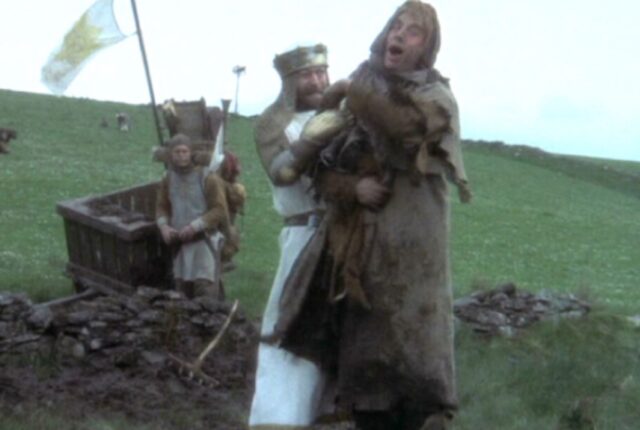
King Arthur attempting to throttle a peasant in the field

“See the violence inherent in the system!” Credit: Python (Monty) Pictures

What an impossible task to pick just a single thing I love about this film! But if I had to choose one scene, it would be when a lost King Arthur comes across an old woman—but oops, it’s actually a man named Dennis—and ends up in a discussion about medieval politics. Arthur explains that he is king because the Lady of the Lake conferred the sword Excalibur on him, signifying that he should rule as king of the Britons by divine right.

To this, Dennis replies, “Strange women lying in ponds distributing swords is no basis for a system of government. Supreme executive power derives from a mandate from the masses, not from some farcical aquatic ceremony.”

Even though it was filmed half a century ago, the scene offers a delightful send-up of autocracy. And not to be too much of a downer here, but all of us living in the United States probably need to be reminded that living in an autocracy would suck for a lot of reasons. So let’s not do that.

Eric Berger

Photo of Jennifer Ouellette

Jennifer is a senior writer at Ars Technica with a particular focus on where science meets culture, covering everything from physics and related interdisciplinary topics to her favorite films and TV series. Jennifer lives in Baltimore with her spouse, physicist Sean M. Carroll, and their two cats, Ariel and Caliban.

Monty Python and the Holy Grail turns 50 Read More »

sony-releases-new-trailer-for-28-years-later

Sony releases new trailer for 28 Years Later

Danny Boyle directs the third film in the post-apocalyptic franchise, 28 Years Later.

The critically acclaimed 2002 film 28 Days Later is often credited with sparking the 21st-century revival of the zombie genre. Director Danny Boyle is back with more zombie-virus dystopian horror in his new film set in the same fictional world, 28 Years Later—not so much a direct sequel but the start of a new planned trilogy.

(Some spoilers for 28 Days Later and 28 Weeks Later below.)

In 28 Days Later, a highly contagious “Rage Virus” is accidentally released from a lab in Cambridge, England. Those infected turn into violent, mindless monsters who brutally attack the uninfected—so-called “fast zombies.” Transmitted by bites, scratches, or even just by getting a drop of infected blood in one’s mouth, the virus spreads rapidly, effectively collapsing society. A bicycle courier named Jim (Cillian Murphy) awakens from a coma 28 days later to find London mostly deserted, apart from a handful of survivors fleeing the infected hordes, and joins them in the pursuit of safety. Jim (barely) survives, and we see zombies dying of starvation in the streets during the denouement.

The sequel, 28 Weeks Later, featured a new cast of characters living on the outskirts of London. With the help of NATO soldiers, Britain has begun rebuilding, taking in refugees and moving them to safe-zone districts. But all it takes is one careless person getting infected and raging out for the virus to spread uncontrollably yet again. So naturally, that’s what happens. The survivors eventually flee to France, only for the rage virus to spread there, too.

As early as 2007, Boyle had plans for a third film, set 28 months after the original outbreak, but it ended up in development hell. When the film finally got the green light in January 2024, the title had changed to 28 Years Later, given how much time had passed. Alex Garland returns as screenwriter and also wrote the two sequels for this new trilogy.

How much time do we have left?

Per the official synopsis:

It’s been almost three decades since the rage virus escaped a biological weapons laboratory, and now, still in a ruthlessly enforced quarantine, some have found ways to exist amidst the infected. One such group of survivors lives on a small island connected to the mainland by a single, heavily defended causeway. When one of the group leaves the island on a mission into the dark heart of the mainland, he discovers secrets, wonders, and horrors that have mutated not only the infected but other survivors as well.

Jodie Comer plays Isla, who lives with her husband, Jamie, (Aaron Taylor-Johnson) and 12-year-old son, Spike (Alfie Williams), on the aforementioned island. Isla is pregnant, and Jamie scrounges out a living as a scavenger. The cast also includes Ralph Fiennes as Dr. Kelson, one of the survivors of the original outbreak; Jack O’Connell as cult leader Sir Jimmy Crystal; Edvin Ryding as Swedish NATO soldier Erik Sundqvist; Erin Kellyman as Jimmy Ink; and Emma Laird in an as-yet-undisclosed role.

Sony releases new trailer for 28 Years Later Read More »

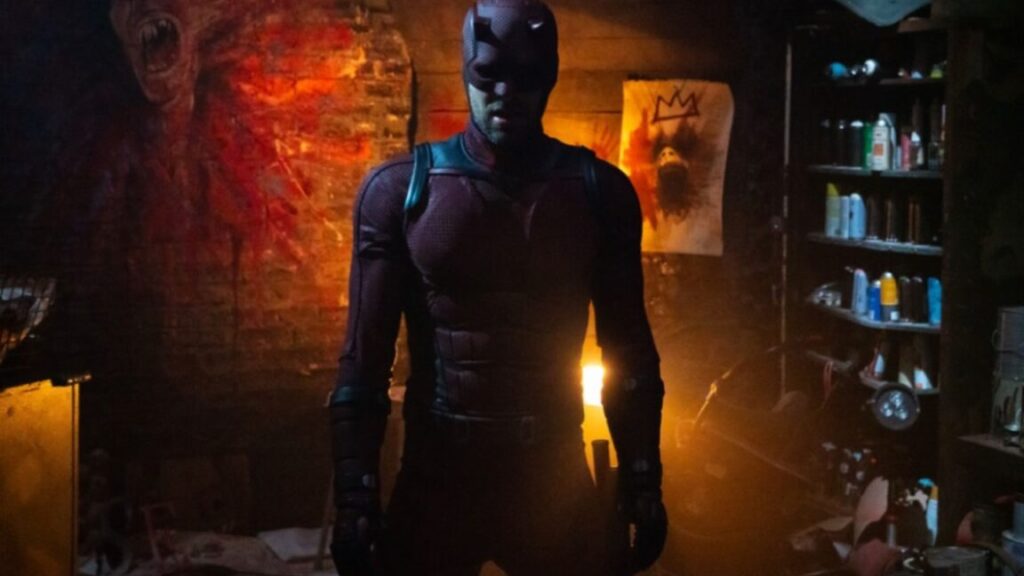
creating-a-distinctive-aesthetic-for-daredevil:-born-again

Creating a distinctive aesthetic for Daredevil: Born Again


Ars chats with cinematographer Hillary Fyfe Spera on bringing a 1970s film vibe to the Marvel series.

Enthusiasm was understandably high for Daredevil: Born Again, Marvel’s revival of the hugely popular series in the Netflix Defenders universe. Not only was Charlie Cox returning to the title role as Matt Murdock/Daredevil, but Vincent D’Onofrio was also coming back as his nemesis, crime lord Wilson Fisk/Kingpin. Their dynamic has always been electric, and that on-screen magic is as powerful as ever in Born Again, which quickly earned critical raves and a second season that is currently filming.

(Some spoilers for the series below, but no major reveals beyond the opening events of the first episode.)

Born Again was initially envisioned as more of an episodic reset rather than a straight continuation of the serialized Netflix series. But during the 2023 Hollywood strikes, with production halted, the studio gave the show a creative overhaul more in line with the Netflix tone, even though six episodes had been largely completed by then. The pilot was reshot completely, and new footage was added to subsequent episodes to ensure narrative continuity with the original Daredevil—with a few well-placed nods to other characters in the MCU for good measure.

It was a savvy move. Sure, fans were shocked when the pilot episode killed off Matt’s best friend and law partner, Foggy Nelson (Elden Hensen), in the first 10 minutes, with his grief-stricken law partner, Karen Page (Deborah Ann Woll), taking her leave from the firm by the pilot’s end. But that creative choice cleared the decks to place the focus squarely on Matt’s and Fisk’s parallel arcs. Matt decides to focus on his legal work while Fisk is elected mayor of New York City, intent on leaving his criminal life behind. But each man struggles to remain in the light as the dark sides of their respective natures fight to be released.

The result is a series that feels very much a part of its predecessor while still having its own distinctive feel. Much of that is due to cinematographer Hillary Fyfe Spera, working in conjunction with the broader production team to bring Born Again‘s aesthetic to vivid life. Fyfe Spera drew much of her inspiration from 1970s films like Taxi DriverThe French Connection, The Conversation, and Klute. “I’m a big fan of films of the ’70s, especially New York films,” Fyfe Spera told Ars. “It’s pervaded all of my cinematography from the beginning. This one in particular felt like a great opportunity to use that as a reference. There’s a lot of paranoia, and it’s really about character, even though we’re in a comic book environment. I just thought that the parallels of that reference were solid.”

Ars caught up with Fyfe Spera to learn more.

Karen, Matt, and Foggy enjoy a moment of camaraderie before tragedy strikes. Marvel Studios/Disney+

Ars Technica: I was surprised to learn that you never watched an episode of the original Netflix series when designing the overall look of Born Again. What was your rationale for that?

Hillary Fyfe Spera: I think as a creative person you don’t want to get too much in your head before you get going. I was very aware of Daredevil, the original series. I have a lot of friends who worked on it. I’ve seen sequences, which are intimidatingly incredible. [My decision] stemmed from wanting to bring something new to the table. We still pay homage to the original; that’s in our blood, in our DNA. But there was enough of that in the ether, and I wanted to think forward and be very aware of the original comics and the original lore and story. It was more about the identities of the characters and making sure New York itself was an authentic character. Looking back now, we landed in a lot of the same places. I knew that would happen naturally.

Ars Technica:  I was intrigued by your choice to use anamorphic lenses, one assumes to capture some of that ’70s feel, particularly the broad shots of the city.

Hillary Fyfe Spera: It’s another thing that I just saw from the very beginning; you just get a feeling about lenses in your gut. I know the original show was 1.78; I just saw this story as 2.39. It just felt like so many of the cityscapes exist in that wide-screen format. For me, the great thing about anamorphic is the relationship within composition in the lens. We talk about this dichotomy of two individuals or reflections or parallel worlds. I felt the widescreen gave us that ability. Another thing we do frequently is center framing, something the widescreen lens can really nail. Also, we shoot with these vintage-series Panavision anamorphics, which are so beautiful and textured, and have beautiful flaring effects. It brought organic textured elements to the look of the show that were a little out of the box.

Ars Technica: The city is very much a character, not just a showy backdrop. Is that why you insisted on shooting as much as possible on location?

Hillary Fyfe Spera: We shot in New York on the streets, and that is a challenge. We deal with everything from weather to fans to just New Yorkers who don’t really care, they just need to go where they’re going. Rats were a big part of it. We use a lot of wet downs and steam sources to replicate what it looks like outside our window every day. It’s funny, I’ll walk down the street and be like, “Oh look at that steam source, it’s real, it’s coming out of the street.”

Shooting a show of this scale and with its demands in a practical environment is such a fun challenge, because you have to be beholden to what you’re receiving from the universe. I think that’s cool. One of my favorite things about cinematography is that you can plan it to an inch of its life, prepare a storyboard and shot list as much as you possibly can, and then the excitement of being out in the world and having to adapt to what’s happening is a huge part of it. I think we did that. We had the confidence to say, “Well, the sun’s setting over there and that looks pretty great, let’s make that an element, let’s bring it in.” Man, those fluorescent bulbs that we can’t turn off across the street? They’re part of it. They’re the wrong color, but maybe they’re the right color because that’s real.

Ars Technica: Were there any serendipitous moments you hadn’t planned but decided to keep in the show anyway? 

Hillary Fyfe Spera: There’s one that we were shooting on an interior. It was on a set that we built, where Fisk has a halo effect around his head. It’s a reflection in a table. That set was built by Michael Shaw, our production designer. One of our operators happened to tilt the camera down into the reflection, and we’re like, “Oh my God, it’s right there.” Of course, it ended up in the show; it was a total gimme. Another example is a lot of our New York City street stuff, which was completely just found. We just went out there and we shot it: the hotdog carts, the streets, the steam, the pigeons. There’s so many pigeons. I think it really makes it feel authentic.

Ars Technica: The Matt Murdock/Wilson Fisk dynamic is so central to the show. How does the cinematography visually enhance that dynamic? 

Hillary Fyfe Spera: They’re coming back to their identities as Kingpin and Daredevil, and they’re wrestling with those sides of themselves. I think in Charlie and Vincent’s case, both of them would say that neither one is complete without the other. For us, visually, that’s just such a fun challenge to be able to show that dichotomy and their alter egos. We do it a lot with lensing.

In Fisk’s case, we use a lot of wide-angle lenses, very close to him, very low angle to show his stature and his size. We use it with a white light in the pilot, where, as the Kingpin identity is haunting him and coming more to the surface, we show that with this white light. There’s the klieg lights of his inauguration, but then he steps into darkness and into this white light. It’s actually a key frame taken directly from the comic book, of that under light on him.

For Matt Murdock, it’s similar. He is wrestling with going back to being Daredevil, which he’s put aside after Foggy’s death. The red blinking light for him is an indication of that haunting him. You know it’s inevitable, you know he’s going to put the suit back on. It’s who these guys are, they’re damaged individuals dealing with their past and their true selves. And his world, just from an aesthetic place, is a lot warmer with a lot more use of handheld.

We’re using visual languages to separate everyone, but also have them be in the same conversation. As the show progresses, that arc is evolving. So, as Fisk becomes more Kingpin, we light him with a lot more white light, more oppression, he’s the institution. Matt is going into more of the red light environment, the warmer environment. There’s a diner scene between the two of them, and within their coverage Matt is shot handheld and Fisk is shot with a studio mode with a lockdown camera. So, we’re mixing, we’re blending it even within the scenes to try and stay true to that thesis.

Ars Technica: The episodes are definitely getting darker in terms of the lighting. That has become quite an issue, particularly on television, because many people’s TVs are not set up to be able to handle that much darkness.

Hillary Fyfe Spera: Yeah, when I visit my parents, I try to mess with their TV settings a little. People are just watching it in the wrong way. I can’t speak for everyone; I love darkness. I love a night exterior, I love what you don’t see. For me, that goes back to films like The French Connection. It’s all about what you don’t see. With digital, you see so much, you have so much latitude and resolution that it’s a challenge in the other way, where we’re trying to create environments where there is a lot of contrast and there is a lot of mystery. I just think cinematographers get excited with the ability to play with that. It’s hard to have darkness in a digital medium. But I think viewers on the whole are getting used to it. I think it’s an evolving conversation.

Ars Technica: The fight choreography looks like it would be another big challenge for a cinematographer.

Hillary Fyfe Spera: I need to give a shoutout to my gaffer, Charlie Grubbs, and key grip, Matt Staples. We light an environment, we shoot those sequences with three cameras a lot of times, which is hard to do from a lighting perspective because you’re trying to make every shot feel really unique. A lot of that fight stuff is happening so quickly that you want to backlight a lot, to really set out moments so you can see it. You don’t want to fall into a muddy movement world where you can’t really make out the incredible choreography. So we do try and set environments that are cinematic, but that shoot certain directions that are really going to pinpoint the movement and the action.

It’s a collaboration conversation with Phil Silvera, our stunt coordinator and action director: not only how we can support him, but how we can add these cinematic moments that sometimes aren’t always based in reality, but are just super fun. We’ll do interactive lighting, headlights moving through, flares, just to add a little something to the sequence. The lighting of those sequences are as much a character, I think, as the performances themselves.

Ars Technica: Will you be continuing the same general look and feel in terms of cinematography for S2?

Hillary Fyfe Spera: I’ve never come back for a second season. I love doing a project and moving on, but what was so cool about doing this one was that the plan is to evolve it, so we keep going. The way we leave things in episode nine—I don’t know if we’re picking up directly after, but there is a visual arc that lands in nine, and we will continue that in S2, which has its own arc as well. There are more characters and more storylines in S2, and it’s all being folded into the visual look, but it is coming from the same place: the grounded, ’70s New York look, and even more comic cinematic moments. I think we’re going to bring it.

Photo of Jennifer Ouellette

Jennifer is a senior writer at Ars Technica with a particular focus on where science meets culture, covering everything from physics and related interdisciplinary topics to her favorite films and TV series. Jennifer lives in Baltimore with her spouse, physicist Sean M. Carroll, and their two cats, Ariel and Caliban.

Creating a distinctive aesthetic for Daredevil: Born Again Read More »

go-back-to-the-grid-in-tron:-ares-trailer

Go back to the Grid in TRON: Ares trailer

An AI program enters the real world in TRON: Ares.

It’s difficult to underestimate the massive influence that Disney’s 1982 cult science fiction film, TRON, had on both the film industry—thanks to combining live action with what were then groundbreaking visual effects, rife with computer-generated imagery—and on nerd culture at large.  Over the ensuing decades there has been one sequel, an animated TV series, a comic book miniseries, video games, and theme park attractions, all modeled on director Steve Lisberg’s original fictional world.

Now we’re getting a third installment in the film franchise: TRON: Ares, directed by Joachim Rønning (Pirates of the Caribbean: Dead Men Tell No Tales, Maleficent: Mistress of Evil), that serves as a standalone sequel to 2010’s TRON: Legacy. Disney just released the first trailer and poster art, and while the footage is short on plot, it’s got the show-stopping visuals we’ve come to expect from all things TRON.

(Spoilers for ending of TRON: Legacy below.)

TRON: Legacy ended with Sam Flynn (Garrett Hedlund), son of Kevin Flynn (Jeff Bridges) from the original film, preventing the digital world from bleeding into the real world, as planned by the Grid’s malevolent ruling program, Clu. He brought with him Quorra (Olivia Wilde), a naturally occurring isomorphic algorithm targeted for extinction by Clu.

Go back to the Grid in TRON: Ares trailer Read More »

genres-are-bustin’-out-all-over-in-strange-new-worlds-s3-teaser

Genres are bustin’ out all over in Strange New Worlds S3 teaser

Star Trek: Strange New Worlds returns this summer with ten new episodes.

Paramount+ has dropped a tantalizing one-minute teaser for the upcoming third season of Star Trek: Strange New Worlds., and it looks like the latest adventures of the starship Enterprise will bring romance, comedy, mystery, and even a bit of analog tech, not to mention a brand new villain.

(Some spoilers for S2 below)

We haven’t seen much from the third season to date. There was an exclusive clip during San Diego Comic Con last summer—a callback to the S2 episode “Charades,” in which a higher-dimensional race, the Kerkohvians, accidentally reconfigured Spock’s half-human, half-Vulcan physiology to that of a full-blooded human, just before Spock was supposed to meet his Vulcan fiancee’s parents. The S3 clip had the situation reversed: The human crew had to make themselves Vulcan to succeed on a new mission but weren’t able to change back.

The S2 finale found the Enterprise under vicious attack by the Gorn, who were in the midst of invading one of the Federation’s colony worlds. Several crew members were kidnapped (La’an, M’Benga, Ortegas, and Sam), along with other survivors of the attack. Pike faced a momentous decision: follow orders to retreat, or disobey them to rescue his crew. In October, we learned that Pike naturally chose the latter. New footage shown at New York City Comic-Con picked up where the finale left off, giving us the kind of harrowing high-stakes pitched space battle against a ferocious enemy that has long been a hallmark of the franchise.

Genres are bustin’ out all over in Strange New Worlds S3 teaser Read More »

john-wick-has-a-new-target-in-latest-ballerina-trailer

John Wick has a new target in latest Ballerina trailer

Ana de Armas stars as an assassin in training in From the World of John Wick: Ballerina.

Lionsgate dropped a new trailer for Ballerina—or, as the studio is now calling it, From the World of John Wick: Ballerina, because what every film needs is a needlessly clunky title. There’s nothing clunky about this new trailer, however: It’s the stylized, action-packed dose of pure adrenaline one would expect from the franchise, and it ends with Ana de Armas’ titular ballerina facing off against none other than John Wick himself (Keanu Reeves).

(Spoilers for 2019’s John Wick Chapter 3: Parabellum.)

Chronologically, Ballerina takes place during the events of John Wick Chapter 3: Parabellum. As previously reported, Parabellum found Wick declared excommunicado from the High Table for killing crime lord Santino D’Antonio on the grounds of the Continental. On the run with a bounty on his head, he makes his way to the headquarters of the Ruska Roma crime syndicate, led by the Director (Anjelica Huston). That’s where we learned Wick was originally named Jardani Jovonovich and trained as an assassin with the syndicate. The Director also trains young girls to be ballerina-assassins, and one young ballerina (played by Unity Phelan) is shown rehearsing in the scene. That dancer, Eve Macarro, is the main character in Ballerina, now played by de Armas.

Huston returns as the Director, Ian McShane is back as Winston, and Lance Reddick makes one final (posthumous) appearance as the Continental concierge, Charon. New cast members include Gabriel Byrne as main villain the Chancellor, who turns an entire town against Eve; Sharon Duncan-Brewster as Nogi, Eve’s mentor; Norman Reedus as Daniel Pine; and Catalina Sandino Moreno and David Castaneda in as-yet-undisclosed roles.

John Wick has a new target in latest Ballerina trailer Read More »

behind-the-scenes-of-the-electric-state

Behind the scenes of The Electric State

The directors adopted more of a colorful 1990s aesthetic than the haunting art that originally inspired their film. While some fans of Stålenhag’s work expressed disappointment at this artistic choice, the artist himself had nothing but praise. “When you paint or draw something, you can do anything,” Stålenhag has said. ‘There are no constraints other than the time you spend painting. To see a live action movie make something I painted and to see it so truthfully translated impressed me on all levels.”

Bringing a vision to life

The task of bringing that aesthetic to the screen fell to people like Oscar-winning production designer Dennis Gassner, whose many credits include Barton Fink, Bugsy, The Hudsucker Proxy, The Truman Show, Blade Runner 2049, Skyfall, Quantum of Solace, Spectre, Into the Woods, and Big Fish. (In fact, there’s a carousel featured in the design of the Happyland amusement park that Gassner first used in Big Fish.) He and Richard L. Johnson (Pacific Rim, The Avengers) led a team that not only designed and constructed more than 100 sets for the film, but also created a host of original robot characters to augment the ones featured in Stålenhag’s book.

On set during filming of The Electric State Netflix

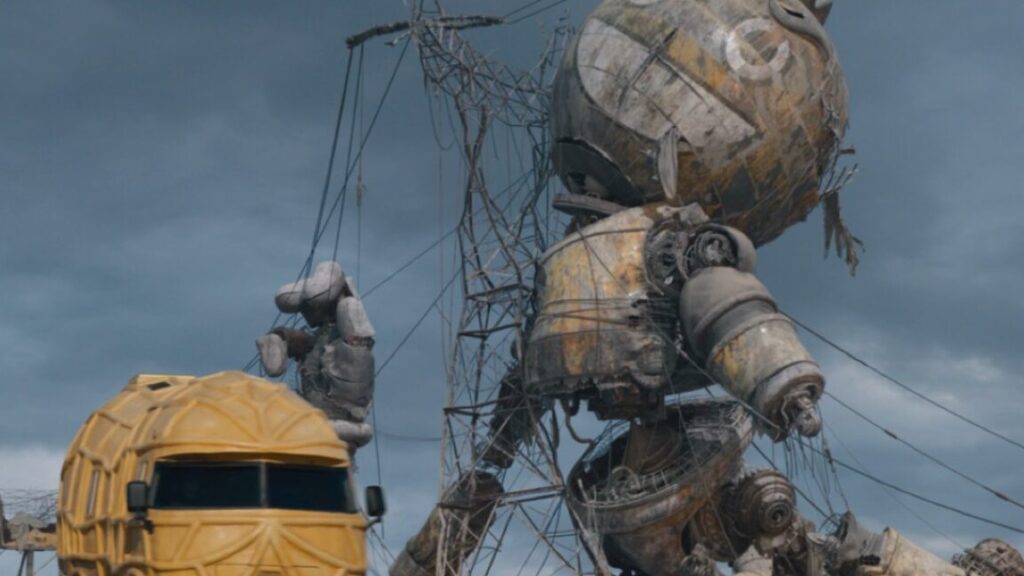
All the robots featured in the film have their own stories, “distinct personalities and emotional arcs,” per Anthony Russo. The directors wanted the robots to “feel authentic to the alternate 1990s but still had roots in recognizable designs,” according to Joe Russo—the kinds of things one would see in vintage commercials, shopping malls, corporate branding, and so forth. “Everything is story,” Gassner told Ars. “Story is paramount. What story are you telling? Who are the characters in this story? What are their environments? How do they feel within the environments?”

Gassner’s team designed about 175 robots all told, selecting their favorites to be featured in the final film. “It’s like a great casting call,” Gassner said. “So we played a lot, there was a long time of development in the art department between myself and a vast team of artists. We worked very closely with the visual effects department, but what the characters look like are part of the art department, and our collaboration with Joe and Anthony Russo on the study of characters. That was the fun part, getting the shape right, the character right, the color right, the clothing right.”

Behind the scenes of The Electric State Read More »

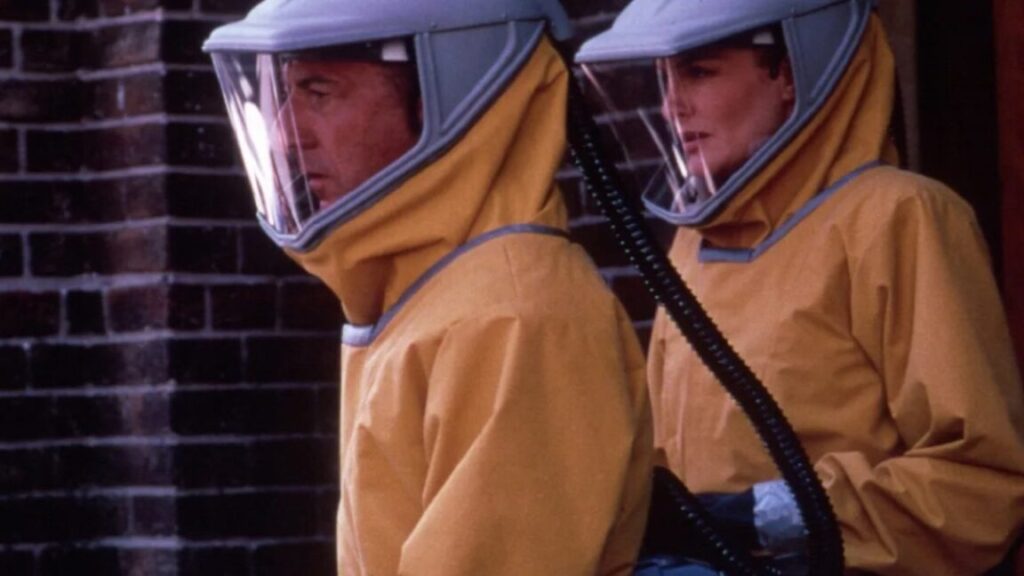
outbreak-turns-30

Outbreak turns 30


Ars chats with epidemiologist Tara Smith about the film’s scientific accuracy and impact over 3 decades.

Dustin Hoffman and Renee Russo starred in this medical disaster thriller. Credit: Warner Bros.

Back in 2020, when the COVID pandemic was still new, everyone was “sheltering in place” and bingeing films and television. Pandemic-related fare proved especially popular, including the 1995 medical disaster-thriller Outbreak, starring Dustin Hoffman. Chalk it up to morbid curiosity, which some researchers have suggested is an evolved response mechanism for dealing with threats by learning from imagined experiences. Outbreak turned 30 this week, making this the perfect time to revisit the film.

(Spoilers for Outbreak abound below.) 

Outbreak deals with the re-emergence of a deadly virus called Motaba, 28 years after it first appeared in an African jungle, infecting US soldiers and many others. The US military secretly destroyed the camp to conceal evidence of the virus, a project overseen by Major General Donald McClintock (Donald Sutherland) and Brigadier General William Ford (Morgan Freeman). When it re-emerges in Zaire decades later, a military doctor, Colonel Sam Daniels (Hoffman), takes a team to the afflicted village to investigate, only to find the entire town has died.

Daniels takes blood samples and realizes the villagers had been infected by a deadly new virus. But Ford shrugs off  Daniels’ concerns about a potential global spread, not wanting the truth to come out about the bombing of the village nearly 30 years ago. Daniels alerts his estranged ex-wife, Dr. Roberta “Robby” Keough, who works for the Centers for Disease Control and Prevention, about the virus, and she, too, is initially concerned.

Meanwhile, a local monkey is captured and brought to the US as an exotic pet. A smuggler named Jimbo (Patrick Dempsey)—who works at an animal testing facility—tries to sell the monkey to a pet shop owner named Rudy (Daniel Chodos) in the fictional town of Cedar Creek, California. The monkey bites Rudy. Unable to sell the monkey, Jimbo lets it loose in the woods and flies home to Boston. Both Jimbo and his girlfriend (who greets him at Logan Airport and passionately kisses a feverish Jimbo right before he collapses) die from the virus.

Naturally Keough hears about the Boston cases and realizes Daniels was right—the new virus has found its way to American soil. Initially she thinks there aren’t any other cases, but then Rudy’s demise comes to light, along with the death of a hospital technician who became infected after accidentally breaking a vial of Rudy’s blood during testing. When the virus strikes down a cinema filled with moviegoers, Daniels and Keough realize the virus has mutated and become airborne.

This time Ford and a reluctant McClintock can’t afford not to act as the bodies keep piling up.  The military declares martial law in the town as Daniels and his fellow scientists race to develop a cure, even as the nefarious McClintock schemes to bomb Cedar Creek to smithereens to contain the virus. The deaths of the residents strike him as a necessary cost to preserve his hopes of developing Motaba as a biological weapon; he dismisses them as “casualties of war.”

Outbreak ended up grossing nearly $190 million worldwide when it was released in March 1995, but critical reviews were mixed. Some loved the medical thriller aspects and quick pacing, while others dismissed it as shallow and improbable. Some of the biggest criticisms of the film came from scientists.

A mixed bag

“Honestly, the science, if you look at it broadly, is not awful,” Tara Smith, an epidemiologist at Kent State University in Ohio, told Ars. “They showed BSL-4 facilities and had a little description of the different levels that you work in. The protagonists respond to an outbreak, they take samples, they bring them back to the lab. They infect some cells, infect some animals, they do some microscopy, although it’s not clear that they’re actually doing electron microscopy, which would be needed to see the virus. But overall, the steps are right.”

Granted, there are plenty of things to nitpick. “There’s a lot of playfulness,” said Smith. “Kevin Spacey [who plays military doctor Lt. Col. Casey Schuler] takes out a fake virus tube and tosses it to Cuba Gooding Jr. [who plays another military doctor, Major Salt]. You don’t play in the BSL-4 laboratories. You just don’t. And a lab tech [who becomes infected] is spinning a centrifuge and doing other things at the same time. Then he opens up the centrifuge and just puts his hand in there and everything breaks. That’s how he gets exposed to the virus. I’ve used a centrifuge hundreds of times. You wait until everything is stopped to open it up. As a trained scientist, those are the things you are told over and over not to do. [The filmmakers] exploit those to drive the plot.”

One of the biggest scientific criticisms is the time compression: the virus multiplies in the body within an hour instead of days; Salt eventually synthesizes a cure in under a minute when this would normally take months; and Keough (who has been infected) recovers almost immediately after being injected with said cure. Smith also noted that scientists identify the two Motaba strains using electron micrographs rather than sequencing them, as would normally be required.

And that whole bit about the Motaba virus liquefying organs just isn’t a thing, according to Smith. “If you read The Hot Zone [Richard Preston’s bestselling 1994 nonfiction thriller], or watch Outbreak and take a shot every time you hear ‘liquefying,’ you would be dead by the end,” she said. “I don’t know how that trope got so established in the media, but you see it every time the Ebola comes up: people are bleeding from their eyes, they’re liquefying. That doesn’t happen. They’re horribly sick. It is an awful virus, but people don’t just melt.”

That said, “I think the biggest [scientific] issue with Outbreak was the whole airborne thing,” said Smith. “Realistically, viruses just don’t change transmission like that.”

Influencing public perceptions

According to Smith, Outbreak may have impacted public perceptions of the 2014–2016 Ebola outbreak—the largest yet seen—fueling widespread fear. “There were very serious people in The New York Times talking about Ebola potentially becoming airborne,” she said. “There was one study where scientists had aerosolized the virus on purpose and given it to pigs and the pigs got infected, which was treated as proof that Ebola could be airborne.”

“That idea that Ebola is super contagious and you can spread it by air—that really originates with Outbreak in 1995, because if you look at the science, it’s just not there,” Smith continued. “Ebola is not that easy to get unless you have close, personal, bodily-fluid-exchanging contact. But people certainly thought it was airborne in 2014–2015, and thought that Ebola was going to cause this huge outbreak in the United States. Of course, we just had a few select cases.”

Smith is currently working on a project that reviews various outbreak stories in popular media and their influence on public perception, particularly when it comes to the origins of those outbreaks. “Where does the virus, fungus, or bacteria come from?” said Smith. “So many films and TV series have used a lab leak origin, where something was made in the laboratory, it escapes, and causes a global pandemic. That’s an important narrative when we talk about the COVID pandemic, because so many people jumped on the lab leak bandwagon as an origin for that. In Outbreak it’s a natural virus, not a lab leak. I don’t think you’d see that if it were re-made today.”

Sam and Salt find the information they’re looking for. Warner Bros.

Outbreak is often unfavorably compared to another pandemic movie, 2011’s Contagion, of which Smith is naturally a fan. “Contagion is the gold standard [of pandemic movies],” said Smith. “Contagion was done in very close collaboration with a lot of scientists. One of the scientists in the movie is even named for [Columbia University epidemiologist] Ian Lipkin. Scientific accuracy was more important from the start. And there’s a bigger timeframe. These things happen in months rather than days. Even in Contagion, the vaccine was developed quicker than in the COVID pandemic, but at least it was a little bit more realistically done, scarily so when you think about the Jude Law character who was the blogger peddling fake cures—very similar to Ivermectin during the COVID pandemic.”

One might quibble with the science, but as entertainment, after 30 years, the film holds up remarkably well, despite the obvious tropes of action films of the 1990s. (Sam and Salt defying orders and hijacking a military helicopter, then using it to face-off mid-air against a military aircraft deployed to bomb the town out of existence, is just one credibility-straining example.) The talented cast alone makes it worth a rewatch. And for Smith, it was nice to see a strong female epidemiologist as a leading character in Russo’s Bobby Keough. On the whole, “I honestly think Outbreak was fairly good,” she said.

Photo of Jennifer Ouellette

Jennifer is a senior writer at Ars Technica with a particular focus on where science meets culture, covering everything from physics and related interdisciplinary topics to her favorite films and TV series. Jennifer lives in Baltimore with her spouse, physicist Sean M. Carroll, and their two cats, Ariel and Caliban.

Outbreak turns 30 Read More »

hbo-drops-the-last-of-us-s2-trailer

HBO drops The Last of Us S2 trailer

Pedro Pascal returns as Joel in The Last of Us S2.

HBO released a one-minute teaser of the hotly anticipated second season of The Last of Us—based on Naughty Dog’s hugely popular video game franchise—during CES in January. We now have a full trailer, unveiled at SXSW after the footage leaked over the weekend, chock-full of Easter eggs for gaming fans of The Last of Us Part II.

(Spoilers for S1 below.)

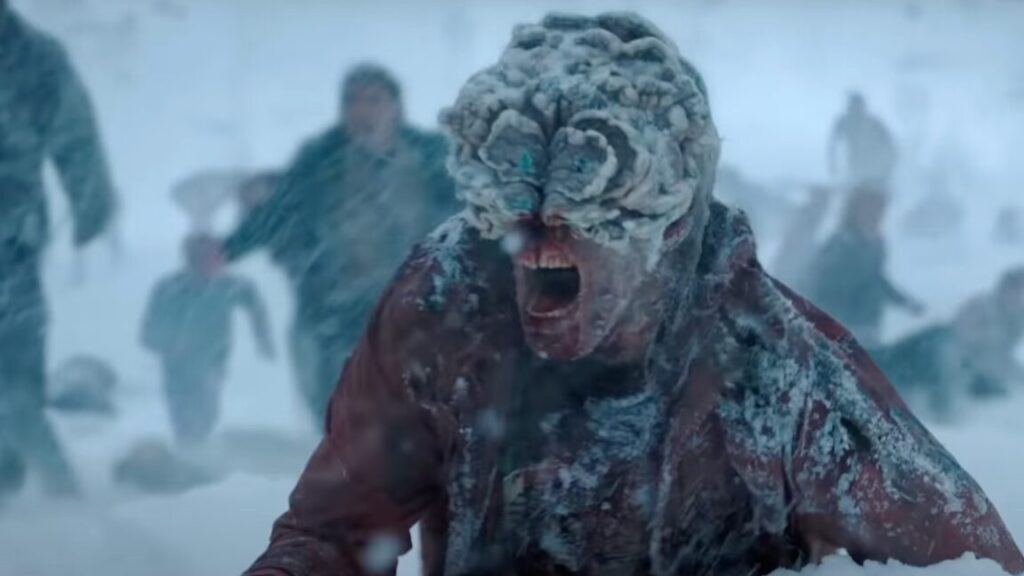
The series takes place in the 20-year aftermath of a deadly outbreak of mutant fungus (Cordyceps) that turns humans into monstrous zombie-like creatures (the Infected, or Clickers). The world has become a series of separate totalitarian quarantine zones and independent settlements, with a thriving black market and a rebel militia known as the Fireflies making life complicated for the survivors. Joel (Pedro Pascal) is a hardened smuggler tasked with escorting the teenage Ellie (Bella Ramsay) across the devastated US, battling hostile forces and hordes of zombies, to a Fireflies unit outside the quarantine zone. Ellie is special: She is immune to the deadly fungus, and the hope is that her immunity holds the key to beating the disease.

S2 is set five years after the events of the first season and finds the bond beginning to fray between plucky survivors Joel and Ellie. That’s the inevitable outcome of S1’s shocking finale, when they finally arrived at their destination, only to discover the secret to her immunity to the Cordyceps fungus meant Ellie would have to die to find a cure. Ellie was willing to sacrifice herself, but once she was under anesthesia, Joel went berserk and killed all the hospital staff to save her life—and lied to Ellie about it, claiming the staff were killed by raiders.

HBO drops The Last of Us S2 trailer Read More »

andor-s2-featurette-teases-canonical-tragic-event

Andor S2 featurette teases canonical tragic event

Most of the main S1 cast is returning for S2, with the exception of Shaw. Forest Whitaker once again reprises his Rogue One role as Clone Wars veteran Saw Gerrera, joined by fellow Rogue One alums Ben Mendelsohn and Alan Tudyk as Orson Krennic and K-2SO, respectively. Benjamin Bratt has also been cast in an as-yet-undisclosed role.

The behind-the-scenes look opens with footage of a desperate emergency broadcast calling for help because Imperial ships were landing, filled with storm troopers intent on quashing any protesters or nascent rebels against the Empire who might be lurking about. “Revolutionary movements are spontaneously happening all over the galaxy,” series creator Tony Gilroy explains. “How those come together is the stuff of our story.” While S1 focused a great deal on political intrigue, Genevieve O’Reilly, who plays Mon Mothma, describes S2 as a “juggernaut,” with a size and scope to match.

The footage shown—some new, some shown in the last week’s teaser—confirms that assessment. There are glimpses of Gerrera, Krennic, and K-2SO, as well as Mothma’s home world, Chandrila. And are all those protesters chanting on the planet of Ghorman? That means we’re likely to see the infamous Ghorman Massacre, a brutal event that resulted in Mothma resigning from the Senate in protest against Emperor Palpatine. The massacre was so horrifying that it eventually served to mobilize and unite rebel forces across the galaxy in the Star Wars canon.

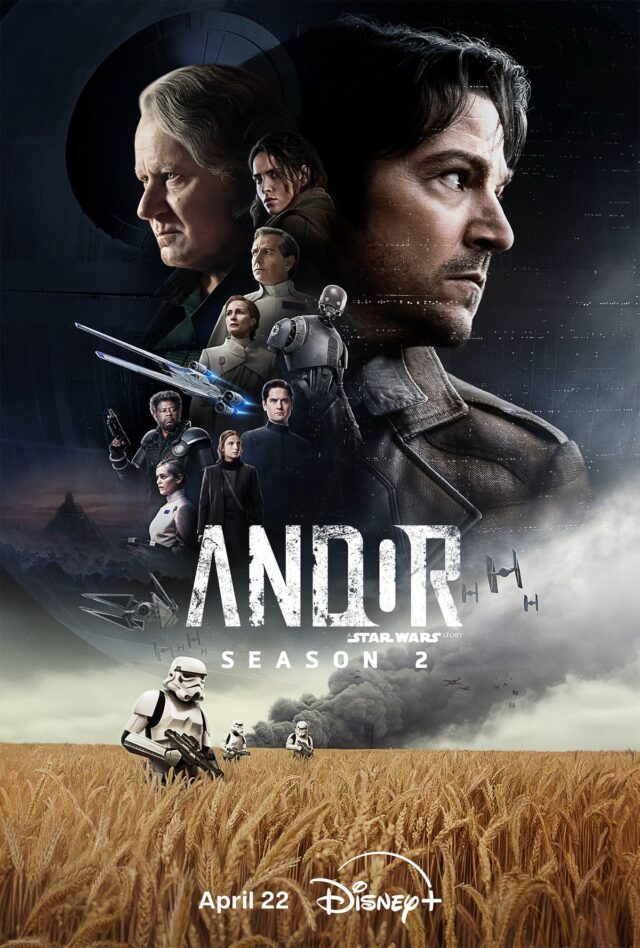
The first three (of 12) episodes of Andor S2 premiere on April 22, 2025, on Disney+. Subsequent three-episode chapters will drop weekly for the next three weeks after that.

poster art for Andor S2

Credit: LucasFilm/Disney+

Andor S2 featurette teases canonical tragic event Read More »

netflix-drops-trailer-for-the-russo-brothers’-the-electric-state

Netflix drops trailer for the Russo brothers’ The Electric State

Millie Bobby Brown and Chris Pratt star in the Netflix original film The Electric State.

Anthony and Joe Russo have their hands full these days with the Marvel films Avengers: Doomsday and Avengers: Secret War, slated for 2026 and 2027 releases, respectively. But we’ll get a chance to see another, smaller film from the directors this month on Netflix: The Electric State, adapted from the graphic novel by Swedish artist/designer Simon Stålenhag.

Stålenhag’s stunningly surreal neofuturistic art—featured in his narrative art books, 2014’s Tales from the Loop and 2016’s Things From the Flood—inspired the 2020 eight-episode series Tales From the Loop, in which residents of a rural town find themselves grappling with strange occurrences thanks to the presence of an underground particle accelerator. That adaptation captured the mood and tone of the art that inspired it and received Emmy nominations for cinematography and special visual effects.

The Electric State was Stålenhag’s third such book, published in 2018 and set in a similar dystopian, ravaged landscape. Paragraphs of text, accompanied by larger artworks, tell the story of a teen girl named Michelle who must travel across the country with her robot companion to find her long-lost brother, while being pursued by a federal agent. The Russo brothers acquired the rights early on and initially intended to make the film with Universal, but when the studio decided it would not be giving the film a theatrical release, Netflix bought the distribution rights.

It’s worth noting that the Russo brothers have made several major plot changes from the source material, a decision that did not please Stålenhag’s many fans, particularly since the first-look images revealed that the directors were also adopting more of a colorful 1990s aesthetic than the haunting art that originally inspired their film. Per the official premise:

Netflix drops trailer for the Russo brothers’ The Electric State Read More »