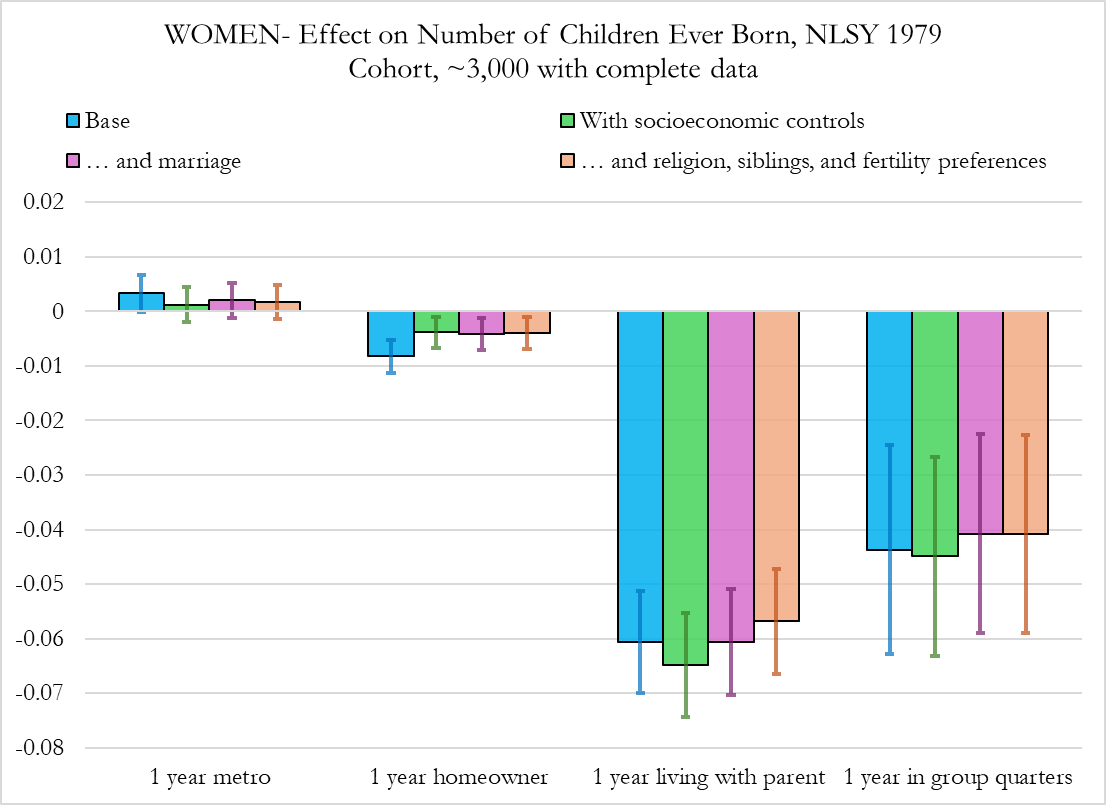
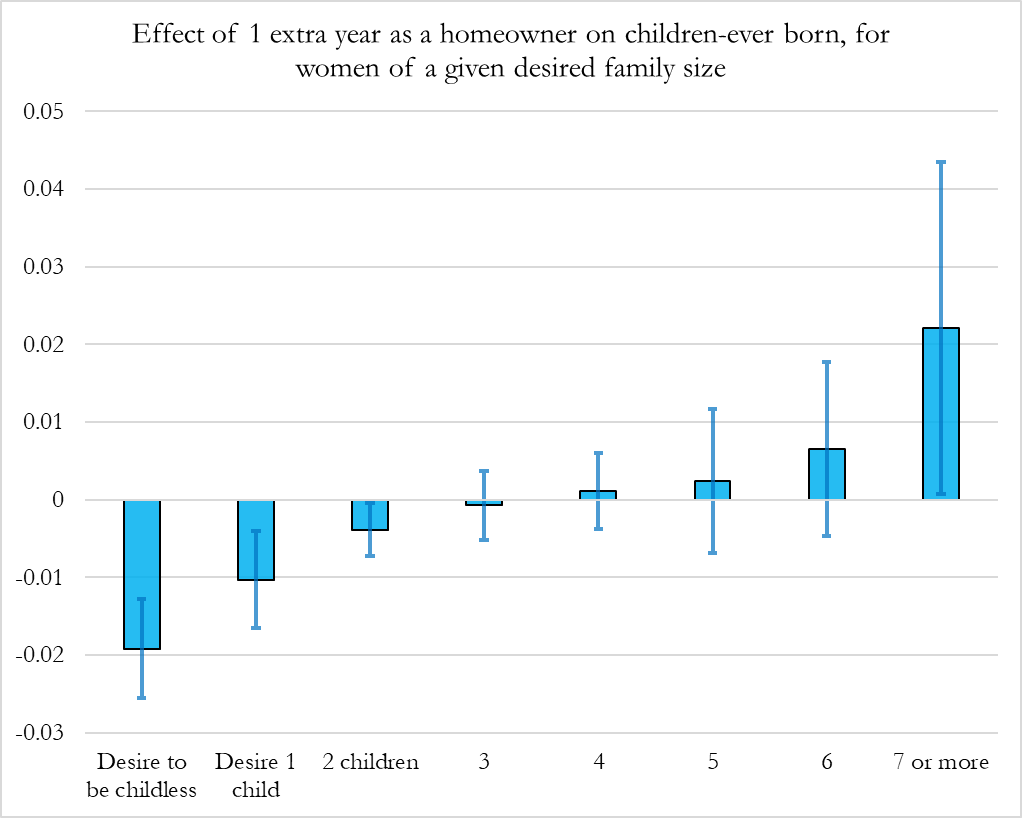
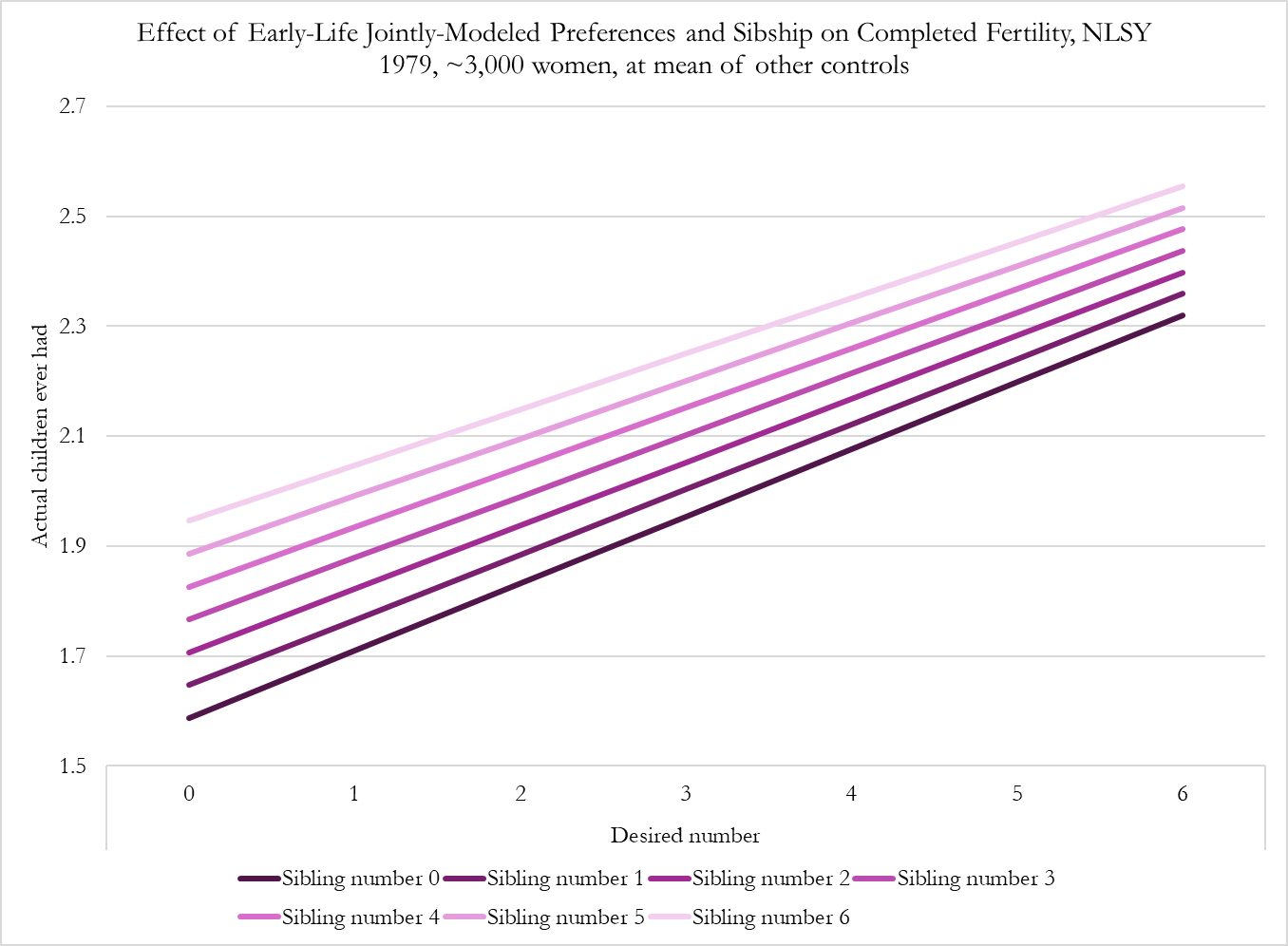
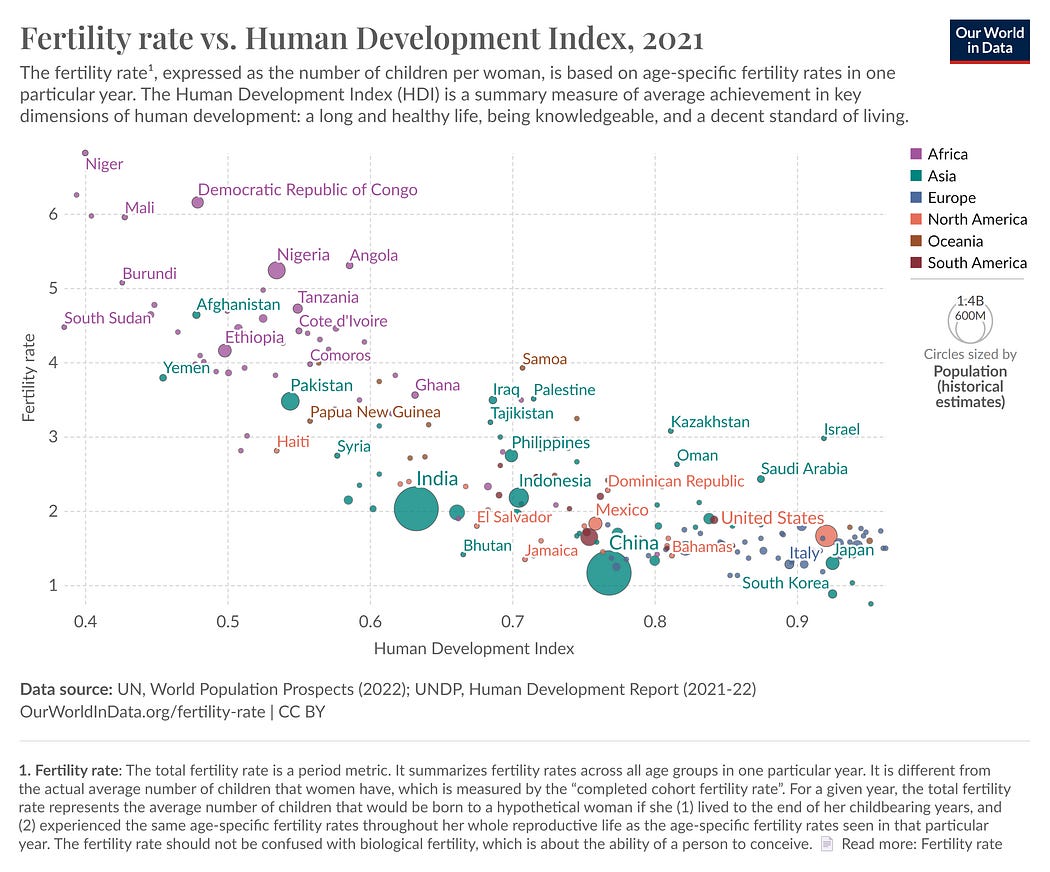
The central message of the fertility roundups has always been that we have a choice.
If we do want to raise fertility, we can do that. People respond to incentives. That means money, especially if paid up front, and it also means time, lifestyle and respect.
If we do it purely with cash, it would be expensive, but a well-designed version of this would still be net profitable to the state. On the order of $300k per additional live birth would get this done in the United States, depending on how you structure it. This is not money spent, it is money transferred, and it helps the kids quite a lot.
If we do it by dealing with the Revolution of Rising Requirements, by providing non-cash advantages or changing the culture, that’s a more complex intervention, but we have options that let us do far better.
Those who disagree have tried almost nothing, and are all out of ideas.
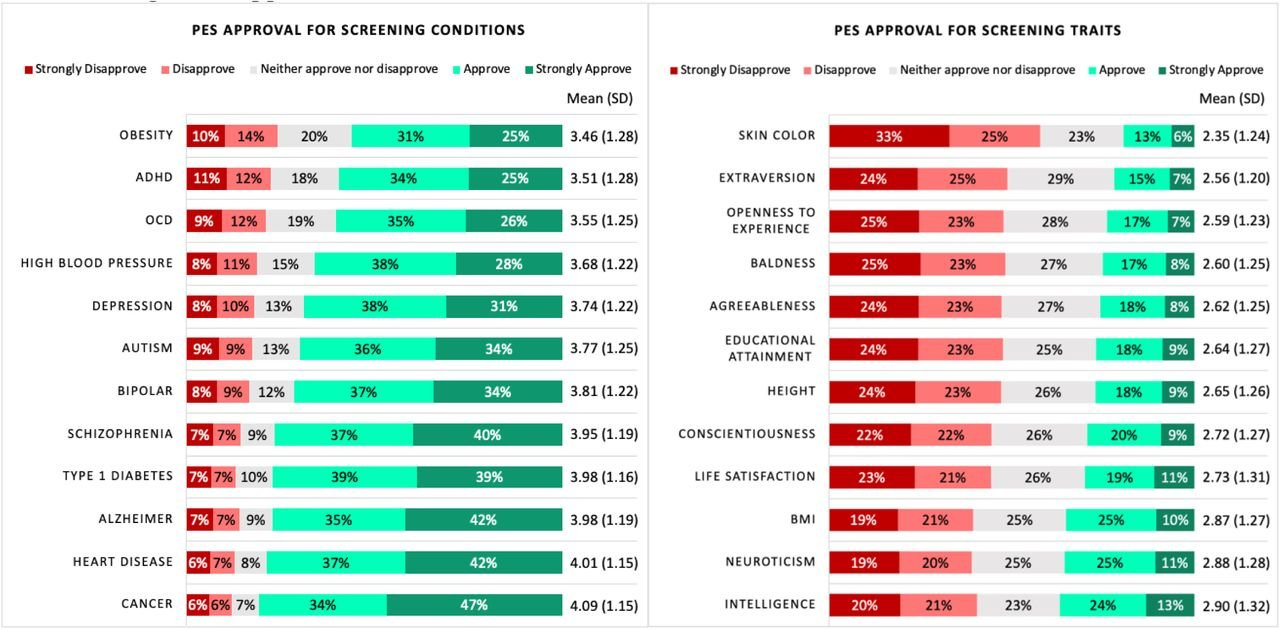
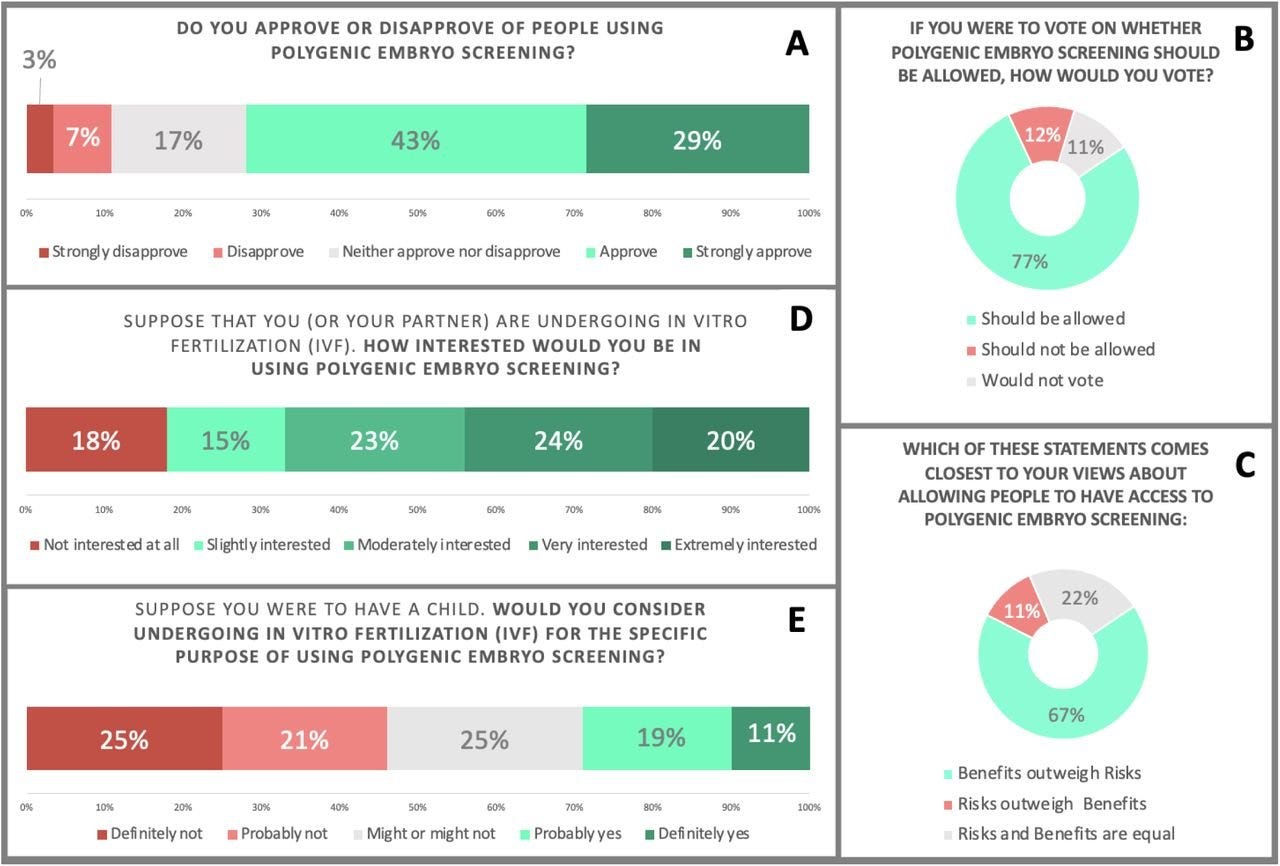
Alex Strudwick Young: Today parents can, for the first time, access polygenic embryo testing for IQ and many diseases through a routine test (PGT-A) done worldwide and in 60% of US IVF cycles.
… In many jurisdictions you have a legal right to your PGT-A data under regulations such as HIPAA in the USA and GDPR in the EU.
Herasight has a lot of experience dealing with these bureaucratic processes and gatekeepers. Contact us for help.
Couples with PGT-A data can now access Herasight’s polygenic predictors for IQ and many diseases, including the most powerful predictors for Alzheimer’s, schizophrenia, and cancers.
Selection on our IQ predictor, CogPGT, can boost offspring IQ by up to 9 points.
Selection will be awesome, it is crazy that we are trying to slow it down rather than encourage it. Yes, this was predictable and we know why people do it, that doesn’t make it not crazy.
Saying ‘up to 9 points’ is weasel wording, but it seems plausible to me to see ~10 IQ point average bumps from selection even at current tech levels.
This aligns with everything I know about such things. You should absolutely presume that surrogacy is a win-win-win deal for everyone involved, so long as neither adult party is out to intentionally abuse the other.
Trump’s executive order tasks the Assistant for Domestic Policy to create recommendations for protecting IVF access and reducing out-of-pocket and health plan costs for IVF. This is an excellent, highly cost-effective thing to do. IVF often doesn’t happen because of lack of capital. The best way to subsidize children is out of the gate at birth, but the even better way is to make it cheaper to try. That also removes worries about distortions or adverse selection from big cash payments.
The hope is that in the future, we will be able to take IVF to the next level. We have the technologies in sight to do at least the first two steps within 5-10 years, and there are projects aiming at the next two in that time frame as well:
Brian Armstrong: The IVF clinic of the future will combine a handful of technologies (the Gattaca stack):
1. In vitro gametogenesis (IvG) – make eggs from skin or blood cells (much less invasive)
2. Preimplantation genetic testing (PGT) – choose the embryo that best matches what you want, ideally from thousands or more (see #1)
3. Embryo editing – make further edits for disease prevention, or enhancement
4. Artificial Wombs – removes the risk/burden of pregnancy
Lots of work to get there, but this may help with the decline in birth rates. And it would start to accelerate evolution (which, by natural selection, is a very slow process, and only optimizes for survival and replication).
Amanda Askell: It’s bizarre when relatively techno-utopian people are asked about how to solve declining fertility and instead of talking about artificial wombs, extended fertility spans, AI-assisted childcare, UBI, etc. they’re suddenly like “well we just need to return to the 50s”.
Peter Wildeford: We are so close to technologies that make life better for so many people.
If AI doesn’t fully upend the game board and we fail to make at least the first three happen and probably all four, it will be a policy choice. It will mean humanity has chosen not to better itself and its experience, instead choosing to go quietly into the night. We need to not allow this.
I do understand why one would worry about making IVF Plan A rather than Plan B. But that’s largely because right now the technology, given what our laws allow, is not good enough to be a clear Plan A for most people. That will change.
Noor Siddiqui: When I was in elementary school, my mom started going blind. Retinitis pigmentosa. No family history. No treatments. No cure.
I got lucky. She didn’t. It led me to build @OrchidInc so my baby —and everyone else’s—gets to win the genetic lottery—avoid blindness— and hundreds of severe genetic diseases.
Today, the New York Times covered the tech we’ve spent years building:
Whole genome embryo screening for *hundredsof diseases.
Not in theory. Not in mice. In humans. In IVF centers. Right now.
If you could prevent your child from going blind — would you? From getting pediatric cancer at 5? From heart defects? Schizophrenia at 22? From living a life radically altered by pure genetic bad luck?
This is a choice parents are now able to make.
Sex is for fun. Embryo screening is for babies.
I said that in a video.
People freaked out.
But it’s true. And it will only get more true as the tech improves.
We screen for what matters. And nothing matters more than health.
…
Genomics is moving fast and society is scrambling to catch up. But make no mistake: In 10 years, not screening your embryos will feel like not buckling your seatbelt.
Sarah Constantin: IVF is wonderful and so is embryo screening, but I’m leery of using IVF instead of “the old-fashioned way” when you don’t have a medical reason (like infertility or carrying a genetic disease.)
Why?
IVF still has a high failure rate (though it’s getting better). And it requires hormone treatments. Basically every woman I know who went through IVF and/or egg freezing had a nasty mood reaction to the hormones. Worth it for some — but not for everyone.
Right now you should definitely be wary of using IVF as plan A. The screening benefits are not that strong yet, and it is expensive and painful and time consuming and unfun. So yes, worth it for some, but not for everyone.
In 10 years, if the technology develops in good ways, it should be a clear Plan A, at least in wealthy countries. Even if selection is purely to avoid negative health conditions the cost-benefit analysis will be overwhelming.
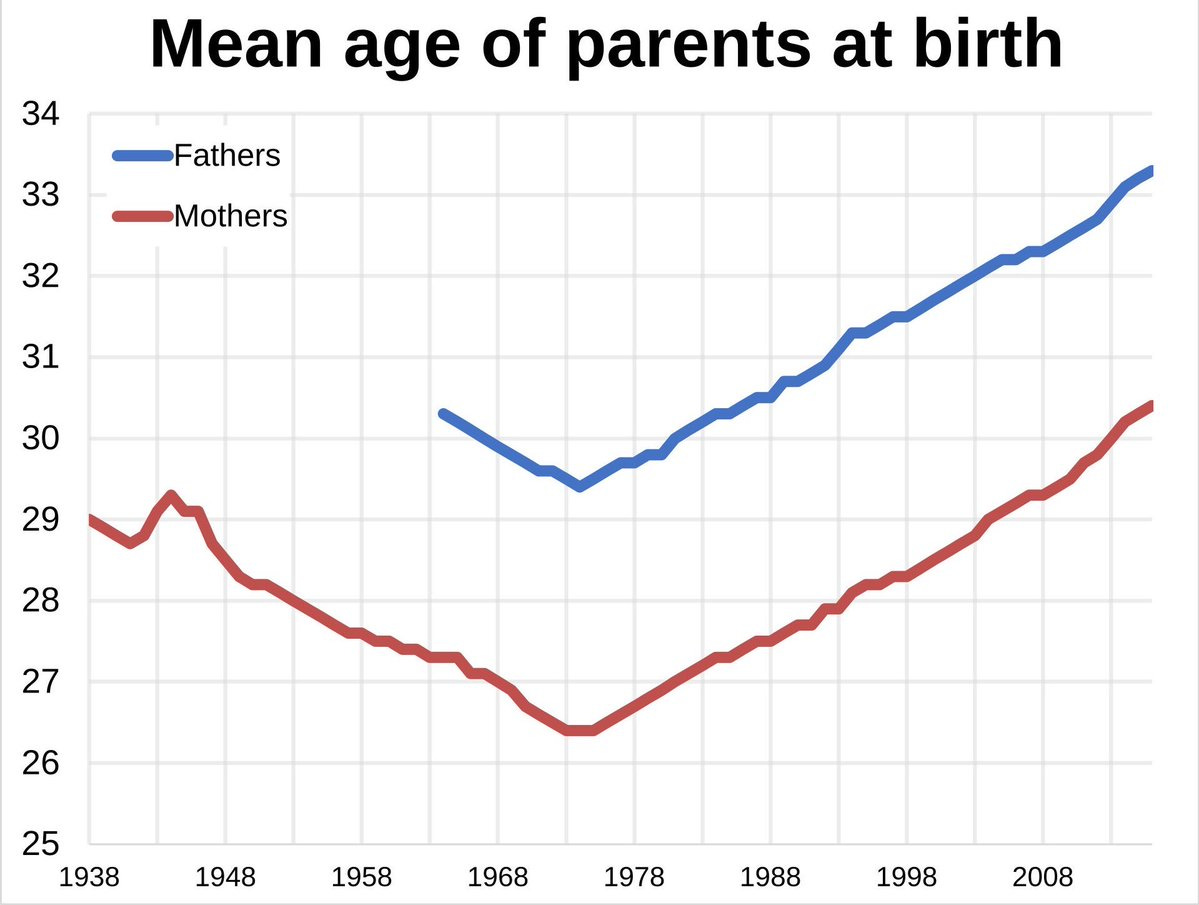
Pop Tingz: For the first time in U.S. history, more women over 40 are giving birth than teenagers.
eva: anyone who wants the birth rate to go back up is going to have to get involved or loudly support scientific research to allow women over 40 who still want to be mothers, that’s the way forward
Zac Hill: A huge tell is how every group wants their opponents to solve problems socially, conveniently nudging society towards their preferred vision, when in fact the solution to almost all existential challenges is typically technological-institutional.
Why not both is usually the correct response. Technological solutions are great, and advancing them or getting rid of bottlenecks, especially regulatory and ‘medical ethics’ or approval bottlenecks, is a big game, up to and including artificial wombs and the creation of embryos from arbitrary cells. But culture and social (and institutional) questions matter a ton as well.
The stupid form of the mistake is saying ‘why don’t you all agree, without any change in institutions or incentives,’ to do some good thing [X]. We can agree that this approach mostly doesn’t work, but that’s why you change the institutions and incentives, in ways that among other things shift culture. And to do that, you often want to create cultural desire for change first.
In the context of fertility, Dakka is my term for Paying Parents Money.
Ken Klippenstein: Trump’s Transportation Secretary Sean Duffy just sent out a memo directing staff to “give preference to communities with marriage and birth rates higher than the national average.”
This is how that would distribute funds:
This definitely wouldn’t ‘work’ to raise fertility, because the incentives here are all way too diffused from the decision making on having kids, and there isn’t a long term reward here to get communities to alter policies even if they could. It’s just weird.
David Holz: crazy question… how many kids would you be willing to have in exchange for paying zero taxes?
It’s not as easy as he makes it out to be, because you can only use this gun once. So if you say ‘you need to have 5 kids’ you lose the people who would have 3, and the people who would have had 10 only have 5, and not everyone who wants to hit 5 gets to hit 5, plans don’t always work out, liquidity will be a big issue since the tax exemption only hits later and biology is not always kind.
So even if we decided it was worthwhile, it definitely isn’t that easy. And this is a rather inefficient way to get where you want to go. But yes, it shows that at the limit, 73% of people answered they can absolutely be bribed. Usually people overestimate their responses, but it’s still striking.
A lot of the problem, in practice, has been everyone’s aversion to things that someone might call ‘eugenics’ or that impact some groups more than others.
People don’t want to use incentives that mostly work on poor people. They also recoil in horror if you suggest shaping the incentives so they work equally well or better for rich people. That rules out all of the possible incentives.
Scott Greer: To hammer home a point, government policy likely can’t reverse declining marriage rates.
Robin Hanson: There are in fact larger dollar amounts than $14K.
Patrick McKenzie: As, for example, thoroughly understood by governments when the behavior change they want to incentivize is “Please work for us for a year.”
Americans often face a dramatic marriage penalty, that can be much bigger than this. The cost of divorce, or marrying the wrong person, is very high.
A one time $14,000 transfer is not all that much. For many, it won’t even cover the wedding! It is certainly a good start, but you’ll need More Dakka to get people to marry for real that much more often.
If you don’t think people will marry for money? Most of us know people who have married for health insurance. A marriage is whatever the people involved make of it. The worry with subsidizing marriage, especially with a lump sum, is that marriages are easy to fake, and the marginal financially motivated marriage doesn’t give you what you want.
Whereas children are extremely difficult to fake, they either exist or they don’t.
Thus, you want to ensure marriage isn’t penalized, but you can’t reward it that much unless you also condition on children, which risks prolonging deeply awful marriages.
Peter Eduardo in WaPo similarly warned that ‘no motherhood medal or baby bonus will fix what economic modernization broke,’ saying even well-conceived policies have ‘mostly failed’ to lift fertility ‘for good’ but that is the wrong counterfactual, as usual the evidence that nothing works is that you tried nothing much and you’re all out of ideas. Or that because differences in subsidies don’t explain most differences in fertility, subsidies must not matter. That’s not how it works.
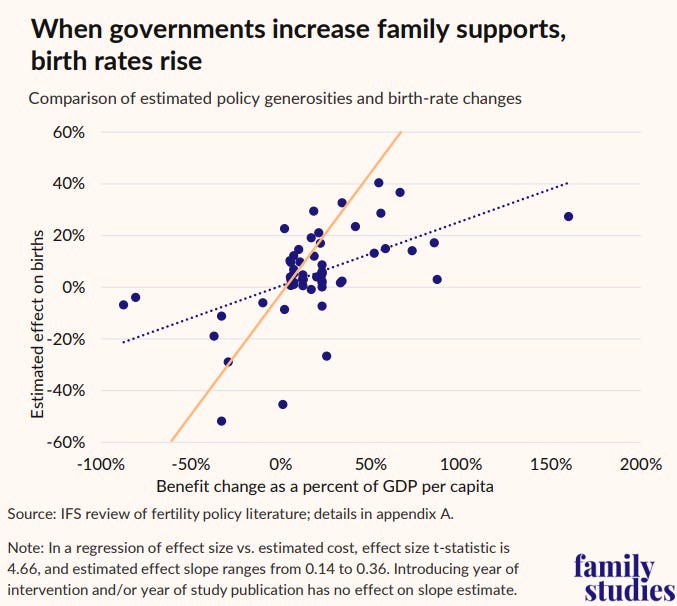
Ansel Lindner: Spending 100% GDP per capita for a 20% increase is “working”? How is that mathematically sustainable?
US TFR 1.6 x 1.2 = 1.92
100% GDP per capita =~$80,000 per child
3.7 million × $80,000 = $296 billion/year
10% of GDP to not reach replacement? Still gets worse every year.
Lyman Stone: No, a present discounted value of 100% of GDP per capita. Not $80,000 in annual payments to family per kid, $80,000 in present discounted value of future annual payments. Assuming an 18-year child payment, that’s annual payments of about $6,000 more per kid.
That’s $80k for a 20% growth in fertility, which comes out to $400k in transfers per marginal child born. That’s modestly higher than my prior estimate of roughly $300k. The difference can be accounted for by the fact that this would be paid out over 18 years, whereas up front payments have much larger effects.
So yes, I think this is the price tag, which scales roughly with GDP, and note that there is minimal deadweight loss or overall loss of wealth here.
I do think we can get far more efficient mileage out of other changes first, that reduce the burdens and risks on parents, raise their status and make having children more appealing. But yes, we can absolutely solve this problem primarily with money.
Talking price a bit, Anthony is definitely not correct at $5k but at $50k? Yes.
Anthony Pompliano: If the government is handing out $5,000 bonuses to moms who have a baby, we are going to see a baby boom unlike anything America has ever seen.
Michael Anotnelli: I’m gonna need you to break your streak of absolutely awful takes. You’re ice cold bro.
James Surowiecki: No one who has kids would ever think that $5000 is going to make a difference to the decision to have a child or not.
Jason Bell: I’m reminded of @ATabarrok’s response when a free Krispy Kreme donut spurred people to get vaccinated: “there’s always someone at the margin”
My math says that a $50k baby bonus would result in about a 20% boost to fertility as a primary effect, and I would predict a secondary cultural wave that increases that further, so I would guess we’d sustainably get something like 30%, moving from 1.63 to 2.1, landing us at replacement level. That’s what it takes.
First, the parents will come under a ton of pressure to refund those payments. What kind of parent are you if you are taxing your children? The contract is not stable.
Second, there’s a time mismatch. You are investing in children now in order to collect big payments down the line starting in 20 years. But the parents will have a liquidity issue, they need the money now, to raise the children, and expect to be much wealthier in the future already.
Robin’s answer no doubt is that the parents can sell those tax claims to others, but that’s just not going to fly culturally even beyond how much the rest wouldn’t fly, and even if it did we run into major adverse selection issues.
Third, people will find the whole thing to be an abomination on so many levels. It would be a supremely heavy lift compared to what you would get in return.
You would think that it would do this. We all assume they would do this. One of the objections to fixed payments for parents is that this could result mainly in poor people having more kids, since you would assume richer parents would respond a lot less.
I don’t think this would hold if you scaled the amounts, but also I’m surprised by the result in the first place?
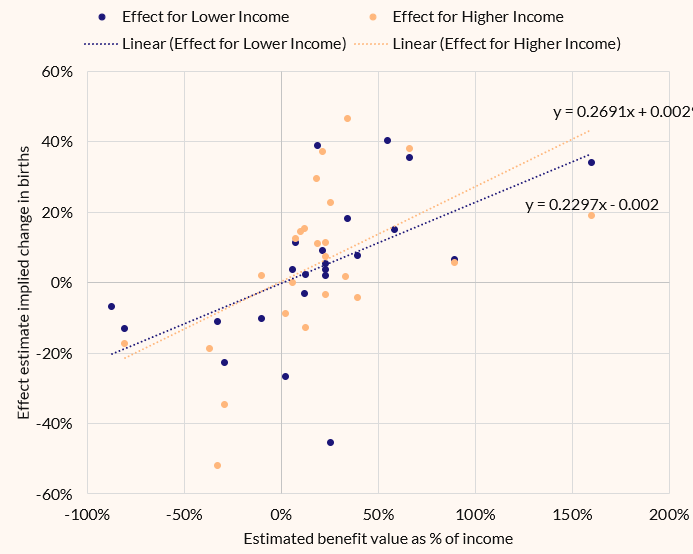
Lyman Stone: So I went back through all those studies to check and see if they reported heterogeneity tests. Spoiler: many did. In total, from 60 initial intervention estimates, I was able to find 23 estimates of effects specifically on low-income people, and 24 for middle/high.
…
So we use that standard cost estimate from my study in May, and we apply it symmetrically to lower- and higher-income treated groups alike? This is basically saying “For a fixed budgetary spend, which group boosts fertility more?”
There’s basically no difference: if you give a middle/high earner $3,000 to have a kid, their odds of having a kid rise by essentially the identical amount as if you give a low earner $3,000 to have a kid.
A lot of people have this mental model where effects should always scale with income, but this is obviously wrong for a lot of effect types! If I give somebody a $10 hamburger voucher, poor people will not by 4x as many hamburgers even though it’s 4x the share of their income.
The reason is that it is a voucher for hamburgers and the price of hamburgers is relatively fixed with respect to income. Sure rich people may go to a bougier place and poor people a cheaper one, but by and large most people are going to purchase pretty similar hamburgers.
Despite the cultural narratives purporting to tell you there are absolutely massive class differences in parenting, the actual fact of the matter is the economic costs associated with how people would prefer to parent are actually not that variable across most of the income spectrum.
There are obvious exceptions. Private schools, extra space and hired help are obvious ways in which richer people will spend a lot more money. Despite this, the differences are not that vast, and we get this very interesting result.
Ben Podgursky: It’s frustrating that collapsing birthrates are treated as unfixable when the reality is that we could largely fix it if we treated it like treat healthcare — a problem, but something we can spend real money to fix.
We spend ~$150,000 per cancer patient. Why less for a child?
I’m unhappy about US taxes today because it goes straight into badly structured entitlement giveaways for old people. If you raised my taxes to 60% to pay for a subsidy that made it nearly free to raise a child age 0-18, I would be happy to pay it.
The more I run these numbers the more upset I get. We could straight up give $150,000 cash for each child and it would only cost 1.6% of GDP, not even twice what we spend to treat cancer. Medicare is 3.7% of GDP.
Lyman Stone: Right???? People see these price tags and they just simply do not realize what gobsmacking sums we spend on old people.
The average worker (+their employer) paid $15-20,000 last year to provide subsidies and healthcare to retirees, valued at about $20-$50k/yr per retiree.
But we surely couldn’t do $10k/year for a kid! That would be craaaaazy!
We could, in many school districts we already do in other ways, and we would be redistributing the money and wealth and purchasing power, not destroying it.
If my calculations are correct, paying out the $150k would not only effectively lift almost all children out of poverty, it would raise the fertility rate to well above replacement.
In the long term, this would make the debt more sustainable rather than less, even if we did it purely with borrowed money.
If Lyman Stone’s model is correct, that a 4% present-value benefit yields a ~1% TFR increase, then if we gave parents benefits with an NPV (net present value) of $150k, that would be about 181% of GDP, so a 45% boost, which is a similar result of a TFR of 2.4, which would be enough buffer to cover substantial decreases from other sources.
We could also supplement that with cultural and other changes, and get that result vastly cheaper.
Also note that what matters is the net difference, so if you are taxing those without children to pay for the benefit, the benefit can be smaller and still fully work.
As always, how you do it matters too. The more up front and locked-in and salient the payment, the more impact it will have. We are not doing a good job with this.
In some senses obviously this is a lot of money, but in context I think this is not actually a lot of money, and again it pays for itself over time.
Marko Jukic: If a tech CEO revealed he could manufacture self-replicating fully autonomous universally adaptable humaniform AGIs that stayed in good working condition for ~60 years for $450k each, he would be hailed as a hero and the U.S. government would order $10 trillion worth of them.
At $450k per child, we could double the U.S. birth rate and reach well above replacement fertility for the price of just $1.6 trillion. That is just 23% of annual federal spending and less than Social Security + Medicare. It’s literally a steal!
Boomers just hate children and believe as a matter of selfish dogmatic faith they should not only cost $0 and raise themselves, but actually pay Boomers for the privilege of being born. There is no other explanation for this plain economic irrationality.
This doesn’t fail because we can’t do it. It fails because we don’t want to do it.
As stated this is of course rather silly but Zac Hill nails it.
John Arnold: Convinced the one and only way to increase the birth rate in the US is a federal cap on hours per week allowed for organized youth sports. That’s the binding constraint.
Cam Hardaway: This is so good… I’m with you. We traipse our 4 sons all over the place playing youth sports.
Zac Hill: The thrust of this is prolly directionally accurate tbh.
What if the cap was only on family presence or participation in youth sports?
I don’t fully understand how parents were convinced to devote so many hours and dollars for organized youth sports, but the combination of pressure to do the sports and the ways they impose time costs on parents is by all reports really nasty.
Youth sports are a good thing if you can free the parents from these burdens.
This is a special case of the Revolution of Rising Requirements. The problem is not the sports, or even that they are organized. The problem is the supervision, and perhaps the associated fees that go to various luxury features.
The situation they’re studying is a house lottery rather than a benefit program, which is a little weird. As I understand it, the lottery has everyone paying the same fixed amount from the start into the pool, then every month at least one person gets money from that pool to go buy a house outright. So it’s a weird forced saving program, where you get the house at an uncertain random point.
Which gives us an RCT.
Dimas Fazio, Tarun Ramadorai, Janis Skrastins and Bernardus Doornik:
Abstract: This paper examines the impact of access to housing on fertility rates using random variation from housing credit lotteries in Brazil.
We find that obtaining housing increases the average probability of having a child by 3.8% and the number of children by 3.2%. For 20-25-year-olds, the corresponding effects are 32% and 33%, with no increase in fertility for people above age 40. The lifetime fertility increase for a 20-year old is twice as large from obtaining housing immediately relative to obtaining it at age 30.
The increase in fertility is stronger for households in areas with lower quality housing, greater rental expenses relative to income, and those with lower household income and lower female income share. These results suggest that alleviating housing credit and physical space constraints can significantly increase fertility.
This downplays the effect on 20-25 year olds:
More importantly, we find that the effects of housing credit are far stronger for 20 to 25 year-olds in their peak child-bearing years, who exhibit a 32 percent increase in the probability of child-bearing and a 33 percent increase in the number of children relative to the base-rate.
…
Our estimates reveal that for an individual who wishes to obtain housing between ages 20-24 but obtains it ten years later (30-34), total lifetime fertility is half that from receiving housing access immediately upon joining.
Directionally none of this was in doubt. The question is efficiency of the transfer.
The value of the house was $87,000. Looking at some charts, that was roughly the media house price in Brazil at that time, so let’s assume to get the same effect you need to enable buying roughly the median house.
In America today, the median house price is about $420,000.
Suppose we had a rule that any married couple between the ages of 20 and 25 could request make a one-time request from the Federal government, usable only to go buy a house anywhere in America with a size minimum. They would then have to pay off the mortgage, so the effective subsidy was identical to the Brazil program relative to the cost of housing. If the couple pays off the mortgage, they keep the house at the end. If not the bank sells the house and gives the government the proceeds.
The base financial cost of this program is $130k for the subsidy (assuming a 3.5% NPV discount rate), plus some extra for adverse selection, administration and fraud. Claude thinks maybe $170k all-in.
The couple gets the house right away, and their mortgage payments would be substantially lower than typical rent payments on a matching property. They get housing security, and eliminate marginal cost of housing when having children, have a huge future wealth effect, and net save on cash flow versus renting.
In terms of politics, the exact age range thing makes things tricky, but ‘first time home buyer subsidy’ is already a big Democratic platform thing. Seems super doable relative to other proposals on fertility. This is just… a lot bigger than the existing proposed housing subsidies, and better structured.
Remember what happened in Brazil? The lifetime fertility rate roughly doubled between the winners versus the losers. Participants probably start out with higher than average fertility because they paired up young, and let’s not consider various other positive splash-on effects from cultural shifts and convincing people to marry earlier that might also be very large. And there are various other ways we can do better – this isn’t meant to be the actual form of the proposal, yet.
The flip side is that losing the lottery probably is very bad for fertility versus baseline, so this is likely an overestimation in that way, if you can’t give this to everyone. And the participants in the study typically had informal (but lucrative) employment, which could change things in other ways. Both could lead to this being a large overestimate.
The biggest downside, other than potentially hurting people’s mobility, is presumably that this raises housing prices, and yes that is a cost not a benefit. We would very much need to build more housing, especially 3+ bedroom family housing. But it is a benefit to existing homeowners, so you could perhaps pair this rather aggressive YIMBY changes, for a win-win. Imagine if the subsidy only applied to areas that successfully built enough 3+ bedroom housing, and of course people in areas that miss out could move to areas that didn’t miss.
Our previous estimate of the typical cost-per-birth from subsidies in America is $270k. Here, if we get 100% of the effect in the Brazil study, it would be $100k, and you can increase the cost as you discount the efficiency from there, with the transfer having other positive knock-on effects.
If you really wanted to supercharge the effectiveness and efficiency of this program, of course, you could offer it only for couples with at least one child, especially if the chances of winning the lottery were high once a couple was eligible.
You also get a ton of other benefits. It’s all crazy enough to work.
Housing choice estimates confirm a Becker quantity-quality model’s predictions: large families are more cost-sensitive, and so rising housing costs disincentivize fertility.
To study the causal effect of rising housing costs on fertility, I vary them directly within the model, finding that rising costs since 1990 are responsible for 11% fewer children, 51% of the total fertility rate decline between the 2000s and 2010s, and 7 percentage points fewer young families in the 2010s. Policy counterfactuals indicate that a supply shift for large units generates 2.3 times more births than an equal-cost shift for small units: family-friendly housing is the more important policy lever.
That strongly points to a cost burden explanation of fertility declines. If half the decline is rising housing costs, then if you add in other new requirements on families, especially in terms of child supervision, you can plausibly explain most of the decline, or perhaps more than all of it.
The problem with trying to fix this via traditional YIMBY approaches is that creating lots of smaller housing units doesn’t provide the multi-bedroom housing large families need. The response to this is that a lowering tide lowers all boats. If you create more smaller units, then that reduces rent on smaller units and demand for larger units, so larger units drop in price. You can also combine multiple smaller units.
There is still a risk that if you ‘lock people into’ smaller units, especially if they buy them, that this can be quite bad for fertility. It would be reasonable to try and encourage those in smaller units to mostly rent.
The better solution than that is to directly build more larger units. Some YIMBY policies are directly about smaller units, but most are about building more square feet of housing on the same amount of land, or the same house on less land.
The best solution is to differentially support larger apartments and houses, giving them various cost benefits, on top of allowing smaller units for 1-2 person households.
There is no conflict here. A 22 year old out of college that only wants an SRO or a small studio apartment should get to save money, while saving that extra room for a family that needs it.
The other part of the problem is Rising Expectations. Houses and apartments are much bigger not only because they are required to be but because people demand it. Couples looking at having children will insist upon a lot more house than they did in the past. Ideally they would relax this requirement a bit, but whether or not they do we can make it a lot easier to afford whatever they do eventually end up with.
Kelsey Piper: Every part of every American city should pass the toddler test: you feel safe walking through it with two toddlers who will try to eat cigarette butts and needles if there are any around to be eaten. If you have to use the subway, the elevators work and fit the stroller.
Here’s some great news, all you have to do to raise births is… make people happy?
Hopefully we wanted to do that anyway.
Cartoons Hate Her!: Why have people decided the birth rate is some kind of proxy for overall happiness? Do you think people procreate specifically bc they’re happy? Which country do you think is happiest rn?
Lyman Stone: Actually yes, the BEST predictor of fertility is “Do you intend to have children in the next year?” The second-best is a vector of marital and contraceptive status.
But 3rd best is just asking people “How happy are you?”
Live birth odds scale pseudo-linearly with happiness!
And it’s additive! If you do a model of Intentions + Marital Status + Contraceptive Status + Happiness, each one matters separately and together!
There’s also a pretty straightforward interaction term between Marital Status and Contraceptive Status.
If you’re holding roughly constant the general wealth and education levels, then yeah. Your goal is in large part to make people happy, and also make them married and get them into relationships, which also tends to make people happy.
New paper claims that while China’s One Child Policy initially had very little impact on fertility, that was because at first it was not enforced. When the ‘One Vote Veto’ policy caused it to actually be enforced in the early 1990s, then it had a big impact, accounting for 46% of China’s fertility decline that decade. I’m not going to dive into the data but that explanation makes sense to me.
Jay Carraway: The Wirecutter’s top car seat is $230 up from $160 earlier this year. Some of the most popular strollers have gone up 20-30%. The thing where Trump just randomly waived a wand and raised the price of a bunch of stuff on parents seems pretty unreported by the media.
The media had absolutely reported that tariffs occurred as like a factual thing that happened. But the equivalent “Democrat did this” version would be human interest story after human interest story. And Trump directly did this! Unlike 2022 inflation.
These extra costs plunge families into financial problems and poverty, and will absolutely filter down into fertility decisions as prospective parents see them and adjust. Indeed, expect these changes to have oversized impact, as they are the kind of prices that are most salient.
Dakka can come in many forms. Honor is often the most efficient and effective.
Robin Hanson: How could we supercharge Mother’s Day, to make it a much bigger deal, in order to raise the status of Mothers?
Benjamin Hoffman: Every year on Mothers’ Day, we do a land reform where plots are allocated to women on the basis of # children (maybe w diminishing marginal returns).
Mothers vote on the national budget on Mothers Day, with legit authority to freeze govt operations until there’s a proposal they approve.
Legal penalties for falsely claiming to be a mother (analogous to falsely claiming to be a physician), involving public humiliation on Mothers’ Day (e.g. stockading, tarring & feathering).
Katherine Boyle: You can change the status of something very quickly. Cringe can become cool in years, not decades. We’ve had a generation of women who were repeatedly told that motherhood is low status. We’re now seeing the culture turn hard on this, and it will continue to accelerate.
Made in Cosmos: If you were in charge of making motherhood high status again, where would you start?
This is a great question, but it starts in daily life. Here’s some super easy things states and companies could do to honor families.
All airlines, TSA lines, and other forms of travel should allow families to board first, before priority and first class. Family lanes should be required.
Carpool lanes on highways renamed family lanes. Florida should do this asap. @GovRonDeSantis
every parking lot should be required by law to have family reserved parking, just like handicapped parking, for the safety of mothers and children.
Family lanes at all stores for ease of checkout.
Reserved seating for families at churches, houses of worship and other community spaces where children should be encouraged to go.
In short, society should beat us over the head that families take priority above class, work and other forms of identity or protected groups, because family is the backbone of our civilization.
The federal government should do a commission on the state of the American family, and make many recommendations to encourage businesses and communities to prioritize the family in daily life.
These changes aren’t hard, and there are many more ideas to make reality.
This is some lame-ass stuff right there. We can surely do way better than that.
Basic cringe stuff works. At every Mets game we stop to honor a veteran. You can honor a mother too, and do other similar things.
I do think status in part goes hand in hand with the financial aspects. Offering good financial supports in various ways would do a lot, including in provision of health insurance. But that’s not the question here.
Various legal protections would similarly be good but I don’t think it does much.
Offering more community spaces and activities for kids would help. As would making it not allowed to bar kids from various activities or locations, and not okay to require kids to be on absurd standards of behavior in public spaces – if they’re not physically bothering you, it’s almost entirely not your problem.
Media representations matter a lot, and could be targeted in various ways. In particular, we need to develop cultural norms of frowning on those who disdain having children, and also put large families into media more often – right now there are never more children than are strictly needed for the plot.
But the most important thing, I think, is lifestyle, childcare requirements and expectation setting about what is required to be a ‘good mother’ or to avoid potential legal hassles.
Motherhood is low status in large part because it is associated with these absurd supervision requirements. If we Let Kids be Kids, the way we used to in let’s say the 1980s let alone the 1950s, in a world that is now vastly safer and where you can give the kid a phone with GPS, I think that gets us a huge portion of the way there.
Which is another way of saying that, media portrayals and honors aside, mostly I think the way you raise the status of mothers is to… actually make their lives better.
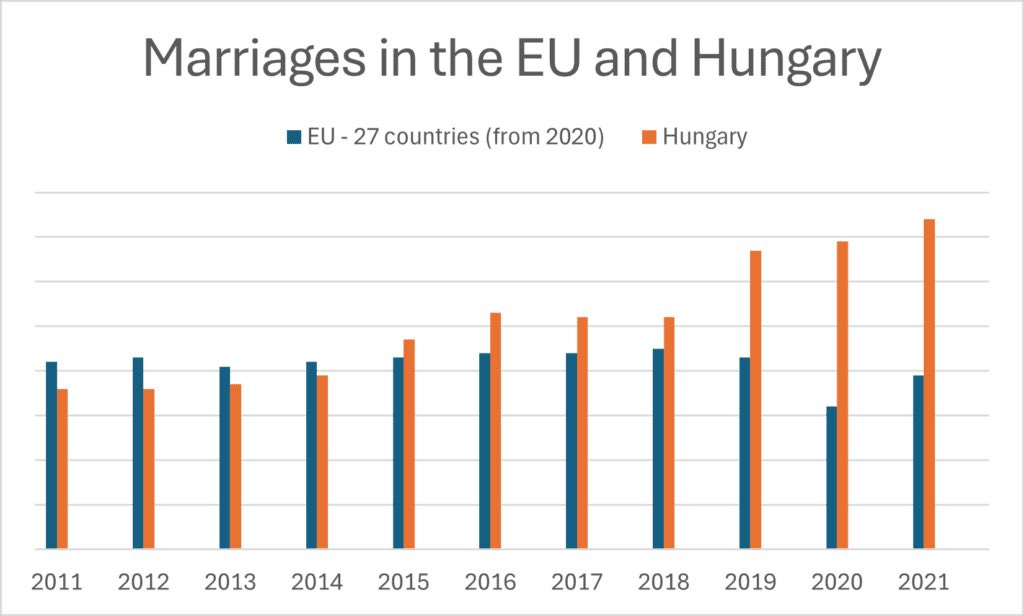
Nikita Sokolsky: Just as with the previous Hungarian policy that applied to families with 4+ kids, the tax exemption is incorrectly reported and its scope is exaggerated.
Nikita was talking back at the beginning of 2025. They have now passed the new rules.
As I understand the final version:
If a mother has 3+ kids she is permanently immune to the 15% income tax.
If a mother has 2+ kids she gets it phased in over time as a function of her current age (for 2026 it’s under 40) but by 2030 everyone gets this too.
Increases in the monthly tax-base allowance that reduces taxable income, which can be applied to the father’s income, and which scales with family size. So one childs gets 100k HUF (~$300) per month, whereas for 3+ children it’s 330k HUF per child per month, so about $3000 per month.
Adopted kids can count, which could lead to some very extreme incentive effects.
It has always been a rather insane policy implementation to say that a mother pays no income tax, while her spouse pays income tax. You’re producing a gigantic distortion, where you’re pushing the mother to work and the father to stay home, what?
The obvious reason is that you can’t verify who the father is and you otherwise open up the system to tax dodges by the wealthy, but you have to be able to patch that – you could require a marriage that predates the children, and perhaps cap the father’s immunity at some very high income threshold.
The obvious simple solution is to use a fixed absolute subsidy, rather than a reduction in income taxes, because you don’t actually want to supercharge the incentive for market work onto mothers in particular.
I would expect a substantial increase in fertility if this passes, but not as much as if it was designed better, or if it was more expansive as is often reported. I’d expect the expanded tax credit to be doing the far more efficient work here, I would have said expand the credit and perhaps scale it higher for larger families, and leave the income tax rates alone or find a way to lower them in general.
I would also expect some unfortunate secondary effects, with the huge tax push towards stay-at-home fathers or full time hired caregivers.
Tim Carney investigates Hungary’s problem, and finds the same issue, that the current policy is nominally pro-natal but it’s also a work subsidy for mothers in particular, and they also make the classic housing mistake of subsidizing demand rather than addressing supply.
Bryan Caplan offers a report. He has great things to say about the attendees and speakers in general, not as nice things to say about the chosen lineup of speakers on opening night, which matters. And he regrets that the group was sufficiently right-wing that it likely will drive potential left-wing attendees further away, making the problem worse.
I don’t know how widespread such discrimination is even when renting. I suppose families in some ways are more trouble, although in others they are more reliable.
Sam Altman: i can’t think of a non-cliche way to say this, but everyone who says having a kid is the best thing in the world is both correct and still somehow understating it.
Good news it seems many single men actually do still want to have large families, as in 5-10 children, and yes as the post says this is a good thing to want and quite the call to self improvement to make this possible. The fault is in our society for making the logistics of this idea seem impossible, and also for many people treating ‘I want a lot of kids’ as something toxic or wrong.
Some obvious basic logistics for men if you are indeed going forward and your woman is pregnant, basically planning for the fact that this is going to mess with her head and ensure that you can handle it and how to respond so as to make it through okay, and to be ready with her preferences for giving birth and practicing the route to the hospital and other neat stuff like that.
Arnold Kling offers a vision of intentional communities for young families, where you have to have a child under the age to 10 to move in, the mirror image of ‘senior communities’ where you have to be over 55, with services to help parents like community day-care but distinct households as per usual.
This seems like an obviously good idea. Parents of young kids benefit from being around other parents of young kids and from the establishment of child-friendly norms. As usual, People Don’t Do Things, but you love to see it, the same way I previously discussed.
This doesn’t have to be some huge production. A large friend group should work wonders.
Phil Levin: I reckon that living near 20+ friends has doubled the fertility rate of our friend group.
•Some had kids who wouldn’t have
•Some had more kids than planned (inc. us)
•Some had kids earlier
[Shilling for the “housing theory of fertility”]
12 kids born so far in the group — all under the age of 4.
It is weird that Apple releasing an ad that basically says having a daughter is good and so buy Apple’s new AirPods now with hearing aids causes statements like this and that statement gets 7 million views (you can watch at the link):
Benny Johnson: I’m stunned. Apple just released the single greatest pro-parenting ad in the history of American advertising.
The pro-family cultural revolution is here.
Watch. Try not to cry…
I mean, great ad, but yeah, this really shouldn’t be news, this should be Tuesday.
How bad is it? What is causing the massive, catastrophic declines in fertility?
What can we do to stabilize and reverse these trends to a sustainable level?
Today I’m going to focus on news about what is happening and why, and next time I’ll ask what we’ve learned since last check-in about we could perhaps do about it.
One could consider all this a supplement to my sequence on The Revolution of Rising Expectations, and The Revolution of Rising Requirements. That’s the central dynamic.
Lyman Stone: Five Basic Arguments for Understanding Fertility:
Data has to be read “vertically” (longitudinally), not “sideways” (cross-sectionally)
No variable comes anywhere close to “survey-reported fertility preferences” in terms of ability to explain national fertility trends in the long run
People develop preferences through fairly well-understood processes related to expected life outcomes and social comparison
The name for the theory which best stands to explain why preferences have fallen is “developmental idealism.”
Countries with fertility falling considerably below desires are doing so primarily due to delayed marriage and coupling
TANGENTIALLY RELATED BONUS: Education reduces fertility largely by serving as a vector for developmental idealism in various forms, not least by changing parenting culture.
The central point of idea #1 is you have to look at changes over time, as in:
If you can tell Italy, “When countries build more low-density settlements, TFR rises,” that is orders of magnitude more informative than, “Countries with more low-density settlements have higher TFR.”
The first statement is informing policymakers about an actual potentiality; the second is asking Italy to become Nepal.
The overall central thesis:
“Falling child mortality means people don’t need to have as many kids to hit their family goals, and those family goals are themselves simply falling over time.”
…
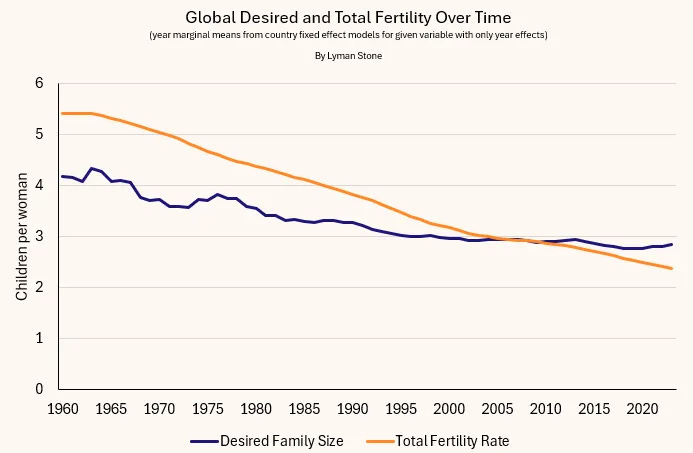
Both actual and desired fertility have fallen since 1960, but actual fertility has fallen much more. The biggest reason for this is actual fertility is also influenced by child mortality, which has fallen a lot since 1960.
So in this model, the question becomes why are desired family sizes falling?
Lyman thinks this mostly comes down to comparisons with others (he explicitly doesn’t want to use the word ‘status’ here).
And his thesis is essentially that people around the world saw European wealth, found themselves ‘at the bottom’ of a brand-new social scale, and were told to fix this they had to Westernize, and Western culture causes the fertility decline.
This doesn’t explain where the Western desire for smaller families came from.
I also don’t think that this is why Western culture was adapted. I think Western culture is more attractive to people in various ways – it largely wins in the ‘marketplace of ideas’ when the decisions are up to individuals. Which I think is largely the level at which the decisions are made.
People’s severe pessimism, and inability to understand how good we have it, is making all these issues a lot worse.
Ben Landau-Taylor: Knowing a decent amount of history will cure lots of fashionable delusions, but none quite so hard as “How could anyone bring a child into a world as remarkably troubled and chaotic as the year 2025”.
Matt McAteer: Historical periods with names like “The Twenty Years’ Anarchy”, “The Killing Time”, “The Bronze Age Collapse”…or god forbid, “The Great Emu War”…2025 doesn’t seem so bad by comparison.
Nested 456: My mother grew up playing in bomb sites in northern England right after WW2. Really we’re spoiled brats in comparison
Are there big downsides and serious issues? Oh, definitely, atomization and lack of child freedoms and forms of affordability are big problems, and AI is a big risk.
Handy and Shester do offer an explanation for a lot of it, pointing to decline in maternal mortality, saying this explained the majority of increases in fertility. That is certainly an easy story to tell. Having a child is super scary, so if you make it less scary and reduce the health risks you should get a lot more willingness to have more kids.
Tyler Cowen sees this as a negative for a future baby boom, since maternal mortality is now low enough that you can’t pull this trick again. The opposite perspective is that until the Baby Boom we had this force pushing hard against having kids and people had tons of kids anyway, whereas now it is greatly reduced, so if we solve our other problems we would be in a great spot.
The paperwork issue is highly linked to the safety obsession issues, but also takes on a logic all its own.
As with car seat requirements, the obvious response is ‘that’s silly, people wouldn’t not have kids because of that’ but actually no, this stuff is a nightmare, it’s a big cost and stress on your life, it adds up and people absolutely notice. AI being able to handle most of this can’t come soon enough.
Katherine Boyle: We don’t talk enough about how many forms you have to fill out when raising kids. Constant forms, releases, checklists, signatures. There’s a reason why litigious societies have fewer children. People just get tired of filling out the forms.
The forms occasionally matter. But I’ve found you don’t have to fill out the checklists. Pro tip. Throw them away.
Blake Scholl: I was going to have more children but the paperwork was too much.
Sean McDonald: It’s shocking how many times I’ve been normied in the circumstance I won’t blindly sign a parent form. People will get like..actually mad if you read them.
Nathan Mintz: An AI agent to fill out forms for parents – will DM wiring information later.
Cristin Culver: It’s 13 tedious steps to reconfirm to my children’s school district that the 13 forms I uploaded last time are still correct. 🥵
Back in 2022 I wrote an extended analysis on car seats as contraception. Prospective parents faced with having to change cars, and having to deal with the car seats, choose to have fewer children.
People think you can only fit two car seats in most cars. This drives behaviors remarkably strongly, resulting in substantial reductions in birth rates. No, really.
The obvious solution is that the extent of the car seat requirements are mostly patently absurd, and can be heavily reduced with almost no downsides.
It turns out there are also ways to put in three car seats, in many cases, using currently available seats, with a little work. That setup is still annoying as hell, but you can do it.
The improved practical solution is there is a European car seat design that takes this to four car seats across a compact. It can be done. They have the technology.
In an even stupider explanation than usual, the problem is that our crash test fixtures that we use cannot physically include a load leg, so we cannot test the four car seat setup formally, so we cannot formally verify that they comply with safety regulations.
Scarlet Astrorum: I know why we can’t have 4 kids to a row in the car and it’s a silly regulatory thing. Currently, US testing protocols do not allow crash testing of U.S. car seats that feature a load leg, similar to the British four-seater Multimac (pictured).
The crash test fixture itself is designed so it cannot physically include a load leg. The sled test fixture does not have a floor so there is no place to attach a load leg.
This means safe, multiple-kid carseats used widely in Europe can’t even be *evaluatedfor safety- it’s not that they break US safety regulations, they just can’t even attach onto the safety testing sled, which is all seat (also pictured).
To test the 4-kid carseats which use a load arm, there are already functional test fixtures, like the ECE R129 Dynamic Test Bench, pictured here, which has a floor. We just need to add this as a testing option. Manufacturers could still test with the old sled.
What needs to change: 49 CFR § 571.213 s10.1-4 and Figure 1A which lock you in to testing with a floorless sled All that needs to change is updating the wording to clarify test positioning for a sled with a floor as well.
You would also have to spread the word so people know about this option.
David Holz: i find it so strange when people say they can’t afford kids. your ancestors were able to afford kids for the last 300,000 years! are we *reallyless wealthy now? you might think your parents were better off, but how about further back? they still went on.
Scarlet Astrorum: What people mean when they say this is often “I am not legally allowed to raise children the way my poor ancestors did”
Personally I only have to go back 2 generations to find behavior that I think is reasonable given circumstances but would be currently legally considered neglect
“I will not risk the custody of my existing children to raise more children than I can supervise according to today’s strict standards” is unfortunately a very reasonable stance. Of course, there are creative workarounds, but they are not uniformly available
That is indeed about what it costs to raise a child. If you shrink that number dramatically, the result would be very different, at least in America.
America has the unique advantage that we want to have children, and like this man we are big mad that we feel unable to have them, usually because of things fungible with money. So we should obviously help people pay for this public good.
Heather Long: Goldin concludes that two factors explain much of the downward trend by country: the speed at which women entered the workforce after World War II, and how quickly men’s ideas about who should raise kids and tidy up at home caught up. This clash of expectations explains the fertility decline across the globe.
In places where men do more around the house, fertility rates are higher, where they do less, rates are lower.
Even the green bars are 1.7-1.8. That’s still below 2.1, even with a somewhat cherry-picked graph.
Also this is rather obviously not the right explanatory variable.
Why should we care about how many hours of housework a woman does more than the man, rather than the number of hours the woman does housework at all?
The suggestion from Goldin is more subsidized child care, but that has a long track record of not actually impacting fertility.
The actual underlying thing is, presumably, how hard it is on the woman to have children, in terms of both absolute cost – can you do it at all – and marginal cost versus not doing it. The various types of costs are, again presumably, mostly fungible.
The idea that ‘50-50’ is a magic thing that makes the work go away, or that it seeming fair would take away the barrier, is silly. The problem identified here is too much work, too many costs, that fall on the woman in particular, and also the household in general.
One can solve that with money, but the way to do it is simply to decrease the necessary amount of work. There used to be tons of housework because it was physically necessary, we did not have washers and dryers and dishwashers and so on. Whereas today, this is about unreasonable standards, and a lot of those standards are demands for child supervision and ‘safety’ or ‘enrichment’ that simply never happened in the past.
Ruxandra Teslo: One’s 30s are a crucial period for professional advancement. Especially in so-called “greedy careers”: those where returns to longer hours are non-linear.
But one’s mid 30s is also when most women’s fertility starts to drop.
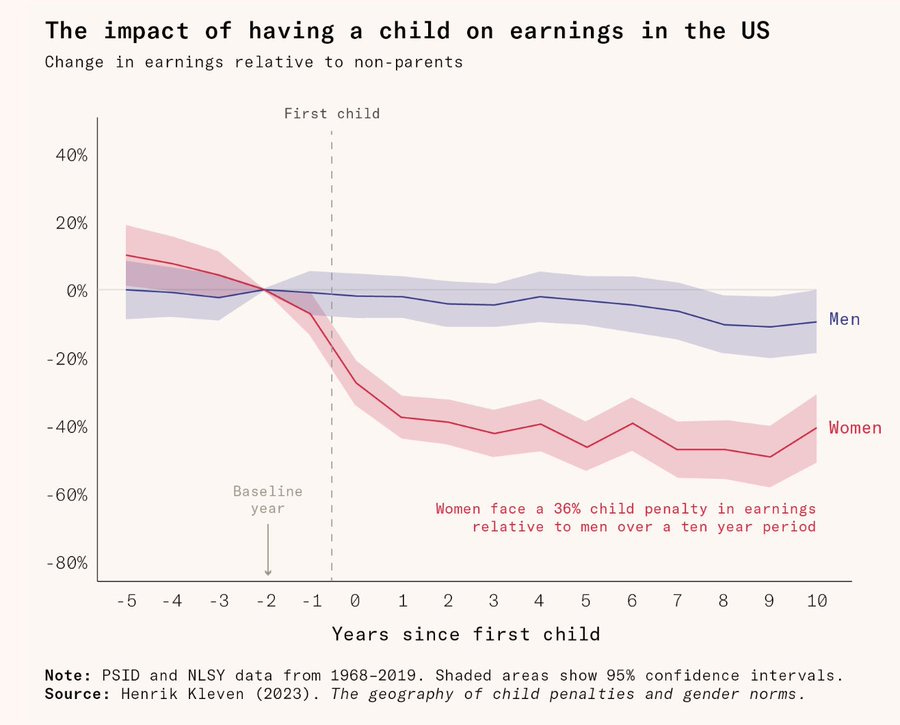
In this piece, I lay out how a large part of the “gender pay gap” is just this: a motherhood pay gap. And, as Nobel Laureate Claudia Goldin points out, this is particularly true in high-stakes careers like business, law, medicine, entrepreneurship and so on.
This reduction in earnings is not just about money either: it’s about general career advancement and personal satisfaction with one’s profession. Time lost in one’s 30s is hard to recuperate from later on.
In law, for example, one’s 30s is when the highest levels of salary growth take place. Founders who launch unicorns (startups worth more than a billion dollars) have a median age of 34 when they found their companies. In academia, one’s thirties are usually the time when a researcher goes through a string of high-pressure postdoctoral positions in an attempt to secure an independent position.
Aware of this, women delay pregnancy until they have advanced in their careers as far as possible. This is especially true for women w/ professional degrees. Women without a bachelor’s degree tend to have 1 to 1.5 children on ~ by age 28, while those with higher educational attainment have around 0.25 children by same age.
Highly educated women attempt to catch up during their 30s, with their birth rates increasing more rapidly. However, this compensatory period is limited, as fertility rates across all education levels tend to plateau around age 39. Thus, the educated group ends up with less kids.
The chance of conceiving a baby naturally with regular sex drops from 25 percent per month in one’s twenties to about five percent per month at 40, while the chance of miscarrying rises from about eight percent for women under 30 to around one in three for 40-year-olds.
[thread continues and morphs into discussing technological fertility solutions]
From Her Article: Women know this gap exists and plan accordingly: in countries where the motherhood penalty is keenest, the birth rate is lower.
…
We have come a long way from the explicit sex discrimination of the past. Today, the gap is primarily driven by the career toll exacted by motherhood.
A lot of the problem is our inability to realistically talk and think about the problem. There’s no solution that avoids trading off at least one sacred value.
It’s definitely super annoying that when you have kids you have to earn your quiet. This both means that you properly appreciate these things, and also that you understand that they’re not that important.
Hazal Appleyard: When you watch stuff like this as a parent, you realise how truly empty and meaningless all of those things are.
Destind for Manifest: “I don’t want children because it would keep me away from my favorite activities which are watching cartoons, doing silly hand gestures and taking videos of my daily life, all while keeping an exaggerated smile on my face at all times”
Literally the perfect mom
Yashkaf: your life isn’t child-free. you *arethe child
no one’s making “my child-free life” content about using the spare 6 hours each day to learn some difficult skill or write a book or volunteer at a hospice
it’s always made by people who don’t seem to have plans, goals, or attention spans longer than an hour
Becoming a parent also makes it extremely logistically tricky to go to the movies, or to go out to dinner, especially together. Beyond that, yes, obviously extremely tone deaf.
The basic principle here is correct, I think.
Which is, first, that most people have substantial slack in their living expenses, and that in today’s consumer society your expenses will expand to fill the funds available but you’d probably be fine spending a lot less. Digital entertainment in particular can go down to approximately free if you have the internet, and you’ll still be miles ahead of what was available a few years ago at any price.
And second, that if you actually do have to make real sacrifices here, it is worth doing that, and historically this was the norm. Most families historically really did struggle with material needs and make what today would seem like unthinkable tradeoffs.
Also third, although she’s not saying it here, that not being able to afford it now does not mean you can’t figure it out as you go.
Amanda Askell: My friends just had a baby and now I kind of want one. Maybe our species procreates via FOMO.
I have bumped up the dating value of aspiring stay at home partners accordingly, on the off chance that I ever encounter one.
Another key form of motivation is, what are you getting in return for having kids? In particular, what will your kids do for you? How much will they be what you want them to be? Will they share your values?
The post mostly focuses on the various ways Indian parents shape the experiences of their children including getting transfers of resources back from them but mostly about upholding cultural and religious traditions, and how much modernity is fraying at that. For many, that takes away a strong reason to have kids.
Robert Sterling: I know a huge number of people in their 60s and 70s with one grandchild at most. Many with zero.
These people had 3-4 kids of their own, and they assumed their kids would do the same. They planned for 10-15 grandkids at this age.
Not for me to judge, but it’s sad to see.
I have little doubt that those considering having kids are not properly taking into account the grandparent effect, either for their parents or in the future for themselves.
Throughout, the frame is ‘of course my children should be able to make their own choices about whether to have kids,’ and yes no one is arguing otherwise, but this risks quickly bleeding into the frame of ‘no one else’s preferences should factor into this decision,’ which is madness.
It also frames the tragedy purely in experiential terms, of missing out on the joy and feeling without purpose. It also means your line dies out, which is also rather important, but we’ve decided as a society you are not allowed to care about that out loud.
Mason: I really hope I am able to say whatever I need to say and do whatever I need to do for my children to have some grasp of what a complex and transcendent joy it is to bring a new person into the world.
My daughter’s great-grandfather is dying at hospice. He is not truly present anymore.
Even when he was able to first meet her, he was not always fully there.
But a few times he did recognize me, so he knew who she was, and he would not eat so that he could just watch her toddle around.
I do not know how to explain it, man. At the very end, when you barely even remember who you are, the newest additions to your lineage hold you completely spellbound.
He would just stare at her and say, “She never even cries,” over and over, so softly.
The flip side is that parents, who are prospective grandparents, seem unwilling to push for this. Especially tragic is when they hoard their wealth, leaving their kids without the financial means to have kids. There is an obviously great trade for everyone – you support them financially so they can have the kids they would otherwise want – but everyone is too proud or can’t admit what they want or wants them to ‘make it on their own’ or other such nonsense.
I appreciated this part of her framing: Having kids is now ‘opt-in,’ which is great, except for two problems:
We’ve given people such high standards for when they should feel permission to opt-in. Then if they do go forward anyway, it is common to mostly refuse to help.
Because it is opt-in, there’s a feeling that the kids are therefore not anyone else’s responsibility, only the parents, at least outside an emergency. Shirking that responsibility hurts the prospect of having grandparents, as any good or even bad decision theorist knows, and thus does not improve one’s life or lineage.
I do not agree with her conclusion that therefore contraception, which enables us to go to ‘opt-in,’ is bad actually. That does not seem like the way to fix this problem.
On top of how impossible we’ve made raising kids, and then we’ve given people the impression it’s even more impossible than that.
Potential parents are also often making the decision with keen understanding of the downsides but not the upsides. We have no hesitations talking about the downsides, but we do hesitate on the upsides, and we especially hesitate to point out the negative consequences of not having kids. Plus the downsides of having kids are far more legible than the benefits of kids or of the downsides of not having kids.
Zeta: crying in a diner bathroom because life has no end goal or meaning, the one person who feels like family is as unhappy as you are, you can’t eat bread, you kinda want kids but every time you spend time with other people’s kids it seems waaayyyy too high maintenance, your elderly parents/your only real home are fading and close to death as are impossibly young kids with weird-ass cancers that should be solvable but humans fuck it up and what is even the point of anything
I don’t know how parents do it, like I get excited to have kids purely as a genetics experiment and then I spend time with them and it’s non-stop chores which are tedious and boring like with a puppy but also not chill like a puppy because it’s a future human but you can’t talk to them about mass neutrophil death in bone formation when they ask questions that necessitate it
also I know I don’t believe in academia or science but I need to believe in something – like I need someone to let me rant about what we know for sure in development- otherwise it’s just a chaotic mass of noise hurtling towards a permanent stop just as turbulent and meaningless as the start
eigenrobot: there’s a lot of that but you kinda stop noticing it because there’s a lot of this too
Mason: Kids are hard but they are 100% better than this, the “what’s even the point” malaise that a lot of us start to feel because we are people who are meant to be building families and our social infrastructure was ill-suited to get everyone to do it in a timely fashion
I don’t know if it’s a blackpill or a whitepill, but I do think you have to pick your poison a little bit here
Kids will overwhelm you and deprive you of many comforts for a time, life without them may gradually lead you to become a patchwork of hedonistic copes
Again I struggle to explain the “upside” of parenthood bc it doesn’t lend itself to tabulation. I don’t just *likemy kids, they are the MOST everything. They are little glowing coals in a cold and uncaring universe. I hold that dear when I am cleaning the poop off the walls
The shading here makes it look a lot more dire than it is, but yes a lack of other kids makes it tougher to have or decide to have your own.
Mason: 50 years ago, about 1 in 3 of the people around you were children. Now it’s about 1 in 5. That makes a huge difference when it comes to the availability of infrastructure for kids, convenient playmates, family activities.
For a lot of young people, parenting just looks isolating.
This is one of the underappreciated ways a population collapse accelerates: when fewer people have kids, fewer people in the age cohort behind them see what it’s like having kids, and it just seems like a strange thing that removes you from public life and activities.
That’s one reason I think the (fraction of) pronatalists who advocate excessive use of childcare to make parenting less disruptive to their personal lives are counterproductive to their cause.
Constantly trying to get away from your kids to live your best life sends a message.
n an ideal world, most adults have some kids, and society accomodates them to a reasonable degree because it wants their labor and their money
Unofficial kid zones pop up everywhere, indoors and out. Low-supervision safety features are standard to the way things are built.
The first best solution is different from what an individual can do on the margin.
I see the problem of childcare as not ‘the parents are spending too little time with the kids’ but rather ‘we require insane levels of childcare from parents’ so the rational response is to outsource a bunch of that if you can do it. The ideal solution would be to push back on requiring that level of childcare at all, and returning to past rules.
This is at least a little misleading, since desire to have children is a major cause of coupling, and marginal couples should on average be having fewer children. But I do accept the premise to at least a substantial degree.
Also noteworthy is having less education means a bigger decline:
This is happening worldwide, and Alice claims it corresponds with the rise in smartphones. For America I don’t see the timing working out there? Seems like the declines start too early.
The first explanation is that wives are treated rather horribly by their in-laws and new family, which I can totally see being a huge impact but also isn’t at all new? And it’s weird, because you wouldn’t think a cultural norm that is this bad for your child’s or family’s fertility would survive for long, especially now with internet connectivity making everyone aware how crazy it all is, and yet.
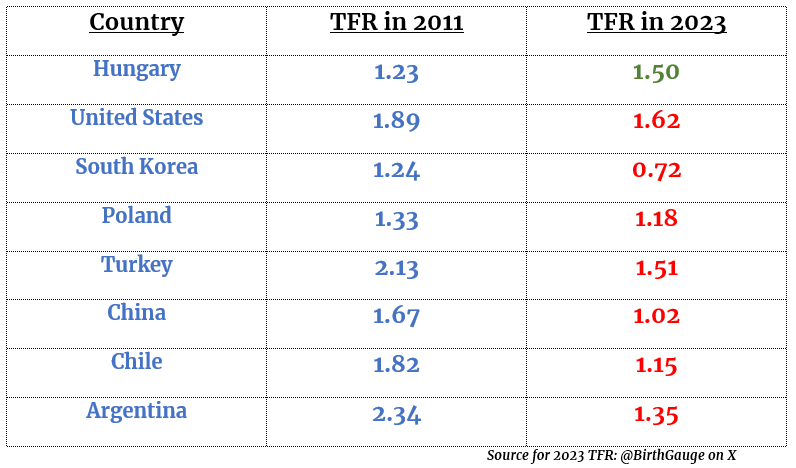
Camus: South Korea is quietly living through something no society has ever survived: a 96% population collapse in just four generations — with zero war, zero plague, zero famine.
100 people today → 25 children → 6 grandchildren → 4 great-grandchildren. That’s it. Game over for an entire nation by ~2125 if fertility stays where it is (0.68–0.72).
No historical catastrophe comes close:
– Black Death killed ~50% in a few years
– Mongol invasions ~10–15% regionally
– Spanish flu ~2–5% globally
South Korea is on pace to lose 96% of its genetic lineage in a single century… peacefully.
We shut down the entire world for a virus with 1–2% fatality. This is 96% extinction and the silence is deafening.
Japan, Taiwan, Italy, Spain, Singapore, Hong Kong, Poland, Greece — all following the same curve, just 10–20 years behind.
Robots, AI and automation might mitigate the effects along the way and prevent total societal collapse for a while, but there would soon be no one left to constitute the society. It would cease to exist.
It’s so tragic that a lot of this is a perception problem, where parents think that children who can’t compete for positional educational goods are better off not existing.
Timothy Lee: Parenting norms in South Korea are apparently insane. American society has been trending in the same direction and we should think about ways to reverse this trend. The stakes aren’t actually as high as a lot of parents think they are.
Phoebe Arslanagic-Little (in Works in Progress): South Korea is often held up as an example of the failure of public policy to reverse low fertility rates. This is seriously misleading. Contrary to popular myth, South Korean pro-parent subsidies have not been very large, and relative to their modest size, they have been fairly successful.
… In South Korea, mothers’ employment falls by 49 percent relative to fathers, over ten years – 62 percent initially, then rising as their child ages. In the US it falls by a quarter and in Sweden by only 9 percent.
South Koreans work more hours – 1,865 hours a year – in comparison with 1,736 hours in the US and 1,431 in Sweden. This makes it hard to balance work and motherhood, or work and anything else.
… Today, South Korea is the world’s most expensive place to raise a child, costing an average of $275,000 from birth to age 18, which is 7.8 times the country’s GDP per capita compared to the US’s 4.1. And that is without accounting for the mother’s forgone income.
… But South Korea is even worse. Almost 80 percent of children attend a hagwon, a type of private cram school operating in the evenings and on weekends. In 2023, South Koreans poured a total of $19 billion into the shadow education system. Families with teenagers in the top fifth of the income distribution spend 18 percent ($869) of their monthly income on tutoring. Families in the bottom fifth of earners spend an average of $350 a month on tutoring, as much as they spend on food.
Because most students, upon starting high school, have already learned the entire mathematics curriculum, teachers expect students to be able to keep up with a rapid pace. There’s even pejorative slang for the kids who are left behind– supoja – meaning someone who has given up on mathematics.
The article goes on and things only get worse. Workplace culture is supremely sexist. There’s a 1.15:1 male:female ratio due to sex selection. Gender relations have completely fallen apart.
The good news is that marginal help helped. The bad news is, you need More Dakka.
Every South Korean baby is now accompanied by some $22,000 in government support through different programs over the first few years of their lives. But they will cost their parents an average of roughly $15,000 every year for eighteen years, and these policies do not come close to addressing the child penalty for South Korean mothers.
… For each ten percent increase in the bonus, fertility rates have risen by 0.58 percent, 0.34 percent, and 0.36 percent for first, second, and third births respectively. The effect appears to be the result of a real increase in births, rather than a shift in the timing of births.
Patrick McKenzie: I don’t think I had clocked “The nation we presently understand to be South Korea has opted to cease existing.” until WIP phrased baked-in demographic decline in the first sentence here.
Think we wouldn’t have many lawyers or doctors if we decided “Well we tried paying lawyers $22k once, that didn’t work, guess money can’t be turned into lawyers and that leaves me fresh out of ideas.”
If you ask for a $270k expense, and offer $22k in subsidy, that helps, but not much.
The result here is actually pretty disappointing, and implies a cost much larger than that in America. The difference is that in America we want to have more kids and can’t afford them, whereas in South Korea they mostly don’t want more kids and also can’t afford them. That makes it a lot harder to make progress purely with money.
It’s plausible that this would improve with scale. If the subsidy was $30k initially and then $15k per year for 18 years, so you can actually pay all the expenses (although not the lost time), that completely changes the game and likely causes massive cultural shifts. The danger would be if those funds were then captured by positional competition, especially private tuition and tutoring, so you’d need to also crack down on that in this cultural context. My prediction is if you did both of those it would basically work, but that something like that is what it would take.
Robin Hanson points us to this article called The End of Children, mostly highlighting the horror show that is South Korea when it comes to raising children.
Timothy Taylor takes a shot at looking for why South Korea’s fertility is so low, nothing I haven’t covered before. I’m increasingly leading to ‘generalized dystopia’ as the most important reason, with the mismatch of misogyny against changing expectations plus the tutoring costs, general indebtedness and work demands being the concrete items.
As a reminder, these are the demographics, they do not look good at all, watch the whole chart slowly creep older and the bottom crisis zone that started in 2020 expand.
• The last large cohort of women, those aged 34 to 39, is rapidly moving into the non-reproductive age range.
• There is an extreme surplus of males. More than 30 million. These are men who cannot possibly find a wife, an enormous population of incels by mathematical necessity.
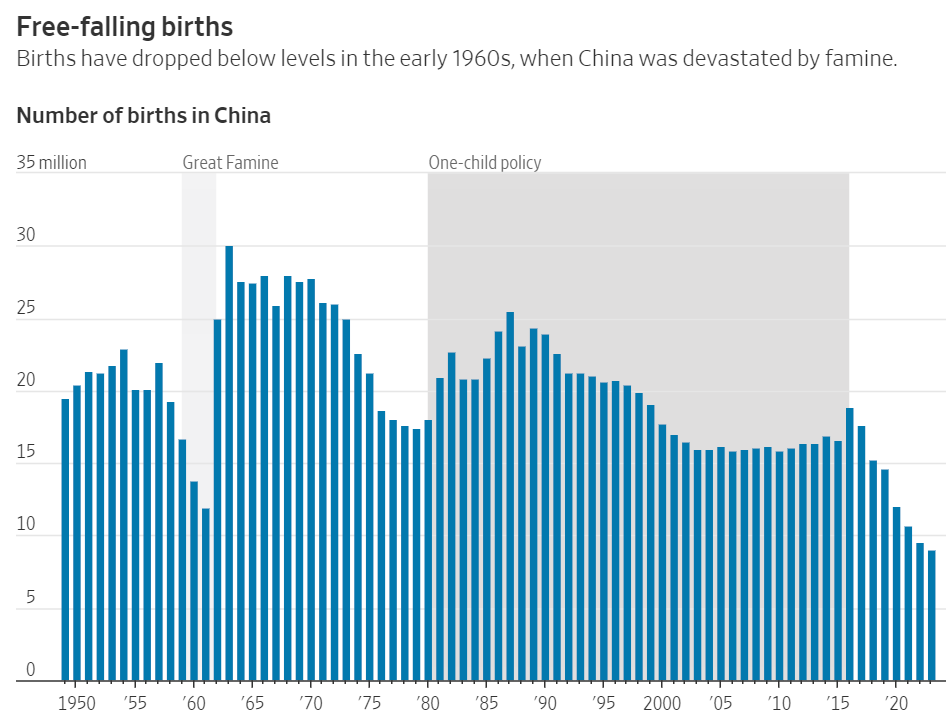
• Since around 2020, the number of children born has completely collapsed and shows no sign of recovery. In a few decades, China will be full of elderly people and short on workers.
Marko Jukic: There is not going to be a Chinese century unless they become the first industrialized country to reverse demographic decline. Seems unlikely, so the default outcome by 2100 is a world poorer than it is today, as we aren’t on track to win the century either.
AI will presumably upend the game board one way or another, but the most absurd part is always the projection that things will stabilize, as in:
The article has that graph be ‘if China’s fertility rate doesn’t bounce back.’ Whereas actually the chart here for 2050 is rather optimistic under ‘economic normal’ conditions.
One change in particular seems helpful, which is that if a parent gifts the couple real property, it stays with their side of the family in a divorce. I like this change because it makes it much more attractive to give the new couple a place to live, especially one big enough for a family. That’s known to have a big fertility impact.
What impact will that have on fertility?
Samo Burja: China might have just undertaken the most harsh and serious pro-fertility reform in the world.
It won’t be enough.
But this shows they have political will to solve fertility through any means necessary even if it doesn’t look nice to modern sensibilities.
Ben Hoffman: This doesn’t seem well-targeted at fertility. If fertility is referenced it’s a pretext.
Dan Elton: Douglas Murray seems right on this point — “Western” culture will survive, but specifically European cultures will not, except for small vestiges maintained for tourists.
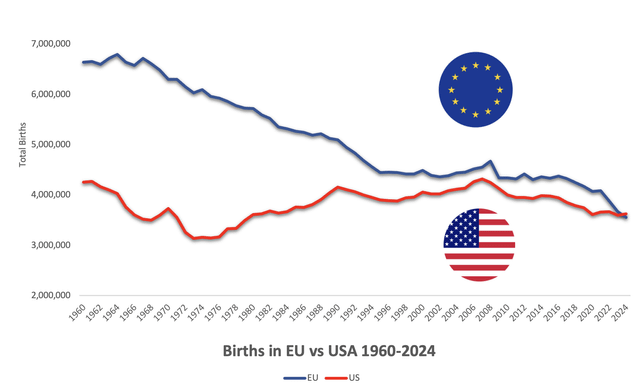
Francois Valentin: For the first time in its history the EU recorded fewer births in 2024 than the US.
Despite having an extra 120 million inhabitants.
This is what a relatively healthy demographic graph looks like in 2025.
John Arnold: Forget office to resi. We need college campus to retirement community conversions.
We still primarily need office to residential because of the three rules of real estate, which are location, location, location. You can put the retirement communities in rural areas and find places you’re still allowed to build.
New Mexico to offer free child care regardless of income. As usual, I like the subsidy but I hate the economic distortion of paying for daycare without paying for those who hire a nanny or stay home to watch the kids, and it also likely will drive up the real cost of child care. It would be much better to offer this money as an expanded child tax credit and let families decide how to spend that, including the option to only have one income.
More Births: On the combined measures of income and fertility, one nation is far ahead of the rest. Israel’s score laps every other country in this index. High fertility countries usually have very low GDPs and high GDP countries usually have very low birthrates. Israel is the only country in the world that does well in both categories.
Israel has high levels of education. It has high housing costs. It has existential threats from outside, but so do Ukraine and Azerbaijan. Israeli levels of religiosity are unremarkable, only 27% attend a service weekly and secular Jewish fertility is around replacement. Social services are generous but not unusually so.
Ultimately, those who live in Israel or talk to Israelis almost always arrive at the same conclusion. Israeli culture just values having children intensely.
… Another wonderful article, by Danielle Kubes in Canada’s National Post, offers precisely the same explanation for high Israeli fertility: Israel is positively dripping with pronatal belief.
The conclusion is, a lot of things matter, but what matters most is that Israel has strong pronatal beliefs. As in, they rushed dead men from the October 7 attacks to the hospital, so they could do sperm extractions and allow them to have kids despite being dead.
Fix your fertility rate, seek abundance beyond measure, or lose your civilization.
Your call.
Samo Burja: As far as I can tell, the most notable political science results of the 21st century is democracy cannot work well with low fertility rates.
All converge on prioritizing retirees over workers and immigrants over citizens escalating social transfers beyond sustainability.
I think this means we should try to understand non-democratic regimes better since they will represent the majority of global political power in the future.
It seems to me that the great graying and mass immigration simply are the end of democracies as we understood them.
Just as failure to manage an economy and international trade were the end of Soviet Communism as we understood it.
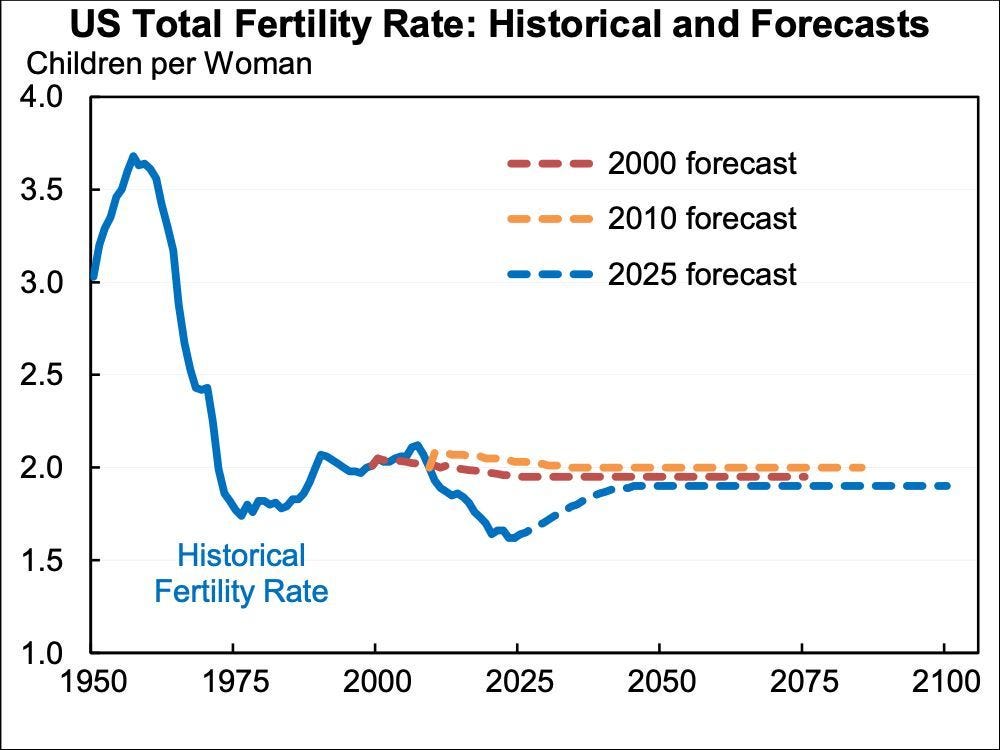
Why do official baseline scenarios consistently project recovering fertility rates?
Kelsey Piper: always a great sign when a projection is “for completely mysterious reasons this trend will reverse starting immediately and return to the baseline we believed in 25 years ago”
Jason Furman: Fertility rates are way below what the Social Security Trustees projected in both 2000 and 2010. And yet they have barely updated their long-run forecast. What’s the best argument for the plausibility of their forecast?
Compare the lines. This is not how a reasonable person would update based on what has happened since the year 2000. It could go that way if we play our cards right, but it sure as hell is not a baseline scenario and we are not currently playing any cards.
Whyvert: Gregory Clark has evidence that Britain’s upper classes had low fertility 1850-1920. This would have reversed the earlier “survival of the richest” dynamic. It may partly explain Britain’s relative decline from the late 19th century.
For most of history the rich had more children that survived to adulthood than the poor. Then that reversed, and this is aying that in Britain this happened big time in the late 1800s.
Claim that only 1% or less of children are genetically unrelated to their presumed fathers, very different from the opt-repeated figure of 10%. That’s a very different number, especially since a large fraction of the 1% are fully aware of the situation.
I do think such projections are ‘likely to work out’ in terms of the fiscal implications due to AI, or be rendered irrelevant by it in various ways, but that is a coincidence.
There is little sign that the momentum of the situation is changing. Instead, things continue to slowly get worse, as nations in holes continue to keep digging. The longer we wait, the more expensive the ultimate price will be. We will soon find out what the new administration does, which could go any number of ways.
South Korea since 2006 has spent just over 1% of GDP on baby making incentives.
It is not doing that much. But then what would you expect?
As Emmett Shear says, wake me when it’s a lot higher. Which they are indeed proposing. I do not understand why people like Tim Carney respond the opposite way.
Tim Carney: This ought to puncture the notion that affordability or inequality is the source of America’s Baby Bust.
Dan Peters: Watch, they’ll just say it’s not enough money.
There’s no winning with facts.
Yes. Yes I will. It’s not enough money.
Paid sick leave decreases, rather than increases, fertility. This is despite paid sick leave being obviously very helpful when being pregnant, and also when having a child, which makes you sick more often and gives such flexibility higher value in general. Women today want more children than they have. If paid sick leave is decreasing fertility, something is going very wrong.
Why would this have the opposite effect? Could this be a wealth effect, a classic case of giving people what you think they want, rather than what they actually want or need? The paper’s suggestion that this facilitates use of birth control? How does that even interact with ‘sick leave’ and why is this even an issue? Something else?
My best guess is that this essentially forces the women to take more sick leave, but in a way that they see as hurting their careers, or that increases how much they expect their careers to be hurt, or causes employers to try and stop women from having kids, or some combination thereof. So things end up getting worse. But that still feels like a weird ‘just so’ story.
Hungary has dedicated major resources to this – no taxes for 3+ kids, debt forgiveness, major subsidies for homes. It’s actually equivalent to ~5% of their GDP. The US military is 3.2%, so big spending.
Nothing happened.
Hungarian: This is false! You only get an exemption from a minor tax, not _ALL_ taxes! If families with 3+ kids literally paid zero tax including zero “employer-paid” taxes, it would be a huge deal. But the Hungarian government doesn’t (yet) have the courage for such a drastic move.
The total tax rate (combined mandatory employee+employer contributions) can easily surpass 50% in Hungary. If they’d actually exempt big families from _all_ taxes they’d nearly double the take-home salary for many workers.
M: Is it wrong that I find it funny that one of those tweet is about Hungarian women never paying income tax again, and then when you look at Hungary’s tax schedule they have one of the highest ratios of sales tax:income in Europe (and to some degree the world)?
Huntrax: Hungarian here
This will be a VERY basic introduction, rules are more complex. If you have children (even a single child) in Hungary, you get the following from the government:
1) Direct cash transfer: Around USD 30/child/month, unchanged since 2008.
2) Tax benefit: (Tax benefit was originally introduced instead of increasing direct cash transfer to target “those who are not willing to work” (mainly Romani minority), if mother does not work, can be used by the father. The amount depend on the number of the children, but can be up to 100 USD if you have three or more children per child per month. (Again, amount unchanged since around 2016)
3) Mothers with more than three children is exempt from salary personal income tax. This sounds very generous, but I do not think that this is THAT common, and these mothers are generally on the lower side of the salary range.
4) “major subsidies” for home. This is partially true. This subsidy system (partially) blamed for making houses very expensive, and given the current prices in the capital, a subsidy can buy you around 1 sqm/child. Also, higher subsidies generally kick in for the third child.
5) Debt forgiveness: certain types of debt, generally only after the third child.
If you are a middle class Hungarian family, life is expensive (particularly housing) and these subsidies do not really make any difference
Technically if you add up all family support benefits of all kinds, including pre-existing ones, I do see claims this adds to 5%, versus an OECD average of 2.1%. The majority of that 5% was from pre-existing supports, the change was only 1%-2% of GDP. That’s not nothing, but a long cry from 5%. America is unusually low here, we mostly do our transfers using other methods.
More Births responds that they are very much running ahead of the obvious comparable countries. Depending on when you start, they are doing relatively well, and certainly doing far better than many other places.
The FT has an article portraying the whole thing as a clear failure despite generous subsidies. In their central example a family got 80k Euros, and had as many kids as was medically safe for them to have. Their explanation is that the boost in fertility was merely a shift in getting a generation to have their kids earlier.
I don’t buy this for several reasons, including that if you attempt to have kids earlier you are going to end up with more kids, if only because you might change your mind and might have medical issues if you wait, or you might then have time to decide to have more.
One strong argument here is that the subsidies are structured badly. If you give people tax breaks, then that helps once you are already well off, but the poor who would be most sensitive to subsidies get left out. And if you are then rewarding earning more by being regressive, that cuts against prioritizing having a big family.
I would also point out that everything we know says you want to prioritize getting parents cash money quickly. That impacts behavior far more than long term subsidies. Giving people tax breaks after several children is exactly the kind of move that is not going to get much impact on fertility per dollar spent.
Philip Pilkington: The “family policy doesn’t work” meme is stale and annoying. The impact on the marriage rate is crystal clear. This is the first step.
Lyman Sone: I have to say, I think the evidence “Family policy boosts marriage and reduces divorce” is CRAZY STRONG. It gets less attention, but it’s ludicrously empirically strong, and we have an incredible test case in Hungary where they tried it and got a HUGE effect.
The case for family policy boosting births I think is still strong, but the effect sizes are DEFINITELY smaller, and costs higher, and effects a bit more contested.
But, “People create marital status in response to financial incentives” is 100% true.
What remains to be seen and is empirically unknown is if these incentivized marriages will be as fecund as pre-reform marriages. We won’t know this for quite a few years.
But like if your goal is to increase the % of kids born to married parents, and to reduce parental divorce, reducing the marriage penalty in tax/benefit codes 100% will cause that outcome and it isn’t really a serious scholarly debate if this is true.
As someone who had to decide whether to get married, I can verify this absolutely makes a huge difference. The incentives here can be very, very large. If we had gotten married earlier, it would have plausibly cost six figures in lost financial aid.
Also, it seems quite obvious to me that if you boost the marriage rate, you also boost the birth rate. As in, yes, being counterfactually married should quite obviously lead to decisions to have more children. So should giving married people better financial conditions relative to the unmarried, over and above changing people’s marriage decisions, although the size of that mechanism is reasonably disputed. How could these things fail to be true?
Aside from Poland those are not adjacent countries, and some similar countries did well without similar subsidies (on a world-relative basis) but none of this seems suggestive of subsidies not working.
France offers proposal for free fertility tests at ages 18-25, women’s groups are ‘outraged’ because they focused on physical fertility rather than making kids affordable. How dare they provide information about reproductive health. Yes, affordability is the bigger issue. I still will never understand the attitude of ‘this is a good thing and in no way interferes with other good things but is not the best possible thing, so we are going to be outraged you proposed it.’
Except yes, Macron’s plan also includes financial support for new parents. Alas, no number is mentioned here. I am confident the number is far too low, because Macron would never dare, and also because if the number was high enough I would have heard.
The plan also emphasizes the importance of paternal involvement in a child’s life, including a proposed ‘duty to visit’ for fathers. I worry this would actively discourage fertility far more than it encourages it. I also am not convinced, if a father needs a law to be there, that you want him around.
Surrogacy, it says, is excluded due to ‘ethical concerns.’ Still with this nonsense, although that’s a lot less bad than Italy going nuts and banning surrogacy outright.
A new postputs America’s socially optimal fertility rate at 2.4, and estimates we should place a value of $1.17 million on each additional birth, and to do this should be willing to spend $290k per birth. They suggest greatly increasing the child tax credit.
Remember that my estimates of the effective cost to induce a new birth are consistently in the realm of $300k in marginal spending, roughly a quarter of this social value and equal to the paper’s proposed willingness to pay. There are better ways to do this than writing checks, but writing checks works, and it works better the more you frontload the payments, and the more you pay outright in cash.
Emil Kirkegaard: Quite a lot of people approve of embryo selection for all manners of traits. It’s not just some fringe. 37% approve for intelligence. Majorities approve of screening for all kinds of diseases and disorders.
Polygenic Embryo Screening: High Approval Despite Substantial Concerns from the U.S. Public
Some 30% of people are willing to do IVF just to do embryo selection. That’s no small number!
In usual @RichardHanania fashion, conservatives were less approving, despite having more to gain from it (their fertility is much higher). Younger people more in favor, so things probably moving in that direction.
The correct value of effective polygenic screening is highly unlike zero. If you think there is nothing wrong with it, and it works, you substantially improve your offspring’s outcomes on a variety of metrics, as per your definition of improve. Yes, IVF is highly annoying and expensive, but the upside is huge. 30% of people recognize this, and 55% would at least consider it.
General approval is very, very good. 67%-11% say benefits outweigh costs, 77%-12% would have it be legal. Good show, everyone.
The range of approvals for different outcomes mostly matches what you would expect.
Everyone hates physical diseases like cancer and heart disease. Preventing some mental diseases are mostly unobjectionable (and yes the implications of that sentence are as crazy as they sound). If it is a ‘condition,’ people are mostly fine preventing it. Obesity is the most objectionable, but seems like a very clear place to have a preference, given its impact on health and other life outcomes. Whether or not you think obesity is a person’s choice given their genes, you should want to be able to select against it.
Traits, on the other hand, give people the willies. Eliminating bad things is different from looking for good things in people’s minds. A lot of this is framing. Note how much worse ‘BMI’ does than ‘obesity.’ Even more so ‘life satisfaction’ versus ‘depression.’ There’s a strong anti-vanity streak here, given the opposition to making your child not bald. And a highly reasonable big jump at the top on skin color, while noticing that you do also choose the parents.
To some extent I sympathize. You don’t want people to race to give their children genetic positional goods, forcing others to follow or be left behind, with no social gains. But you do want to give them absolute goods that make people healthier, happier, smarter, more productive and so on, including well above the median.
Thus my number one disliked trait selection would be height. Height is mostly a positional good. We should save our selection pressure for positive sum games. Personality traits should be handled with caution. Mostly I would want to invest available trait stats into intelligence and constitution, but if you could also offer me strength, dexterity or wisdom, or the positive sum forms of charisma, I’m definitely listening.
Not being able to afford kids or the house to raise them in.
Also that people have been taught not to have kids until the money is sorted out, whereas in the past people would more often muddle through. Expected time and attention spent on kids also gets mentioned, both kids being treated as needing vastly more supervision and there being less others around to help with that.
Another one mentioned a few times is mental illness. A lot of people are now diagnosed with mental illness, which is some combination of increased diagnosis and viewing things differently, and also higher rates of mental illness. That leaves a lot of people not wanting to pass that on to their kids, or terrified they can’t be good parents.
This suggests that we need to lower costs along many fronts of both money and time, and also we need to stop telling people to wait until they meet very high bars.
How much does having children lower lifetime earnings?
Maxwell Tabarrok citesa new Danish study of women who attempted IVF, and concludes it has strong evidence that having children does not reduce long term earnings. There is a correlation, but he concludes it is not causal.
That seems weird. Children are a huge time sink and you are forced to take time off. How could that not matter? Maxwell says women largely time their kids to correspond to counterfactual earnings peaks, which says a lot about how much money is driving lower fertility. And the counterforce to less time is higher motivation and justification.
If you do not have kids, it is very easy to satisfice on money, to choose more rewarding or less stressful jobs or those with less hours, and end up earning less, because you can. Similarly, when you negotiate salaries and such, saying you have to support a family is a strong argument, as I have witnessed many times. So it is not so crazy to me that these effects might roughly cancel out.
I would go a step farther than Maxwell does in the conclusion. If the result is correct, then it shows that financial considerations are greatly warping fertility choices. If that is true, then well-structured payments and other incentives can greatly change those choices.
You cannot have a world where women are carefully timing kids to not interfere with their earning potential, and also have a $70k baby bonus (as proposed in South Korea) not make a huge difference. Even better, you could vary or condition the bonus based on timing.
One can also look to this paper on the willingness to pay for IVF. They see no long-term ‘protective’ effects (of having no child) on earnings.
How much are peoplewilling to pay for IVF if they are infertile? This varies really quite a lot. The majority of the time the answer is $0, or actually far less than $0. Other times, the answer is almost anything if they think it will work. People very highly value their fertility preferences. I do not think that marginal willingness to pay is a good measure of overall welfare gains in this spot.
A lot of people do end up in the middle as well, if only due to of inability to pay.
From the abstract: Despite the high private non-pecuniary cost of infertility, we estimate a relatively low revealed private willingness to pay for infertility treatment. The rate of IVF initiations drops by half when treatment is not covered by health insurance.
The response to insurance is substantially more pronounced at lower income levels. At the median of the disposable income distribution, our estimates imply a willingness to pay of at most 22% of annual income for initiating an IVF treatment (or about a 30% chance of having a child).
At least 40% of the response to insurance coverage can be explained by a liquidity effect rather than traditional moral hazard, implying that insurance provides an important consumption smoothing benefit in this context. We show that insurance coverage of infertility treatments determines both the total number of additional children and their allocation across the socioeconomic spectrum.
This offers us another insight. If at least 40% of response to insurance on IVF is liquidity effects, then it would stand to reason that 40% of the response to child subsidies would also depend on it addressing liquidity effects.
In other words: If I offer a $10k subsidy payable over time, versus a $6k subsidy payable on birth (and perhaps even partially before?), we should expect those to have similar fertility impacts. You really, really want to do cash on delivery.
IVF also has other disadvantages. It is highly uncertain, and people with moderate willingness to pay are going to be risk averse on that, although this could conflict with the liquidity issue. IVF is physically highly uncomfortable, if it was a trivial procedure willingness to pay would likely go up. There is also certainly some ‘it is unnatural’ tax, and the risk of dealing with multiple babies at once is not fun either. IVF is wonderful, but you’d pay even more to get a natural conception, if IVF is not also being used to do any form of embryo selection.
But what is the lower bound being offered here? 22% of annual income for a 30% chance of having an a child is 73% of annual income per child.
If nothing else, this seems like overwhelmingly strong evidence that IVF should be fully covered by insurance or by the state for all infertile couples, in all areas with below replacement fertility. It is the lowest hanging of fruits.
IVF for embryo selection beyond avoiding particular health concerns alas remains remarkably unpopular. The term ‘ruining it for everyone’ seems relevant, and now we have to deal with the consequences. The good news is that if you stick to health concerns, people are mostly sane about this, with 72% approval (versus 11% disapproval) for screening in general and similar for doing it for health. And 82% said they’d be at least somewhat interested conditional on already using IVF.
Lyman Stone argues extensively that we should not expect genetic selection to get us out of our fertility problems any time soon. I think that at the limit ‘life finds a way’ applies no matter what your simulations and correlations tell you, but we should not rely on anything like this as a practical solution.
American women arevery not concerned (14%) about overall fertility. Men are more concerned (30%) but not enough to do anything about it, and younger people (and more liberal people) are even less worried than that. Until that changes dramatically, we will never be able to try solutions capable of working. Samo Burja reports similar attitudes across genders in his anecdata, and points out the preferences cut across many proposed explanatory factors.
The culture is all too eager to tell us that children, or even marriage, will make us miserable, when it is not true even if you discount the long term. The latest example was this, where there was a widely distributed claim in a new book that said married women are miserable, because they report being unhappy when their spouse isn’t around… but that actually meant ‘spouse absent’ meaning no longer living with them, not ‘stepped out of the room.’ So married people are indeed happier, so long as they actually live together, which is highly recommended standard practice. Whoops.
When the parents are together, they are staying together more often, as well.
We’re not that close to 1960-level numbers, but that’s a dramatic fall in the divorce rate. The decline in unwed births is smaller, but noticeable and looks steady.
Robin Hanson notes that many recent cultural trends among wealthy nations have primarily only happened in Western countries, moving away from mostly static Asia and Africa. Elsewhere, wealth did not predict the changes, but still did predict fertility drops. This matches previous observations that East Asia now has the worst of both worlds, where women and families have to deal with modern challenges, expectations and demands and also older ones, but women can also opt out entirely. So they do.
After Dobbs, vasectomies and tubal ligation procedures are up. Tubal ligations are up over 400 per 100k individuals with healthcare appointments on a monthly basis. That sounds like a lot, and is more than double from 2019. Vasectomies are over 100 per 100k appointments.
How would you design a city so that more people would fall in love? In all seriousness, I would start with YIMBY. Build, baby, build, so housing costs are affordable. That gives people the opportunity. Next up better mass transit and fully walkable, not being able to see someone logistically is a huge barrier and everything gets more pleasant. Then yes, absolutely, you create a bunch of parks and benches and monuments and museums and so on, and go from there.
More Births: We rarely see fertility studies focusing on men. A new Finnish study finds that a man’s major or field of study has a big impact on how many children he will have! The researchers explain that in fields with higher economic uncertainty, men tend to have fewer children.
These are large effects.
I would double down on Robin Hanson’s warning to beware the philosophy degree.
Rather far gone, given that this is how Politico’s Gaby Del Valle framed a conference about the idea that maybe children are good, actually:
Gaby Del Valle (Politico):
“The Big Idea: The Far Right’s Campaign to Explode the Population”
Tagline: Behind the scenes at the first Natal Conference, where a motley alliance is throwing out the idea of winning converts to their cause and trying to make their own instead.
…
This conference suggests there’s a simple way around the problem of majority rule: breeding a new majority — one that looks and sounds just like them.
Gaby, it seems, cannot imagine any reason one might think that children are good or that the country would be better off with more of them. They couldn’t mean what they say about demographic collapse and our dependence on growth. They couldn’t be genuine in their values. It must be a political takeover, or racism.
Ross Douthat: Nothing wrong with a journo noting that ppl interested in a pro-natalism conference tend to be eccentric or extreme. But the contextual Q should be, “isn’t it … odd that only oddballs seem interested in the looming depopulation of the developed world?”
They are not the only ones. They are the only ones at the conference that markets to exactly that kind of people. I am not going to that sort of conference. But yes, the fact that this is the way they had to fill out the conference is a sign of the times.
In general, if some choice is happening 1% of the time, and you want that to be even lower, what do you do? It stands to reason that drawing lots of attention to it, giving people ‘the facts’ and making people really think hard about it might not be your best plan. This is especially true if there is lots of existing misconception and hyperbole working in your favor. Many programs to get kids to not do things actively backfire.
A funny suggestion at the link was making people do this once a year. Presumably that would have very different impacts, in addition to being deeply silly. But yes, my presumption is that any form of drawing attention and thought to the question would increase fertility.
Richard Chappell: The most interesting thing in that Guardian article was the potential tension between these two highlighted sentences. An important part of making parenting easier could be to reduce the social pressure to be “model parents”. (It seems like there are real tradeoffs here.)
Should we worry more about “bad” parenting, or about discouraging ppl from becoming parents at all? My sense is more the latter. Which might suggest the need for more positive (less judgemental) attitudes towards even very imperfect parents.
Exactly. The whole point is to make it easier to have kids. By responding with ‘are they really model parents?’ you are exactly proving why this is so important. If we only let ‘model parents’ have kids there won’t be many kids. If parents think they have to act as model parents all the time, they will be miserable and often opt out or quit early. You do need to pass a minimum bar, but past that the important thing is to show up, stick around and have the kids at all.
Rob Henderson: A generation ago, a poor woman would have children with a man in the hope that this would lead to marriage and family. This seldom happened. Those children witnessed this failure, absorbed its lessons, grew up, and now are simply not having kids.
Throughout my childhood, I lived in homes with 2 different girls who became mothers at age 16, then both had another kid at 18, and another in their 20s (all different fathers). Interestingly, they had daughters only. Those girls are now in their mid-twenties; none have children.
“The Trustees continue to assume that recent low rates of period fertility are, in part, indicative of a gradual shift to older ages of childbearing for younger birth cohorts.”
Marko Jukic: When we say “our core societal institutions are fragile and dysfunctional because they no longer suit the circumstances to which they were designed but cannot change,” this is what we mean.
Yeah, no. This is a completely insane baseline estimate. I do not especially worry about the solvency of the trust fund under baseline assumptions because I also see the assumptions about AI and various other things. The worry is if this could be people’s excuse for not panicking. That would be a problem.
Razib Khan tells the story of declining fertility as the story of urbanization. No question this is a key part of the story. Fertility and urbanization have a national correlation of -0.48. Within nations, cities have always, going back to ancient times, been much lower fertility than rural areas, with cities usually below replacement. A lot of that was always due to poor health and plague, an effect that used to be far larger than today, but that is only one reason of many. And urbanization is way up.
Your periodic reminder that we tax marriage, which also means we tax fertility. We do it less than we used to, but we still very much do it.
When you tax something, you get less of it.
Niskanen Center: The U.S. tax code disproportionately discourages marriage among middle-and low-income families. We need to fix this.
They offer a variety of proposals. At core this is a basic set of arithmetic problems. It is not difficult to adjust the numbers such that it is almost always beneficial or at least neutral to be married, especially when there are children involved.
Indeed, if we cannot do better, there is a very obvious solution. Raise base rates as needed to compensate, and then allow married couples to file as if they were unmarried, if they calculate that this is cleaper. End of penalty.
I do not know how much of the fertility drop is ‘women and also men do not appreciate that there is a biological clock and they only have so long to have kids.’
I do know the answer is ‘quite a lot.’ So you get things like this:
Kira: I spoke to a 35yo, unmarried female relative recently. She is seeing someone & they’re considering marriage but says she is “taking it slow.” I asked her if she wanted to have children. She said yes. Four.
I told her she’s too old for “taking it slow” if she wants four children and at this age she’ll be lucky to have a couple after an engagement, wedding and honeymoon period has passed. Not to mention the time it actually takes to grow and birth a baby.
She was stunned. She gasped a bit and said “wow. You don’t mince words, huh?” I told her “of course not. People aren’t being honest with young women about their bodies and timelines. Has anyone ever told you that your prime child bearing years are over? Has anyone ever talked to you about how aging changes your fertility?”
She said no. No one. Not one person. And as stupid as it sounds, she hadn’t thought about it until I mentioned it. She didn’t realize she didn’t have all the time in the world. I don’t know if it changed anything for her but I do think it’s a travesty that something so basic had never been presented to her before.
We need to start being blunt with young women. They can make their own choices on their timelines but it should be done with the most information possible.
Carol Williams: My son and daughter-in-law didn’t want children, then changed their minds. Too late, though. After several attempts, IVF and miscarriage, they’ve given up. My daughter-in-law is 42. They would adopt but don’t have the money. Sad for them.
Coleman Hughes: Columbia and Barnard students are not stupid in the low IQ sense. They had good test scores and good grades in high school.
But in my experience, many of them were deeply lacking in the common sense department––which is a separate thing altogether.
To give an example, I remember a friend once told me that she had learned in class that the concept of a woman’s “biological clock” was a myth, and that women really don’t need to worry about declining fertility as they age into their 40s and 50s. She accepted this as true.
I remember health class. This is likely the most important one thing to include. Everyone needs to know what the timeline looks like.
If they choose to ignore it, that needs to be an informed choice.
Vivienne: FYI we are basically at the point where we can make gametes out of skin cells. I expect this to be available for humans in 10 years. I wouldn’t worry about it too much. I’ve also considered freezing my eggs lately, but I’m ambivalent enough that I feel fine relying on the possibility of future tech, and I wouldn’t want a baby for another decade at least. And my heart is mostly set on cloning. Hope this article gives you comfort.
I should’ve spoken more strongly. We literally are at that point. It has been done. It is being done. “Last year, Japanese researchers created eggs from the skin cells of male mice, leading to the birth of mouse pups with two fathers.”
Yes it’s amazing that people haven’t really been talking about this. It should be front page news all over the world. The thing people have been fantasizing about for decades. Everyone seems to be counting down to it, and it’s already happened lol.
It does seem at least somewhat reasonable to say ‘either the technology to do this will exist 10 years from now when I need it, or we probably have much bigger problems.’ It still seems like a relatively cheap action to prepare in case that’s not true.
What motivates educated women who have five or more kids? Catherine Ruth Pakaluk writes a book in which she asks fifty of them, Hanna’s Children. Mostly they were motivated by the belief that children are the best and most valuable thing. They knew that having lots of kids was difficult and expensive and terrifying and required sacrifice, and they did it anyway and made it work. The group was also largely religious.
The reviewer here noted that the marginal cost of additional children seems to decline. That has been my experience as well. There are dire warnings that two is more than twice as hard as one, or three will be so much harder than two. It definitely brings additional challenges, but my experience is that this is not so, there are decreasing marginal costs all around. They complement each other, and I think are clearly better off for having each other, and many of the costs in both money and time are fixed or scale highly sub-linearly.
Au Pair programs are the definition of win-win.
A student gets a place to stay and a chance to study in America, and some walking around money. A family gets badly needed childcare. It is completely voluntary. The economic benefits are obvious. Everyone wins. The possibility of an Au Pair substantially enhances options, and thus fertility.
So, of course:
Kelsey Bolar: President Biden has threatened to take away our main source of child care by proposing a regulation that could double the cost of hosting an au pair.
If Biden wants to help families like ours balance our home and professional lives, he should expand the program to include senior care—not threaten to destroy it. @mrsshap & I in today’s @WSJopinion.
Caroline Downey: As a triplet, I know the 8 au pairs we had from age 0-4 helped my parents tremendously. I remember them so fondly (sometimes we, now 26 years old, still get Polish chocolate packages). This regulation is anti-family.
Raising required compensation would dramatically nosedive participation. These people really do not get how supply or demand curves work. Fertility would suffer.
The comments have several people talking about ‘slave labor.’ No one knows what words mean anymore. That includes both ‘slave’ and also ‘labor.’
Abstract: Children require care. The market for childcare has received much attention in recent years as many countries consider subsidizing or supplying childcare as a response to dropping birth rates.
However, the relationship between childcare markets and the fertility gap – the difference between desired and achieved fertility – is yet to be explored. We build upon previous work by investigating the regulation of childcare and fertility gaps across the U.S. states.
Our results consistently show fewer childcare regulations are associated with smaller fertility gaps. This suggests that women are better able to achieve their fertility goals in policy environments that allow for more flexibility in childcare options and lower costs.
Your childcare regulations must be really harmful if parents respond by having noticeably fewer children. That is as clear a message as you can get. Listen.
The potential changes are big. They estimate that if you shifted from the highest level of regulation (Connecticut) to the lowest (Louisiana), the total fertility rate (TFR) would rise from 1.51 to 1.7, or 13% (!). If every state moved to Louisiana’s level, we would see roughly 38% of that improvement, or a 5% rise in fertility.
I talked Claude through the calculations and I am choosing to skip several adjustments so someone should do it more formally, but when I estimate the actual all-in cost this imposes on parents, I get that each 1 point increase on the 0-10 point scale increases costs by between $6k (low estimate) and $13k (high estimate). At 2.74 points of average improvement per state, using a middle estimate of $9k per point, we get about $24,600 per child that needs such care, for a 5% fertility increase.
Yes, I am fully ignoring the positive benefits to children and parents, because I do not think that has substantial impact on either quality or fertility decisions.
Thus, we can approximate that paying parents $24,600 per child over five years would increase fertility by 5%.
Writing this check would be an expensive way to raise fertility, costing almost $500,000 per additional birth. Note that many existing programs try to write such checks anyway, or do it selectively, to offset their harms.
Also note that we above found that baby bonus payments get at least 40% of their effectiveness from boosting liquidity. By spreading payments out over five years, we lose that benefit. So if we instead were to write the $24,600 check, we should expect to get an 8.3% increase in fertility, and decrease the cost per birth to about $300,000.
Remember the calculation on car seats as contraception? There parents faced an up-front cost, and I calculated that this implied the marginal cost per additional birth from a flat child subsidy program would be about $270,000 (or ~$286k in 2024 dollars).
Two years later, we have an estimate from a different program, and we got $300k.
Those are stunningly similar numbers.
We can now be reasonably confident that this is roughly what such programs would cost if implemented at modest size.
For transfers at birth to new mothers in America, for every $300k we spend, we should expect to get roughly one additional birth.
We can also gain this result from anything that reduces effective costs to parents. Car seat requirements and child care regulations are two good places to start. There are many others.
This would likely to be much tougher in places without a sufficient fertility gap. America has the large advantage that women actively want more kids. All we have to do is enable that.
Another fun note from the same paper is that Lyman Stone notes basically no person-level control variables matter for the fertility gap between desired kids and realized kids.
The amount of variance here is bizarre. Shouldn’t these curves be smooth via the law of large numbers? What is moving them around so much? I am actually asking.
Even Tokyo, Japan, where housing is cheap and plentiful now and the government begs people to have more children cannot muster a TFR above 1.0. Why? Urban high rises are family unfriendly in the extreme. I witnessed this during a trip to Tokyo in Sept.
I do not think this need to be true, also a lot of this is correlational or selection effects.
Mostly I think this is a confusion between size of the building and cost of the space.
South Korea’s high rises do not allocate the space you need for a family, especially when you lack easy access to outside space, and kids are not allowed to roam freely.
Meanwhile, the drops in fertility reflect places where zoning changes, not places where the physical buildings change in their impact.
You don’t see a change from 2-plexes to 4-plexes, because those are still in the same types of areas. Then the 5-19 group is again similar, representing the ability to build modest apartment buildings. And then a jump at 20+ or so, which start to only make sense where space is at a premium.
When you build a large apartment building, you lower the cost of housing everywhere, which is good for fertility in any given location. But the particular location is likely to be expensive, and thus locally have lower fertility, again partly via selection.
The only way out is through. If South Korea had twice as many high rises, allowing all units to be larger at lower prices, then the fertility penalty would stop.
New Yorkers leave to raise families partly to get green space and the illusion of safety (and some real safety, although that is mainly from people thinking you are acting unsafely and calling authorities).
But mostly they leave because the rent is high, and taxes are high, and the private schools are expensive.
If you doubled the amount of residential housing in New York City, what happens? That depends on how much prices drop versus the population increasing. You are going to get a J-shaped fertility impact curve overall, and it is unclear where we currently are on that curve.
My presumption is that at equilibrium, if we doubled NYC’s residential space, we would grow the population from something like 8 million to 14 million, with a substantial drop in rents and increase in average apartment size, and local fertility would rise substantially, as would fertility elsewhere.
Whether that dominated the compositional shift is unclear, if you did not use the gigantic wealth effect wisely. If you used the wealth effect in substantial part as a child subsidy? Now it is not even close.
I think a similar thing is happening in this study thatpopulation density predicts lower fertility. Yes, it predicts lower fertility, but that is largely due to predicting higher space costs. And also historically cities being unhealthier much more than they are now, and children being more valuable in the countryside, where again we want to drive that to zero.
The housing data that’s readily coded kinda sucks. It’s basically:
Metro vs. Nonmetro
Homeowner vs. Not
Live with parents, live on own, or GQ
But we CAN untangle some major endogeneity, because NLSY gives us: 1) Fertility preferences surveyed before exit from parental household or adulthood 2) Sibling numbers 3) Childhood religious environment All potentially huge confounds driving endogenous selection.
so if we start with JUST housing-related variables this is what we get.
turns out more years in metro areas maybe BOOSTS fertility and more years as a homeowner REDUCES fertility.
this is bizarre to me.
but LOOK AT THE EFFECT OF LIVING WITH PARENTS (note this graph is for MEN not women but they look similar)
That’s an 0.04 hit to fertility per year of living with parents per year. Whereas time in a metro area is positive.
Lyman Stone: I HAVE TOLD YOU PEOPLE REPEATEDLY THIS IS THE PROBLEM AND IT REMAINS TODAY IN FACT THE PROBLEM
The young people must have their own houses.
Here’s what you get correcting for some stuff:
Controlling for marital status feels like it should reduce the impact of living with parents. Yet we see almost no change.
Either way, we should worry about reverse causation and correlation. Yes, there are socioeconomic and marital status controls here, but presumably people who live with their parents are often doing so exactly because they are not ready to raise a family.
Lyman Stone: okay but these are kinda dumb controls. to be really savvy we don’t just want a control variable, we want an interaction: say, does the effect of homeownership vary based on preferences? Yes, it does! This is for women, with all other controls entered.
For women who desire 0 or 1 child (so women with quite low preferences), one extra year of homeownership is associated with a considerable decline in fertility.
But as desires rise, so does effect.
So this kinda looks like homeownership is associated with a modest improvement in correspondence between desires and outcomes at least for people at the extremes.
I can tell you the same effect appears if I use metro status. More years spent in metro areas = LOWER fertility for women with 0-1 desires, HIGHER fertility for women with 3+ desires.
…
On the whole, these results are a LOT more favorable to density than I expected them to be (cc @MoreBirths ). That said, the measures here are really oblique. “Do you own a home,” “Are you in a metro area,” “Do you live with your parents.” None of these are “high density.”
This might be a story about resources, optionality and preference fulfilment then? And yes, the more children you want the more children you get in general, but only to a limited extent. I am guessing that preferences shift a lot, if the correlation is this low.
So the idea is that if you are doing well, able to live in a metro area or own house, then you are in much better position to bargain for and get what you want. You can stay on your own or choose a partner that matches your preferences. If you are not doing well, you might compromise on children in either direction.
Lyman Stone suggests the issue is not urbanization, it is small houses that do not lend themselves to starting families.
Lyman Stone: When you absolutely want to usher in the end of humanity: “low fertility means there are tons of empty bedrooms; a good solution would be to just build a lot of tinier houses with no extra bedrooms, or subdivide current houses to be single units.”
On this hill I will die:
Dense urban environments are not an intrinsic threat to family formation
Small houses are an incontrovertible threat to family formation
A threat that keeps threatening for decades after construction
If you want to boost family formation through zoning abolish parking requirements, allow ADUs as of right, raise height limits.
We chop the fingers off of developers who build any unit under 2 bedrooms.
People being like, “we need a bunch of small apartments so young people can get out of their parents’ houses!”
No.
We need to build so many 2 bedroom units that 2-bedroom units become cheap enough for 20-somethings to buy.
If your view of what is possible with supply expansion is limited to making rental studios affordable for basement-dwellers then you are simply not grasping how far below where we COULD BE we actually are.
We should be flooding the market with efficiently sized and affordably priced units that can house young people through multiple life stages. push the price of a 2-bedroom starter home down, down, down, down.
So yes, it would be great if every 24 year old could get their own two bedroom starter house or apartment in the places they want to live, even New York City or San Francisco. It would also be the first time in history.
I do know that supply reduces price. However.
You know what it would take to make housing that cheap?
The cube.
Otherwise, all you are doing is forcing those 24 year olds to get roommates because they are forced to buy 2-4 times ‘as much house’ as they actually need.
Roommates are presumably actively bad for family formation versus living alone. Whereas if you rent one bedroom apartments (or studios, or dorm rooms) to single people, they gain disposable income and opportunity, and can then move later when they are ready. Why in the world would you want to tie a 24-year-old down to a 2-bedroom apartment or starter house and mortgage they don’t need, making it hard to move?
Yes, you want to build so much housing that the prices crash, build baby build as much as possible, but it can only take you so far.
Alexa Curtis: I just met a 72 year old woman who’s been telling me about her life.
Best quote she said:
You can either have a house and kids or you can fly first class.
I want to fly first class.
I found her inspiring. 💖
I never fly first class (except once I got a random free upgrade). I don’t get it. Even without the kids, why wouldn’t you instead want a ‘first class’ house? But the broader point matters far more.
Lyman Stone: OWD heads this section by saying, “Fertility first falls with development — and then rises with development.” Building on this, UVA student Maxwell Tabarrok argues that “Maximum Progress” can prevent permanently declining fertility. If society advances enough, fertility will rise again. I mention Maxwell because I did a twitter thread recently rebutting his piece. I did so because I was asked to do so by others; but ultimately, Maxwell did an impressively good job of putting together the “U-shape argument” in one specific place. Since writing the thread I’ve had requests to formalize the argument a bit more. That’s what this is.
Lyman Stone: My basic thesis is this: The view that mere growth will boost fertility again is wrong. It is based on seriously outdated underlying research, doesn’t fit the actual empirical facts of the case well, and it leads to theoretical confusion which inhibits clear understanding of how fertility actually works.
His first argument is that the traditional U-curve findings, that when income rises very high fertility increases again above replacement, are based on tiny portions of larger surveys, and are statistically unreliable. Even worse, they have timing issues, as income varies with age.
Lyman Stone: So do we have any evidence on lifetime disposable income? Yes we do, from Sweden.
Meanwhile, women’s incomes are pretty much totally unrelated to fertility. Whoopsie! And women’s earnings are negatively related to fertility.
Lyman Stone: So, every kind of income is pronatal except for women’s wages. Women’s interest income, business income, rental income, welfare income, support from husband or family… all probably pronatal. Earnings, no.
…
On the other hand, you might look at the nearly-universal rule of species that status predicts reproductive success, you might look at the stable male earnings-fertility gradient, and suppose that high income will usually predict high fertility. This is my view. High income will usually predict high fertility. Exception cases will usually involve unobserved underlying cultural stratification, or mismeasurement, or be very transitory.
…
The relationship between income and fertility is culturally determined.
Income has a relationship with fertility. But it’s not Income →Fertility, either up or down. It’s (Income X Culture) →Fertility.
Perhaps one could say that income relative to expectations and social position predicts individual fertility? That seems like the actual mechanism. As you get higher income (perhaps excluding female labor income, because of the substitution problem) relative to the perceived financial cost of children, you get more children. The problem is that if rising income also raises perceived costs more, you go backwards.
His core argument is that what we actually have is Simpson’s Paradox. That what’s going on is that compositional changes in income cohorts are creating a U-curve that isn’t a good way of understanding the situation:
Or this example of looking at Amish and Ultra-Orthodox Jews:
This points to the hypothesis that causality is in both directions. Children impact income, so you may not be measuring what you think. Although that suggests that very high income groups are even higher fertility than they look.
And yes, these graphs are quite interesting. The first is slanted by household structure (e.g. ‘do you live with your parents’?)
This is married women not living with their parents:
So what matters is not being 70%+ of the income share. These numbers only look at years when the woman is married, which is why TFR is in the 4 range this whole time, although I’m still confused why it pushed it up that high. Perhaps we really should be focusing on getting more marriages to form and last.
Next up she shows schooling is a linear predictor of low fertility at all income levels, listing four reasons:
School culture is non-familistic.
School puts people in a childish position.
School changes economic opportunity, offering anti-family trade-offs.
Schools change the underlying culture.
I would add that school delays economic actility, and one’s ability to get into a life position where one can get ready to have a family, and we now strongly discourage family formation during one’s education.
Lyman Stone: While income proxies for those, many places have seen dramatic shifts in those variables without dramatic shifts in income, and many places have seen dramatic shifts in income without dramatic shifts in health, school, and media. Our prior should probably be that “mere income” has no societal effect on fertility.
The core argument Maxwell Tabarrok is making is that labor supply is now declining as a function of labor productivity. People value their leisure time and non-work activities, so they are satisficing on work and income. Which means that as wealth and productivity increase further, hours worked will decline and the opportunity cost of children will go down, and fertility will go up.
I do not think that is a good way to think about this, and the graphs he provides are unconvincing. Instead, I would go back to my notion above of anticipated cost (including opportunity cost) of children versus available surplus under culturally expected and legally required patterns of consumption.
So I would instead say: Beware the Iron Law of Wages.
Kitten: If you think people aren’t having kids because of money, you need to examine and think about this graph more.
Yes it’s J-shaped, but “you need to be making $500k to afford as many kids as somebody making $40k” is a crazy thing to believe.
Our disease is spiritual, not material.
Lyman Stone offers this version via Maxwell Tabarrok, which highlights where the people are, and more importantly where they are not, which is at the upper right.
One can also steal from Robert Anton Wilson, and refer to the problem as The Revolution of Rising Expectations.
The logic is obvious in an otherwise static Malthusian context. Solve for the equilibrium, and there is only one answer. The population increases until the point where the marginal product is equal to that required for replacement rate fertility.
What happens when instead productivity is rapidly increasing, and we are growing wealthier?
Wages must rise, so they do not tend towards the minimum necessary to sustain life.
Instead, the minimum necessary to sustain life tends towards wages.
This happens through a combination of regulatory fiat requiring the purchase of more and higher quality goods, through various forms of artificial and real scarcity, increasingly expensive status competitions, and shifts in cultural expectation so that we consider more and higher quality goods necessary to sustain life.
Then consider what happens when culture, together with birth control, shifts to make it considered ‘sustaining life’ to sustain yourself without raising a family let alone a large one, and the requirement adjustments render children unable to work and expensive to raise.
For a time you get radically, horribly out of equilibrium. Expectations for living standards zoom past the Iron Law. People trying to meet those expectations are suddenly unable or barely able to raise families while staying consistent with cultural expectations and legal requirements, and many choose to opt out, can’t make it work or settle for only one child. Fertility falls well below replacement.
Then this risks becoming self-sustaining as it further shifts culture, and those trying to raise families must compete with those who give up on that. If adjustments are not made, the people die out, and their civilization falls.
Let’s not mince words. If 80% of your young people think of your country as ‘hell’ and 75% want to leave, then it matters little that South Korea is some economic miracle. The economic miracle exists so that the people may benefit. The people are not benefiting, to the point of choosing to cease to exist. Why is no one noticing this? Well, no one except everyone who makes South Korean media, which is both quite good and also constantly shouting this from the rooftops if you’re listening.
Snowden Todd: But where South Korea measurably exceeds Japan—and indeed, the rest of the developed world—is in its inflexible working conditions for women, extreme geographic concentration around its capital, and overinvestment in education.
That’s the up front pitch. Instead Snowden paints a portrait of a country on a decades long quest to pursue GDP-style prosperity at any cost, with government and a handful of big corporations colluding throughout, wages suppressed and overtime the default.
And while chaebols are known for martial work cultures, they remain better than the alternative. As one job-seeker put it, “you will work overtime in every company anyway, so it’s better to stick with ones that actually pay you for overtime.”
Those big companies, the chaebols, are big and productive, but only combine for 14% of jobs at places with 250+ employees, versus 58% in America. Whereas the rest of the economy is not so productive.
Asked about the nation’s fertility woes, President Yoon recently declared that South Korean culture is too competitive. In one sense, he is right—young people find themselves in a high-stakes game for vanishingly few jobs at the nation’s best firms.
But in another sense, he misses the mark: South Korea’s young people are suffering in large part from a lack of competition among firms. Extensive corporate welfare has produced a system in which businesses are paid to occupy different niches rather than evolving according to market incentives.
The obvious first question is why aren’t you setting up shop in South Korea?
It seems like an amazing place to run a business. Everyone is highly educated. Everyone is disciplined and happy to work tons of overtime. You are competing for workers against horribly inefficient small businesses paying horrible wages.
If you are working for one of these small businesses, should you not found a new company instead? It doesn’t have to be a startup rocket ship.
The second question is why would you stay? What good is having a wealthy country if this is how you must live in it?
On the direct fertility question, yeah, the problem does seem overdetermined. You work long hours for low pay with little prospects, and if you have a child they get this elite education to suffer the same fate. Does not seem tempting.
Married births in Georgia spiked much higher in the late 2000s and mostly stayed high. What happened?
Johann Kurtz (after dismissing some other factors): The evidence points to an unusual factor: a prominent Patriarch of the popular Georgian Orthodox Church, Ilia II, announced that he would personally baptize and become godfather to all third children onwards.
Births of third children boomed (so much so, in fact, that it eclipsed continuing declines in first and second children).
This has widely been understood as a religious phenomenon, but I propose that it is better understood as a status phenomenon.
They had a great symbolic weapon to deploy. What else could serve this roll? Obviously ‘money’ but status can plausibly be a lot cheaper.
He then contrasts this with South Korea, where he says your status demands on where you work, which is based on intense early life zero sum competitions between students, hence all the super expensive private tutoring.
The obvious response to the situation in South Korea would be to opt out of it. Accept that your children might be low status in the eyes of others, but if you can pass on the willingness to accept this and keep going, you inherit the country. What use is high status with one or no grandchildren? Alas, this is not a popular way of thinking.
Here Johann Kurtz extends the argument that status is the thing that counts, and that the newly low status of stay at home moms is the thing we have to fight. This seems super doable if we decide that we care. The issue is that so far we don’t care enough.
The Spectator Index: Japan’s government says there are now 9 million vacant homes in the country, as it struggles with a declining and ageing population.
Angelica: I’m in Tokyo speaking to a new friend who lived in Montreal for the past 20 years but is just returning to Japan now for a dream job. I asked her what the demographic collapse feels like from Japan:
“In Tokyo, you hardly feel it at all. Everything is more or less the same. But in the countryside like in Kyushu where my parents live, it’s like everything good you’ve ever valued is being destroyed. Every famous store or ramen shop, gone forever. The countryside now feels alienating.”
Chris Bartlett: Yeah much of the countryside in Japan looks like ghost towns, often no one under 70, no kids or families, it’s incredibly sad. Cities meanwhile look at first glance fairly normal as that’s where younger people congregate, have kids. That said even cities are lacking kids really.
Charlie Robertson: People worry a little too much about China’s demographics in the 2020s. They still have about 2.2 working age adults per pensioner or child until 2030 – that’s as good as Japan ever achieved (in 1970, and again in 1995-2000).
They won’t look like Japan today until 2050.
That does not sound all that comforting if you don’t think AI changes everything. Yes, you have 25 years before you get to what is happening to Japan, but that is not so long, and from there things look to accelerate further.
Essentially China was fine until about 2017, then things declined rapidly and even more so with Covid. They are five years or so into the new very low fertility period. In terms of overall population numbers that will take a while to have its full impact, but it will compound rapidly.
As usual, notice the ‘and then a miracle occurs’ on the later part of the chart. Why should we expect things to stabilize after 2055? It is not impossible, but that seems like denial if you think it is the baseline scenario.
The weird part of such projections is that even those who face the music in the near term somehow think the music will stop.
Science is Strategic: China’s demographic decline is unprecedented
Danielle Fong: this is going to feel really bad on the way down, but versions of this demographic story are playing out everywhere. I think we actually need a significant retooling of civilization to value and support young families.
All the efforts at population control, but nobody really was counting on the hysteresis after we want to turn it off.
By these projections, things kind of mostly stabilize. Why should we expect this?
Daniel Eth: This sort of extrapolation out to 2100 is ridiculous. Total “end of history” way of looking at things, as if tech changes (and cultural changes, for that matter) won’t completely change what happens in the interim.
Yes, no matter what happens with AI we know for sure that 2100 will look a lot different from 2024. It still seems sensible to project the baseline scenario properly, that is what properly motivates us to pursue the right changes, and we have no reason to presume that tech or cultural changes will tend to work in our favor here. So far cultural changes lowering birth rates have snowballed rather than balanced out.
More Births says this region has a high percentage of people living in apartment towers near the coast, and lots of young people living with their parents, and declining religiosity, and high youth unemployment (although lower than Southern Spain). Essentially the model is simple: Young people are failing to launch and get jobs and houses, so they are less likely to have kids.
Robin Hanson: When first-world young people live in apartment towers near picturesque nice-climate coasts, often with parents, with weak young male income and employment, they have few kids.
Here is an interesting potential alternative explanation, although it still does not bode well for the region.
Fahrenheit Maximalist (to More Births): Nice write up, I’d like to add another factor, young people have little economic prospect and are moving away to other regions of Europe, so the actual TFR of Galician people, while not at replacement rate, is much higher than 1.0.
But such data is hard to get, as the destination country don’t necessarily break down fertility numbers by intrapass-European origin, the depopulation of provincial countries in Europe is a tragedy created by a combination of Erasmus exchange student program and the freedom of movement of Schengen treaty, and I don’t see this often discussed in the context of Southern European fertility rates, you can blame Catholicism and lack of housing all you want but the reality is young people are just seduced to moving elsewhere.
It seems like everywhere we can point to several of the usual low fertility suspects.
Dylan Patel: TSMC employees are 0.3% of Taiwan’s population but 1.8% of annual fertility,
Taiwan’s Total Fertility Rate is 1.24
TSMC employees are above replacement rate though
To solve the fertility crisis all we have to do is make everyone work for TSMC.
Gwern: “employees at its plants in Taiwan gave birth to 2,463 children in 2023, representing about 1.8 percent of the country’s total births of 135,571 that year.” So, not adjusted in any way for things like age, health/employment, hiring, firing sick or fat employees…
Focus Taiwan: Under the child care program, eligible employees are granted up to 12 weeks of paid maternity leave for a first child, 16 weeks for a second child and 20 weeks for a third child or more, TSMC said.
The company also provides 10 days of paid paternity leave so employees can spend time with their spouse for prenatal check-ups and newborn care, TSMC added.
In addition, the company’s Employee Welfare Committee provides NT$10,000 (US$312.5) in childbirth subsidies and up to NT$10,000 in public group insurance for each birth, TSMC said.
The company has built four preschools on its campuses in Taiwan’s three science parks in Hsinchu, Taichung and Tainan to provide a secure and enriching educational environment for employees’ children aged two to six, while the childcare services are also available from 7 a.m. to 8 p.m. to accommodate employee work schedules, according to TSMC.
Those policies seem fine, but not exceptional, and as others noted company benefits don’t seem to move fertility decisions much. Total compensation matters far more.
Claude estimated that if we account for demographics we should expect something like 0.45% of births to be to TSMC employees. My guess looking at the calculation is this is a modest underestimate, but only a modest one.
The fertility rate has dropped to 1.44. There are a lot of responses pointing to various causes that seem especially bad in the UK, especially their housing crisis, but this isn’t out of line with other similar countries.
The problem of low fertility is not new. Here is Polybius talking about it in Ancient Greece, blaming it for their fall. His culprit? Men becoming ‘perverted to a passion for show and money and the pleasures of idle life, and accordingly either not marrying at all, or, if they did marry, refusing to rear the children that were born, or at most one or two out of a great number, for the sake of leaving them well off or bringing them up in extravagant luxury.’
Sounds familiar.
Why is the Israeli birth rate so high, even outside religious communities? The hypothesis offered here is that those religious communities are integrated with more secular ones and seen as worthy of aspiration in at least some senses, so the memes and practices of very high fertility orthodox Jews filter down somewhat to other groups as well. And this is enough to keep the fertility rate at stable levels even among the secular, and has a much bigger effect among those in between.
It is a plausible theory. It suggests that the ‘right kind’ of cultural mingling, that allows us to assimilate ideas from isolated high fertility cultures without the high fertility cultures assimilating ours in exchange, could be part of a solution. It also points back to the status hypothesis, that essentially Israel offers the high-fertility subcultures sufficiently high status that it raises the status of high fertility everywhere.
Money is always the default. As always, if brute force doesn’t solve your problem, then you are not using enough.
It’s hard to imagine it wouldn’t have a big effect if they did it.
Provided it is as it appears: a lump sum cash payment close to time of birth paid for from general tax revenues, not cuts to other family programs
Ben Landau-Taylor: I don’t really expect this to work. But if you’re gonna spend a few billion on a harebrained scheme that might not work—and let’s be real, we do that a lot—then this seems like one of the better ones you could try.
Samo Burja: For Korea even more than the U.S. reserving 20% of elite university spots to young mothers and fathers would immediately jump start fertility.
Ben Landau-Taylor: I don’t really expect this to work. But if you’re gonna spend a few billion on a harebrained scheme that might not work—and let’s be real, we do that a lot—then this seems like one of the better ones you could try.
The part where that means only 4.5 years of tax receipts, and thus a net loss, seems to miss the calculation. The payment is (likely progressive) redistribution, from some Koreans to others. We already do a lot of that without any fiscal payoff. The worry is that this would require marginal tax rates that were too high, and the deadweight loss would exceed the benefits.
My prediction is that I expect that if they did try $70k baby bonuses, as a lump sum payment, they would get a big impact. I also agree with Lyman that details matter. You 100% want to give this out as a lump sum so people feel it. And as this series has seen several times, South Korea has many other angles they could attack, if they were so inclined.
Here is someone who is at least brainstorming about opportunity costs:
Alex Nowrasteh: He asked what I’d do to increase fertility if that were the only outcome I cared about. After clarifying that I don’t support this policy, I said that I’d massively increase marginal tax rates on the second worker in any household to force them out of the labor market, which would lower their opportunity cost of having children. Then the producer came out and hustled me on set.
The problem is no one is forcing you to be a household. If you massively increase taxes on two-adult households, you get less households, especially what would have been two-income households.
So no, that will not work. If you want to drop the hammer via taxes, you have to tax childless households, or single person households. Or you can subsidize children heavily, which is the same thing, someone has to pay for that.
Bryan Caplan proposes a graduated income tax adjustment (+50%/0%/-20%/-40%/-60%/-80%/-100%) based on number of children, although he would prefer a tax holiday for some years. The advantage of lowering tax rates rather than lump sums is that you improve incentives, you avoid a budget line item and the people most tempted by lower tax rates are plausibly the right people to get to have more kids. Certainly a graduated schedule is better than Hungary’s ‘have four and never pay again’ plan.
I certainly know it would work, including that it would have worked on me personally.
I am almost certainly going to stick with three, but offer me no income tax for life and I assure you I’d have had four years ago.
The obvious issue is that this would get supremely expensive. Everyone earning millions a year would obviously find a way to have six kids, if necessary via surrogates or outright paying potential partners, and raised by those partners or often almost entirely by nannies. That is not exactly the goal, and you’d be paying way more than the market price to get it.
So you would want some cap on the effect, which could blunt how much it works. For those who have liquidity issues or short time preferences, which is most people, you are much more effective per dollar with the lump sum.
When deciding whether to have a child, it is the perceived costs matter.
Rachel Cohen: This spring, a European study came out with the provocative conclusion that having children contributes “little to nothing” to the persistent gap in earnings between men and women.
…
Meanwhile, the media does little to allay that concern: “One of the worst career moves a woman can make is to have children,” the New York Times once declared.
But while these economists found that Danish women who used in vitro fertilization experienced a large earnings penalty right after the birth of their first child, over the course of their careers, this penalty faded out. Eventually, the mothers even benefitted from a child premium compared to women who were not initially successful with IVF.
In other words, the so-called “motherhood penalty” that says women pay a price in the workplace for becoming moms might be less severe than previously thought.
“As children grow older and demand less care, we see that the mother’s earnings start to recover, with much of the immediate penalties made up 10 years after the birth of the first child,” the researchers wrote.
This is a good test, since success with IVF should be a good randomizer. It also is not as crazy as it sounds. The conventional wisdom is that fatherhood increases earnings, because the incentive to step up and earn more outweighs other considerations. Ten years is a long time, but it is a far cry from thinking this lasts for 40, and the trend actively reverses later on.
So in this study, the women whose IVF was successful took a large earning hit in year one, but recover rapidly starting with year two, break even by year 10 and end up with 2% higher overall lifetime earnings.
Using IVF means the study included relatively older prospective mothers. Other data suggests that having children when younger carries a larger earnings penalty. Also this was in Denmark, which likely made things easier in various ways.
A key claim in the post is that, because this finding conflicts with the standard narratives and the stories people want to tell, no one wanted to listen, and it was hard to even get the study published. But that a literature review tells a different story than the conventional one:
Rachel Cohen: Though it doesn’t always make it into the media discussion, scholars know that the motherhood penalty — which past researchhas foundaverages 5 to 10 percent per child for women in their 20s and 30s — can vary significantly based on occupation, the age at which women have their first child, their marital status, their cultural background, and whether they live in an urban or rural environment.
Averages can mask a lot, too. White women tend to experience higher motherhood penalties than Black and Hispanic women, but the magnitude of the penalty has gone down significantly for all women over the last 50 years, thanks to factors such as increased educational attainment and mothers returning more quickly to work after having kids. In some fields, there’s no penalty at all.
I don’t have the time to dive into the literature. Certainly, if women end up earning as much or more in the end, that means (counting raising the children) that they are doing massively more overall work to do it. And the children still cost a lot of money. But we should do our best to avoid giving families and women the wrong idea about the magnitude of this penalty.
Bryan Caplan is asked by reader Matt Kuras how to look for a woman who will want lots of kids. Bryan hits some of the obvious suggestions. Be up front about what you want, try multiple dating platforms, indicate some flexibility. He suggests potentially looking overseas, especially since Matt already speaks Spanish.
But Byran cautions (in response to Matt’s request) that going to Utah only makes sense if you go full Mormon. Whereas half the comments are saying, yes, you find this woman in a church, obviously. Certainly that is the percentage play, and has massive benefits, but involves very high particular costs one might not want to accept, as would other religious options.
Another thing several people noted is that saying 3+ kids up front narrows the field a lot, whereas once you have one often you can go from there. Either way, you ultimately have little say in the matter, promises are not reliably kept and preferences change, as they should given how much more one learns. It should help to be clear on what you want, but making a hard commit to big numbers a dealbreaker is not a luxury atheists have these days unless they want to sacrifice a lot everywhere else.
Are you good at predicting your own fertility? A paper asks.
Abstract: Unique data from the Berea Panel Study provides new evidence about fertility outcomes before age 30 and beliefs about these outcomes elicited soon after college graduation. Comparing outcomes and beliefs yields a measure of belief accuracy.
Individuals who are unmarried and not in relationships at age 24 are extremely optimistic about the probability of having children, while married individuals have very accurate beliefs. Novel attractiveness measures are central for understanding fertility beliefs and outcomes for females but not for males.
Marriage is a mechanism that is relevant for understanding differences in beliefs, outcomes, and misperceptions across relationship and attractiveness groups.
This makes sense. If you are single you are not properly discounting for various things that can go wrong, whereas if you are married you have ‘derisked’ in many ways.
Emmett Shear: Making $250k/year doesn’t induce you to have many more children vs $200k/year vs $150k/year. But making $500k/year does, and making $1m/year *reallydoes.
At the high end with effectively unlimited resources, TFR is the highest.
This makes sense if you think about the amount of labor it takes to raise children. If mom or dad could be working and making $150k/year, leaving the workforce to care for the children is expensive. If you could only be making $25k/year, children “cost less”.
The shape of this curve suggests if you want people to be able to have closer to the number of children that they’d prefer (the number they’d have without resource constraints), it’s important that the subsidy be proportional to the income of the family.
Fixed subsidies (eg public education, a fixed earned income tax credit) make a *muchbigger proportional difference in this analysis for 20th percentile income family than a 60th percentile income family…and almost all our subsidies have that shape today.
But you don’t need it to scale indefinitely — families making $1m/year are already roughly “unconstrained” on this scale and thus don’t need a lot more subsidy.
Therefore, the ideal intervention to enable families to have their desired number of children looks something like “income tax credit of 10% of your total income per child, with a cap at $100k/year” or something to that effect.
Wow would that be a hard sell, but yes, absolutely, that is how it should work. People without children, who make a lot of money, should face higher tax rates than they do now, whereas those with children should face lower rates. This faces the reality.
The pace seems to be doing this about twice a year. The actual situation changes slowly, so presumably the pace of interesting new things should slow down over time from here.
Scott Lincicome notes American population now expected to peak in 2080 at 369 million.
South Korea now down to 0.7 births per woman. The story of South Korea is told as a resounding success, of a country that made itself rich and prosperous. But what does it profit us, if we become nominally rich and prosperous, but with conditions so hostile that we cannot or will not bring children into them? If the rule you followed led you here, of what use was the rule? Why should others follow it?
More Births reminds us that we have indeed seen countries fall below replacement level and come roaring back, most famously in the Baby Boom. Cultural trends can go any number of ways.
Basil: The fertility rate drops from 2015 -> 2023 are insane in just EIGHT YEARS:
France: 1.96 -> 1.68
Sweden: 1.85 -> 1.42
America: 1.84 -> 1.64
UK: 1.78 -> 1.45
Russia: 1.78 -> 1.41
China: 1.75 -> 1.05 (wtf)
Germany: 1.50 -> 1.42
South Korea: 1.24 -> .73 (jesus christ)
Netherlands: 1.55 -> 1.45
Canada: 1.60 -> 1.25
Japan: 1.45 -> 1.21
Poland: 1.44 -> 1.28
Taiwan: 1.18 -> 0.86
Those are LFR numbers, so the actual changes are presumably bigger.
I continue to say that if the numbers can decline this fast, they can also bounce back. Indeed do many things come to pass, and we can expect transformational technological change. Things have looked bleak or inevitable before. Don’t lose hope.
That WSJ article ends with a Harvard professor saying China should not pursue ‘higher’ birthrates, allowing itself to quickly cease to exist, in order to instead address nominal measures of well being.
Martin Whyte, a sociology professor emeritus at Harvard University, said in an essay in China-US Focus, run by the independent China-United States Exchange Foundation, last year that instead of pursuing higher birthrates, China should focus on improving the welfare of its people, such as expanding education opportunities for rural youths and reducing gender discrimination.
What is the point of ‘opportunity’ and non-discrimination, if there is no future? What use is an education in a rapidly aging and thus economically crashing country facing a population collapse?
Emmett Shear points out that people see gradients of relative reward, rather than looking at absolute rewards. This is a key reason that as societies get richer, people have fewer kids rather than more kids. If you want to fix this, you need to differentially give parents, and only parents, money, and also other resources including respect and status.
Many who advocate for pro-fertility policies end up focusing on money because that is an easier knob to turn, and an easier knob to measure in terms of impact, and everyone keeps not trying it. But yes, the true low-hanging fruit is largely in culture.
The boredom theory of fertility, that people have lots of alternative ways to spend their time that do not involve or lead to kids or relationships, or any meaningful interactions with other humans, seems underrated.
Birth Gauge: As the fertility decline was the most pronounced among teenagers and young adults in all of these cases, the widespread availability of affordable smartphones for everyone that started in the mid 2010s is a powerful explanation of the overall trend.
Being connected to the whole virtual world is obviously more interesting than casual unprotected sex, hence the strong decline of teenage pregnancies. The young in middle income countries are also more exposed to developed country living standards.
…
So my feeling is that we are also seeing an increasing ideological divide among young people in developed countries: One group that increasingly consciously decides for having kids and another increasingly consciously decides against having kids.
Misha Gurevich: I wonder if a lot of people have sex/kids out of boredom so alleviation of boredom drives down birth rates. Although probably the actual effect is more indirect. You would rather have sex than swipe on your phone but you would rather swipe on your phone than aimlessly hang around the mall or bar or wherever
BPRS: I remember seeing a study out of India showing drops in fertility correlate more closely in time with arrival of television than any other factor. It was explained as influence of cosmopolitan norms of smaller families, etc, but it could just as well be simple boredom reduction.
Misha Gurevich: In other countries before TV it seems to drop with introduction of widespread education, maybe literacy also has this problem if to a lesser extent
Some more speculation.
Mike Solana: what if there were an epigenetic fertility kill switch activated in dense populations? Constant internet exposure simulates feelings of ultra high density. Ergo, the iPhone did it? Or maybe just the heat the battery throws off in our pocket, but either way I’m blaming jobs.
Ryan Peterson: iPhone did it because of dating apps. People have too many options.
I do not think you can put that much of this on dating apps, there are too many additional impacted steps that this would not impact.
Jennifer Leigh: The birth rate is declining because motherhood *costsmoney, jobs *paymoney, and the two are largely incompatible. I’m tired of everyone pretending they don’t understand this.
People like to pretend that the problem is more complex than this but it just isn’t. Maybe the solution is or will be. But the problem absolutely isn’t. It’s simple economics.
The more money a woman can make the higher her opportunity cost is for having kids. Women in wealthier countries may be better able to afford child related expenses but they also have higher motherhood cost.
Another often missed point when talking about the past with regards to birth rates is that children used to be an economic *benefit*. They worked. The 1950s model of nuclear family with kids at school, dad at work, and mom at home was not the norm for most of human history. For most of history the norm was that the whole family “worked”, including children.
I would include costs beyond money. Otherwise? Yes.
Children cost vast amounts of time and money, and we bar any attempts to use them to recoup those costs. If you want to make the necessary money, you mostly need to spend time, and increasingly modern work has increasing marginal returns to time. Meanwhile, we have made raising children far less rewarding and pleasant, on top of its economic burden.
Reduce the time and other lifestyle costs of raising children, reduce the monetary costs, provide other benefits, pay parents money. Ideally in that order. This isn’t hard.
Robin Hanson: “U.S. government would have to spend approximately half of its expected lifetime tax receipts if it wanted to fully offset families’ costs of having a child.” So, its feasible then.
Eliezer Yudkowsky: On the pronatalist side, deregulate childcare first and then talk about pumping demand? Otherwise you’ll just build another Infinite Cost Engine like with housing, healthcare, and college. Never let government try to pay for anything where the government has also built a supply bottleneck.
This is not a critique of Robin Hanson. You can always trust Robin to be consistent from his own perspective and he’s usually pretty consistent from my own perspective too.
I would indeed vastly prefer to deregulate childcare, but also we have not regulated any of this via hard caps that would eat any subsidies we gave to parents. I do not think this is an infinite cost engine as such. So I do think the subsidy plan would work. And I agree with Robin that, while the costs look extreme, the return on investment to even the most brute force interventions is clearly positive. There are still vastly better ways.
More Births gets into a debate with Ross Douthat about cultural causes of declining fertility, disputing Douthat’s claim that Ehrlich’s ideas and related motivations are not a major factor. There is indeed a major actively anti-natal movement in play.
I see two potential arguments one can make here. One is that square footage of your apartment is too expensive, because high rises are more expensive than alternative housing, which is the point made here. In that case it is purely about housing prices, and I expect the additional high rise construction costs to both not ultimately much matter and to be dwarfed by supply and demand considerations. Besides, if they are so much more expensive, what is stopping the midsize buildings from being built, exactly? This would also be a self-correcting problem as the population declines.
The other case is that it is about outdoor space and distance to the outdoors. If you concentrate that many families in one place, they perhaps have nowhere reasonable to go outside, although the high rises could also allow quite a lot of green space, and elevators work pretty well.
I do believe in the housing theory of everything and that expensive housing is a large part of the problem here, but it seems weird to blame it on the high rises, rather than on the country packing so many people into relatively little space. If anything, as the post notes, Seoul and the other very expansive urban areas are less dense than American cities like Philadelphia, but the solution to that is not to not build high rises, it is to also build more other housing.
Lyman Stone offers another analysis, also centering housing details but also other problems. South Koreans have subsidized housing, yes, but what they get is not good for family life. Formal contracts made it impossible to capture your children’s wages as was previously common, and the welfare state is weak, so everyone is obsessed with saving as much money as possible.
On the issue of gender inequality, Lyman points to the gap in attitudes, that men think the women are too feminist and the women think the men are too sexist, so they can’t reach harmony. Then there’s the k-pop music industry (!), which is heavily state-supported, a pervasive cultural phenomenon, and contractually single, childless and youth focused, driving cultural norms.
Phoebe Arslangic-Little asks why free taxis, free IVF and subsidized housing, which she calls ‘showering couples with cash’ hasn’t worked. Right off the bat I would say, yes that all helps, but define ‘showering.’ The subsidies offered a small fraction of total economic costs, and are dwarfed by the changes and issues raised by Lyman Stone.
Phoebe instead focuses on sexist attitudes pressuring women. And yeah, it sounds bad.
Phoebe Arslangic-Little: Sexist attitudes put tremendous pressure on South Korean women.
In 2019 the government warned pregnant women not to look disheveled while cooking their husband’s meals…
And 53% of South Koreans think women have less right to a job than men when jobs are scarce.
Workplace maternity discrimination is also rife, forcing women to choose between parenthood and a career.
As a result, South Korea has the biggest gender pay gap in the OECD.
Change is happening, but there is a growing backlash, with young South Korean men spearheading a vigorous anti-feminist movement.
…
Adding a post to reflect an extremely good point made by @lymanstoneky (& others): “Where Korea is unique is in the yawning gap in gender attitudes between reproductive age men and women.” It’s this values gap especially that contributes to SK’s problems.
Traditional sexist attitudes and sexism were more severe than this pretty much everywhere, and made life worse in many ways for women and especially mothers. They were however part of a cultural package selected and designed in large part for high fertility.
If you get rid of the sexism, life improves, but you also remove the cultural package that was enhancing fertility. Without the help and together with the shifting economics and other realities of raising a family, fertility seems to reliably drop below replacement, so you need to replace the old incentives with new ones somehow.
You can, however, do so much worse.
If you get rid of the fertility-load-bearing parts of the old culture, but you keep the sexism, as appears to be what happened in South Korea, then you get the worst of both worlds. Life sucks a lot more whether you have kids or not, and you make having children look like a stupendously bad deal, so people don’t do it.
It is hard to look at a government that warns pregnant women ‘not to look disheveled while cooking their husband’s meals’ and see one that cares about fertility. Or a government that heavily subsidizes its pop music industry while forcing its stars to remain single and childless, as I will discuss below.
So yes, that is how you get a situation where you can correctly respond to ‘how can we raise fertility’ with ‘you need more gender equality and less sexism.’ We know from other places that fixing that will not be sufficient, but at this point it seems necessary.
More Births highlights the k-pop angle, where its stars are forced to stay single and childless, and speculates it is a big deal. It is certainly a factor unique to South Korea.
More Births: Although it would be difficult to prove, it seems likely that the KPOP industry’s bizarre demand that its stars remain single is reinforcing a sexless and childless culture. This may be hurting global fertility rates given KPOP’s massive global reach.
If K-Pop made an effort to be supportive of its stars having partners and families, that could boost fertility in 🇰🇷 and worldwide!
Not only that – if K-Pop became pro-family, it would likely boost relations with the North, which is deeply distrustful of the South’s culture.
Stone points to the vast political divide between men and women in South Korea as another thing that is likely lowering birthrates. I concur. I wrote last month how these days, inter-political marriage is less common than interracial marriage!
I have no idea the magnitude of the impact of k-pop, but it sure isn’t helping. A government that was serious about saving the country would pivot to a pro-family cultural agenda.
South Korea also has to fix the economics. Phoebe only mentions IVF:
Phoebe Arslangic-Little: South Korea’s policies aren’t working at least in part because free IVF does nothing to end the sharp trade-off between career and motherhood that women face, or to alleviate the pressure of traditional gender attitudes.
It is odd to focus this much on IVF. Even at $0, this is still a rather annoying procedure. Even in South Korea it is only responsible for 7.2% of births versus 2.1% in the United States. That’s an additional 5.1% of births, presumably as a result of making it free, not all of which are additional counterfactual births, although I think most of them are. Also, ‘free’ is a misnomer here, they subsidize but it is far from the full cost.
They should pay for all of it within reason (obviously not infinite cycles for incentive reasons), as a first step or down payment.
Free IVF is great because you are mostly subsidizing marginal births, and doing so exactly at the pain point and where there is a liquidity crunch. Notice how nicely targeted the subsidy looks. The subsidy is really tiny, and I can see how this both unlocks a real liquidity or affordability bottleneck, and also changes the emotional valiance of the decision far out of proportion to the amount.
So this is likely a key part of the low hanging fruit of subsidizing more births, the most efficient path we have available. We already essentially think health care should be a human right and mostly covered by insurance everyone has, so in a sense the marginal cost here is very close to zero.
East Asians, especially South Koreans, appear to be preoccupied with their offspring’s education—most children spend time in expensive private institutes and in cram schools in the evenings and on weekends. At the same time, South Korea currently has the lowest total fertility rate in the world. Motivated by novel empirical evidence on spillovers in private education spending, we propose a theory with status externalities and endogenous fertility that connects these two facts.
Using a quantitative heterogeneous-agent model calibrated to Korea, we find that fertility would be 28% higher in the absence of the status externality and that childlessness in the poorest quintile would fall from five to less than one percent. We then explore the effects of various government policies. A pro-natal transfer or an education tax can increase fertility and reduce education spending, with heterogeneous effects across the income distribution.
The policy mix that maximizes the current generation’s welfare consists of an education tax of 22% and moderate pro-natal transfers.
This would raise average fertility by about 11% and decrease education spending by 39%. Although this policy increases the welfare of the current generation, it may not do the same for future generations as it lowers their human capital.
Academics cannot fathom the idea that education spending might not enhance human capital at the margin. In a hyper-competitive system where every child’s lives are swallowed by the competition, often along with those of the parents and also their bank accounts, and without the slack to succeed via actual curiosity and learning? It seems likely that the education spending is actively wasteful.
If my calculations are correct, then a tax on education spending, which is then remitted to parents generally, is clearly welfare-improving across the board.
The current situation is clearly unsustainable on its face:
Another notable feature of Korean society is that children’s education is very highly valued by parents. This preoccupation with education is sometimes called “education fever,” echoing the title of a popular book by Michael Seth (2002). Many teenagers attend math and English classes in private education institutes called hagwons, often as late as midnight. Others, meanwhile, spend numerous hours each week with a private tutor.
Participation rates in after-school programs are around 75%. These private education investments are so expensive that, on average, an individual family spends as much as 9.2% of their income per child on education (even though most children attend public schools).
In this paper, we propose a new mechanism that connects high education spending with low birth rates. The novel ingredient is a status externality in which parents value the education of their children relative to the education of other children
Yes. Because that is what education is primarily about at such margins. It is a zero-sum status competition, a signaling game, a Red Queen’s race.
Using regional variation in the change of late-night curfews on hagwons as instruments, we find that lower spending on private education among relatively rich families lowered private education expenditures of socioeconomically disadvantaged (i.e., low-income or low-education) families.
This is not obviously the correct way to react if you seek relative status. If high-income families are investing less in their children’s education, then that likely increases rather than decreases returns to effort by low-income families, as they have a better chance of getting ahead.
So this seems a lot more like cultural pressures and norms and patterns? You see what others are doing, you feel you must do it also.
Whereas the correct way to play is actually the opposite. In America a few decades ago, when others are putting in relatively low effort considering, you could reliably get to an elite college via the tiger mom all-in high-investment strategy. That is plausibly a very good return.
Whereas in South Korea now, if you run that race, everyone is running it with you, all you are doing is staying put as everyone drowns. The only way to win is not to play. As the population shrinks and there are too few workers for too many jobs, your well-rounded kids who stayed home learning to code will thrive, and you could afford more of them that way.
Note that the intervention mechanism still works, and perhaps works better, if everyone is trying to make educational investments relative to those around them, rather than trying to get relative status via results.
The paper attempts to estimate the fertility effects of transfers. They compare their results to Kim (2020), which found that cash transfers raised the fertility rate in South Korea by 3%, with payments of very roughly 680 USD for the first child, 926 for the second and 2,350 for the third. Also note:
Hong et al. (2016) estimate the causal effect of these transfers in Korea using regional and time variation, finding that a one-time cash bonus of 1,000 USD increases the crude birth rate by 4.4%.
So that’s a very easy one to estimate from, you pay a little under $23k per birth. That is super affordable. Still, I question the methodologies here. The new paper seems not to have great justification for its calculations. I find them plausible, but a lot of numbers could be plausible.
Every time I read about South Korea the situation seems worse. The linked post has women working 9-6, saying they have no time for anything else, often studying and getting an IV drip on weekends to be able to keep working and acting like that is normal, talk of women forced to leave their jobs or passed over for promotions due to having a child.
South Korea teaches women they are supposed to be the equals of men. Then it exerts, on everyone, pressures that will crush you if you take on something like a family, and also teaches everyone that men are useless at home, so women are told they should choose career over family then told they must choose. So they do.
Also there is talk of expensive supplemental classes mentioned above as essentially culturally mandatory starting at age four, with 94% (!!!) saying it was a financial burden and only 2% not paying private tuition, with the resulting pressure consuming everyone through their 20s.
Only now, aged 32, does Minji feel free, and able to enjoy herself. She loves to travel and is learning to dive.
But her biggest consideration is that she does not want to put a child through the same competitive misery she experienced.
If it is truly that bad, then there are essentially three choices: Ban, tax or pay for it. Given it is a dystopian status competition hell, pay for it seems terrible, but if we have 98% participation now and 94% financial hardship, then this could be a way to justify a huge de facto transfer to parents.
If New York City paid $20,000 per child per year to parents, everyone would be screaming about how awful that was and how parents would have kids to collect the check. Pay that much and more per child for public schools and no one much minds. That’s the reason to do in-kind payments, it makes them politically viable by guarding against profiteering.
Something is going to have to give. It is time for a lot More Dakka.
It looks like rather large payments for children are indeed about to be tried in South Korea. Not on a country level, which would be ideal, but rather on a corporate level. At $75,000 per birth, this is serious money, enough to actually change people’s decisions, as opposed to a ‘baby payment’ of $2,250 that is nice but not going to move the needle so much.
The potential selection problems are obvious. Once you announce the policy, people will want to work for you if they already planned on having children. That makes it impossible to know how many additional births this actually induced. My guess is it is still quite a lot.
Also I am betting that you get a ton of very good workers, very loyal to you and to each other, who come together as a team and kick serious butt.
If something like this does not work, the next step I suppose is to accept that South Korea has a culture where women cannot have it all, that there is no slack permitted in life, and that this problem exists in increasingly many places but they have it the worst.
Which implies three potential solutions if you have to intervene economically rather than directly on culture. You can do one or more.
Either you can actually pass and enforce labor laws that make families compatible with having good jobs and provide enough incentive to the employer that they can go along with it.
Or you can accept that being a mother is going to be a full-time job, you can create paths to doing a new type of less intensive job that is compatible and provide regulatory or monetary subsidies to that.
Or you can fully bite the bullet and say that being a mother of sufficiently many children is a noble full time job and compensate it like you mean that. As in, pay them a large fraction of the median salary and do it even if they have a husband that works. You don’t have to like it, but there are no good choices.
What determines the amount that is affordable?
Simone Collins: Is there some amount we could pay people to get them to have kids? Of course. Is there an amount a government would be able to pay (i.e., something that would pass in Congress) that would make a significant difference? The answer is no. Anyone telling you otherwise is either not familiar with the data or is lying to you in an effort to promote some other agenda.
Robin Hanson: There is in fact an amount that would induce kids that govt could afford to pay, via borrowing on the future taxes those kids would pay. Whether Congress might vote for that seems an open question.
Right now, nothing will pass Congress, so obviously nothing that works will pass either. What about in the future? That depends on how much things shift.
Borrowing against the taxes from a future citizen only counts as ‘affordable’ if you borrow against the surplus, and include the financing costs. A child born today can expect to pay quite a lot in taxes over their lifetime. And of course they already are effectively taking on their share of the national debt. I don’t know exactly what the answer should be here. I am confident that the answer is ‘a lot.’
Lyman Stone: I like @jburnmurdoch but this entire post is wrong and detached from the scholarly literature. I appreciate the friendly cites to me, but the thesis is totally wrong.
[technical arguments in thread]
Also, it should be noted that consistency in time use data is low: countries ask it in very different ways and there are huge cultural changes in how people conceive of and report childcare time. Now it’s true parenting time has risen, I don’t dispute that!
But actual policy studies using high-quality causal inference are passed over for a mostly-fake correlational study of mediocre data?
Finally, there’s a deeper theoretical issue here.
Yes, culture is hugely important.
The government shapes the culture.
It’s not ambiguous why marriage rates have disproportionately declined for poor people! It’s because governments pay them not to get married!
Young people are disproportionately poorer and so more exposed to the marriage penalties in means-tested programs. This effect accounts for a very large share of the total marriage rate decline.
Because virtually every welfare state on earth punishes marriage, this also works well to explain the highly correlated decline in marriage across countries: they all rolled out similarly anti-marriage welfare states!
[continues hammering various points]
Robin Hanson: “Analysed across all rich countries, birth rates are no higher among those where childcare is fully subsidised than those where parents pay eye-watering fees … culture is far more powerful than policy … Birth rates in liberal, developed countries look exceptionally unlikely to return to replacement level any time soon. If they miraculously do so, it will most likely be due to broad social & cultural shifts, not policy”
But policy, including money, can BUY cultural shifts! This isn’t either or.
Lyman Stone (later in thread): Free childcare subsidizes babies, yes.
But it also is a tax on babies. In particular, it’s a subsidy (free) you only get if you pay a tax (less time with your kid). Because spending time with your kid is the point of having kids, and because the people most willing…
… to have more kids are people who would like to spend more time with kids, offering a subsidy only available to people willing to reduce time with kids is throwing money at the absolute least efficient part of the fertility decision tree.
‘Free’ childcare is a highly inefficient subsidy. It forces parents to deal with an anti-marriage, and anti-income welfare state, it forces the modality of using commercial childcare at scale which many parents reasonably feel terrible using, it greatly raises the costs of childcare for those not getting the subsidies, and you get the benefits slowly over years in a way that is not so fungible. So one can expect this to be a pretty terrible policy, and also to be substituting for other policy and reflective of a culture that does not understand what it is to be a family or actually value children. It would be unsurprising if it was not correlated with higher birth rates in practice.
Flint, Michigan offers new mothers $1,500 for pregnancy and $500 per month for the first twelve months, with no income test. This seems excellent. Alas, there is a limit to how much a local area can do, given that people can move and the costs are paid locally while benefits largely accrue nationally. Offering $7,500 total is likely on the high end of what is practical before people start inefficiently gaming the system.
In case it needs to be said, I am paying quite a lot more than this to raise my three children. If you do not count taxes, they account for the majority of family expenses.
Anna North of Vox is the latest to interpret cash payment programs as failures. I continue to see the implied marginal costs as affordable, and like Robin Hanson I say one can simply pay more. Also pay more in the form of a lump sum, which is much more efficient than convoluted policies or increased leave that many do not even want.
Guarantees of maternity leave increases the measured gender pay gap, increasing the measured motherhood pay gap, and increased the likelihood of first children but decreased the chance of additional children. There is the note that without leave more women leave the workforce entirely, which decreases the pay gap as measured while increasing the real one. Based on first principles of economics this is not surprising. Once again, if you want to help out new parents, much better to give them money directly rather than trying to give them things indirectly, and let people find what arrangements work for them.
If we take the spirit of the question, however, and assume the billions are sterile, then I do think this is rather clear. Also a hell of a willingness to pay.
Miri Vinnie: We actually have data on this! And the answer is: not much Women who want kids generally want at least 2, thus the % of one-child families hasn’t changed at all in 30 yrs. But instead of having 2 they’re having 0. Most often because they don’t have anyone to have kids with.
Cartoons Hate Her: She’s right, and also, I don’t understand why the declining birth rate is seen as “women choosing to have fewer kids” when often women want more kids than their husbands do.
The way it works today is that the man wants X kids, the woman wants Y kids, and by default this means you get min(X,Y) kids. If you instead got Y kids, or avg(X,Y) kids, that would be a lot more kids. So would if people aggressively filtered to ensure X=Y, but too often we don’t prioritize that until very late in the game. And also of course if you don’t have a partner, or life circumstances don’t allow, or biology doesn’t cooperate, you can get less that way too.
If you are fine with people choosing to have zero kids when it is an obvious mistake, and you want the human race to continue to exist, well then some people are going to have to have really quite a lot of kids, often in ways and for reasons that do not seem ideal. I am fine with it.
Being pregnant, in many ways, sucks. It seems highly reasonable to pay money to avoid it, in a voluntary win-win trade. We shouldn’t have a stigma about this.
Amanda Askell: If I ever have kids, I want to have them via a surrogate because (a) I want to use my own eggs and (b) I don’t don’t want to be pregnant or give birth. This feels like a preference that is probably taboo but shouldn’t be.
To me the answer is clear. That is part of what makes it a good scissor.
The transformative answers are coming. Eventually.
Max Novendstern: the most underrated technology right now: the capacity to generate egg cells from stem cells in arbitrary quantity + capacity to select for IQ among embryos means IVF will enable the selection of children with one-in-a-million IQ markers. this is not priced in.
Yes. When (not if, when) we gain the ability to do this, and do it sufficiently cheaply, not only do we remove practical age limits on fertility, we can also do arbitrary amounts of embryo selection.
Will a lot of people try to stop this from happening, treat it as some horrible thing? Yes, of course they will. Don’t let them stop it.
Cremieux: This is an interesting prospect. TL;DR: If you qualify, a company will freeze your eggs for free, but they keep half the eggs.
They sell them to people who need eggs to have children.
No monetary cost to you. This is a cute end run around the ‘we are not allowed to pay people for things’ problem.
How you think about it depends on how you think about egg donation. I am all for it. If someone else wants to raise my biological children, to me that seems like a win for everyone involved, especially the child. I did not donate (sperm) ‘when I had the chance’ but I notice I am sad about that.
7.4% of women who freeze their eggs go back and use them. Is that a good rate? It is all about cost versus benefit, risk versus reward. The frozen eggs are an insurance policy and an option. The value of having a child when you could not have otherwise had one is often very high. If you consider the all-in cost including storage as something like $25,000, then yes this is very much a rich society’s game to be playing, but the money seems well spent.
It is a strange project. I hope that it can be used as an illustration of how to view ‘right side of history’ arguments.
Often we are told that we should support that which we anticipate future people supporting, so as to be on the ‘right side of history.’ This can be long term reputational, so future people treat us kindly. It can be short term, keeping an eye on what the winners will reward and punish. Get on the winning team now, based on its arguments it will win in the future, and help it win now. This strategy is commonly employed throughout the political and social spectrums.
Certainly one should notice what features lead to success, or have what positive or negative impact. And one should update accordingly in various ways. What one should not do is automatically bow to our new insect overlords (or future AI overlords). We do not bow down. We definitely do not do it in advance.
How much should we respect the features of these insular cultures, if we believe the future is likely to fully go the extreme way that Hanson anticipates? One must evaluate the features case by case, look at what work they do in various ways, decide for one’s self where the important work is done and what is the best approach.
Hanson names several promising traits.
The most promising is that children and fertility begets fertility, especially happy children. Children do better with lots of other children to play with and a world that is built around them rather than shoving them off to the side. And the children in such cultures, Hanson reports, typically are happier than our children, despite materially having far less.
I mostly buy this. Our society is very bad at giving children independence and responsibility, giving them meaning and tangible things to do. Instead it is obsessed with the child’s progression through various hoops and requirements, making their lives, and those of the parents, a constant stream of stress. We do not need to do this. A radically different attitude towards children and raising children would go a long way. It is not obvious that this would not on its own, or together with modest other reforms to improve economic conditions, be sufficient.
What about the strong communal bond and lack of resentment of community obligations? That also seems promising. Communal bonds are great and we are doing a terrible job of creating or maintaining them. This does not require an extreme insular culture. We need to get on this too, big time.
What about the isolation, strong religion and restrictions on technology? They are necessary, under current conditions, to protect the valuable parts of the social technology from sustained attack across generations. Religion is also (among other things) a highly active ingredient in justifying extreme investment in community, and in tolerating a lot of quite inherently boring community and cultural obligations.
I believe this can be made to work without the extreme isolation, and with only relatively sane limits on technology, under current conditions. Whether current conditions sustain themselves under development of AI is of course another matter, but if everything transforms from AI (whether or not something good or better results) than questions of current fertility levels would become moot either way.
Robin Hanson offers My Fertility Posts. He has quit a lot of them. If you want to explore, I recommend reading them in order of publication, as it allows you to follow Robin has he thinks about the problem, establishes his perspective, then considers implications. It is quite a trip.
We used to shame ‘incorrectly’ having children via sexuality.
Then we stopped shaming sexuality. Which is good.
Also we used to shame not having children. Then we stopped doing that.
Which, again, is good, if you find other ways to still ensure there are children.
Except then we started shaming ‘incorrectly’ having children directly.
We have also continuously raised the bar on what counts as ‘incorrect.’
And we don’t much praise those who have children.
All of which is bad.
And means not enough kids.
Especially when kids make it hard to otherwise maintain social status.
We used to shame people too hard over too many and the wrong things. It is good that we do less of that, although in some cases (such as some forms of literal crime) we have clearly taken this too far. The problem is that the shaming we used to do mostly did have an underlying societal purpose.
And rather than everyone realizing shaming is bad and not to do it at all, we have substituted other forms of shaming and other social pressures.
The pro-social shaming, and pro-social judgments and status rewards, have been subject to unilateral disarmament. We took the pro-social versions down, letting the socially neutral and actively anti-social shaming and judgments run rampant in their place. At minimum, if we want to fix this, we will need to orient positive social status to those who do the things we want people to do more often, such as having children.
We could of course also throw money at the problem. And we should do that as well. But it will be a lot cheaper if we do both.
Bryan Caplan: Conformity drives a lot of fertility behavior. The main driver of the Baby Boom really was, “Everyone else is having big families; we should, too.”
Which ironically means that publicizing Baby Busts probably makes them worse. See South Korea!
This should worry us when considering small interventions on the margin. But it should give us hope around large interventions, or interventions with broad cultural impact, and helps explain the many very large historical swings in fertility.
Cousins are vanishing as the birth rate declines, I would presume in practice even mores than the numbers would suggest, as our families become more disconnected. Cousins (and nieces and nephews) are a clear example of a positive externality that is not properly priced into people’s decisions. Cousins make us less alone, provide social support and connections and optionality. They do this at vey low cost, if a cousin is not relevant to your interests you can mostly ignore them.
We used to use various forms of social pressure to get people to do socially optimal things more often, now we do much less of that, and we have no plan to replace the effect.
If you don’t respect parents, people will be reluctant to become one.
Felicia Day: When someone at a function I don’t want to talk to comes up at me, I say I’ve decided to focus on being a parent for a while. They literally can’t leave fast enough.
This raises an obvious dilemma. If Felicia Day said that to me, do I take it as a sign she wants to leave me alone? Or do we get to happily geek out about kids? Because I would happily geek out with Felicia Day about kids, with or without also geeking out about lots of other things. DM me anytime.
Robin Hanson asks, what trends need to reverse to help fix fertility declines?
Robin Hanson: The following 8 social trends plausibly contribute to falling fertility:
More gender equality – More equal gender norms, options, & expectations, have contributed to fewer women having kids.
Higher parenting effort – Expectations for how much attention and effort parents give each kid have risen.
Long stiff career paths – The path of school & early career prep til one is established worker is longer & less flexible.
Cap- vs cornerstone marry – Now marrying/kids wait until we fully formed, career established, then find matching mate.
Grandparent less involved – Parents once helped kids choose mates, & helped them raise kids. Now kids more on own.
More urban less rural – People now love in denser urban areas where housing costs more, kids have less space.
Less fundamental religion – Religion once clearly promoted fertility, but we less religious, especially re fundamentalism.
Integrated world culture – We pay less attention to local, and more to global, community comparisons and norms.
Here was the combined effect. I think this underrates high parenting effort and the influence of religion, but I can see a good case for career paths, cornerstones and grandparents as well. I am inclined to consider cornerstone more of a consequence or symptom than a direct cause, but this is not clear.
The ‘big four’ here are all rising costs. Higher effort required from you and less outside effort mean the direct costs are higher. Cornerstone approaches and stiff career paths raise opportunity costs.
As discussed under South Korea, gender equality is tricky here. If you get rid of other traditional values and norms around children and families, then more gender equality probably becomes actively good for fertility. The logic is simple: Once you give women the choice on how many children they have, otherwise treating them badly and giving them less opportunity is going to cause them to choose to have less children rather than more children. The way that older gender inequality promoted fertility was that it took that choice away from women. I hope we can all agree that giving them that choice was a good change.
Jamie: My grandmother who was born in 1930 wants you all to know that there is no Return to Tradition. They constantly had kids out of wedlock, they just hid them. She said I should tweet that.
Constantly is a relative term. It is highly plausible, and I would think likely, that there are two equilibria, neither of which involves getting rid of out of wedlock births.
Maintaining norms against out of wedlock births, and minimizing how many there are, necessarily involves a lot of people choosing to hide out of wedlock births in various ways, but also a lot less such births overall.
Not maintaining those norms means you do not have to do that, but you get a lot more such births as a fraction of births.
Similar rules hold for many other behaviors, including much criminal activity. We have moved a lot of things recently from the first category to the second category. The hypocrisy and local misery and cruelty inherent in option one has not survived our greater awareness. Alas, often the second option is actually worse as an equilibrium.
One can also see this as a market failure. There is a wide range of behaviors that imposes externalities on society as a whole, that we want to happen less often, but which it is impossible to entirely eradicate. Our strategy used to be to punish such activities to reduce their frequency, even though this is locally destructive and resulted in worse local outcomes, and people paid costs to not get caught. This was not an ideal solution, but it was often still net positive when compared with the original market failure, and increasingly we are cutting down Chesterton’s Fence.
DINKs (double income, no kids) bragging about how they get to go on vacations and order both appetizers and desert and other neat stuff like that. I like to think you can see the hints desperation below the surface as they attempt to justify how they made good life choices, but not everyone is that self-aware.
Andrew Domalewski: every dual income no kids couple I know who isn’t having kids “because of climate change” constantly posts photos of their vacations around the world…
Again, we have a similar dilemma. If you are going to be DINKs either way, I do not want you to be unhappy, please do go around subsidizing the local restaurants and taking vacations and such and have a blast. However, the world where such people experience a bunch of existential angst and find the whole thing turning to ash in their mouths after a while is in the long run a better world.
Bryan Hobart: Feeling faintly annoyed that 1) someone is going to get management fees for a “baby boom” ETF that’s prepped to launch as soon as Taylor Swift announces she’s pregnant, and 2) I will probably not get around to buying Bright Horizons or Carter’s in advance of this.
What other public companies are most levered to birth rate?
The numbers peak at 30-49, when people are raising kids. Sadly, the number falls away a lot for 65+, when one would hope that family and kids (and grandkids) would be a major source of meaning in one’s retirement. America seems to be doing a relatively strong job of not letting this fall off (and in Taiwan it actually goes up, but from an extremely low point). In Sweden it falls off a cliff. Perhaps this is variance. If not I would like to better understand the causes.
This is a two-way problem. We need people to find meaning in family, because people need meaning, and because it causes them to have and invest in families and children, which in turn will provide many things we need including more meaning.
We also don’t have many fans of romance in terms of meaning, I am very surprised this is so low.
Alice Evans: Only 1% of Taiwanese emphasized romance. This tracks. I went to one mall and one supermarket today, there are no valentines. But there are thousands of celebrations of money.
In a more general alarm category, all the numbers here are scary but also what the hell is going on in East Asia? They also don’t value friends and community, religion (the USA has 15% here, no one else is over 5%), work, hobbies or civic engagement. Looks like they simply lack almost all meaning.
I am sad we did not get China onto these charts, very curious where they would land.
Americans acrossthe board say that having a job or career you enjoy, or having close friends, is far more important than having children or being married.
I believe that Americans and similar people throughout the world are very, very wrong about this. Even on a pure happiness level, this is not what causes long term happiness. Ask your grandparents. In any case, this is obviously a huge part of the fertility problem.
It is actually rather stunning that the fertility problem is not vastly worse? If only 26% of people think having children is very important specifically to a ‘fulfilling’ life, you would think that would be vastly worse.
Paper says that India’s son preference is focused on desire to have at least one son, who can perform eldest son duties. That is enough for a large imbalance, and reduced family size is making this effect much larger. The paper doesn’t point to solutions. It considers cash transfers, but worries this would concentrate girls among poorer families. Which it clearly would, but you do get overall balance, matches still have to even out, and I don’t see a better alternative.
Aria Babu looks at correlations to ask what beliefs kill birth rates. Most things she looked at had little or no effect. The biggest effect was the percentage who agreed that ‘if the mother works, a preschool child is likely to suffer.’ Even then, the trend is not super strong, with a correlational effect size of 0.25 births per woman for no one versus everyone believing it, probably not entirely causal. Mostly this tells us that there is no one easy answer.
Rachel Cohen writes in Vox about motherhood dread. She paints a story where many moms are happy with their lives, or have egalitarian home arrangements, but they are afraid to tell anyone, whereas those who are dissatisfied complain loudly and proudly. It is okay to not be okay with motherhood, and not okay to be okay with it. So every woman gets filled with dread about the whole thing. Even if the underlying facts are happy, they have to feign unhappiness, which itself sucks. And of course, the financial and health burdens are immense. We used to sugar coat them, now we do the opposite. There is also complaining about inegalitarian gender norms at home, but even under theoretically ideal conditions that could only solve half of the problem.
Mostly it’s a lot of complaining, although with an attempted positive attitude, about the fact that everyone is constantly and exclusively complaining, whereas a positive attitude could go a long way. It makes clear that both the cultural and financial incentives are stacked against being a mother, both of which we will have to work to reverse. And more fundamentally, that we have let dread at the burdens of motherhood run rampant, while we work to suppress dread about growing old without children, dying lonely and leaving nothing as a legacy.
Enlarge/ Nitrogen tanks holding tens of thousands of frozen embryos and eggs sit in the embryology lab at New Hope Fertility Center in New York City on December 20, 2017.
The announcement—the first facility to report halting IVF services—is the much-feared outcome of Friday’s ruling, which was widely decried by reproductive health advocates.
“We are saddened that this will impact our patients’ attempt to have a baby through IVF, but we must evaluate the potential that our patients and our physicians could be prosecuted criminally or face punitive damages for following the standard of care for IVF treatments,” UAB said a statement to media. The statement noted that egg retrieval would continue but that egg fertilization and embryo development are now paused.
Ars has reached out to UAB for further comment and will update this story with any additional information.
Production of extra embryos is a normal part of IVF treatment for several reasons. Most notably, not all embryos will be viable, implant in a uterus, and lead to a live birth. So, creating as many embryos as possible is a common strategy to ensure that people who wish to conceive have the best chance of doing so. Embryos can also be screened for genetic conditions, allowing only the healthiest to be implanted, while those with debilitating or fatal abnormalities can be discarded.
But, the standard practices of IVF used for hundreds of thousands of patients each year were thrown into question and upheaval Friday when the Alabama Supreme Court ruled that all embryos, even those outside of a uterus or frozen in storage, are “children” under state law. Anyone who destroys them is liable under the state’s Wrongful Death of a Minor Act, the court concluded. Chief Justice Tom Parker cited his religious beliefs and quoted the Bible to support the stance.
Reproductive health experts quickly speculated that the ruling would roll back IVF treatment in the state. Some facilities, such as the case of UAB, may halt treatment entirely. While others may choose to fertilize eggs conservatively, adding cost and time to the already arduous process of IVF. Genetic screening of embryos from couples who carry debilitating or fatal mutations may no longer be possible. Doctors could be sued if an embryonic ball of a few cells does not survive the treatment. Insurance rates for fertility clinics could skyrocket. Patients, meanwhile, may have to keep unneeded embryos frozen indefinitely.
On Tuesday, The Washington Post reported that the ruling had created a wave of anger, shock, and confusion across the state. Patients are considering moving frozen embryos—some leftover from IVF rounds, some purposely banked for future use—to storage facilities out of the state. Lawyers cautioned that divorce settlements that stipulate frozen embryos must be destroyed may now be void.
But the fear and confusion don’t end there. Health advocates worry more states will follow Alabama’s lead. And, if small clumps of cells gain personhood rights in more states, liability could spread to contraceptive use and people who suffer a miscarriage.