infection

hong-kong-monkey-encounter-lands-man-in-icu-with-rare,-deadly-virus

Hong Kong monkey encounter lands man in ICU with rare, deadly virus

rare but deadly —

The man had recently visited a country park known for its macaque monkeys.

This photo taken in August 2014 shows macaque monkeys in a country park in Hong Kong.

Enlarge / This photo taken in August 2014 shows macaque monkeys in a country park in Hong Kong.

A 37-year-old man is fighting for his life in an intensive care unit in Hong Kong after being wounded by monkeys during a recent park visit and contracting a rare and deadly virus spread by primates.

The man, who was previously in good health, was wounded by wild macaque monkeys during a visit to Kam Shan Country Park in late February, according to local health officials. The park is well known for its conservation of wild macaques and features an area that locals call “Monkey Hill” and describe as a macaque kingdom.

On March 21, he was admitted to the hospital with a fever and “decreased conscious level,” health officials reported. As of Wednesday, April 3, he was in the ICU listed in critical condition. Officials reported the man’s case Wednesday after testing of his cerebrospinal fluid revealed the presence of B virus.

B virus, also known as herpes B virus or herpesvirus simiae, is a common infection in macaques, usually causing asymptomatic or mild disease. Infections in humans are extremely rare, but when they occur, they usually come from macaque encounters and are often severe and deadly. The infection can start out a lot like the flu, but the virus can move to the brain and spinal cord, causing brain damage, nerve damage, and death. The US Centers for Disease Control and Prevention estimates that about 70 percent of untreated infections in humans are fatal.

Despite the presence of macaques around Hong Kong, the man’s case is the first known B virus infection documented there. The virus was discovered in 1932, and since then only 50 human infections have been documented as of 2019, the CDC reports. Of those 50 people infected, 21 died. The agency notes that in one case, from 1997, a researcher was infected and died after bodily fluid from an infected monkey splashed into her eye. Still, contracting the virus is rare, even among people exposed to macaques. The CDC reports that there are hundreds of reports of macaque bites and scratches each year in US animal facilities, and infections remain very uncommon.

However low the risk, health officials recommend keeping your distance from wild monkeys and not feeding or touching them. If you are bitten or scratched, wash the wound immediately and seek medical attention.

Hong Kong monkey encounter lands man in ICU with rare, deadly virus Read More »

“very-sick”-pet-cat-gave-oregon-resident-case-of-bubonic-plague

“Very sick” pet cat gave Oregon resident case of bubonic plague

Surprise plague —

The person’s cat was reportedly extremely ill and had a draining abscess.

A cat, but not the one with plague.

Enlarge / A cat, but not the one with plague.

An Oregon resident contracted bubonic plague from their “very sick” pet cat, marking the first time since 2015 that someone in the state has been stricken with the Black Death bacterium, according to local health officials.

Plague bacteria, Yersinia pestis, circulates cryptically in the US in various types of rodents and their fleas. It causes an average of seven human cases a year, with a range of 1 to 17, according to the Centers for Disease Control and Prevention. The cases tend to cluster in two regions, the CDC notes: a hotspot that spans northern New Mexico, northern Arizona, and southern Colorado, and another region spanning California, far western Nevada, and southern Oregon.

The new case in Oregon occurred in the central county of Deschutes. It was fortunately caught early before the infection developed into a more severe, systemic bloodstream infection (septicemic plague). However, according to a local official who spoke with NBC News, some doctors felt the person had developed a cough while being treated at the hospital. This could indicate progression toward pneumonic plague, a more life-threatening and more readily contagious variety of the plague that spreads via respiratory droplets. Nevertheless, the person’s case reportedly responded well to antibiotic treatment, and the person is recovering.

Health officials worked to prevent the spread of the disease. “All close contacts of the resident and their pet have been contacted and provided medication to prevent illness,” Richard Fawcett, Deschutes County Health Officer, said in a news release.

Fawcett told NBC News that the cat was “very sick” and had a draining abscess, indicating “a fairly substantial” infection. The person could have become infected by plague-infected fleas from the cat or by handling the sick cat or its bodily fluids directly. Symptoms usually develop two to eight days after exposure, when the infection occurs in the lymph nodes. Early symptoms include sudden onset of fever, nausea, weakness, chills, muscle aches, and/or visibly swollen lymph nodes called buboes. If left untreated, the infection progresses to the septicemic or pneumonic forms.

It’s unclear how or why the cat became infected. But cats are particularly susceptible to plague and are considered a common source of infection in the US. The animals, when left to roam outdoors, can pick up infections from fleas as well as killing and eating infected rodents. Though dogs can also pick up the infection from fleas or other animals, they are less likely to develop clinical illness, according to the CDC.

While plague cases are generally rare in the US, Deschutes County Health Services offered general tips to keep from contracting the deadly bacteria, namely: Avoid contact with fleas and rodents, particularly sick, injured, or dead ones; Keep pets on a leash and protected with flea control products; Work to keep rodents out and away from homes and other buildings; and avoid areas with lots of rodents while camping and hiking and wear insect repellant when outdoors to ward off fleas.

According to the CDC, there were 496 plague cases in the US between 1970 and 2020. And between 2000 and 2020, the CDC counted 14 deaths.

“Very sick” pet cat gave Oregon resident case of bubonic plague Read More »

every-homeopathic-eye-drop-should-be-pulled-off-the-market,-fda-says

Every homeopathic eye drop should be pulled off the market, FDA says

don’t risk it —

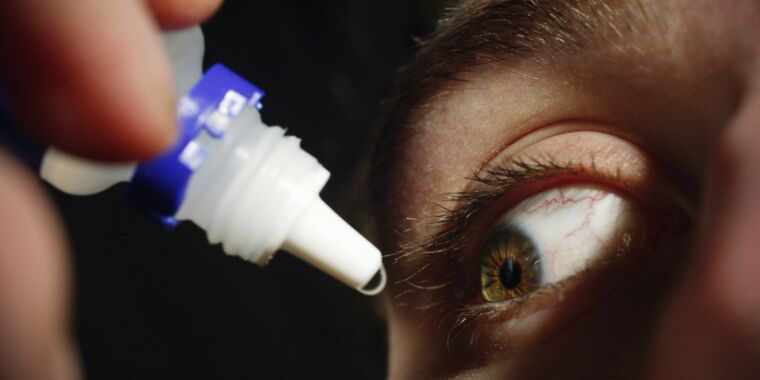
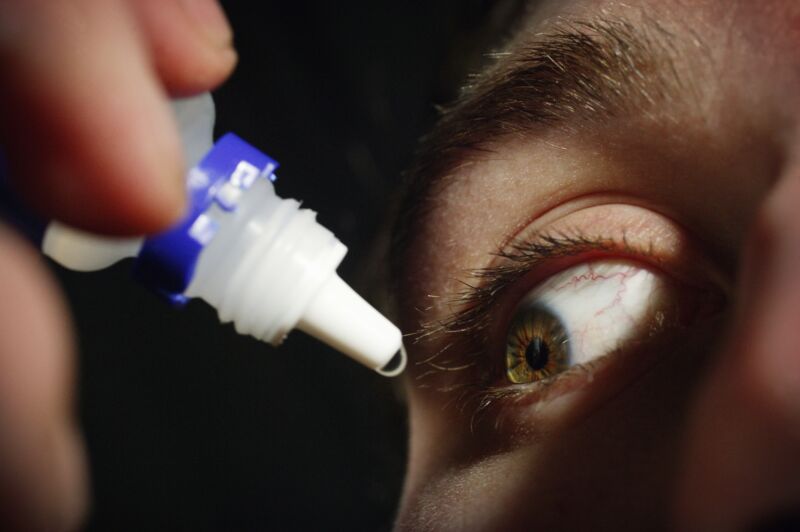
Eye drops are uniquely risky because the eye is an immune-privileged site.

Young man applying eye drops.

This year has been marked by many terrifying things, but perhaps the most surprising of the 2023 horrors was … eye drops.

The seemingly innocuous teeny squeeze bottle made for alarming headlines numerous times during our current revolution around the sun, with lengthy lists of recalls, startling factory inspections, and ghastly reports of people developing near-untreatable bacterial infections, losing their eyes and vision, and dying.

Recapping this unexpected threat to health, the Food and Drug Administration on Tuesday released an advisory titled “What You Should Know about Eye Drops” in hopes of keeping the dangers of this year from leaking into the next. Among the notable points from the regulator was this stark pronouncement: No one should ever use any homeopathic ophthalmic products, and every single such product should be pulled off the market.

The point is unexpected, given that none of the high-profile infections and recalls this year involved homeopathic products. But, it should be welcomed by any advocates of evidence-based medicine.

Homeopathy is an 18th century pseudoscience that produces bogus remedies that work no better than a placebo and, if prepared improperly, can be toxic, even deadly. The practice relies on two false principles: the  “law of similars,” aka “like cures like,” meaning a substance that causes a specific symptom in a healthy person can treat conditions and diseases that involve that same symptom, and the “law of infinitesimals,” which states that diluting the substance renders it more potent. As such, homeopathic products begin with toxic substances that are then extremely diluted—often into oblivion—in a ritualistic procedure. Some homeopaths hold that water molecules can have “memory.”

Clear risks

In the US, these products are marketed as legitimate treatments and sold alongside evidence-based treatments (though consumer advocates are trying to change that). The reason this is allowed for now is because of a regulatory quirk: Based on the 1938 Food, Drug, and Cosmetic Act, homeopathic products are generally considered exempt from pre-market FDA safety and efficacy reviews as long as the active ingredient in the product is included in the Homeopathic Pharmacopoeia, a list of substances approved by homeopaths.

In recent years, the FDA and the Federal Trade Commission have cracked down on homeopathic products, though. And it seems from today’s advisory that the FDA is not holding back on homeopathic products for the eyes. The regulator notes that any products meant for the eye “pose a heightened risk of harm” because the eyes are an immune-privileged site in the body. That is, innate immune responses are restrained in the eye to prevent damaging inflammation, which could threaten vision. “Any drug used in the eyes must be sterile to reduce the risk of infection,” the FDA said.

But whether or not homeopathic eye drops are labeled as sterile doesn’t seem to matter to the FDA. The regulator cautions: “Do not use ophthalmic products that: Are labeled as homeopathic, as these products should not be marketed.” Their lack of pre-market safety and efficacy reviews appears to be enough to warrant avoidance.

The FDA also cautions consumers not to use any over-the-counter eye drop product that claims to treat glaucoma, cataracts, retinopathy, or macular degeneration because there are simply no actual over-the-actual treatments for these conditions. If a non-prescription product claims this, you can assume it’s bogus and avoid it. Consumers should also avoid anything that includes Methylsulfonylmethane (MSM), which is illegally sold in the US, and anything with silver sulfate or argentum because these can permanently change the white color of your eyes.

Every homeopathic eye drop should be pulled off the market, FDA says Read More »