kagi

for-the-lazy-techie:-these-are-ars-staff’s-last-minute-holiday-gift-picks

For the lazy techie: These are Ars staff’s last-minute holiday gift picks


Two wireless mice, two external hard drives, and a partridge in a pear tree.

Credit: Aurich Lawson | Getty Images

The holidays have snuck up on us. How is it already that time?

If you’re on top of things and have already bought all your Christmas gifts, I commend you. Not all of us are so conscientious. In fact, one of us is so behind on holiday prep that he is not only running late on buying gifts; he’s also behind on publishing the Ars staff gift guide he said he’d write. (Whoever could we be talking about?)

So for my fellow last-minute scramblers, I polled Ars writers and editors for gift ideas they know will be solid because they’ve actually used them. As such, you’ll find gift options below that Ars staffers have used enough to feel good about recommending. Further, I made sure all of these are available for delivery before Christmas as of today, at least where I live.

For each gadget (or whatever else it might be), we have a brief description of how or why we’ve been using this particular thing and why we would recommend it. Note that the prices we’ve listed here represent where they were at the time this article was written, but online retailers often vary prices based on different factors, so you might see something different when you click through.

Ars Commentariat: If you feel inclined, feel free to share some other ideas. I genuinely might take advantage if you share something good.

Ars Technica may earn compensation for sales from links on this post through affiliate programs. (We won’t affiliatize any shared links in the comments, of course.)

Under $50

Tiny USB-A to USB-C adapter pack – $8

Somehow, amazingly, we are still living in a split USB-C/USB-A world all these years later. No one’s thrilled about it, but there’s no end in sight. Some folks in the Apple ecosystem turn to Apple’s first-party adapters, but there are two problems with them in my view: first, they’re weirdly expensive, as you’d expect. And second, they’re larger than they need to be.

I have about a dozen of these little adapters sitting around my house. The only downside is that because they’re shorter, they’re thicker, so you can’t always put two right next to each other in the MacBook Pro’s USB-C ports. But in the aforementioned mixed-use quagmire we all now occupy, odds are good you can just put it next to something that actually uses a USB-C connection. If you’re like me, you’re at about 2/3 USB-C and 1/3 USB-A at this point.

There are a bunch of brands for these, but they’re all pretty interchangeable, and I’ve not had any problems with these in particular.

– Samuel Axon

The Thing on 4K UltraHD Blu-ray – $12

People often debate whether Die Hard is a Christmas movie. (I definitely think it is.) But there’s another movie I often watch during the holidays: John Carpenter’s The Thing. I’ll freely admit it’s not holiday-themed in any way, but it’s at least filled with snow and winter gloom!

I don’t buy every movie on physical media—I’ve accepted that a lot of my library is going to be on Apple’s TV app or coming and going on streaming services—but I try to collect the lifelong favorites to make sure I’ll still have them decades down the road. (As long as they keep making Blu-ray players, anyway, which unfortunately is starting to look as uncertain as whether a favorite film stays on Netflix.)

A screengrab from The Thing

MacReady is admittedly not known for his holiday cheer. Credit: Universal

For me, The Thing definitely qualifies as a favorite that’s worth holding onto for years to come.

– Samuel Axon

Acer USB C Hub, 7 in 1 Multi-Port Adapter – $18

Modern laptops with only two USB-C ports basically require a hub. This Acer turns one port into HDMI (4K@30Hz), two USB-A ports for legacy gear, SD/microSD slots, and 100 W passthrough charging. At $18, I keep one in my bag and one on my desk. It’s not fancy, but it earns its keep the first time you need to dump a memory card or plug into a TV set.

– Benj Edwards

Artificial Intelligence: A Guide for Thinking Humans by Melanie Mitchell – $20

Originally published in 2019, it’s an amazing testament to how strong this book is that even after all that’s happened, the 2025 reissue doesn’t change much. Melanie Mitchell, a professor of computer science at Portland State University and an external professor at the Santa Fe Institute, nails this historical summary of how we got to this point through multiple AI springs and AI winters.

She carefully explains the concepts and research underpinnings of contemporary developments in machine learning, large language models, image generation, and so on, while amplifying key voices from several of the people who contributed to progress in this field—both doomsayers and boosters alike—with a technically rigorous and ethically informed point of view.

If you or someone you know is just getting started learning about AI as we know it today, there are a lot of books they could read, and some of them are surely more contemporary. But I can hardly think of any that make a better foundation.

– Samuel Axon

Pinecil soldering iron – $40

Every self-respecting geek should own a soldering iron. Even if you aren’t making your own PCBs or recapping old electronics, it’s the kind of thing that just comes in handy. Especially around the holidays, when people are getting out their old battery-powered decorations that come with a lot of memories, wear, and flaky power terminals. Be the hero that brings a treasured light-up keepsake back to life!

When you don’t need a full-on soldering station, though, it’s nice to have something compact and easy to slip in a drawer. Enter the Pinecil, conveniently powered over USB-C, with a slick little screen allowing for easy temperature control (in F or C) and firmware that auto-sleeps if you forget to unplug it.

– Aurich Lawson

Anker 67 watt USB charger and Anker USB-C silicon power cable – $25 and $16

If you already have a suitable USB-C power supply (you really want at least 60 watts) and a USB-C cable, you’re set. If not, this power supply from Anker—a reliable brand, in my experience—is compact and folds up for easy storage. Not all USB-C cables are up to the task of transmitting the magic wall juice, so if you’re not sure you have an appropriate one, pick up the above cable, which is sheathed in silicon to keep it nice and floppy so you’re not wrestling with a stiff cord while using your iron.

– Aurich Lawson

Knog Bike Bells – $22 – $33

While a lot of my road bike’s miles are spent on actual roads, it’s hard to do any long rides in my area without spending a little time on a cycle trail—one shared by pedestrians, runners, scooter riders, casual cyclists, and random others. Even if the rules of most of those trails didn’t specify using a bell, it’s a smart idea to have one—especially one that’s loud enough to cut through whatever’s coming out of the headphones that most people wear.

But real estate on my handlebars is limited. They already host a cycling computer and a light, and two cables and two hydraulic tubes snake their way through the area, emerging from under the handlebar tape before diving into the frame. Finding a bell that both works and keeps out of the way turned into a bit of a challenge. And then a solution presented itself: A company called Knog sent me an email about their bell offerings.
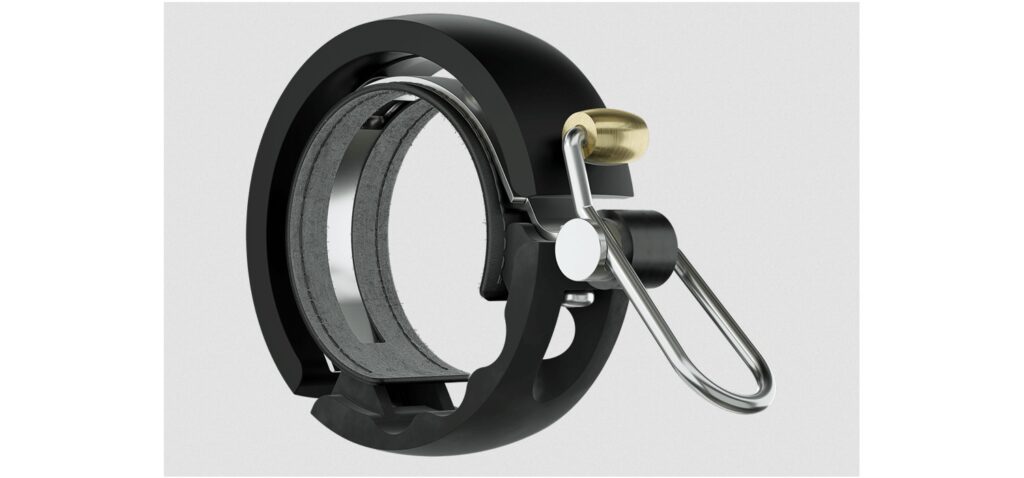
A bike bell against a white background

One of Knog’s bike bells. Credit: Knog

All of Knog’s options are mechanically simple—just a half circle of metal that follows the circumference of the handlebar and a spring-loaded hammer to strike it—and loud enough to catch even headphone wearers’ attention. They’re also low-profile, barely sticking out from the handlebars themselves, and they’re narrow enough that it was easy to find space for one without bumping it into any of the cabling. It’s all unobtrusive enough that I forget mine’s there until I need it. Yes, you can find lots of cheaper alternative designs (the Knogs run between $20 and $45), but for me, it’s worth paying an extra $10–$15 for something that suits my needs this well.

– John Timmer

Razer Orochi V2 wireless mouse – $34

This is the mouse I’m using right now as I type this. I wanted a mouse that could cross basically every domain: It needed to be good enough for gaming, but conveniently wireless, while also working well across macOS, Windows, and Linux—and it needed to be portable and not too embarrassing in a professional context because I fly to far-flung cities for work at least a dozen times a year. Razer’s Orochi met all of those goals, and I appreciate that it looks neat and professional, despite the fact that it’s very much a gamer mouse.

The only area where it fumbles is that Razer’s app seems to crash and cause problems for me on both macOS and Windows, but it works just fine without the app, so I uninstalled it, and everything’s been golden since. (To be clear, you don’t need to install it to use the mouse.)

It wins points for versatility; I don’t think it really compromises anything across all the situations I mentioned.

As of this writing, it’s on sale for $34, but the typical price is $70—still not bad for what you’re getting.

– Samuel Axon

Pricier picks

OWC Express 1M2 – $90

I set up a home studio this year to record my righteous jams, and as part of that process, I needed an external SSD both to back up project files and to hold many hundreds of gigs of virtual instruments. I wanted something 1) blazingly fast, 2) good-looking, 3) bus-powered, 4) free of all (and all too common) sleep/wake glitches, 5) unlikely to burst into flames (these things can get hot), and yet also 6) completely fanless because my righteous jams would be far less righteous with a fan droning in the background.
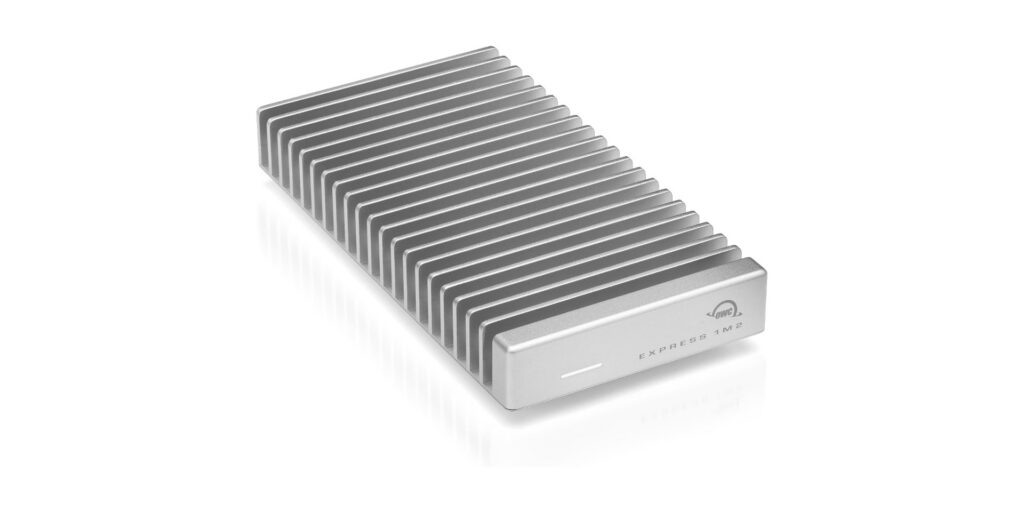
A durable hard drive enclosure

The OWC Express 1M2 is used for backups for Nate’s “righteous jams.” Credit: OWC

Those criteria led me to OWC’s Express 1M2, an SSD enclosure that transfers data at 40Gb/s over USB 4, matches the look of my Mac mini perfectly (and works with PCs), and is bus-powered. It has never given me a sleep/wake problem; it gets warm but never palm-searingly hot, and it dissipates heat through a chonky, milled-aluminum case that requires no fan.

I love this thing. It was ludicrously easy to install my own NVMe M.2 drive in it (though you can also pay a small premium for pre-installed storage). I’ve never had a moment of trouble—nor have I ever heard it. Yes, the enclosure costs more than some other options, but it’s a well-made piece of kit that can transfer data nearly as fast as my Mac’s internal SSD and should last for years. If someone in your life needs an SSD enclosure, they could do far, far worse than the Express 1M2.

– Nate Anderson

Kagi subscription – $108/year

It’s been about a year since I switched full-time to Kagi for my search engine needs, leaving Google behind in a cloud of dust and not looking back, and it was the correct choice, at least for me. Kagi’s upsides are many—including and especially search that works how it’s supposed to work instead of by fabricating garbage or tricking you into buying things—but the big downside is that while Kagi has a free tier, real daily usage requires money.

But if you’re a happy Kagi user like me and you want to tempt others into using the service, Kagi has gift subscriptions! If you’ve been trying to tempt a friend or relative into abandoning Google’s sinking AI ship but they’re balking at the price, throw some money at that problem and knock that barrier down! A “pro” Kagi subscription with unlimited search costs about a hundred dollars a year, and while that obviously isn’t nothing, it’s also not an unfair price—especially for something I use every day. Kagi: It’s what’s for Christmas!

– Lee Hutchinson

Philips Hue Bridge Pro – $99

Unlike Kagi, I’ve been using Philips Hue lights for a long, long time—13 years and counting, and most of those old first-gen bulbs are still operational. But the bridge, the Hue component that actually connects to your LAN, has long had an annoying problem: It can hook up to a max of about 50 Hue bulbs, and that’s it. (The reason has to do with cost-saving choices Philips made on the bridge design.)

Thirteen years has been enough for me to accumulate at least 50 Hue devices, so this limit has been problematic for me—but it’s a problem no more! After a decade and change, Philips has finally released an updated “Pro” bridge that handles far more Hue devices—and it comes in stylish black! The new bridge brings some new capabilities, too, but the big news is that new device limit—something long-time customers like me have spent years pining for. Now I can festoon my house with even more automatic lights!

– Lee Hutchinson

The Logitech MX Master 4 – $120

The Logitech MX Master 3S and the newer MX Master 4 remain two of the best productivity mice on the market. Both use an 8,000-DPI Darkfield sensor, the excellent MagSpeed electromagnetic scroll wheel, and Logitech’s deep customization stack. The 3S has been our long-standing recommendation, but the MX Master 4 brings a few quality-of-life improvements that may justify the upgrade. Most notably, it replaces the 3S’s soft-touch palm coating, which wears quickly and tends to attract grime, with more durable textured materials. The redesigned switches also make the 4 one of the quietest mice you can buy, with muted clicks and a near-silent scroll wheel.

A hand moves a mouse against a white background

Logitech MX Master 4, the mouse used by Ars Editor-in-Chief Ken Fisher. Credit: Logitech

The more ambitious addition is the new haptic system, meant to provide tactile feedback for shortcut triggers and app-specific “Actions Ring” menus. In practice, though, software support remains thin. Productivity apps haven’t yet embraced haptic signaling, and months after launch, the plugin ecosystem is still limited. The MX Master 4 is a well-executed refinement, but its headline feature is waiting for the software world to catch up.

– Ken Fisher

Ray-Ban Meta Wayfarer glasses – $247

The Ray-Ban Meta glasses may look bulkier than a standard pair of Wayfarers, but the added hardware delivers a genuinely interesting glimpse at where mobile computing is headed. After spending time with them, it’s clear that eyewear will likely follow the same trajectory as smartwatches: once niche, now a viable surface for ambient computing. The multimodal AI features are impressive, and the built-in camera produces better-than-expected 1080p/30fps video, though low-light performance remains limited by the small sensor.

These are still early-stage devices with the usual growing pains, but they’re a compelling gift for early adopters who want a front-row seat to the future of wearable interfaces.

– Ken Fisher

Samsung T9 external SSD (2 TB) – $235

As I once again attempted to make the Sophie’s Choice of which Steam game to uninstall because I ran out of disk space, I realized that part of my problem is that I have two computers (a macOS laptop and a Windows desktop) and I’ve doubled up on storing certain things—like the absolutely enormous eXoDOS collection, for example—on both machines so I could access them regardless of where I was at.

The best thing I could do to help my constant space woes was to consolidate anything that I needed on both machines into an external drive I could share between them. I went with Samsung’s T9 external SSD, and so far, I’m happy with it. As planned, I now have a lot more breathing room on both computers.

– Samuel Axon

Photo of Samuel Axon

Samuel Axon is the editorial lead for tech and gaming coverage at Ars Technica. He covers AI, software development, gaming, entertainment, and mixed reality. He has been writing about gaming and technology for nearly two decades at Engadget, PC World, Mashable, Vice, Polygon, Wired, and others. He previously ran a marketing and PR agency in the gaming industry, led editorial for the TV network CBS, and worked on social media marketing strategy for Samsung Mobile at the creative agency SPCSHP. He also is an independent software and game developer for iOS, Windows, and other platforms, and he is a graduate of DePaul University, where he studied interactive media and software development.

For the lazy techie: These are Ars staff’s last-minute holiday gift picks Read More »

enough-is-enough—i-dumped-google’s-worsening-search-for-kagi

Enough is enough—I dumped Google’s worsening search for Kagi


I like how the search engine is the product instead of me.

Artist's depiction of the article author heaving a large multicolored

“Won’t be needing this anymore!” Credit: Aurich “The King” Lawson

“Won’t be needing this anymore!” Credit: Aurich “The King” Lawson

Mandatory AI summaries have come to Google, and they gleefully showcase hallucinations while confidently insisting on their truth. I feel about them the same way I felt about mandatory G+ logins when all I wanted to do was access my damn YouTube account: I hate them. Intensely.

But unlike those mandatory G+ logins—on which Google eventually relented before shutting down the G+ service—our reading of the tea leaves suggests that, this time, the search giant is extremely pleased with how things are going.

Fabricated AI dreck polluting your search? It’s the new normal. Miss your little results page with its 10 little blue links? Too bad. They’re gone now, and you can’t get them back, no matter what ephemeral workarounds or temporarily functional flags or undocumented, could-fail-at-any-time URL tricks you use.

And the galling thing is that Google expects you to be a good consumer and just take it. The subtext of the company’s (probably AI-generated) robo-MBA-speak non-responses to criticism and complaining is clear: “LOL, what are you going to do, use a different search engine? Now, shut up and have some more AI!”

But like the old sailor used to say: “That’s all I can stands, and I can’t stands no more.” So I did start using a different search engine—one that doesn’t constantly shower me with half-baked, anti-consumer AI offerings.

Out with Google, in with Kagi.

What the hell is a Kagi?

Kagi was founded in 2018, but its search product has only been publicly available since June 2022. It purports to be an independent search engine that pulls results from around the web (including from its own index) and is aimed at returning search to a user-friendly, user-focused experience. The company’s stated purpose is to deliver useful search results, full stop. The goal is not to blast you with AI garbage or bury you in “Knowledge Graph” summaries hacked together from posts in a 12-year-old Reddit thread between two guys named /u/WeedBoner420 and /u/14HitlerWasRight88.

Kagi’s offerings (it has a web browser, too, though I’ve not used it) are based on a simple idea. There’s an (oversimplified) axiom that if a good or service (like Google search, for example, or good ol’ Facebook) is free for you to use, it’s because you’re the product, not the customer. With Google, you pay with your attention, your behavioral metrics, and the intimate personal details of your wants and hopes and dreams (and the contents of your emails and other electronic communications—Google’s got most of that, too).

With Kagi, you pay for the product using money. That’s it! You give them some money, and you get some service—great service, really, which I’m overall quite happy with and which I’ll get to shortly. You don’t have to look at any ads. You don’t have to look at AI droppings. You don’t have to give perpetual ownership of your mind-palace to a pile of optioned-out tech bros in sleeveless Patagonia vests while you are endlessly subjected to amateur AI Rorschach tests every time you search for “pierogis near me.”

How much money are we talking?

I dunno, about a hundred bucks a year? That’s what I’m spending as an individual for unlimited searches. I’m using Kagi’s “Professional” plan, but there are others, including a free offering so that you can poke around and see if the service is worth your time.

image of kagi billing panel

This is my account’s billing page, showing what I’ve paid for Kagi in the past year. (By the time this article runs, I’ll have renewed my subscription!)

Credit: Lee Hutchinson

This is my account’s billing page, showing what I’ve paid for Kagi in the past year. (By the time this article runs, I’ll have renewed my subscription!) Credit: Lee Hutchinson

I’d previously bounced off two trial runs with Kagi in 2023 and 2024 because the idea of paying for search just felt so alien. But that was before Google’s AI enshittification rolled out in full force. Now, sitting in the middle of 2025 with the world burning down around me, a hundred bucks to kick Google to the curb and get better search results feels totally worth it. Your mileage may vary, of course.

The other thing that made me nervous about paying for search was the idea that my money was going to enrich some scumbag VC fund, but fortunately, there’s good news on that front. According to the company’s “About” page, Kagi has not taken any money from venture capitalist firms. Instead, it has been funded by a combination of self-investment by the founder, selling equity to some Kagi users in two rounds, and subscription revenue:

Kagi was bootstrapped from 2018 to 2023 with ~$3M initial funding from the founder. In 2023, Kagi raised $670K from Kagi users in its first external fundraise, followed by $1.88M raised in 2024, again from our users, bringing the number of users-investors to 93… In early 2024, Kagi became a Public Benefit Corporation (PBC).

What about DuckDuckGo? Or Bing? Or Brave?

Sure, those can be perfectly cromulent alternatives to Google, but honestly, I don’t think they go far enough. DuckDuckGo is fine, but it largely utilizes Bing’s index; and while DuckDuckGo exercises considerable control over its search results, the company is tied to the vicissitudes of Microsoft by that index. It’s a bit like sitting in a boat tied to a submarine. Sure, everything’s fine now, but at some point, that sub will do what subs do—and your boat is gonna follow it down.

And as for Bing itself, perhaps I’m nitpicky [Ed. note: He is!], but using Bing feels like interacting with 2000-era MSN’s slightly perkier grandkid. It’s younger and fresher, yes, but it still radiates that same old stanky feeling of taste-free, designed-by-committee artlessness. I’d rather just use Google—which is saying something. At least Google’s search home page remains uncluttered.

Brave Search is another fascinating option I haven’t spent a tremendous amount of time with, largely because Brave’s cryptocurrency ties still feel incredibly low-rent and skeevy. I’m slowly warming up to the Brave Browser as a replacement for Chrome (see the screenshots in this article!), but I’m just not comfortable with Brave yet—and likely won’t be unless the company divorces itself from cryptocurrencies entirely.

More anonymity, if you want it

The feature that convinced me to start paying for Kagi was its Privacy Pass option. Based on a clean-sheet Rust implementation of the Privacy Pass standard (IETF RFCs 9576, 9577, and 9578) by Raphael Robert, this is a technology that uses cryptographic token-based auth to send an “I’m a paying user, please give me results” signal to Kagi, without Kagi knowing which user made the request. (There’s a much longer Kagi blog post with actual technical details for the curious.)

To search using the tool, you install the Privacy Pass extension (linked in the docs above) in your browser, log in to Kagi, and enable the extension. This causes the plugin to request a bundle of tokens from the search service. After that, you can log out and/or use private windows, and those tokens are utilized whenever you do a Kagi search.

image of a kagi search with privacy pass enabled

Privacy pass is enabled, allowing me to explore the delicious mystery of pierogis with some semblance of privacy.

Credit: Lee Hutchinson

Privacy pass is enabled, allowing me to explore the delicious mystery of pierogis with some semblance of privacy. Credit: Lee Hutchinson

The obvious flaw here is that Kagi still records source IP addresses along with Privacy Pass searches, potentially de-anonymizing them, but there’s a path around that: Privacy Pass functions with Tor, and Kagi maintains a Tor onion address for searches.

So why do I keep using Privacy Pass without Tor, in spite of the opsec flaw? Maybe it’s the placebo effect in action, but I feel better about putting at least a tiny bit of friction in the way of someone with root attempting to casually browse my search history. Like, I want there to be at least a SQL JOIN or two between my IP address and my searches for “best Mass Effect alien sex choices” or “cleaning tips for Garrus body pillow.” I mean, you know, assuming I were ever to search for such things.

What’s it like to use?

Moving on with embarrassed rapidity, let’s look at Kagi a bit and see how using it feels.

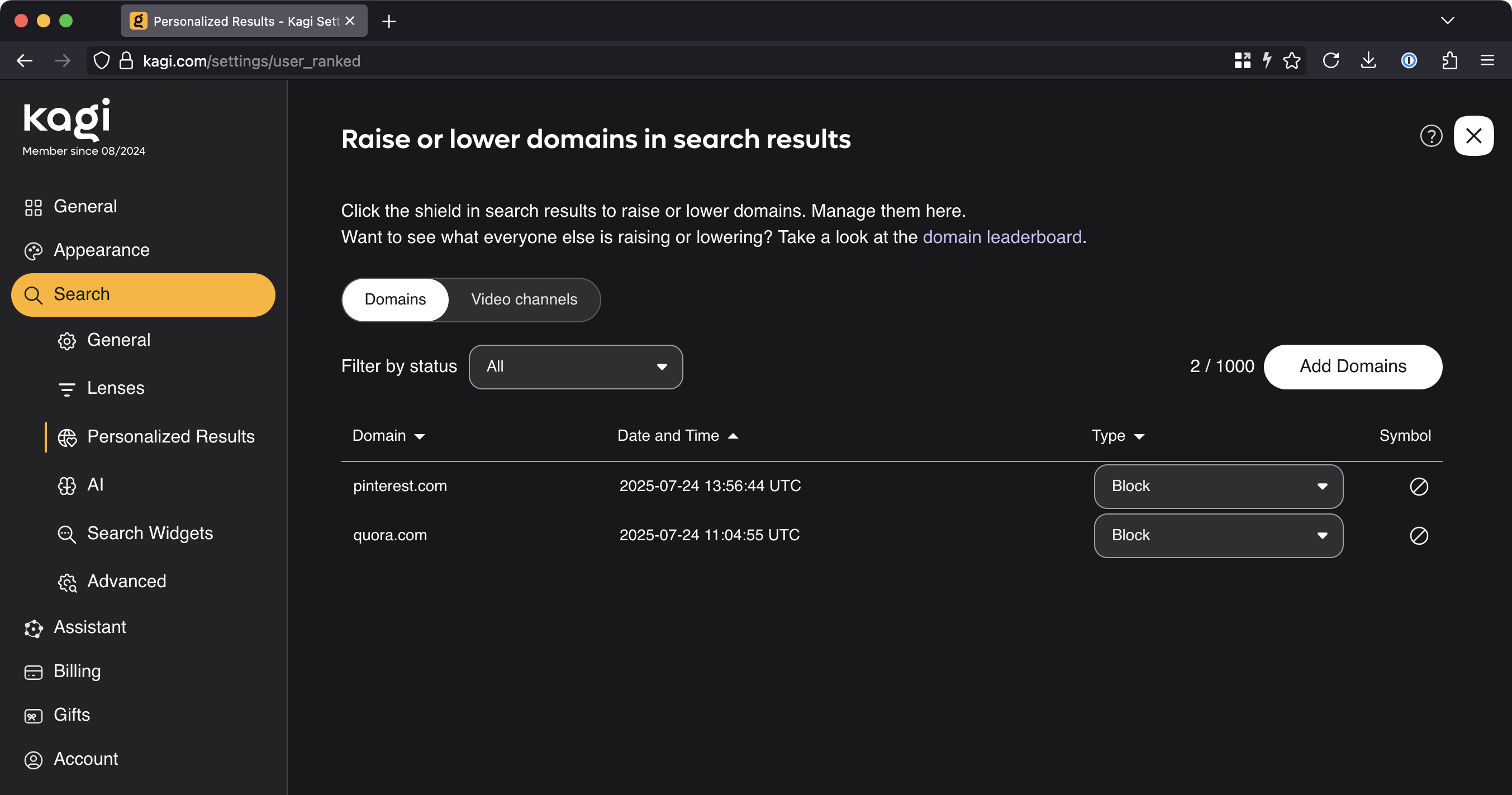
My anecdotal observation is that Kagi doesn’t favor Reddit-based results nearly as much as Google does, but sometimes it still has them near or at the top. And here is where Kagi curb-stomps Google with quality-of-life features: Kagi lets you prioritize or de-prioritize a website’s prominence in your search results. You can even pin that site to the top of the screen or block it completely.

This is a feature I’ve wanted Google to get for about 25 damn years but that the company has consistently refused to properly implement (likely because allowing users to exclude sites from search results notionally reduces engagement and therefore reduces the potential revenue that Google can extract from search). Well, screw you, Google, because Kagi lets me prioritize or exclude sites from my results, and it works great—I’m extraordinarily pleased to never again have to worry about Quora or Pinterest links showing up in my search results.

Further, Kagi lets me adjust these settings both for the current set of search results (if you don’t want Reddit results for this search but you don’t want to drop Reddit altogether) and also globally (for all future searches):

image of kagi search personalization options

Goodbye forever, useless crap sites.

Credit: Lee Hutchinson

Goodbye forever, useless crap sites. Credit: Lee Hutchinson

Another tremendous quality-of-life improvement comes via Kagi’s image search, which does a bunch of stuff that Google should and/or used to do—like giving you direct right-click access to save images without having to fight the search engine with workarounds, plugins, or Tampermonkey-esque userscripts.

The Kagi experience is also vastly more customizable than Google’s (or at least, how Google’s has become). The widgets that appear in your results can be turned off, and the “lenses” through which Kagi sees the web can be adjusted to influence what kinds of things do and do not appear in your results.

If that doesn’t do it for you, how about the ability to inject custom CSS into your search and landing pages? Or to automatically rewrite search result URLs to taste, doing things like redirecting reddit.com to old.reddit.com? Or breaking free of AMP pages and always viewing originals instead?

Image of kagi custom css field

Imagine all the things Ars readers will put here.

Credit: Lee Hutchinson

Imagine all the things Ars readers will put here. Credit: Lee Hutchinson

Is that all there is?

Those are really all the features I care about, but there are loads of other Kagi bits to discover—like a Kagi Maps tool (it’s pretty good, though I’m not ready to take it up full time yet) and a Kagi video search tool. There are also tons of classic old-Google-style inline search customizations, including verbatim mode, where instead of trying to infer context about your search terms, Kagi searches for exactly what you put in the box. You can also add custom search operators that do whatever you program them to do, and you get API-based access for doing programmatic things with search.

A quick run-through of a few additional options pages. This is the general customization page. Lee Hutchinson

I haven’t spent any time with Kagi’s Orion browser, but it’s there as an option for folks who want a WebKit-based browser with baked-in support for Privacy Pass and other Kagi functionality. For now, Firefox continues to serve me well, with Brave as a fallback for working with Google Docs and other tools I can’t avoid and that treat non-Chromium browsers like second-class citizens. However, Orion is probably on the horizon for me if things in Mozilla-land continue to sour.

Cool, but is it any good?

Rather than fill space with a ton of comparative screenshots between Kagi and Google or Kagi and Bing, I want to talk about my subjective experience using the product. (You can do all the comparison searches you want—just go and start searching—and your comparisons will be a lot more relevant to your personal use cases than any examples I can dream up!)

My time with Kagi so far has included about seven months of casual opportunistic use, where I’d occasionally throw a query at it to see how it did, and about five months of committed daily use. In the five months of daily usage, I can count on one hand the times I’ve done a supplementary Google search because Kagi didn’t have what I was looking for on the first page of results. I’ve done searches for all the kinds of things I usually look for in a given day—article fact-checking queries, searches for details about the parts of speech, hunts for duck facts (we have some feral Muscovy ducks nesting in our front yard), obscure technical details about Project Apollo, who the hell played Dupont in Equilibrium (Angus Macfadyen, who also played Robert the Bruce in Braveheart), and many, many other queries.

Image of Firefox history window showing kagi searches for july 22

A typical afternoon of Kagi searches, from my Firefox history window.

Credit: Lee Hutchinson

A typical afternoon of Kagi searches, from my Firefox history window. Credit: Lee Hutchinson

For all of these things, Kagi has responded quickly and correctly. The time to service a query feels more or less like Google’s service times; according to the timer at the top of the page, my Kagi searches complete in between 0.2 and 0.8 seconds. Kagi handles misspellings in search terms with the grace expected of a modern search engine and has had no problem figuring out my typos.

Holistically, taking search customizations into account on top of the actual search performance, my subjective assessment is that Kagi gets me accurate, high-quality results on more or less any given query, and it does so without festooning the results pages with features I find detractive and irrelevant.

I know that’s not a data-driven assessment, and it doesn’t fall back on charts or graphs or figures, but it’s how I feel after using the product every single day for most of 2025 so far. For me, Kagi’s search performance is firmly in the “good enough” category, and that’s what I need.

Kagi and AI

Unfortunately, the thing that’s stopping me from being completely effusive in my praise is that Kagi is exhibiting a disappointing amount of “keeping-up-with-the-Joneses” by rolling out a big ‘ol pile of (optional, so far) AI-enabled search features.

A blog post from founder Vladimir Prelovac talks about the company’s use of AI, and it says all the right things, but at this point, I trust written statements from tech company founders about as far as I can throw their corporate office buildings. (And, dear reader, that ain’t very far).

image of kagi ai features

No thanks. But I would like to exclude AI images from my search results, please.

Credit: Lee Hutchinson

No thanks. But I would like to exclude AI images from my search results, please. Credit: Lee Hutchinson

The short version is that, like Google, Kagi has some AI features: There’s an AI search results summarizer, an AI page summarizer, and an “ask questions about your results” chatbot-style function where you can interactively interrogate an LLM about your search topic and results. So far, all of these things can be disabled or ignored. I don’t know how good any of the features are because I have disabled or ignored them.

If the existence of AI in a product is a bright red line you won’t cross, you’ll have to turn back now and find another search engine alternative that doesn’t use AI and also doesn’t suck. When/if you do, let me know, because the pickings are slim.

Is Kagi for you?

Kagi might be for you—especially if you’ve recently typed a simple question into Google and gotten back a pile of fabricated gibberish in place of those 10 blue links that used to serve so well. Are you annoyed that Google’s search sucks vastly more now than it did 10 years ago? Are you unhappy with how difficult it is to get Google search to do what you want? Are you fed up? Are you pissed off?

If your answer to those questions is the same full-throated “Hell yes, I am!” that mine was, then perhaps it’s time to try an alternative. And Kagi’s a pretty decent one—if you’re not averse to paying for it.

It’s a fantastic feeling to type in a search query and once again get useful, relevant, non-AI results (that I can customize!). It’s a bit of sanity returning to my Internet experience, and I’m grateful. Until Kagi is bought by a value-destroying vampire VC fund or implodes into its own AI-driven enshittification cycle, I’ll probably keep paying for it.

After that, who knows? Maybe I’ll throw away my computers and live in a cave. At least until the cave’s robot exclusion protocol fails and the Googlebot comes for me.

Photo of Lee Hutchinson

Lee is the Senior Technology Editor, and oversees story development for the gadget, culture, IT, and video sections of Ars Technica. A long-time member of the Ars OpenForum with an extensive background in enterprise storage and security, he lives in Houston.

Enough is enough—I dumped Google’s worsening search for Kagi Read More »

bing-outage-shows-just-how-little-competition-google-search-really-has

Bing outage shows just how little competition Google search really has

Searching for new search —

Opinion: Actively searching without Google or Bing is harder than it looks.

Google logo on a phone in front of a Bing logo in the background

Getty Images

Bing, Microsoft’s search engine platform, went down in the very early morning today. That meant that searches from Microsoft’s Edge browsers that had yet to change their default providers didn’t work. It also meant that services relying on Bing’s search API—Microsoft’s own Copilot, ChatGPT search, Yahoo, Ecosia, and DuckDuckGo—similarly failed.

Services were largely restored by the morning Eastern work hours, but the timing feels apt, concerning, or some combination of the two. Google, the consistently dominating search platform, just last week announced and debuted AI Overviews as a default addition to all searches. If you don’t want an AI response but still want to use Google, you can hunt down the new “Web” option in a menu, or you can, per Ernie Smith, tack “&udm=14” onto your search or use Smith’s own “Konami code” shortcut page.

If dismay about AI’s hallucinations, power draw, or pizza recipes concern you—along with perhaps broader Google issues involving privacy, tracking, news, SEO, or monopoly power—most of your other major options were brought down by a single API outage this morning. Moving past that kind of single point of vulnerability will take some work, both by the industry and by you, the person wondering if there’s a real alternative.

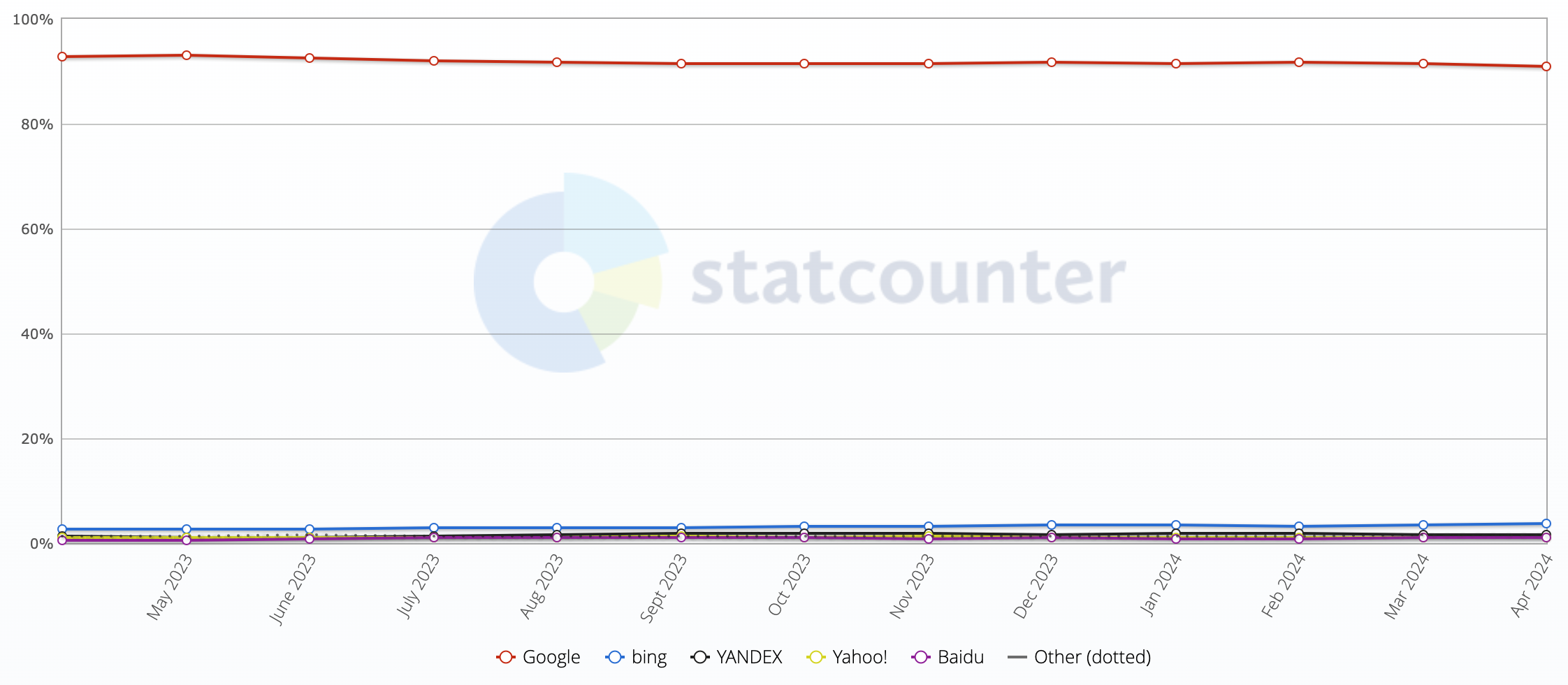
Search engine market share, as measured by StatCounter, April 2023–April 2024.

Search engine market share, as measured by StatCounter, April 2023–April 2024.

StatCounter

Upward of a billion dollars a year

The overwhelming majority of search tools offering an “alternative” to Google are using Google, Bing, or Yandex, the three major search engines that maintain massive global indexes. Yandex, being based in Russia, is a non-starter for many people around the world at the moment. Bing offers its services widely, most notably to DuckDuckGo, but its ad-based revenue model and privacy particulars have caused some friction there in the past. Before his company was able to block more of Microsoft’s own tracking scripts, DuckDuckGo CEO and founder Gabriel Weinberg explained in a Reddit reply why firms like his weren’t going the full DIY route:

… [W]e source most of our traditional links and images privately from Bing … Really only two companies (Google and Microsoft) have a high-quality global web link index (because I believe it costs upwards of a billion dollars a year to do), and so literally every other global search engine needs to bootstrap with one or both of them to provide a mainstream search product. The same is true for maps btw — only the biggest companies can similarly afford to put satellites up and send ground cars to take streetview pictures of every neighborhood.

Bing makes Microsoft money, if not quite profit yet. It’s in Microsoft’s interest to keep its search index stocked and API open, even if its focus is almost entirely on its own AI chatbot version of Bing. Yet if Microsoft decided to pull API access, or it became unreliable, Google’s default position gets even stronger. What would non-conformists have to choose from then?

Bing outage shows just how little competition Google search really has Read More »