nlrb

us-decides-spacex-is-like-an-airline,-exempting-it-from-labor-relations-act

US decides SpaceX is like an airline, exempting it from Labor Relations Act


SpaceX deemed a common carrier

US labels SpaceX a common carrier by air, will regulate firm under railway law.

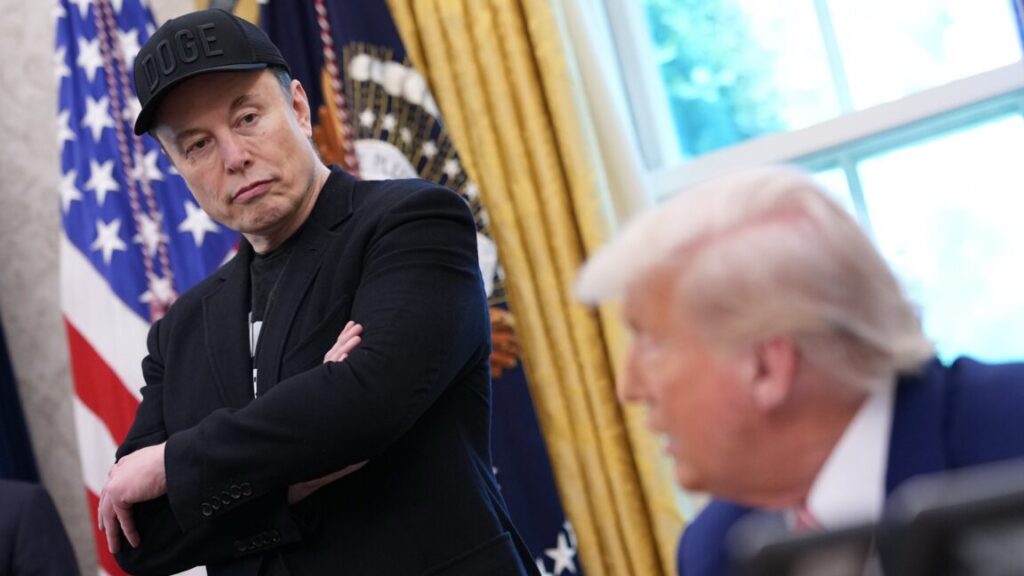
Elon Musk listens as President Donald Trump speaks to reporters in the Oval Office of the White House on May 30, 2025. Credit: Getty Images | Kevin Dietsch

The National Labor Relations Board abandoned a Biden-era complaint against SpaceX after a finding that the agency does not have jurisdiction over Elon Musk’s space company. The US labor board said SpaceX should instead be regulated under the Railway Labor Act, which governs labor relations at railroad and airline companies.

The Railway Labor Act is enforced by a separate agency, the National Mediation Board, and has different rules than the National Labor Relations Act enforced by the NLRB. For example, the Railway Labor Act has an extensive dispute-resolution process that makes it difficult for railroad and airline employees to strike. Employers regulated under the Railway Labor Act are exempt from the National Labor Relations Act.

In January 2024, an NLRB regional director alleged in a complaint that SpaceX illegally fired eight employees who, in an open letter, criticized CEO Musk as a “frequent source of embarrassment.” The complaint sought reinstatement of the employees, back pay, and letters of apology to the fired employees.

SpaceX responded by suing the NLRB, claiming the labor agency’s structure is unconstitutional. But a different issue SpaceX raised later—that it is a common carrier, like a rail company or airline—is what compelled the NLRB to drop its case. US regulators ultimately decided that SpaceX should be treated as a “common carrier by air” and “a carrier by air transporting mail” for the government.

SpaceX deemed a common carrier

In a February 6 letter to attorneys who represent the fired employees, NLRB Regional Director Danielle Pierce said the agency would defer to a National Mediation Board opinion that SpaceX is a common carrier:

In the course of the investigation and litigation of this case, a question was presented as to whether the Employer’s operations fall within the jurisdiction of the Railway Labor Act (“RLA”) rather than the [National Labor Relations] Act. As a result, consistent with Board law, the matter was referred to the National Mediation Board (“NMB”) on May 21, 2025 for an opinion as to whether the Employer is covered by the RLA. On January 14, 2026, the NMB issued its decision finding that the Employer is subject to the RLA as a common carrier by air engaged in interstate or foreign commerce as well as a carrier by air transporting mail for or under contract with the United States Government. Accordingly, the National Labor Relations Board lacks jurisdiction over the Employer and, therefore, I am dismissing your charge.

The letter was provided to Ars today by Anne Shaver, an attorney for the fired SpaceX employees. “The Railway Labor Act does not apply to space travel,” Shaver told Ars. “It is alarming that the NMB would take the initiative to radically expand the RLA’s jurisdiction to space travel absent direction from Congress, and that the NLRB would simply defer. We find the decision to be contrary to law and public policy.”

We contacted the NLRB today and will update this article if it provides a response. The NLRB decision was previously reported by Bloomberg and The New York Times.

“Jennifer Abruzzo, NLRB general counsel under former President Joe Biden, had rejected SpaceX’s claim that allegations against the company should be handled by the NMB,” Bloomberg wrote. “After President Donald Trump fired her in January last year, SpaceX asked the labor board to reconsider the issue.”

NLRB looked for way to settle

In April 2025, SpaceX and the NLRB told a federal appeals court in a joint filing that the NLRB would ask the NMB to decide whether it had jurisdiction over SpaceX. The decision to seek the NMB’s opinion was made “in the interests of potentially settling the legal disputes currently pending between the NLRB and SpaceX on terms mutually agreeable to both parties,” the joint filing said.

Shaver provided a July 2025 filing that the employees’ attorneys made with the NMB. The filing said that despite SpaceX claiming to hold itself out to the public as a common carrier through its website and certain marketing materials, the firm doesn’t actually carry passengers without “a negotiated, bespoke contract.”

“SpaceX’s descriptions of its transport activities are highly misleading,” the filing said. “First, regarding human spaceflight, other than sending astronauts to the ISS on behalf of the US and foreign governments, it has only ever agreed to contract with two very wealthy, famous entrepreneurs. The Inspiration4 and Polaris Dawn missions were both for Jared Isaacman, CEO of Shift4 and President Trump’s former pick to lead NASA prior to his public falling out with SpaceX CEO Elon Musk. Fram2 was for Chun Wang, a cryptocurrency investor who reportedly paid $55 million per seat. A total of two private customers for human spaceflight does not a common carrier make.”

The letter said that SpaceX redacted pricing information from marketing materials it submitted as exhibits. “If these were actually marketing materials provided to the public, there would be no need to redact pricing information,” the filing said. “SpaceX’s redactions underscore that it provides such materials at its discretion to select recipients, not to the public at large—far from the conduct of a true common carrier.”

The ex-employees’ attorneys further argued that SpaceX is not engaged in interstate or foreign commerce as defined by the Railway Labor Act. “SpaceX’s transport activities are not between one state or territory and another, nor between a state or territory and a foreign nation, nor between points in the same state but through another state. Rather, they originate in Florida, Texas, or California, and go to outer space,” the filing said.

Spaceflight company and… mail carrier?

The filing also disputed SpaceX’s argument that it is a “carrier by air transporting mail for or under contract with the United States Government.” Evidence presented by SpaceX shows only that it carried SpaceX employee letters to the crew of the International Space Station and “crew supplies provided for by the US government in its contracts with SpaceX to haul cargo to the ISS,” the filing said. “They do not show that the government has contracted with SpaceX as a ‘mail carrier.’”

SpaceX’s argument “is rife with speculation regarding its plans for the future,” the ex-employees’ attorneys told the NMB. “One can only surmise that the reason for its constant reference to its future intent to develop its role as a ‘common carrier’ is the lack of current standing in that capacity.” The filing said Congress would have to add space travel to the Railway Labor Act’s jurisdiction in order for SpaceX to be considered a common carrier.

When asked about plans for appeal, Shaver noted that they have a pending case in US District Court for the Central District of California: Holland-Thielen et al v. SpaceX and Elon Musk. “The status of that case is that we defeated SpaceX’s motion to compel arbitration at the district court level, and that is now on appeal to the 9th circuit,” she said.

SpaceX’s lawsuit against the NLRB is still ongoing at the US Court of Appeals for the 5th Circuit, but the case was put on hold while the sides waited for the NMB and NLRB to decide which agency has jurisdiction over SpaceX.

Photo of Jon Brodkin

Jon is a Senior IT Reporter for Ars Technica. He covers the telecom industry, Federal Communications Commission rulemakings, broadband consumer affairs, court cases, and government regulation of the tech industry.

US decides SpaceX is like an airline, exempting it from Labor Relations Act Read More »
amazon-facing-strike-threats-as-senate-report-details-hidden-widespread-injuries

Amazon facing strike threats as Senate report details hidden widespread injuries


“Obsessed with speed and productivity”

Amazon ignores strike threats, denies claims of “uniquely dangerous warehouses.”

Just as Amazon warehouse workers are threatening to launch the “first large-scale” unfair labor practices strike at Amazon in US history, Sen. Bernie Sanders (I-Vt.) released a report accusing Amazon of operating “uniquely dangerous warehouses” that allegedly put profits over worker safety.

As chair of the Senate Committee on Health, Education, Labor, and Pensions, Sanders started investigating Amazon in June 2023. His goal was “to uncover why Amazon’s injury rates far exceed those of its competitors and to understand what happens to Amazon workers when they are injured on the job.”

According to Sanders, Amazon “sometimes ignored” the committee’s requests and ultimately only supplied 285 documents requested. The e-commerce giant was mostly only willing to hand over “training materials given to on-site first aid staff,” Sanders noted, rather than “information on how it tracks workers, the quotas it imposes on workers, and the disciplinary actions it takes when workers cannot meet those quotas, internal studies on the connection between speed and injury rates, and the company’s treatment of injured workers.”

To fill in the gaps, Sanders’ team “conducted an exhaustive inquiry,” interviewing nearly 500 workers who provided “more than 1,400 documents, photographs, and videos to support their stories.” And while Amazon’s responses were “extremely limited,” Sanders said that the Committee was also able to uncover internal studies that repeatedly show that “Amazon chose not to act” to address safety risks, allegedly “accepting injuries to its workers as the cost of doing business.”

Perhaps most critically, key findings accuse Amazon of manipulating workplace injury data by “cherry-picking” data instead of confronting the alleged fact that “an analysis of the company’s data shows that Amazon warehouses recorded over 30 percent more injuries than the warehousing industry average in 2023.” The report also alleged that Amazon lied to federal regulators about injury data, discouraged workers from receiving outside care to hide injuries, and terminated injured workers while on approved medical leave.

“This evidence reveals a deeply troubling picture of how one of the largest corporations in the world treats its workforce,” Sanders reported, documenting “a corporate culture obsessed with speed and productivity.”

Amazon disputed Sanders’ report

In a statement, Amazon spokesperson Kelly Nantel disputed the report as “wrong on the facts.”

Sanders’ report allegedly “weaves together out-of-date documents and unverifiable anecdotes to create a pre-conceived narrative that he and his allies have been pushing for the past 18 months,” Nantel said. “The facts are, our expectations for our employees are safe and reasonable—and that was validated both by a judge in Washington after a thorough hearing and by the State’s Board of Industrial Insurance Appeals, which vacated ergonomic citations alleging a hazardous pace of work.”

Nantel said that Sanders ignored that Amazon has made “meaningful progress on safety—improving our recordable incident rates by 28 percent in the US since 2019, and our lost time incident rates (the most serious injuries) by 75 percent.”

But Sanders’ report anticipated this response, alleging that “many” workers “live with severe injuries and permanent disabilities because of the company’s insistence on enforcing grueling productivity quotas and its refusal to adequately care for injured workers.” Sanders said if Amazon had compelling evidence that refuted workers’ claims, the company failed to produce it.

“Although the Committee expects Amazon will dispute the veracity of the evidence those workers provided, Amazon has had eighteen months to offer its own evidence and has refused to do so,” Sanders reported.

Amazon Labor Union preparing to strike

In August, the National Labor Relations Board (NLRB) determined that Amazon is a joint employer of contracted drivers hired to ensure the e-commerce giant delivers its packages when promised. The Amazon Labor Union (ALU)—which nearly unanimously voted to affiliate with the International Brotherhood of Teamsters this summer—considered this a huge win after Amazon had long argued that it had no duty to bargain with driver unions and no responsibility for alleged union busting.

Things seemed to escalate quickly after that, with the NLRB in October alleging that Amazon illegally refused to bargain with the union, which reportedly represents thousands of drivers who are frustrated by what they claim are low wages and dangerous working conditions. As the NLRB continues to seemingly side with workers, Amazon allegedly is “teaming up with Elon Musk in a lawsuit to get the NLRB declared unconstitutional,” workers said in an email campaign reviewed by Ars.

Now, as the holidays approach and on-time deliveries remain Amazon’s top priority, the ALU gave the tech company until Sunday to come to the bargaining table or else “hundreds of workers are prepared to go on strike” at various warehouses. In another email reviewed by Ars, the ALU pushed for donations to support workers ahead of the planned strike.

“It’s one of the busiest times of year for Amazon,” the email said. “The threat of hundreds of workers at one of its busiest warehouses walking out has real power.”

In a statement provided to Ars, Amazon spokesperson Eileen Hards said that Sanders refused to visit Amazon facilities to see working conditions “firsthand” and instead pushed a “pre-conceived narrative” that Amazon claims is unsupported. Her statement also seemed to suggest that Amazon isn’t taking the threat of workers striking seriously, alleging that the ALU also pushes a “false narrative” by supposedly exaggerating the number of workers who have unionized. (Amazon’s full statement disputing Sanders’ claims in-depth is here.)

“For more than a year now, the Teamsters have continued to intentionally mislead the public—claiming that they represent ‘thousands of Amazon employees and drivers,’” Hards said. “They don’t, and this is another attempt to push a false narrative. The truth is that the Teamsters have actively threatened, intimidated, and attempted to coerce Amazon employees and third-party drivers to join them, which is illegal and is the subject of multiple pending unfair labor practice charges against the union.”

Workers seem unlikely to be quieted by such statements, telling Sanders that Amazon allegedly regularly ignores their safety concerns, orders workers to stay in roles causing them pain, denies workers’ medical care, and refuses to accommodate disabilities. Among the support needed for workers preparing to walk out are medical care and legal support, including “worker retaliation defense funds,” the union’s campaign said.

While Amazon seemingly downplays the number of workers reportedly past their breaking point, Sanders alleged that the problem is much more widespread than Amazon admits. According to his report, Amazon workers over “the past seven years” were “nearly twice as likely to be injured as workers in warehouses operated by the rest of the warehousing industry,” and “more than two-thirds of Amazon’s warehouses have injury rates that exceed the industry average.”

Amazon allegedly refuses to accept these estimates, even going so far as repeatedly claiming that “worker injuries were actually the result of workers’ ‘frailty’ and ‘intrinsic likelihood of injury,'” Sanders reported, rather than due to Amazon’s fast-paced quotas.

Laws that could end Amazon’s alleged abuse

On top of changes that Amazon could voluntarily make internally to allegedly improve worker safety, Sanders recommended a range of regulatory actions to force Amazon to end the allegedly abusive practices.

Among solutions is a policy that would require Amazon to disclose worker quotas that allegedly “force workers to move quickly and in ways that cause injuries.” Such transparency is required in some states but could become federal law, if the Warehouse Worker Protection Act passes.

And likely even more impactful, Sanders pushed to pass the Protecting America’s Workers Act (PAWA), which would increase civil monetary penalties for violations of worker safety laws.

In his report, Sanders noted that Amazon is much too big to be held accountable by current maximum penalties for workplace safety violations, which are just over $16,000. Penalties for 50 violations for one two-year period were just $300,000, Sanders said, which was “approximately 1 percent of Amazon CEO Andy Jassy’s total compensation in 2023.”

Passing PAWA would spike the maximum penalty for willful and repeated violations to $700,000 and is necessary, Sanders advocated, to “hold Amazon accountable for its failure to protect its workers.”

Additional legal protections that Congress could pass to protect workers include laws protecting workers’ rights to organize, banning Amazon from disciplining workers based on automated systems allegedly “prone to errors,” and ending Amazon’s alleged spying, partly by limiting worker surveillance.

In his report, Sanders suggested that his findings align with workers’ concerns that have become “the basis of efforts to organize warehouses in New York, Kentucky, Florida, Alabama, Missouri, and beyond.” And as many workers seem ready to strike at Amazon’s busiest time of year, instead of feeling optimistic that Amazon will bargain with workers, they’re bracing for suspected retaliation and planning to hit Amazon where it hurts most—the e-commerce giant’s bottom line.

In an email Monday, the campaign suggested that “Amazon only speaks one language, and that’s money.”

“We’re ready to withhold our labor if they continue to ignore their legal obligation to come to the table,” the email said, noting that when it comes to worker well-being, “our message is clear: We can’t wait anymore.”

Photo of Ashley Belanger

Ashley is a senior policy reporter for Ars Technica, dedicated to tracking social impacts of emerging policies and new technologies. She is a Chicago-based journalist with 20 years of experience.

Amazon facing strike threats as Senate report details hidden widespread injuries Read More »

rto-mandate-was-attempt-at-thwarting-grindr-workers-unionizing:-us-labor-board

RTO mandate was attempt at thwarting Grindr workers unionizing: US labor board

The National Labor Relations Board (NLRB) is accusing Grindr of using a return-to-office (RTO) mandate in an attempt to block employee efforts to form a union.

On July 20, 2023, employees at the LGBTQ+ dating app announced plans to unionize. On August 3, 2023, Grindr told employees that they had two weeks to decide if they would start working in an office location two days per week or exit Grindr with six months of severance, per The New York Times, which reported that it saw the memo. Grindr also reportedly offered up to $15,000 for relocation expenses to its offices in New York, Chicago, Los Angeles, San Francisco, and Washington DC. Before the RTO mandate, Grindr allowed fully remote work.

Despite the announcement’s timing, Grindr said in August 2023 that it had been working on an RTO mandate for months and that employees were notified of this in early summer 2023, per the NYT. On August 4, 2023, the Communications Workers of America Union, which Grindr employees were working to join, filed a complaint with the NLRB.

Most workers attempting to unionize quit after RTO mandate

About 80 of the 120 workers who were trying to unionize left due to the RTO mandate, Bloomberg reported on Monday. Grindr was said to have 178 employees when it announced the mandate, meaning it lost about 45 percent of employees overall.

In August 2023, a Grindr spokesperson told The Times that Grindr’s RTO plans were unrelated to union efforts and claimed that Grindr executives “respect and support our team members’ rights to make their own decision about union representation.”

In a September 2023 statement, Eric Cortez, a member of the group organizing the Grindr union, said regarding the employee departures: “These decisions have left Grindr dangerously understaffed and raises questions about the safety, security, and stability of the app for users.”

NLRB files complaint against Grindr

The NLRB’s general counsel office followed up on Friday with a complaint against Grindr, saying that the RTO mandate was issued illegally in retaliation of workers unionizing, Bloomberg reported Monday. The NLRB’s also accusing Grindr of breaking the law by not recognizing or negotiating with the union.

RTO mandate was attempt at thwarting Grindr workers unionizing: US labor board Read More »

labor-board-confirms-amazon-drivers-are-employees,-in-finding-hailed-by-union

Labor board confirms Amazon drivers are employees, in finding hailed by union

Driving a hard bargain —

“We are Amazon workers”: Delivery drivers celebrate labor board finding.

Labor board confirms Amazon drivers are employees, in finding hailed by union

Amazon may be forced to meet some unionized delivery drivers at the bargaining table after a regional National Labor Relations Board (NLRB) director determined Thursday that Amazon is a joint employer of contractors hired to ensure the e-commerce giant delivers its packages when promised.

This seems like a potentially big loss for Amazon, which had long argued that delivery service partners (DSPs) exclusively employed the delivery drivers, not Amazon. By rejecting its employer status, Amazon had previously argued that it had no duty to bargain with driver unions and no responsibility for alleged union busting, The Washington Post reported.

But now, after a yearlong investigation, the NLRB has issued what Amazon delivery drivers’ union has claimed was “a groundbreaking decision that sets the stage for Amazon delivery drivers across the country to organize with the Teamsters.”

In a press release reviewed by Ars, the NLRB regional director confirmed that as a joint employer, Amazon had “unlawfully failed and refused to bargain with the union” after terminating their DSP’s contract and terminating “all unionized employees.” The NLRB found that rather than bargaining with the union, Amazon “delayed start times by grounding vans and not preparing packages for loading,” withheld information from the union, and “made unlawful threats.” Teamsters said those threats included “job loss” and “intimidating employees with security guards.”

Sean M. O’Brien, the Teamsters general president, claimed the win for drivers unionizing not just in California but for nearly 280,000 drivers nationwide.

“Amazon drivers have taken their future into their own hands and won a monumental determination that makes clear Amazon has a legal obligation to bargain with its drivers over their working conditions,” O’Brien said. “This strike has paved the way for every other Amazon worker in the country to demand what they deserve and to get Amazon to the bargaining table.”

Unless a settlement is reached, the NLRB will soon “issue a complaint against Amazon and prosecute the corporate giant at a trial” after finding that “Amazon engaged in a long list of egregious unfair labor practices at its Palmdale facility,” Teamsters said.

Apparently downplaying the NLRB determination, Amazon is claiming that the Teamsters are trying to “misrepresent what is happening here.” Seemingly Amazon is taking issue with the union claiming that an NLRB determination on the merits of their case is a major win when the NLRB has yet to issue a final ruling.

According to the NLRB’s press release, “a merit determination is not a ‘Board decision/ruling’—it is the first step in the NLRB’s General Counsel litigating the allegations after investigating an unfair labor practice charge.”

Amazon’s spokesperson, Eileen Hards, told Ars that the NLRB office confirmed to Amazon that it will be “dismissing most of the Teamsters’ more significant claims it filed last year in Palmdale.” That apparently includes dismissing the Teamsters’ claims that Amazon unlawfully terminated its contract with one of their DSPs and that Amazon had a legal obligation to honor the Teamsters’ contract with that DSP.

Next, the NLRB will determine if the “remaining allegations should be decided by an administrative law judge,” Hards said. After that, Amazon will have opportunities to appeal any unfavorable rulings, first to the Board and then to a federal appeals court, the NLRB confirmed to Ars.

Hards confirmed that Amazon still expects all the Teamsters’ remaining claims will be dismissed.

“As we have said all along, there is no merit to the Teamsters’ claims,” Hards told Ars. “If and when the agency decides it wants to litigate the remaining allegations, we expect they will be dismissed as well.”

But Hards declined to comment on the impacts of the NLRB’s determination that Amazon is a joint employer of the unionized delivery drivers.

One Amazon driver in Palmdale, Jessie Moreno, said that worker conditions for Amazon drivers could improve because of the determination.

“Amazon can no longer dodge responsibility for our low wages and dangerous working conditions, and it cannot continue to get away with committing unfair labor practices,” Moreno said. “We are Amazon workers, and we are holding Amazon accountable.”

Amazon drivers uniting “like never before”

The NLRB determination came following a complaint from 84 Amazon workers from Palmdale, California, who became the first Amazon delivery drivers to unionize in April 2023, represented by Teamsters Local 396.

While their DSP recognized the union, workers launched an unfair labor strike in June 2023 after Amazon allegedly “engaged in dozens of unfair labor practices in violation of federal labor law in an effort to quash workers’ organizing efforts,” the Teamsters said.

The picket line quickly expanded “to over 50 Amazon warehouses across 10 states,” the Teamsters said. Most recently, drivers in Skokie, Illinois, “launched their own unfair labor practice strike in June 2024,” right around the same time that “more than 5,500 members of the Amazon Labor Union in New York voted by an overwhelming 98.3 percent to affiliate with the Teamsters.”

In their blog, the Teamsters said that Amazon “has avoided responsibility for its drivers through its DSP subcontractor business model” since 2018, but drivers hope that yesterday’s NLRB determination could put an end to the dodgy tactic.

“The NLRB’s joint employer determination shatters that myth” that “DSP drivers are not official employees of Amazon” and “makes clear that through its DSP business model, Amazon exercises widespread control over drivers’ labor and working conditions, making Amazon the drivers’ employer,” the Teamsters said.

The Teamsters said that they are “confident” that “the NLRB’s regional determination for the Palmdale workers will extend to Amazon DSP drivers who unionize nationwide.” One union member and Amazon driver, Brandi Diaz, celebrated what she considered to be the US government recognizing that the DSP program is a “sham.”

“We wear Amazon uniforms, we drive Amazon vans, and Amazon controls every minute of our day,” Diaz said. “Amazon can no longer have all the benefits of their own fleet of drivers without the responsibilities that come with it. The time has come for Amazon drivers across the country to organize with the Teamsters and demand what we deserve.”

Drivers are currently fighting to increase wages and improve driver safety amid what they claim are unchecked dangerous conditions they must navigate as Amazon drivers. Moreno said that the NLRB determination was a significant step toward unionizing more drivers and ending Amazon’s allegedly unfair labor practices nationwide.

“We have been on strike to stop Amazon’s lawbreaking and we are winning at the NLRB, while we are uniting Amazon workers across the country like never before,” Moreno said.

Labor board confirms Amazon drivers are employees, in finding hailed by union Read More »