openai

chatgpt-can-now-write-erotica-as-openai-eases-up-on-ai-paternalism

ChatGPT can now write erotica as OpenAI eases up on AI paternalism

“Following the initial release of the Model Spec (May 2024), many users and developers expressed support for enabling a ‘grown-up mode.’ We’re exploring how to let developers and users generate erotica and gore in age-appropriate contexts through the API and ChatGPT so long as our usage policies are met—while drawing a hard line against potentially harmful uses like sexual deepfakes and revenge porn.”

OpenAI CEO Sam Altman has mentioned the need for a “grown-up mode” publicly in the past as well. While it seems like “grown-up mode” is finally here, it’s not technically a “mode,” but a new universal policy that potentially gives ChatGPT users more flexibility in interacting with the AI assistant.

Of course, uncensored large language models (LLMs) have been around for years at this point, with hobbyist communities online developing them for reasons that range from wanting bespoke written pornography to not wanting any kind of paternalistic censorship.

In July 2023, we reported that the ChatGPT user base started declining for the first time after OpenAI started more heavily censoring outputs due to public and lawmaker backlash. At that time, some users began to use uncensored chatbots that could run on local hardware and were often available for free as “open weights” models.

Three types of iffy content

The Model Spec outlines formalized rules for restricting or generating potentially harmful content while staying within guidelines. OpenAI has divided this kind of restricted or iffy content into three categories of declining severity: prohibited content (“only applies to sexual content involving minors”), restricted content (“includes informational hazards and sensitive personal data”), and sensitive content in appropriate contexts (“includes erotica and gore”).

Under the category of prohibited content, OpenAI says that generating sexual content involving minors is always prohibited, although the assistant may “discuss sexual content involving minors in non-graphic educational or sex-ed contexts, including non-graphic depictions within personal harm anecdotes.”

Under restricted content, OpenAI’s document outlines how ChatGPT should never generate information hazards (like how to build a bomb, make illegal drugs, or manipulate political views) or provide sensitive personal data (like searching for someone’s address).

Under sensitive content, ChatGPT’s guidelines mirror what we stated above: Erotica or gore may only be generated under specific circumstances that include educational, medical, and historical contexts or when transforming user-provided content.

ChatGPT can now write erotica as OpenAI eases up on AI paternalism Read More »

sam-altman:-openai-is-not-for-sale,-even-for-elon-musk’s-$97-billion-offer

Sam Altman: OpenAI is not for sale, even for Elon Musk’s $97 billion offer

A brief history of Musk vs. Altman

The beef between Musk and Altman goes back to 2015, when the pair partnered (with others) to co-found OpenAI as a nonprofit. Musk cut ties with the company in 2018 but watched from the sidelines as OpenAI became a media darling in 2022 and 2023 following the launch of ChatGPT and then GPT-4.

In July 2023, Musk created his own OpenAI competitor, xAI (maker of Grok). Since then, Musk has become a frequent legal thorn in Altman and OpenAI’s side, at times suing both OpenAI and Altman personally, claiming that OpenAI has strayed from its original open source mission—especially after reports emerged about Altman’s plans to transition portions of OpenAI into a for-profit company, something Musk has fiercely criticized.

Musk initially sued the company and Altman in March 2024, claiming that OpenAI’s alliance with Microsoft had broken its agreement to make a major breakthrough in AI “freely available to the public.” Musk withdrew the suit in June 2024, then revived it in August 2024 under similar complaints.

Musk and Altman have been publicly trading barbs frequently on X and in the press over the past few years, most recently when Musk criticized Altman’s $500B “Stargate” AI infrastructure project announced last month.

This morning, when asked on Bloomberg Television if Musk’s move comes from personal insecurity about xAI, Altman replied, “Probably his whole life is from a position of insecurity.”

“I don’t think he’s a happy guy. I feel for him,” he added.

Sam Altman: OpenAI is not for sale, even for Elon Musk’s $97 billion offer Read More »

openai’s-secret-weapon-against-nvidia-dependence-takes-shape

OpenAI’s secret weapon against Nvidia dependence takes shape

OpenAI is entering the final stages of designing its long-rumored AI processor with the aim of decreasing the company’s dependence on Nvidia hardware, according to a Reuters report released Monday. The ChatGPT creator plans to send its chip designs to Taiwan Semiconductor Manufacturing Co. (TSMC) for fabrication within the next few months, but the chip has not yet been formally announced.

The OpenAI chip’s full capabilities, technical details, and exact timeline are still unknown, but the company reportedly intends to iterate on the design and improve it over time, giving it leverage in negotiations with chip suppliers—and potentially granting the company future independence with a chip design it controls outright.

In the past, we’ve seen other tech companies, such as Microsoft, Amazon, Google, and Meta, create their own AI acceleration chips for reasons that range from cost reduction to relieving shortages of AI chips supplied by Nvidia, which enjoys a near-market monopoly on high-powered GPUs (such as the Blackwell series) for data center use.

In October 2023, we covered a report about OpenAI’s intention to create its own AI accelerator chips for similar reasons, so OpenAI’s custom chip project has been in the works for some time. In early 2024, OpenAI CEO Sam Altman also began spending considerable time traveling around the world trying to raise up to a reported $7 trillion to increase world chip fabrication capacity.

OpenAI’s secret weapon against Nvidia dependence takes shape Read More »

chatgpt-comes-to-500,000-new-users-in-openai’s-largest-ai-education-deal-yet

ChatGPT comes to 500,000 new users in OpenAI’s largest AI education deal yet

On Tuesday, OpenAI announced plans to introduce ChatGPT to California State University’s 460,000 students and 63,000 faculty members across 23 campuses, reports Reuters. The education-focused version of the AI assistant will aim to provide students with personalized tutoring and study guides, while faculty will be able to use it for administrative work.

“It is critical that the entire education ecosystem—institutions, systems, technologists, educators, and governments—work together to ensure that all students have access to AI and gain the skills to use it responsibly,” said Leah Belsky, VP and general manager of education at OpenAI, in a statement.

OpenAI began integrating ChatGPT into educational settings in 2023, despite early concerns from some schools about plagiarism and potential cheating, leading to early bans in some US school districts and universities. But over time, resistance to AI assistants softened in some educational institutions.

Prior to OpenAI’s launch of ChatGPT Edu in May 2024—a version purpose-built for academic use—several schools had already been using ChatGPT Enterprise, including the University of Pennsylvania’s Wharton School (employer of frequent AI commentator Ethan Mollick), the University of Texas at Austin, and the University of Oxford.

Currently, the new California State partnership represents OpenAI’s largest deployment yet in US higher education.

The higher education market has become competitive for AI model makers, as Reuters notes. Last November, Google’s DeepMind division partnered with a London university to provide AI education and mentorship to teenage students. And in January, Google invested $120 million in AI education programs and plans to introduce its Gemini model to students’ school accounts.

The pros and cons

In the past, we’ve written frequently about accuracy issues with AI chatbots, such as producing confabulations—plausible fictions—that might lead students astray. We’ve also covered the aforementioned concerns about cheating. Those issues remain, and relying on ChatGPT as a factual reference is still not the best idea because the service could introduce errors into academic work that might be difficult to detect.

ChatGPT comes to 500,000 new users in OpenAI’s largest AI education deal yet Read More »

hugging-face-clones-openai’s-deep-research-in-24-hours

Hugging Face clones OpenAI’s Deep Research in 24 hours

On Tuesday, Hugging Face researchers released an open source AI research agent called “Open Deep Research,” created by an in-house team as a challenge 24 hours after the launch of OpenAI’s Deep Research feature, which can autonomously browse the web and create research reports. The project seeks to match Deep Research’s performance while making the technology freely available to developers.

“While powerful LLMs are now freely available in open-source, OpenAI didn’t disclose much about the agentic framework underlying Deep Research,” writes Hugging Face on its announcement page. “So we decided to embark on a 24-hour mission to reproduce their results and open-source the needed framework along the way!”

Similar to both OpenAI’s Deep Research and Google’s implementation of its own “Deep Research” using Gemini (first introduced in December—before OpenAI), Hugging Face’s solution adds an “agent” framework to an existing AI model to allow it to perform multi-step tasks, such as collecting information and building the report as it goes along that it presents to the user at the end.

The open source clone is already racking up comparable benchmark results. After only a day’s work, Hugging Face’s Open Deep Research has reached 55.15 percent accuracy on the General AI Assistants (GAIA) benchmark, which tests an AI model’s ability to gather and synthesize information from multiple sources. OpenAI’s Deep Research scored 67.36 percent accuracy on the same benchmark.

As Hugging Face points out in its post, GAIA includes complex multi-step questions such as this one:

Which of the fruits shown in the 2008 painting “Embroidery from Uzbekistan” were served as part of the October 1949 breakfast menu for the ocean liner that was later used as a floating prop for the film “The Last Voyage”? Give the items as a comma-separated list, ordering them in clockwise order based on their arrangement in the painting starting from the 12 o’clock position. Use the plural form of each fruit.

To correctly answer that type of question, the AI agent must seek out multiple disparate sources and assemble them into a coherent answer. Many of the questions in GAIA represent no easy task, even for a human, so they test agentic AI’s mettle quite well.

Hugging Face clones OpenAI’s Deep Research in 24 hours Read More »

openai-hits-back-at-deepseek-with-o3-mini-reasoning-model

OpenAI hits back at DeepSeek with o3-mini reasoning model

Over the last week, OpenAI’s place atop the AI model hierarchy has been heavily challenged by Chinese model DeepSeek. Today, OpenAI struck back with the public release of o3-mini, its latest simulated reasoning model and the first of its kind the company will offer for free to all users without a subscription.

First teased last month, OpenAI brags in today’s announcement that o3-mini “advances the boundaries of what small models can achieve.” Like September’s o1-mini before it, the model has been optimized for STEM functions and shows “particular strength in science, math, and coding” despite lower operating costs and latency than o1-mini, OpenAI says.

Harder, better, faster, stronger

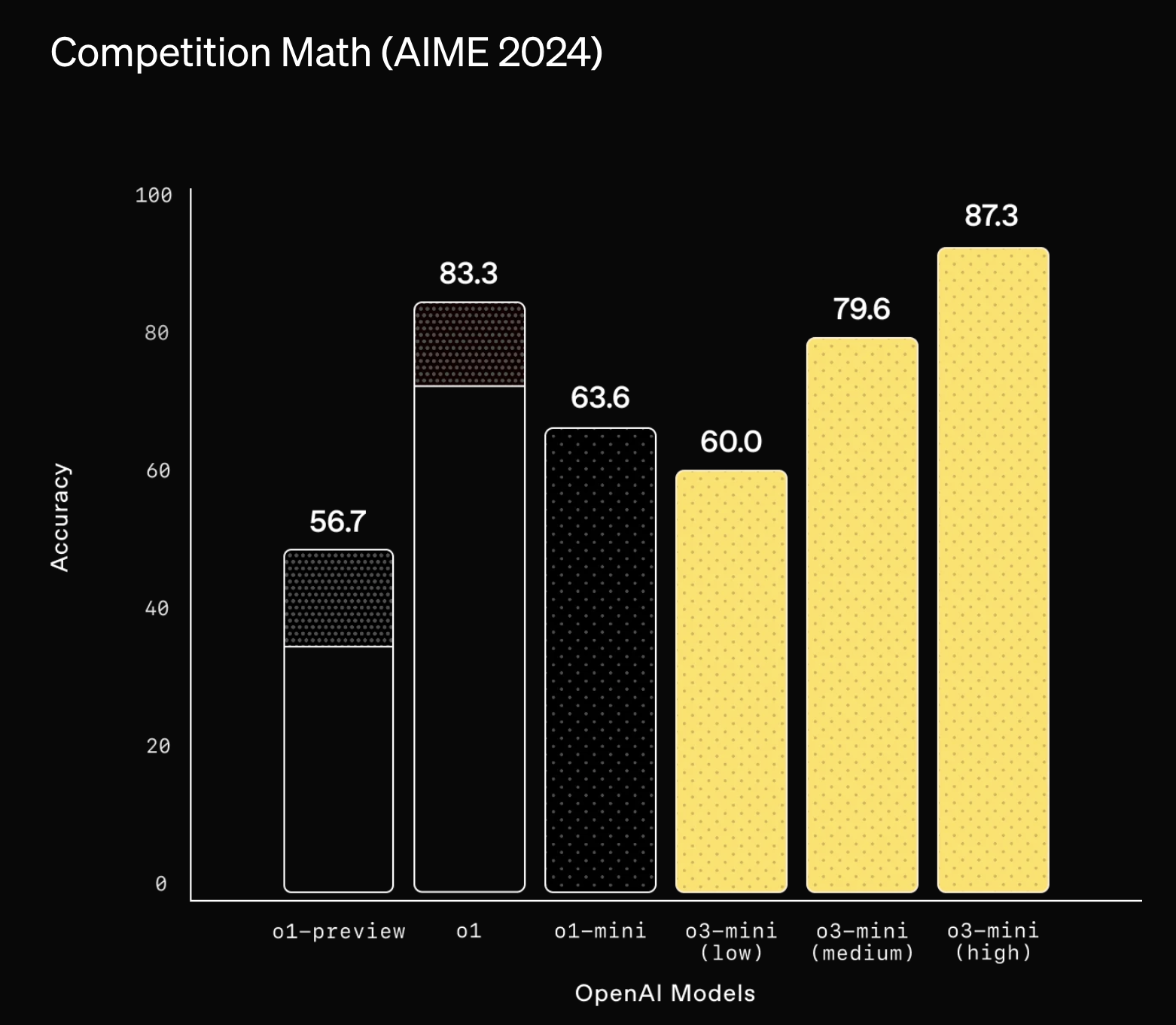
Users are able to choose from three different “reasoning effort options” when using o3-mini, allowing them to fine-tune a balance between latency and accuracy depending on the task. The lowest of these reasoning levels generally shows accuracy levels comparable to o1-mini in math and coding benchmarks, according to OpenAI, while the highest matches or surpasses the full-fledged o1 model in the same tests.

The reasoning effort chosen can have a sizable impact on the accuracy of the o3 model in OpenAI’s tests.

The reasoning effort chosen can have a sizable impact on the accuracy of the o3 model in OpenAI’s tests. Credit: OpenAI

OpenAI says testers reported a 39 percent reduction in “major errors” when using o3-mini, compared to o1-mini, and preferred the o3-mini responses 56 percent of the time. That’s despite the medium version of o3-mini offering a 24 percent faster response time than o1-mini on average—down from 10.16 seconds to 7.7 seconds.

OpenAI hits back at DeepSeek with o3-mini reasoning model Read More »

report:-deepseek’s-chat-histories-and-internal-data-were-publicly-exposed

Report: DeepSeek’s chat histories and internal data were publicly exposed

A cloud security firm found a publicly accessible, fully controllable database belonging to DeepSeek, the Chinese firm that has recently shaken up the AI world, “within minutes” of examining DeepSeek’s security, according to a blog post by Wiz.

An analytical ClickHouse database tied to DeepSeek, “completely open and unauthenticated,” contained more than 1 million instances of “chat history, backend data, and sensitive information, including log streams, API secrets, and operational details,” according to Wiz. An open web interface also allowed for full database control and privilege escalation, with internal API endpoints and keys available through the interface and common URL parameters.

“While much of the attention around AI security is focused on futuristic threats, the real dangers often come from basic risks—like accidental external exposure of databases,” writes Gal Nagli at Wiz’s blog. “As organizations rush to adopt AI tools and services from a growing number of startups and providers, it’s essential to remember that by doing so, we’re entrusting these companies with sensitive data. The rapid pace of adoption often leads to overlooking security, but protecting customer data must remain the top priority.”

Ars has contacted DeepSeek for comment and will update this post with any response. Wiz noted that it did not receive a response from DeepSeek regarding its findings, but after contacting every DeepSeek email and LinkedIn profile Wiz could find on Wednesday, the company protected the databases Wiz had previously accessed within half an hour.

Report: DeepSeek’s chat histories and internal data were publicly exposed Read More »

openai-teases-“new-era”-of-ai-in-us,-deepens-ties-with-government

OpenAI teases “new era” of AI in US, deepens ties with government

On Thursday, OpenAI announced that it is deepening its ties with the US government through a partnership with the National Laboratories and expects to use AI to “supercharge” research across a wide range of fields to better serve the public.

“This is the beginning of a new era, where AI will advance science, strengthen national security, and support US government initiatives,” OpenAI said.

The deal ensures that “approximately 15,000 scientists working across a wide range of disciplines to advance our understanding of nature and the universe” will have access to OpenAI’s latest reasoning models, the announcement said.

For researchers from Los Alamos, Lawrence Livermore, and Sandia National Labs, access to “o1 or another o-series model” will be available on Venado—an Nvidia supercomputer at Los Alamos that will become a “shared resource.” Microsoft will help deploy the model, OpenAI noted.

OpenAI suggested this access could propel major “breakthroughs in materials science, renewable energy, astrophysics,” and other areas that Venado was “specifically designed” to advance.

Key areas of focus for Venado’s deployment of OpenAI’s model include accelerating US global tech leadership, finding ways to treat and prevent disease, strengthening cybersecurity, protecting the US power grid, detecting natural and man-made threats “before they emerge,” and ” deepening our understanding of the forces that govern the universe,” OpenAI said.

Perhaps among OpenAI’s flashiest promises for the partnership, though, is helping the US achieve a “a new era of US energy leadership by unlocking the full potential of natural resources and revolutionizing the nation’s energy infrastructure.” That is urgently needed, as officials have warned that America’s aging energy infrastructure is becoming increasingly unstable, threatening the country’s health and welfare, and without efforts to stabilize it, the US economy could tank.

But possibly the most “highly consequential” government use case for OpenAI’s models will be supercharging research safeguarding national security, OpenAI indicated.

OpenAI teases “new era” of AI in US, deepens ties with government Read More »

i-agree-with-openai:-you-shouldn’t-use-other-peoples’-work-without-permission

I agree with OpenAI: You shouldn’t use other peoples’ work without permission

ChatGPT developer OpenAI and other players in the generative AI business were caught unawares this week by a Chinese company named DeepSeek, whose open source R1 simulated reasoning model provides results similar to OpenAI’s best paid models (with some notable exceptions) despite being created using just a fraction of the computing power.

Since ChatGPT, Stable Diffusion, and other generative AI models first became publicly available in late 2022 and 2023, the US AI industry has been undergirded by the assumption that you’d need ever-greater amounts of training data and compute power to continue improving their models and get—eventually, maybe—to a functioning version of artificial general intelligence, or AGI.

Those assumptions were reflected in everything from Nvidia’s stock price to energy investments and data center plans. Whether DeepSeek fundamentally upends those plans remains to be seen. But at a bare minimum, it has shaken investors who have poured money into OpenAI, a company that reportedly believes it won’t turn a profit until the end of the decade.

OpenAI CEO Sam Altman concedes that the DeepSeek R1 model is “impressive,” but the company is taking steps to protect its models (both language and business); OpenAI told the Financial Times and other outlets that it believed DeepSeek had used output from OpenAI’s models to train the R1 model, a method known as “distillation.” Using OpenAI’s models to train a model that will compete with OpenAI’s models is a violation of the company’s terms of service.

“We take aggressive, proactive countermeasures to protect our technology and will continue working closely with the US government to protect the most capable models being built here,” an OpenAI spokesperson told Ars.

So taking data without permission is bad, now?

I’m not here to say whether the R1 model is the product of distillation. What I can say is that it’s a little rich for OpenAI to suddenly be so very publicly concerned about the sanctity of proprietary data.

I agree with OpenAI: You shouldn’t use other peoples’ work without permission Read More »

microsoft-now-hosts-ai-model-accused-of-copying-openai-data

Microsoft now hosts AI model accused of copying OpenAI data

Fresh on the heels of a controversy in which ChatGPT-maker OpenAI accused the Chinese company behind DeepSeek R1 of using its AI model outputs against its terms of service, OpenAI’s largest investor, Microsoft, announced on Wednesday that it will now host DeepSeek R1 on its Azure cloud service.

DeepSeek R1 has been the talk of the AI world for the past week because it is a freely available simulated reasoning model that reportedly matches OpenAI’s o1 in performance—while allegedly being trained for a fraction of the cost.

Azure allows software developers to rent computing muscle from machines hosted in Microsoft-owned data centers, as well as rent access to software that runs on them.

“R1 offers a powerful, cost-efficient model that allows more users to harness state-of-the-art AI capabilities with minimal infrastructure investment,” wrote Microsoft Corporate Vice President Asha Sharma in a news release.

DeepSeek R1 runs at a fraction of the cost of o1, at least through each company’s own services. Comparative prices for R1 and o1 were not immediately available on Azure, but DeepSeek lists R1’s API cost as $2.19 per million output tokens, while OpenAI’s o1 costs $60 per million output tokens. That’s a massive discount for a model that performs similarly to o1-pro in various tasks.

Promoting a controversial AI model

On its face, the decision to host R1 on Microsoft servers is not unusual: The company offers access to over 1,800 models on its Azure AI Foundry service with the hopes of allowing software developers to experiment with various AI models and integrate them into their products. In some ways, whatever model they choose, Microsoft still wins because it’s being hosted on the company’s cloud service.

Microsoft now hosts AI model accused of copying OpenAI data Read More »

ai-haters-build-tarpits-to-trap-and-trick-ai-scrapers-that-ignore-robots.txt

AI haters build tarpits to trap and trick AI scrapers that ignore robots.txt


Making AI crawlers squirm

Attackers explain how an anti-spam defense became an AI weapon.

Last summer, Anthropic inspired backlash when its ClaudeBot AI crawler was accused of hammering websites a million or more times a day.

And it wasn’t the only artificial intelligence company making headlines for supposedly ignoring instructions in robots.txt files to avoid scraping web content on certain sites. Around the same time, Reddit’s CEO called out all AI companies whose crawlers he said were “a pain in the ass to block,” despite the tech industry otherwise agreeing to respect “no scraping” robots.txt rules.

Watching the controversy unfold was a software developer whom Ars has granted anonymity to discuss his development of malware (we’ll call him Aaron). Shortly after he noticed Facebook’s crawler exceeding 30 million hits on his site, Aaron began plotting a new kind of attack on crawlers “clobbering” websites that he told Ars he hoped would give “teeth” to robots.txt.

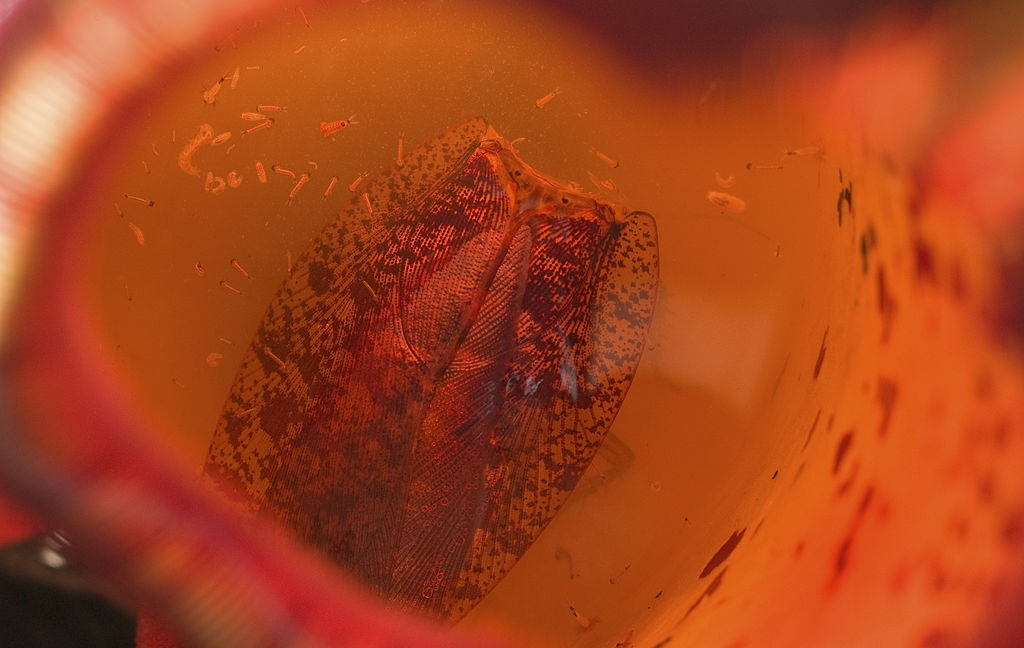
Building on an anti-spam cybersecurity tactic known as tarpitting, he created Nepenthes, malicious software named after a carnivorous plant that will “eat just about anything that finds its way inside.”

Aaron clearly warns users that Nepenthes is aggressive malware. It’s not to be deployed by site owners uncomfortable with trapping AI crawlers and sending them down an “infinite maze” of static files with no exit links, where they “get stuck” and “thrash around” for months, he tells users. Once trapped, the crawlers can be fed gibberish data, aka Markov babble, which is designed to poison AI models. That’s likely an appealing bonus feature for any site owners who, like Aaron, are fed up with paying for AI scraping and just want to watch AI burn.

Tarpits were originally designed to waste spammers’ time and resources, but creators like Aaron have now evolved the tactic into an anti-AI weapon. As of this writing, Aaron confirmed that Nepenthes can effectively trap all the major web crawlers. So far, only OpenAI’s crawler has managed to escape.

It’s unclear how much damage tarpits or other AI attacks can ultimately do. Last May, Laxmi Korada, Microsoft’s director of partner technology, published a report detailing how leading AI companies were coping with poisoning, one of the earliest AI defense tactics deployed. He noted that all companies have developed poisoning countermeasures, while OpenAI “has been quite vigilant” and excels at detecting the “first signs of data poisoning attempts.”

Despite these efforts, he concluded that data poisoning was “a serious threat to machine learning models.” And in 2025, tarpitting represents a new threat, potentially increasing the costs of fresh data at a moment when AI companies are heavily investing and competing to innovate quickly while rarely turning significant profits.

“A link to a Nepenthes location from your site will flood out valid URLs within your site’s domain name, making it unlikely the crawler will access real content,” a Nepenthes explainer reads.

The only AI company that responded to Ars’ request to comment was OpenAI, whose spokesperson confirmed that OpenAI is already working on a way to fight tarpitting.

“We’re aware of efforts to disrupt AI web crawlers,” OpenAI’s spokesperson said. “We design our systems to be resilient while respecting robots.txt and standard web practices.”

But to Aaron, the fight is not about winning. Instead, it’s about resisting the AI industry further decaying the Internet with tech that no one asked for, like chatbots that replace customer service agents or the rise of inaccurate AI search summaries. By releasing Nepenthes, he hopes to do as much damage as possible, perhaps spiking companies’ AI training costs, dragging out training efforts, or even accelerating model collapse, with tarpits helping to delay the next wave of enshittification.

“Ultimately, it’s like the Internet that I grew up on and loved is long gone,” Aaron told Ars. “I’m just fed up, and you know what? Let’s fight back, even if it’s not successful. Be indigestible. Grow spikes.”

Nepenthes instantly inspires another tarpit

Nepenthes was released in mid-January but was instantly popularized beyond Aaron’s expectations after tech journalist Cory Doctorow boosted a tech commentator, Jürgen Geuter, praising the novel AI attack method on Mastodon. Very quickly, Aaron was shocked to see engagement with Nepenthes skyrocket.

“That’s when I realized, ‘oh this is going to be something,'” Aaron told Ars. “I’m kind of shocked by how much it’s blown up.”

It’s hard to tell how widely Nepenthes has been deployed. Site owners are discouraged from flagging when the malware has been deployed, forcing crawlers to face unknown “consequences” if they ignore robots.txt instructions.

Aaron told Ars that while “a handful” of site owners have reached out and “most people are being quiet about it,” his web server logs indicate that people are already deploying the tool. Likely, site owners want to protect their content, deter scraping, or mess with AI companies.

When software developer and hacker Gergely Nagy, who goes by the handle “algernon” online, saw Nepenthes, he was delighted. At that time, Nagy told Ars that nearly all of his server’s bandwidth was being “eaten” by AI crawlers.

Already blocking scraping and attempting to poison AI models through a simpler method, Nagy took his defense method further and created his own tarpit, Iocaine. He told Ars the tarpit immediately killed off about 94 percent of bot traffic to his site, which was primarily from AI crawlers. Soon, social media discussion drove users to inquire about Iocaine deployment, including not just individuals but also organizations wanting to take stronger steps to block scraping.

Iocaine takes ideas (not code) from Nepenthes, but it’s more intent on using the tarpit to poison AI models. Nagy used a reverse proxy to trap crawlers in an “infinite maze of garbage” in an attempt to slowly poison their data collection as much as possible for daring to ignore robots.txt.

Taking its name from “one of the deadliest poisons known to man” from The Princess Bride, Iocaine is jokingly depicted as the “deadliest poison known to AI.” While there’s no way of validating that claim, Nagy’s motto is that the more poisoning attacks that are out there, “the merrier.” He told Ars that his primary reasons for building Iocaine were to help rights holders wall off valuable content and stop AI crawlers from crawling with abandon.

Tarpits aren’t perfect weapons against AI

Running malware like Nepenthes can burden servers, too. Aaron likened the cost of running Nepenthes to running a cheap virtual machine on a Raspberry Pi, and Nagy said that serving crawlers Iocaine costs about the same as serving his website.

But Aaron told Ars that Nepenthes wasting resources is the chief objection he’s seen preventing its deployment. Critics fear that deploying Nepenthes widely will not only burden their servers but also increase the costs of powering all that AI crawling for nothing.

“That seems to be what they’re worried about more than anything,” Aaron told Ars. “The amount of power that AI models require is already astronomical, and I’m making it worse. And my view of that is, OK, so if I do nothing, AI models, they boil the planet. If I switch this on, they boil the planet. How is that my fault?”

Aaron also defends against this criticism by suggesting that a broader impact could slow down AI investment enough to possibly curb some of that energy consumption. Perhaps due to the resistance, AI companies will be pushed to seek permission first to scrape or agree to pay more content creators for training on their data.

“Any time one of these crawlers pulls from my tarpit, it’s resources they’ve consumed and will have to pay hard cash for, but, being bullshit, the money [they] have spent to get it won’t be paid back by revenue,” Aaron posted, explaining his tactic online. “It effectively raises their costs. And seeing how none of them have turned a profit yet, that’s a big problem for them. The investor money will not continue forever without the investors getting paid.”

Nagy agrees that the more anti-AI attacks there are, the greater the potential is for them to have an impact. And by releasing Iocaine, Nagy showed that social media chatter about new attacks can inspire new tools within a few days. Marcus Butler, an independent software developer, similarly built his poisoning attack called Quixotic over a few days, he told Ars. Soon afterward, he received messages from others who built their own versions of his tool.

Butler is not in the camp of wanting to destroy AI. He told Ars that he doesn’t think “tools like Quixotic (or Nepenthes) will ‘burn AI to the ground.'” Instead, he takes a more measured stance, suggesting that “these tools provide a little protection (a very little protection) against scrapers taking content and, say, reposting it or using it for training purposes.”

But for a certain sect of Internet users, every little bit of protection seemingly helps. Geuter linked Ars to a list of tools bent on sabotaging AI. Ultimately, he expects that tools like Nepenthes are “probably not gonna be useful in the long run” because AI companies can likely detect and drop gibberish from training data. But Nepenthes represents a sea change, Geuter told Ars, providing a useful tool for people who “feel helpless” in the face of endless scraping and showing that “the story of there being no alternative or choice is false.”

Criticism of tarpits as AI weapons

Critics debating Nepenthes’ utility on Hacker News suggested that most AI crawlers could easily avoid tarpits like Nepenthes, with one commenter describing the attack as being “very crawler 101.” Aaron said that was his “favorite comment” because if tarpits are considered elementary attacks, he has “2 million lines of access log that show that Google didn’t graduate.”

But efforts to poison AI or waste AI resources don’t just mess with the tech industry. Governments globally are seeking to leverage AI to solve societal problems, and attacks on AI’s resilience seemingly threaten to disrupt that progress.

Nathan VanHoudnos is a senior AI security research scientist in the federally funded CERT Division of the Carnegie Mellon University Software Engineering Institute, which partners with academia, industry, law enforcement, and government to “improve the security and resilience of computer systems and networks.” He told Ars that new threats like tarpits seem to replicate a problem that AI companies are already well aware of: “that some of the stuff that you’re going to download from the Internet might not be good for you.”

“It sounds like these tarpit creators just mainly want to cause a little bit of trouble,” VanHoudnos said. “They want to make it a little harder for these folks to get” the “better or different” data “that they’re looking for.”

VanHoudnos co-authored a paper on “Counter AI” last August, pointing out that attackers like Aaron and Nagy are limited in how much they can mess with AI models. They may have “influence over what training data is collected but may not be able to control how the data are labeled, have access to the trained model, or have access to the Al system,” the paper said.

Further, AI companies are increasingly turning to the deep web for unique data, so any efforts to wall off valuable content with tarpits may be coming right when crawling on the surface web starts to slow, VanHoudnos suggested.

But according to VanHoudnos, AI crawlers are also “relatively cheap,” and companies may deprioritize fighting against new attacks on crawlers if “there are higher-priority assets” under attack. And tarpitting “does need to be taken seriously because it is a tool in a toolkit throughout the whole life cycle of these systems. There is no silver bullet, but this is an interesting tool in a toolkit,” he said.

Offering a choice to abstain from AI training

Aaron told Ars that he never intended Nepenthes to be a major project but that he occasionally puts in work to fix bugs or add new features. He said he’d consider working on integrations for real-time reactions to crawlers if there was enough demand.

Currently, Aaron predicts that Nepenthes might be most attractive to rights holders who want AI companies to pay to scrape their data. And many people seem enthusiastic about using it to reinforce robots.txt. But “some of the most exciting people are in the ‘let it burn’ category,” Aaron said. These people are drawn to tools like Nepenthes as an act of rebellion against AI making the Internet less useful and enjoyable for users.

Geuter told Ars that he considers Nepenthes “more of a sociopolitical statement than really a technological solution (because the problem it’s trying to address isn’t purely technical, it’s social, political, legal, and needs way bigger levers).”

To Geuter, a computer scientist who has been writing about the social, political, and structural impact of tech for two decades, AI is the “most aggressive” example of “technologies that are not done ‘for us’ but ‘to us.'”

“It feels a bit like the social contract that society and the tech sector/engineering have had (you build useful things, and we’re OK with you being well-off) has been canceled from one side,” Geuter said. “And that side now wants to have its toy eat the world. People feel threatened and want the threats to stop.”

As AI evolves, so do attacks, with one 2021 study showing that increasingly stronger data poisoning attacks, for example, were able to break data sanitization defenses. Whether these attacks can ever do meaningful destruction or not, Geuter sees tarpits as a “powerful symbol” of the resistance that Aaron and Nagy readily joined.

“It’s a great sign to see that people are challenging the notion that we all have to do AI now,” Geuter said. “Because we don’t. It’s a choice. A choice that mostly benefits monopolists.”

Tarpit creators like Nagy will likely be watching to see if poisoning attacks continue growing in sophistication. On the Iocaine site—which, yes, is protected from scraping by Iocaine—he posted this call to action: “Let’s make AI poisoning the norm. If we all do it, they won’t have anything to crawl.”

Photo of Ashley Belanger

Ashley is a senior policy reporter for Ars Technica, dedicated to tracking social impacts of emerging policies and new technologies. She is a Chicago-based journalist with 20 years of experience.

AI haters build tarpits to trap and trick AI scrapers that ignore robots.txt Read More »

anthropic-builds-rag-directly-into-claude-models-with-new-citations-api

Anthropic builds RAG directly into Claude models with new Citations API

Willison notes that while citing sources helps verify accuracy, building a system that does it well “can be quite tricky,” but Citations appears to be a step in the right direction by building RAG capability directly into the model.

Apparently, that capability is not a new thing. Anthropic’s Alex Albert wrote on X, “Under the hood, Claude is trained to cite sources. With Citations, we are exposing this ability to devs. To use Citations, users can pass a new “citations: enabled:true” parameter on any document type they send through the API.”

Early adopter reports promising results

The company released Citations for Claude 3.5 Sonnet and Claude 3.5 Haiku models through both the Anthropic API and Google Cloud’s Vertex AI platform, but it’s apparently already getting some use in the field.

Anthropic says that Thomson Reuters, which uses Claude to power its CoCounsel legal AI reference platform, is looking forward to using Citations in a way that helps “minimize hallucination risk but also strengthens trust in AI-generated content.”

Additionally, financial technology company Endex told Anthropic that Citations reduced their source confabulations from 10 percent to zero while increasing references per response by 20 percent, according to CEO Tarun Amasa.

Despite these claims, relying on any LLM to accurately relay reference information is still a risk until the technology is more deeply studied and proven in the field.

Anthropic will charge users its standard token-based pricing, though quoted text in responses won’t count toward output token costs. Sourcing a 100-page document as a reference would cost approximately $0.30 with Claude 3.5 Sonnet or $0.08 with Claude 3.5 Haiku, according to Anthropic’s standard API pricing.

Anthropic builds RAG directly into Claude models with new Citations API Read More »