openai

the-ai-wars-heat-up-with-claude-3,-claimed-to-have-“near-human”-abilities

The AI wars heat up with Claude 3, claimed to have “near-human” abilities

The Anthropic Claude 3 logo.

Enlarge / The Anthropic Claude 3 logo.

On Monday, Anthropic released Claude 3, a family of three AI language models similar to those that power ChatGPT. Anthropic claims the models set new industry benchmarks across a range of cognitive tasks, even approaching “near-human” capability in some cases. It’s available now through Anthropic’s website, with the most powerful model being subscription-only. It’s also available via API for developers.

Claude 3’s three models represent increasing complexity and parameter count: Claude 3 Haiku, Claude 3 Sonnet, and Claude 3 Opus. Sonnet powers the Claude.ai chatbot now for free with an email sign-in. But as mentioned above, Opus is only available through Anthropic’s web chat interface if you pay $20 a month for “Claude Pro,” a subscription service offered through the Anthropic website. All three feature a 200,000-token context window. (The context window is the number of tokens—fragments of a word—that an AI language model can process at once.)

We covered the launch of Claude in March 2023 and Claude 2 in July that same year. Each time, Anthropic fell slightly behind OpenAI’s best models in capability while surpassing them in terms of context window length. With Claude 3, Anthropic has perhaps finally caught up with OpenAI’s released models in terms of performance, although there is no consensus among experts yet—and the presentation of AI benchmarks is notoriously prone to cherry-picking.
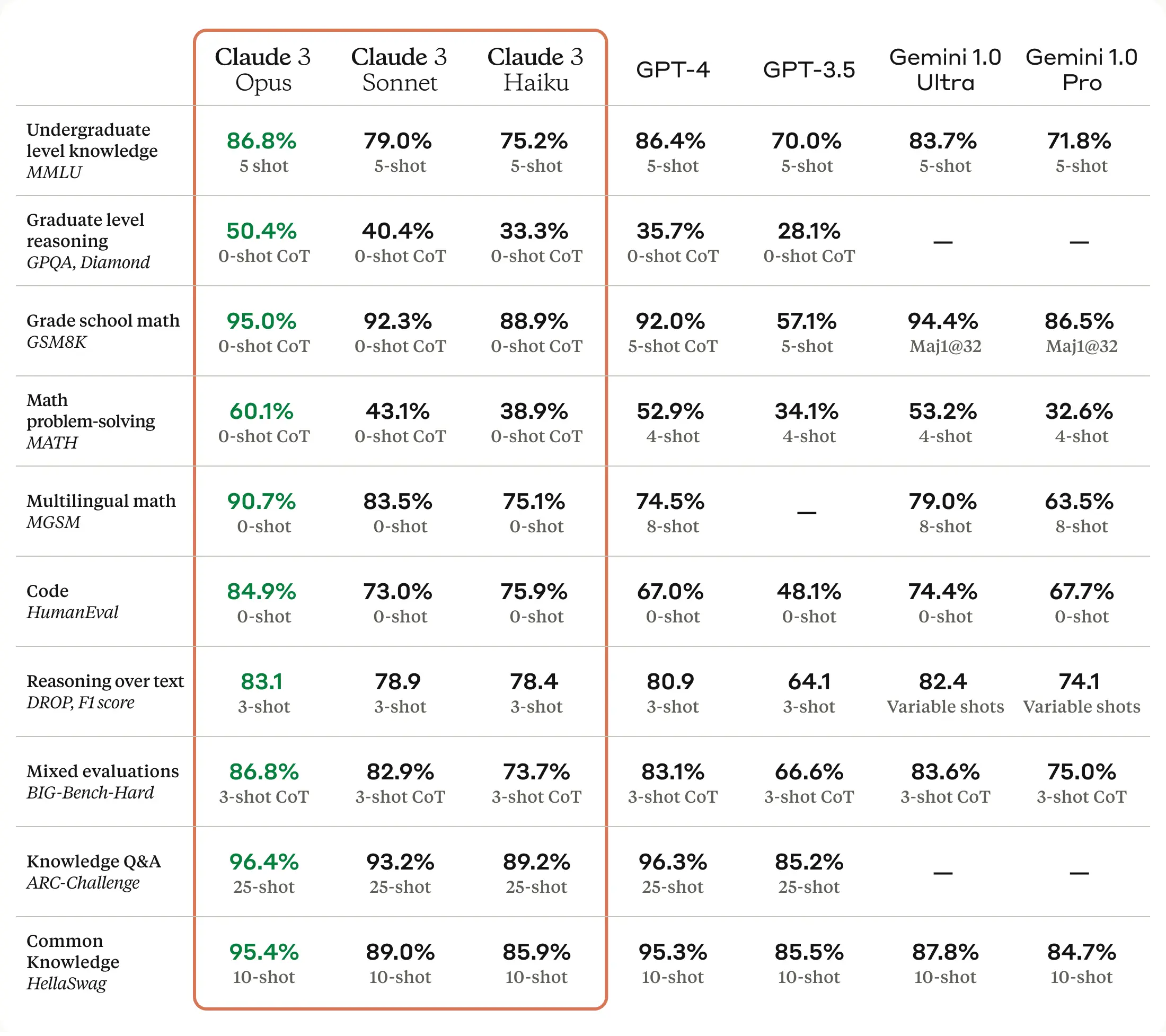
A Claude 3 benchmark chart provided by Anthropic.

Enlarge / A Claude 3 benchmark chart provided by Anthropic.

Claude 3 reportedly demonstrates advanced performance across various cognitive tasks, including reasoning, expert knowledge, mathematics, and language fluency. (Despite the lack of consensus over whether large language models “know” or “reason,” the AI research community commonly uses those terms.) The company claims that the Opus model, the most capable of the three, exhibits “near-human levels of comprehension and fluency on complex tasks.”

That’s quite a heady claim and deserves to be parsed more carefully. It’s probably true that Opus is “near-human” on some specific benchmarks, but that doesn’t mean that Opus is a general intelligence like a human (consider that pocket calculators are superhuman at math). So, it’s a purposely eye-catching claim that can be watered down with qualifications.

According to Anthropic, Claude 3 Opus beats GPT-4 on 10 AI benchmarks, including MMLU (undergraduate level knowledge), GSM8K (grade school math), HumanEval (coding), and the colorfully named HellaSwag (common knowledge). Several of the wins are very narrow, such as 86.8 percent for Opus vs. 86.4 percent on a five-shot trial of MMLU, and some gaps are big, such as 84.9 percent on HumanEval over GPT-4’s 67.0 percent. But what that might mean, exactly, to you as a customer is difficult to say.

“As always, LLM benchmarks should be treated with a little bit of suspicion,” says AI researcher Simon Willison, who spoke with Ars about Claude 3. “How well a model performs on benchmarks doesn’t tell you much about how the model ‘feels’ to use. But this is still a huge deal—no other model has beaten GPT-4 on a range of widely used benchmarks like this.”

The AI wars heat up with Claude 3, claimed to have “near-human” abilities Read More »

elon-musk-sues-openai-and-sam-altman,-accusing-them-of-chasing-profits

Elon Musk sues OpenAI and Sam Altman, accusing them of chasing profits

YA Musk lawsuit —

OpenAI is now a “closed-source de facto subsidiary” of Microsoft, says lawsuit.

Elon Musk sues OpenAI and Sam Altman, accusing them of chasing profits

Elon Musk has sued OpenAI and its chief executive Sam Altman for breach of contract, alleging they have compromised the start-up’s original mission of building artificial intelligence systems for the benefit of humanity.

In the lawsuit, filed to a San Francisco court on Thursday, Musk’s lawyers wrote that OpenAI’s multibillion-dollar alliance with Microsoft had broken an agreement to make a major breakthrough in AI “freely available to the public.”

Instead, the lawsuit said, OpenAI was working on “proprietary technology to maximise profits for literally the largest company in the world.”

The legal fight escalates a long-running dispute between Musk, who has founded his own AI company, known as xAI, and OpenAI, which has received a $13 billion investment from Microsoft.

Musk, who helped co-found OpenAI in 2015, said in his legal filing he had donated $44 million to the group, and had been “induced” to make contributions by promises, “including in writing,” that it would remain a non-profit organisation.

He left OpenAI’s board in 2018 following disagreements with Altman on the direction of research. A year later, the group established the for-profit arm that Microsoft has invested into.

Microsoft’s president Brad Smith told the Financial Times this week that while the companies were “very important partners,” “Microsoft does not control OpenAI.”

Musk’s lawsuit alleges that OpenAI’s latest AI model, GPT4, released in March last year, breached the threshold for artificial general intelligence (AGI), at which computers function at or above the level of human intelligence.

The Microsoft deal only gives the tech giant a licence to OpenAI’s pre-AGI technology, the lawsuit said, and determining when this threshold is reached is key to Musk’s case.

The lawsuit seeks a court judgment over whether GPT4 should already be considered to be AGI, arguing that OpenAI’s board was “ill-equipped” to make such a determination.

The filing adds that OpenAI is also building another model, Q*, that will be even more powerful and capable than GPT4. It argues that OpenAI is committed under the terms of its founding agreement to make such technology available publicly.

“Mr. Musk has long recognised that AGI poses a grave threat to humanity—perhaps the greatest existential threat we face today,” the lawsuit says.

“To this day, OpenAI, Inc.’s website continues to profess that its charter is to ensure that AGI ‘benefits all of humanity’,” it adds. “In reality, however, OpenAI, Inc. has been transformed into a closed-source de facto subsidiary of the largest technology company in the world: Microsoft.”

OpenAI maintains it has not yet achieved AGI, despite its models’ success in language and reasoning tasks. Large language models like GPT4 still generate errors, fabrications and so-called hallucinations.

The lawsuit also seeks to “compel” OpenAI to adhere to its founding agreement to build technology that does not simply benefit individuals such as Altman and corporations such as Microsoft.

Musk’s own xAI company is a direct competitor to OpenAI and launched its first product, a chatbot named Grok, in December.

OpenAI declined to comment. Representatives for Musk have been approached for comment. Microsoft did not immediately respond to a request for comment.

The Microsoft-OpenAI alliance is being reviewed by competition watchdogs in the US, EU and UK.

The US Securities and Exchange Commission issued subpoenas to OpenAI executives in November as part of an investigation into whether Altman had misled its investors, according to people familiar with the move.

That investigation came shortly after OpenAI’s board fired Altman as chief executive only to reinstate him days later. A new board has since been instituted including former Salesforce co-chief executive Bret Taylor as chair.

There is an ongoing internal review of the former board’s allegations against Altman by independent law firm WilmerHale.

© 2024 The Financial Times Ltd. All rights reserved Not to be redistributed, copied, or modified in any way.

Elon Musk sues OpenAI and Sam Altman, accusing them of chasing profits Read More »
microsoft-partners-with-openai-rival-mistral-for-ai-models,-drawing-eu-scrutiny

Microsoft partners with OpenAI-rival Mistral for AI models, drawing EU scrutiny

The European Approach —

15M euro investment comes as Microsoft hosts Mistral’s GPT-4 alternatives on Azure.

Velib bicycles are parked in front of the the U.S. computer and micro-computing company headquarters Microsoft on January 25, 2023 in Issy-les-Moulineaux, France.

On Monday, Microsoft announced plans to offer AI models from Mistral through its Azure cloud computing platform, which came in conjunction with a 15 million euro non-equity investment in the French firm, which is often seen as a European rival to OpenAI. Since then, the investment deal has faced scrutiny from European Union regulators.

Microsoft’s deal with Mistral, known for its large language models akin to OpenAI’s GPT-4 (which powers the subscription versions of ChatGPT), marks a notable expansion of its AI portfolio at a time when its well-known investment in California-based OpenAI has raised regulatory eyebrows. The new deal with Mistral drew particular attention from regulators because Microsoft’s investment could convert into equity (partial ownership of Mistral as a company) during Mistral’s next funding round.

The development has intensified ongoing investigations into Microsoft’s practices, particularly related to the tech giant’s dominance in the cloud computing sector. According to Reuters, EU lawmakers have voiced concerns that Mistral’s recent lobbying for looser AI regulations might have been influenced by its relationship with Microsoft. These apprehensions are compounded by the French government’s denial of prior knowledge of the deal, despite earlier lobbying for more lenient AI laws in Europe. The situation underscores the complex interplay between national interests, corporate influence, and regulatory oversight in the rapidly evolving AI landscape.

Avoiding American influence

The EU’s reaction to the Microsoft-Mistral deal reflects broader tensions over the role of Big Tech companies in shaping the future of AI and their potential to stifle competition. Calls for a thorough investigation into Microsoft and Mistral’s partnership have been echoed across the continent, according to Reuters, with some lawmakers accusing the firms of attempting to undermine European legislative efforts aimed at ensuring a fair and competitive digital market.

The controversy also touches on the broader debate about “European champions” in the tech industry. France, along with Germany and Italy, had advocated for regulatory exemptions to protect European startups. However, the Microsoft-Mistral deal has led some, like MEP Kim van Sparrentak, to question the motives behind these exemptions, suggesting they might have inadvertently favored American Big Tech interests.

“That story seems to have been a front for American-influenced Big Tech lobby,” said Sparrentak, as quoted by Reuters. Sparrentak has been a key architect of the EU’s AI Act, which has not yet been passed. “The Act almost collapsed under the guise of no rules for ‘European champions,’ and now look. European regulators have been played.”

MEP Alexandra Geese also expressed concerns over the concentration of money and power resulting from such partnerships, calling for an investigation. Max von Thun, Europe director at the Open Markets Institute, emphasized the urgency of investigating the partnership, criticizing Mistral’s reported attempts to influence the AI Act.

Also on Monday, amid the partnership news, Mistral announced Mistral Large, a new large language model (LLM) that Mistral says “ranks directly after GPT-4 based on standard benchmarks.” Mistral has previously released several open-weights AI models that have made news for their capabilities, but Mistral Large will be a closed model only available to customers through an API.

Microsoft partners with OpenAI-rival Mistral for AI models, drawing EU scrutiny Read More »

openai-accuses-nyt-of-hacking-chatgpt-to-set-up-copyright-suit

OpenAI accuses NYT of hacking ChatGPT to set up copyright suit

OpenAI accuses NYT of hacking ChatGPT to set up copyright suit

OpenAI is now boldly claiming that The New York Times “paid someone to hack OpenAI’s products” like ChatGPT to “set up” a lawsuit against the leading AI maker.

In a court filing Monday, OpenAI alleged that “100 examples in which some version of OpenAI’s GPT-4 model supposedly generated several paragraphs of Times content as outputs in response to user prompts” do not reflect how normal people use ChatGPT.

Instead, it allegedly took The Times “tens of thousands of attempts to generate” these supposedly “highly anomalous results” by “targeting and exploiting a bug” that OpenAI claims it is now “committed to addressing.”

According to OpenAI this activity amounts to “contrived attacks” by a “hired gun”—who allegedly hacked OpenAI models until they hallucinated fake NYT content or regurgitated training data to replicate NYT articles. NYT allegedly paid for these “attacks” to gather evidence to support The Times’ claims that OpenAI’s products imperil its journalism by allegedly regurgitating reporting and stealing The Times’ audiences.

“Contrary to the allegations in the complaint, however, ChatGPT is not in any way a substitute for a subscription to The New York Times,” OpenAI argued in a motion that seeks to dismiss the majority of The Times’ claims. “In the real world, people do not use ChatGPT or any other OpenAI product for that purpose. Nor could they. In the ordinary course, one cannot use ChatGPT to serve up Times articles at will.”

In the filing, OpenAI described The Times as enthusiastically reporting on its chatbot developments for years without raising any concerns about copyright infringement. OpenAI claimed that it disclosed that The Times’ articles were used to train its AI models in 2020, but The Times only cared after ChatGPT’s popularity exploded after its debut in 2022.

According to OpenAI, “It was only after this rapid adoption, along with reports of the value unlocked by these new technologies, that the Times claimed that OpenAI had ‘infringed its copyright[s]’ and reached out to demand ‘commercial terms.’ After months of discussions, the Times filed suit two days after Christmas, demanding ‘billions of dollars.'”

Ian Crosby, Susman Godfrey partner and lead counsel for The New York Times, told Ars that “what OpenAI bizarrely mischaracterizes as ‘hacking’ is simply using OpenAI’s products to look for evidence that they stole and reproduced The Times’s copyrighted works. And that is exactly what we found. In fact, the scale of OpenAI’s copying is much larger than the 100-plus examples set forth in the complaint.”

Crosby told Ars that OpenAI’s filing notably “doesn’t dispute—nor can they—that they copied millions of The Times’ works to build and power its commercial products without our permission.”

“Building new products is no excuse for violating copyright law, and that’s exactly what OpenAI has done on an unprecedented scale,” Crosby said.

OpenAI argued that the court should dismiss claims alleging direct copyright, contributory infringement, Digital Millennium Copyright Act violations, and misappropriation, all of which it describes as “legally infirm.” Some fail because they are time-barred—seeking damages on training data for OpenAI’s older models—OpenAI claimed. Others allegedly fail because they misunderstand fair use or are preempted by federal laws.

If OpenAI’s motion is granted, the case would be substantially narrowed.

But if the motion is not granted and The Times ultimately wins—and it might—OpenAI may be forced to wipe ChatGPT and start over.

“OpenAI, which has been secretive and has deliberately concealed how its products operate, is now asserting it’s too late to bring a claim for infringement or hold them accountable. We disagree,” Crosby told Ars. “It’s noteworthy that OpenAI doesn’t dispute that it copied Times works without permission within the statute of limitations to train its more recent and current models.”

OpenAI did not immediately respond to Ars’ request to comment.

OpenAI accuses NYT of hacking ChatGPT to set up copyright suit Read More »
tyler-perry-puts-$800-million-studio-expansion-on-hold-because-of-openai’s-sora

Tyler Perry puts $800 million studio expansion on hold because of OpenAI’s Sora

The Synthetic Screen —

Perry: Mind-blowing AI video-generation tools “will touch every corner of our industry.”

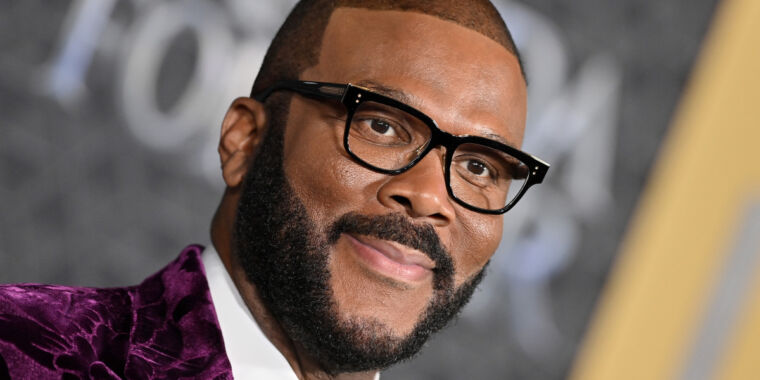
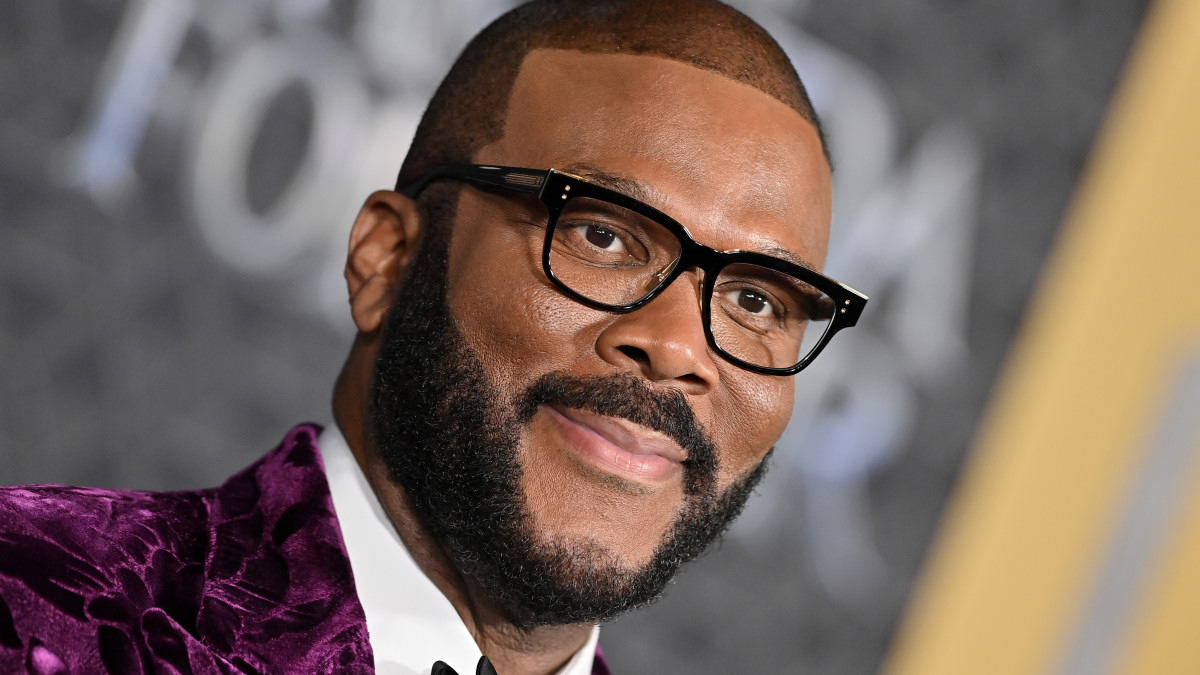
Tyler Perry in 2022.

Enlarge / Tyler Perry in 2022.

In an interview with The Hollywood Reporter published Thursday, filmmaker Tyler Perry spoke about his concerns related to the impact of AI video synthesis on entertainment industry jobs. In particular, he revealed that he has suspended a planned $800 million expansion of his production studio after seeing what OpenAI’s recently announced AI video generator Sora can do.

“I have been watching AI very closely,” Perry said in the interview. “I was in the middle of, and have been planning for the last four years… an $800 million expansion at the studio, which would’ve increased the backlot a tremendous size—we were adding 12 more soundstages. All of that is currently and indefinitely on hold because of Sora and what I’m seeing. I had gotten word over the last year or so that this was coming, but I had no idea until I saw recently the demonstrations of what it’s able to do. It’s shocking to me.”

OpenAI, the company behind ChatGPT, revealed a preview of Sora’s capabilities last week. Sora is a text-to-video synthesis model, and it uses a neural network—previously trained on video examples—that can take written descriptions of a scene and turn them into high-definition video clips up to 60 seconds long. Sora caused shock in the tech world because it appeared to surpass other AI video generators in capability dramatically. It seems that a similar shock also rippled into adjacent professional fields. “Being told that it can do all of these things is one thing, but actually seeing the capabilities, it was mind-blowing,” Perry said in the interview.

Tyler Perry Studios, which the actor and producer acquired in 2015, is a 330-acre lot located in Atlanta and is one of the largest film production facilities in the United States. Perry, who is perhaps best known for his series of Madea films, says that technology like Sora worries him because it could make the need for building sets or traveling to locations obsolete. He cites examples of virtual shooting in the snow of Colorado or on the Moon just by using a text prompt. “This AI can generate it like nothing.” The technology may represent a radical reduction in costs necessary to create a film, and that will likely put entertainment industry jobs in jeopardy.

“It makes me worry so much about all of the people in the business,” he told The Hollywood Reporter. “Because as I was looking at it, I immediately started thinking of everyone in the industry who would be affected by this, including actors and grip and electric and transportation and sound and editors, and looking at this, I’m thinking this will touch every corner of our industry.”

You can read the full interview at The Hollywood Reporter, which did an excellent job of covering Perry’s thoughts on a technology that may end up fundamentally disrupting Hollywood. To his mind, AI tech poses an existential risk to the entertainment industry that it can’t ignore: “There’s got to be some sort of regulations in order to protect us. If not, I just don’t see how we survive.”

Perry also looks beyond Hollywood and says that it’s not just filmmaking that needs to be on alert, and he calls for government action to help retain human employment in the age of AI. “If you look at it across the world, how it’s changing so quickly, I’m hoping that there’s a whole government approach to help everyone be able to sustain.”

Tyler Perry puts $800 million studio expansion on hold because of OpenAI’s Sora Read More »

stability-announces-stable-diffusion-3,-a-next-gen-ai-image-generator

Stability announces Stable Diffusion 3, a next-gen AI image generator

Pics and it didn’t happen —

SD3 may bring DALL-E-like prompt fidelity to an open-weights image-synthesis model.

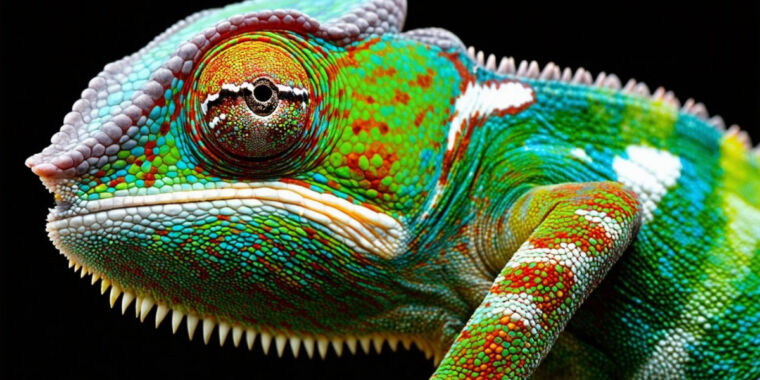
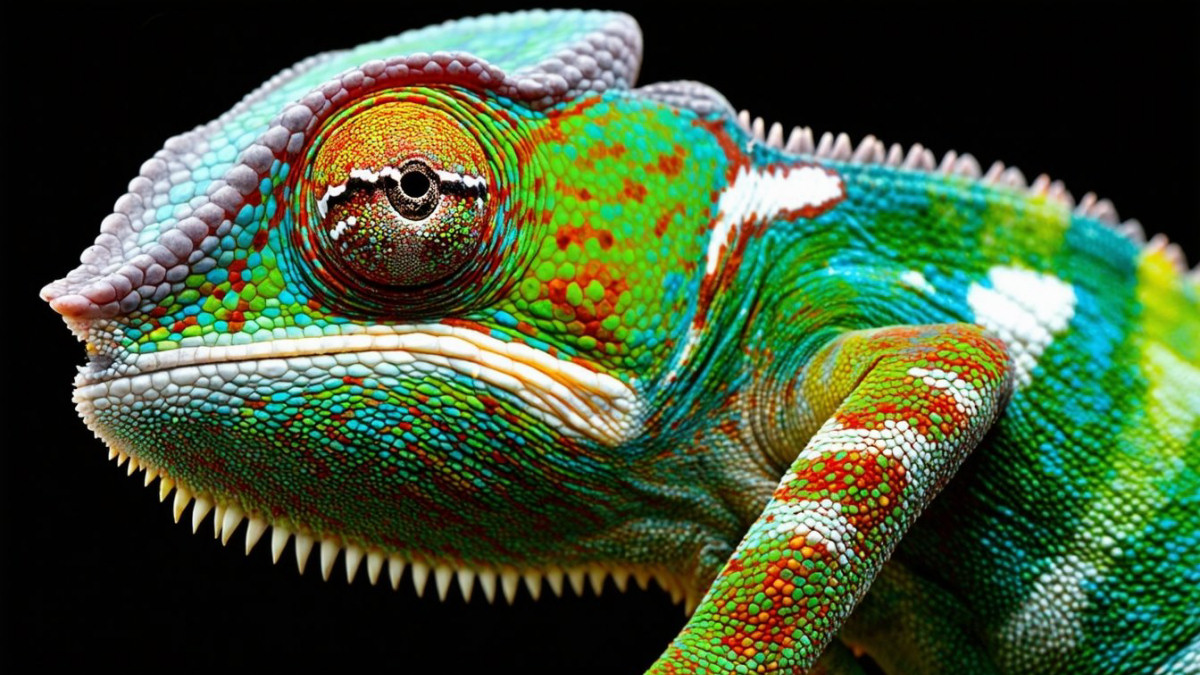
Stable Diffusion 3 generation with the prompt: studio photograph closeup of a chameleon over a black background.

Enlarge / Stable Diffusion 3 generation with the prompt: studio photograph closeup of a chameleon over a black background.

On Thursday, Stability AI announced Stable Diffusion 3, an open-weights next-generation image-synthesis model. It follows its predecessors by reportedly generating detailed, multi-subject images with improved quality and accuracy in text generation. The brief announcement was not accompanied by a public demo, but Stability is opening up a waitlist today for those who would like to try it.

Stability says that its Stable Diffusion 3 family of models (which takes text descriptions called “prompts” and turns them into matching images) range in size from 800 million to 8 billion parameters. The size range accommodates allowing different versions of the model to run locally on a variety of devices—from smartphones to servers. Parameter size roughly corresponds to model capability in terms of how much detail it can generate. Larger models also require more VRAM on GPU accelerators to run.

Since 2022, we’ve seen Stability launch a progression of AI image-generation models: Stable Diffusion 1.4, 1.5, 2.0, 2.1, XL, XL Turbo, and now 3. Stability has made a name for itself as providing a more open alternative to proprietary image-synthesis models like OpenAI’s DALL-E 3, though not without controversy due to the use of copyrighted training data, bias, and the potential for abuse. (This has led to lawsuits that are unresolved.) Stable Diffusion models have been open-weights and source-available, which means the models can be run locally and fine-tuned to change their outputs.

  • Stable Diffusion 3 generation with the prompt: Epic anime artwork of a wizard atop a mountain at night casting a cosmic spell into the dark sky that says “Stable Diffusion 3” made out of colorful energy.

  • An AI-generated image of a grandma wearing a “Go big or go home sweatshirt” generated by Stable Diffusion 3.

  • Stable Diffusion 3 generation with the prompt: Three transparent glass bottles on a wooden table. The one on the left has red liquid and the number 1. The one in the middle has blue liquid and the number 2. The one on the right has green liquid and the number 3.

  • An AI-generated image created by Stable Diffusion 3.

  • Stable Diffusion 3 generation with the prompt: A horse balancing on top of a colorful ball in a field with green grass and a mountain in the background.

  • Stable Diffusion 3 generation with the prompt: Moody still life of assorted pumpkins.

  • Stable Diffusion 3 generation with the prompt: a painting of an astronaut riding a pig wearing a tutu holding a pink umbrella, on the ground next to the pig is a robin bird wearing a top hat, in the corner are the words “stable diffusion.”

  • Stable Diffusion 3 generation with the prompt: Resting on the kitchen table is an embroidered cloth with the text ‘good night’ and an embroidered baby tiger. Next to the cloth there is a lit candle. The lighting is dim and dramatic.

  • Stable Diffusion 3 generation with the prompt: Photo of an 90’s desktop computer on a work desk, on the computer screen it says “welcome”. On the wall in the background we see beautiful graffiti with the text “SD3” very large on the wall.

As far as tech improvements are concerned, Stability CEO Emad Mostaque wrote on X, “This uses a new type of diffusion transformer (similar to Sora) combined with flow matching and other improvements. This takes advantage of transformer improvements & can not only scale further but accept multimodal inputs.”

Like Mostaque said, the Stable Diffusion 3 family uses diffusion transformer architecture, which is a new way of creating images with AI that swaps out the usual image-building blocks (such as U-Net architecture) for a system that works on small pieces of the picture. The method was inspired by transformers, which are good at handling patterns and sequences. This approach not only scales up efficiently but also reportedly produces higher-quality images.

Stable Diffusion 3 also utilizes “flow matching,” which is a technique for creating AI models that can generate images by learning how to transition from random noise to a structured image smoothly. It does this without needing to simulate every step of the process, instead focusing on the overall direction or flow that the image creation should follow.

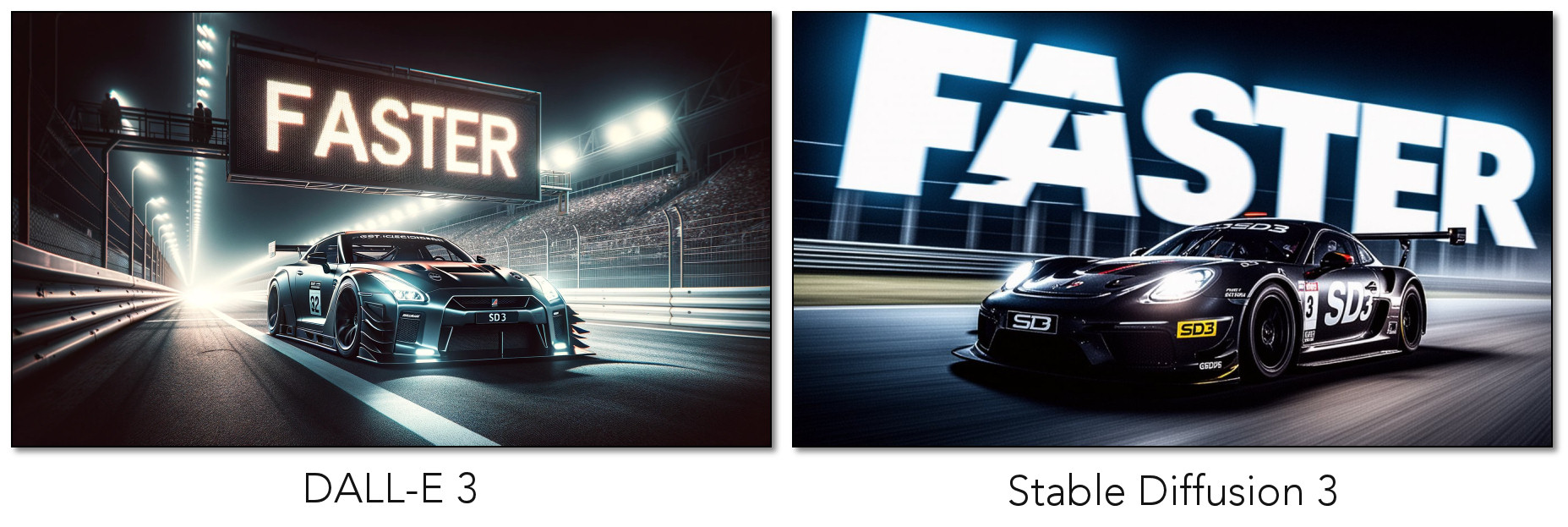
A comparison of outputs between OpenAI's DALL-E 3 and Stable Diffusion 3 with the prompt,

Enlarge / A comparison of outputs between OpenAI’s DALL-E 3 and Stable Diffusion 3 with the prompt, “Night photo of a sports car with the text “SD3″ on the side, the car is on a race track at high speed, a huge road sign with the text ‘faster.'”

We do not have access to Stable Diffusion 3 (SD3), but from samples we found posted on Stability’s website and associated social media accounts, the generations appear roughly comparable to other state-of-the-art image-synthesis models at the moment, including the aforementioned DALL-E 3, Adobe Firefly, Imagine with Meta AI, Midjourney, and Google Imagen.

SD3 appears to handle text generation very well in the examples provided by others, which are potentially cherry-picked. Text generation was a particular weakness of earlier image-synthesis models, so an improvement to that capability in a free model is a big deal. Also, prompt fidelity (how closely it follows descriptions in prompts) seems to be similar to DALL-E 3, but we haven’t tested that ourselves yet.

While Stable Diffusion 3 isn’t widely available, Stability says that once testing is complete, its weights will be free to download and run locally. “This preview phase, as with previous models,” Stability writes, “is crucial for gathering insights to improve its performance and safety ahead of an open release.”

Stability has been experimenting with a variety of image-synthesis architectures recently. Aside from SDXL and SDXL Turbo, just last week, the company announced Stable Cascade, which uses a three-stage process for text-to-image synthesis.

Listing image by Emad Mostaque (Stability AI)

Stability announces Stable Diffusion 3, a next-gen AI image generator Read More »

google-goes-“open-ai”-with-gemma,-a-free,-open-weights-chatbot-family

Google goes “open AI” with Gemma, a free, open-weights chatbot family

Free hallucinations for all —

Gemma chatbots can run locally, and they reportedly outperform Meta’s Llama 2.

The Google Gemma logo

On Wednesday, Google announced a new family of AI language models called Gemma, which are free, open-weights models built on technology similar to the more powerful but closed Gemini models. Unlike Gemini, Gemma models can run locally on a desktop or laptop computer. It’s Google’s first significant open large language model (LLM) release since OpenAI’s ChatGPT started a frenzy for AI chatbots in 2022.

Gemma models come in two sizes: Gemma 2B (2 billion parameters) and Gemma 7B (7 billion parameters), each available in pre-trained and instruction-tuned variants. In AI, parameters are values in a neural network that determine AI model behavior, and weights are a subset of these parameters stored in a file.

Developed by Google DeepMind and other Google AI teams, Gemma pulls from techniques learned during the development of Gemini, which is the family name for Google’s most capable (public-facing) commercial LLMs, including the ones that power its Gemini AI assistant. Google says the name comes from the Latin gemma, which means “precious stone.”

While Gemma is Google’s first major open LLM since the launch of ChatGPT (it has released smaller research models such as FLAN-T5 in the past), it’s not Google’s first contribution to open AI research. The company cites the development of the Transformer architecture, as well as releases like TensorFlow, BERT, T5, and JAX as key contributions, and it would not be controversial to say that those have been important to the field.

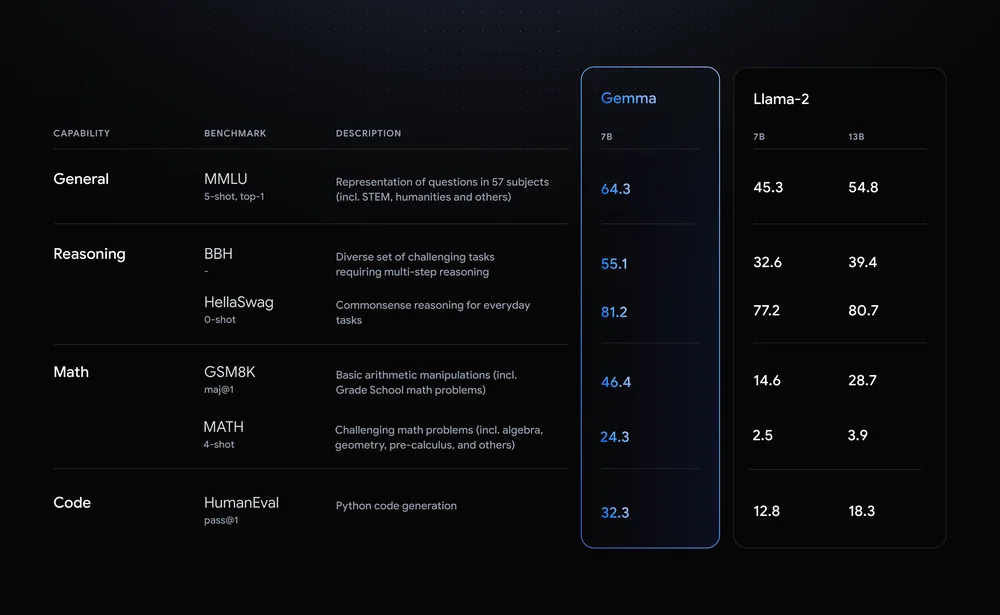
A chart of Gemma performance provided by Google. Google says that Gemma outperforms Meta's Llama 2 on several benchmarks.

Enlarge / A chart of Gemma performance provided by Google. Google says that Gemma outperforms Meta’s Llama 2 on several benchmarks.

Owing to lesser capability and high confabulation rates, smaller open-weights LLMs have been more like tech demos until recently, as some larger ones have begun to match GPT-3.5 performance levels. Still, experts see source-available and open-weights AI models as essential steps in ensuring transparency and privacy in chatbots. Google Gemma is not “open source” however, since that term usually refers to a specific type of software license with few restrictions attached.

In reality, Gemma feels like a conspicuous play to match Meta, which has made a big deal out of releasing open-weights models (such as LLaMA and Llama 2) since February of last year. That technique stands in opposition to AI models like OpenAI’s GPT-4 Turbo, which is only available through the ChatGPT application and a cloud API and cannot be run locally. A Reuters report on Gemma focuses on the Meta angle and surmises that Google hopes to attract more developers to its Vertex AI cloud platform.

We have not used Gemma yet; however, Google claims the 7B model outperforms Meta’s Llama 2 7B and 13B models on several benchmarks for math, Python code generation, general knowledge, and commonsense reasoning tasks. It’s available today through Kaggle, a machine-learning community platform, and Hugging Face.

In other news, Google paired the Gemma release with a “Responsible Generative AI Toolkit,” which Google hopes will offer guidance and tools for developing what the company calls “safe and responsible” AI applications.

Google goes “open AI” with Gemma, a free, open-weights chatbot family Read More »

will-smith-parodies-viral-ai-generated-video-by-actually-eating-spaghetti

Will Smith parodies viral AI-generated video by actually eating spaghetti

Mangia, mangia —

Actor pokes fun at 2023 AI video by eating spaghetti messily and claiming it’s AI-generated.

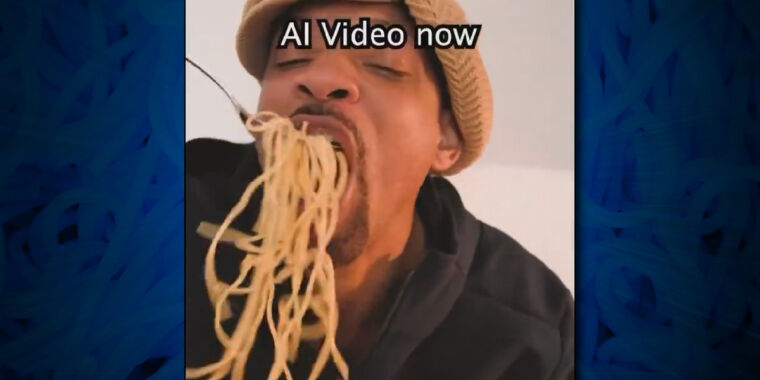
The real Will Smith eating spaghetti, parodying an AI-generated video from 2023.

Enlarge / The real Will Smith eating spaghetti, parodying an AI-generated video from 2023.

On Monday, Will Smith posted a video on his official Instagram feed that parodied an AI-generated video of the actor eating spaghetti that went viral last year. With the recent announcement of OpenAI’s Sora video synthesis model, many people have noted the dramatic jump in AI-video quality over the past year compared to the infamous spaghetti video. Smith’s new video plays on that comparison by showing the actual actor eating spaghetti in a comical fashion and claiming that it is AI-generated.

Captioned “This is getting out of hand!”, the Instagram video uses a split screen layout to show the original AI-generated spaghetti video created by a Reddit user named “chaindrop” in March 2023 on the top, labeled with the subtitle “AI Video 1 year ago.” Below that, in a box titled “AI Video Now,” the real Smith shows 11 video segments of himself actually eating spaghetti by slurping it up while shaking his head, pouring it into his mouth with his fingers, and even nibbling on a friend’s hair. 2006’s Snap Yo Fingers by Lil Jon plays in the background.

In the Instagram comments section, some people expressed confusion about the new (non-AI) video, saying, “I’m still in doubt if second video was also made by AI or not.” In a reply, someone else wrote, “Boomers are gonna loose [sic] this one. Second one is clearly him making a joke but I wouldn’t doubt it in a couple months time it will get like that.”

We have not yet seen a model with the capability of Sora attempt to create a new Will-Smith-eating-spaghetti AI video, but the result would likely be far better than what we saw last year, even if it contained obvious glitches. Given how things are progressing, we wouldn’t be surprised if by 2025, video synthesis AI models can replicate the parody video created by Smith himself.

It’s worth noting for history’s sake that despite the comparison, the video of Will Smith eating spaghetti did not represent the state of the art in text-to-video synthesis at the time of its creation in March 2023 (that title would likely apply to Runway’s Gen-2, which was then in closed testing). However, the spaghetti video was reasonably advanced for open weights models at the time, having used the ModelScope AI model. More capable video synthesis models had already been released at that time, but due to the humorous cultural reference, it’s arguably more fun to compare today’s AI video synthesis to Will Smith grotesquely eating spaghetti than to teddy bears washing dishes.

Will Smith parodies viral AI-generated video by actually eating spaghetti Read More »

reddit-sells-training-data-to-unnamed-ai-company-ahead-of-ipo

Reddit sells training data to unnamed AI company ahead of IPO

Everything has a price —

If you’ve posted on Reddit, you’re likely feeding the future of AI.

In this photo illustration the American social news

On Friday, Bloomberg reported that Reddit has signed a contract allowing an unnamed AI company to train its models on the site’s content, according to people familiar with the matter. The move comes as the social media platform nears the introduction of its initial public offering (IPO), which could happen as soon as next month.

Reddit initially revealed the deal, which is reported to be worth $60 million a year, earlier in 2024 to potential investors of an anticipated IPO, Bloomberg said. The Bloomberg source speculates that the contract could serve as a model for future agreements with other AI companies.

After an era where AI companies utilized AI training data without expressly seeking any rightsholder permission, some tech firms have more recently begun entering deals where some content used for training AI models similar to GPT-4 (which runs the paid version of ChatGPT) comes under license. In December, for example, OpenAI signed an agreement with German publisher Axel Springer (publisher of Politico and Business Insider) for access to its articles. Previously, OpenAI has struck deals with other organizations, including the Associated Press. Reportedly, OpenAI is also in licensing talks with CNN, Fox, and Time, among others.

In April 2023, Reddit founder and CEO Steve Huffman told The New York Times that it planned to charge AI companies for access to its almost two decades’ worth of human-generated content.

If the reported $60 million/year deal goes through, it’s quite possible that if you’ve ever posted on Reddit, some of that material may be used to train the next generation of AI models that create text, still pictures, and video. Even without the deal, experts have discovered in the past that Reddit has been a key source of training data for large language models and AI image generators.

While we don’t know if OpenAI is the company that signed the deal with Reddit, Bloomberg speculates that Reddit’s ability to tap into AI hype for additional revenue may boost the value of its IPO, which might be worth $5 billion. Despite drama last year, Bloomberg states that Reddit pulled in more than $800 million in revenue in 2023, growing about 20 percent over its 2022 numbers.

Advance Publications, which owns Ars Technica parent Condé Nast, is the largest shareholder of Reddit.

Reddit sells training data to unnamed AI company ahead of IPO Read More »

elon-musk’s-x-allows-china-based-propaganda-banned-on-other-platforms

Elon Musk’s X allows China-based propaganda banned on other platforms

Rinse-wash-repeat. —

X accused of overlooking propaganda flagged by Meta and criminal prosecutors.

Elon Musk’s X allows China-based propaganda banned on other platforms

Lax content moderation on X (aka Twitter) has disrupted coordinated efforts between social media companies and law enforcement to tamp down on “propaganda accounts controlled by foreign entities aiming to influence US politics,” The Washington Post reported.

Now propaganda is “flourishing” on X, The Post said, while other social media companies are stuck in endless cycles, watching some of the propaganda that they block proliferate on X, then inevitably spread back to their platforms.

Meta, Google, and then-Twitter began coordinating takedown efforts with law enforcement and disinformation researchers after Russian-backed influence campaigns manipulated their platforms in hopes of swaying the 2016 US presidential election.

The next year, all three companies promised Congress to work tirelessly to stop Russian-backed propaganda from spreading on their platforms. The companies created explicit election misinformation policies and began meeting biweekly to compare notes on propaganda networks each platform uncovered, according to The Post’s interviews with anonymous sources who participated in these meetings.

However, after Elon Musk purchased Twitter and rebranded the company as X, his company withdrew from the alliance in May 2023.

Sources told The Post that the last X meeting attendee was Irish intelligence expert Aaron Rodericks—who was allegedly disciplined for liking an X post calling Musk “a dipshit.” Rodericks was subsequently laid off when Musk dismissed the entire election integrity team last September, and after that, X apparently ditched the biweekly meeting entirely and “just kind of disappeared,” a source told The Post.

In 2023, for example, Meta flagged 150 “artificial influence accounts” identified on its platform, of which “136 were still present on X as of Thursday evening,” according to The Post’s analysis. X’s seeming oversight extends to all but eight of the 123 “deceptive China-based campaigns” connected to accounts that Meta flagged last May, August, and December, The Post reported.

The Post’s report also provided an exclusive analysis from the Stanford Internet Observatory (SIO), which found that 86 propaganda accounts that Meta flagged last November “are still active on X.”

The majority of these accounts—81—were China-based accounts posing as Americans, SIO reported. These accounts frequently ripped photos from Americans’ LinkedIn profiles, then changed the real Americans’ names while posting about both China and US politics, as well as people often trending on X, such as Musk and Joe Biden.

Meta has warned that China-based influence campaigns are “multiplying,” The Post noted, while X’s standards remain seemingly too relaxed. Even accounts linked to criminal investigations remain active on X. One “account that is accused of being run by the Chinese Ministry of Public Security,” The Post reported, remains on X despite its posts being cited by US prosecutors in a criminal complaint.

Prosecutors connected that account to “dozens” of X accounts attempting to “shape public perceptions” about the Chinese Communist Party, the Chinese government, and other world leaders. The accounts also comment on hot-button topics like the fentanyl problem or police brutality, seemingly to convey “a sense of dismay over the state of America without any clear partisan bent,” Elise Thomas, an analyst for a London nonprofit called the Institute for Strategic Dialogue, told The Post.

Some X accounts flagged by The Post had more than 1 million followers. Five have paid X for verification, suggesting that their disinformation campaigns—targeting hashtags to confound discourse on US politics—are seemingly being boosted by X.

SIO technical research manager Renée DiResta criticized X’s decision to stop coordinating with other platforms.

“The presence of these accounts reinforces the fact that state actors continue to try to influence US politics by masquerading as media and fellow Americans,” DiResta told The Post. “Ahead of the 2022 midterms, researchers and platform integrity teams were collaborating to disrupt foreign influence efforts. That collaboration seems to have ground to a halt, Twitter does not seem to be addressing even networks identified by its peers, and that’s not great.”

Musk shut down X’s election integrity team because he claimed that the team was actually “undermining” election integrity. But analysts are bracing for floods of misinformation to sway 2024 elections, as some major platforms have removed election misinformation policies just as rapid advances in AI technologies have made misinformation spread via text, images, audio, and video harder for the average person to detect.

In one prominent example, a fake robocaller relied on AI voice technology to pose as Biden to tell Democrats not to vote. That incident seemingly pushed the Federal Trade Commission on Thursday to propose penalizing AI impersonation.

It seems apparent that propaganda accounts from foreign entities on X will use every tool available to get eyes on their content, perhaps expecting Musk’s platform to be the slowest to police them. According to The Post, some of the X accounts spreading propaganda are using what appears to be AI-generated images of Biden and Donald Trump to garner tens of thousands of views on posts.

It’s possible that X will start tightening up on content moderation as elections draw closer. Yesterday, X joined Amazon, Google, Meta, OpenAI, TikTok, and other Big Tech companies in signing an agreement to fight “deceptive use of AI” during 2024 elections. Among the top goals identified in the “AI Elections accord” are identifying where propaganda originates, detecting how propaganda spreads across platforms, and “undertaking collective efforts to evaluate and learn from the experiences and outcomes of dealing” with propaganda.

Elon Musk’s X allows China-based propaganda banned on other platforms Read More »

openai-collapses-media-reality-with-sora,-a-photorealistic-ai-video-generator

OpenAI collapses media reality with Sora, a photorealistic AI video generator

Pics and it didn’t happen —

Hello, cultural singularity—soon, every video you see online could be completely fake.

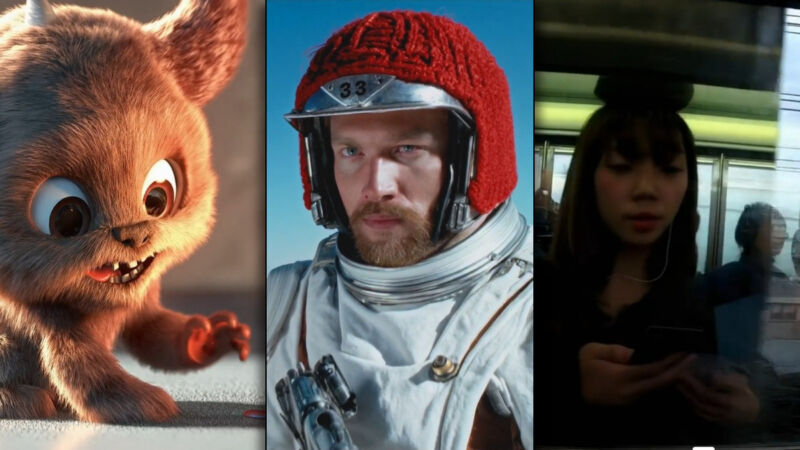
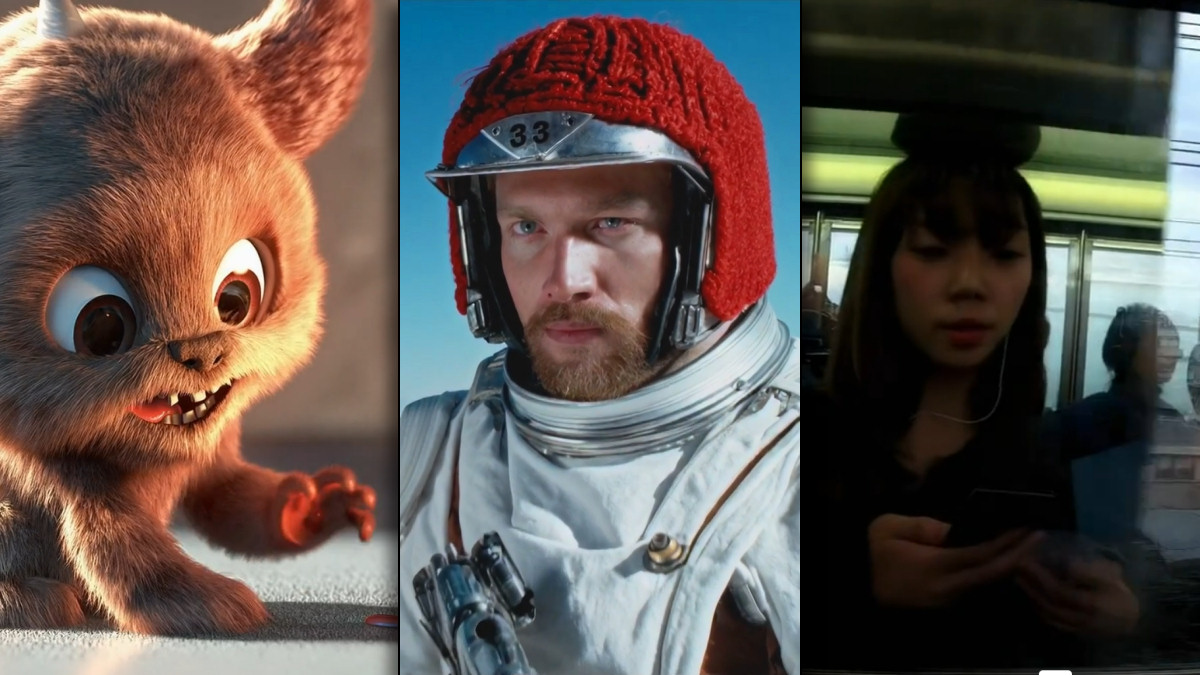
Snapshots from three videos generated using OpenAI's Sora.

Enlarge / Snapshots from three videos generated using OpenAI’s Sora.

On Thursday, OpenAI announced Sora, a text-to-video AI model that can generate 60-second-long photorealistic HD video from written descriptions. While it’s only a research preview that we have not tested, it reportedly creates synthetic video (but not audio yet) at a fidelity and consistency greater than any text-to-video model available at the moment. It’s also freaking people out.

“It was nice knowing you all. Please tell your grandchildren about my videos and the lengths we went to to actually record them,” wrote Wall Street Journal tech reporter Joanna Stern on X.

“This could be the ‘holy shit’ moment of AI,” wrote Tom Warren of The Verge.

“Every single one of these videos is AI-generated, and if this doesn’t concern you at least a little bit, nothing will,” tweeted YouTube tech journalist Marques Brownlee.

For future reference—since this type of panic will some day appear ridiculous—there’s a generation of people who grew up believing that photorealistic video must be created by cameras. When video was faked (say, for Hollywood films), it took a lot of time, money, and effort to do so, and the results weren’t perfect. That gave people a baseline level of comfort that what they were seeing remotely was likely to be true, or at least representative of some kind of underlying truth. Even when the kid jumped over the lava, there was at least a kid and a room.

The prompt that generated the video above: “A movie trailer featuring the adventures of the 30 year old space man wearing a red wool knitted motorcycle helmet, blue sky, salt desert, cinematic style, shot on 35mm film, vivid colors.

Technology like Sora pulls the rug out from under that kind of media frame of reference. Very soon, every photorealistic video you see online could be 100 percent false in every way. Moreover, every historical video you see could also be false. How we confront that as a society and work around it while maintaining trust in remote communications is far beyond the scope of this article, but I tried my hand at offering some solutions back in 2020, when all of the tech we’re seeing now seemed like a distant fantasy to most people.

In that piece, I called the moment that truth and fiction in media become indistinguishable the “cultural singularity.” It appears that OpenAI is on track to bring that prediction to pass a bit sooner than we expected.

Prompt: Reflections in the window of a train traveling through the Tokyo suburbs.

OpenAI has found that, like other AI models that use the transformer architecture, Sora scales with available compute. Given far more powerful computers behind the scenes, AI video fidelity could improve considerably over time. In other words, this is the “worst” AI-generated video is ever going to look. There’s no synchronized sound yet, but that might be solved in future models.

How (we think) they pulled it off

AI video synthesis has progressed by leaps and bounds over the past two years. We first covered text-to-video models in September 2022 with Meta’s Make-A-Video. A month later, Google showed off Imagen Video. And just 11 months ago, an AI-generated version of Will Smith eating spaghetti went viral. In May of last year, what was previously considered to be the front-runner in the text-to-video space, Runway Gen-2, helped craft a fake beer commercial full of twisted monstrosities, generated in two-second increments. In earlier video-generation models, people pop in and out of reality with ease, limbs flow together like pasta, and physics doesn’t seem to matter.

Sora (which means “sky” in Japanese) appears to be something altogether different. It’s high-resolution (1920×1080), can generate video with temporal consistency (maintaining the same subject over time) that lasts up to 60 seconds, and appears to follow text prompts with a great deal of fidelity. So, how did OpenAI pull it off?

OpenAI doesn’t usually share insider technical details with the press, so we’re left to speculate based on theories from experts and information given to the public.

OpenAI says that Sora is a diffusion model, much like DALL-E 3 and Stable Diffusion. It generates a video by starting off with noise and “gradually transforms it by removing the noise over many steps,” the company explains. It “recognizes” objects and concepts listed in the written prompt and pulls them out of the noise, so to speak, until a coherent series of video frames emerge.

Sora is capable of generating videos all at once from a text prompt, extending existing videos, or generating videos from still images. It achieves temporal consistency by giving the model “foresight” of many frames at once, as OpenAI calls it, solving the problem of ensuring a generated subject remains the same even if it falls out of view temporarily.

OpenAI represents video as collections of smaller groups of data called “patches,” which the company says are similar to tokens (fragments of a word) in GPT-4. “By unifying how we represent data, we can train diffusion transformers on a wider range of visual data than was possible before, spanning different durations, resolutions, and aspect ratios,” the company writes.

An important tool in OpenAI’s bag of tricks is that its use of AI models is compounding. Earlier models are helping to create more complex ones. Sora follows prompts well because, like DALL-E 3, it utilizes synthetic captions that describe scenes in the training data generated by another AI model like GPT-4V. And the company is not stopping here. “Sora serves as a foundation for models that can understand and simulate the real world,” OpenAI writes, “a capability we believe will be an important milestone for achieving AGI.”

One question on many people’s minds is what data OpenAI used to train Sora. OpenAI has not revealed its dataset, but based on what people are seeing in the results, it’s possible OpenAI is using synthetic video data generated in a video game engine in addition to sources of real video (say, scraped from YouTube or licensed from stock video libraries). Nvidia’s Dr. Jim Fan, who is a specialist in training AI with synthetic data, wrote on X, “I won’t be surprised if Sora is trained on lots of synthetic data using Unreal Engine 5. It has to be!” Until confirmed by OpenAI, however, that’s just speculation.

OpenAI collapses media reality with Sora, a photorealistic AI video generator Read More »

judge-rejects-most-chatgpt-copyright-claims-from-book-authors

Judge rejects most ChatGPT copyright claims from book authors

Insufficient evidence —

OpenAI plans to defeat authors’ remaining claim at a “later stage” of the case.

Judge rejects most ChatGPT copyright claims from book authors

A US district judge in California has largely sided with OpenAI, dismissing the majority of claims raised by authors alleging that large language models powering ChatGPT were illegally trained on pirated copies of their books without their permission.

By allegedly repackaging original works as ChatGPT outputs, authors alleged, OpenAI’s most popular chatbot was just a high-tech “grift” that seemingly violated copyright laws, as well as state laws preventing unfair business practices and unjust enrichment.

According to judge Araceli Martínez-Olguín, authors behind three separate lawsuits—including Sarah Silverman, Michael Chabon, and Paul Tremblay—have failed to provide evidence supporting any of their claims except for direct copyright infringement.

OpenAI had argued as much in their promptly filed motion to dismiss these cases last August. At that time, OpenAI said that it expected to beat the direct infringement claim at a “later stage” of the proceedings.

Among copyright claims tossed by Martínez-Olguín were accusations of vicarious copyright infringement. Perhaps most significantly, Martínez-Olguín agreed with OpenAI that the authors’ allegation that “every” ChatGPT output “is an infringing derivative work” is “insufficient” to allege vicarious infringement, which requires evidence that ChatGPT outputs are “substantially similar” or “similar at all” to authors’ books.

“Plaintiffs here have not alleged that the ChatGPT outputs contain direct copies of the copyrighted books,” Martínez-Olguín wrote. “Because they fail to allege direct copying, they must show a substantial similarity between the outputs and the copyrighted materials.”

Authors also failed to convince Martínez-Olguín that OpenAI violated the Digital Millennium Copyright Act (DMCA) by allegedly removing copyright management information (CMI)—such as author names, titles of works, and terms and conditions for use of the work—from training data.

This claim failed because authors cited “no facts” that OpenAI intentionally removed the CMI or built the training process to omit CMI, Martínez-Olguín wrote. Further, the authors cited examples of ChatGPT referencing their names, which would seem to suggest that some CMI remains in the training data.

Some of the remaining claims were dependent on copyright claims to survive, Martínez-Olguín wrote.

Arguing that OpenAI caused economic injury by unfairly repurposing authors’ works, even if authors could show evidence of a DMCA violation, authors could only speculate about what injury was caused, the judge said.

Similarly, allegations of “fraudulent” unfair conduct—accusing OpenAI of “deceptively” designing ChatGPT to produce outputs that omit CMI—”rest on a violation of the DMCA,” Martínez-Olguín wrote.

The only claim under California’s unfair competition law that was allowed to proceed alleged that OpenAI used copyrighted works to train ChatGPT without authors’ permission. Because the state law broadly defines what’s considered “unfair,” Martínez-Olguín said that it’s possible that OpenAI’s use of the training data “may constitute an unfair practice.”

Remaining claims of negligence and unjust enrichment failed, Martínez-Olguín wrote, because authors only alleged intentional acts and did not explain how OpenAI “received and unjustly retained a benefit” from training ChatGPT on their works.

Authors have been ordered to consolidate their complaints and have until March 13 to amend arguments and continue pursuing any of the dismissed claims.

To shore up the tossed copyright claims, authors would likely need to provide examples of ChatGPT outputs that are similar to their works, as well as evidence of OpenAI intentionally removing CMI to “induce, enable, facilitate, or conceal infringement,” Martínez-Olguín wrote.

Ars could not immediately reach the authors’ lawyers or OpenAI for comment.

As authors likely prepare to continue fighting OpenAI, the US Copyright Office has been fielding public input before releasing guidance that could one day help rights holders pursue legal claims and may eventually require works to be licensed from copyright owners for use as training materials. Among the thorniest questions is whether AI tools like ChatGPT should be considered authors when spouting outputs included in creative works.

While the Copyright Office prepares to release three reports this year “revealing its position on copyright law in relation to AI,” according to The New York Times, OpenAI recently made it clear that it does not plan to stop referencing copyrighted works in its training data. Last month, OpenAI said it would be “impossible” to train AI models without copyrighted materials, because “copyright today covers virtually every sort of human expression—including blogposts, photographs, forum posts, scraps of software code, and government documents.”

According to OpenAI, it doesn’t just need old copyrighted materials; it needs current copyright materials to ensure that chatbot and other AI tools’ outputs “meet the needs of today’s citizens.”

Rights holders will likely be bracing throughout this confusing time, waiting for the Copyright Office’s reports. But once there is clarity, those reports could “be hugely consequential, weighing heavily in courts, as well as with lawmakers and regulators,” The Times reported.

Judge rejects most ChatGPT copyright claims from book authors Read More »