SanDisk

sandisk-says-goodbye-to-wd-blue-and-black-ssds,-hello-to-new-“optimus”-drives

SanDisk says goodbye to WD Blue and Black SSDs, hello to new “Optimus” drives

In late 2023, storage company Western Digital announced plans to split itself into two companies. One, which would still be called Western Digital, would focus on spinning hard drives, which are no longer used much in consumer systems but remain important to NAS devices and data centers. The other, called SanDisk, would handle solid-state storage, including the drives that Western Digital sold to consumers under its Blue, Black, Green, and Red brands.

That split effectively undid what Western Digital did a decade ago when it bought SanDisk for $19 billion. And we’re just now starting to see the way the split will affect the company’s existing consumer drives.

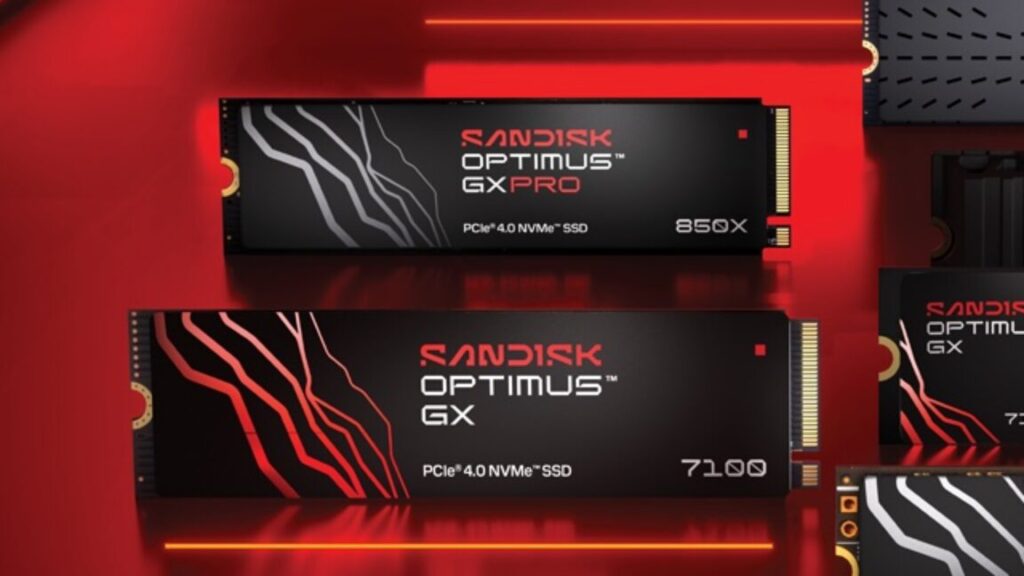
Today, SanDisk announced that mainstream WD Blue and WD Black SSDs would be discontinued and replaced by SanDisk Optimus-branded disks with the same model numbers.

WD Blue drives will now be “SanDisk Optimus” drives, starting with the Optimus 5100, a rebadged version of the WD Blue SN5100. Mid-tier WD Black drives will be branded as “SanDisk Optimus GX,” and the Optimus GX 7100 will replace the WD Black SN7100. And high-end WD Black drives will become “SanDisk Optimus GX Pro” SSDs, with the Optimus GX Pro 850X and 8100 replacing the WD Black SN850X and 8100 drives.

Given that these are all fast NVMe SSDs, I suspect the average user would have trouble detecting much of a difference between the low-end WD Blue/Optimus drives and the high-end WD Black/Optimus GX Pro SSDs. But the functional differences between the drives remain the same as before: the Blue/Optimus 5100 uses somewhat slower and less durable quad-level cell (QLC) flash memory, while the Black/Optimus GX 7100 uses triple-level cell (TLC) memory. The Black/Optimus GX Pro 8100 maximizes performance by stepping up to a PCIe 5.0 interface instead of PCIe 4.0 and including a dedicated DRAM cache (the 5100 and 7100 each claim a small chunk of your system RAM for this, called the Host Memory Buffer, or HMB). The 850X is a slightly older drive that keeps the dedicated DRAM but is also limited to PCIe 4.0 speeds.

SanDisk says goodbye to WD Blue and Black SSDs, hello to new “Optimus” drives Read More »

sd-cards-finally-expected-to-hit-4tb-in-2025

SD cards finally expected to hit 4TB in 2025

Not quite at 128TB yet —

For media pros’ cameras and laptops.

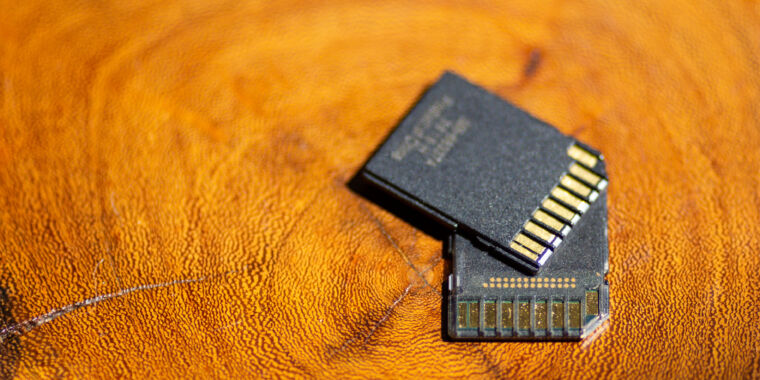
Two SD cards on a wood surface

Enlarge / Generic, non-Western Digital SD cards.

Western Digital plans to release the first 4TB SD card next year. On Thursday, the storage firm announced plans to demo the product in person next week.

Western Digital will launch the SD card, which follows the SD Association’s Secure Digital Ultra Capacity (SDUC) standard, under its SanDisk brand and market it toward “complex media and entertainment workflows,” such as high-resolution video with high framerates, using cameras and laptops, the announcement said.

The spacious card will use the Ultra High Speed-1 (UHS-1) bus interface, supporting max theoretical transfer rates of up to 104 MB per second. It will support minimum write speeds of 10 MB/s, AnandTech reported. Minimum sequential write speeds are expected to reach 30 MB/s, the publication said.

With those specs, the upcoming SD card should be able to fit storage-hungry video formats, including 8K, although the card won’t be speedy enough to support raw 8K video recording. That helps explain why Western Digital is initially previewing the offering at The National Association of Broadcasters’ annual event for broadcast and media professionals, which starts tomorrow in Las Vegas.

“Attendees will get a preview of the 4TB SD card’s full capacity and learn more about how it will expand the creative possibilities for cameras and laptops,” Western Digital said.

Hopefully, Western Digital will provide more information about the SD card at the event, as this week’s announcement didn’t go into further details, such as the type of NAND the card will use or whether it will support the SanDisk-created DDR200/DDR208 mode, which could enable higher data transfer speeds of up to 170 MB/s (but only with a host that supports that mode).

Western Digital didn’t say what the SD card would cost, but with its advanced capabilities and targeted audience of professional creators, the offering will likely have premium pricing. The 1TB SanDisk Extreme Pro SDXC UHS-I Card currently has a $140 MSRP.

WD’s announcement comes six years after the SD Association, which writes SD standards, announced the SDUC standard that bumped the max possible capacity for SD cards from 2TB to 128TB. As with many releases of new standards, some were eager to believe that “SD cards could soon hold 128TB of storage.” But with 4TB not expected to arrive until 2025 (assuming there are no delays), “soon,” even today, is unrealistic. The 2018 standard only made such capacities a possibility. At the time, the max theoretical capacities for an SD card had been 2TB for about nine years, but the most spacious SD cards actually available for purchase at the time were 512GB.

Today, the highest capacity SD cards readily available are 1TB (Western Digital also this week announced plans to release a 2TB SanDisk Extreme Pro SDXC UHS-I memory card at an unspecified date), while 2TB microSD cards only became available this year.

With Western Digital’s announcement, the industry inches closer to SD cards’ maximum potential. For professionals with high-storage needs, that’s exciting news, as having more capable technology opens more possibiltiies, like working with high-res media.

However, Western Digital’s announcement also comes as SanDisk’s reputation for reliable storage is in serious question by professional and long-time customers. There are multiple lawsuits about SanDisk Extreme portable SSDs reportedly failing unexpectedly. These alleged failures, combined with frustration around Western Digital’s limited response to reported data losses, could have professionals with work-critical storage needs consider waiting for another brand to make the leap to 4TB.

SD cards finally expected to hit 4TB in 2025 Read More »