self-driving car

waymo-leverages-genie-3-to-create-a-world-model-for-self-driving-cars

Waymo leverages Genie 3 to create a world model for self-driving cars

On the road with AI

The Waymo World Model is not just a straight port of Genie 3 with dashcam videos stuffed inside. Waymo and DeepMind used a specialized post-training process to make the new model generate both 2D video and 3D lidar outputs of the same scene. While cameras are great for visualizing fine details, Waymo says lidar is necessary to add critical depth information to what a self-driving car “sees” on the road—maybe someone should tell Tesla about that.

Using a world model allows Waymo to take video from its vehicles and use prompts to change the route the vehicle takes, which it calls driving action control. These simulations, which come with lidar maps, reportedly offer greater realism and consistency than older reconstructive simulation methods.

With the world model, Waymo can see what would happen if the car took a different turn.

This model can also help improve the self-driving AI even without adding or removing everything. There are plenty of dashcam videos available for training self-driving vehicles, but they lack the multimodal sensor data of Waymo’s vehicles. Dropping such a video into the Waymo World Model generates matching sensor data, showing how the driving AI would have seen that situation.

While the Waymo World Model can create entirely synthetic scenes, the company seems mostly interested in “mutating” the conditions in real videos. The blog post contains examples of changing the time of day or weather, adding new signage, or placing vehicles in unusual places. Or, hey, why not an elephant in the road?

Waymo is ready in case an elephant shows up.

Waymo’s early test cities were consistently sunny (like Phoenix) with little inclement weather. These kinds of simulations could help the cars adapt to the more varied conditions. The new markets include places with more difficult conditions, including Boston and Washington, D.C.

Of course, the benefit of the new AI model will depend on how accurately Genie 3 can simulate the real world. The test videos we’ve seen of Genie 3 run the gamut from pretty believable to uncanny valley territory, but Waymo believes the technology has improved to the point that it can teach self-driving cars a thing or two.

Waymo leverages Genie 3 to create a world model for self-driving cars Read More »
self-driving-waymo-cars-keep-sf-residents-awake-all-night-by-honking-at-each-other

Self-driving Waymo cars keep SF residents awake all night by honking at each other

The ghost in the machine —

Haunted by glitching algorithms, self-driving cars disturb the peace in San Francisco.

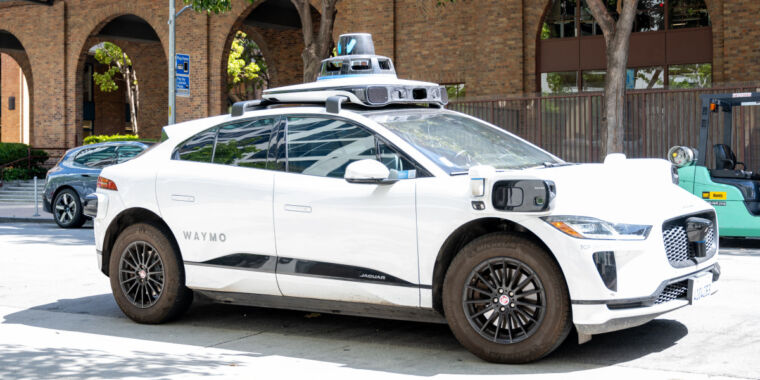
A Waymo self-driving car in front of Google's San Francisco headquarters, San Francisco, California, June 7, 2024.

Enlarge / A Waymo self-driving car in front of Google’s San Francisco headquarters, San Francisco, California, June 7, 2024.

Silicon Valley’s latest disruption? Your sleep schedule. On Saturday, NBC Bay Area reported that San Francisco’s South of Market residents are being awakened throughout the night by Waymo self-driving cars honking at each other in a parking lot. No one is inside the cars, and they appear to be automatically reacting to each other’s presence.

Videos provided by residents to NBC show Waymo cars filing into the parking lot and attempting to back into spots, which seems to trigger honking from other Waymo vehicles. The automatic nature of these interactions—which seem to peak around 4 am every night—has left neighbors bewildered and sleep-deprived.

NBC Bay Area’s report: “Waymo cars keep SF neighborhood awake.”

According to NBC, the disturbances began several weeks ago when Waymo vehicles started using a parking lot off 2nd Street near Harrison Street. Residents in nearby high-rise buildings have observed the autonomous vehicles entering the lot to pause between rides, but the cars’ behavior has become a source of frustration for the neighborhood.

Christopher Cherry, who lives in an adjacent building, told NBC Bay Area that he initially welcomed Waymo’s presence, expecting it to enhance local security and tranquility. However, his optimism waned as the frequency of honking incidents increased. “We started out with a couple of honks here and there, and then as more and more cars started to arrive, the situation got worse,” he told NBC.

The lack of human operators in the vehicles has complicated efforts to address the issue directly since there is no one they can ask to stop honking. That lack of accountability forced residents to report their concerns to Waymo’s corporate headquarters, which had not responded to the incidents until NBC inquired as part of its report. A Waymo spokesperson told NBC, “We are aware that in some scenarios our vehicles may briefly honk while navigating our parking lots. We have identified the cause and are in the process of implementing a fix.”

The absurdity of the situation prompted tech author and journalist James Vincent to write on X, “current tech trends are resistant to satire precisely because they satirize themselves. a car park of empty cars, honking at one another, nudging back and forth to drop off nobody, is a perfect image of tech serving its own prerogatives rather than humanity’s.”

Self-driving Waymo cars keep SF residents awake all night by honking at each other Read More »