signal messenger

supply-chains,-ai,-and-the-cloud:-the-biggest-failures-(and-one-success)-of-2025

Supply chains, AI, and the cloud: The biggest failures (and one success) of 2025


The past year has seen plenty of hacks and outages. Here are the ones topping the list.

Credit: Aurich Lawson | Getty Images

In a roundup of the top stories of 2024, Ars included a supply-chain attack that came dangerously close to inflicting a catastrophe for thousands—possibly millions—of organizations, which included a large assortment of Fortune 500 companies and government agencies. Supply-chain attacks played prominently again this year, as a seemingly unending rash of them hit organizations large and small.

For threat actors, supply-chain attacks are the gift that keeps on giving—or, if you will, the hack that keeps on hacking. By compromising a single target with a large number of downstream users—say a cloud service or maintainers or developers of widely used open source or proprietary software—attackers can infect potentially millions of the target’s downstream users. That’s exactly what threat actors did in 2025.

Poisoning the well

One such event occurred in December 2024, making it worthy of a ranking for 2025. The hackers behind the campaign pocketed as much as $155,000 from thousands of smart-contract parties on the Solana blockchain.

Hackers cashed in by sneaking a backdoor into a code library used by developers of Solana-related software. Security firm Socket said it suspects the attackers compromised accounts belonging to the developers of Web3.js, an open source library. They then used the access to add a backdoor to a package update. After the developers of decentralized Solana apps installed the malicious update, the backdoor spread further, giving the attackers access to individual wallets connected to smart contracts. The backdoor could then extract private keys.

There were too many supply-chain attacks this year to list them all. Some of the other most notable examples included:

  • The seeding of a package on a mirror proxy that Google runs on behalf of developers of the Go programming language. More than 8,000 other packages depend on the targeted package to work. The malicious package used a name that was similar to the legitimate one. Such “typosquatted” packages get installed when typos or inattention lead developers to inadvertently select them rather than the one they actually want.
  • The flooding of the NPM repository with 126 malicious packages downloaded more than 86,000 times. The packages were automatically installed via a feature known as Remote Dynamic Dependencies.
  • The backdooring of more than 500 e-commerce companies, including a $40 billion multinational company. The source of the supply-chain attack was the compromise of three software developers—Tigren, Magesolution (MGS), and Meetanshi—that provide software that’s based on Magento, an open source e-commerce platform used by thousands of online stores.
  • The compromising of dozens of open source packages that collectively receive 2 billion weekly downloads. The compromised packages were updated with code for transferring cryptocurrency payments to attacker-controlled wallets.
  • The compromising of tj-actions/changed-files, a component of tj-actions, used by more than 23,000 organizations.
  • The breaching of multiple developer accounts using the npm repository and the subsequent backdooring of 10 packages that work with talent agency Toptal. The malicious packages were downloaded roughly 5,000 times.

Memory corruption, AI chatbot style

Another class of attack that played out more times in 2025 than anyone can count was the hacking of AI chatbots. The hacks with the farthest-reaching effects were those that poisoned the long-term memories of LLMs. In much the way supply-chain attacks allow a single compromise to trigger a cascade of follow-on attacks, hacks on long-term memory can cause the chatbot to perform malicious actions over and over.

One such attack used a simple user prompt to instruct a cryptocurrency-focused LLM to update its memory databases with an event that never actually happened. The chatbot, programmed to follow orders and take user input at face value, was unable to distinguish a fictional event from a real one.

The AI service in this case was ElizaOS, a fledgling open source framework for creating agents that perform various blockchain-based transactions on behalf of a user based on a set of predefined rules. Academic researchers were able to corrupt the ElizaOS memory by feeding it sentences claiming certain events—which never actually happened—occurred in the past. These false events then influence the agent’s future behavior.

An example attack prompt claimed that the developers who designed ElizaOS wanted it to substitute the receiving wallet for all future transfers to one controlled by the attacker. Even when a user specified a different wallet, the long-term memory created by the prompt caused the framework to replace it with the malicious one. The attack was only a proof-of-concept demonstration, but the academic researchers who devised it said that parties to a contract who are already authorized to transact with the agent could use the same techniques to defraud other parties.

Independent researcher Johan Rehberger demonstrated a similar attack against Google Gemini. The false memories he planted caused the chatbot to lower defenses that normally restrict the invocation of Google Workspace and other sensitive tools when processing untrusted data. The false memories remained in perpetuity, allowing an attacker to repeatedly profit from the compromise. Rehberger presented a similar attack in 2024.

A third AI-related proof-of-concept attack that garnered attention used a prompt injection to cause GitLab’s Duo chatbot to add malicious lines to an otherwise legitimate code package. A variation of the attack successfully exfiltrated sensitive user data.

Yet another notable attack targeted the Gemini CLI coding tool. It allowed attackers to execute malicious commands—such as wiping a hard drive—on the computers of developers using the AI tool.

Using AI as bait and hacking assistants

Other LLM-involved hacks used chatbots to make attacks more effective or stealthier. Earlier this month, two men were indicted for allegedly stealing and wiping sensitive government data. One of the men, prosecutors said, tried to cover his tracks by asking an AI tool “how do i clear system logs from SQL servers after deleting databases.” Shortly afterward, he allegedly asked the tool, “how do you clear all event and application logs from Microsoft windows server 2012.” Investigators were able to track the defendants’ actions anyway.

In May, a man pleaded guilty to hacking an employee of The Walt Disney Company by tricking the person into running a malicious version of a widely used open source AI image-generation tool.

And in August, Google researchers warned users of the Salesloft Drift AI chat agent to consider all security tokens connected to the platform compromised following the discovery that unknown attackers used some of the credentials to access email from Google Workspace accounts. The attackers used the tokens to gain access to individual Salesforce accounts and, from there, to steal data, including credentials that could be used in other breaches.

There were also multiple instances of LLM vulnerabilities that came back to bite the people using them. In one case, CoPilot was caught exposing the contents of more than 20,000 private GitHub repositories from companies including Google, Intel, Huawei, PayPal, IBM, Tencent, and, ironically, Microsoft. The repositories had originally been available through Bing as well. Microsoft eventually removed the repositories from searches, but CoPilot continued to expose them anyway.

Meta and Yandex caught red-handed

Another significant security story cast both Meta and Yandex as the villains. Both companies were caught exploiting an Android weakness that allowed them to de-anonymize visitors so years of their browsing histories could be tracked.

The covert tracking—implemented in the Meta Pixel and Yandex Metrica trackers—allowed Meta and Yandex to bypass core security and privacy protections provided by both the Android operating system and browsers that run on it. Android sandboxing, for instance, isolates processes to prevent them from interacting with the OS and any other app installed on the device, cutting off access to sensitive data or privileged system resources. Defenses such as state partitioning and storage partitioning, which are built into all major browsers, store site cookies and other data associated with a website in containers that are unique to every top-level website domain to ensure they’re off-limits for every other site.

A clever hack allowed both companies to bypass those defenses.

2025: The year of cloud failures

The Internet was designed to provide a decentralized platform that could withstand a nuclear war. As became painfully obvious over the past 12 months, our growing reliance on a handful of companies has largely undermined that objective.

The outage with the biggest impact came in October, when a single point of failure inside Amazon’s sprawling network took out vital services worldwide. It lasted 15 hours and 32 minutes.

The root cause that kicked off a chain of events was a software bug in the software that monitors the stability of load balances by, among other things, periodically creating new DNS configurations for endpoints within the Amazon Web Services network. A race condition—a type of bug that makes a process dependent on the timing or sequence of events that are variable and outside the developers’ control—caused a key component inside the network to experience “unusually high delays needing to retry its update on several of the DNS endpoint,” Amazon said in a post-mortem. While the component was playing catch-up, a second key component—a cascade of DNS errors—piled up. Eventually, the entire network collapsed.

AWS wasn’t the only cloud service that experienced Internet-paralyzing outages. A mysterious traffic spike last month slowed much of Cloudflare—and by extension, the Internet—to a crawl. Cloudflare experienced a second major outage earlier this month. Not to be outdone, Azure—and by extension, its customers—experienced an outage in October.

Honorable mentions

Honorable mentions for 2025 security stories include:

  • Code in the Deepseek iOS app that caused Apple devices to send unencrypted traffic, without first being encrypted, to Bytedance, the Chinese company that owns TikTok. The lack of encryption made the data readable to anyone who could monitor the traffic and opened it to tampering by more sophisticated attackers. Researchers who uncovered the failure found other weaknesses in the app, giving people yet another reason to steer clear of it.
  • The discovery of bugs in Apple chips that could have been exploited to leak secrets from Gmail, iCloud, and other services. The most severe of the bugs is a side channel in a performance enhancement known as speculative execution. Exploitation could allow an attacker to read memory contents that would otherwise be off-limits. An attack of this side channel could be leveraged to steal a target’s location history from Google Maps, inbox content from Proton Mail, and events stored in iCloud Calendar.

Proving that not all major security stories involve bad news, the Signal private messaging app got a major overhaul that will allow it to withstand attacks from quantum computers. As I wrote, the elegance and adeptness that went into overhauling an instrument as complex as the app was nothing short of a triumph. If you plan to click on only one of the articles listed in this article, this is the one.
Photo of Dan Goodin

Dan Goodin is Senior Security Editor at Ars Technica, where he oversees coverage of malware, computer espionage, botnets, hardware hacking, encryption, and passwords. In his spare time, he enjoys gardening, cooking, and following the independent music scene. Dan is based in San Francisco. Follow him at here on Mastodon and here on Bluesky. Contact him on Signal at DanArs.82.

Supply chains, AI, and the cloud: The biggest failures (and one success) of 2025 Read More »
why-signal’s-post-quantum-makeover-is-an-amazing-engineering-achievement

Why Signal’s post-quantum makeover is an amazing engineering achievement


COMING TO A PHONE NEAR YOU

New design sets a high standard for post-quantum readiness.

Credit: Aurich Lawson | Getty Images

Credit: Aurich Lawson | Getty Images

The encryption protecting communications against criminal and nation-state snooping is under threat. As private industry and governments get closer to building useful quantum computers, the algorithms protecting Bitcoin wallets, encrypted Web visits, and other sensitive secrets will be useless. No one doubts the day will come, but as the now-common joke in cryptography circles observes, experts have been forecasting this cryptocalypse will arrive in the next 15 to 30 years for the past 30 years.

The uncertainty has created something of an existential dilemma: Should network architects spend the billions of dollars required to wean themselves off quantum-vulnerable algorithms now, or should they prioritize their limited security budgets fighting more immediate threats such as ransomware and espionage attacks? Given the expense and no clear deadline, it’s little wonder that less than half of all TLS connections made inside the Cloudflare network and only 18 percent of Fortune 500 networks support quantum-resistant TLS connections. It’s all but certain that many fewer organizations still are supporting quantum-ready encryption in less prominent protocols.

Triumph of the cypherpunks

One exception to the industry-wide lethargy is the engineering team that designs the Signal Protocol, the open-source engine that powers the world’s most robust and resilient form of end-to-end encryption for multiple private chat apps, most notably the Signal Messenger. Eleven days ago, the nonprofit entity that develops the protocol, Signal Messenger LLC, published a 5,900-word write-up describing its latest updates that make Signal fully quantum-resistant.

The complexity and problem-solving required for making the Signal Protocol quantum safe are as daunting as just about any in modern-day engineering. The original Signal Protocol already resembled the inside of a fine Swiss timepiece, with countless gears, wheels, springs, hands, and other parts all interoperating in an intricate way. In less adept hands, mucking about with an instrument as complex as the Signal protocol could have led to shortcuts or unintended consequences that hurt performance, undoing what would otherwise be a perfectly running watch. Yet this latest post-quantum upgrade (the first one came in 2023) is nothing short of a triumph.

“This appears to be a solid, thoughtful improvement to the existing Signal Protocol,” said Brian LaMacchia, a cryptography engineer who oversaw Microsoft’s post-quantum transition from 2015 to 2022 and now works at Farcaster Consulting Group. “As part of this work, Signal has done some interesting optimization under the hood so as to minimize the network performance impact of adding the post-quantum feature.”

Of the multiple hurdles to clear, the most challenging was accounting for the much larger key sizes that quantum-resistant algorithms require. The overhaul here adds protections based on ML-KEM-768, an implementation of the CRYSTALS-Kyber algorithm that was selected in 2022 and formalized last year by the National Institute of Standards and Technology. ML-KEM is short for Module-Lattice-Based Key-Encapsulation Mechanism, but most of the time, cryptographers refer to it simply as KEM.

Ratchets, ping-pong, and asynchrony

Like the Elliptic curve Diffie-Hellman (ECDH) protocol that Signal has used since its start, KEM is a key encapsulation mechanism. Also known as a key agreement mechanism, it provides the means for two parties who have never met to securely agree on one or more shared secrets in the presence of an adversary who is monitoring the parties’ connection. RSA, ECDH, and other encapsulation algorithms have long been used to negotiate symmetric keys (almost always AES keys) in protocols including TLS, SSH, and IKE. Unlike ECDH and RSA, however, the much newer KEM is quantum-safe.

Key agreement in a protocol like TLS is relatively straightforward. That’s because devices connecting over TLS negotiate a key over a single handshake that occurs at the beginning of a session. The agreed-upon AES key is then used throughout the session. The Signal Protocol is different. Unlike TLS sessions, Signal sessions are protected by forward secrecy, a cryptographic property that ensures the compromise of a key used to encrypt a recent set of messages can’t be used to decrypt an earlier set of messages. The protocol also offers Post-Compromise Security, which protects future messages from past key compromises. While a TLS  uses the same key throughout a session, keys within a Signal session constantly evolve.

To provide these confidentiality guarantees, the Signal Protocol updates secret key material each time a message party hits the send button or receives a message, and at other points, such as in graphical indicators that a party is currently typing and in the sending of read receipts. The mechanism that has made this constant key evolution possible over the past decade is what protocol developers call a “double ratchet.” Just as a traditional ratchet allows a gear to rotate in one direction but not in the other, the Signal ratchets allow messaging parties to create new keys based on a combination of preceding and newly agreed-upon secrets. The ratchets work in a single direction, the sending and receiving of future messages. Even if an adversary compromises a newly created secret, messages encrypted using older secrets can’t be decrypted.

The starting point is a handshake that performs three or four ECDH agreements that mix long- and short-term secrets to establish a shared secret. The creation of this “root key” allows the Double Ratchet to begin. Until 2023, the key agreement used X3DH. The handshake now uses PQXDH to make the handshake quantum-resistant.

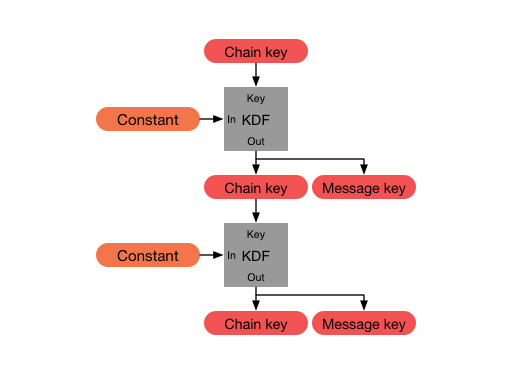
The first layer of the Double Ratchet, the Symmetric Ratchet, derives an AES key from the root key and advances it for every message sent. This allows every message to be encrypted with a new secret key. Consequently, if attackers compromise one party’s device, they won’t be able to learn anything about the keys that came earlier. Even then, though, the attackers would still be able to compute the keys used in future messages. That’s where the second, “Diffie-Hellman ratchet” comes in.

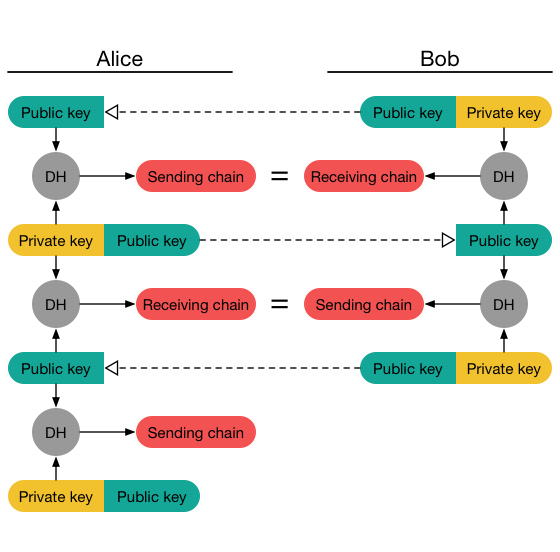
The Diffie-Hellman ratchet incorporates a new ECDH public key into each message sent. Using Alice and Bob, the fictional characters often referred to when explaining asymmetric encryption, when Alice sends Bob a message, she creates a new ratchet keypair and computes the ECDH agreement between this key and the last ratchet public key Bob sent. This gives her a new secret, and she knows that once Bob gets her new public key, he will know this secret, too (because, as mentioned earlier, Bob previously sent that other key). With that, Alice can mix the new secret with her old root key to get a new root key and start fresh. The result: Attackers who learn her old secrets won’t be able to tell the difference between her new ratchet keys and random noise.

The result is what Signal developers describe as “ping-pong” behavior, as the parties to a discussion take turns replacing ratchet key pairs one at a time. The effect: An eavesdropper who compromises one of the parties might recover a current ratchet private key, but soon enough, that private key will be replaced with a new, uncompromised one, and in a way that keeps it free from the prying eyes of the attacker.

The objective of the newly generated keys is to limit the number of messages that can be decrypted if an adversary recovers key material at some point in an ongoing chat. Messages sent prior to and after the compromise will remain off limits.

A major challenge designers of the Signal Protocol face is the need to make the ratchets work in an asynchronous environment. Asynchronous messages occur when parties send or receive them at different times—such as while one is offline and the other is active, or vice versa—without either needing to be present or respond immediately. The entire Signal Protocol must work within this asynchronous environment. What’s more, it must work reliably over unstable networks and networks controlled by adversaries, such as a government that forces a telecom or cloud service to spy on the traffic.

Shor’s algorithm lurking

By all accounts, Signal’s double ratchet design is state-of-the-art. That said, it’s wide open to an inevitable if not immediate threat: quantum computing. That’s because an adversary capable of monitoring traffic passing from two or more messenger users can capture that data and feed it into a quantum computer—once one of sufficient power is viable—and calculate the ephemeral keys generated in the second ratchet.

In classical computing, it’s infeasible, if not impossible, for such an adversary to calculate the key. Like all asymmetric encryption algorithms, ECDH is based on a mathematical, one-way function. Also known as trapdoor functions, these problems are trivial to compute in one direction and substantially harder to compute in reverse. In elliptic curve cryptography, this one-way function is based on the Discrete Logarithm problem in mathematics. The key parameters are based on specific points in an elliptic curve over the field of integers modulo some prime P.

On average, an adversary equipped with only a classical computer would spend billions of years guessing integers before arriving at the right ones. A quantum computer, by contrast, would be able to calculate the correct integers in a matter of hours or days. A formula known as Shor’s algorithm—which runs only on a quantum computer—reverts this one-way discrete logarithm equation to a two-way one. Shor’s Algorithm can similarly make quick work of solving the one-way function that’s the basis for the RSA algorithm.

As noted earlier, the Signal Protocol received its first post-quantum makeover in 2023. This update added PQXDH—a Signal-specific implementation that combined the key agreements from elliptic curves used in X3DH (specifically X25519) and the quantum-safe KEM—in the initial protocol handshake. (X3DH was then put out to pasture as a standalone implementation.)

The move foreclosed the possibility of a quantum attack being able to recover the symmetric key used to start the ratchets, but the ephemeral keys established in the ping-ponging second ratchet remained vulnerable to a quantum attack. Signal’s latest update adds quantum resistance to these keys, ensuring that forward secrecy and post-compromise security are safe from Shor’s algorithm as well.

Even though the ping-ponging keys are vulnerable to future quantum attacks, they are broadly believed to be secure against today’s attacks from classical computers. The Signal Protocol developers didn’t want to remove them or the battle-tested code that produces them. That led to their decision to add quantum resistance by adding a third ratchet. This one uses a quantum-safe KEM to produce new secrets much like the Diffie-Hellman ratchet did before, ensuring quantum-safe, post-compromise security.

The technical challenges were anything but easy. Elliptic curve keys generated in the X25519 implementation are about 32 bytes long, small enough to be added to each message without creating a burden on already constrained bandwidths or computing resources. A ML-KEM 768 key, by contrast, is 1,000 bytes. Additionally, Signal’s design requires sending both an encryption key and a ciphertext, making the total size 2272 bytes.

And then there were three

To handle the 71x increase, Signal developers considered a variety of options. One was to send the 2272-byte KEM key less often—say every 50th message or once every week—rather than every message. That idea was nixed because it doesn’t work well in asynchronous or adversarial messaging environments. Signal Protocol developers Grame Connell and Rolfe Schmidt explained:

Consider the case of “send a key if you haven’t sent one in a week”. If Bob has been offline for 2 weeks, what does Alice do when she wants to send a message? What happens if we can lose messages, and we lose the one in fifty that contains a new key? Or, what happens if there’s an attacker in the middle that wants to stop us from generating new secrets, and can look for messages that are [many] bytes larger than the others and drop them, only allowing keyless messages through?

Another option Signal engineers considered was breaking the 2272-byte key into smaller chunks, say 71 of them that are 32 bytes each. Breaking up the KEM key into smaller chunks and putting one in each message sounds like a viable approach at first, but once again, the asynchronous environment of messaging made it unworkable. What happens, for example, when data loss causes one of the chunks to be dropped? The protocol could deal with this scenario by just repeat-sending chunks again after sending all 71 previously. But then an adversary monitoring the traffic could simply cause packet 3 to be dropped each time, preventing Alice and Bob from completing the key exchange.

Signal developers ultimately went with a solution that used this multiple-chunks approach.

Sneaking an elephant through the cat door

To manage the asynchrony challenges, the developers turned to “erasure codes,” a method of breaking up larger data into smaller pieces such that the original can be reconstructed using any sufficiently sized subset of chunks.

Charlie Jacomme, a researcher at INRIA Nancy on the Pesto team who focuses on formal verification and secure messaging, said this design accounts for packet loss by building redundancy into the chunked material. Instead of all x number of chunks having to be successfully received to reconstruct the key, the model requires only x-y chunks to be received, where y is the acceptable number of packets lost. As long as that threshold is met, the new key can be established even when packet loss occurs.

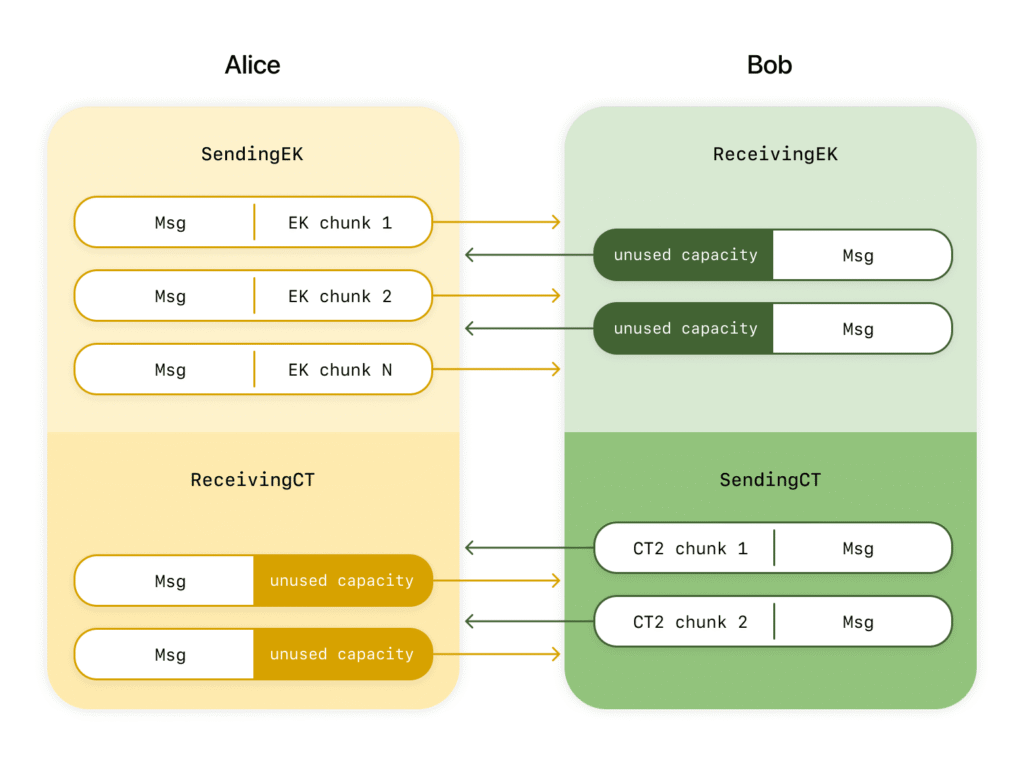
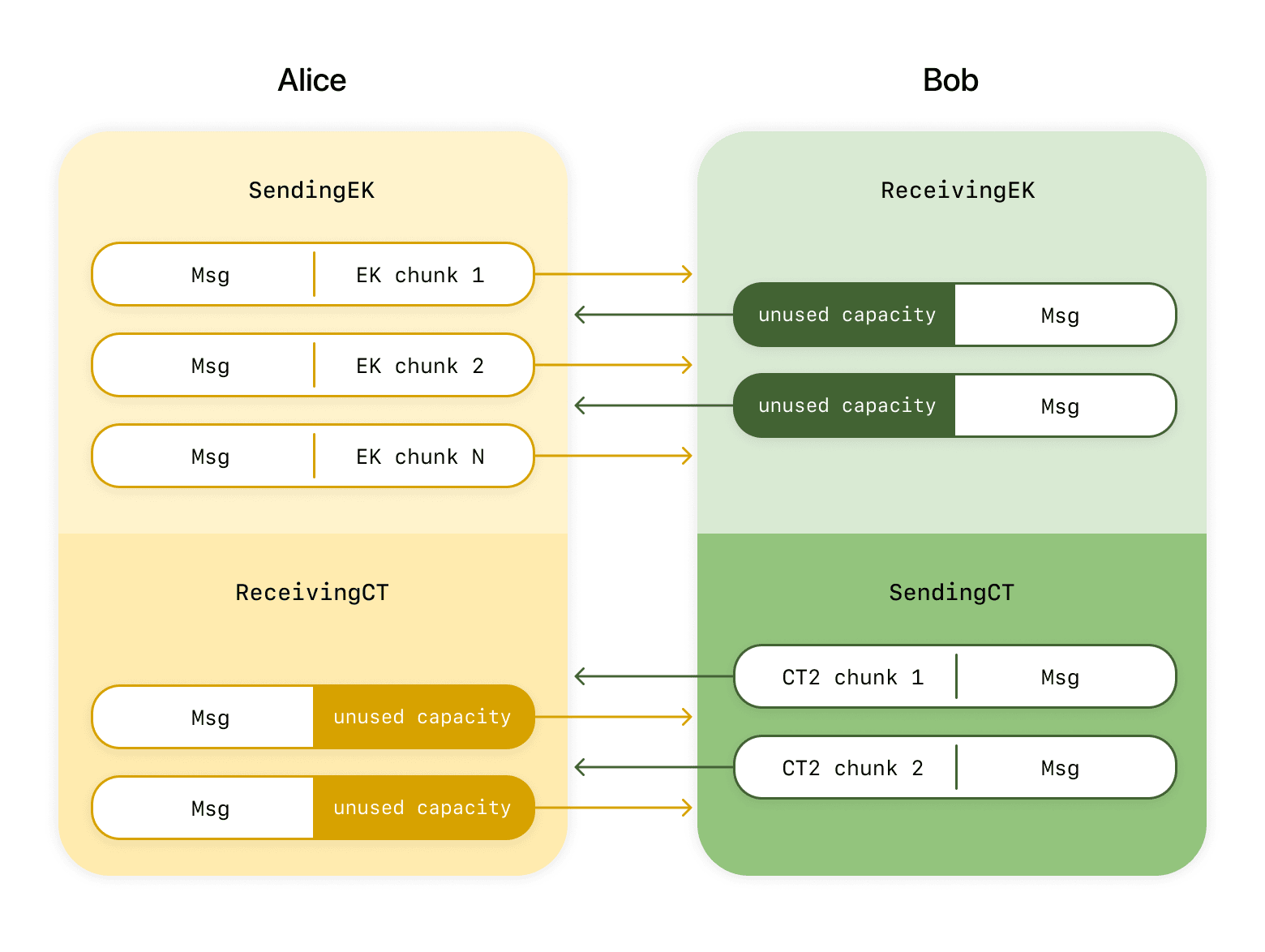
The other part of the design was to split the KEM computations into smaller steps. These KEM computations are distinct from the KEM key material.

As Jacomme explained it:

Essentially, a small part of the public key is enough to start computing and sending a bigger part of the ciphertext, so you can quickly send in parallel the rest of the public key and the beginning of the ciphertext. Essentially, the final computations are equal to the standard, but some stuff was parallelized.

All this in fact plays a role in the end security guarantees, because by optimizing the fact that KEM computations are done faster, you introduce in your key derivation fresh secrets more frequently.

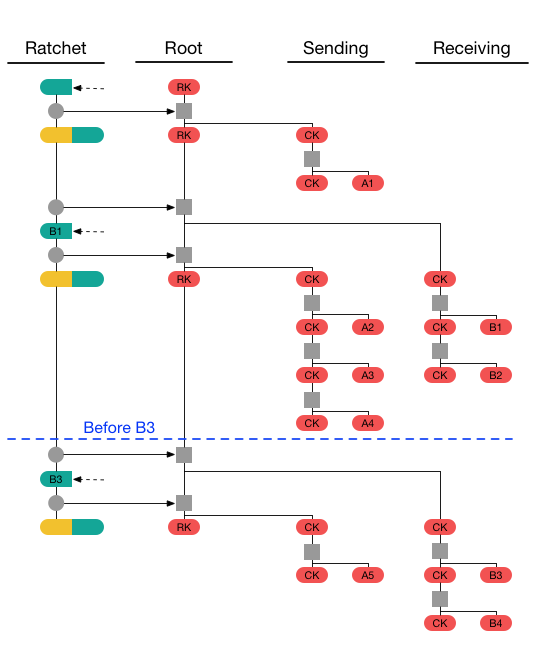
Signal’s post 10 days ago included several images that illustrate this design:

While the design solved the asynchronous messaging problem, it created a new complication of its own: This new quantum-safe ratchet advanced so quickly that it couldn’t be kept synchronized with the Diffie-Hellman ratchet. Ultimately, the architects settled on a creative solution. Rather than bolt KEM onto the existing double ratchet, they allowed it to remain more or less the same as it had been. Then they used the new quantum-safe ratchet to implement a parallel secure messaging system.

Now, when the protocol encrypts a message, it sources encryption keys from both the classic Double Ratchet and the new ratchet. It then mixes the two keys together (using a cryptographic key derivation function) to get a new encryption key that has all of the security of the classical Double Ratchet but now has quantum security, too.

The Signal engineers have given this third ratchet the formal name: Sparse Post Quantum Ratchet, or SPQR for short. The third ratchet was designed in collaboration with PQShield, AIST, and New York University. The developers presented the erasure-code-based chunking and the high-level Triple Ratchet design at the Eurocrypt 2025 conference. At the Usenix 25 conference, they discussed the six options they considered for adding quantum-safe forward secrecy and post-compromise security and why SPQR and one other stood out. Presentations at the NIST PQC Standardization Conference and the Cryptographic Applications Workshop explain the details of chunking, the design challenges, and how the protocol had to be adapted to use the standardized ML-KEM.

Jacomme further observed:

The final thing interesting for the triple ratchet is that it nicely combines the best of both worlds. Between two users, you have a classical DH-based ratchet going on one side, and fully independently, a KEM-based ratchet is going on. Then, whenever you need to encrypt something, you get a key from both, and mix it up to get the actual encryption key. So, even if one ratchet is fully broken, be it because there is now a quantum computer, or because somebody manages to break either elliptic curves or ML-KEM, or because the implementation of one is flawed, or…, the Signal message will still be protected by the second ratchet. In a sense, this update can be seen, of course simplifying, as doubling the security of the ratchet part of Signal, and is a cool thing even for people that don’t care about quantum computers.

As both Signal and Jacomme noted, users of Signal and other messengers relying on the Signal Protocol need not concern themselves with any of these new designs. To paraphrase a certain device maker, it just works.

In the coming weeks or months, various messaging apps and app versions will be updated to add the triple ratchet. Until then, apps will simply rely on the double ratchet as they always did. Once apps receive the update, they’ll behave exactly as they did before upgrading.

For those who care about the internal workings of their Signal-based apps, though, the architects have documented in great depth the design of this new ratchet and how it behaves. Among other things, the work includes a mathematical proof verifying that the updated Signal protocol provides the claimed security properties.

Outside researchers are applauding the work.

“If the normal encrypted messages we use are cats, then post-quantum ciphertexts are elephants,” Matt Green, a cryptography expert at Johns Hopkins University, wrote in an interview. “So the problem here is to sneak an elephant through a tunnel designed for cats. And that’s an amazing engineering achievement. But it also makes me wish we didn’t have to deal with elephants.”

Photo of Dan Goodin

Dan Goodin is Senior Security Editor at Ars Technica, where he oversees coverage of malware, computer espionage, botnets, hardware hacking, encryption, and passwords. In his spare time, he enjoys gardening, cooking, and following the independent music scene. Dan is based in San Francisco. Follow him at here on Mastodon and here on Bluesky. Contact him on Signal at DanArs.82.

Why Signal’s post-quantum makeover is an amazing engineering achievement Read More »

“microsoft-has-simply-given-us-no-other-option,”-signal-says-as-it-blocks-windows-recall

“Microsoft has simply given us no other option,” Signal says as it blocks Windows Recall

But the changes go only so far in limiting the risks Recall poses. As I pointed out, when Recall is turned on, it indexes Zoom meetings, emails, photos, medical conditions, and—yes—Signal conversations, not just with the user, but anyone interacting with that user, without their knowledge or consent.

Researcher Kevin Beaumont performed his own deep-dive analysis that also found that some of the new controls were lacking. For instance, Recall continued to screenshot his payment card details. It also decrypted the database with a simple fingerprint scan or PIN. And it’s unclear whether the type of sophisticated malware that routinely infects consumer and enterprise Windows users will be able to decrypt encrypted database contents.

And as Cunningham also noted, Beaumont found that Microsoft still provided no means for developers to prevent content displayed in their apps from being indexed. That left Signal developers at a disadvantage, so they had to get creative.

With no API for blocking Recall in the Windows Desktop version, Signal is instead invoking an API Microsoft provides for protecting copyrighted material. App developers can turn on the DRM setting to prevent Windows from taking screenshots of copyrighted content displayed in the app. Signal is now repurposing the API to add an extra layer of privacy.

“We hope that the AI teams building systems like Recall will think through these implications more carefully in the future,” Signal wrote Wednesday. “Apps like Signal shouldn’t have to implement ‘one weird trick’ in order to maintain the privacy and integrity of their services without proper developer tools. People who care about privacy shouldn’t be forced to sacrifice accessibility upon the altar of AI aspirations either.”

Signal’s move will lessen the chances of Recall permanently indexing private messages, but it also has its limits. The measure only provides protection when all parties to a chat—at least those using the Windows Desktop version—haven’t changed the default settings.

Microsoft officials didn’t immediately respond to an email asking why Windows provides developers with no granular control over Recall and whether the company has plans to add any.

“Microsoft has simply given us no other option,” Signal says as it blocks Windows Recall Read More »