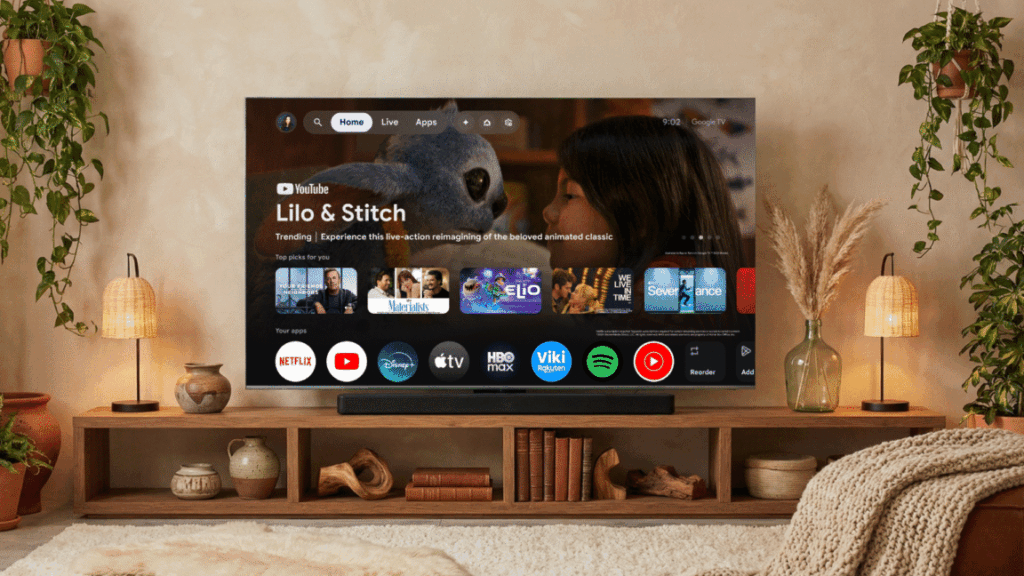
That might be a fun distraction, but it’s not a core TV experience. Google’s image and video models are good enough that you might gain some benefit from monkeying around with them on a larger screen, but Gemini is also available for more general tasks.
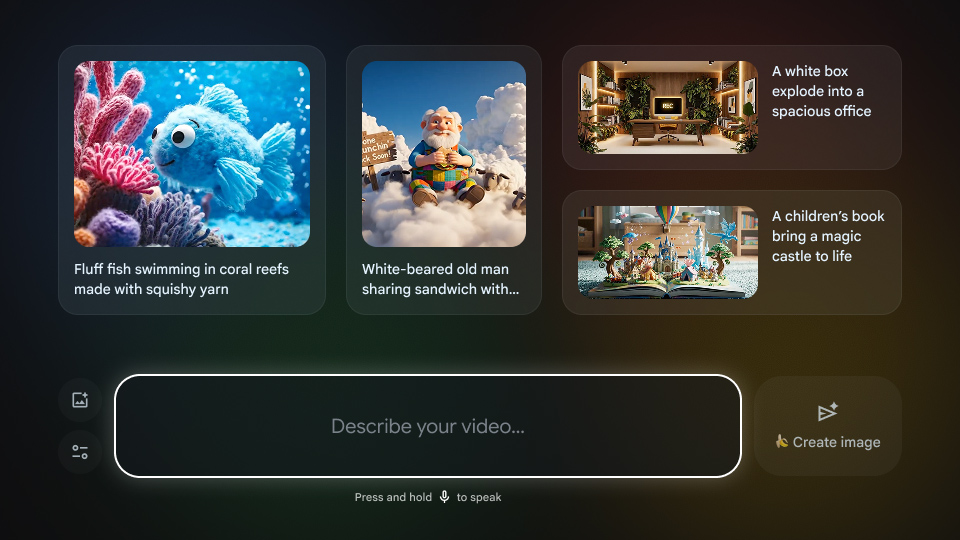
Google TV will support generating new images and videos with Google’s AI models.
Credit: Google
Google TV will support generating new images and videos with Google’s AI models. Credit: Google
This update brings a full chatbot-like experience to TVs. If you want to catch up on sports scores or get recommendations for what to watch, you can ask the robot. The outputs might be a little different from what you would expect from using Gemini on the web or in an app. Google says it has devised a “visually rich framework” that will make the AI more usable on a TV. There will also be a “Dive Deeper” option in each response to generate an interactive overview of the topic.
Gemini can also take action to tweak system settings based on your complaints. For example, pull up Gemini and say “the dialog is too quiet” and watch as the AI makes adjustments to address that.
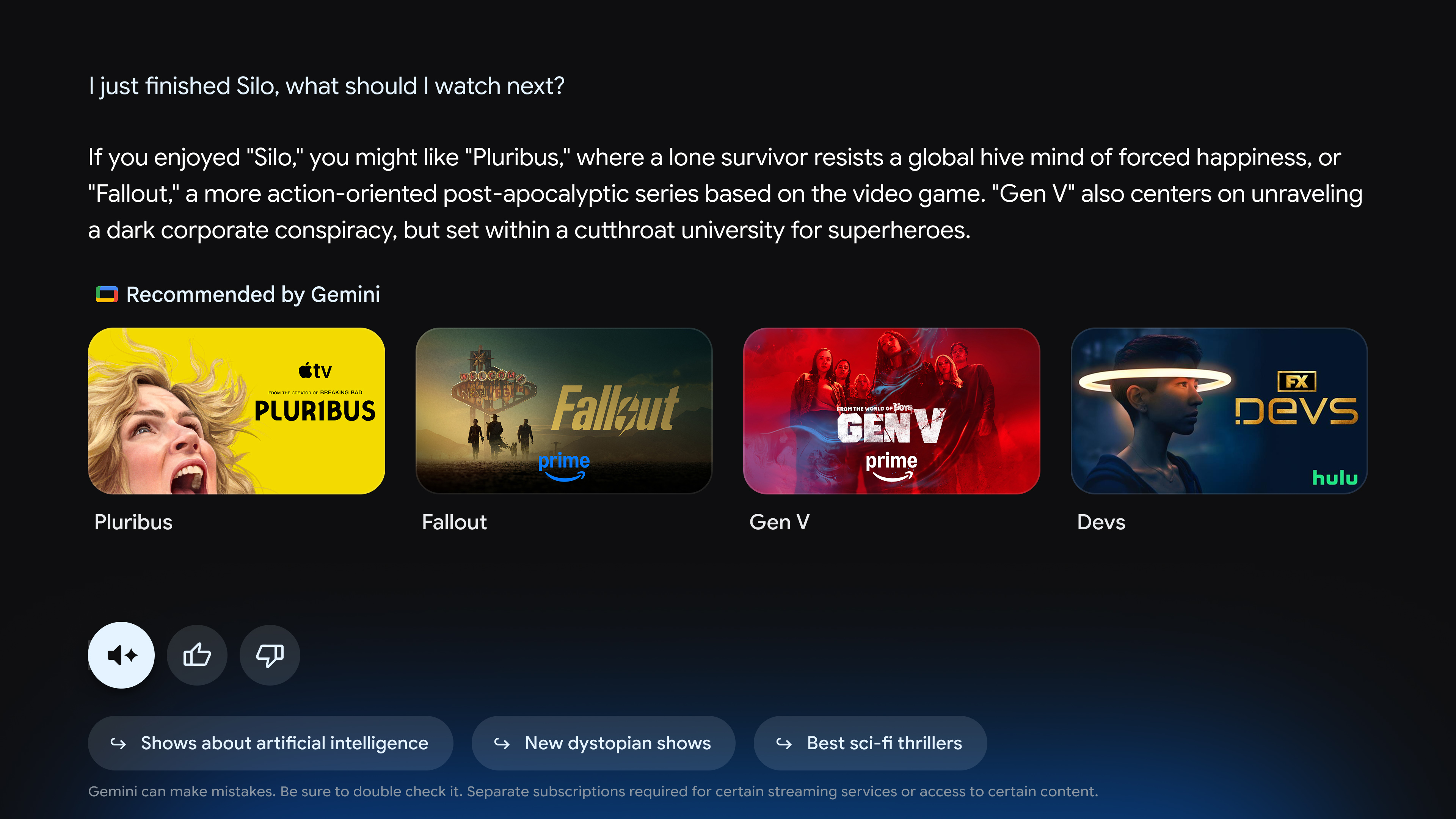
Gemini’s replies on Google TV will be more visual.
Credit: Google
Gemini’s replies on Google TV will be more visual. Credit: Google
The new Gemini features will debut on TCL TVs that run Google TV, but most other devices, even Google’s own TV Streamer, will have to wait a few months. Even then, you won’t see Gemini taking over every TV or streaming box with Google’s software. The new Gemini features require the full Google TV experience with Android OS version 14 or higher.

Automated Content Recognition brings “mass surveillance” to homes, lawsuits say.
Credit: Getty Images | Maskot
Texas Attorney General Ken Paxton sued five large TV manufacturers yesterday, alleging that their smart TVs spy on viewers without consent. Paxton sued Samsung, the longtime TV market share leader, along with LG, Sony, Hisense, and TCL.
“These companies have been unlawfully collecting personal data through Automated Content Recognition (‘ACR’) technology,” Paxton’s office alleged in a press release that contains links to all five lawsuits. “ACR in its simplest terms is an uninvited, invisible digital invader. This software can capture screenshots of a user’s television display every 500 milliseconds, monitor viewing activity in real time, and transmit that information back to the company without the user’s knowledge or consent. The companies then sell that consumer information to target ads across platforms for a profit. This technology puts users’ privacy and sensitive information, such as passwords, bank information, and other personal information at risk.”
The lawsuits allege violations of the Texas Deceptive Trade Practices Act, seeking damages of up to $10,000 for each violation and up to $250,000 for each violation affecting people 65 years or older. Texas also wants restraining orders prohibiting the collection, sharing, and selling of ACR data while the lawsuits are pending.
Texas argues that providing personalized content and targeted advertising are not legitimate purposes for collecting ACR data about consumers. The companies’ “insatiable appetite for consumer data far exceeds what is reasonably necessary,” and the “invasive data harvesting is only needed to increase advertisement revenue, which does not satisfy a consumer-necessity standard,” the lawsuits say.
Paxton is far from the first person to raise privacy concerns about smart TVs. The Center for Digital Democracy advocacy group said in a report last year that in “the world of connected TV, viewer surveillance is now built directly into the television set, making manufacturers central players in data collection, monitoring, and digital marketing.” We recently published a guide on how to break free from smart TV ads and tracking.
“Companies using ACR claim that it is all opt-in data, with permission required to use it,” the Center for Digital Democracy report said. “But the ACR system is bundled into new TVs as part of the initial set-up, and its extensive role in monitoring and sharing viewer actions is not fully explained. As a consequence, most consumers would be unaware of the threats and risks involved in signing up for the service.”
“Mass surveillance system” in US living rooms
Pointing out that Hisense and TCL are based in China, Paxton’s press release said the firms’ “Chinese ties pose serious concerns about consumer data harvesting and are exacerbated by China’s National Security Law, which gives its government the capability to get its hands on US consumer data.”
“Companies, especially those connected to the Chinese Communist Party, have no business illegally recording Americans’ devices inside their own homes,” Paxton said. “This conduct is invasive, deceptive, and unlawful. The fundamental right to privacy will be protected in Texas because owning a television does not mean surrendering your personal information to Big Tech or foreign adversaries.”
The Paxton lawsuits, filed in district courts in several Texas counties, are identical in many respects. The complaints allege that TVs made by the five companies “aren’t just entertainment devices—they’re a mass surveillance system sitting in millions of American living rooms. What consumers were told would enhance their viewing experience actually tracks, analyzes, and sells intimate details about everything they watch.”
Using ACR, each company “secretly monitors what consumers watch across streaming apps, cable, and even connected devices like gaming consoles or Blu-ray players,” and harvests the data to build profiles of consumer behavior and sell the data for profit, the complaints say.
We contacted the five companies sued by Texas today. Sony, LG, and Hisense responded and said they would not comment on a pending legal matter.
Difficult opt-out processes detailed
The complaints allege that the companies fail to obtain meaningful consent from users. The following excerpt is from the Samsung lawsuit but is repeated almost verbatim in the others:
Consumers never agreed to Samsung Watchware. When families buy a television, they don’t expect it to spy on them. They don’t expect their viewing habits packaged and auctioned to advertisers. Yet Samsung deceptively guides consumers to activate ACR and buries any explanation of what that means in dense legal jargon that few will read or understand. The so-called “consent” Samsung obtains is meaningless. Disclosures are hidden, vague, and misleading. The company collects far more data than necessary to make the TV work. Consumers are stripped of real choice and kept in the dark about what’s happening in their own homes on Samsung Smart TVs.
Samsung and other companies force consumers to go through multistep menus to exercise their privacy choices, Texas said. “Consumers must circumnavigate a long, non-intuitive path to exercise their right to opt-out,” the Samsung lawsuit said. This involves selecting menu choices for Settings, Additional Settings, General Privacy, Terms & Privacy, Viewing Information Services, and, finally, “Disable,” the lawsuit said. There are “additional toggles for Interest-Based Ads, Ad Personalization, and Privacy Choices,” the lawsuit said.
The “privacy choices are not meaningful because opt-out rights are scattered across four or more separate menus which requires approximately 15+ clicks,” the lawsuit continued. “To fully opt-out of ACR and related ad tracking on Samsung Smart TVs, consumers must disable at least two settings: (1) Viewing Information Services, and (2) Interest-Based Ads. Each of which appear in different parts of the setting UI. Conversely, Samsung provides consumers with a one-click enrollment option to opt-in during the initial start-up process.”
When consumers first start up a Samsung smart TV, they “must click through a multipage onboarding flow before landing on a consent screen, titled Smart Hub Terms & Conditions,” the lawsuit said. “Upon finally reaching the consent screen, consumers are presented with four notices: Terms & Conditions: Dispute Resolution Agreement, Smart Hub U.S. Policy Notice, Viewing Information Services, and Interest-Based Advertisements Service U.S. Privacy Notice, with only one button prominently displayed: I Agree to all.”
Deceptive trade practices alleged
It would be unreasonable to expect consumers to understand that Samsung TVs come equipped with surveillance capabilities, the lawsuit said. “Most consumers do not know, nor have any reason to suspect, that Samsung Smart TVs are capturing in real-time the audio and visuals displayed on the screen and using the information to profile them for advertisers,” it said.
Paxton alleges that TV companies violated the state’s Deceptive Trade Practices Act with misrepresentations regarding the collection of personal information and failure to disclose the use of ACR technology. The lawsuit against Hisense additionally alleges a failure to disclose that it may provide the Chinese government with consumers’ personal data.
Hisense “fails to disclose to Texas Consumers that under Chinese law, Hisense is required to transfer its collections of Texas consumers’ personal data to the People’s Republic of China when requested by the PRC,” the lawsuit said.
The TCL lawsuit doesn’t include that specific charge. But both the Hisense and TCL complaints say the Chinese Communist Party may use ACR data from the companies’ smart TVs “to influence or compromise public figures in Texas, including judges, elected officials, and law enforcement, and for corporate espionage by surveilling those employed in critical infrastructure, as part of the CCP’s long-term plan to destabilize and undermine American democracy.”
The TVs “are effectively Chinese-sponsored surveillance devices, recording the viewing habits of Texans at every turn without their knowledge or consent,” the lawsuits said.
Jon is a Senior IT Reporter for Ars Technica. He covers the telecom industry, Federal Communications Commission rulemakings, broadband consumer affairs, court cases, and government regulation of the tech industry.
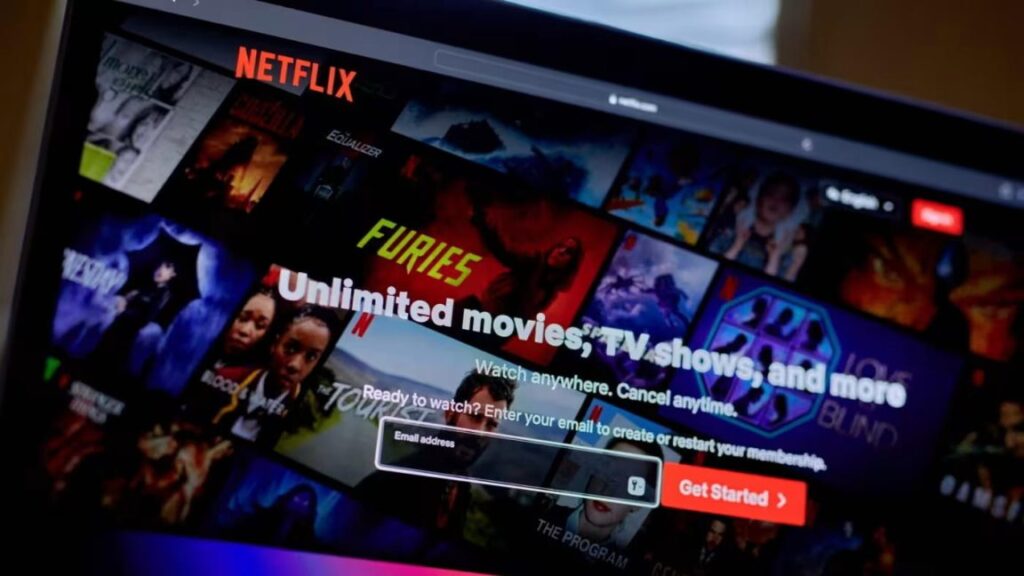
Have you been trying to cast Stranger Things from your phone, only to find that your TV isn’t cooperating? It’s not the TV—Netflix is to blame for this one, and it’s intentional. The streaming app has recently updated its support for Google Cast to disable the feature in most situations. You’ll need to pay for one of the company’s more expensive plans, and even then, Netflix will only cast to older TVs and streaming dongles.
The Google Cast system began appearing in apps shortly after the original Chromecast launched in 2013. Since then, Netflix users have been able to start video streams on TVs and streaming boxes from the mobile app. That was vital for streaming targets without their own remote or on-screen interface, but times change.
Today, Google has moved beyond the remote-free Chromecast experience, and most TVs have their own standalone Netflix apps. Netflix itself is also allergic to anything that would allow people to share passwords or watch in a new place. Over the last couple of weeks, Netflix updated its Android app to remove most casting options, mirroring a change in 2019 to kill Apple AirPlay.
The company’s support site (spotted by Android Authority) now clarifies that casting is only supported in a narrow set of circumstances. First, you need to be paying for one of the ad-free service tiers, which start at $18 per month. Those on the $8 ad-supported plan won’t have casting support.
Even then, Casting only appears for devices without a remote, like the earlier generations of Google Chromecasts, as well as some older TVs with Cast built in. For example, anyone still rocking Google’s 3rd Gen Chromecast from 2018 can cast video in Netflix, but those with the 2020 Chromecast dongle (which has a remote and a full Android OS) will have to use the TV app. Essentially, anything running Android/Google TV or a smart TV with a full Netflix app will force you to log in before you can watch anything.
News 4 watched the movie and confirmed it contains several scenes that match the description given by board members, including one where a group of fully nude women [!] work inside a factory [!!] packaging cocaine [!!!], some wearing only lab coats [!!!!].
Another scene shows a fully nude woman giving a man a massage, eventually moving under the table while the dialogue strongly suggests sexual activity.
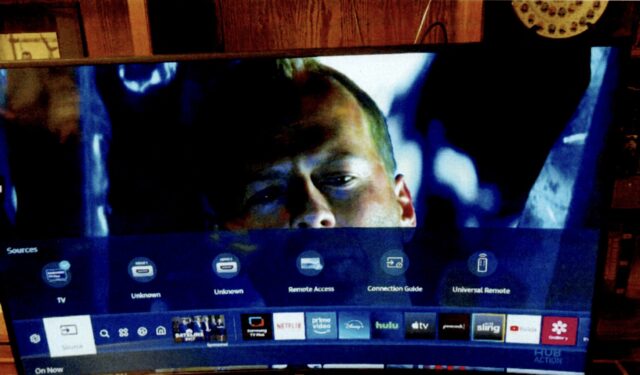
But why was The Protector showing on a TV in a state office building at all? Investigators came to find out that the Samsung smart TV in question—recently installed in the office—had been set up in such a way that it defaulted to showing Samsung TV Plus Channel 1204, the “Movie Hub Action.” (You can see Samsung’s full list of TV Plus streaming channels here.) And at the time of the state board meeting, Movie Hub Action was streaming The Protector. How and why the TV was turned on or switched to this streaming channel isn’t clear, but the whole thing appears to be an absolutely bizarre accident.
As part of this important investigation, the sheriff’s office then took clips from The Protector to the board members who complained. According to the Oklahoma Voice, “The board members, Becky Carson and Ryan Deatherage, confirmed to the Sheriff’s Office that the movie was consistent with what they saw on the TV.”
Behold! The actual TV from the incident. Credit: Alias
Hooking smart TVs up to the Internet looks increasingly like a bad idea, though not usually for the reason found in this case. TV manufacturers have taken what should have been a useful feature and turned it into a way to spy on what you’re watching and to push ads to your TV.
Now you can add “showing naked, cocaine-packaging factory workers to Oklahoma Board of Education members” to the list of grievances.
AdGood’s offerings also include a managed service for ad campaign management for nonprofits. AdGood doesn’t yet offer pixels, but Johns said developments like that are “in the works.”
Johns explained that while many nonprofits use services like Meta and Google AdWords for tracking ads, they’re “hitting plateaus” with their typical methods. He said there is nonprofit interest in reaching younger audiences, who often use CTV devices:
A lot of them have been looking for ways to get [into CTV ads], but, unfortunately, with minimum spend amounts, they’re just not able to access it.
Helping nonprofits make commercials
AdGood also sells a self-serve generative AI ad manager, which it offers via a partnership with Streamr.AI. The tool is designed to simplify the process of creating 30-second video ads that are “completely editable via a chat prompt,” according to Johns.
“It automatically generates all their targeting. They can update their targeting for whatever they want, and then they can swipe a credit card and essentially run that campaign. It goes into our approval queue, which typically takes 24 hours for us to approve because it needs to be deemed TV-quality,” he explained.
The executive said AdGood charges nonprofits a $7 CPM and a $250 flat fee for the service. He added:
Think about a small nonprofit in a local community, for instance, my son’s special needs baseball team. I can get together with five other parents, easily pull together a campaign, and run it in our local town. We get seven kids to show up, and it changes their lives. We’re talking about $250 having a massive impact in a local market.
Looking ahead, Johns said he’d like to see AdGood’s platform and team grow to be able to give every customer “a certain allocation of inventory, whether it’s 50,000 impressions a month or 100,000 a month.”
For some, streaming ads are rarely a good thing. But when those ads can help important causes and replace odd blank ad spaces that make us question our own existence, it brings new meaning to the idea of a “good” commercial.
Enlarge/ I have hundreds of UUIDs and I must scream.
Getty Images
The modern “smart” TV asks a lot of us. In exchange for connecting you to a few streaming services you use, a TV will collect data, show ads, and serve as another vector for bad actors. In a few reported cases, though, a modern connected TV has been blamed for attacks not on privacy, eyeballs, or passwords but on an entirely different computer.
The TV in question is a Hisense TV, and the computer is a Windows PC, specifically one belonging to Priscilla Snow, a musician and audio designer in Montréal, Quebec. Her post about her Hisense experience reads like a mystery. Of course, because you already know the crime and the culprit, it’s more like a Columbo episode. Either way, it’s thrilling in a very specific I-can’t-believe-that-fixed-it kind of thrill.
Disappearing Settings, keyboards, remote desktops, and eventually taskbars
Snow’s Windows PC had “a few hiccups over the past couple of years,” Snow wrote on April 19. She couldn’t open display settings, for one. A MIDI keyboard interface stopped working. Task manager would start to hang until force-closed. Video capture cards had trouble connecting. As Snow notes, any veteran of a Windows computer that has had lots of stuff installed on it can mentally write off most of these things, or at least stash them away until the next reinstall.
Then, while trying to figure out why a remote desktop session wasn’t working, the task bars on Snow’s PC disappeared. The PC refused to launch any settings panels. After updating drivers and restarting the PC, the taskbars returned, but only for six days. Snow hunted for solutions, and after using “the exact right string in my search,” she found a Reddit thread that led to a Microsoft support question, all describing the same kinds of seemingly spectral problems her computer was having over time, with no clear cause.
User Narayan B wrote in Microsoft’s forum that the issue is the Hisense TV generating “random UUIDs for UPNP network discovery every few minutes.” Windows, seemingly not knowing why any device would routinely do this, sees and adds those alternate Hisense devices to its Device Association Framework, or DAF. This service being stuffed full of attention-grabbing devices can hang up Task Manager, Bluetooth, the Settings apps, File Explorer, and more.
The fix is deleting hundreds of keys from the registry. Narayan B wrote that noticed his Hisense TV flooding Windows’ device discovery systems before but “didn’t think Windows would go for a toss due to this.” Snow did the same, and everything—Task Manager, MIDI keyboard, remote desktop, even a CRT monitor she had assumed was broken—started working again.
UUID, UPNP, DAF, and hundreds of Registry keys
Along with deleting hundreds of keys with maniacal keyboard pounding, Snow notes in chats attached to her post that she disabled “Set up network connected devices automatically” on her “Private networks” settings in Windows. And, of course, she recommend not buying the same Hisense 50Q8G she bought, or at least not having it on the same network.
The mystery is solved, but the culprit remains very much at large. Or culprits—plural—depending on how you think a Windows PC should react to a shapeshifting TV.
Ars reached out to Hisense to ask for comment and will update the post if we hear back.
Everyone with a Roku TV or streaming device will eventually be forced to enable two-factor authentication after the company disclosed two separate incidents in which roughly 600,000 customers had their accounts accessed through credential stuffing.
Credential stuffing is an attack in which usernames and passwords exposed in one leak are tried out against other accounts, typically using automated scripts. When people reuse usernames and passwords across services or make small, easily intuited changes between them, actors can gain access to accounts with even more identifying information and access.
In the case of the Roku attacks, that meant access to stored payment methods, which could then be used to buy streaming subscriptions and Roku hardware. Roku wrote on its blog, and in a mandated data breach report, that purchases occurred in “less than 400 cases” and that full credit card numbers and other “sensitive information” was not revealed.
The first incident, “earlier this year,” involved roughly 15,000 user accounts, Roku stated. By monitoring these accounts, Roku identified a second incident, one that touched 576,000 accounts. These were collectively “a small fraction of Roku’s more than 80M active accounts,” the post states, but the streaming giant will work to prevent future such stuffing attacks.
The affected accounts will have their passwords reset and will be notified, along with having charges reversed. Every Roku account, when next requiring a login, will now need to verify their account through a link sent to their email address. Alternatively, one can use the device ID of any linked Roku device, according to Roku’s support page. (Forcing this upgrade yourself is probably a good idea for past or present Roku owners.)
Security blog BleepingComputer reported around the time of the incident that breached Roku accounts were sold for as little as 50 cents each and likely obtained using commonly available stuffing tools that bypass brute-force protections through proxies and other means. BleepingComputer reported that “a source” tied Roku’s recent updates to its Dispute Resolution Terms, which all but locked Roku devices until a customer agreed, to the fraudulent activity. Roku told BleepingComputer that the two were not related.