100 years later, where is Robert Goddard’s first liquid-fueled rocket?
“He didn’t preserve it as a sacred object… “
Robert Goddard (at left) and Henry Sachs, Percy Roope, and Esther Goddard with parts from the first liquid-fueled rocket after its history-making flight in Auburn, Massachusetts, March 16, 1926. Credit: Robert Goddard/Clark University/collectSPACE.com
It flew for only two seconds, but its impact is still felt a century later.
Robert Goddard’s first liquid-fueled rocket, which lifted off from a snowy field on March 16, 1926, has been written about extensively. Earlier solid-fueled rockets existed, but liquid-fueled rockets promised the sustainability and control needed to send spacecraft and humans into Earth orbit and beyond.
“The rocket’s reach was short, but it marked the moment that humanity entered a new era,” said Kevin Schindler, author of “Robert Goddard’s Massachusetts,” speaking at the site of that first launch as part of a centennial commemoration held Saturday in Auburn (March 14). “It proved that liquid fuel could lift a craft skyward—the essential breakthrough that would one day carry humans to the moon.”
Photos from that day exist through the efforts of Goddard’s wife, as does a monument stand from where the rocket, nicknamed “Nell,” left the ground (today, located on a golf course). Over the decades, replicas of Nell have been built, even ones capable of flight. But a century later, a question about the rocket remains.
Where is it now?
First (and last?) to see
“Goddard didn’t seek the spotlight. He sought the truth. He was a scientist. Apart from his small team, very few people could say that they were truly there who felt the steady roar and saw the flash of fire against the New England snow. One of those people was my father,” said Thomas Hastings, addressing a small crowd who gathered in Auburn.
Hasting’s father, Gerald, who was 10 years old on that day in 1926, was sledding with some friends when he saw “four people in heavy coats got out of [their] vehicle and remove some rather large objects.” As he later learned, those four were Goddard, Goddard’s wife Esther, Goddard’s crew chief Henry Sachs, and Clark University assistant physics professor Percy Roope.
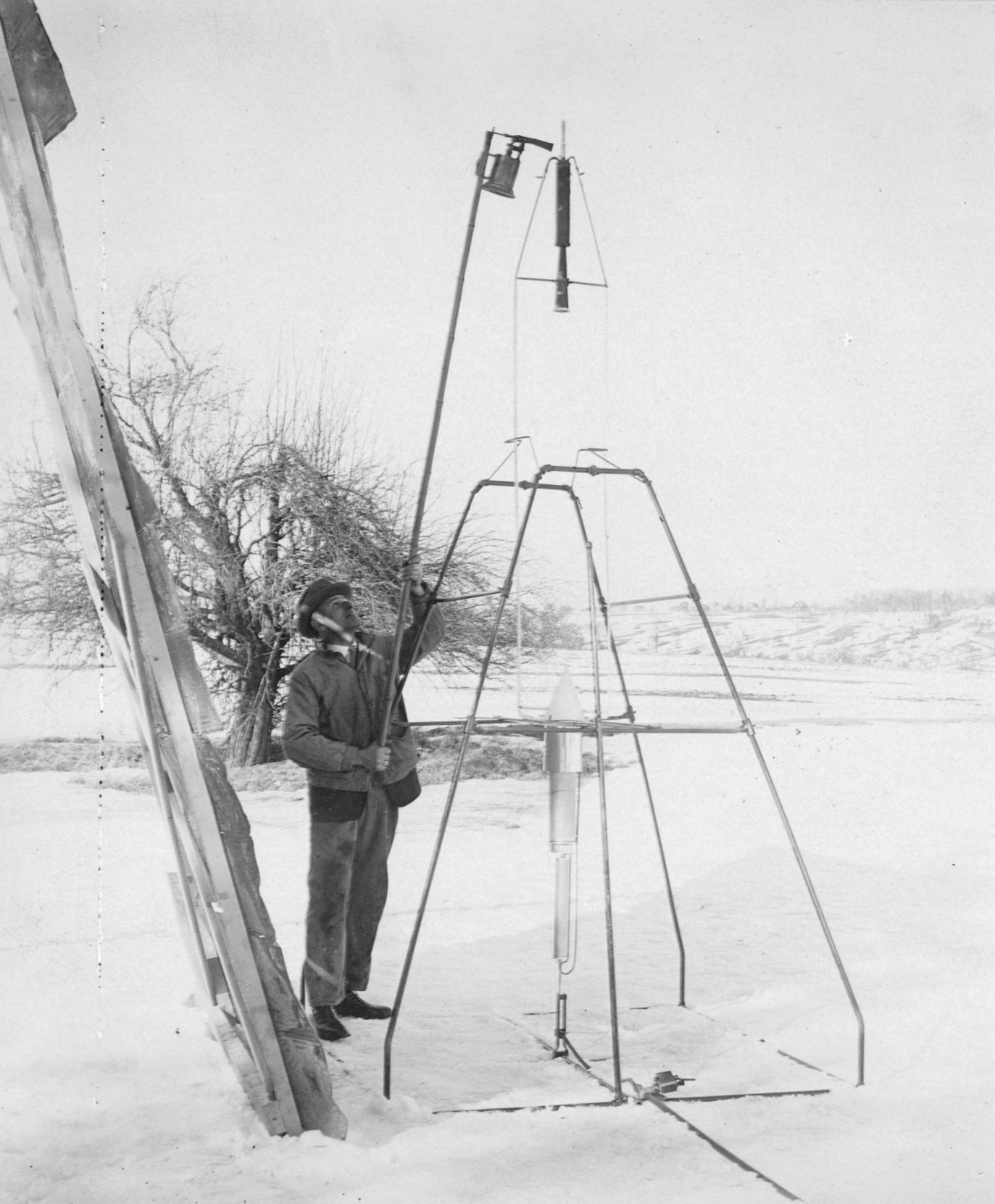
Henry Sachs, Robert Goddard’s assistant, ignites the first liquid fueled rocket on March 16, 1926.
Credit: Esther Goddard/Clark University
Henry Sachs, Robert Goddard’s assistant, ignites the first liquid fueled rocket on March 16, 1926. Credit: Esther Goddard/Clark University
“Dad [later] commented that the scene felt very strange,” said Hastings. “He and his friends continued looking on with great interest as the nameless visitors took whatever it was they had removed from the vehicle and assembled the pieces.”
“You can imagine how his imagination soared suddenly. They saw fire and smoke and heard loud noise as some object shot up into the air,” Hastings said, recounting what his father told him. “Dad and his friends shook their heads at each other, completely baffled by what they had just witnessed, and they continued sledding like you would expect them to.”
Goddard wrote in his notebook that the rocket “rose 41 feet & went 184 feet, in 2.5 secs.” The next day, he added, “Even though the release was pulled, the rocket did not rise at first, but the flame came out, and there was a steady roar. After a number of seconds it rose, slowly until it cleared the frame, and then at express train speed, curving over to the left, and striking the ice and snow, still going at a rapid rate.”
“It looked almost magical as it rose, without any appreciably greater noise or flame, as if it said, ‘I’ve been here long enough; I think I’ll be going somewhere else, if you don’t mind,’” he wrote.
Nell’s “salvation”
Nell, which gained its name from the title character of the then-contemporary play “Salvation Nell,” found its salvation in pieces.
Hastings, as recounted by his son, recalled watching as the “strangers in dark coats ran through the snow, gathered up what it was they had brought and set on fire, and they put the pieces back into their vehicle.”
Esther took a photograph of her husband standing with the recovered parts. She also posed for a similar photo, together with Sachs and Roope. In his notebook, Goddard wrote that they brought the rocket’s remains back to his laboratory.
By all accounts, Goddard did not try to reassemble Nell, nor did he treat the pieces as historic artifacts.
“He didn’t preserve it as a sacred object,” wrote Michael Neufeld, who retired as a senior curator for the space history division of the Smithsonian National Air and Space Museum, in an email. “He didn’t have a lot of money at that point and reused everything.”
A nozzle and a flood
In 1950, five years after Goddard’s death, the Guggenheim Foundation for the Promotion of Aeronautics donated to the Smithsonian the scientist’s immediate successor to Nell. Goddard attempted to launch that rocket on May 4 and 5, 1926.
“It survives because its thrust was too weak to launch itself,” wrote Neufeld. “For some reason he preserved it.”
The National Air and Space Museum’s collection catalog describes the Goddard May 1926 rocket as “likely includ[ing] the nozzle” recovered from Nell.
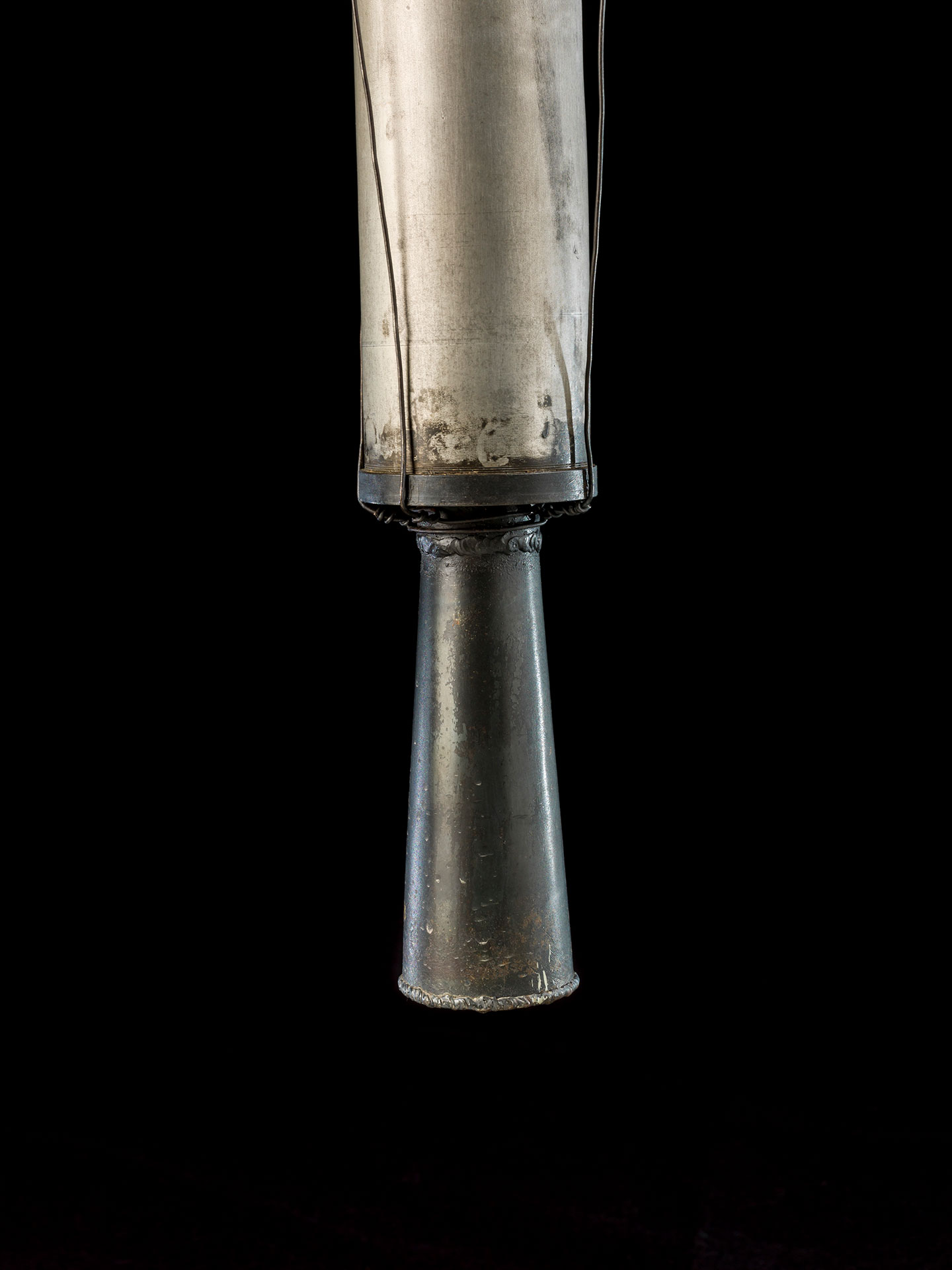
The nozzle on Robert Goddard’s May 1926 rocket, which did not fly and was donated to the National Air and Space Museum, “likely” was at least part of the first liquid fueled rocket launch on March 16 of that same year.
Credit: Smithsonian National Air and Space Museum
The nozzle on Robert Goddard’s May 1926 rocket, which did not fly and was donated to the National Air and Space Museum, “likely” was at least part of the first liquid fueled rocket launch on March 16 of that same year. Credit: Smithsonian National Air and Space Museum
“I gather the nozzle assertion is based on his notes. I haven’t seen them myself,” said Neufeld. “More may be on the May 1926 rocket, which we can’t prove.”
Goddard’s notebook is held at the Robert H. Goddard Library at Clark University today. In his March 16, 1926, entry, Goddard recorded that “the lower half of the nozzle burned off.” Photos taken prior to Nell’s launch show a longer nozzle than what is installed on the May rocket, perhaps supporting its suggested reuse.
Frank Winter, a retired curator of rocketry at the National Air and Space Museum, recently wrote an article for “Quest: The History of Spaceflight Quarterly,” in which he cited an inventory of the Robert H. Goddard Collection at the Roswell Museum and Arts Center in New Mexico, including “the protective conical cap that was mounted on top of the propellant tanks, nozzle fragments and the combustion chamber” from Nell.
Unfortunately, the Roswell Museum has been closed since October 2024, ever since it was devastated by a flood. Reached for this article, Caroline Brooks, the Roswell Museum’s executive director, confirmed they have four pieces claimed to be part of the March 1926 flight.
As referenced by both Winter and Brooks, W.S. Crane researched and published a catalog for the museum’s Goddard holdings in 1994. The chamber is attributed to coming from Clark University and the nozzle fragments are described as a gift from Esther Goddard. The source of the nose cone is unknown.
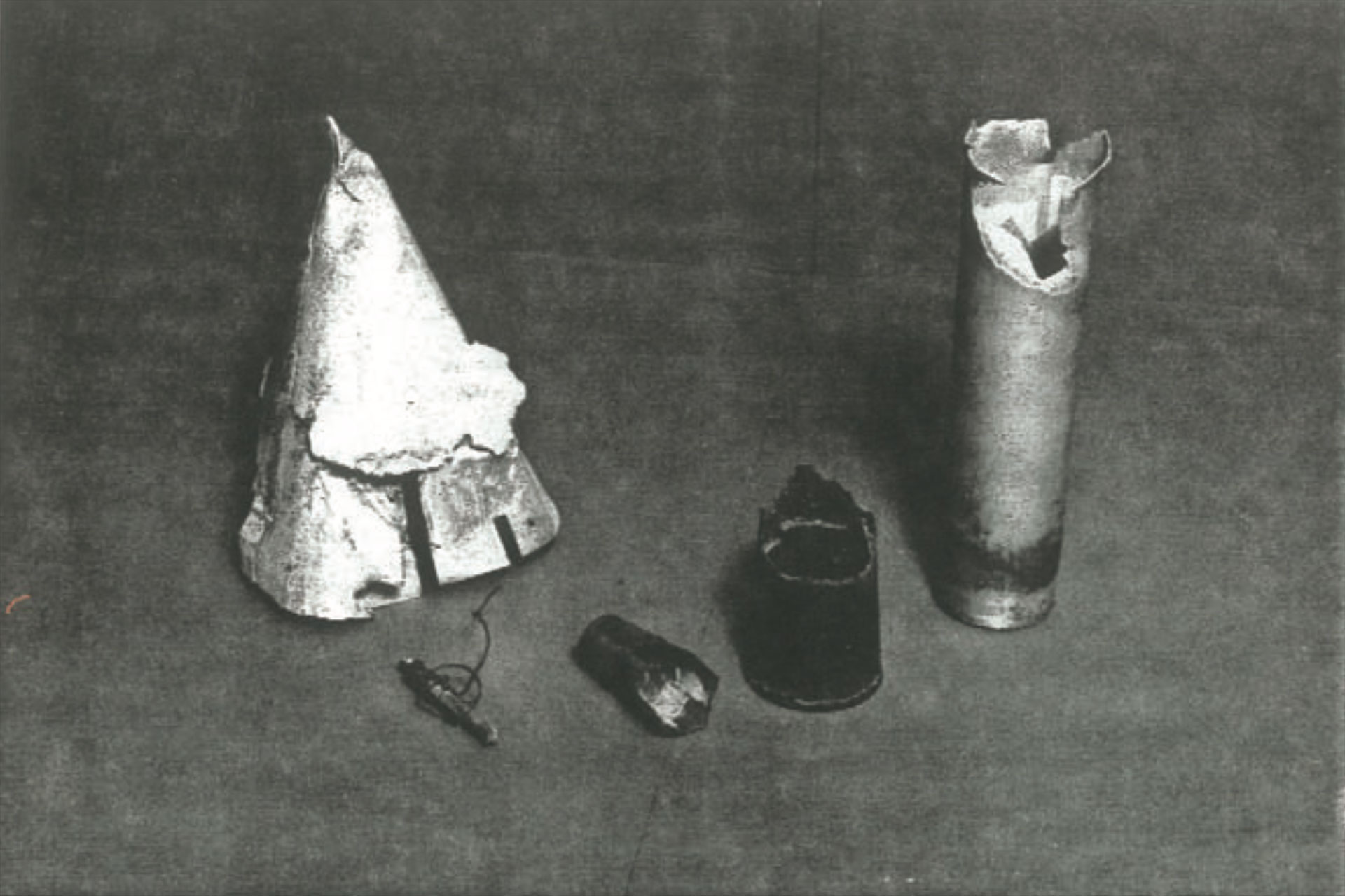
Fragments attributed to flying as part of the world’s first liquid fuel rocket in the Robert Goddard collection at the Roswell Museum and Arts Center in New Mexico.
Credit: W.S. Crane/Roswell Museum
Fragments attributed to flying as part of the world’s first liquid fuel rocket in the Robert Goddard collection at the Roswell Museum and Arts Center in New Mexico. Credit: W.S. Crane/Roswell Museum
The museum also has the rod, rollers, and wire that were used to ignite Nell. “Pulling the wire opened a hole in the bottom of the liquid oxygen tank, where the oxygen dripped onto a heated surface,” Crane wrote, adding that the assembly was also a gift from Mrs. Goddard.
“We are a few years out from a full recovery,” wrote Brooks in an email. “The Goddard collection will return in a contemporary and updated presentation (compared to the original exhibit, which dated back to 1959) when the museum reopens.”
Cente-Nell-ial
Today, the remains from the world’s first liquid-fueled rocket to fly might be less consequential than the legacy they helped create. Goddard’s design for Nell—especially mounting the exhaust nozzle above its propellant tank—was less a model for the engines that followed than a symbol of what is possible.
“Apart from its historic significance, this rocket became a minor source of embarrassment for Dr. Goddard, since the illogical position of the combustion chamber at the top is evidence that he had failed to consider some very basic physics in his design,” wrote Crane. “This is a great example of the role of common sense and intuition in pioneering engineering, and one of the very few times that Dr. Goddard’s failed him.”
Today, replicas, more than the remains, help the public understand Nell’s role in history. Since its opening in 1976, the National Air and Space Museum has displayed a full-scale, NASA-donated recreation of Goddard’s first rocket (which is now at the Steven F. Udvar-Hazy Center in Virginia).
In December 2003, for the national celebration of the centennial of flight, NASA’s Marshall Space Flight Center worked with the American Institute of Aeronautics and Astronautics (AIAA) to reconstruct “historically accurate, functional replicas” of Nell. The project was carried out to “clearly understand, recreate, and document the mechanisms and workings of the 1926 rocket” and created a “resource for researchers studying the evolution of liquid rocketry.”
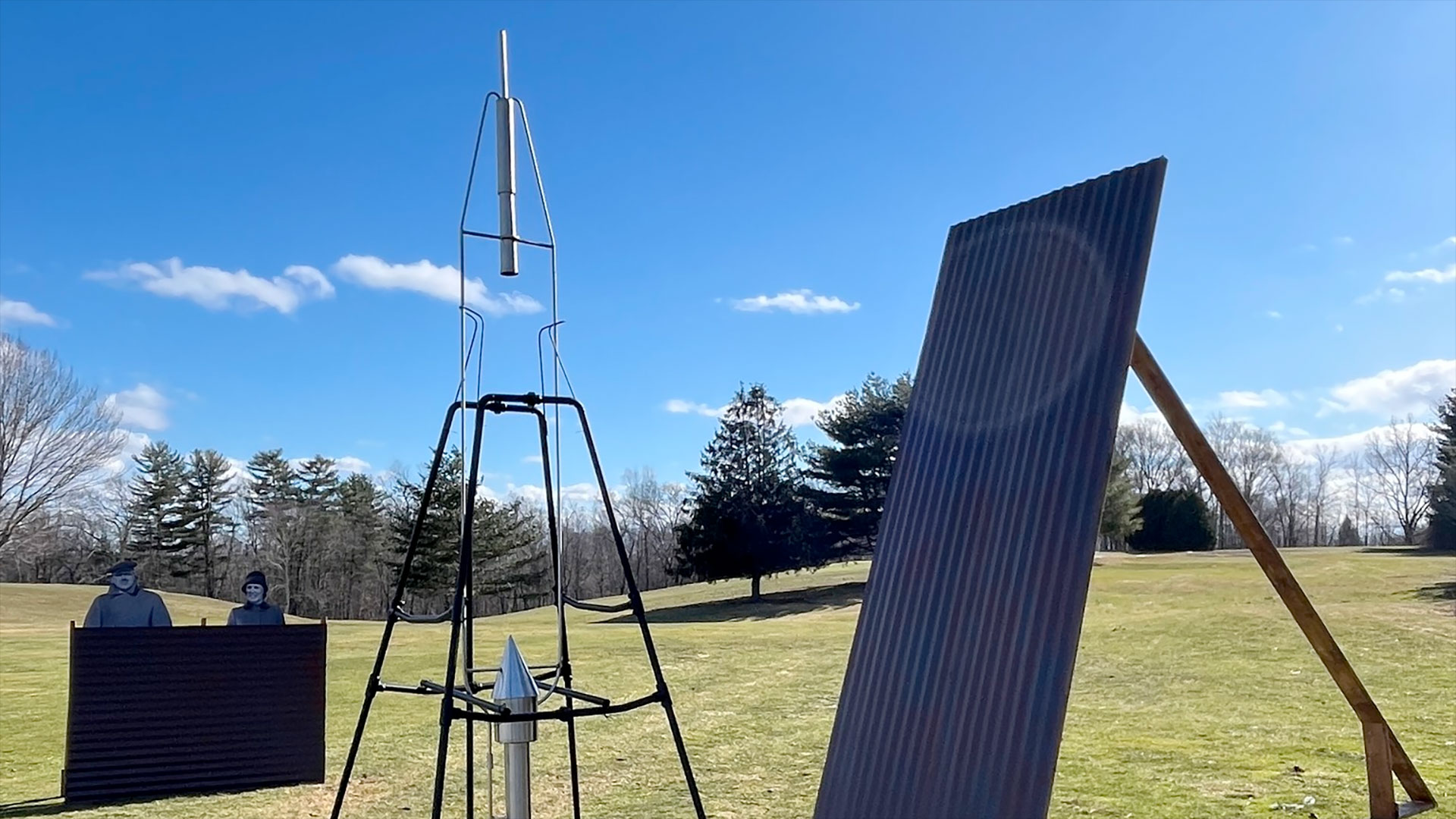
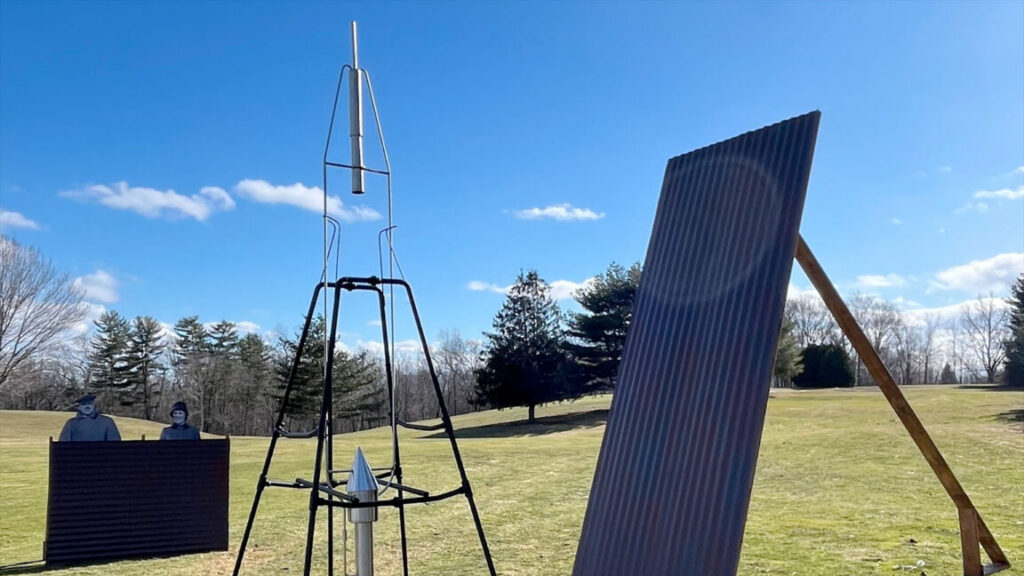
A full-scale replica of Robert Goddard’s first liquid fueled rocket on display at the site where the original launched on March 16, 1926. The static model was on exhibit as part of the centennial celebration in Auburn, Massachusetts, on Saturday, March 14, 2026.
Credit: Auburn Fire Rescue Department
A full-scale replica of Robert Goddard’s first liquid fueled rocket on display at the site where the original launched on March 16, 1926. The static model was on exhibit as part of the centennial celebration in Auburn, Massachusetts, on Saturday, March 14, 2026. Credit: Auburn Fire Rescue Department
On Monday, a different full-size replica premieres on display at The Museum of Worcester, just 10 minutes from where the real Nell launched. On exhibit through August, the rocket is a model, but its support frame was used in a 1929 launch test, on loan from Clark University.
“Goddard’s legacy is not just technological. It’s aspirational,” said Schindler. “It tells us that greatness can emerge from quiet places, that bold ideas can take root in small towns, and that the next breakthrough may come from someone standing right here looking up at the sky with wonder.”
“As we honor the centennial, we’re invited to step into the story ourselves. The next century of exploration will be shaped by those who choose to dream boldly, learn deeply, and support the next generation of explorers,” he said.
Listing image: Auburn Fire Rescue Department
Robert Pearlman is a space historian, journalist and the founder and editor of collectSPACE, a daily news publication and online community focused on where space exploration intersects with pop culture. He is also a contributing writer for Space.com and co-author of “Space Stations: The Art, Science, and Reality of Working in Space” published by Smithsonian Books in 2018. He is on the leadership board for For All Moonkind and is a member of the American Astronautical Society’s history committee.
100 years later, where is Robert Goddard’s first liquid-fueled rocket? Read More »