Super Bowl

ring-cancels-flock-deal-after-dystopian-super-bowl-ad-prompts-mass-outrage

Ring cancels Flock deal after dystopian Super Bowl ad prompts mass outrage

Both statements verified that the integration never launched and that no Ring customers’ videos were ever sent to Flock.

Ring did not credit users’ privacy concerns for its change of heart. Instead, they claimed that a joint decision was made “following a comprehensive review” where Ring “determined the planned Flock Safety integration would require significantly more time and resources than anticipated.”

Separately, Flock said that “we believe this decision allows both companies to best serve their respective customers and communities.”

The only hint that Ring gave users that their concerns had been heard came in the last line of its blog, which said, “We’ll continue to carefully evaluate future partnerships to ensure they align with our standards for customer trust, safety, and privacy.”

Sharing his views on X and Bluesky, John Scott-Railton, a senior cybersecurity researcher at the Citizen Lab, joined critics calling Ring’s statement insufficient. He posted an image of the ad frame that Markey found creepy next to a statement from Ring, writing, “On the left? A picture of mass surveillance from #Ring’s ad. On the right? A ring [spokesperson] saying that they are not doing mass surveillance. The company cannot have it both ways.”

Ring’s statements so far do not “acknowledge the real issue,” Scott-Railton said, which is privacy risks. For Ring, it seemed like a missed opportunity to discuss or introduce privacy features to reassure concerned users, he suggested, noting the backlash showed “Americans want more control of their privacy right now” and “are savvy enough to see through sappy dog pics.”

“Stop trying to build a surveillance dystopia consumers didn’t ask for” and “focus on shipping good, private products,” Scott-Railton said.

He also suggested that lawmakers should take note of the grassroots support that could possibly help pass laws to push back on mass surveillance. That could help block not just a potential future partnership with Flock, but possibly also stop Ring from becoming the next Flock.

“Ring communications not acknowledging the lesson they just got publicly taught is a bad sign that they hope this goes away,” Scott-Railton said.

Ring cancels Flock deal after dystopian Super Bowl ad prompts mass outrage Read More »
openai-is-hoppin’-mad-about-anthropic’s-new-super-bowl-tv-ads

OpenAI is hoppin’ mad about Anthropic’s new Super Bowl TV ads

On Wednesday, OpenAI CEO Sam Altman and Chief Marketing Officer Kate Rouch complained on X after rival AI lab Anthropic released four commercials, two of which will run during the Super Bowl on Sunday, mocking the idea of including ads in AI chatbot conversations. Anthropic’s campaign seemingly touched a nerve at OpenAI just weeks after the ChatGPT maker began testing ads in a lower-cost tier of its chatbot.

Altman called Anthropic’s ads “clearly dishonest,” accused the company of being “authoritarian,” and said it “serves an expensive product to rich people,” while Rouch wrote, “Real betrayal isn’t ads. It’s control.”

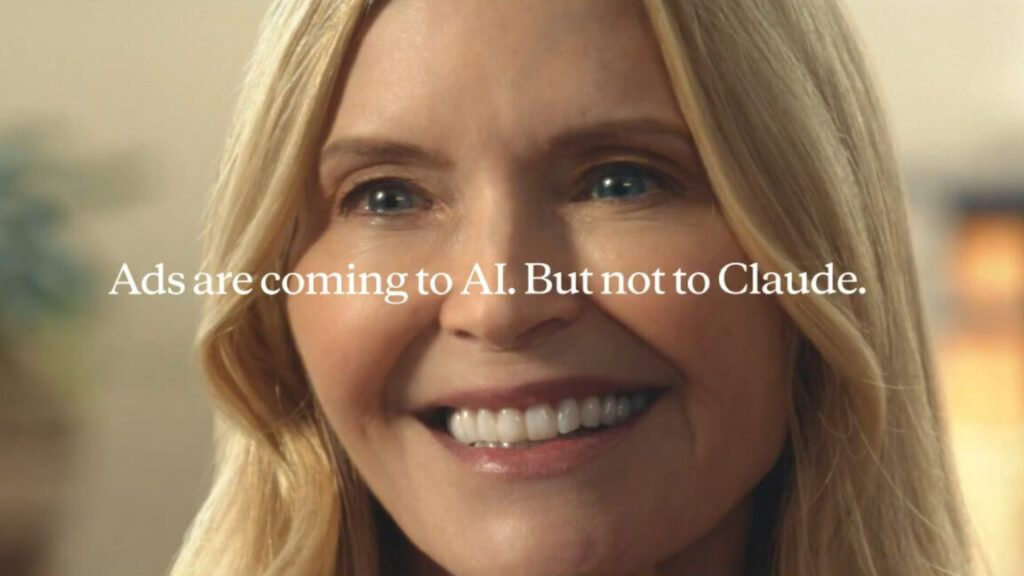
Anthropic’s four commercials, part of a campaign called “A Time and a Place,” each open with a single word splashed across the screen: “Betrayal,” “Violation,” “Deception,” and “Treachery.” They depict scenarios where a person asks a human stand-in for an AI chatbot for personal advice, only to get blindsided by a product pitch.

Anthropic’s 2026 Super Bowl commercial.

In one spot, a man asks a therapist-style chatbot (a woman sitting in a chair) how to communicate better with his mom. The bot offers a few suggestions, then pivots to promoting a fictional cougar-dating site called Golden Encounters.

In another spot, a skinny man looking for fitness tips instead gets served an ad for height-boosting insoles. Each ad ends with the tagline: “Ads are coming to AI. But not to Claude.” Anthropic plans to air a 30-second version during Super Bowl LX, with a 60-second cut running in the pregame, according to CNBC.

In the X posts, the OpenAI executives argue that these commercials are misleading because the planned ChatGPT ads will appear labeled at the bottom of conversational responses in banners and will not alter the chatbot’s answers.

But there’s a slight twist: OpenAI’s own blog post about its ad plans states that the company will “test ads at the bottom of answers in ChatGPT when there’s a relevant sponsored product or service based on your current conversation,” meaning the ads will be conversation-specific.

The financial backdrop explains some of the tension over ads in chatbots. As Ars previously reported, OpenAI struck more than $1.4 trillion in infrastructure deals in 2025 and expects to burn roughly $9 billion this year while generating about $13 billion in revenue. Only about 5 percent of ChatGPT’s 800 million weekly users pay for subscriptions. Anthropic is also not yet profitable, but it relies on enterprise contracts and paid subscriptions rather than advertising, and it has not taken on infrastructure commitments at the same scale as OpenAI.

OpenAI is hoppin’ mad about Anthropic’s new Super Bowl TV ads Read More »

the-super-bowl’s-best-and-wackiest-ai-commercials

The Super Bowl’s best and wackiest AI commercials

Superb Owl News —

It’s nothing like “crypto bowl” in 2022, but AI made a notable splash during the big game.

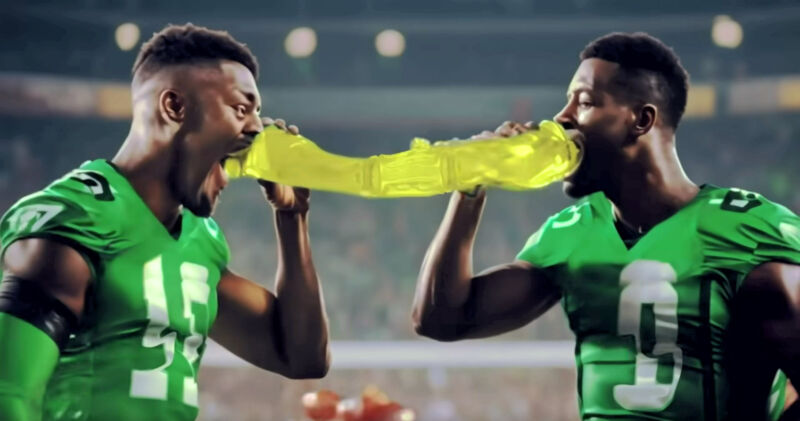
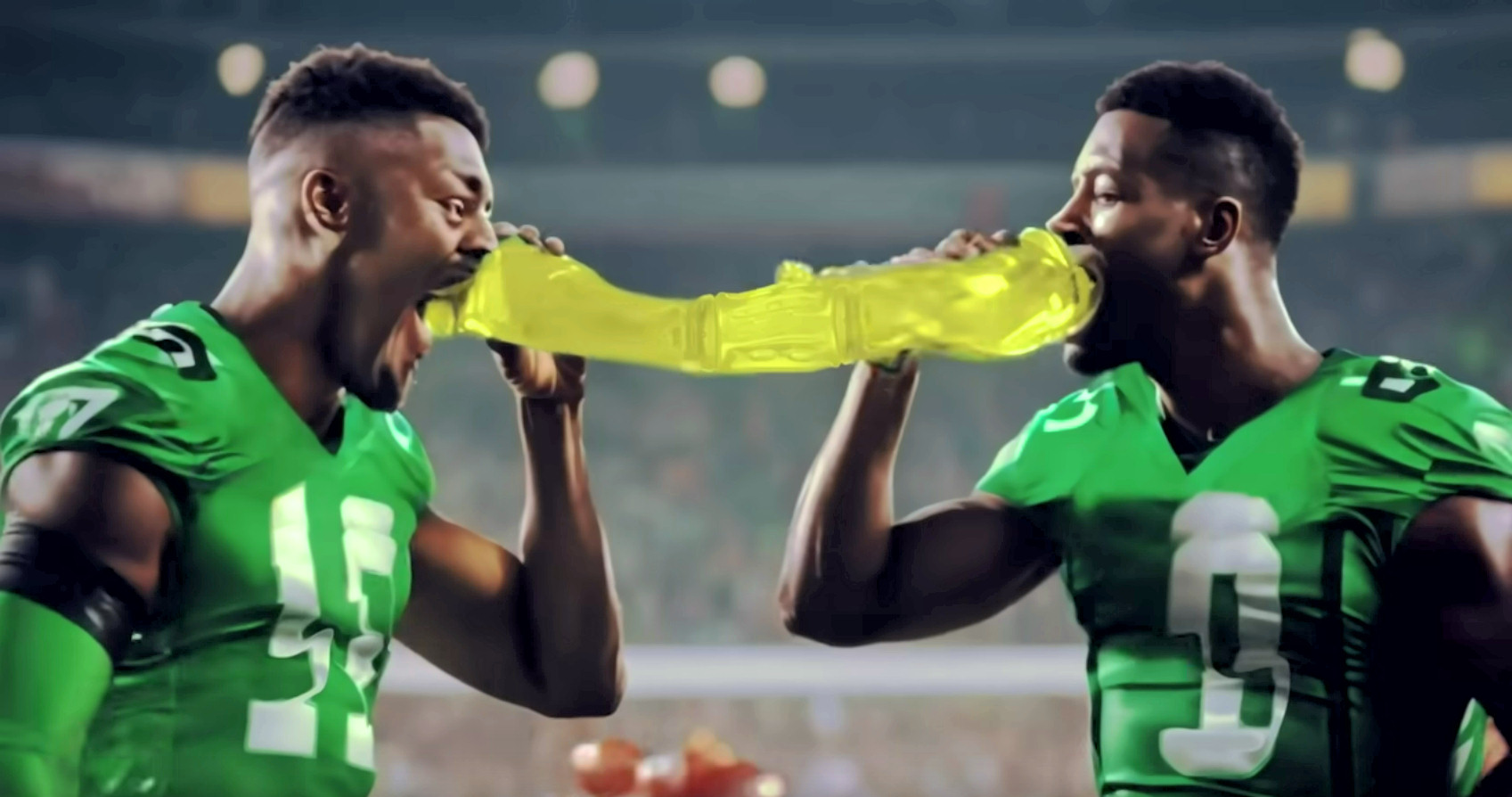
A still image from BodyArmor's 2024

Enlarge / A still image from BodyArmor’s 2024 “Field of Fake” Super Bowl commercial.

BodyArmor

Heavily hyped tech products have a history of appearing in Super Bowl commercials during football’s biggest game—including the Apple Macintosh in 1984, dot-com companies in 2000, and cryptocurrency firms in 2022. In 2024, the hot tech in town is artificial intelligence, and several companies showed AI-related ads at Super Bowl LVIII. Here’s a rundown of notable appearances that range from serious to wacky.

Microsoft Copilot

Microsoft Game Day Commercial | Copilot: Your everyday AI companion.

It’s been a year since Microsoft launched the AI assistant Microsoft Copilot (as “Bing Chat“), and Microsoft is leaning heavily into its AI-assistant technology, which is powered by large language models from OpenAI. In Copilot’s first-ever Super Bowl commercial, we see scenes of various people with defiant text overlaid on the screen: “They say I will never open my own business or get my degree. They say I will never make my movie or build something. They say I’m too old to learn something new. Too young to change the world. But I say watch me.”

Then the commercial shows Copilot creating solutions to some of these problems, with prompts like, “Generate storyboard images for the dragon scene in my script,” “Write code for my 3d open world game,” “Quiz me in organic chemistry,” and “Design a sign for my classic truck repair garage Mike’s.”

Of course, since generative AI is an unfinished technology, many of these solutions are more aspirational than practical at the moment. On Bluesky, writer Ed Zitron put Microsoft’s truck repair logo to the test and saw results that weren’t nearly as polished as those seen in the commercial. On X, others have criticized and poked fun at the “3d open world game” generation prompt, which is a complex task that would take far more than a single, simple prompt to produce useful code.

Google Pixel 8 “Guided Frame” feature

Javier in Frame | Google Pixel SB Commercial 2024.

Instead of focusing on generative aspects of AI, Google’s commercial showed off a feature called “Guided Frame” on the Pixel 8 phone that uses machine vision technology and a computer voice to help people with blindness or low vision to take photos by centering the frame on a face or multiple faces. Guided Frame debuted in 2022 in conjunction with the Google Pixel 7.

The commercial tells the story of a person named Javier, who says, “For many people with blindness or low vision, there hasn’t always been an easy way to capture daily life.” We see a simulated blurry first-person view of Javier holding a smartphone and hear a computer-synthesized voice describing what the AI model sees, directing the person to center on a face to snap various photos and selfies.

Considering the controversies that generative AI currently generates (pun intended), it’s refreshing to see a positive application of AI technology used as an accessibility feature. Relatedly, an app called Be My Eyes (powered by OpenAI’s GPT-4V) also aims to help low-vision people interact with the world.

Despicable Me 4

Despicable Me 4 – Minion Intelligence (Big Game Spot).

So far, we’ve covered a couple attempts to show AI-powered products as positive features. Elsewhere in Super Bowl ads, companies weren’t as generous about the technology. In an ad for the film Despicable Me 4, we see two Minions creating a series of terribly disfigured AI-generated still images reminiscent of Stable Diffusion 1.4 from 2022. There’s three-legged people doing yoga, a painting of Steve Carell and Will Ferrell as Elizabethan gentlemen, a handshake with too many fingers, people eating spaghetti in a weird way, and a pair of people riding dachshunds in a race.

The images are paired with an earnest voiceover that says, “Artificial intelligence is changing the way we see the world, showing us what we never thought possible, transforming the way we do business, and bringing family and friends closer together. With artificial intelligence, the future is in good hands.” When the voiceover ends, the camera pans out to show hundreds of Minions generating similarly twisted images on computers.

Speaking of image synthesis at the Super Bowl, people mistook a Christian commercial created by He Gets Us, LLC as having been AI-generated, likely due to its gaudy technicolor visuals. With the benefit of a YouTube replay and the ability to look at details, the “He washed feet” commercial doesn’t appear AI-generated to us, but it goes to show how the concept of image synthesis has begun to cast doubt on human-made creations.

The Super Bowl’s best and wackiest AI commercials Read More »

fake-grass,-real-injuries?-dissecting-the-nfl’s-artificial-turf-debate

Fake grass, real injuries? Dissecting the NFL’s artificial turf debate

Fake grass, real injuries? Dissecting the NFL’s artificial turf debate

iStock/Getty Images

Super Bowl LVIII will be played on a natural grass field in an indoor stadium in Las Vegas on February 11, 2024. How do you keep a grass field vibrant in such a hostile growing environment like the Nevada desert?

The answer: You don’t. By the end of the regular NFL season, paint was used to camouflage the reality that only a few scant patches of grass remained in Allegiant Stadium, home to the Las Vegas Raiders. Immediately after the Raiders’ last game on January 7, 2024, the field crew ripped up the remaining grass, installed California-grown sod over three days, and began the tedious process of keeping the grass alive long enough for the big game.

Herculean efforts to prepare a vibrant natural grass field for 2024’s Super Bowl LVIII are especially questionable when one realizes that Allegiant Stadium also has an artificial turf playing surface available (used by UNLV Football). Why don’t teams in hostile environments switch to more robust artificial turf, which is designed to overcome the many limitations of natural grass fields?

The answer lies in a debate over the safety of synthetic playing surfaces. While artificial turf manufacturers tout research that their products result in fewer injuries, the NFL Players Association (NFLPA) claims it raises injury risk and is advocating for its use to be abolished in the NFL. Let’s explore some key arguments of this debate, which continues to grab headlines with each high-profile NFL injury.

Super Bowl gridirons

Pressure for NFL field managers is especially high following the embarrassingly poor field conditions of last year’s Super Bowl. Super Bowl LVII took place at State Farm Stadium in Glendale, Arizona—another natural grass field in the desert (with a retractable roof, closed at night to protect the grass). Despite two years of preparation and an $800,000 investment, the grass field was a disaster, as players struggled to find footing on its slippery surface.

Veteran NFL groundskeeper George Toma attributed the mess to woefully improper field preparation. Players also complained about the slipping issue the previous time the Super Bowl was hosted at the natural grass field in State Farm Stadium eight years prior for Super Bowl XLIX in 2015. That year, the poor traction was blamed on the green paint used on the grass.

For perspective, some of the best sports field managers in the nation oversee field preparations for the Super Bowl. However, maintaining natural grass in desert conditions is so unfavorable (especially when the grass is sometimes indoors) that even the best can mess it up.

None of these issues existed when the Super Bowl was last played on artificial turf. Super Bowl LVI in 2022 was held at SoFi Stadium in Inglewood, California, home to both the Los Angeles Rams and Chargers. Not only did the artificial turf stand up to double the workload during the regular season (hosting home games for the LA Rams and the LA Chargers), but it also withstood a busy playoff season. The artificial turf field at SoFi Stadium hosted NFL games through the regular season and right up to the last playoff game when the LA Rams beat the San Francisco 49ers. Two weeks later, the Rams ended up winning Super Bowl LVI on the very same surface.

While turf avoids the durability issues seen with grass surfaces, players have widespread concerns about its safety—a recent poll by the NFLPA reported 92 percent of players favored grass.

Fake grass, real injuries? Dissecting the NFL’s artificial turf debate Read More »