
“We have a very strong incentive to send a crew as quickly as we can safely do so.”
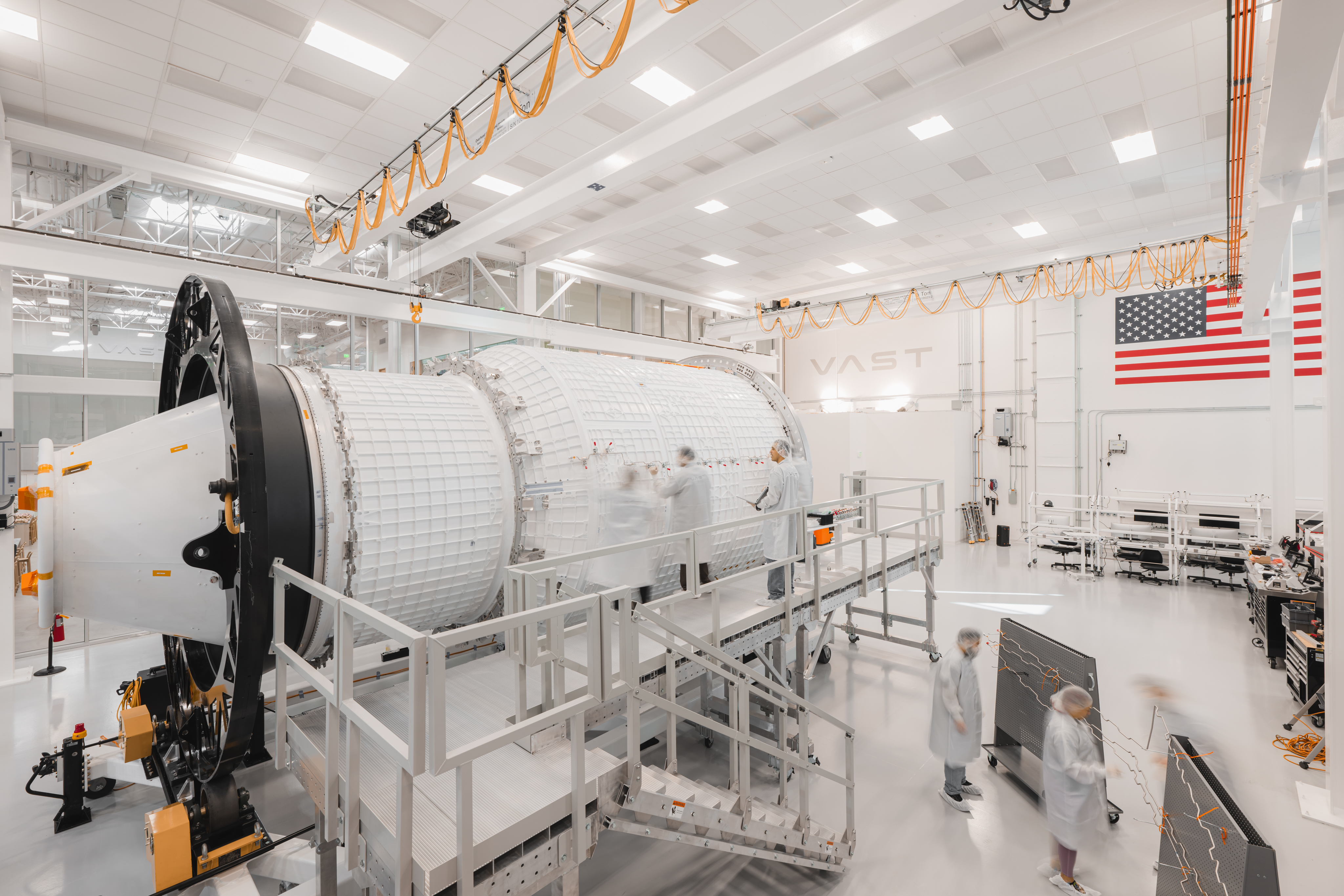
The Haven-1 space station seen here in the Vast Space clean room. Credit: Vast Space
The Haven-1 space station seen here in the Vast Space clean room. Credit: Vast Space
As Ars reported last week, NASA’s plan to replace the International Space Station with commercial space stations is running into a time crunch.
The sprawling International Space Station is due to be decommissioned less than five years from now, and the US space agency has yet to formally publish rules and requirements for the follow-on stations being designed and developed by several different private companies.
Although there are expected to be multiple bidders in “phase two” of NASA’s commercial space station program, there are at present four main contenders: Voyager Technologies, Axiom Space, Blue Origin, and Vast Space. At some point later this year, the space agency is expected to select one, or more likely two, of these companies for larger contracts that will support their efforts to build their stations.
To get a sense of the overall landscape as the competition heats up, Ars recently interviewed Voyager chief executive Dylan Taylor about his company’s plans for a private station, Starlab. Today we are publishing an interview with Max Haot, the chief executive of Vast. The company is furthest along in terms of development, choosing to build a smaller, interim space station, Haven-1, capable of short-duration stays. Eventually, NASA wants facilities capable of continuous habitation, but it is not clear whether that will be a requirement starting in 2030.
Until today, Haven-1 had a public launch date of mid-2026. However, as Haot explained in our interview, that launch date is no longer tenable.
Ars: You’re slipping the launch of Haven-1 from the middle of this year to the first quarter of 2027. Why?
Max Haot: This is obviously our first space station, and we’re moving as safely and as fast as we can. That’s the date right now that we are confident we will meet. We’ve been tracking that date, without slip, for quite a while. And that’s still a year, probably two years or even more, ahead of anyone else. It will be building the world’s first commercial space station from scratch, from an empty building and no team, in under four years.
Ars: Where are you with the hardware?
Haot: Last Saturday (January 10) we reached the key milestone of fully completing the primary structure, and some of the secondary structure; all of the acceptance testing occurred in November as well. Now we are starting clean room integration, which starts with TCS (thermal control system), propulsion, interior shells, and then moving on to avionics. And then final close out, which we expect will be done by the fall, and then we have on the books with NASA a full test campaign at the end of the year at Plum Brook. Then the launch in Q1 next year.
Ars: What happens after you launch Haven-1?
Haot: We are not launching Haven-1 with crew inside. It’s a 15-ton, very valuable and expensive satellite, but still no humans involved, launching on a Falcon 9. So then we have a period that we can monitor it and control it uncrewed and confirm everything is functioning perfectly, right? We are holding pressure. We are controlling attitude. These checkouts can happen in as little as two weeks.
At the end of it, we have to basically convince SpaceX, both contractually and with many verification events, that it will be safe to dock Dragon. And if they agree with the data we provide them, they will put a fully trained crew on board Dragon and bring them up. It could be as early as two weeks after, and it could be as late as any time within three years, which is a lifetime of Haven-1. But we have a very strong incentive to send a crew as quickly as we can safely do so.
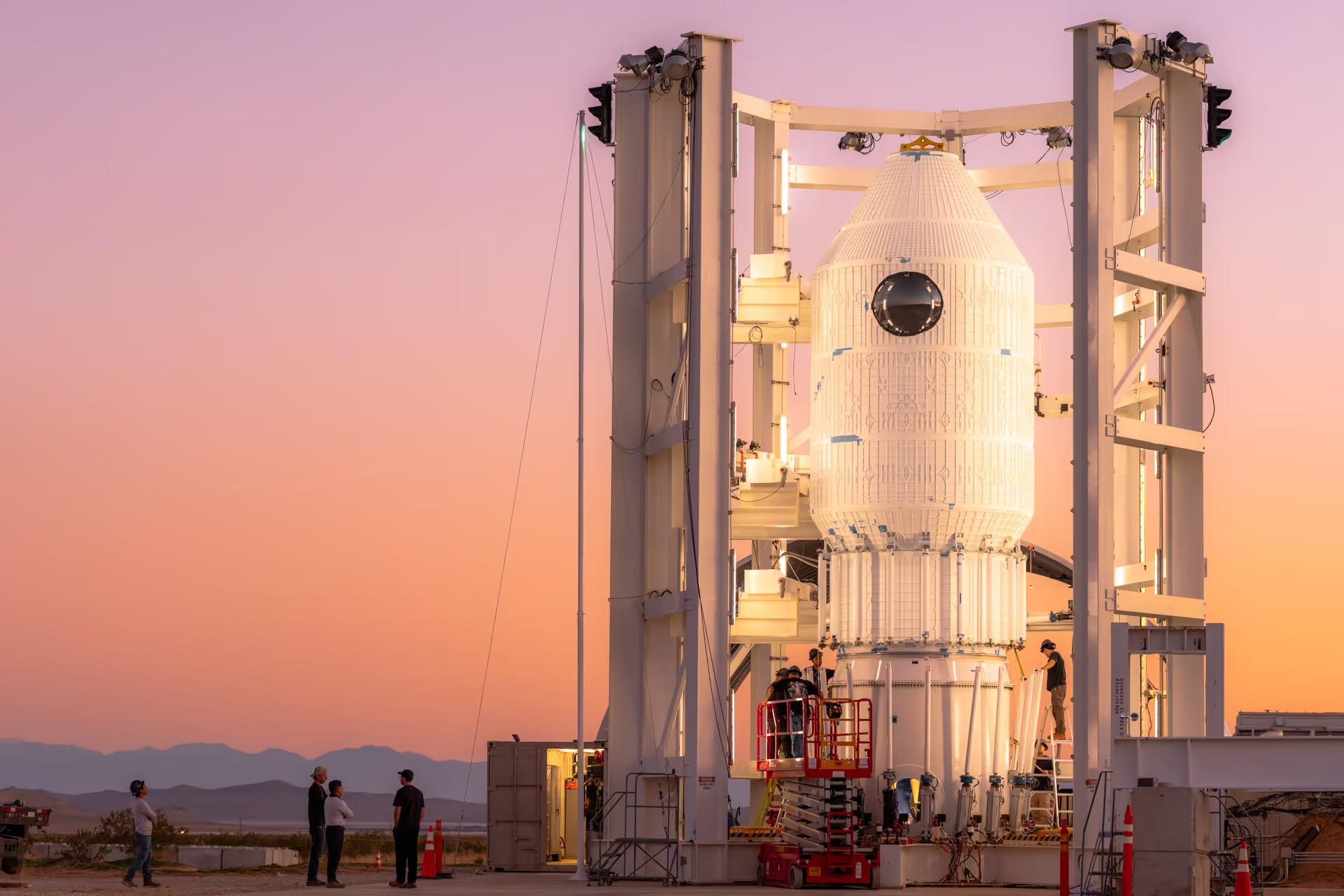
The Haven-1 space station undergoes acceptance testing.
Credit: Vast Space
The Haven-1 space station undergoes acceptance testing. Credit: Vast Space
Ars: Have you picked the crew yet?
Haot: We are in deep negotiations, maybe more than that, with both private individuals and nation states. But there’s nothing we are ready to announce yet. Especially with the Q1 launch date, in our desire to follow with the crew right after, this is now becoming pretty urgent. We believe, with our partner at SpaceX, one year for training is very comfortable, and we think we can compress it to maybe as little as six months for both training on Dragon and Haven-1 so long as we have an experienced crew. So we have a bit of time left to announce it.
Ars: You mentioned Haven-1 has a three-year lifetime. How many crews will you try to cycle through?
Haot: The nominal plan is for a two-week mission, and we have one fully contracted with SpaceX, as well as a second one that we have a deposit and an option on. And then we plan to do two more. That’s assuming they are 10-day missions with two days of transfer on either side. So two-week missions. We also have the option to maybe do a 30-day mission if we want. So the exact duration and makeup will be decided as we make progress with customers and potentially NASA.
Ars: What is the plan after Haven-1?
Haot: If you look at the first module of our second station, what will be the difference? We have two docking ports, not one. We expect to have more power, and potentially more volume, depending on the launch vehicle. What you see on our website and what we do might be different. We have a lot of optionality. But other than that, it’s all of the exact same components of Haven demo and Haven-1, which are basically being iterated on. And so that’s the key. The life support system, the air revitalization system, the software, the primary structure—the first module of Haven-2 will be just tweaks on Haven-1. That’s why we think we’re in the best position of all of the competitors. And that’s not been enabled by chance, right? It’s been enabled by a billion-dollar investment in 1,000 employees and all the facilities to mass produce the follow-on modules.
Ars: NASA is nearing the second phase of its competition for commercial space stations, known as CLDs. Do you plan to compete with Haven-1 or Haven-2 for these contracts?
Haot: We have not decided because, as you know, it’s unclear yet what the requirements will be. Will they be asking for a 30-day demonstration flight? On our end it’s unclear if we want to bid that 30-day demonstration with Haven-1, or Haven-2 with two or three modules. If they ask for a 30-day mission, we have the option to offer it on Haven-1 in 2027 if we want to.
Ars: Last week a key space staffer in the US Senate, Maddy Davis, said she was “begging” for NASA to release the phase two “request for proposals” that would set the ground rules for the CLD competition. Do you feel the same way?
Haot: Vast is dedicated to ensuring we have continuous human presence in low-Earth orbit after the ISS is retired. The date we are aiming at is end of 2030. Maddy mentioned an ISS extension. We agree, for America, if no one is ready it should be extended. But in our view, we will be ready, and we need to make sure we’re ready to start a continuous crewed mission by the end of 2030. That’s less than five years away now, right? So we definitely agree with the sentiment, and I think the full industry agrees, and I’m pretty sure Jared Isaacman also agrees that it is overdue and it’s time to make a decision and release an RFP.
Ars: What do you hope to see in that RFP when it comes to requirements?
Haot: We obviously can’t decide what NASA will do, and we will be competitive in whatever they decide. But there’s a few key recommendations we feel strongly about. The first one is that, as they consider whether they proceed with a demonstration mission or something else, we think they should focus on what is right for the country. What we are hearing is that they are trying to tweak the approach to do something fair to all of the bidders. And I don’t think it should matter whether people have been doing a right thing or wrong thing, and whether what’s right for the country puts somebody in a better position or not.
The second piece, obviously, is to move faster, which we just talked about. The third piece is that we think it’s really important that they require a demonstration. If you look at every human space flight program in history, none of them went straight from the program starting to a long-duration mission on a spacecraft. They all had a stepping stone, and right now none of us has proven we can have humans safely on orbit in a space station. And so in our view, they should require demonstration, and not on the eve of January 1, 2031. They should require a demonstration with crew as quickly as possible before they buy services.
Ars: You mentioned doing the “right thing for the country.” What does that mean for NASA?
Haot: It means you’re focused on commercial stations being ready by 2030, so there is not a need to extend the ISS. And it means ensuring we have not just one winner, but two, in case history repeats itself, such as Boeing and SpaceX in crew transportation.
Ars: Do you think the government has committed enough funding to make the commercial space station program a success?
Haot: I’m a vendor, and obviously I’d like as much buffer as possible, and as much funding as possible. With the current budget we don’t think more than two winners is reasonable, but it should absolutely be two in the best interest of the country. If there was a bigger budget, obviously, three would be great. And so if you look at the CLD budget line, which is approved for next year—projected over five years for development, and you assume two winners, and then services that come later—we are confident we can be successful and profitable with two companies operating.
Obviously, we also need international customers, right? We need Europe. We need Japan, where we just opened a subsidiary. We need all the new emerging human spaceflight nations in the Middle East, in Europe, in Asia. And a little bit of private spaceflight. We’re not in a space tourism era, in orbit, but there are still some private individuals willing to fund a mission and do important work. With that, we get to profitability.
We think a big differentiator of Vast is that we are really excited and eager to unlock the orbital economy. I’m talking about in-space semiconductor, fiber, pharmaceutical manufacturing, and so on. We think that’s our upside. We want to unlock it. But we don’t know how quickly it will happen or how big it will be. What we do know is, whoever has a platform up there with flight crew, facilities, and power will be the one unlocking it. But in our business model, if that’s delayed, we can still be profitable.
Eric Berger is the senior space editor at Ars Technica, covering everything from astronomy to private space to NASA policy, and author of two books: Liftoff, about the rise of SpaceX; and Reentry, on the development of the Falcon 9 rocket and Dragon. A certified meteorologist, Eric lives in Houston.