advertising

openai-researcher-quits-over-chatgpt-ads,-warns-of-“facebook”-path

OpenAI researcher quits over ChatGPT ads, warns of “Facebook” path

On Wednesday, former OpenAI researcher Zoë Hitzig published a guest essay in The New York Times announcing that she resigned from the company on Monday, the same day OpenAI began testing advertisements inside ChatGPT. Hitzig, an economist and published poet who holds a junior fellowship at the Harvard Society of Fellows, spent two years at OpenAI helping shape how its AI models were built and priced. She wrote that OpenAI’s advertising strategy risks repeating the same mistakes that Facebook made a decade ago.

“I once believed I could help the people building A.I. get ahead of the problems it would create,” Hitzig wrote. “This week confirmed my slow realization that OpenAI seems to have stopped asking the questions I’d joined to help answer.”

Hitzig did not call advertising itself immoral. Instead, she argued that the nature of the data at stake makes ChatGPT ads especially risky. Users have shared medical fears, relationship problems, and religious beliefs with the chatbot, she wrote, often “because people believed they were talking to something that had no ulterior agenda.” She called this accumulated record of personal disclosures “an archive of human candor that has no precedent.”

She also drew a direct parallel to Facebook’s early history, noting that the social media company once promised users control over their data and the ability to vote on policy changes. Those pledges eroded over time, Hitzig wrote, and the Federal Trade Commission found that privacy changes Facebook marketed as giving users more control actually did the opposite.

She warned that a similar trajectory could play out with ChatGPT: “I believe the first iteration of ads will probably follow those principles. But I’m worried subsequent iterations won’t, because the company is building an economic engine that creates strong incentives to override its own rules.”

Ads arrive after a week of AI industry sparring

Hitzig’s resignation adds another voice to a growing debate over advertising in AI chatbots. OpenAI announced in January that it would begin testing ads in the US for users on its free and $8-per-month “Go” subscription tiers, while paid Plus, Pro, Business, Enterprise, and Education subscribers would not see ads. The company said ads would appear at the bottom of ChatGPT responses, be clearly labeled, and would not influence the chatbot’s answers.

OpenAI researcher quits over ChatGPT ads, warns of “Facebook” path Read More »
openai-is-hoppin’-mad-about-anthropic’s-new-super-bowl-tv-ads

OpenAI is hoppin’ mad about Anthropic’s new Super Bowl TV ads

On Wednesday, OpenAI CEO Sam Altman and Chief Marketing Officer Kate Rouch complained on X after rival AI lab Anthropic released four commercials, two of which will run during the Super Bowl on Sunday, mocking the idea of including ads in AI chatbot conversations. Anthropic’s campaign seemingly touched a nerve at OpenAI just weeks after the ChatGPT maker began testing ads in a lower-cost tier of its chatbot.

Altman called Anthropic’s ads “clearly dishonest,” accused the company of being “authoritarian,” and said it “serves an expensive product to rich people,” while Rouch wrote, “Real betrayal isn’t ads. It’s control.”

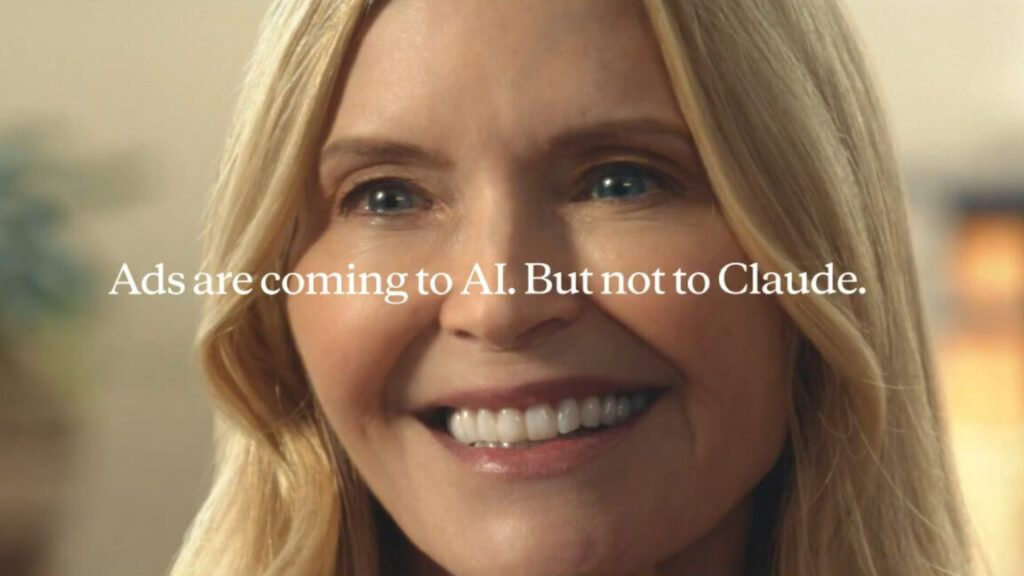
Anthropic’s four commercials, part of a campaign called “A Time and a Place,” each open with a single word splashed across the screen: “Betrayal,” “Violation,” “Deception,” and “Treachery.” They depict scenarios where a person asks a human stand-in for an AI chatbot for personal advice, only to get blindsided by a product pitch.

Anthropic’s 2026 Super Bowl commercial.

In one spot, a man asks a therapist-style chatbot (a woman sitting in a chair) how to communicate better with his mom. The bot offers a few suggestions, then pivots to promoting a fictional cougar-dating site called Golden Encounters.

In another spot, a skinny man looking for fitness tips instead gets served an ad for height-boosting insoles. Each ad ends with the tagline: “Ads are coming to AI. But not to Claude.” Anthropic plans to air a 30-second version during Super Bowl LX, with a 60-second cut running in the pregame, according to CNBC.

In the X posts, the OpenAI executives argue that these commercials are misleading because the planned ChatGPT ads will appear labeled at the bottom of conversational responses in banners and will not alter the chatbot’s answers.

But there’s a slight twist: OpenAI’s own blog post about its ad plans states that the company will “test ads at the bottom of answers in ChatGPT when there’s a relevant sponsored product or service based on your current conversation,” meaning the ads will be conversation-specific.

The financial backdrop explains some of the tension over ads in chatbots. As Ars previously reported, OpenAI struck more than $1.4 trillion in infrastructure deals in 2025 and expects to burn roughly $9 billion this year while generating about $13 billion in revenue. Only about 5 percent of ChatGPT’s 800 million weekly users pay for subscriptions. Anthropic is also not yet profitable, but it relies on enterprise contracts and paid subscriptions rather than advertising, and it has not taken on infrastructure commitments at the same scale as OpenAI.

OpenAI is hoppin’ mad about Anthropic’s new Super Bowl TV ads Read More »

openai-to-test-ads-in-chatgpt-as-it-burns-through-billions

OpenAI to test ads in ChatGPT as it burns through billions

Financial pressures and a changing tune

OpenAI’s advertising experiment reflects the enormous financial pressures facing the company. OpenAI does not expect to be profitable until 2030 and has committed to spend about $1.4 trillion on massive data centers and chips for AI.

According to financial documents obtained by The Wall Street Journal in November, OpenAI expects to burn through roughly $9 billion this year while generating $13 billion in revenue. Only about 5 percent of ChatGPT’s 800 million weekly users pay for subscriptions, so it’s not enough to cover all of OpenAI’s operating costs.

Not everyone is convinced ads will solve OpenAI’s financial problems. “I am extremely bearish on this ads product,” tech critic Ed Zitron wrote on Bluesky. “Even if this becomes a good business line, OpenAI’s services cost too much for it to matter!”

OpenAI’s embrace of ads appears to come reluctantly, since it runs counter to a “personal bias” against advertising that Altman has shared in earlier public statements. For example, during a fireside chat at Harvard University in 2024, Altman said he found the combination of ads and AI “uniquely unsettling,” implying that he would not like it if the chatbot itself changed its responses due to advertising pressure. He added: “When I think of like GPT writing me a response, if I had to go figure out exactly how much was who paying here to influence what I’m being shown, I don’t think I would like that.”

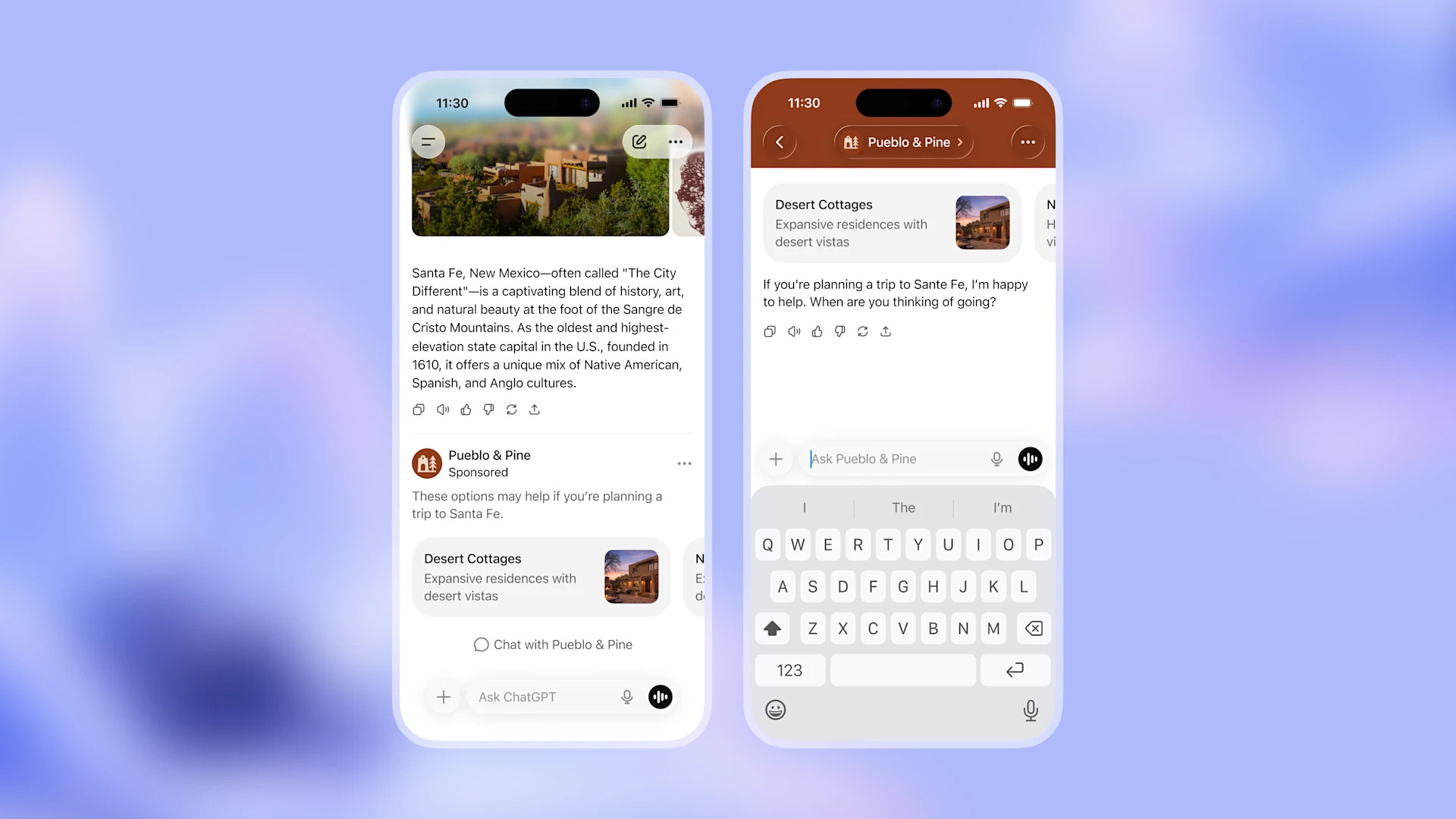
An example mock-up of an advertisement in ChatGPT provided by OpenAI.

An example mock-up of an advertisement in ChatGPT provided by OpenAI.

An example mock-up of an advertisement in ChatGPT provided by OpenAI. Credit: OpenAI

Along those lines, OpenAI’s approach appears to be a compromise between needing ad revenue and not wanting sponsored content to appear directly within ChatGPT’s written responses. By placing banner ads at the bottom of answers separated from the conversation history, OpenAI appears to be addressing Altman’s concern: The AI assistant’s actual output, the company says, will remain uninfluenced by advertisers.

Indeed, Simo wrote in a blog post that OpenAI’s ads will not influence ChatGPT’s conversational responses and that the company will not share conversations with advertisers and will not show ads on sensitive topics such as mental health and politics to users it determines to be under 18.

“As we introduce ads, it’s crucial we preserve what makes ChatGPT valuable in the first place,” Simo wrote. “That means you need to trust that ChatGPT’s responses are driven by what’s objectively useful, never by advertising.”

OpenAI to test ads in ChatGPT as it burns through billions Read More »

putin-oks-plan-to-turn-russian-spacecraft-into-flying-billboards

Putin OKs plan to turn Russian spacecraft into flying billboards

These are tough times for Russia’s civilian space program. In the last few years, Russia has cut back on the number of Soyuz crew missions it is sending to the International Space Station, and a replacement for the nearly 60-year-old Soyuz spacecraft remains elusive.

While the United States and China are launching more space missions than ever before, Russia’s once-dominant launch cadence is on a downhill slide.

Russia’s access to global markets dried up after Russian President Vladimir Putin launched the country’s invasion of Ukraine in February 2022. The fallout from the invasion killed several key space partnership between Russia and Europe. Russia’s capacity to do new things in space seems to be focused on military programs like anti-satellite weapons.

The Roscosmos State Corporation for Space Activities, Russia’s official space agency, may have a plan to offset the decline. Late last month, Putin approved changes to federal laws governing advertising and space activities to “allow for the placement of advertising on spacecraft,” Roscosmos posted on its official Telegram account.

We’ve seen this before

The Russian State Duma, dominated by Putin loyalists, previously approved the amendments.

“According to the amendments, Roscosmos has been granted the right, effective January 1, 2026, to place advertising on space objects owned by both the State Corporation itself and federally,” Roscosmos said. “The amendments will create a mechanism for attracting private investment in Russian space exploration and reduce the burden on the state budget.”

The law requires that advertising symbols not affect spacecraft safety. The Russian government said it will establish a fee structure for advertising on federally owned space objects.

Roscosmos didn’t say this, but advertisers eligible for the offer will presumably be limited to Russia and its allies. Any ads from the West would likely violate sanctions.

Rocket-makers have routinely applied decals, stickers, and special paint jobs to their vehicles. This is a particularly popular practice in Russia. Usually, these logos represent customers and suppliers. Sometimes they honor special occasions, like the 60th anniversary of the first human spaceflight mission by Soviet cosmonaut Yuri Gagarin and the 80th anniversary of the end of World War II.

Putin OKs plan to turn Russian spacecraft into flying billboards Read More »

in-court-filing,-google-concedes-the-open-web-is-in-“rapid-decline”

In court filing, Google concedes the open web is in “rapid decline”

Advertising and the open web

Google objects to this characterization. A spokesperson calls it a “cherry-picked” line from the filing that has been misconstrued. Google’s position is that the entire passage is referring to open-web advertising rather than the open web itself. “Investments in non-open web display advertising like connected TV and retail media are growing at the expense of those in open web display advertising,” says Google.

If we assume this is true, it doesn’t exactly let Google off the hook. As AI tools have proliferated, we’ve heard from Google time and time again that traffic from search to the web is healthy. When people use the web more, Google makes more money from all those eyeballs on ads, and indeed, Google’s earnings have never been higher. However, Google isn’t just putting ads on websites—Google is also big in mobile apps. As Google’s own filings make clear, in-app ads are by far the largest growth sector in advertising. Meanwhile, time spent on non-social and non-video content is stagnant or slightly declining, and as a result, display ads on the open web earn less.

So, whether Google’s wording in the filing is meant to address the web or advertising on the web may be a distinction without a difference. If ads on websites aren’t making the big bucks, Google’s incentives will undoubtedly change. While Google says its increasingly AI-first search experience is still consistently sending traffic to websites, it has not released data to show that. If display ads are in “rapid decline,” then it’s not really in Google’s interest to continue sending traffic to non-social and non-video content. Maybe it makes more sense to keep people penned up on its platform where they can interact with its AI tools.

Of course, the web isn’t just ad-supported content—Google representatives have repeatedly trotted out the claim that Google’s crawlers have seen a 45 percent increase in indexable content since 2023. This metric, Google says, shows that open web advertising could be imploding while the web is healthy and thriving. We don’t know what kind of content is in this 45 percent, but given the timeframe cited, AI slop is a safe bet.

If the increasingly AI-heavy open web isn’t worth advertisers’ attention, is it really right to claim the web is thriving as Google so often does? Google’s filing may simply be admitting to what we all know: the open web is supported by advertising, and ads increasingly can’t pay the bills. And is that a thriving web? Not unless you count AI slop.

In court filing, Google concedes the open web is in “rapid decline” Read More »

samsung-teams-up-with-glance-to-use-your-face-in-ai-generated-lock-screen-ads

Samsung teams up with Glance to use your face in AI-generated lock screen ads

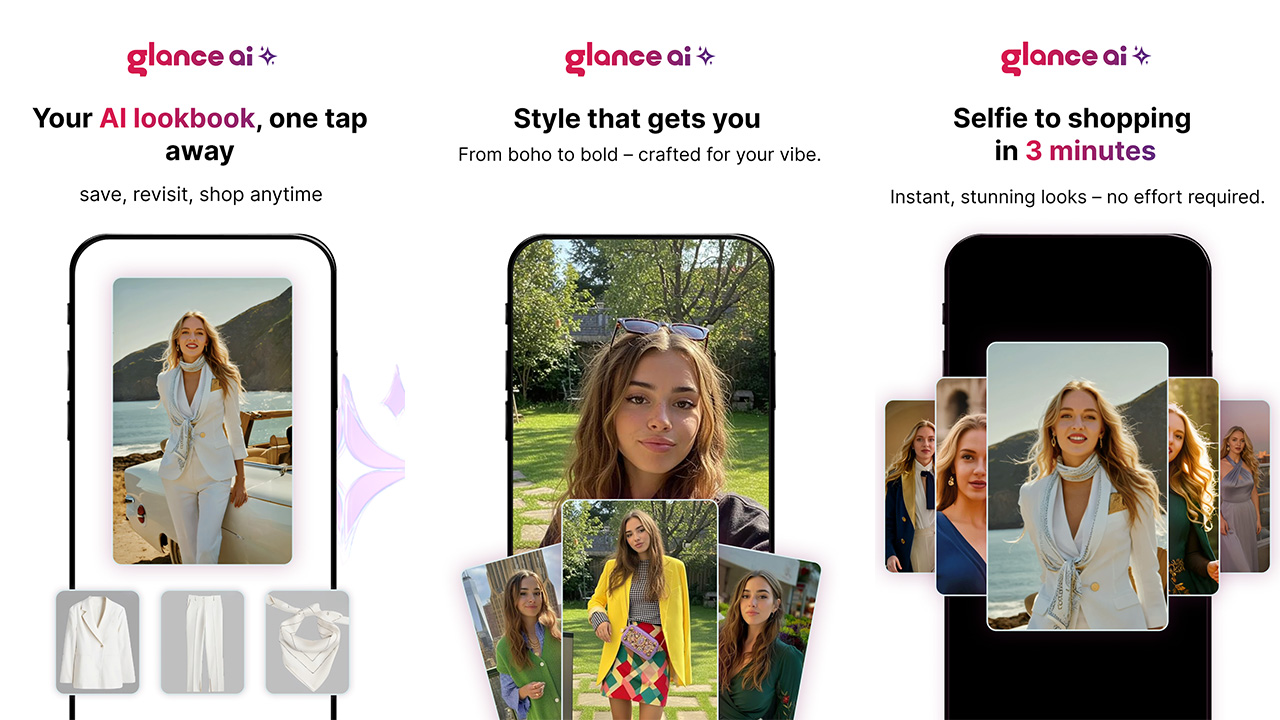
On an average day, you might unlock or look at your phone dozens of times, which makes the lock screen a hot property for advertising. Ad tech company Glance has been taking advantage of that for years with its ad-laden lock screen experiences, but it’s going further in the age of AI. Samsung and Glance have teamed up to deliver a new “AI shopping” experience that uses a selfie to create custom fashion ads. This feature is rolling out to numerous Samsung phones in the next month.

Glance has been around for a while—its non-AI lock screen experience has been bundled on various phones from Samsung, Motorola, and others. Before the AI era, Glance lured people in with promises of pretty pictures and news alerts, which came with a side of ads and tracking. The new Glance AI feature has all that, but it adds an unsettling face-stealing layer to the experience.

The AI-infused Glance will arrive on Samsung phones as both a standalone app and a fully integrated lock screen. Thankfully, this is a fully opt-in experience. If you never open or set up Glance, you can keep using the normal lock screen on your phone.

Credit: Glance

Should you choose to wade into the murky waters of AI shopping, Glance will have you take a selfie and provide some basic body type details. From there, it uses Google Gemini and Imagen to create fashion ads tailored to you—because they are you. Your lock screen will be populated with images of you “in outfits and destinations [you] would never imagine.” Naturally, you will be able to buy the looks chosen for you with a tap, which fills Glance’s coffers.

Samsung teams up with Glance to use your face in AI-generated lock screen ads Read More »

doj-confirms-it-wants-to-break-up-google’s-ad-business

DOJ confirms it wants to break up Google’s ad business

In the trial, Google will paint this demand as a severe overreach, claiming that few, if any, companies would have the resources to purchase and run the products. Last year, an ad consultant estimated Google’s ad empire could be worth up to $95 billion, quite possibly too big to sell. However, Google was similarly skeptical about Chrome, and representatives from other companies have said throughout the search remedy trial that they would love to buy Google’s browser.

An uphill battle

After losing three antitrust cases in just a couple of years, Google will have a hard time convincing the judge it is capable of turning over a new leaf with light remedies. A DOJ lawyer told the court Google is a “recidivist monopolist” that has a pattern of skirting its legal obligations. Still, Google is looking for mercy in the case. We expect to get more details on Google’s proposed remedies as the next trial nears, but it already offered a preview in today’s hearing.

Google suggests making a smaller subset of ad data available and ending the use of some pricing schemes, including unified pricing, that the court has found to be anticompetitive. Google also promised not to re-implement discontinued practices like “last look,” which gave the company a chance to outbid rivals at the last moment. This was featured prominently in the DOJ’s case, although Google ended the practice several years ago.

To ensure it adheres to the remedies, Google suggested a court-appointed monitor would audit the process. However, Brinkema seemed unimpressed with this proposal.

As in its other cases, Google says it plans to appeal the verdict, but before it can do that, the remedies phase has to be completed. Even if it can get the remedies paused for appeal, the decision could be a blow to investor confidence. So, Google will do whatever it can to avoid the worst-case scenario, leaning on the existence of competing advertisers like Meta and TikTok to show that the market is still competitive.

Like the search case, Google won’t be facing any big developments over the summer, but this fall could be rough. Judge Amit Mehta will most likely rule on the search remedies in August, and the ad tech remedies case will begin the following month. Google also has the Play Store case hanging over its head. It lost the first round, but the company hopes to prevail on appeal when the case gets underway again, probably in late 2025.

DOJ confirms it wants to break up Google’s ad business Read More »

google-is-quietly-testing-ads-in-ai-chatbots

Google is quietly testing ads in AI chatbots

Google has built an enormously successful business around the idea of putting ads in search results. Its most recent quarterly results showed the company made more than $50 billion from search ads, but what happens if AI becomes the dominant form of finding information? Google is preparing for that possibility by testing chatbot ads, but you won’t see them in Google’s Gemini AI—at least not yet.

A report from Bloomberg describes how Google began working on a plan in 2024 to adapt AdSense ads to a chatbot experience. Usually, AdSense ads appear in search results and are scattered around websites. Google ran a small test of chatbot ads late last year, partnering with select AI startups, including AI search apps iAsk and Liner.

The testing must have gone well because Google is now allowing more chatbot makers to sign up for AdSense. “AdSense for Search is available for websites that want to show relevant ads in their conversational AI experiences,” said a Google spokesperson.

If people continue shifting to using AI chatbots to find information, this expansion of AdSense could help prop up profits. There’s no hint of advertising in Google’s own Gemini chatbot or AI Mode search, but the day may be coming when you won’t get the clean, ad-free experience at no cost.

A path to profit

Google is racing to catch up to OpenAI, which has a substantial lead in chatbot market share despite Gemini’s recent growth. This has led Google to freely provide some of its most capable AI tools, including Deep Research, Gemini Pro, and Veo 2 video generation. There are limits to how much you can use most of these features with a free account, but it must be costing Google a boatload of cash.

Google is quietly testing ads in AI chatbots Read More »

google-won’t-ditch-third-party-cookies-in-chrome-after-all

Google won’t ditch third-party cookies in Chrome after all

Maintaining the status quo

While Google’s sandbox project is looking more directionless today, it is not completely ending the initiative. The team still plans to deploy promised improvements in Chrome’s Incognito Mode, which has been re-architected to preserve user privacy after numerous complaints. Incognito Mode blocks all third-party cookies, and later this year, it will gain IP protection, which masks a user’s IP address to protect against cross-site tracking.

What is Topics?

Chavez admits that this change will mean Google’s Privacy Sandbox APIs will have a “different role to play” in the market. That’s a kind way to put it. Google will continue developing these tools and will work with industry partners to find a path forward in the coming months. The company still hopes to see adoption of the Privacy Sandbox increase, but the industry is unlikely to give up on cookies voluntarily.

While Google focuses on how ad privacy has improved since it began working on the Privacy Sandbox, the changes in Google’s legal exposure are probably more relevant. Since launching the program, Google has lost three antitrust cases, two of which are relevant here: the search case currently in the remedy phase and the newly decided ad tech case. As the government begins arguing that Chrome gives Google too much power, it would be a bad look to force a realignment of the advertising industry using the dominance of Chrome.

In some ways, this is a loss—tracking cookies are undeniably terrible, and Google’s proposed alternative is better for privacy, at least on paper. However, universal adoption of the Privacy Sandbox could also give Google more power than it already has, and the supposed privacy advantages may never have fully materialized as Google continues to seek higher revenue.

Google won’t ditch third-party cookies in Chrome after all Read More »

big-brands-are-spending-small-sums-on-x-to-stay-out-of-musk’s-crosshairs

Big brands are spending small sums on X to stay out of Musk’s crosshairs

According to data from Emarketer, X’s revenue will increase to $2.3 billion this year compared with $1.9 billion a year ago. However, global sales in 2022, when the group was known as Twitter and taken over by Musk, were $4.1 billion.

Total US ad spend on X was down by 2 percent in the first two months of 2025 compared with a year ago, according to data from market intelligence group Sensor Tower, despite the recent return of groups such as Hulu and Unilever.

American Express also rejoined the platform this year but its ad spend is down by about 80 percent compared with the first quarter of 2022, Sensor Tower said.

However, four large ad agencies—WPP, Omnicom, Interpublic Group, and Publicis—have recently agreed on deals, or are in talks, to set annual spending targets with X in so-called “upfront deals,” where advertisers commit to purchasing slots in advance.

X, WPP, Omnicom, and Publicis declined to comment. Interpublic Group did not respond to a request for comment.

Fears have risen within the advertising industry after X filed a federal antitrust lawsuit last summer against Global Alliance for Responsible Media, a coalition of brands, ad agencies, and some companies including Unilever, accusing them of coordinating an “illegal boycott” under the guise of a brand safety initiative. The Republican-led House of Representatives Committee on the Judiciary has also leveled similar accusations.

Unilever was dropped from X’s lawsuit after it restarted advertising on the social media platform in October.

Following discussions with their legal team, some staff at WPP’s GroupM now feel concerned about what they put in writing about X or communicate over video conferencing given the lawsuit, according to one person familiar with the matter.

Another advertising executive noted that the planned $13 billion merger between Omnicom and Interpublic had been delayed by a further request for information from a US watchdog this month, holding the threat of regulatory intervention over the deal.

Big brands are spending small sums on X to stay out of Musk’s crosshairs Read More »

“myterms”-wants-to-become-the-new-way-we-dictate-our-privacy-on-the-web

“MyTerms” wants to become the new way we dictate our privacy on the web

Searls and his group are putting up the standards and letting the browsers, extension-makers, website managers, mobile platforms, and other pieces of the tech stack craft the tools. So long as the human is the first party to a contract, the digital thing is the second, a “disinterested non-profit” provides the roster of agreements, and both sides keep records of what they agreed to, the function can take whatever shape the Internet decides.

Terms offered, not requests submitted

Searls’ and his group’s standard is a plea for a sensible alternative to the modern reality of accessing web information. It asks us to stop pretending that we’re all reading agreements stuffed full with opaque language, agreeing to thousands upon thousands of words’ worth of terms every day and willfully offering up information about us. And, of course, it makes people ask if it is due to become another version of Do Not Track.

Do Not Track was a request, while MyTerms is inherently a demand. Websites and services could, of course, simply refuse to show or provide content and data if a MyTerms agent is present, or they could ask or demand that people set the least restrictive terms.

There is nothing inherently wrong with setting up a user-first privacy scheme and pushing for sites and software to do the right thing and abide by it. People may choose to stick to search engines and sites that agree to MyTerms. Time will tell if MyTerms can gain the kind of leverage Searls is aiming for.

“MyTerms” wants to become the new way we dictate our privacy on the web Read More »

google’s-play-store-wants-to-pivot-from-grab-and-go-to-an-active-destination

Google’s Play Store wants to pivot from grab-and-go to an active destination

It’s still a store, just with a different product —

If multi-app shopping doesn’t keep you there, maybe free Pixel gear will.

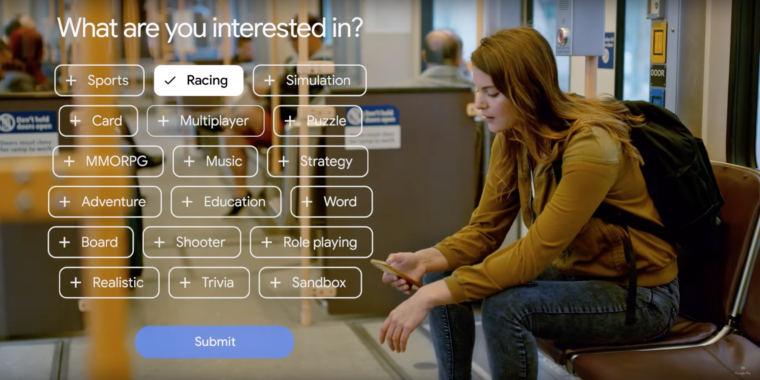
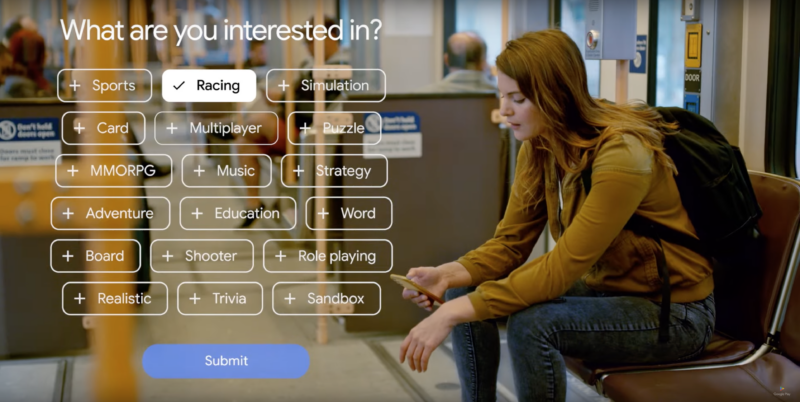
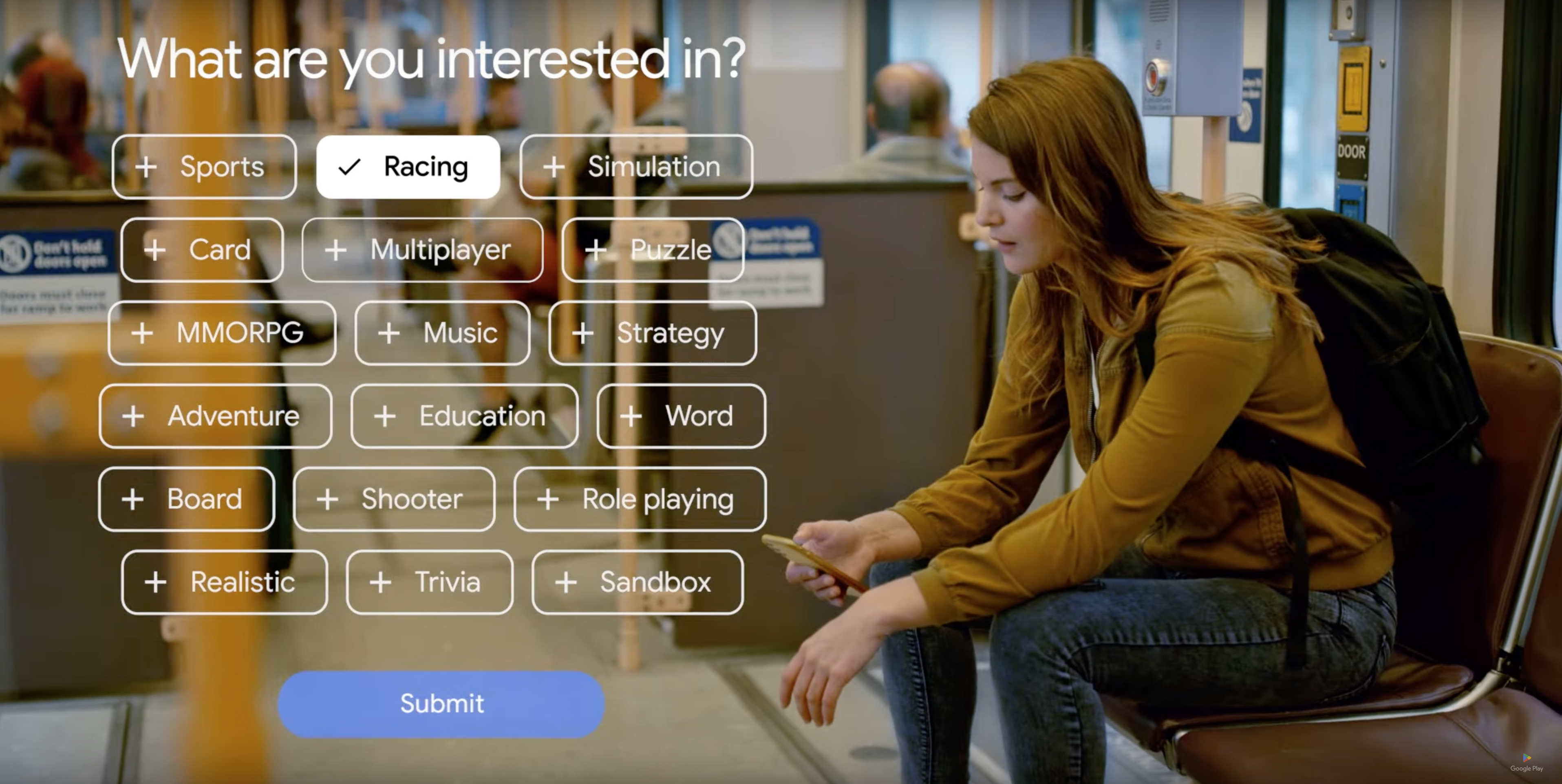
Enlarge / I like the idea of clicking “Realistic,” “MMORPG,” and “Word” boxes, just to see what comes back.

Google

Google Play is a lot of things—perhaps too many things for those who just want to install some apps. If that’s how you feel, you might find “Google Play’s next chapter” a bit bewildering, as Google hopes to make it “more than a store.” Or you might start thinking about how to turn Play Points into a future Pixel phone.

Google Play’s “new way to Play.”

In a blog post about “How we’re evolving Google Play,” VP and General Manager of Google Play Sam Bright outlines the big changes to Google Play:

  • AI-generated app reviews and summaries, along with app comparisons
  • “Curated spaces” for interests, showing content from apps related to one thing (like cricket, and Japanese comics)
  • Game recommendations based on genres and features you select.
  • Google Play Games on PC can pick up where you left off in games played on mobile and can soon play multiple titles at the same time on desktop.
  • Play Points enthusiasts who are in the Diamond, Platinum, or Gold levels can win Pixel devices, Razer gaming products, and other gear, along with other game and access perks.

Those are the upgrades to existing Play features. The big new thing is Collections, which, like the “curated spaces,” takes content from apps you already have installed and organizes them around broad categories. I spotted “Watch,” “Listen,” “Read,” “Games,” “Social,” “Shop,” and “Food” in Google’s animated example. You can toggle individual apps feeding into the Collections in the settings.

It’s hard not to look at Google Play’s new focus on having users actively express their interests in certain topics and do their shopping inside a fully Google-ized space, against the timing of yesterday’s announcement regarding third-party cookies. Maybe that connection isn’t apparent right off, but bear with me.

The Play Store is still contractually installed on the vast majority of Android devices, but competition and changes could be coming following Google’s loss to Epic in an antitrust trial and proposed remedies Google deeply dislikes. Meanwhile, the Play Store and Google’s alleged non-compliance with new regulations, like allowing developers to notify customers about payment options outside the store, are under investigation.

If the tide turns against tracking users across apps, websites, and stores, and if the Play Store becomes non-required for browsing and purchasing apps, it’s in Google’s interests to get people actively committing to things they want to see more about on their phone screens. It’s a version of what Chrome is doing with its Privacy Sandbox and its “Topics” that it can flag for advertisers. Google’s video for the new Play experience suggests “turning a sea of apps into a world of discovery.” The prompt “What are you interested in?” works for the parties on both ends of Google’s Play space.

Google’s Play Store wants to pivot from grab-and-go to an active destination Read More »