Bioware

why-reviving-the-shuttered-anthem-is-turning-out-tougher-than-expected

Why reviving the shuttered Anthem is turning out tougher than expected


Despite proof-of-concept video, EA’s Frostbite Engine servers are difficult to pick apart.

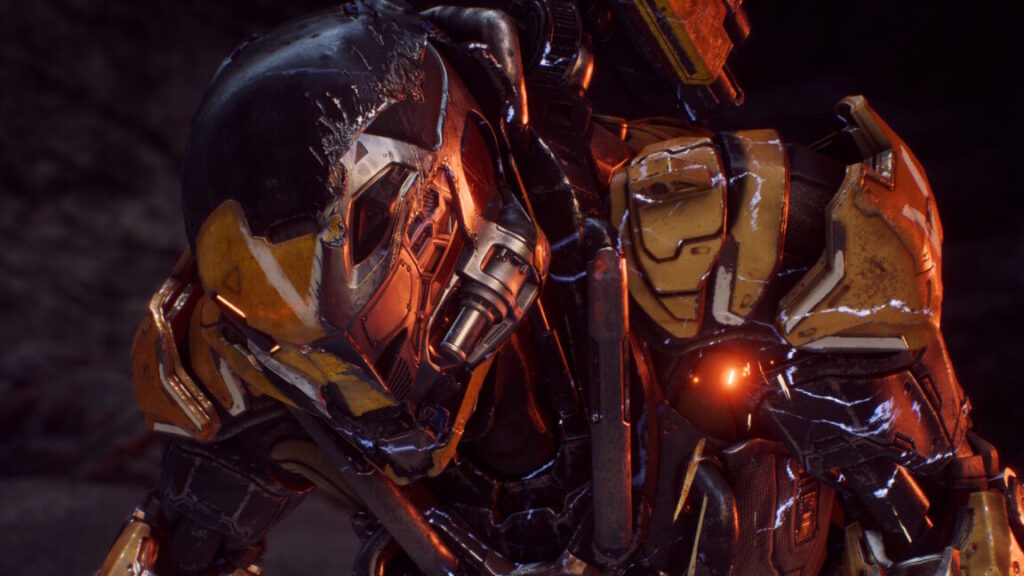
Anthem may be down, but it’s not quite out yet. Credit: Bioware

On January 12, EA shut down the official servers for Anthem, making Bioware’s multiplayer sci-fi adventure completely unplayable for the first time since its troubled 2019 launch. Last week, though, the Anthem community woke up to a new video showing the game at least partially loading on what appears to be a simulated background server.

The people behind that video—and the Anthem revival project that made it possible—told Ars they were optimistic about their efforts to coerce EA’s temperamental Frostbite engine into running the game without access to EA’s servers. That said, the team also wants to temper expectations that may have risen a bit too high in the wake of what is just a proof-of-concept video.

Andersson799’s early proof-of-concept video showing Anthem partially loading on emulated local servers.

“People are getting excited [about the video], and naturally people are going to get their hopes up,” project administrator Laurie told Ars. “I don’t want to be the person that’s going to have to deal with the aftermath if it turns out that we can’t actually get anywhere.”

Keep an eye on those packets

The Anthem revival effort currently centers around The Fort’s Forge, a Discord server where a handful of volunteer engineers and developers have gathered to pick apart the game and its unique architecture. Laurie said they initially set up the group “out of little more than spite for EA and Bioware around the time the shutdown got announced” back in July.

While Laurie has some experience with the community behind Gundam Evolution revival project Side 7, they knew they’d need help from people with direct experience working on EA’s Frostbite engine games. Luckily, Laurie said they were “able to catch the eyes of people who are familiar with this line of work [without] searching too much.”

One of those people was Ness199X, an experienced Frostbite tinkerer who told Ars he “never really played much Anthem” before the game’s shutdown was announced. When a friend pointed out the impending death of the title, though, Ness said he was motivated to preserve the game for posterity.

Initial efforts to examine what made Anthem tick “came up empty,” Ness said, largely because the game uses EA’s bespoke Frostbite engine differently than other EA titles. To begin mapping out those differences, Ness released a packet logger tool in September that let contributors record their own network traffic between the client and EA’s official servers. In addition to helping with reverse-engineering work, Ness writes on the Fort’s Forge Discord that players who logged their packets should be able to fully recover their characters if and when Anthem comes back in playable form.

Catching Frostbite

By analyzing that crowdsourced packet data, Ness said the Fort’s Forge team has been able to break Anthem down into three essential services:

  1. EA’s Blaze server: Used for basic player authentication.
  2. Bioware Online Services (aka BIGS): A JSON web server used to track player information like inventory and quest progression.
  3. The Frostbite multiplayer engine: Loads level data and tracks the real-time positions of players and non-player characters in those levels.

Early efforts to emulate the Blaze and BIGS portions of that architecture helped lead directly to last week’s proof-of-concept video. Andersson799—who says he’s been tinkering with Battlefield and other Frostbite games since 2015—said he was quickly able to use his own logged Anthem packets to create a “barebones anthem private server” that served as a “quick and dirty” sample that he decided to share via YouTube.

“I basically made the tool to just simply reply with the packet captures that I got,” Andersson told me. That was enough to “get in to the game with player profiles loaded and everything.” And while Ness says there’s still some effort needed “to [make Blaze and BIGS] work well and smoothly in terms of quest progression, etc.,” the path forward on those portions is relatively straightforward.

It’s the Frostbite engine and its odd client-server architecture that forms the biggest barrier to getting Anthem up and running again without EA’s servers. “Due to how Frostbite is designed, all gameplay in a Frostbite game runs in a ‘server’ context,” Ness explained. Even in a single-player game like Mass Effect: Andromeda, he said, “the client just creates a separate server thread and pipes all the traffic internally.”

“I feel like with Anthem, it heavily relies on online data that was stored in Bioware’s server,” Andersson added. “In my initial testing, the game couldn’t load into the level without that data.”

Anthem‘s Fort Tarsis area loads its data from local files, rather than EA’s servers.

There’s some hope that this crucial level data is still available and recoverable, though. Ness points out that Fort Tarsis, the game’s lobby area, already runs using offline data piped through a local “server” thread, meaning the rest of the game could theoretically be coerced to run similarly.

Just as important, he says, “as far as we have been able to discern, all the logic for the other levels, which when the game was live ran on a remote server, also exists in the client,” Ness said. “By patching the game we can most likely enable the ability to host these in process as well. That’s what we’re exploring.”

“To be honest we’re not entirely sure…”

While all that local level data should be usable in theory, seemingly random differences between Anthem and other Frostbite games are getting in the way of loading the data in practice. Anthem acts like a standard Frostbite game “for the most part,” Ness said, but at times will show unusual behaviors that are hard to pin down.

“For example, when we try to load most maps, no NPCs spawn, but in some maps they do,” he said. “And we have yet to determine why. Ness has some suspicion that the odd behavior is connected to the “fairly extensive amount of player data the game keeps as part of its online RPG nature,” but adds that “to be honest we’re not entirely sure how deep the differences go, other than that the engine didn’t behave how we expected it to.”

Ness said he’s about 75 percent confident that the team will be able to figure out how to fully leverage the Frostbite engine to power a version of the game that runs without EA’s centralized servers. If that effort succeeds, he says a playable version of Anthem could be back up and running in “months, or less even, depending on motivation.” But if the efforts to pick apart Anthem’s take on Frostbite hits a brick wall, Ness says “the amount of work increases fairly exponentially and I’m a lot less confident that we have the motivation for that.”

“I’m fairly confident that we can get this game to be playable again, like how it is supposed to be,” Andersson said. “It’ll just take time as most of us have our own life to manage besides this.”
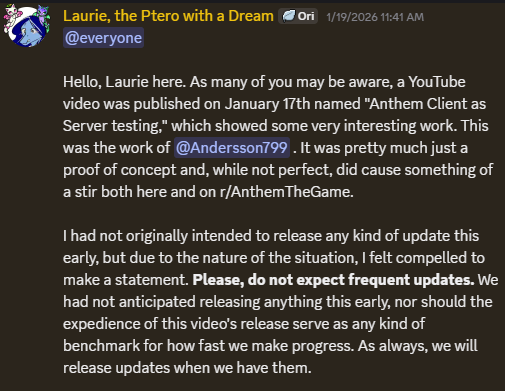
Engaging in some expectations management on the Fort’s Forge Discord.

Engaging in some expectations management on the Fort’s Forge Discord. Credit: Laurie / The Fort’s Forge

In the meantime, Laurie is still trying to manage expectations set by the somewhat premature posting of Andersson’s proof-of-concept video. “Please, do not expect frequent updates,” Laurie wrote in the Fort’s Forge Discord. “We had not anticipated releasing anything this early, nor should the expedience of this video’s release serve as any kind of benchmark for how fast we make progress.”

Laurie also took to Reddit to publicly call the video “a really hacky thing so I want to ask people to manage their expectations just a bit. A lot of stuff clearly doesn’t work as ‘intended,’ and definitely needs at minimum, more polish.”

At one point last week, Laurie says they had to stop accepting new members to the Fort’s Forge Discord, “mostly to prevent an influx of people in response to… news coverage.” And while people with Frostbite engine modding experience are encouraged to reach out, the small team is being cautious about growing too large, too fast.

“We’re a little reluctant to add developers right now as we have no real code base to work from,” Ness said, describing their current efforts as “scratch work” maintained in separate forms by multiple people. “But once we firm that up (hopefully in the next weeks), we will look to add more [coders].”

Photo of Kyle Orland

Kyle Orland has been the Senior Gaming Editor at Ars Technica since 2012, writing primarily about the business, tech, and culture behind video games. He has journalism and computer science degrees from University of Maryland. He once wrote a whole book about Minesweeper.

Why reviving the shuttered Anthem is turning out tougher than expected Read More »
bioware’s-anthem-will-soon-be-completely-unplayable

BioWare’s Anthem will soon be completely unplayable


Replay the troubled jetpack shooter before the servers shut down for good on Jan. 12.

Anthem may be down, but it’s not quite out yet. Credit: Bioware

We’ll admit that we weren’t paying enough attention to the state of Anthem—BioWare’s troubled 2019 jetpack-powered open-world shooter—to notice EA’s July announcement that it was planning to shut down the game’s servers. But with that planned server shutdown now just a week away, we thought it was worth alerting you readers to your final opportunity to play one of BioWare’s most ambitious failures.

Anthem was unveiled at E3 2017 in a demo that was later revealed to have been largely faked to paper over major issues with the game’s early development. Anthem’s early 2019 release was met with a lot of middling-to-poor reviews (including one from Ars itself), followed about a year later by a promise from BioWare General Manager Casey Hudson that a “longer-term redesign” and “substantial reinvention” of the overall game experience were coming. Hudson left BioWare in December 2020, though, and a few months later, that planned Anthem overhaul was officially canceled.

While active development on Anthem has been dormant for years, the game’s servers have remained up and running. And though the game didn’t exactly explode in popularity during that period of benign neglect, estimates from MMO Populations suggest a few hundred to a few thousand players have been jetpacking around the game’s world daily. The game also still sees a smattering of daily subreddit posts, including some hoping against hope for a fan-led private server revival, a la the Pretendo Network. And there are still a small handful of Twitch streamers sharing the game while they still can, including one racing to obtain all of the in-game achievements after picking up a $4 copy at Goodwill.

If you want to join in and get one last taste of Anthem before the January 12 shutdown, tracking down a used physical copy is probably your best bet. Current digital owners can still redownload Anthem for the time being, but EA removed the game from digital storefronts shortly after the server shutdown was announced last summer and removed it from EA Play and Xbox Game Pass subscriptions on August 15. Though many fans have been begging EA to enable some sort of offline mode, the publisher’s announcement makes clear that “Anthem was designed to be an online-only title so once the servers go offline, the game will no longer be playable.”

The FOMO from that impending server shutdown may bring back players who haven’t given Anthem a second thought for years now. After that, maybe the gaming world at large will finally realize that we don’t know what we’ve got till it’s gone.

Photo of Kyle Orland

Kyle Orland has been the Senior Gaming Editor at Ars Technica since 2012, writing primarily about the business, tech, and culture behind video games. He has journalism and computer science degrees from University of Maryland. He once wrote a whole book about Minesweeper.

BioWare’s Anthem will soon be completely unplayable Read More »

star-wars:-fate-of-the-old-republic-announced-as-a-kotor-spiritual-successor

Star Wars: Fate of the Old Republic announced as a KOTOR spiritual successor

Over two decades after the release of Star Wars: Knights of the Old Republic II, a new project described as a “spiritual successor” to that seminal RPG series was announced at The Game Awards Thursday night. Star Wars: Fate of the Old Republic will be a collaboration between Lucasfilm Games and Arcanaut Studios, a new development house being launched by original KOTOR director Casey Hudson.

Hudson, who will serve as director on the new game, said in an interview with StarWars.com that he has remained in contact with Lucasfilm since the KOTOR days, in the hopes of being able to collaborate in the Star Wars universe again. “It took the right conditions to get everything to line up,” he told the site.

Calling KOTOR “one of the defining experiences of my career,” Hudson said he wants to “explore a contemporary vision” of the Star Wars universe and “deliver on the combination of player agency and immersion in Star Wars” that defined the original games. As director on the upcoming game, Hudson said he sees his role as “to gather and shape a cohesive vision that the entire team contributes to. Ensuring that everyone shares that vision and understands their part in creating it is critical to the success of a project.”

Star Wars: Fate of the Old Republic announced as a KOTOR spiritual successor Read More »

2002’s-neverwinter-nights-gets-a-patch-in-2025-from-“unpaid-software-engineers”

2002’s Neverwinter Nights gets a patch in 2025 from “unpaid software engineers”

Neverwinter Nights came out in 2002 and received an enhanced edition in 2018. In 2025, that should really be it, but there’s something special about Bioware’s second dip into the Dungeons & Dragons universe. The energy from the game’s community is strong enough that, based largely on the work of “unpaid software engineers,” the game received a new patch last week.

Neverwinter Nights (NN) Enhanced Edition (on Steam and GOG) now has anti-aliasing and anisotropic filtering built in, major improvements to its networking code and performance, and more than 100 other improvements. As noted by PC GamerNN was originally built for single-core CPUs, so while it may seem odd to seek “major” improvements to performance for a 23-year-old RPG, it is far from optimized for modern systems.

NN received a similar fan-led patch, described as “a year-long love effort” by community developers, in 2023.

Perhaps it’s not so surprising that NN achieved this kind of fan-driven immortality. Opinions vary on the virtues of its single-player campaigns, but its “persistent worlds,” essentially tiny MMOs run by people with DM-like powers, kept it from giving off the abandoned feel of other “massive” online games. Fantasy author Luke Scull credits the game with launching his writing career and continues to work on an unofficial sequel to the game, The Blades of Netheril, with a roadmap of seven chapters through at least 2027.

2002’s Neverwinter Nights gets a patch in 2025 from “unpaid software engineers” Read More »

dragon-age:-the-veilguard-and-the-choices-you-make-while-saving-the-world

Dragon Age: The Veilguard and the choices you make while saving the world


“Events are weaving together quickly. The fate of the world shall be decided.”

Dragon Age: The Veilguard is as much about the world, story, and characters as the gameplay. Credit: EA

BioWare’s reputation as a AAA game development studio is built on three pillars: world-building, storytelling, and character development. In-game codices offer textual support for fan theories, replays are kept fresh by systems that encourage experimenting with alternative quest resolutions, and players get so attached to their characters that an entire fan-built ecosystem of player-generated fiction and artwork has sprung up over the years.

After two very publicly disappointing releases with Mass Effect: Andromeda and Anthem, BioWare pivoted back to the formula that brought it success, but I’m wrapping up the first third of The Veilguard, and it feels like there’s an ingredient missing from the special sauce. Where are the quests that really let me agonize over the potential repercussions of my choices?

I love Thedas, and I love the ragtag group of friends my hero has to assemble anew in each game, but what really gets me going as a roleplayer are the morally ambiguous questions that make me squirm: the dreadful and delicious BioWare decisions.

Should I listen to the tormented templar and assume every mage I meet is so dangerous that I need to adopt a “strike first, ask questions later” policy, or can I assume at least some magic users are probably not going to murder me on sight? When I find out my best friend’s kleptomania is the reason my city has been under armed occupation for the past 10 years, do I turn her in, or do I swear to defend her to the end?

Questions like these keep me coming back to replay BioWare games over and over. I’ve been eagerly awaiting the release of the fourth game in the Dragon Age franchise so I can find out what fresh dilemmas I’ll have to wrangle, but at about 70 hours in, they seem to be in short supply.

The allure of interactive media, and the limitations

Before we get into some actual BioWare choices, I think it’s important to acknowledge the realities of the medium. These games are brilliant interactive stories. They reach me like my favorite novels do, but they offer a flexibility not available in printed media (well, outside of the old Choose Your Own Adventure novels, anyway). I’m not just reading about the main character’s decisions; I’m making the main character’s decisions, and that can be some heady stuff.

There’s a limit to how much of the plot can be put into a player’s hands, though. A roleplaying game developer wants to give as much player agency as possible, but that has to happen through the illusion of choice. You must arrive at one specific location for the sake of the plot, but the game can accommodate letting you choose from several open pathways to get there. It’s a railroad—hopefully a well-hidden railroad—but at the end of the day, no matter how great the storytelling is, these are still video games. There’s only so much they can do.

So if you have to maintain an illusion of choice but also want to to invite your players to thoughtfully engage with your decision nodes, what do you do? You reward them for playing along and suspending their disbelief by giving their choices meaningful weight inside your shared fantasy world.

If the win condition of a basic quest is a simple “perform action X at location Y,” you have to spice that up with some complexity or the game gets very old very quickly. That complexity can be programmatic, or it can be narrative. With your game development tools, you can give the player more than one route to navigate to location Y through good map design, or you can make action X easier or harder to accomplish by setting preconditions like puzzles to solve or other nodes that need interaction. With the narrative, you’re not limited to what can be accomplished in your game engine. The question becomes, “How much can I give the player to emotionally react to?”

In a field packed with quality roleplaying game developers, this is where BioWare has historically shined: making me have big feelings about my companions and the world they live in. This is what I crave.

Who is (my) Rook, anyway?

The Veilguard sets up your protagonist, Rook, with a lightly sketched backstory tied to your chosen faction. You pick a first name, you are assigned a last name, and you read a brief summary of an important event in Rook’s recent history. The rest is on you, and you reveal Rook’s essential nature through the dialog wheel and the major plot choices you make. Those plot choices are necessarily mechanically limited in scope and in rewards/consequences, but narratively, there’s a lot of ground you can cover.

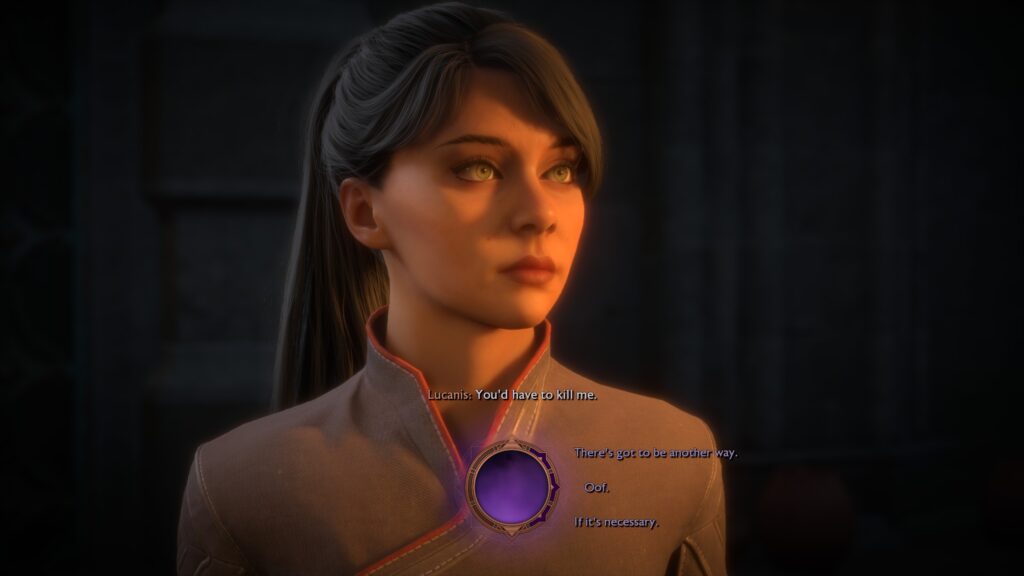
One version of the protagonist in Dragon Age The Veilguard, with a dialogue wheel showing options

For the record, I picked “Oof.” That’s just how my Rook rolls. Credit: Marisol Cuervo

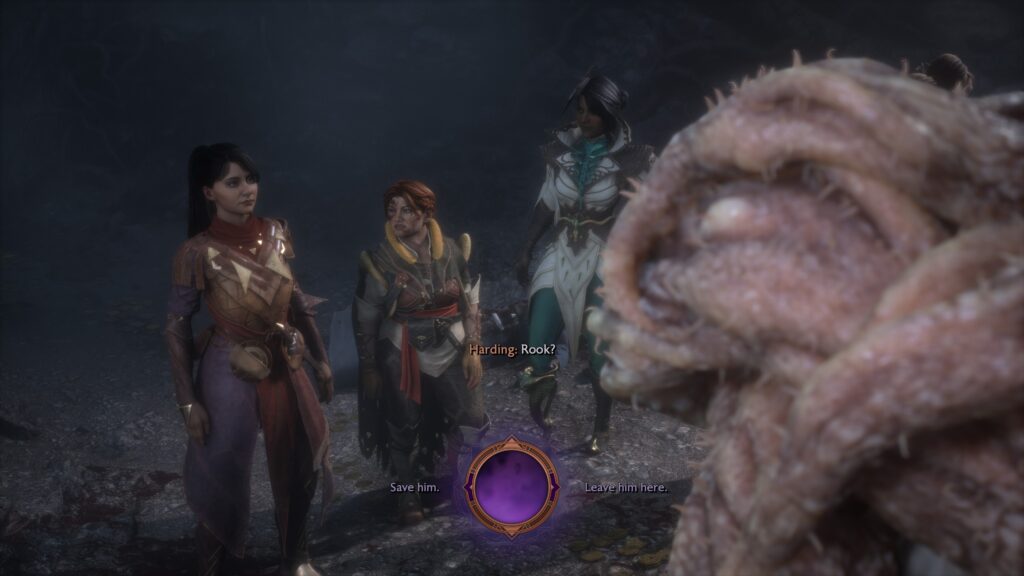
During the game’s tutorial, you’re given information about a town that has mysteriously fallen out of communication with the group you’re assisting. You and your companions set out to discover what happened. You investigate the town, find the person responsible, and decide what happens to him next. Mechanically, it’s pretty straightforward.

The real action is happening inside your head. As Rook, I’ve just walked through a real horror show in this small village, put together some really disturbing clues about what’s happening, and I’m now staring down the person responsible while he’s trapped inside an uncomfortably slimy-looking cyst of material the game calls the Blight. Here is the choice: What does my Rook decide to do with him, and what does that choice say about her character? I can’t answer that question without looking through the lens of my personal morality, even if I intend for Rook to act counter to my own nature.

My first emotional, knee-jerk reaction is to say screw this guy. Leave him to the consequences of his own making. He’s given me an offensively venal justification for how he got here, so let him sit there and stare at his material reward for all the good it will do him while he’s being swallowed by the Blight.

The alternative is saving him. You get to give him a scathing lecture, but he goes free, and it’s because you made that choice. You walked through the center of what used to be a vibrant settlement and saw this guy, you know he’s the one who allowed this mess to happen, and you stayed true to your moral center anyway. Don’t you feel good? Look at you, big hero! All those other people will die from the Blight, but you held the line and said, “Well, not this one.”

A dialogue wheel gives the player a decisive choice

Being vindictive might feel good, but I feel leaving him is a profoundly evil choice. Credit: Marisol Cuervo

There’s no objectively right answer about what to do with the mayor, and I’m here for it. Leaving him or saving him: Neither option is without ethical hazards. I can use this medium to dig deep into who I am and how I see myself before building up my idea of who my Rook is going to be.

Make your decision, and Rook lives with the consequences. Some are significant, and some… not so much.

Your choices are world-changing—but also can’t be

Longtime BioWare fans have historically been given the luxury of having their choices—large and small—acknowledged by the next game in the franchise. In past games, this happened largely through small dialog mentions or NPC reappearances, but as satisfying as this is for me as a player, it creates a big problem for BioWare.

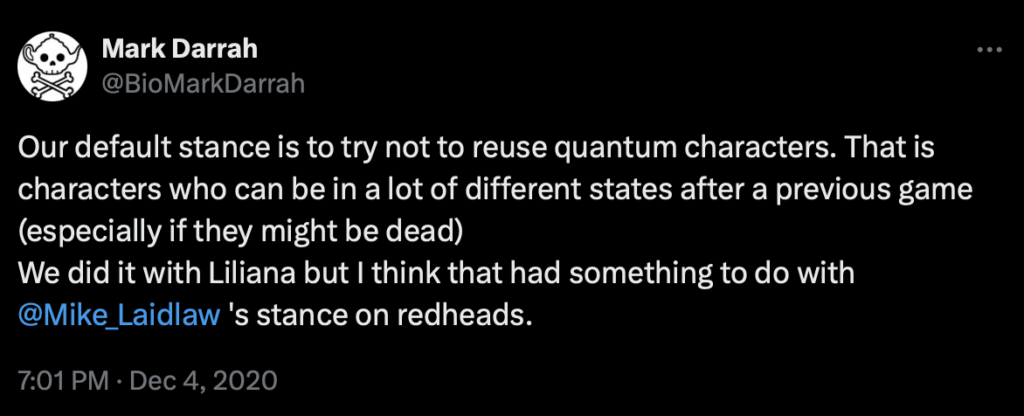
Here’s an example: depending on the actions of the player, ginger-haired bard and possible romantic companion Leliana can be missed entirely as a recruitable companion in Dragon Age: Origins, the first game in the franchise. If she is recruited, she can potentially die in a later quest. It’s not guaranteed that she survives the first game. That’s a bit of a problem in Dragon Age II, where Leliana shows up in one of the downloadable content packs. It’s a bigger problem in the third game, where Leliana is the official spymaster for the titular Inquisition. BioWare calls these NPCs who can exist in a superposition of states “quantum characters.”

A tweet that says BioWare's default stance is to avoid using quantum characters, but an exception was made for Liliana

One of the game’s creative leaders talking about “quantum characters.” Credit: Marisol Cuervo

If you follow this thought to its logical end, you can understand where BioWare is coming from: After a critical mass of quantum characters is reached, the effects are impossible to manage. BioWare sidesteps the Leliana problem entirely in The Veilguard by just not talking about her.

BioWare has staunchly maintained that, as a studio, it does not have a set canon for the history of its games; there’s only the personal canon each player develops as a result of their gameplay. As I’ve been playing, I can tell there’s been a lot of thought put into ensuring none of The Veilguard’s in-game references to areas covered in the previous three games would invalidate a player’s personal canon, and I appreciate that. That’s not an easy needle to thread. I can also see that the same care was put into ensuring that this game’s decisions would not create future quantum characters, and that means the choices we’re given are very carefully constrained to this story and only this story.

But it still feels like we’re missing an opportunity to make these moral decisions on a smaller scale. Dragon Age: Inquisition introduced a collectible and cleverly hidden item for players to track down while they worked on saving the world. Collect enough trinkets and you eventually open up an entirely optional area to explore. Because this is BioWare, though, there was a catch: To find the trinkets, you had to stare through the crystal eyes of a skull sourced from the body of a mage who has been forcibly cut off from the source of all magic in the world. Is your Inquisitor on board with that, even if it comes with a payoff? Personally, I don’t like the idea. My Inquisitor? She thoroughly looted the joint. It’s a small choice, and it doesn’t really impact the long-term state of the world, but I still really enjoyed working through it.

Later in the first act of The Veilguard, Rook finally gets an opportunity to make one of the big, ethically difficult decisions. I’ll avoid spoilers, but I don’t mind sharing that it was a satisfyingly difficult choice to make, and I wasn’t sure I felt good about my decision. I spent a lot of time staring at the screen before clicking on my answer. Yeah, that’s the good stuff right there.

In keeping with the studio’s effort to avoid creating quantum worldstates, The Veilguard treads lightly with the mechanical consequences of this specific choice and the player is asked to take up the narrative repercussions. How hard the consequences hit, or if they miss, comes down to your individual approach to roleplaying games. Are you a player who inhabits the character and lives in the world? Or is it more like you’re riding along, only watching a story unfold? Your answer will greatly influence how connected you feel to the choices BioWare asks you to make.

Is this better or worse?

Much online discussion around The Veilguard has centered on Bioware’s decision to incorporate only three choices from the previous game in the series, Inquisition, rather than using the existing Dragon Age Keep to import an entire worldstate. I’m a little disappointed by this, but I’m also not sure anything in Thedas is significantly changed because my Hero of Ferelden was a softie who convinced the guard in the Ostagar camp to give his lunch to the prisoner who was in the cage for attempted desertion.

At the same time, as I wrap up the first act, I’m missing the mild tension I should be feeling when the dialog wheel comes up, and not just because many of the dialog choices seem to be three flavors of “yes, and…” One of my companions was deeply unhappy with me for a period of time after I made the big first-act decision and sharply rebuffed my attempts at justification, snapping at me that I should go. Previous games allowed companions to leave your party forever if they disagreed enough with your main character; this doesn’t seem to be a mechanic you need to worry about in The Veilguard.

Rook’s friends might be divided on how they view her choice of verbal persuasion versus percussive diplomacy, but none of them had anything to say about it while she was very earnestly attempting to convince a significant NPC they were making a pretty big mistake. One of Rook’s companions later asked about her intentions during that interaction but otherwise had no reaction.

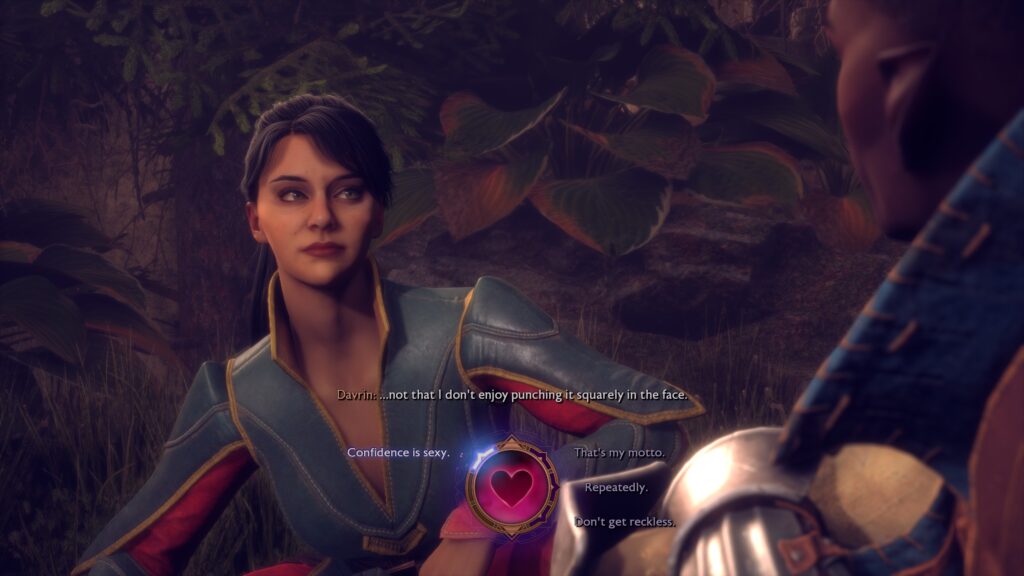
Another dialogue choice in Veilguard

BioWare, are you OK? Why do you keep punching people who don’t agree with you? Credit: Marisol Cuervo

Seventy hours into the game, I’m looking for places where I have to navigate my own ethical landscape before I can choose to have Rook conform to, or flaunt, the social mores of northern Thedas. I’m still helping people, being the hero, and having a lot of fun doing so, but the problems I’m solving aren’t sticky, and they lack the nuance I enjoyed in previous games. I want to really wrestle with the potential consequences before I decide to do something. Maybe this is something I’ll see more of in the second act.

If the banal, puppy-kicking kind of evil has been minimized in favor of larger stakes—something I applaud—it has left a sort of vacuum on the roleplaying spectrum. BioWare has big opinions about how heroes should act and how they should handle interpersonal conflict. I wish I felt more like I was having that struggle rather than being told that’s how Rook is feeling.

I’m hopeful my Rook isn’t just going to just save the world, but that in the next act of the game, I’ll see more opportunities from BioWare to let her do it her way.

Dragon Age: The Veilguard and the choices you make while saving the world Read More »