Cars

used-tesla-prices-tumble-as-embarrassed-owners-look-to-sell

Used Tesla prices tumble as embarrassed owners look to sell

Similarly, one should take with a pinch of salt a website offering to steal Teslas from owners who are unable to find a buyer themselves.

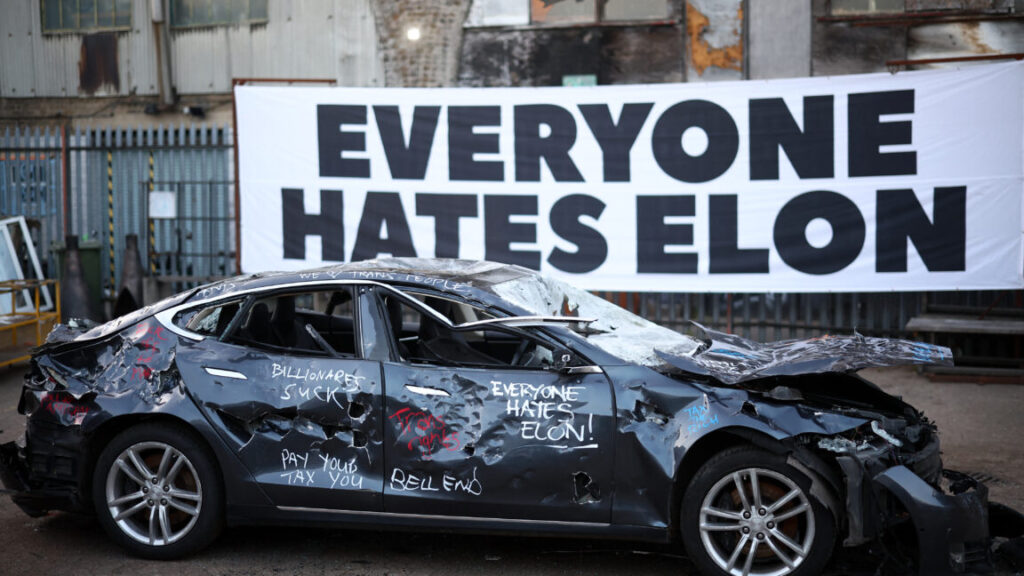
According to data from Car Gurus, used Tesla prices have fallen twice as fast (-3.7 percent) as the wider car market (-1.5 percent) over the last 90 days. Year over year, used Tesla prices are down 7.5 percent, compared to 2.8 percent for the market as a whole. And that’s on top of steep depreciation caused by a series of new car price cuts over the past few years, as well as rental car companies and other companies disposing of fleets of Teslas en masse.

The Model 3 has been on sale longer than the Model Y, and you’d expect the older cars to have depreciated more. Indeed, the average price of a 2017 Model 3 is just under $20,000 now. But even recent model years are shedding value rapidly—a model-year 2022 Model 3 is worth just $25,000 on average.

Model Y prices have decreased by a greater degree, although the higher MSRP and younger age of the Y mean prices haven’t dropped quite as far as the 3, yet. But CarGurus has seen between 16–21 percent drops for each model year of the Model Y, year over year.

CarGurus isn’t the only one to notice this trend, either. According to its data, iSeeCars says used Teslas have dropped by 13.6 percent, year over year. The Models 3, Y, and S were all in its top four EVs for depreciation, although top place went to the Porsche Taycan (which might be starting to look like a bargain).

For its part, Tesla has been trying to boost its image with the help of President Trump. On Monday, the president took to the South Lawn of the White House to promote Tesla’s cars, apparently buying one despite having campaigned on an explicitly anti-electric vehicle platform.

Used Tesla prices tumble as embarrassed owners look to sell Read More »

despite-everything,-us-ev-sales-are-up-28%-this-year

Despite everything, US EV sales are up 28% this year

With all the announcements from automakers planning for more gasoline and hybrid cars in their future lineups, you’d think that electric vehicles had stopped selling. While that might be increasingly true for Tesla, everyone else is more than picking up the slack. According to analysts at Rho Motion, global EV sales are up 30 percent this year already. Even here in the US, EV sales were still up 28 percent compared to 2024, despite particularly EV-unfriendly headwinds.

Getting ahead of those unfriendly winds may actually be driving the sales bump in the US, where EV sales only grew by less than 8 percent last year, for contrast. “American drivers bought 30 percent more electric vehicles than they had by this time last year, making use of the final months of IRA tax breaks before the incentives are expected to be pulled later this year,” said Charles Lester, Rho Motion data manager.

With the expected loss of government incentives and the prospect of new tariffs that will add tens of thousands of dollars to new car prices, now is probably a good time to buy an EV if you think you’re going to want or need one.

Perhaps surprisingly, growth in the much more EV-tolerant European Union was barely higher, at 29 percent for the year to date, helped by a new tax on plug-in hybrid weight in France, Rho Motion says. Both Germany and the UK EV markets have grown by 40 percent this year.

China is speeding past the rest of the world in terms of electrifying its transportation, and unsurprisingly it comes out on top in Rho Motion’s data, with 35 percent growth for the year to date compared to 2024. Looking month by month shows an even more impressive 73 percent increase year over year, thanks to where the lunar new year fell in 2024 and 2025.

Despite everything, US EV sales are up 28% this year Read More »

bevs-are-better-than-combustion:-the-2025-bmw-i4-xdrive40-review

BEVs are better than combustion: The 2025 BMW i4 xDrive40 review

But it’s not really fair to compare yesterday’s 430i with this i4 xDrive40; with 395 hp (295 kW) and 442 lb-ft (600 Nm) on tap and a $62,300 MSRP, this EV is another rung up the price and power ladders.

The i4 uses BMW’s fifth-generation electric motors, and unlike most other OEMs, BMW uses electrically excited synchronous motors instead of permanent magnets. The front is rated at 255 hp (190 kW) and 243 lb-ft (330 Nm), and the rear maxes out at 308 hp (230 kW) and 295 lb-ft (400 Nm). They’re powered by an 84 kWh battery pack (81 kWh usable), which on 18-inch wheels is good for an EPA range of 287 miles (462 km).

Our test car was fitted with 19-inch wheels, though, which cuts the EPA range to 269 miles (432 km). If you want a long-distance i4, the single-motor eDrive40 on 18-inch wheels can travel 318 miles (511 km) between charges, according to the EPA, which offers an interesting demonstration of the effect of wheel size and single versus dual motors on range efficiency.

A BMW i4 wheel

There’s a new design for the 19-inch M Aero wheels, but they’re part of a $2,200 package. Credit: Jonathan Gitlin

It’s very easy to switch between having the car regeneratively brake when you lift the throttle (in B) or just coast (in D), thanks to the little lever on the center console. (Either way, the car will regeneratively brake when you use the brake pedal, up to 0.3 G, at which point the friction brakes take over.) If you needed to, you could hit 62 mph (100 km/h) in 5.1 seconds from a standstill, which makes it quick by normal standards if not by bench racers. In practice, it’s more than fast enough to merge into a gap or overtake someone if necessary.

During our time with the i4, I averaged a little worse than the EPA numbers. The winter has been relatively mild as a result of climate change, but the weather remained around or below freezing during our week with the i4, and we averaged 3.1 miles/kWh (20 kWh/100 km). Interestingly, I didn’t notice much of a drop when using Sport mode, or much of a gain using Eco mode, on the same 24-mile mix of city streets, suburban arteries, and highways.

BEVs are better than combustion: The 2025 BMW i4 xDrive40 review Read More »

maserati-kills-electric-version-of-mc20-supercar-for-lack-of-demand

Maserati kills electric version of MC20 supercar for lack of demand

Electric motors are, in so many ways, much better than internal combustion engines. They don’t waste most of the energy you put into them as heat and sound, they’re easy to control, and they make huge amounts of torque almost instantly. Having recently driven BMW’s 430i and i4 back to back over the course of two weeks, the electric version was easier in traffic and more responsive on a twisty road. Electric wins, then. Except at the very high end, it seems.

Because even though electric motors can pack a punch, people paying big money for super- and hypercars are increasingly disinterested in those cars being electrified. So much so that Maserati has canceled the all-electric version of the MC20.

The MC20 debuted in 2020. No longer associated with Ferrari after that brand was spun out and IPO’d, the MC20 could offer a full carbon-fiber monocoque and an engine with very clever F1-derived combustion technology, undercutting its now-independent Italian competitor to the tune of more than $100,000 in the process.

Maserati kills electric version of MC20 supercar for lack of demand Read More »

volkswagen-gets-the-message:-cheap,-stylish-evs-coming-from-2026

Volkswagen gets the message: Cheap, stylish EVs coming from 2026

A surprise find in my inbox this morning: news from Volkswagen about a pair of new electric vehicles it has in the works. Even better, they’re both small and affordable, bucking the supersized, overpriced trend of the past few years. But before we get too excited, there’s currently no guarantee either will go on sale in North America.

Next year sees the European debut of the ID. 2all, a small electric hatchback that VW wants to sell for less than 25,000 euros ($26,671). But the ID. 2all isn’t really news: VW showed off the concept, as well as a GTI version, back in September 2023.

What is new is the ID. EVERY1, an all-electric entry-level car that, if the concept is anything to go by, is high on style and charm. It does not have a retro shape like a Mini or Fiat 500—VW could easily have succumbed to a retread of the Giugiaro-styled Golf from 1976 but opted for something new instead. The design language involves three pillars: stability, likability, and surprise elements, or “secret sauce,” according to VW’s description.

The ID. EVERY1 is the antithesis of the giant SUVs and trucks that have come out of Detroit these past few years.

“The widely flared wheelarches over the large 19-inch wheels and the athletic and clearly designed surfaces of the silhouette ensure stability,” said VW head of design Andreas Mindt, confirming the inability of modern designers to stay away from huge wheels.

“The slightly cheeky smile at the front is a particularly likable feature. A secret sauce element is the roof drawn in the middle, usually seen on sports cars. All these design elements lend the ID. EVERY1 a charismatic identity with which people can identify,” Mindt said.

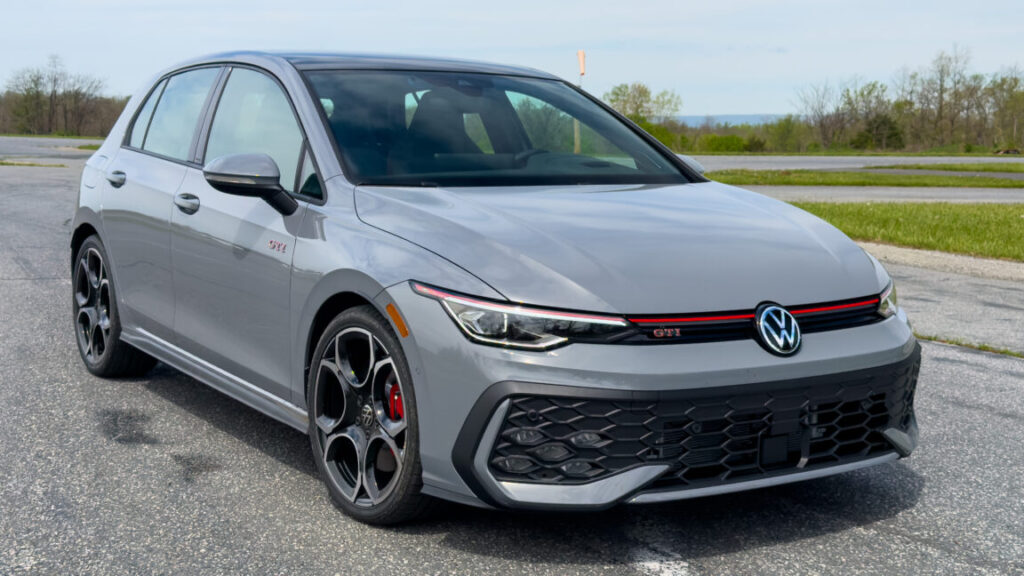
It really is a small car—at 152.8 inches (3,880 mm) long, it’s much shorter than the smallest car VW sells here in the US, the Golf GTI, which is a still-diminutive 168.8 inches (4,288 mm) in length. Like the slightly bigger ID. 2all—which is still much shorter than a Golf), the ID. EVERY1 will use a new front-wheel drive version of VW’s modular MEB platform. (Initially introduced for rear- or all-wheel-drive EVs, MEB underpins cars like the ID.4 crossover and ID. Buzz bus.)

Volkswagen gets the message: Cheap, stylish EVs coming from 2026 Read More »

the-2025-genesis-gv80-coupe-proves-to-be-a-real-crowd-pleaser

The 2025 Genesis GV80 Coupe proves to be a real crowd-pleaser

The 27-inch OLED screen combines the main instrument display and an infotainment screen. It’s a big improvement on what you’ll find in older GV80s (and G80s and GV70s), and the native system is by no means unpleasant to use. Although with Android Auto and Apple CarPlay, most drivers will probably just cast their phones. That will require a wire—while there is a Qi wireless charging pad, I was not able to wirelessly cast my iPhone using CarPlay; I had to plug into the USB-C port. (The press specs say it should have wireless CarPlay and Android Auto, for what it’s worth.)

Having a jog dial to interact with the infotainment is a plus in terms of driver distraction, but that’s immediately negated by having to use a touchscreen for the climate controls.

Beyond those gripes, the dark leather and contrast stitching look and feel good, and I appreciate the way the driver’s seat side bolsters hug you a little tighter when you switch into Sport mode or accelerate hard in one of the other modes. Our week with the Genesis GV80 coincided with some below-freezing weather, and I was glad to find that the seat heaters got warm very quickly—within a block of leaving the house, in fact.

I was also grateful for the fact that the center console armrest warms up when you turn on your seat heater—I’m not sure I’ve come across that feature in a car until now.

Tempting the former boss of BMW’s M division, Albert Biermann, away to set up Genesis’ vehicle dynamics department was also a good move. Biermann has been retired for a while now, but he evidently passed on some skills before that happened. The GV80 Coupe is particularly well-damped and won’t bounce you around in your seat over low-speed obstacles like potholes or speed bumps that, in other SUVs, can result in the occupants being shaken from side to side in their seats.

The 2025 Genesis GV80 Coupe proves to be a real crowd-pleaser Read More »

the-2026-mercedes-benz-cla-is-good-enough-to-make-a-believer-out-of-ev-skeptics

The 2026 Mercedes-Benz CLA is good enough to make a believer out of EV skeptics


But if you’re still skeptical, don’t worry: There’s a hybrid version, too.

A camouflaged EV prototype in the snow

It’s not quite ready to be seen uncamouflaged, but Mercedes-Benz was ready to let us drive the new CLA. Credit: Tim Stevens

It’s not quite ready to be seen uncamouflaged, but Mercedes-Benz was ready to let us drive the new CLA. Credit: Tim Stevens

Mercedes-Benz’s EV efforts aren’t exactly burning up the sales charts. Models like the EQS and EQE haven’t convinced the brand’s demanding clientele that batteries are the future, forcing the company to scale back its electric ambitions.

Scale back, but not abandon. Benz is about to launch a new generation of EVs relying on technology derived from the epically efficient EQXX. The first is the new CLA. It’s coming soon, and after getting some time behind the wheel of a prototype vehicle undergoing final testing in the snowy wilds of Sweden, I’m convinced this could be the car to change Mercedes’ electrified fortunes.

And, for anyone who isn’t convinced, there’ll be a hybrid version too.

The EV is definitely the focus, though, and it tackles many of the most significant sticking points for would-be buyers of the company’s current electric offerings. First among those points is the styling. The somewhat anonymous shapes of the EQS and EQE have not earned those machines many fans outside of obsessive aerodynamicists. While the CLA I drove was unfortunately clad beneath some eye-warping camouflage, it seems to share enough lines with the Concept CLA Class that I’m already convinced it’ll be a looker.

The second concern with many of Benz’s current EVs is cost. Yes, you can get an EQB in the mid-$50,000 range, but that’s based on the older GLB. The least expensive of the company’s current EV range is the EQE sedan, with a mid-$70,000 starting price. That puts it well out of reach for many avid EV enthusiasts.

The front half. of a Mercedes-Benz CLA prototype

The CLA will have Mercedes’ first entirely in-house EV powertrain, and it’s far more efficient than the ones its currently offering. Credit: Tim Stevens

The current, gas-powered CLA starts in the mid-$40,000 range. Mercedes isn’t saying how much this new one will cost, but while the EV version will presumably be more, it should come in well beneath the EQE.

Next is the driving dynamic, which is really what brought me to Sweden. Both the EQS and EQE are fine cars, comfortable and calm with plenty of torque and power to be fun. However, they’re simply not the most engaging of machines. Can the CLA do better?

First impressions are definitely a yes. My driving was performed in the low-grip, wintery environment of northern Sweden, making it a little difficult to tell exactly how the car will feel when pushed in a more temperate world. But lowering the level of adhesion also lets you get an immediate sense of how well-balanced a machine is, and the CLA feels very well-balanced indeed.

When pushed beyond the limit of adhesion, it did have a tendency to understeer, but it didn’t take much provocation to bring the rear end around. Even with the stability control on, the 4matic-equipped car I drove was happy to swing out the rear as I danced from one corner to the next. When cruising at more relaxed speeds, the car soaked up the decidedly rough road surfaces extremely well for a car with such petite dimensions.

Most impressive was how well it handled the limited grip. One of the prime advantages of electrification is how quickly and smoothly stability and traction control can react to a loss of grip. The CLA didn’t immediately cut all power when it detected wheelspin, it quickly and automatically raised or lowered output to match the available grip.

The back half of a Mercedes CLA prototype

There will also be a hybrid version of the CLA for those who aren’t ready for a full EV. Credit: Tim Stevens

Power delivery, then, wasn’t all-or-nothing, and when it gave all it was plenty. The electric CLA felt comparably quick to the 402-hp EQE 500 4matic. The CLA 4matic makes similar power: 268 hp (200 kW) from the rear motor and 107 hp (80 kW) from the front. It gets off the line quickly, with the two-speed transmission on the rear axle ensuring that motor was still pulling strongly as I approached 100 mph (160 km/h).

Things were even more interesting when I needed to slow down. The CLA will be the debut of a new, unified braking system that effectively decouples the brake pedal from the actual physical action of the brakes. It’s not quite a full brake-by-wire system as there’s still a mechanical linkage there as a sort of fall-back, but in normal operation, the sensation you get from the brake pedal is entirely artificial, created by springs and bushings, not hydraulics.

There’s no feedback here, no haptics or adjustable resistance to signal what the brakes are doing. Indeed, the only indication that I’d triggered ABS on hard stops was the chatting noise coming from the wheels. In exchange, you get a consistent, solid brake feel, with the car mixing regenerative braking and physical braking as needed to deliver clean, consistent stops.

It’ll take more extensive testing to know how well the system handles something like a summer track day, but I can say that in my testing I got the brakes hot enough to be quite pungent, yet the car still stopped cleanly and predictably.

When it comes to one-pedal driving, the CLA offers a “D-” mode that will bring the car to a complete stop, but the outright deceleration rate after lifting off the accelerator is nowhere near as strong as something like a Tesla on Standard mode. That’s in addition to two lighter regen modes, plus “D Auto,” which varies regen based on surrounding traffic and terrain, just like the company’s current EVs.

A mercedes-benz CLA prototype seen head-on

The CLA was well-balanced on the ice. Credit: Tim Stevens

The CLA is also designed to address any concerns about efficiency with a number of improvements. That includes a new heat pump that can scavenge waste energy from the motor, the battery pack, and the ambient air. It’s said to heat the cabin twice as quickly with half the power consumption of the old heat pump.

There’s also a revised motor design, utilizing permanent magnets on both the front and rear axle. The system relies on a decoupling system to reduce drag on the front axle when it’s not needed, as on the EQE SUV, but the engagement is so quick and seamless that I never noticed.

The battery pack has also been revised, with a new chemistry that Mercedes says boosts overall energy density by 20 percent while also enabling a “significant reduction” in the use of cobalt.

The net result is a machine that promises to go 5.2 miles/kWh (11.9 kWh/100 km) and offers 466 miles (750 km) of range from the 85 kWh usable capacity “premium” battery pack. That’s on the European WLTP cycle, so on the American EPA cycle we can probably expect something closer to 400 miles (644 km). That still compares very favorably to the 308 miles (497 km) the current EQE can manage from its 96 kWh battery pack.

And, when you run out of juice, the new CLA’s 800-volt architecture enables charging rates of up to 320 kW. That theoretically means 186 miles (300 km) of charge in just 10 minutes.

The back of a Mercedes-Benz prototype in the snow

Battery energy density is up, and there’s a more efficient heat pump for the cabin. Credit: Tim Stevens

So, then, the promise is for a better-looking, better-driving, more-affordable, longer-range, and quicker-charging EV. That sounds like a winning bet, but Mercedes still has a hedge in. I didn’t just drive the electric CLA up in Sweden. I also got a go in the 48-volt hybrid version.

Yes, there’s a new CLA for you even if you’re still not on board with the EV revolution. This one’s built around a 1.5 L four-cylinder engine paired with an electric motor that’s integrated with an eight-speed, dual-clutch transmission. Engine output is rated at 188 hp (140 kW), plus an additional 27 hp (20 kW) from the electric motor.

That’s enough to drive the car up to 62 mph (100 kph) without spinning up the gasoline engine, but with only 1.3 kWh of battery at its disposal, you won’t go far without combustion. Mercedes doesn’t even quote an all-electric range. The engine comes on early and often.

In fact, during my time behind the wheel, I couldn’t get the engine to turn off. The engineers blamed the below-freezing temperatures. So, I can’t say just how sprightly the car will be without internal combustion. With that four-cylinder humming, the car was reasonably sprightly, the transmission slipping smoothly through the gears. Outright power is definitely on the limited side, though. Anyone who cares about acceleration should go for the other CLA, the one with the bigger battery.

The front of a Mercedes-Benz CLA prototype in the snow.

Mercedes-Benz may well have a winner here with the new CLA.

I got a good look at the interior of the two cars, but sadly, I’m not allowed to talk about that yet. Suffice it to say it includes some tasteful and practical changes that should be well-received. More on that to come.

Will the new CLA change Mercedes-Benz’s BEV fortunes? Initial impressions are indeed very good. If it looks half as good as that concept, delivers on the range promise, and is priced right, it should be a winner.

We won’t have long to wait to find out how it looks, but don’t expect an answer to the pricing question until closer to the car entering production later this year. Regardless, it’s great to see all the testing in the EQXX finally bearing fruit. At first bite, it’s tasting sweet.

The 2026 Mercedes-Benz CLA is good enough to make a believer out of EV skeptics Read More »

driving-an-ev-restomod-that-costs-as-much-as-a-house—the-jia-chieftain

Driving an EV restomod that costs as much as a house—the JIA Chieftain

The Chieftain Range Rover is a fascinating thing—a refitted, reskinned, restored classic Range Rover is no new thing, nor is one with a ludicrous American V8 stuffed under the hood. But one that can be had as a gas car, plug-in hybrid, or as an EV? It can be all of those things depending on which boxes you tick. Ars Technica went for a spin in the EV to see how it stacks up.

The UK is something of an EV restomod hub. It’s been throwing electricity in things that didn’t come off the line electrified in the first place for years. Businesses like Electrogenic, Lunaz, and Everrati will, for a price, make an old car feel a little more peppy—depending on who you go to, it’ll come back restored as well. The Chieftain isn’t quite like them. Developed by Oxfordshire, UK, based Jensen International Automotive (the company’s bread ‘n butter is Jensen Interceptors), the Chieftain is an old Range Rover turned up to VERY LOUD. Or, actually, not loud at all.

Of course, these things come at a cost. A Chieftain EV Range Rover conversion, today, will set you back at least $568,000 should you choose to order one. This one was a private commission, and at that price there won’t be any built on spec on the off chance someone wants to buy one “off the peg.” By any stretch of the imagination it is a huge amount for an old car, but they’re custom-built from start to finish.

The Range Rover has aged well. Alex Goy

Yours will be made to your specification, have CarPlay/Android Auto, and the sort of mod cons one would expect in the 2020s. Under its perfectly painted shell—the color is your choice, of course—lives a 120 kWh battery. It’s made of packs mounted under the hood and in the rear, firing power to all four wheels via three motors: one at the front, and two at the rear. The tri-motor setup can theoretically produce around 650 hp (485 kW), but it’s paired back to a smidge over 405 hp (302 kW), so it doesn’t eat its tires on a spirited launch. There’s a 60: 40 rear-to-front torque split to keep things exciting if that’s your jam. Air suspension keeps occupants comfortable and insulated from the world around them.

Driving an EV restomod that costs as much as a house—the JIA Chieftain Read More »

driving-the-new-mercedes-cla-made-me-a-believer-in-mercedes-benz’s-ev-future

Driving the new Mercedes CLA made me a believer in Mercedes-Benz’s EV future


And if it doesn’t, they’ve got a hybrid version, too.

A camouflaged EV prototype in the snow

It’s not quite ready to be seen uncamouflaged, but Mercedes-Benz was ready to let us drive the new CLA. Credit: Tim Stevens

It’s not quite ready to be seen uncamouflaged, but Mercedes-Benz was ready to let us drive the new CLA. Credit: Tim Stevens

Mercedes-Benz’s EV efforts aren’t exactly burning up the sales charts. Models like the EQS and EQE haven’t convinced the brand’s demanding clientele that batteries are the future, forcing the company to scale back its electric ambitions.

Scale back, but not abandon. Benz is about to launch a new generation of EVs relying on technology derived from the epically efficient EQXX. The first is the new CLA. It’s coming soon, and after getting some time behind the wheel of a prototype vehicle undergoing final testing in the snowy wilds of Sweden, I’m convinced this could be the car to change Mercedes’ electrified fortunes.

And, for anyone who isn’t convinced, there’ll be a hybrid version too.

The EV is definitely the focus, though, and it tackles many of the most significant sticking points for would-be buyers of the company’s current electric offerings. First among those points is the styling. The somewhat anonymous shapes of the EQS and EQE have not earned those machines many fans outside of obsessive aerodynamicists. While the CLA I drove was unfortunately clad beneath some eye-warping camouflage, it seems to share enough lines with the Concept CLA Class that I’m already convinced it’ll be a looker.

The second concern with many of Benz’s current EVs is cost. Yes, you can get an EQB in the mid-$50,000 range, but that’s based on the older GLB. The least expensive of the company’s current EV range is the EQE sedan, with a mid-$70,000 starting price. That puts it well out of reach for many avid EV enthusiasts.

The front half. of a Mercedes-Benz CLA prototype

The CLA will have Mercedes’ first entirely in-house EV powertrain, and it’s far more efficient than the ones its currently offering. Credit: Tim Stevens

The current, gas-powered CLA starts in the mid-$40,000 range. Mercedes isn’t saying how much this new one will cost, but while the EV version will presumably be more, it should come in well beneath the EQE.

Next is the driving dynamic, which is really what brought me to Sweden. Both the EQS and EQE are fine cars, comfortable and calm with plenty of torque and power to be fun. However, they’re simply not the most engaging of machines. Can the CLA do better?

First impressions are definitely a yes. My driving was performed in the low-grip, wintery environment of northern Sweden, making it a little difficult to tell exactly how the car will feel when pushed in a more temperate world. But lowering the level of adhesion also lets you get an immediate sense of how well-balanced a machine is, and the CLA feels very well-balanced indeed.

When pushed beyond the limit of adhesion, it did have a tendency to understeer, but it didn’t take much provocation to bring the rear end around. Even with the stability control on, the 4matic-equipped car I drove was happy to swing out the rear as I danced from one corner to the next. When cruising at more relaxed speeds, the car soaked up the decidedly rough road surfaces extremely well for a car with such petite dimensions.

Most impressive was how well it handled the limited grip. One of the prime advantages of electrification is how quickly and smoothly stability and traction control can react to a loss of grip. The CLA didn’t immediately cut all power when it detected wheelspin, it quickly and automatically raised or lowered output to match the available grip.

The back half of a Mercedes CLA prototype

There will also be a hybrid version of the CLA for those who aren’t ready for a full EV. Credit: Tim Stevens

Power delivery, then, wasn’t all-or-nothing, and when it gave all it was plenty. The electric CLA felt comparably quick to the 402-hp EQE 500 4matic. The CLA 4matic makes similar power: 268 hp (200 kW) from the rear motor and 107 hp (80 kW) from the front. It gets off the line quickly, with the two-speed transmission on the rear axle ensuring that motor was still pulling strongly as I approached 100 mph (160 km/h).

Things were even more interesting when I needed to slow down. The CLA will be the debut of a new, unified braking system that effectively decouples the brake pedal from the actual physical action of the brakes. It’s not quite a full brake-by-wire system as there’s still a mechanical linkage there as a sort of fall-back, but in normal operation, the sensation you get from the brake pedal is entirely artificial, created by springs and bushings, not hydraulics.

There’s no feedback here, no haptics or adjustable resistance to signal what the brakes are doing. Indeed, the only indication that I’d triggered ABS on hard stops was the chatting noise coming from the wheels. In exchange, you get a consistent, solid brake feel, with the car mixing regenerative braking and physical braking as needed to deliver clean, consistent stops.

It’ll take more extensive testing to know how well the system handles something like a summer track day, but I can say that in my testing I got the brakes hot enough to be quite pungent, yet the car still stopped cleanly and predictably.

When it comes to one-pedal driving, the CLA offers a “D-” mode that will bring the car to a complete stop, but the outright deceleration rate after lifting off the accelerator is nowhere near as strong as something like a Tesla on Standard mode. That’s in addition to two lighter regen modes, plus “D Auto,” which varies regen based on surrounding traffic and terrain, just like the company’s current EVs.

A mercedes-benz CLA prototype seen head-on

The CLA was well-balanced on the ice. Credit: Tim Stevens

The CLA is also designed to address any concerns about efficiency with a number of improvements. That includes a new heat pump that can scavenge waste energy from the motor, the battery pack, and the ambient air. It’s said to heat the cabin twice as quickly with half the power consumption of the old heat pump.

There’s also a revised motor design, utilizing permanent magnets on both the front and rear axle. The system relies on a decoupling system to reduce drag on the front axle when it’s not needed, as on the EQE SUV, but the engagement is so quick and seamless that I never noticed.

The battery pack has also been revised, with a new chemistry that Mercedes says boosts overall energy density by 20 percent while also enabling a “significant reduction” in the use of cobalt.

The net result is a machine that promises to go 5.2 miles/kWh (11.9 kWh/100 km) and offers 466 miles (750 km) of range from the 85 kWh usable capacity “premium” battery pack. That’s on the European WLTP cycle, so on the American EPA cycle we can probably expect something closer to 400 miles (644 km). That still compares very favorably to the 308 miles (497 km) the current EQE can manage from its 96 kWh battery pack.

And, when you run out of juice, the new CLA’s 800-volt architecture enables charging rates of up to 320 kW. That theoretically means 186 miles (300 km) of charge in just 10 minutes.

The back of a Mercedes-Benz prototype in the snow

Battery energy density is up, and there’s a more efficient heat pump for the cabin. Credit: Tim Stevens

So, then, the promise is for a better-looking, better-driving, more-affordable, longer-range, and quicker-charging EV. That sounds like a winning bet, but Mercedes still has a hedge in. I didn’t just drive the electric CLA up in Sweden. I also got a go in the 48-volt hybrid version.

Yes, there’s a new CLA for you even if you’re still not on board with the EV revolution. This one’s built around a 1.5 L four-cylinder engine paired with an electric motor that’s integrated with an eight-speed, dual-clutch transmission. Engine output is rated at 188 hp (140 kW), plus an additional 27 hp (20 kW) from the electric motor.

That’s enough to drive the car up to 62 mph (100 kph) without spinning up the gasoline engine, but with only 1.3 kWh of battery at its disposal, you won’t go far without combustion. Mercedes doesn’t even quote an all-electric range. The engine comes on early and often.

In fact, during my time behind the wheel, I couldn’t get the engine to turn off. The engineers blamed the below-freezing temperatures. So, I can’t say just how sprightly the car will be without internal combustion. With that four-cylinder humming, the car was reasonably sprightly, the transmission slipping smoothly through the gears. Outright power is definitely on the limited side, though. Anyone who cares about acceleration should go for the other CLA, the one with the bigger battery.

The front of a Mercedes-Benz CLA prototype in the snow.

Mercedes-Benz may well have a winner here with the new CLA.

I got a good look at the interior of the two cars, but sadly, I’m not allowed to talk about that yet. Suffice it to say it includes some tasteful and practical changes that should be well-received. More on that to come.

Will the new CLA change Mercedes-Benz’s BEV fortunes? Initial impressions are indeed very good. If it looks half as good as that concept, delivers on the range promise, and is priced right, it should be a winner.

We won’t have long to wait to find out how it looks, but don’t expect an answer to the pricing question until closer to the car entering production later this year. Regardless, it’s great to see all the testing in the EQXX finally bearing fruit. At first bite, it’s tasting sweet.

Driving the new Mercedes CLA made me a believer in Mercedes-Benz’s EV future Read More »

yes,-it-turns-out-you-can-make-a-tesla-cybertruck-even-uglier

Yes, it turns out you can make a Tesla Cybertruck even uglier

There’s a saying about putting lipstick on a pig, but what if it’s not lipstick? That’s the question the universe set out to answer when it aligned in such a way that famed (or perhaps infamous) car customizer Mansory got itself a Tesla Cybertruck. The Mansory Elongation—a name that must have taken ages to think of—offers exterior, interior, and wheel and tire upgrades for the straight-edged stainless steel-wrapped pickup.

Among those who mod cars, there are the tuners, who focus on adding power and (one hopes) performance, and then there are the customizers, who concentrate more on aesthetics. Once upon a time, the entire luxury car industry worked like that—a client would buy a rolling chassis from Bugatti, Rolls-Royce, or Talbot and then have bodywork added by coachbuilders like Gurney Nutting, Touring, or Figoni et Falaschi.

The rear 3/4 view of a modified Cybertruck

At least the rear winglets don’t entirely compromise access to the bed. Credit: Mansory

Modern homologation requirements have mostly put an end to that level of coachbuilding, but for the ultra-wealthy prepared to spend telephone numbers on cars, brands like Rolls-Royce will still occasionally oblige. More common now are those aftermarket shops that spiff up already luxurious cars, changing normal doors for gullwing versions, adding flaring fenders and bulging wheel arches, and plastering the interior in any hue of leather one might imagine.

Mansory has been on the scene since the end of the 1980s and has made a name for itself festooning Rolls-Royces, Lamborghinis, Ferraris, and even Bugattis with extra bits that their original designers surely did not want added. Now it’s the Tesla Cybertruck’s turn.

Yes, it turns out you can make a Tesla Cybertruck even uglier Read More »

donut-lab-and-the-electric-motors-everyone-has-been-talking-about

Donut Lab and the electric motors everyone has been talking about

“The set of benefits is different to each application or each size,” Piippo said. “In small things, you’re very price conscious, and you need to kind of optimize for the cost. And then the bigger you go, the more performance you can get or the more performance increase compared to the conventional setup you can get.”

“But then there’s also the kind of unlocked new industries where nobody has been that capable making a heavy lift… drone—like lifting shipping containers or something like this—until now. Because we have a very compact shape and very lightweight design, we can do quite a bit of performance in everything that flies because we can play with the cooling in a smart way with this design,” Piippo said.

For a compact EV crossover, Donut Lab thinks its tech could reduce the number of components in a powertrain by three-quarters, saving weight and assembly time—and therefore money. For a semi-truck, the savings could be an order of magnitude higher, according to the company’s case study.

Credit: Donut Labs

In fact, the first use has been for motorcycles. The Verge TS Pro electric motorcycle we tested last summer was created to show off the motor technology.

The reaction at CES was positive—”we had maybe 10 to 20 times more business than we anticipated, and we were aiming quite high,” Lehtimäki said.

“Major OEMs have understood for decades that in-wheel motors would be the golden solution if they could get the weight down,” he said. “But I feel that there’s been some education going on in the last few years because it felt to us that everybody we spoke to, you just show the graph of torque and power per kilogram, and they’re like, ‘OK, when can we have it?'”

Plenty can happen between an OEM testing parts for proving and a product appearing in the showroom that uses that technology. But if all goes well, we might see vehicles with Donut Lab’s motors in a couple of years. They may show up elsewhere, too. Lehtimäki told me that interest has come in from outside the automotive and mobility sectors, including applications like wind turbines and washing machines.

That last one has some charming history to it—when inventors were tinkering with electric cars in the 1970s, they often turned to washing machines for a source of torquey electric motors.

Donut Lab and the electric motors everyone has been talking about Read More »

the-acura-zdx-is-an-example-of-badge-engineering-for-the-software-age

The Acura ZDX is an example of badge engineering for the software age

Acura is gearing up to build its first entirely in-house battery-electric vehicles, but it has gotten a head start with the ZDX SUV. Built in collaboration with General Motors, the ZDX is a comfortable and competent luxury EV. More than that, it’s a shining example of what badge engineering looks like in the digital age.

Automakers have long collaborated with each other. Sometimes that means working together on a powertrain or vehicle platform for use in quite different products. Sometimes, it’s a little less involved—the Dodge Hornet differs very little from the Alfa Romeo Tonale, for example.

In the case of the Acura ZDX, the vehicle platform and the battery-electric powertrain are all thoroughly GM, what used to be called Ultium, until the American automaker retired that branding. It is, in essence, Acura’s take on the Cadillac Lyriq and is similar, if not identical, in terms of power output and pricing.

Although the range starts with the rear-wheel drive $64,500 ZDX A-Spec, our test car was the range-topping all-wheel drive ZDX Type-S, which costs $73,500 before the $7,500 clean vehicle tax credit. It has an output of 499 hp (372 kW) and 544 lb-ft (738 Nm), and it has an EPA range of 278 miles (447 km) on a full charge of the 102 kWh lithium-ion battery pack.

Despite winter temperatures and 22-inch tires (a $600 option), that range estimate seems spot-on—over the course of a week, we averaged 2.7 miles/kWh (23 kWh/100 km).

The next Acura EV to launch will have a NACS port, but ZDXs feature CCS1 for now. Adapters, and access to Tesla’s Supercharger network, should happen in this spring. Jonathan Gitlin

Fast charging wasn’t particularly impressive, especially compared to other luxury SUVs in this price bracket. Acura quotes 42 minutes to go from 20–80 percent state of charge; in practice, I plugged in with 38 percent SoC showing on the dash and had to wait 45 minutes to get to 80 percent. Charging peaked at 91 kW but had dropped to 69 kW by 50 percent SoC.

The Acura ZDX is an example of badge engineering for the software age Read More »